- Product Description Description
- Table of Contents TOC
- List of Table & Figure LOT
- Get Free Sample PDF Sample PDF
Market Size, 2025
$4.18 BnMarket Estimate, 2026
$4.46 BnMarket Forecast, 2034
$7.42 BnCAGR, 2026–2034
6.59%Europe Bamboo Market Report Summary
The European bamboo market was valued at USD 4.18 billion in 2025, is anticipated to reach USD 4.46 billion in 2026, and is projected to reach USD 7.42 billion by 2034, growing at a CAGR of 6.59% during the forecast period from 2026 to 2034. The growth of the European bamboo market is driven by the rising demand for sustainable and eco-friendly materials, increasing consumer awareness regarding environmental conservation, and the expanding application of bamboo in furniture, construction, and home décor. Furthermore, the ongoing shift toward green building materials, coupled with the rising popularity of minimalistic and nature-inspired interior design trends, continues to propel market growth across the region.
Key Market Trends
- Increasing adoption of bamboo-based furniture and décor as a sustainable alternative to traditional wood products.
- Growing use of bamboo in green construction and architectural applications, including flooring, wall panels, and roofing.
- Rising consumer inclination toward eco-conscious home furnishings across urban Europe.
- Expansion of e-commerce platforms enabling broader access to designer bamboo furniture and accessories.
- Adoption of circular economy initiatives promoting renewable materials such as bamboo across EU nations.
Segmental Insights
- Based on product, the chairs segment dominated the European bamboo market in 2025, accounting for 42.3% of the market share. The segment’s dominance is attributed to the rising demand for lightweight, durable, and aesthetically appealing bamboo chairs that complement modern and sustainable interior designs.
- Based on category, the indoor bamboo furniture segment held a dominant share of the market in 2025, driven by the increasing preference for eco-friendly and stylish home furnishings among residential consumers.
- Based on end user, the residential segment accounted for 52.3% of the European bamboo market share in 2025, supported by the growing popularity of bamboo furniture in households and apartments, emphasizing sustainability and functionality.
- Based on distribution channel, the B2C retail channels segment held a dominant position in 2025. This growth is supported by the expanding availability of bamboo products in offline retail stores and online marketplaces, catering to a wide range of customer preferences.
Regional Insights
The European bamboo market demonstrates strong performance across major economies, driven by sustainability goals, eco-friendly design trends, and high consumer awareness.
- Germany was the top performer in the European bamboo market, capturing 23.4% of the market share in 2025, due to strong consumer adoption of sustainable furniture, a growing green construction industry, and supportive government initiatives promoting renewable materials.
- France followed closely, supported by an increasing demand for eco-luxury interiors and locally crafted bamboo furniture.
- The United Kingdom showcased notable growth due to expanding e-commerce sales and a growing preference for sustainable lifestyle products.
- Scandinavian countries such as Denmark and Sweden displayed rising demand driven by minimalist design aesthetics and eco-conscious consumer behavior.
Competitive Landscape
The European bamboo market is highly competitive and fragmented, with leading players emphasizing sustainable sourcing, innovative designs, and material durability. Companies are focusing on eco-friendly manufacturing practices, online retail expansion, and customization options to meet the growing consumer demand for green living solutions. Prominent companies operating in the Europe bamboo market include MOSO International B.V., Tikamoon SA, Greenington LLC, Ecofurn Oy, VidaXL International BV, Arpel Srl, Banni Elegant Home, Raw Materials Amsterdam BV, Tinekhome A/S, Sika-Design ApS, Madam Stoltz ApS, House Doctor ApS, Muubs A/S, Maison du Monde SA, Decoclico (Auchan Retail Intl.), Bambusliebe GmbH, HKLiving BV, Bamboo Lounge, and IKEA.
Europe Bamboo Market Size
The Europe bamboo market size was valued at USD 4.18 billion in 2025 and is anticipated to reach a valuation of USD 4.46 billion in 2026 and USD 7.42 billion by 2034, growing at a CAGR of 6.59% during the forecast period from 2026 to 2034.
The bamboo is the cultivation, processing, and commercial use of bamboo-derived materials across construction,n textiles, furniture, landscaping, and bio-based products. As per Eurostat, more than sixty-eight % of European municipalities have integrated bio-based materials into public infrastructure projects since 2020, with bamboo composites increasingly specified for noise barriers, decking, and urban greening.
MARKET DRIVERS
EU Green Deal and Circular Economy Action Plan: Accelerating Bio-Based Material Adoption
The European Union’s regulatory framework is a primary driver for the growth of the Europe bamboo market. National policies reinforce this shift.. France’s Anti Waste Law requires all new public buildings to incorporate at least 30% bio-sourced materials by 2025, a standard that has spurred municipal adoption of bamboo composite cladding and acoustic panels. Similarly, the Netherlands’ Green Building Protocol awards certification points for materials with high carbon storage potential, such as bamboo, which sequesters up to twelve tons of CO₂ per hectare annually, as confirmed by Wageningen University research.
Rising Consumer Preference for Sustainable and andNon-Timberr Alternatives in Interior Design
European consumers are increasingly rejecting tropical hardwoods and synthetic materials in favor of ethically sourced sustainable alternatives, with bamboo emerging as a preferred choice for furniture, flooring, and home accessories. This an another factor that is propelling the growth of the Europe bamboo market. Bamboo’s natural antibacterial properties, aesthetic versatility, and hardness comparable to oak make it ideal for high-traffic applications. Retailers like IKEA and Maisons du Monde have responded by expanding bamboo lines, with the former sourcing over thirty thousand tons annually for kitchenware and shelving units.
MARKET RESTRAINTS
Lack of Standardized Certification and Misleading Eco Claims Undermine Market Credibility
The inconsistent quality standards and ambiguous sustainability labeling,g, which erode consumer trust and complicate procurement decisions, are quietly restricting the growth of the Europe bamboo market. The absence of traceability from source to product enables greenwashing, with some suppliers misrepresenting chemically intensive viscose rayon as “bamboo fabric.”
Limited Domestic Cultivation and Climate Suitability Constraints: Supply Security
Europe’s reliance on imported bamboo creates structural vulnerabilities due to climatic limitations and agronomic challenges in scaling local production is also limiting the growth of the Europe bamboo market. While species like Phyllostachys aurea can grow in Mediterranean microclimates, most commercially viable bamboo requires tropical or subtropical conditions, absent across much of the continent.
MARKET OPPORTUNITIES
Innovation in Bamboo-Based Bioplastics and Packaging Offers High Growth Potential
Bamboo is emerging as a key feedstock for next-generation bioplastics and compostable packaging solutions aligned with EU single-use plastic restrictions, which is likely to showcase huge growth opportunities for the growth of the Europe bamboo market. Companies like Bambu Home and Green Cell Foam have partnered with European retailers to replace polystyrene with bamboo-based alternatives, reducing plastic waste in e-commerce logistics.
Integration of Bamboo in Urban Green Infrastructure and Climate Resilience Projects
Municipalities across Europe are increasingly deploying bamboo in green infrastructure to combat urban heat islands, manage stormwater, er and enhance biodiversity. Similarly, Rotterdam’s “Sponge City” initiative uses bamboo root systems to stabilize soil l flood-prone zones due to their dense rhizome networks.
MARKET CHALLENGES
Invasive Species Risk and Regulatory Restrictions Hinder Landscape Adoption
The ecological risk posed by certain bamboo species, particularly running types like Phyllostachy, has triggered strict planting regulations that limit ornamental and commercial cultivation in several European countries, which is also escalating the growth of the Europe bamboo market. These restrictions deter landscapers and homeowners from using bamboo despite its aesthetic and carbon benefits. Even clumping varieties face permitting delays due to blanket regulatory caution. This ecological caution creates a paradox where a climate-positive material is treated as a biosecurity threat, undermining its potential in urban forestry and carbon farming initiatives.
Supply Chain Opacity and Carbon Footprint of Long Distance Imports Contradict Sustainability Goals
The environmental credentials of bamboo are undermined by the high carbon emissions associated with long-distance transportation,n and opaque supply chains from Asia are another factor to degrade the growth of the Europe bamboo market.
REPORT COVERAGE
| REPORT METRIC | DETAILS |
| Market Size Available | 2025 to 2034 |
| Base Year | 2025 |
| Forecast Period | 2026 to 2034 |
| CAGR | 6.59% |
| Segments Covered | By Product, Category, End-User, Distribution Channel, And By Country |
| Various Analyses Covered | Global, Regional, and Country Level Analysis, Segment-Level Analysis, DROC, PESTLE Analysis, Porter’s Five Forces Analysis, Competitive Landscape, Analyst Overview of Investment Opportunities |
| Regions Covered | UK, France, Spain, Germany, Italy, Russia, Sweden, Denmark, Switzerland, Netherlands, Turkey, Czech Republic & Rest of Europe |
| Market Leaders Profiled | MOSO International B.V., Tikamoon SA, Greenington LLC, Ecofurn Oy, VidaXL International BV, Arpel Srl, Banni Elegant Home, Raw Materials Amsterdam BV, Tinekhome A/S, Sika-Design ApS, Madam Stoltz ApS, House Doctor ApS, Muubs A/S, Maison du Monde SA, Decoclico (Auchan Retail Intl.), Bambusliebe GmbH, HKLiving BV, Bamboo Lounge, IKEA, Greenington LLC |
SEGMENTAL ANALYSIS
By Product Insights
The chairs segment was the largest by occupying 42.3% of the Europe bamboo market share in 2025, with the functional versatility of bamboo in seating design combined with strong demand in both residential and hospitality settings. Additionally, chairs require less raw material than tables, enabling cost-efficient production and lower transport emissions.
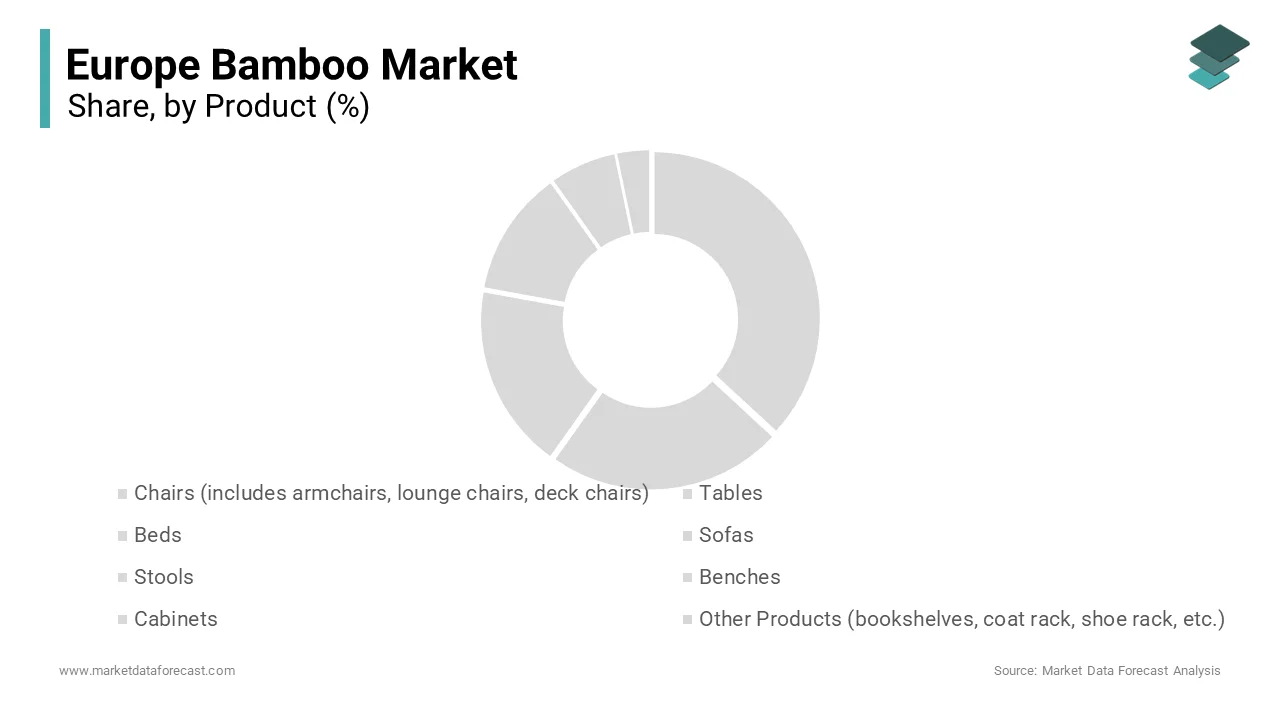
The More segment is anticipated to register a CAGR of 12.8% during the forecast period, with the rise of small space living and minimalist interior trends across European cities, where multifunctional furniture is essential. Bamboo’s dimensional stability and smooth finish make it ideal for precision joinery in modular systems. Brands like String Furniture and Menu have launched bamboo shelving lines that integrate seamlessly with Scandinavian design principles.
By Category Insights
The indoor bamboo furniture segment was the largest by holding a dominant share of the Europe bamboo market in 2025, with the consumer preference for natural materials in living spaces and the compatibility of bamboo with controlled indoor environments where moisture and UV exposure are minimal. Retail channels further amplify accessibility with IKEA offering over thirty indoor bamboo SKUs across Europe. Additionally, indoor pieces face fewer regulatory hurdles than outdoor varieties, which must meet stringent durability and fire safety standards.
The outdoor bamboo furniture segment is anticipated to grow with a CAGR of 10.5% during the forecast period, with urban greening initiatives and the demand for sustainable alternatives to plastic and tropical hardwood. Technological advances in thermal modification and protective coatings have significantly improved weather resistance, with treated bamboo now achieving Class 1 durability ratings under EN 350 standards as verified by the Fraunhofer Institute.
By End User Insights
The residential segment was the largest and held 52.3% of the Europe bamboo market share in 2025, with the rising eco consciousness among homeowners and renters who prioritize sustainable materials for personal spaces. Urbanization further drives demand as compact apartments favor lightweight modular bamboo pieces that optimize space.
The commercial user segment is expected to grow with a CAGR of 11.2% during the forecast period. Companies like Google and Novo Nordisk have installed bamboo workstations and breakout seating across their European campuses to meet internal carbon reduction targets.
By Distribution Channel Insights
B2The C retail channels segment accounted in holding a dominant share of the Europe bamboo market in 2025, with growing demand from direct consumer access through e-commerce, physical showrooms, and specialty eco stores. Mass retailers like IKE, Decathlon, and H&M Home have democratized bamboo furniture by offering affordable entry-level pieces that introduce the material to mainstream audiences.
The B2B project channel is projected to witness a noteworthy CAGR of 11.5% during the forecast period, with large-scale institutional contracts and integrated fit-out projects. Key drivers include the EU Taxonomy for Sustainable Activities, which classifies rapidly renewable materials as eligible for green financing, and the Level(s) framework that quantifies bio-based content in building assessments. Major architecture firms like Snohetta and Foster and Partners now routinely specify bamboo for libraries, schools, and corporate headquarters.
COMPETITIVE LANDSCAPE
Competition in the Europe bamboo market is characterized by a fragmented landscape of specialized processors, design-led brands, and importers vying for credibility in a sustainability-driven but regulation-sensitive environment. Unlike mature commodity markets, here success hinges on technical validation, on aesthetic storytelling, and policy alignment rather than price alone. Established players like Bamboo Logic and Bambuspark compete on engineering performance and compliance with EU standards, while luxury brands such as Ethimo emphasize craftsmanship and design heritage. The market faces pressure from alternative bio materials like cork, flax, and mycelium, which also claim renewability. Simultaneously, unverified imports from Asia with ambiguous sustainability credentials undercut transparent producers.
KEY MARKET PLAYERS
A few of the market players in the Europe bamboo market include
- MOSO International B.V.
- Tikamoon SA
- Greenington LLC
- Ecofurn Oy
- VidaXL International BV
- Arpel Srl
- Banni Elegant Home
- Raw Materials Amsterdam BV
- Tinekhome A/S
- Sika-Design ApS
- Madam Stoltz ApS
- House Doctor ApS
- Muubs A/S
- Maison du Monde SA
- Decoclico (Auchan Retail Intl.)
- Bambusliebe GmbH
- HKLiving BV
- Bamboo Lounge
- IKEA
- Greenington LLC
Top Countries In The Market
Germany Bamboo Market Analysis
Germany was the top performer in the Europe bamboo market with 23.4% of the share in 2025, owing to the stringent sustainability regulations and advanced manufacturing integration. The country’s engineering excellence enables high precision bamboo composite production, with companies like Bamboo Logic developing fire-retardant panels certified under DIN 4102. Urban redevelopment initiatives in cities like Hamburg and Freiburg incorporate bamboo in community centers and co-housing units.
France Bamboo Market Analysis
France was ranked second by holding 18.2% of the Europe bamboo market share in 2025. French designers like Jean Prouvé’s estate and contemporary studios such as Matali Crasset champion bamboo for its sculptural potential and low carbon footprint. Paris alone hosts over forty showrooms dedicated to sustainable furniture, with bamboo featured prominently. Additionally, the country’s overseas territories in the Caribbean and Indian Ocean facilitate research into tropical bamboo species adaptable to Mediterranean climates.
Italy Bamboo Market Analysis
Italy's bamboo market growth is likely to grow with an anticipated CAGR during the forecast period, with its world-renowned furniture craftsmanship to produce high-end bamboo pieces that blend artisanal tradition with modern sustainability. Milan Design Week has featured bamboo installations annually since 2021, with the 2023 edition dedicating a pavilion to “Next Gen Bio Materials.” Southern regions like Sicily and Calabria are piloting commercial bamboo plantations suited to Mediterranean microclimates with yields monitored by the Council for Agricultural Research.
United Kingdom Bamboo Market Analysis
The United Kingdom bamboo market growth is likely to grow with a strong retail penetration and post-Brexit green infrastructure investment. London’s urban greening strategy includes bamboo in over fifty pocket parks and schoolyards to enhance biodiversity and reduce heat island effects. Consumer trust is reinforced by transparent labeling initiatives like the Timber Research and Development Association’s bio materials guide.
Top Players In The Market
- Bamboo Logic BV is a Netherlands-based pioneer in engineered bamboo materials that supplies high-performance panels and profiles to European architects and furniture makers. The company operates Europe’s first industrial-scale bamboo processing facility in Almere, converting raw culms into fire-rated structural components compliant with EU building standards. These initiatives position the company as a technical leader in sustainable construction materials while advancing bamboo’s credibility in safety applications across the region.
- Bambuspark GmbH is a German innovator specializing in thermally modified bamboo for outdoor and interior applications. Headquartered in Berlin, the company combines German engineering with ethically sourced raw material to produce dimensionally stable decking, cladding, and furniture components. It also achieved certification under the EU Ecolabel scheme for its indoor furniture range, reinforcing its alignment with European environmental directives.
- Ethimo Srl is an Italian luxury outdoor furniture brand that has elevated bamboo to a premium design material through artisanal craftsmanship and collaborations with renowned designers. Based in Trevi, the company integrates FSC-certified bamboo with marine-grade textiles and stainless steel to create durable yet elegant collections for high-end residential and hospitality clients.
Top Strategies Used By The Key Market Participants
Key players in the Europe bamboo market focus on regulatory alignment, material innovation,n and design elevation to differentiate in a nascent sector. They invest in thermal modification and composite engineering to meet EU fire durability and safety standards for construction and furniture. Partnerships with public institutions and participation in government procurement programs secure large-scale project visibility. Certification under the EU Ecolabel, FSC, and Cradle to Cradle frameworks builds consumer and specifier trust. Companies also collaborate with designers and architects to position bamboo as a premium aesthetic choice rather than a utilitarian substitute.
MARKET SEGMENTATION
This research report on the Europe bamboo market is segmented and sub-segmented into the following categories.
By Product
- Chairs (includes armchairs, lounge chairs, deck chairs)
- Tables
- Beds
- Sofas
- Stools
- Benches
- Cabinets
- Other Products (bookshelves, coat rack, shoe rack, etc.)
By Category
- Indoor Furniture
- Outdoor Furniture
By End User
- Residential
- Commercial
By Distribution Channel
- B2C/Retail
- Home Centers
- Specialty Furniture Stores
- Online
- Other Distribution Channels
- B2B /Project
By Country
- United Kingdom
- France
- Spain
- Germany
- Italy
- Russia
- Sweden
- Denmark
- Switzerland
- Netherlands
- Rest of Europe