- Product Description Description
- Table of Contents TOC
- List of Table & Figure LOT
- Get Free Sample PDF Sample PDF
Market Size, 2025
$685.84 BnMarket Estimate, 2026
$717.25 BnMarket Forecast, 2034
$1,0266.27 BnCAGR, 2026–2034
4.58%Europe Bancassurance Market Size
The Europe bancassurance market was worth USD 685.84 billion in 2025. The European market is expected to reach USD 1,0266.27 billion by 2034 from USD 717.25 billion in 2026, rising at a CAGR of 4.58% from 2026 to 2034.

Bancassurance refers to the strategic partnership between banks and insurance companies to offer insurance products through banking channels. This model has gained significant traction in Europe, where financial institutions leverage their extensive customer bases and distribution networks to cross-sell insurance policies such as life, health, property, and casualty insurance. The European bancassurance market is characterized by its maturity, driven by regulatory frameworks like the Payment Services Directive (PSD2) and Solvency II, which have encouraged collaboration between banks and insurers. According to multiple studies, bancassurance held approximately 36% of the total European insurance market share in 2021/2022, heavily skewed toward Life Insurance. In countries like France, Italy, and Spain, bancassurance is the dominant channel for life products (often exceeding 60% of premiums), whereas agents and brokers remain the primary distributors for non-life insurance.
The market's growth is underpinned by the increasing demand for integrated financial solutions, as consumers seek convenience and personalized services. European consumers show an increasing preference for digital and direct insurance channels, often leveraging the established trust they have in traditional banking institutions to facilitate these purchases. Furthermore, the rise of digitalization has transformed bancassurance, enabling seamless online policy issuance and claims management. Digital transformation within the banking sector is actively driving higher insurance sales by integrating protection products directly into mobile and online banking ecosystems. However, challenges such as stringent data privacy regulations under the General Data Protection Regulation (GDPR) and competition from standalone insurers persist. Despite these hurdles, the European bancassurance market remains a cornerstone of the financial ecosystem, with projections indicating steady growth as banks continue to innovate and expand their service portfolios.
This evolving landscape underscores the importance of bancassurance as a key driver of financial inclusion and customer-centric innovation in Europe’s highly competitive banking and insurance sectors.
MARKET DRIVERS
Increasing Consumer Trust in Banks
High consumer trust in banks is a major driver of the European bancassurance market. This trust makes it easier to sell insurance products through banking channels. According to a study, European banking institutions maintain a high level of consumer trust, which remains a primary driver for customers choosing to bundle insurance products with their existing financial services. This trust stems from the long-standing relationships banks have with their clients and the perception of banks as secure and reliable institutions. Research suggest that banks serve as the dominant distribution channel for life insurance in Southern Europe, representing the majority of new business premiums due to their deeply integrated branch networks. Besides, banks’ ability to offer tailored solutions, such as bundled insurance packages with loans or mortgages, enhances customer convenience. This alignment of trust and product personalization continues to drive the growth of bancassurance across Europe.
Digital Transformation and Technological Advancements
Digital transformation has emerged as a significant growth enabler of the European bancassurance market. It enables the seamless integration of banking and insurance services. A study indicates that the shift toward online and mobile banking has significantly accelerated the adoption of insurance products as banks integrate automated sales tools into their digital customer journeys The rise of technologies like artificial intelligence and data analytics has allowed banks to analyze customer behavior and offer personalized insurance products. For instance, digitally integrated partnership models between banks and insurers allow for more efficient data sharing and automated underwriting, which consistently lowers the overhead costs associated with traditional insurance distribution. Furthermore, regulatory frameworks like the Payment Services Directive (PSD2) have facilitated secure data sharing between banks and insurers, enhancing collaboration. These technological advancements not only streamline processes but also position bancassurance as a key enabler of financial inclusion and innovation in Europe’s evolving financial landscape.
MARKET RESTRAINTS
Stringent Data Privacy Regulations
The stringent data privacy regulations imposed by the General Data Protection Regulation (GDPR) are one of the major restraints in the Europe bancassurance market. The European Data Protection Board highlights that non-compliance with GDPR can result in fines of up to €20 million or 4% of annual global turnover, creating significant operational challenges for banks and insurers. Sharing customer data between banks and insurance partners requires explicit consent, which complicates cross-selling efforts. A study revealed that a significant portion of the European financial sector continues to face technical and legal hurdles when attempting to balance open-data initiatives with the stringent privacy requirements of the GDPR. This regulatory hurdle limits the seamless integration of services and increases compliance costs. Furthermore, customers’ growing concerns about data security discourage them from opting for bundled products, thereby hindering the growth potential of bancassurance despite its convenience and efficiency.
Intense Competition from Standalone Insurers
The intense competition bancassurance providers face from standalone insurance companies further hinders the expansion of the Europe bancassurance market. These competitors often have more specialized offerings and established brand loyalty. According to various sources, independent agents and brokers remain the largest collective distribution channel across Europe. However, the bancassurance model holds a strong position in specific high-value markets, particularly in life insurance. Standalone insurers leverage advanced digital tools and targeted marketing strategies to attract customers, making it challenging for banks to differentiate their insurance products. Additionally, traditional bancassurance models are under pressure to digitize their offerings as standalone digital insurers leverage modern technology to match the low distribution costs historically enjoyed by banks. This competitive landscape forces banks to invest heavily in product innovation and customer acquisition, straining resources and slowing market penetration. As a result, bancassurance providers must navigate these challenges to maintain relevance in an increasingly crowded marketplace.
MARKET OPPORTUNITIES
Expansion of Digital Bancassurance Platforms
The expansion of digital bancassurance platforms creates a great opportunity for the Europe bancassurance market. This trend is driven by the increasing adoption of online and mobile banking services. The European Commission points out that 63.9% of Europeans in 2023 use internet banking, creating a fertile ground for integrating insurance products into digital banking ecosystems. A study emphasizes that the shift toward digitally enabled sales models is allowing banks to significantly lower their overhead while simultaneously boosting the frequency and quality of interactions with insurance customers. Furthermore, the Payment Services Directive (PSD2) has facilitated secure data sharing between banks and insurers, enabling personalized product offerings. For instance, real-time analytics allows banks to recommend insurance policies based on customer behaviour, such as travel or home purchases. Digital transformation continues to reshape financial services. Consequently, bancassurance providers are well-positioned to capitalize on this trend by enhancing user experience and expanding their reach across Europe.
Growing Demand for Integrated Financial Solutions
The rising demand for integrated financial solutions is opening doors for the European bancassurance market. Customers are increasingly seeking convenience and holistic financial planning. According to research, there is a growing consumer appetite for "one-stop-shop" financial solutions where insurance and banking products are seamlessly integrated to simplify complex life events like buying a home. Banks remain the primary gateway for insurance distribution in Southern Europe, particularly for life and savings products, due to their extensive branch networks and high level of consumer integration. The European Insurance and Occupational Pensions Authority (EIOPA) notes that banks are uniquely positioned to meet this demand due to their extensive customer bases and trusted relationships. Additionally, the growing emphasis on financial inclusion has encouraged banks to offer affordable and accessible insurance products tailored to underserved populations. Banks can address growing demand while strengthening customer loyalty and driving revenue growth. They achieve this by leveraging their extensive distribution networks and deep market penetration in the bancassurance sector.
MARKET CHALLENGES
Regulatory Complexity and Compliance Costs
The complexity of regulatory frameworks is among the major challenges to the Europe bancassurance market. These frameworks impose significant compliance burdens on banks and insurers. The European Insurance and Occupational Pensions Authority (EIOPA) emphasizes that regulations such as Solvency II and the General Data Protection Regulation (GDPR) require extensive documentation, reporting, and customer consent management, increasing operational costs. A 2022 report by the European Banking Federation revealed that financial institutions spend a portion of their annual budgets on compliance-related activities. These stringent regulations often slow down product launches and limit cross-selling opportunities, particularly for smaller players with limited resources. Furthermore, the lack of harmonization across EU member states creates additional challenges, as banks must navigate varying national laws while offering insurance products. This regulatory complexity acts as a barrier to innovation and scalability in the bancassurance market.
Limited Customer Awareness and Education
The limited awareness and understanding of bancassurance products among European consumers impedes the expansion of the European bancassurance market. This hinders adoption rates. According to a study, despite frequent interactions with banking apps and branches, a notable segment of the European consumer base does not associate their primary bank with specialized insurance protection, representing a marketing gap for the sector. This knowledge gap is particularly pronounced in rural areas, where access to financial education is limited. Specialized insurance providers often benefit from a brand identity centered on risk expertise, while banking institutions work to overcome the perception that their insurance products are merely secondary offerings. Additionally, misconceptions about the cost and coverage of bancassurance products further deter potential buyers. Addressing this challenge requires targeted educational campaigns and transparent communication strategies to build trust and demonstrate the value proposition of bancassurance offerings in meeting customers’ financial protection needs.
REPORT COVERAGE
| REPORT METRIC | DETAILS |
| Market Size Available | 2025 to 2034 |
| Base Year | 2025 |
| Forecast Period | 2026 to 2034 |
| Segments Covered | By Type of Insurance, Model Type, Distribution Channel, End User, and Country. |
| Various Analyses Covered | Global, Regional, and Country-Level Analysis, Segment-Level Analysis, Drivers, Restraints, Opportunities, Challenges; PESTLE Analysis; Porter’s Five Forces Analysis, Competitive Landscape, Analyst Overview of Investment Opportunities |
| Countries Covered | UK, France, Spain, Germany, Italy, Russia, Sweden, Denmark, Switzerland, Netherlands, Turkey, Czech Republic, and the Rest of Europe. |
| Market Leaders Profiled | BNP Paribas, Banco Santander, Allianz, ING Group, Generali, Lloyds Banking Group, Barclays Bank Plc, Intesa Sanpaolo, ABN AMRO, Banco Bradesco Europa, American Express Company, Wells Fargo, Zurich, AG Insurance, AXA, and Others. |
SEGMENTAL ANALYSIS
By Type of Insurance Insights
In 2025, the life insurance segment was the largest segment in the Europe bancassurance market and captured a 60.1% share. The supremacy of the segment is attributed to its alignment with long-term financial goals, such as retirement planning and mortgage protection. As the proportion of older Europeans continues to grow, there is an increasing demand for insurance products tailored to wealth management, annuities, and longevity risk. Banks benefit from their trusted customer relationships. The bancassurance model has shifted from primarily selling credit-linked insurance to becoming a major distributor of sophisticated savings and investment-linked life products across Europe. This segment's importance lies in its contribution to financial stability and wealth management, particularly amid an aging population. However, low interest rates challenge profitability, prompting innovation in hybrid products.
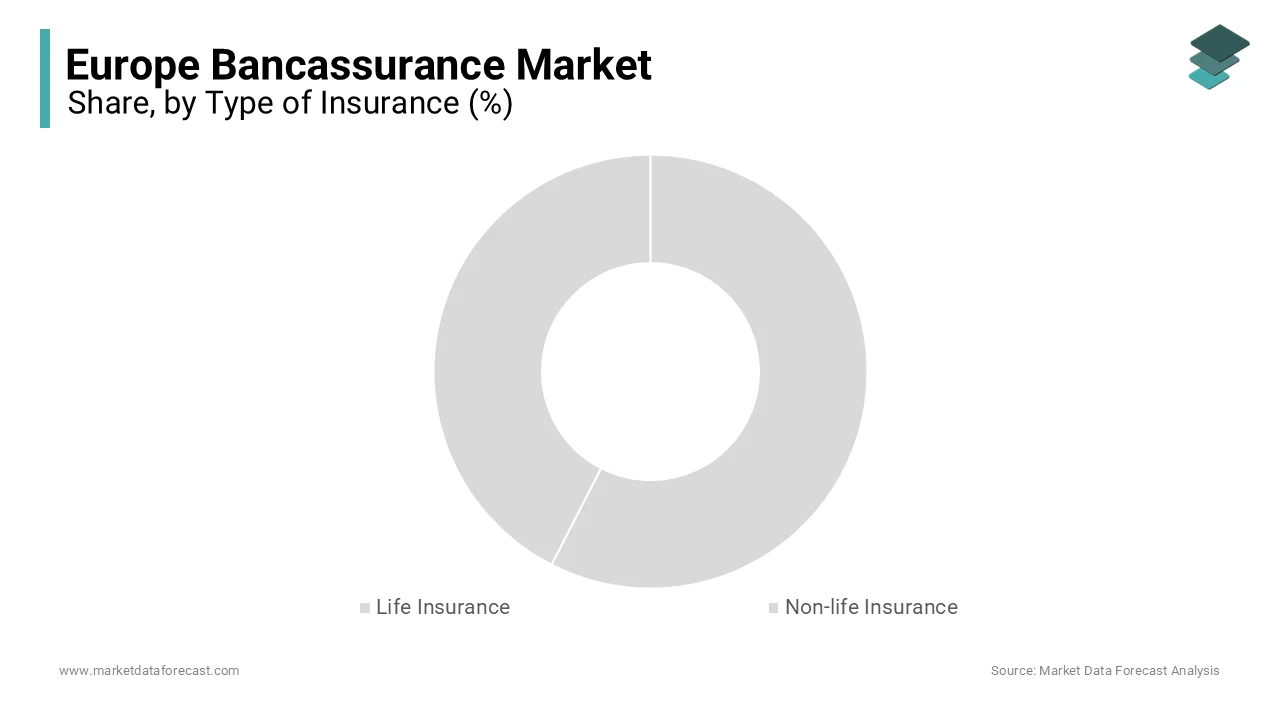
The non-life insurance segment is predicted to witness the highest CAGR of 9.5% from 2026 to 2034 due to rising awareness of risk management, driven by frequent natural disasters and health crises. Mortgage providers successfully leverage the home-buying process to offer integrated property protection, as customers value the simplicity of managing their largest debt and its associated insurance through a single financial institution. Digital platforms have further accelerated adoption, enabling real-time issuance of policies like travel and health insurance. The segment’s importance lies in addressing evolving consumer needs for protection and flexibility. As standalone insurers face competition, banks are capitalizing on their integrated service models to capture this rapidly expanding market share.
REGIONAL ANALYSIS
France Bancassurance Market Analysis
France dominated the Europe bancassurance market and accounted for a 25.2% share in 2025. The dominance of the German market is driven by its deeply integrated financial ecosystem, where banks like BNP Paribas and Crédit Agricole have long-standing partnerships with insurers. The French Banking Federation emphasizes that over 60% of life insurance policies in France are sold through bancassurance channels, driven by customer trust and convenience. Additionally, regulatory support for cross-selling has strengthened this model. France’s aging population further boosts demand for retirement-focused products, making bancassurance a cornerstone of its financial services sector. This robust framework ensures France remains a pioneer in delivering seamless banking and insurance solutions.
Italy Bancassurance Market Analysis
Italy was the second-largest player in the Europe bancassurance market and held a 20.3% share in 2025. The expansion of the Italian market is supported by its high penetration of bancassurance, with banks like Intesa Sanpaolo and UniCredit dominating the landscape. The Italian market is known for a heavy reliance on banks for the distribution of life and pension-linked products, while traditional agents still dominate the non-life and motor insurance sectors. Italians’ strong loyalty to their primary banks facilitates cross-selling, while digital transformation has enhanced accessibility. Furthermore, Italy’s focus on financial inclusion ensures affordable insurance products for underserved populations. These factors, combined with favorable regulatory conditions, solidify Italy’s position as a leader in the European bancassurance market.
Spain Bancassurance Market Analysis
Spain plays a key role in the Europe bancassurance market due to rapid digitalization. This enables banks like Santander and BBVA to offer seamless online insurance solutions. Banks in Spain are aggressively digitizing their insurance offerings to offset a decline in physical branch traffic, leading to a steady migration of simple non-life products to mobile and online banking apps. Spain’s young, tech-savvy population embraces mobile banking, driving adoption rates. Besides, the government’s push for financial education has raised awareness about bundled products, enhancing customer engagement. Spain’s strategic focus on innovation and customer-centric services positions it as a dynamic player in Europe’s bancassurance landscape.
KEY MARKET PLAYERS
The major players in the Europe bancassurance market include
- BNP Paribas
- Banco Santander
- Allianz
- ING Group
- Generali
- Lloyds Banking Group
- Barclays Bank Plc
- Intesa Sanpaolo
- ABN AMRO
- Banco Bradesco Europa
- American Express Company
- Wells Fargo
- Zurich
- AG Insurance
- AXA
MARKET SEGMENTATION
This research report on the Europe bancassurance market is segmented and sub-segmented into the following categories.
By Type of Insurance
- Life Insurance
- Non-Life Insurance
- Health
- Motor
- Property & Casualty
- Travel
- Others
By Model Type
- Pure Distributor Model
- Strategic Alliance Model
- Joint Venture Model
- Financial Holding Model
- Others
By Distribution Channel
- Bank Branch
- Digital / Online Banking
- Mobile Banking Apps
- Contact Centre / Phone
- Affinity & Embedded (FinTech / Retail)
By End User
- Individuals
- SMEs
- Corporates
By Country
- UK
- France
- Spain
- Germany
- Italy
- Russia
- Sweden
- Denmark
- Switzerland
- Netherlands
- Turkey
- Czech Republic
- Rest of Europe