- Product Description Description
- Table of Contents TOC
- List of Table & Figure LOT
- Get Free Sample PDF Sample PDF
Market Size, 2025
$14.97 BnMarket Estimate, 2026
$15.43 BnMarket Forecast, 2034
$19.67 BnCAGR, 2026–2034
3.08%Europe Barley Market Size, Growth, Trends & Forecast (2026–2034)
The Europe barley market size was calculated at USD 14.97 billion in 2025, is estimated to reach USD 15.43 billion in 2026, and is anticipated to be worth USD 19.67 billion by the end of 2034, registering a compound annual growth rate (CAGR) of 3.08% during the forecast period from 2026 to 2034. Driven by resurgent demand from the craft brewing sector, expansion into sustainable livestock feed, and emerging applications in plant-based food innovation and bioeconomy solutions, the market is poised for steady growth.
Key Executive Metrics (At-a-Glance)
- 2025 Base Valuation: USD 14.97 Billion
- 2026 Current Valuation: USD 15.43 Billion
- 2034 Forecast Valuation: USD 19.67 Billion
- Compound Annual Growth Rate (CAGR): 3.08% (2026–2034)
- Largest Grade Segment: Feed Grade Barley
- Fastest-Growing Grade Segment: Food-Grade Barley (6.8% CAGR)
- Largest End-User Segment: Food and Beverages
- Fastest-Growing End-User Segment: Cosmetics and Personal Care (9.2% CAGR)
- Largest Regional Market: France (22.3% share in 2025)
- Fastest-Growing Country Markets: Spain / United Kingdom / Germany
Core Market Drivers
- Craft Brewing Renaissance: High demand for terroir-driven malting barley supported by EU Protected Geographical Indication frameworks.
- Sustainable Feed Formulations: Adoption of barley as an environmentally friendly alternative to imported soy and corn in livestock rations.
Primary Market Restraints & Challenges
- Climate-Induced Yield Volatility: Unpredictable weather shifts destabilizing regional yields and strict malting protein thresholds.
- Stringent Pesticide Regulations: EU limits on crop protection chemicals increasing production costs and disease management challenges.
Europe Barley Market Segmentation Breakdown
| Segment Category | Largest / Dominant Segment | Fastest-Growing Segment |
|---|---|---|
| By Grade | Feed Grade Barley | Food-Grade Barley (6.8% CAGR) |
| By End-User | Food & Beverages | Cosmetics and Personal Care (9.2% CAGR) |
| By Region | France (22.3%) | Spain / United Kingdom / Germany |
Major Industry Players Profiled
Key enterprises shaping the Europe barley market include Soufflet Group (Groupe Soufflet), Boortmalt Group, GrainCorp Limited, Cargill Incorporated, Malteurop Groupe, Axéréal Group, and Muntons Plc.
Europe Barley Market Size
The Europe Barley market size was calculated to be USD 14.97 billion in 2025 and is anticipated to be worth USD 19.67 billion by 2034, from USD 15.43 billion in 2026, growing at a CAGR of 3.08% during the forecast period.
Barley is one of the oldest cultivated cereals in Europe and remains a strategically significant crop due to its dual role in food security and industrial applications. Barley’s agronomic resilience in cooler and drier climates makes it a preferred rotational crop in northern and eastern Europe, contributing to soil health and sustainable farming systems.
MARKET DRIVERS
Resurgent Demand from the Craft Brewing Sector
The craft brewing renaissance across Europe has emerged as a pivotal driver for high-quality malting barley, which is leveling up the growth of the Europe barley Market. Furthermore, the European Union’s Protected Geographical Indication framework has incentivized terroir-driven barley cultivation, as seen in the Czech Saaz region, where local barley varieties are mandated for authentic Pilsner production. This regulatory and cultural synergy ensures sustained premium pricing for malting barley, insulating it from the volatility typical of feed grain markets.
Expansion of Barley in Sustainable Livestock Feed Formulations
Barley’s nutritional profile and environmental footprint have positioned it as a strategic alternative to imported soy and corn in European livestock feed rations, which is escalating the growth of the Europe barley Market. Additionally, barley’s shorter growing cycle and frost tolerance enable double-cropping systems in southern Europe, enhancing feed self-sufficiency. The shift is further accelerated by consumer demand for locally sourced meat and dairy, prompting retailers like Carrefour and Edeka to mandate regional feed ingredients in their private label supply chains.
MARKET RESTRAINTS
Climate-Induced Yield Volatility in Key Production Zones
The unpredictable weather patterns linked to climate change have significantly destabilized barley yields across Europe’s primary growing regions, undermining supply consistency and price stability is solely limiting the growth of the Europe barley Market. These disruptions are particularly acute for malting barley, which requires strict protein content thresholds.
Stringent EU Pesticide Regulations Limiting Input Options
The European Union’s aggressive regulatory stance on crop protection chemicals has curtailed barley farmers’ access to effective pest and disease management tools, which is directly affecting yield potential and production costs. This factor is eventually to decline the growth of the Europe barley Market. This regulatory environment disproportionately affects barley, which lacks the extensive breeding pipeline of wheat or maize for disease resistance traits. Consequently, production risk premiums are rising, discouraging younger farmers from barley specialization and accelerating land use shifts toward less regulated crops.
MARKET OPPORTUNITIES
Integration of Barley into Plant-Based Food Innovation
Barley is gaining traction as a functional ingredient in Europe’s rapidly expanding plant-based food sector due to its high beta-glucan content, neutral flavor profile, and non-allergenic status. The launch of various products into plant-based food innovation and rising awareness among consumers are eventually to leverage growth opportunities for the growth of the Europe Barley Market.
Policy-Driven Expansion of Barley in Bioeconomy Applications
The European Union’s strategic pivot toward a circular bioeconomy has unlocked novel industrial pathways for barley in bio-based chemical and material production, which is likely to enhance the growth of the Europe Barley Market. Barley straw, that often considered a low-value byproduct, contains high cellulose and hemicellulose content suitable for second-generation ethanol and lignin extraction. Furthermore, the EU’s Carbon Border Adjustment Mechanism indirectly favors domestically sourced barley feedstocks by increasing the cost of fossil-based imports.
MARKET CHALLENGES
Persistent Protein Quality Constraints in Malting Barley
The structural challenge in consistently meeting the narrow protein specifications required by the malting and brewing industry is negatively impacting the growth of the Europe barley market. Malting barley must maintain protein content between 9.5 and 11.5 % to ensure optimal enzymatic activity and foam stability in beer; deviations render entire lots unsuitable for premium brewing. The resulting supply bottleneck forces brewers to import high-quality barley from Canada or Australia, undermining the EU’s strategic autonomy in a culturally significant sector.
Fragmented Supply Chain Coordination Across the Value Chain
The systemic inefficiencies stemming from poor coordination among farmers, cooperatives, maltsters, and end users, which are leading to suboptimal quality segregation, pricing opacity, and logistical bottlenecks, are additionally hindering the growth of the Europe barley market. Moreover, digital traceability adoption remains low; only 12 % of barley lots entering EU malt houses in 2022 carried blockchain or QR-based provenance data, per the Digital Agriculture Observatory of the European Commission. The absence of a unified quality assurance platform impedes premium pricing for differentiated barley and discourages investment in precision agronomy.
REPORT COVERAGE
| REPORT METRIC | DETAILS |
| Market Size Available | 2025 to 2034 |
| Base Year | 2025 |
| Forecast Period | 2026 to 2034 |
| CAGR | 3.08% |
| Segments Covered | By Grade, End User, and Region |
| Various Analyses Covered | Global, Regional & Country Level Analysis; Segment-Level Analysis; DROC, PESTLE Analysis; Porter’s Five Forces Analysis; Competitive Landscape; Analyst Overview of Investment Opportunities |
| Regions Covered | UK, France, Spain, Germany, Italy, Russia, Sweden, Denmark, Switzerland, Netherlands, Turkey, and the Czech Republic |
| Market Leaders Profiled | Cargill Incorporated, Malteurop Groupe, Groupe Soufflet, Boortmalt Group, Axéréal Group, Muntons Plc, GrainCorp Limited. |
SEGMENTAL ANALYSIS
By Grade Insights
The Feed Grade barley segment accounted in holding a significant share of the Europe barley market in 2025, with its extensive use in ruminant and poultry feed formulations across the European Union’s vast livestock sector. Germany alone consumed 7.2 million metric tons of feed barley in 2023, according to the German Agricultural Society by reflecting strong integration between arable farming and animal husbandry.
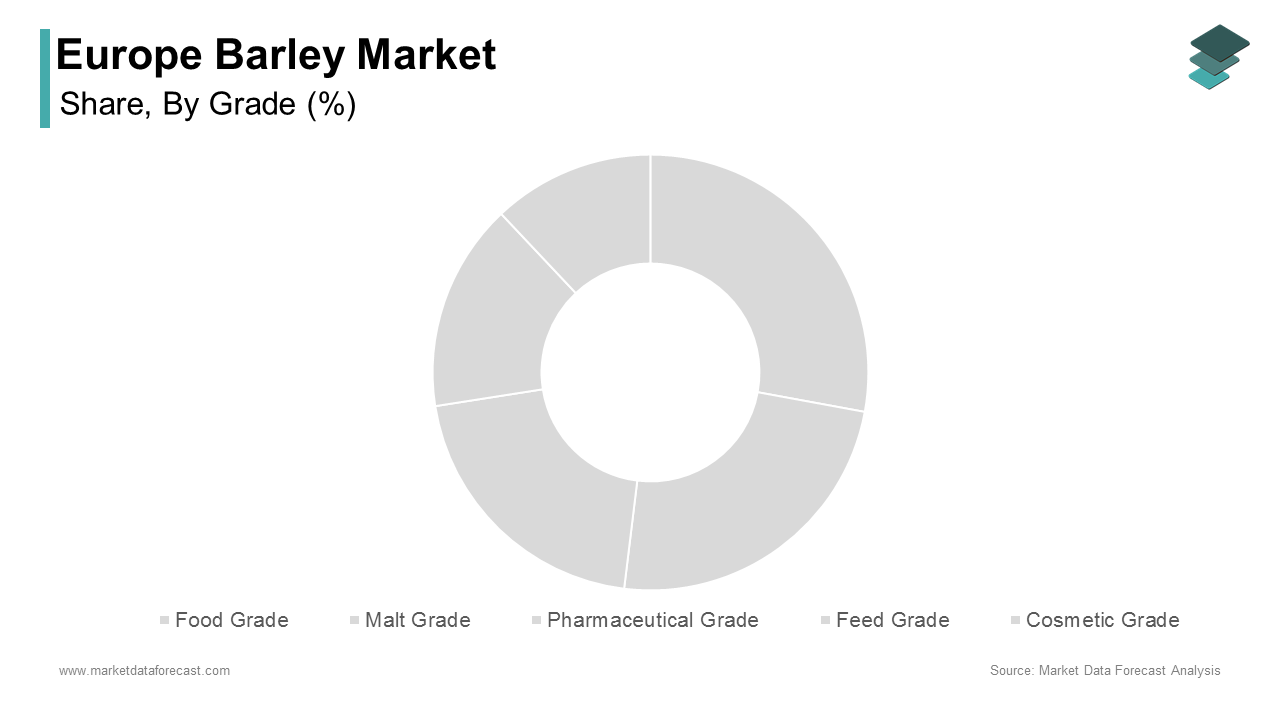
The food-grade barley segment is expected to grow with a significant CAGR of 6.8% during the forecast period, from rising consumer interest in whole grains, functional foods, and clean label ingredients across Western and Northern Europe. Major food manufacturers such as Nestlé and Barilla have reformulated products to include pearled barley and barley flakes, responding to demand for non-allergenic, gluten-reduced (though not gluten-free) grains.
By End-User Insights
The Food and Beverages segment was the largest and held a significant share of the Europe barley market in 2025 with anchored in barley’s irreplaceable role in beer production and its expanding use in bakery, breakfast cereals, and plant-based food systems.
The Cosmetics and Personal Care segment is anticipated to grow with a CAGR of 9.2% from 2026 to 2034, with the clean beauty movement and increasing demand for natural, bioactive, and sustainably sourced ingredients in skincare formulations. Leading brands like L’Oréal and Weleda have integrated barley water and fermented barley extracts into their premium lines, citing clinical studies that demonstrate enhanced skin hydration and reduced transepidermal water loss. Furthermore, barley’s status as a non-GMO, non-allergenic crop aligns with EU Ecolabel and COSMOS certification requirements.
REGIONAL ANALYSIS
France Barley Market Analysis
France was the top performer in the Europe barley market by contributing 22.3% of the share in 2025 with its vast arable land base, advanced agricultural infrastructure, and dual specialization in both feed and malting barley. Additionally, the French government’s Ecophyto Plan II, which promotes reduced pesticide dependency, has encouraged barley’s use in diversified crop rotations, improving soil health while maintaining yield stability.
Germany Barley Market Analysis
Germany was positioned second by capturing 18.3% of the Europe barley market share in 2025 with its tight integration with the livestock and brewing industries, both of which are deeply embedded in the national economy. Germany’s commitment to the EU Green Deal has also spurred investment in barley varieties with enhanced nitrogen use efficiency, reducing environmental impact while maintaining productivity. Furthermore, the country’s advanced malting infrastructure, including global players like Boortmalt, enables value addition and export competitiveness.
Spain Barley Market Analysis
Spain barley market growth is likely to grow with a significant CAGR in next coming years, with the extensive rainfed cultivation in the central and southern Meseta regions, where the crop’s drought tolerance offers a critical advantage in increasingly arid conditions. While malting barley remains a minor segment due to protein variability, ongoing trials with irrigation-managed plots in Aragon show promise for quality improvement. Spain’s strategic adaptation to water scarcity and its role in Mediterranean feed security affirm its pivotal status in the European barley market.
United Kingdom Barley Market Analysis
The United Kingdom barley market growth is propelled by the launch of premium malting varieties that support its globally recognized brewing and distilling heritage. Key growing regions such as East Anglia and Yorkshire benefit from cool maritime climates and well-drained soils ideal for producing low nitrogen barley with excellent germination rates. Furthermore, the UK’s Sustainable Farming Incentive scheme rewards barley growers for soil health and biodiversity practices, which aligns production with net zero goals.
COMPETITION OVERVIEW
The Europe barley market features intense competition among integrated agro-industrial firms, regional cooperatives, and international grain traders. Competition is not primarily price-driven but centers on quality consistency, sustainability credentials, and supply chain reliability. Major players differentiate themselves through proprietary barley varieties, long-term grower contracts, and advanced malting technologies that meet the exacting standards of the brewing and food sectors. Regional cooperatives leverage local farmer networks to secure high-quality feed and malting barley, while multinational corporations utilize global logistics to balance European supply with imports during shortfall years. The entry of plant-based food and bioeconomy players has introduced new demand dynamics, prompting traditional barley handlers to diversify end-use applications. Regulatory compliance with EU pesticide reduction and soil health mandates further raises the operational bar, favoring well-capitalized firms with agronomic expertise and digital infrastructure. This multifaceted competitive landscape drives continuous innovation in both production and value addition.
KEY MARKET PLAYERS
A few of the dominating players in the Europe barley market include
- Cargill Incorporated
- Malteurop Groupe
- Groupe Soufflet
- Boortmalt Group
- Axéréal Group
- Muntons Plc
- GrainCorp Limited
Top Strategies Used by the Key Market Participants
Key players in the Europe barley market employ several strategic approaches to maintain competitiveness and ensure supply chain resilience. Vertical integration remains central, with major firms controlling activities from seed supply and farm advisory services to malting and distribution. Investment in sustainable agriculture is another critical strategy, including regenerative farming pilots, carbon insetting programs, and water efficiency initiatives aligned with EU Green Deal objectives. Companies are also enhancing digital capabilities through blockchain traceability systems and AI-driven yield forecasting tools to improve procurement accuracy. Strategic partnerships with research institutions accelerate the development of climate-adapted barley varieties with stable malting quality.
LEADING PLAYERS IN THE EUROPE BARLEY MARKET
Soufflet Group
Soufflet Group is a leading French agro-industrial company deeply integrated into the European barley value chain through malting, grain trading, and agricultural services. The company operates malting facilities across France, Germany, Poland, and the United Kingdom by supplying premium malt to global brewers and distillers. In recent years, Soufflet has invested in sustainable barley sourcing initiatives, launching farmer support programs that promote low-input cultivation and traceability. It also partnered with research institutions to develop climate-resilient barley varieties, reinforcing its commitment to long-term supply security and quality consistency in the face of environmental volatility.
Boortmalt
Boortmalt is a subsidiary of the global cooperative Axéréal, is one of Europe’s foremost malt producers with a strong presence in Belgium, France, Germany, and the Netherlands. The company supplies malt to over 500 breweries worldwide and emphasizes innovation in malting technology and barley agronomy. Recently, Boortmalt expanded its sustainability roadmap by introducing carbon footprint labeling for its malt products and piloting regenerative agriculture trials with barley growers across northern Europe.
GrainCorp
GrainCorp, though headquartered in Australia, maintains a strategic footprint in the Europe barley market through its European malting division headquartered in the Netherlands. The company sources barley from key EU producing regions and processes it in modern malt houses serving both European and international customers. GrainCorp has recently upgraded its Hamburg and Ghent facilities to increase energy efficiency and processing capacity. It also launched a digital barley procurement platform enabling real-time quality assessment and contract management for European farmers, thereby improving supply chain transparency and responsiveness.
MARKET SEGMENTATION
This research report on the Europe barley market has been segmented and sub-segmented based on grade, end-user, and region.
By Grade
- Food Grade
- Malt Grade
- Pharmaceutical Grade
- Feed Grade
- Cosmetic Grade
By End-User
- Pharmaceuticals
- Food & Beverages
- Cosmetics and Personal Care
- Others
By Region
- UK
- France
- Spain
- Germany
- Italy
- Russia
- Sweden
- Denmark
- Switzerland
- Netherlands
- Turkey
- Czech Republic
- Rest of Europe