- Product Description Description
- Table of Contents TOC
- List of Table & Figure LOT
- Get Free Sample PDF Sample PDF
Market Size, 2025
$49.19 BnMarket Estimate, 2026
$54.12 BnMarket Forecast, 2034
$116.27 BnCAGR, 2026–2034
10.03%Executive Summary: European Bearing Market
- Market Scope: Comprehensive analysis of the European bearing market covering product classifications (ball, roller, and plain bearings), key industrial and automotive applications, and country-level developments across Europe.
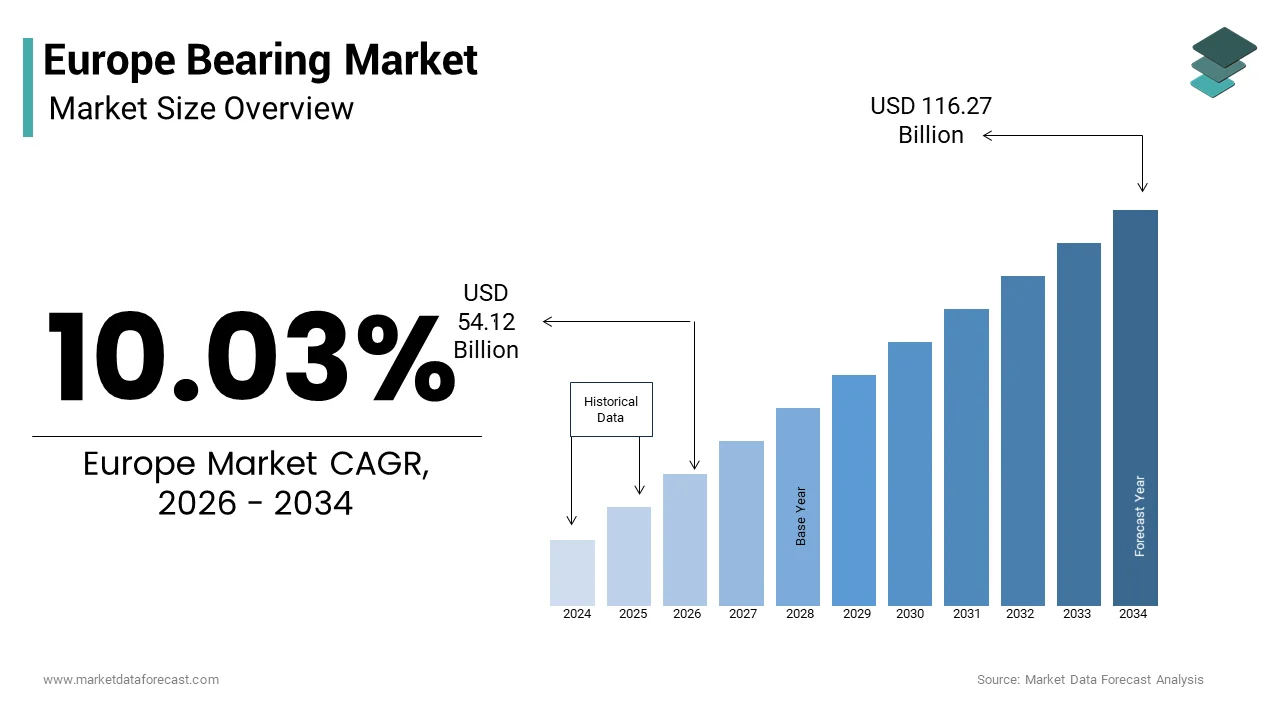
- Market Valuation: Valued at USD 49.19 billion in 2025, estimated at USD 54.12 billion in 2026, and projected to reach USD 116.27 billion by 2034, expanding at a robust CAGR of 10.03% from 2026 to 2034.
- Primary Growth Drivers: Rapid expansion of industrial automation and robotics, aggressive offshore wind energy buildouts, and stringent regulatory safety and energy efficiency standards across the EU.
Key Market Segment Metrics (2026–2034)
| Category | Leading Segment (Base Position) | Fastest-Growing / High-Growth Segment |
|---|---|---|
| By Product | Ball Bearings (captured a dominant 45.5% share in 2025, propelled by low-friction design and high-volume use in electric motors and industrial machinery) | Roller Bearings (forecasted to showcase a solid 8.04% CAGR driven by heavy industry and large-diameter wind turbine drivetrain requirements) |
| By Application | Automotive (represents the largest application with 33.5% market share in 2025, fueled by passenger vehicle output and EV powertrain transition) | Railway & Aerospace (fastest-growing segment at an 8.8% CAGR, driven by the European Green Deal, high-speed rail upgrades, and aerospace modernization) |
| By Country | Germany (market leader accounting for 26.5% share in 2025 due to automotive engineering clusters, heavy machinery, and high robot density) | United Kingdom & France (high-growth hubs anchored by aerospace manufacturing, offshore wind farms, and rail infrastructure) |
Major Market Players & Industry Landscape
Market Structure: Tiered competitive landscape where global multinationals and specialized European manufacturers compete on precision engineering, circular economy remanufacturing, and smart IoT sensor integration rather than low-cost volume.
Key Companies: SKF AB, Schaeffler AG, NTN Corporation, Timken Company, NSK Ltd., JTEKT Corporation, MinebeaMitsumi Inc., NRB Bearings Ltd., RBC Bearings Incorporated, and Wafangdian Bearing Group Corporation.
Europe Bearing Market Size
The European bearing market size was valued at USD 49.19 billion in 2025 and is anticipated to reach USD 54.12 billion in 2026 to reach USD 116.27 billion by 2034, growing at a CAGR of 10.03% during the forecast period from 2026 to 2034.
Bearings are precision-engineered components designed to reduce friction, enable rotational or linear motion,n and support mechanical loads across industrial, automotive,e and energy applications. Bearings are foundational to machinery reliability and energy efficiency, with performance directly impacting operational uptime and lifecycle emissions. The European market is distinguished by its integration within high-value manufacturing chains, stringent machinery safety directives, and a strong emphasis on predictive maintenance. According to the International Federation of Robotics, Europe accounted for 17% of global industrial robot installations in 2023, with the total stock of robots worldwide reaching over 4.2 million units; this underscores the EU’s significant role in automation, where specialized thin-section and crossed roller bearings are critical for articulation. As per the European Commission, electric motors consumed about 56% of final electricity in the EU in 2020, which indicates their dominance in industrial energy use. The Machinery Regulation (EU) 2023/1230 mandates enhanced component traceability and safety reporting for critical parts, including bearings used in lifts, escalators, and agricultural machinery. Furthermore, according to WindEurope, Europe added 16.4 GW of new wind power capacity in 2024, which is equivalent to thousands of turbines, each requiring multiple large-diameter pitch and yaw bearings. This convergence of automation, decarbonization, and regulatory oversight defines the strategic importance of bearings in Europe’s industrial ecosystem.
MARKET DRIVERS
Industrial Automation and Robotics Expansion Drive Demand for Precision Bearings
The rapid deployment of industrial robots and automated guided vehicles across European manufacturing is generating sustained demand for high precision miniature and thin section bearings, which is one of the key factors fuelling the European bearings market growth. According to the International Federation of Robotics, Europe installed hundreds of thousands of new industrial robots in 2024, bringing the operational total to millions of units. Each articulated robot typically incorporates 6 to 10 specialized bearings, including cross roller and angular contact types, to ensure repeatability and torque transmission. As per the European Automotive Manufacturers Association, automotive plants in Germany and Slovakia now operate with robot densities far above global averages, which necessitates frequent bearing replacements due to continuous cyclic loading. Similarly, the rise of e-commerce fulfillment centers has spurred the adoption of autonomous mobile robots, with companies like Ocado and Amazon deploying tens of thousands of units across Europe in 20,24 each requiring multiple compact deep groove ball bearings for wheel and actuator systems. These applications demand extreme dimensional accuracy,acy low noise, and long fatigue life under variable loads. According to the VDMA German Engineering Federation, most new automation projects in 2024 specified ISO P5 or P4 tolerance class bearings, underscoring the performance threshold required in modern smart factories.
Offshore Wind Energy Build Out Accelerates Demand for Large Diameter Specialized Bearings
Europe’s aggressive offshore wind expansion is creating a structural demand surge for large-diameter pitch yaw and main shaft bearings that endure extreme marine conditions and multi-decade service lives, which is further boosting the bearings market expansion in Europe. According to WindEurope, thousands of new wind turbines were installed across the EU in 2024, with offshore capacity growing significantly in the North and Baltic Seas. Each offshore turbine requires at least one main shaft bearing, two yaw bearings, and three pitch bearings with rotor diameters now exceeding 220 meters, driving bearing sizes beyond 4 meters in outer diameter. These components must operate reliably for 25 years with minimal maintenance under high dynamic load,s, salt ssprayy and temperature fluctuations. As per industry disclosures, major projects like Dogger Bank sourced over 100 main shaft bearings from SKF and Schaeffler in 2024, valued at tens of millions of euros. The European Commission’s Net Zero Industry Act designates wind energy as a strategic technology,y further securing long-term bearing demand. Additionally, many regulatory frameworks like the EU Ecodesign Directive for Energy Related Products now include provisions for component durability, directly linking bearing quality to turbine energy yield. This energy transition imperative transforms bearings from standard components into mission-critical enablers of Europe’s clean power future.
MARKET RESTRAINTS
Geopolitical Disruptions in Critical Raw Material Supply Chains Constrain Production
The Europe bearings market faces significant supply chain vulnerabilities due to high import dependency on critical raw materials such as high-purity chromium, nickel, and specialty steel alloys. According to the European Raw Materials Alliance, the EU imports the vast majority of its chromium and nickel from external suppliers. Sanctions on Russian ferroalloys following the 2022 invasion of Ukraine caused bearing steel prices to surge, as reported by Eurofer, the European Steel Association. These materials are essential for manufacturing case-hardened and through-hardened bearing rings that meet ISO 683 standards for fatigue resistance. As per SKF disclosures, raw material volatility delayed delivery of large industrial bearings by several weeks due to alloy allocation constraints. Recycling cannot fully compensate, as bearing scrap often lacks the precise chemical composition required for reprocessing into high-grade steel. Without strategic stockpiling or investment in alternative alloy development, European bearing manufacturers remain exposed to geopolitical and logistical shocks that directly impact production planning and cost stability.
Intense Price Competition from Low-Cost Asian Imports Undermines Local Manufacturers
European bearing producers contend with persistent pricing pressure from mass-produced imports primarily from China and India, which benefit from lower labor, energy, nd environmental compliance costs, which is further impeding the bearings market growth in Europe. According to Eurostat, more than half of bearings consumed in the EU in 2024 were imported, with Chinese suppliers capturing a large share in standard deep groove and tapered roller segments. These imports often lack full traceability or third-party certification, yet enter the market through indirect distribution channels, circumventing Machinery Regulation scrutiny. As per a 2024 investigation by the German Engineering Federation, many low-cost imported bearings failed basic dimensional and hardness tests per ISO 15243 standards, posing safety risks in industrial applications. Despite anti-dumping duties imposed by the European Commission in 2022 ,margins for European SME bearing manufacturers have compress,ed as per the European Bearing Association. This environment forces local producers to either retreat into high precision niches or risk insolvency, unable to match volume pricing while maintaining compliance with EU safety and sustainability mandates.
MARKET OPPORTUNITIES
Integration of Smart Bearings with IoT and Condition Monitoring Systems Creates Premium Segments
The emergence of smart bearings embedded with sensors and wireless connectivity is unlocking high-value service-oriented business models in predictive maintenance and digital twin applications, and is a notable opportunity for the European bearings market. European manufacturers such as SKF and Schaeffler now offer bearings with integrated temperature, vibration, and lubrication sensors that transmit real-time health data to cloud platforms. According to SKF, its Explorer IoT-enabled bearings reduced unplanned downtime significantly in cement plants across Poland and Italy through early fault detection. Similarly, as per Schaeffler, SensorMount technology in rail axle boxes enabled Deutsche Bahn to extend maintenance intervals, saving millions of euros annually. The European Investment Bank allocated hundreds of millions of euros in 2024 under its Industrial Digitalization Fund to support smart component adoption in SMEs. These intelligent bearings transform a passive mechanical part into an active data source, enabling performance-based contracts and lifecycle optimization. As Industry 4.0 matures, this convergence of mechanics and digital intelligence positions smart bearings as a cornerstone of Europe’s predictive maintenance ecosystem.
Circular Economy Initiatives Drive Reconditioning and Remanufacturing Services
The European Union’s Circular Economy Action Plan is catalysing growth in bearing reconditioning, remanufacturingg and core exchange programs that extend product life and reduce resource consumption. Large industrial bearings used in mining, paper, and steel mills often retain most of their original material value even after service life exhaustion. According to SKF, its remanufacturing center in the Netherlands processed thousands of large roller bearings in 2024, restoring them to “as new” condition with far less energy and raw material than new production, as verified by the Fraunhofer Institute. Similarly, as per Schaeffler, its “ReMan” program in Germany offers certified reconditioned bearings with full warranty, reducing customer costs significantly. The EU Ecodesign for Sustainable Products Regulation, set to apply in 2,027 will mandate durability and repairability labels, ling further incentivizing circular models. With industrial customers under Scope 3 emissions reporting pressure, remanufactured bearings provide verifiable carbon reduction credits. This shift from linear to circular value chains aligns economic incentive with environmental obligation, creating a resilient and sustainable segment within the bearings market.
MARKET CHALLENGES
Lack of Standardized Digital Twins for Bearings Hinders Predictive Maintenance Interoperability
Despite advances in smart bearings, the absence of standardized digital twin frameworks across manufacturers impedes seamless integration into plant-wide predictive maintenance systems, which is one of the major challenges to the expansion of the European bearings market. Each bearing OEM currently uses proprietary data formats, communication protocols, and failure modes, els preventing unified monitoring across multi-vendor fleets. According to the European Federation of Industrial Engineering, the average European factory operates equipment from many bearing suppliers,iers yet most lack a single dashboard for bearing health analytics due to data silos. As per a 2024 pilot at a BASF chemical plant, engineers spent hundreds of additional hours per year manually reconciling SKF, Schaeffler, and NSK sensor outputs. The lack of adherence to open standards like OPC UA for rotating equipment delays anomaly detection and reduces model accuracy. Although initiatives like the Asset Administration Shell under GAIA X aim to resolve this fragmentation, adoption remains voluntary and incomplete. Until a common semantic model for bearing performance is established, predictive maintenance will remain fragmented, limiting the full potential of data-driven reliability engineering.
Shortage of Skilled Technicians for Precision Bearing Installation and Maintenance
Europe faces a critical deficit of mechanical technicians trained in precision bearing mounting, lubrication, and alignment,nt which directly compromises machinery reliability and bearing performance. According to the European Association of Bearing Distributors, tens of thousands of certified bearing fitters are lacking across the EU in 2024, with Germany, France, and Italy accounting for most of the gap. Incorrect installation, including improper shaft tolerances, uneven loading, ng or inadequate lubrication, causes a significant share of premature bearing failures as documented by the VDMA. Vocational training programs remain underfunded, and only a minority of technical schools offer dedicated bearing technology curricula, according to Cedefop. As per a 2024 survey by the Polish Engineering Association, many maintenance managers reported delaying machinery upgrades due to the inability to find qualified personnel. This human capital bottleneck not only increases lifecycle costs but also undermines the value proposition of high precision bearings whose performance is installation dependent. Without coordinated workforce development, the technical excellence of European bearing engineering cannot be fully realized in the field.
REPORT COVERAGE
| REPORT METRIC | DETAILS |
| Market Size Available | 2025 to 2034 |
| Base Year | 2025 |
| Forecast Period | 2026 to 2034 |
| CAGR | 10.03% |
| Segments Covered | By Product, Application, and Country. |
| Various Analyses Covered | Global, Regional, and Country Analysis, Segment-Level Analysis, DROC, PESTLE Analysis, Porter’s Five Forces Analysis, Competitive Landscape, Analyst Overview of Investment Opportunities |
| Regions Covered | U.K., France, Germany, Spain, Italy, Sweden, Russia, Denmark, Switzerland, the Netherlands, Turkey, the Czech Republic, and the rest of Europe |
| Market Leaders Profiled | SKF AB, Schaeffler AG, NTN Corporation, Timken Company, NSK Ltd., JTEKT Corporation, MinebeaMitsumi Inc., NRB Bearings Ltd., RBC Bearings Incorporated, and Wafangdian Bearing Group Corporation. |
SEGMENTAL ANALYSIS
By Product Insights
The ball bearings segment occupied the dominating share of 45.5% of the European bearings market in 2025. The dominance of the ball bearings segment in this regional market is driven by their versatility, low-friction characteristics, and widespread use across consumer,i ndustrial, and automotive applications. Ball bearings are the standard choice for fractional and integral horsepower electric motors, rs which power everything from HVAC systems to conveyor belts. According to the European Environment Agency, industrial electric motors consume about 65% of the EU’s total electricity, with several hundred million motors in service across industry and buildings. Each motor typically contains one or two deep groove ball bearings, enabling high-speed rotation with minimal energy loss. Under the EU Ecodesign Directive for electric motors, which mandates IE4 efficiency classes for most new units from 202,3 according to the European Commission, manufacturers increasingly specify low-torque-loss ball bearings to meet performance thresholds. According to ABB and Siemens supplier disclosures, more than 120,000,000 ball bearings were sourced in 2024 for motor production across Europe. The reliability and cost efficiency of ball bearings in these high-volume applications ensure their continued market leadership across both OEM and replacement channels.
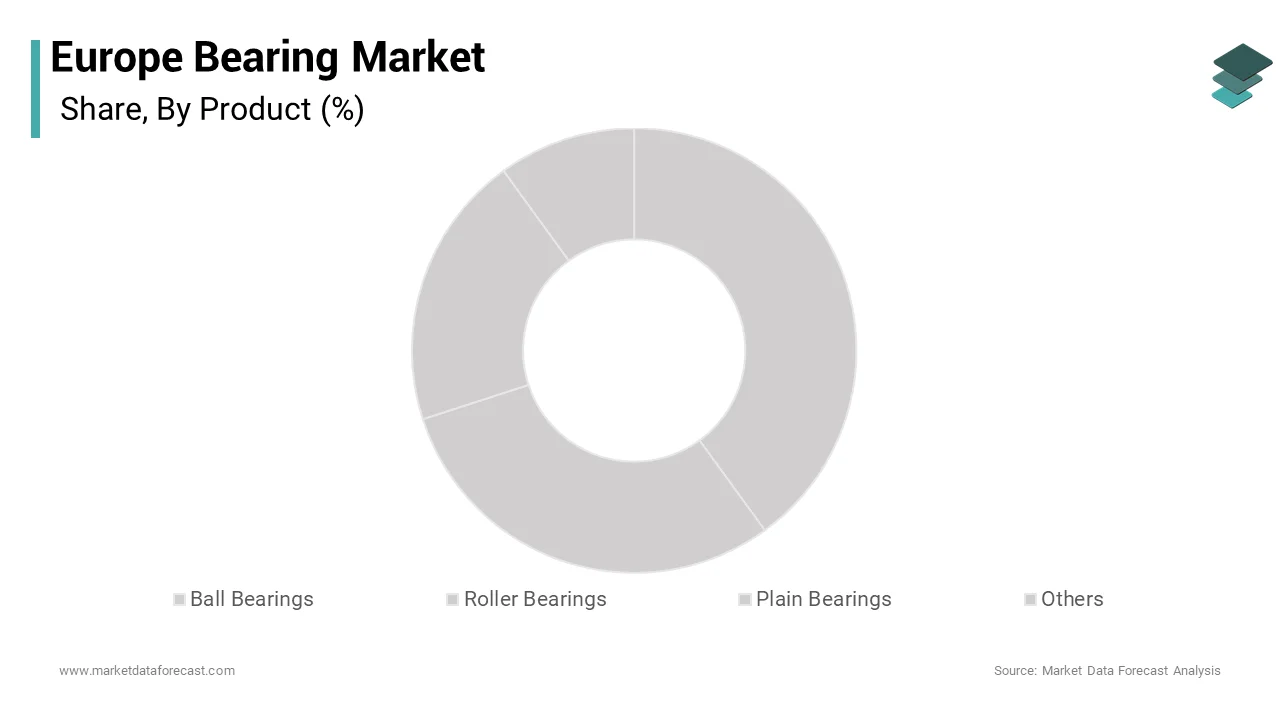
The roller bearings segment is another promising segment and is expected to showcase a CAGR of 8.04% over the forecast period in this regional market. The heavy industry and renewable energy expansion in Europe is primarily driving the growth of the roller bearings segment in this regional market. Roller bearings are essential in wind turbine drivetrains where they support extreme radial and axial loads under variable wind conditions. In 2024, Europe installed 3.2 gigawatts of offshore wind capacity according to WindEurop,e implying over 23,000 large diameter roller bearings across main shaft itsts gearboxes, and pitch systems. Each offshore turbine main shaft bearing exceeds 3 meters in diameter and must operate maintenance-free for 25 years in corrosive marine environments. Projects such as Dogger Bank and Baltic Eagle publicly disclosed custom-engineered roller bearing awards to SKF and Timken, exceeding €120,000,000 in combined value. The European Commission’s Net Zero Industry Act designates offshore wind as strategi,c ensuring sustained demand. Unlike ball bearings, gear roller variants handle higher load capacities, making them irreplaceable in multi-megawatt turbines where failure risks are catastrophic.
By Application Insights
The automotive segment represents the largest application segment for bearings in Europe and had 33.5% of the European bearings market share in 2025. The integrated role of bearings across vehicle production and maintenance is majorly contributing to the dominance of the automotive segment by application in the European market. Each passenger car contains 80 to 120 bearings across wheel hubs, transmissions, steering systems, and electric auxiliaries, according to ACEA technical notes. With 14.2 million light vehicles produced in the EU in 2024, according to ACE, an OEM bearing demand exceeded 1.5 billion units. The transition to electric vehicles has not reduced bearing requirements; instead, ad it has shifted them toward reduction gearsxes electric water pumps, and compressor systems that demand quieter and more precise bearings. Volkswagen’s MEB platform documentation indicates 14 specialized bearings per drivetrain in n 2024 supplier reporting. Furthermore, stringent EU CO2 fleet targets push automakers to reduce mechanical losses where low-friction bearings contribute measurable efficiency gains. This engineering integration ensures automotive remains the largest and most consistent bearing application despite powertrain evolution.
The railway and aerospace application segment is the fastest growing and is estimated to grow at a CAGR of 8.8% over the forecast period, owing to the infrastructure modernization and fleet renewal. The European Green Deal targets doubling rail freight and passenger traffic by 20,30 necessitating new rolling stock and track upgrades. In 2024 the EU allocated €32,000,000,000 to the Connecting Europe Facility for rahigh-speed projectscts underway from Spain to Poland, according to the European Commission. Each high-speed train, such as the Siemens Velaro or Alstom Avelia, contains over 200 tapered and cylindrical roller bearings in bogies,, es gearboxes, and traction motors as specified in EN 13103/EN 13104 compliance materials. Deutsche Bahn’s 2024 procurement announcements covered 300 new ICE 4 trains requiring approximately 60,000 high-precision bearings. These bearings must endure 300 km/h speeds, extreme temperature swings, and 30-year service lives with zero failure tolerance. This regulatory and investment push ensures sustained high-value bearing demand in rail.
COUNTRY ANALYSIS
Germany Bearings Market Analysis
Germany held the leading position in the European bearings market by accounting for 26.5% of the European market share in 2025. Its dominance results from world‑class automotive manufacturing, heavy machinery, and precision engineering clusters. According to the German Association of the Automotive Industry (VDA), Germany produced about 4 million passenger cars in 2024. These manufacturers source high‑precision bearings from domestic suppliers, including Schaeffler and Bosch Rexrothh ensuring tight integration and quality control. Simultaneously, Germany’s machinery sector relies on bearings for machine tools, printing equipment, and robotics, with Germany maintaining Europe’s highest robot density as per the International Federation of Robotics (IFR). The country also leads in wind energy component manufacturing, ing with companies like Enercon and Siemens Gamesa producing gearboxes that demand specialized large‑diameter roller bearings. As per BMWK’s Industriepolitik 2030, federal programmes support bearing innovation in hydrogen compressors and electric drivetrains. With a broad network of bearing production and reconditioning sites and a deeply skilled engineering workforce, Germany remains the undisputed hub of European bearing technology and demand.
Italy Bearings Market Analysis
Italy capturedsecond-largestrgest share of the European bearings market in 2025. The strong industrial machinery of Italy, automotive components, and agricultural equipment sectors are propelling Italy's leading position in the European bearings market. Italy’s bearing demand is fueled by its specialization in high‑value industrial equipment, including textile machines, food processing systems, and ceramic presses which require custom‑engineered plain and ball bearings for continuous operation. Companies like Sacmi and Sidel integrate thousands of precision bearings annually into their global export machinery. According to ACEA, Italy is among the leading EU auto parts producers, supplying components includinwheel hubb and transmission bearings. Agriculture also contributes significantly; Italy’s active tractor fleet exceeds 1 million units as per ISTAT, many equipped with bearings for power take‑off and harvesting systems. As per Italy’s National Recovery and Resilience Plan, funding supports modernization of manufacturing with emphasis on predictive maintenance. This blend of niche industrial strength and supply chain integration sustains Italy’s robust market position.
France Bearings Market Analysis
France is predicted to account for a promising share of the European bearings market over the forecast period due to its leadership in aerospace, rail, and nuclear energy infrastructure. France’s bearings consumption is uniquely shaped by its strategic industries. According to Airbus, global deliveries exceeded 700 aircraft in 2024, with Toulouse serving as a major assembly hub requiring thousands of high‑reliability bearings. The national rail operator SNCF maintains a large TGV fleet, each trainset using specialized roller bearings certified under EU rail safety directives. In nuclear energy, EDF’s 56 reactors use large‑diameter spherical bearings in coolant pumps designed for decades of operation. The French Defense Procurement Agency also drives demand through military vehicle and helicopter programmes requiring extreme‑environment bearings. As per the France 2030 plan, significant funding supports aerospace and rail innovation. This concentration in mission‑critical sectors ensures France’s bearings market remains premium and resilient.
United Kingdom Bearings Market Analysis
The United Kingdom is expected to register a notable CAGR in the European ball bearings market over the forecast period, owing to the aerospace recovery, offshore wind expansion, and automotive engineering. The UK is a global aerospace hub with Rolls‑Royce reporting hundreds of large civil aero engines delivered annually, each containing more than 1,000 high‑temperature bearings. Offshore wind is equally significant; according to RenewableUK, the UK hosts the largest share of Europe’s installed offshore wind capacity, with projects like Hornsea 3 requiring thousands of large pitch and yaw roller bearings. Automotive remains relevant through premium manufacturers like Jaguar Land Rover and Formula 1 teams that demand ultra‑high precision bearings for performance applications. Despite Brexit, UK bearing standards remain aligned with ISO and EN norms, ensuring seamless integration into European supply chains. As per the Offshore Wind Growth Partnership, funding programmes support component localisation, including bearing reconditioning centres. This synergy of high‑tech energy and transport engineering sustains the UK’s strategic bearings footprint.
COMPETITIVE LANDSCAPE
Competition in the Europe bearings market is characterized by a tiered structure where global leaders like SK, Schaeffle,,r and NSK dominate high precision and mission-critical segments through engineering excellence, regulatory compliance,e and integrated service models. These players compete on reliability performance and lifecycle value rather than price, leveraging certifications from TÜV Bureau Veritas and adherence to ISO standards to differentiate from low-cost imports. A second tier comprises specialized European manufacturers focusing on niche applications such as railway plain bearings or food-grade stainless steel variants. Meanwhile, the market faces persistent pressure from Asian imports, particularly in standard ball and tapered roller bearings,s which often lack full traceability yet enter through indirect distribution channels. The EU’anti-dumpingng duties and Machinery Regulation provide some protection, but enforcement remains uneven. Increasingly, competition hinges on the ability to offer smart bearings remanufacturing services and digital twin integration as predictive maintenance becomes central to industrial operations. This environment rewards companies that combine mechanical expertise with digital and sustainability innovation.
KEY MARKET PLAYERS
Companies playing a prominent role in the Europe bearing market include
- SKF AB
- Schaeffler AG
- NTN Corporation
- Timken Company
- NSK Ltd.
- JTEKT Corporation
- MinebeaMitsumi Inc.
- NRB Bearings Ltd.
- RBC Bearings Incorporated
- Wafangdian Bearing Group Corporation.
Top Players In The Market
- SKF Group is a Swedish multinational and a global leader in bearings, seals,, and lubrication systems with deep roots in European industrial engineering. The company contributes significantly to international standards development through ISO and CEN technical committees and supplies high-precision bearings to aerospace, automotive, and renewable energy sectors worldwide. In Europe, SKF operates over 30 manufacturing and reconditioning facilities, ensuring proximity to key OEMs and compliance with the EU Machinery Regulation. In 2024, the company launched its Explorer range ofeof energy-efficientarings featuring low-friction seals and optimized internal geometry, certified under EU Ecodesign requirements. It also expanded its remanufacturing program across the Netherlands and GGermanyy recovering large industrial bearings with 60% lower carbon footprint. These initiatives reinforce SKF’s position as a sustainability and innovation leader in the European bearings ecosystem.
- Schaeffler Group is a German technology company renowned for its high precision rolling and plain bearings serving automotive, industrial,ial, and aerospace markets globally. The company plays a pivotal role in Europe’s mobility transition by supplying electric axle bearings and low noise wheel hub units to major EV manufactu,rers including Volkswagen and BMW. Schaeffler contributes to EU research initiatives such as Horizon Europe, focusing on digital twins for bearing health monitoring 2024. The company introduced its DuraVision surface engineering technology, which extends bearing life in offshore wind applications by 40% under corrosive conditions. It also enhanced its smart bearing portfolio with integrated sensors compatible with GAIA X data spaces. These actions strengthen Schaeffler’s integration into Europe’s digital and green industrial transformation.
- NSK Europe is the regional arm of the Japanese NSK Ltd and a key supplier of ball and roller bearings across automotive,,ndustrial,, nd railway applications in Europe. The company supports global manufacturing standards while adapting to EU-specific requirements, including REACH compliance and machinery safety directives. NSK contributes to automotive efficiency through its low-torque-loss bearings used in electric power steering and reduction gearboxes. In 2024, NSK Europe launched its EcoTop series featuring reduced rolling resistance and 100% recyclable packaging certified by the European Ecolabel. The company also expanded its training academies in France and Poland to address the technician shortage in precision bearing installation. These efforts enhance NSK’s reputation as a reliable and technically competent partner in Europe’s precision engineering landscape.
Top Strategies Used by the Key Market Participants
Key players in the Europe bearings market prioritize regulatory alignment by ensuring all producomplymple with achinery Regulation, REA, and Ecodesign directives through certified materials and traceable production. They invest in energy-efficient bearing designs that reduce mechanical losses in motors and drivetrains, supporting EU decarbonization goals. Companies expand remanufacturing and reconditioning services to meet circular economy mandates and ofoffer cost-effectivelternatives to new components. Strategic partnerships with wind turbine manufacturers, rail operators, rs a, nd EV producers secure long-term high-value contracts. They develop smart bearings with embedded sensors for predictive maintenance integrated into Industry 4.0 platforms using AX-compliant data protocols. Investment in vocational training addresses the critical shortage of skilled technicians for precision installation. Continuous innovation in surface engineering and specialty steels enhances durability in extreme environments such as offshore and mining. These strategies collectively reinforce competitiveness in a technically demanding and regulation-intensive market.
MARKET SEGMENTATION
This research report on the European market has been segmented and sub-segmented into the following categories.
By Product
- Ball Bearings
- Deep Groove Bearings
- Others
- Roller Bearings
- Split
- Tapered
- Others
- Plain Bearings
- Journal Plain Bearings
- Linear Plain Bearings
- Thrust Plain Bearings
- Others
- Others
By Application
- Automotive
- Agriculture
- Electrical
- Mining & Construction
- Railway & Aerospace
- Automotive Aftermarket
- Others
By Country
- UK
- France
- Spain
- Germany
- Italy
- Russia
- Sweden
- Denmark
- Switzerland
- Netherlands
- Turkey
- Czech Republic
- Rest of Europe