- Product Description Description
- Table of Contents TOC
- List of Table & Figure LOT
- Get Free Sample PDF Sample PDF
Market Size, 2025
$125.37 BnMarket Estimate, 2026
$132.92 BnMarket Forecast, 2034
$212.17 BnCAGR, 2026–2034
6.02%Europe Beer Market Size, Growth, Trends & Forecast (2026–2034)
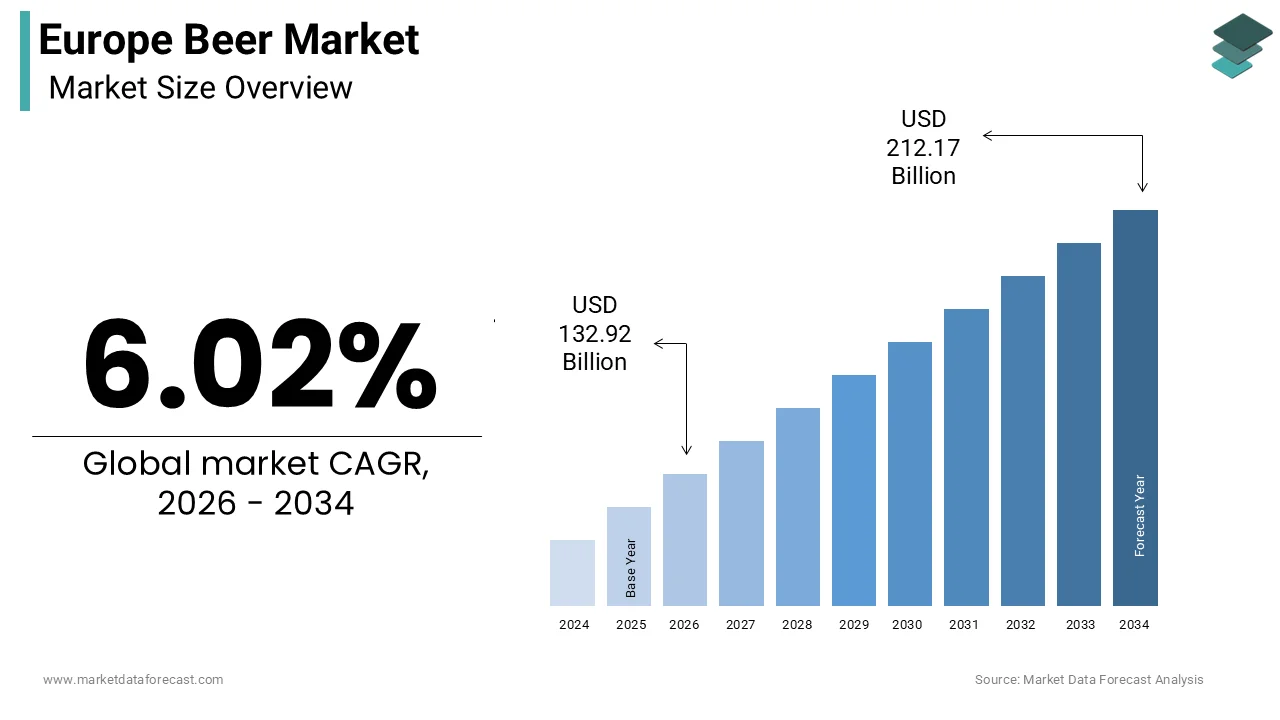
The Europe beer market size was calculated to be USD 125.37 billion in 2025, is estimated to be worth USD 132.92 billion in 2026, and is anticipated to reach USD 212.17 billion by 2034, registering a compound annual growth rate (CAGR) of 6.02% during the forecast period from 2026 to 2034. Driven by rising preferences for premium and craft experiences, alongside health-conscious expansions in low- and non-alcoholic segments, the European brewing landscape continues to undergo dynamic structural shifts.
Key Executive Metrics (At-a-Glance)
- 2025 Base Valuation: USD 125.37 Billion
- 2026 Current Valuation: USD 132.92 Billion
- 2034 Forecast Valuation: USD 212.17 Billion
- Compound Annual Growth Rate (CAGR): 6.02% (2026–2034)
- Dominant Product Type Segment: Lager (held the largest share in 2025 due to broad consumer appeal and entrenched cultural traditions)
- Fastest-Growing Product Segment: Non-Alcoholic Beer (growing at a CAGR of 6.2% fueled by wellness trends and advanced dealcoholization)
- Dominant Package Segment: Glass (captured the highest share in 2025 backed by premium perception and flavor preservation)
- Fastest-Growing Package Segment: Metal Cans (projected at a CAGR of 5.1% driven by portability and convenience)
- Dominant Production Segment: Large-Scale Production Facilities (occupied the largest share in 2025 with macro breweries controlling over 60.8% of output)
- Fastest-Growing Production Segment: Small-Scale & Craft Brewing Operations (expanding rapidly with the European craft market projected to reach USD 73.2 billion by 2034 at a 6.18% CAGR)
- Dominant Alcohol Content Segment: Traditional Full-Strength Beer (held the major share in 2025 at 79.32%)
- Fastest-Growing Alcohol Content Segment: Alcohol-Free Beer (projected at a CAGR of 8.15%)
- Dominant Distribution Channel Segment: Supermarkets & Hypermarkets (led with 36.3% of the market share in 2025)
- Fastest-Growing Distribution Channel Segment: Online Retail (projected at a CAGR of 8.14% driven by e-commerce convenience)
Core Market Drivers
- Rising Consumer Preference for Premium and Craft Beer Experiences: Growing demand for authenticity, flavor diversity, and local provenance over mass-produced offerings.
- Expansion of Low and No-Alcohol Beer Segments: Health-conscious lifestyle choices and improved dealcoholization technologies driving mainstream acceptance.
Primary Market Restraints & Challenges
- Regulatory Pressures and Excise Duty Burdens: Fragmented compliance mandates, labeling requirements, and varying excise taxes across European jurisdictions.
- Contraction of the On-Trade Hospitality Sector: Shift in consumption from hospitality venues toward home consumption, affecting premium visibility.
Europe Beer Market Segmentation Breakdown
| Segment Category | Largest Segment | Fastest-Growing Segment |
|---|---|---|
| By Product Type | Lager (Largest Share in 2025) | Non-Alcoholic Beer (6.2% CAGR) |
| By Package | Glass (Highest Share in 2025) | Metal Cans (5.1% CAGR) |
| By Production | Large-Scale Production Facilities (Largest Share) | Small-Scale & Craft Brewing Operations (Prominent CAGR) |
| By Alcohol Content | Traditional Full-Strength Beer (Major Share at 79.32%) | Alcohol-Free Beer (8.15% CAGR) |
| By Distribution Channel | Supermarkets & Hypermarkets (36.3% Share in 2025) | Online Retail (8.14% CAGR) |
Major Industry Players Profiled
Key global brewing corporations and regional market leaders shaping the European beer sector include Anheuser-Busch InBev, Heineken N.V., Carlsberg Group, Asahi Group Holdings Ltd., Bitburger Brewery, Molson Coors Beverage Company, Constellation Brands, The Boston Beer Company Inc., Kirin Holdings Co. Ltd., and Oettinger Brewery.
Europe Beer Market Size
The Europe beer market size was calculated to be USD 125.37 billion in 2025 and is anticipated to be worth USD 212.17 billion by 2034 from USD 132.92 billion in 2026, growing at a CAGR of 6.02% during the forecast period.
Europe is expected to witness dynamic adjustments in its brewing ecosystems over the next few years, transforming volume expectations through localized, premium options. According to The Brewers of Europe, beer remains deeply embedded in European social traditions, with per capita consumption reaching 126 litres annually in the Czech Republic. As per Eurostat, European Union countries produced 32.7 billion litres of beer in 2024, reflecting the sector's substantial economic footprint. According to the World Health Organization, adults in Europe consume an average of 9.2 litres of pure alcohol yearly, a figure that contextualizes beer within broader public health considerations. As per The Brewers of Europe, the on-trade hospitality channel, which historically accounted for approximately one third of beer consumption, now represents closer to one quarter across the European Union, signaling structural shifts in consumption venues. According to Euronews, Germany leads production with 7.2 billion litres, while non-alcoholic beer volumes grew by 11.1% to 2 billion litres in 2024. These dynamics illustrate a market navigating evolving consumer preferences, regulatory frameworks, and sustainability imperatives, while maintaining its cultural resonance across urban and rural communities throughout the continent.
MARKET DRIVERS
Rising consumer preference for premium and craft beer experiences
European consumers increasingly prioritize quality, authenticity, and flavor diversity over mass-produced options, which is one of the major factors driving the European beer market growth. As per The Brewers of Europe, the number of active breweries across Europe reached over 10000 in 2022, with microbreweries accounting for a significant portion of this expansion. According to The Brewers of Europe, Italy alone recorded 1018 active breweries in 2024, reflecting a 16% increase from 2018 levels. As per European Consumer Insights, consumer research indicates that over 60% of millennials express a preference for craft beer due to its unique taste profiles and local provenance. This demand shift encourages innovation in brewing techniques, ingredient sourcing, and limited-edition releases, which command premium pricing and foster brand loyalty. The craft segment also benefits from experiential consumption trends, including brewery tourism, taproom visits, and collaborative releases with local artisans. These factors collectively elevate average transaction values and stimulate regional economic activity. Furthermore, craft brewers often adopt agile production models, allowing rapid response to emerging flavor trends, such as hazy India pale ales, sour beers, and barrel-aged specialties. This responsiveness strengthens market relevance and attracts discerning consumers seeking differentiation from standardized offerings. The premiumization trajectory thus represents a structural demand driver, underpinned by demographic preferences, cultural appreciation for artisanal production, and a willingness to pay for distinctive sensory experiences.
Expansion of the low and no alcohol beer segments driven by health consciousness
Health-oriented lifestyle choices are accelerating the adoption of low and no-alcohol beer variants across European markets, which is further boosting the European beer market expansion. According to Euronews, production of non-alcoholic beer reached 2 billion litres in 2024, marking an 11.1% year-on-year increase across European markets. As per The Brewers of Europe, this category now constitutes 7.5% of total beer sales in the European Union, demonstrating meaningful, mainstream acceptance. The World Health Organization notes that no level of alcohol consumption is entirely risk-free, which reinforces consumer motivation to moderate intake without abandoning social rituals associated with beer. Advanced dealcoholization technologies now preserve flavor complexity and mouthfeel, enabling products that satisfy sensory expectations previously unmet by early-generation alternatives. Major brewers and craft producers alike are expanding portfolios in this segment, with offerings available on tap in hospitality venues and prominently displayed in retail environments. Demographic analysis shows particularly strong uptake among adults aged 25 to 45, who balance social engagement with wellness priorities. According to industry monitoring, retail data indicate that shelf space allocated to no and low-alcohol beer has expanded by over 30% in key markets, including Germany and the Netherlands. This growth trajectory is further supported by favorable regulatory treatment in several jurisdictions, where reduced alcohol content qualifies for lower excise duties. The segment thus represents a durable demand driver, aligned with public health objectives, evolving consumer values, and technological innovation in beverage formulation.
MARKET RESTRAINTS
Regulatory pressures and excise duty burdens across European jurisdictions
Fragmented and escalating regulatory requirements impose significant operational and financial constraints on beer producers throughout Europe, which is a key restraint to the regional market growth. According to The Brewers of Europe, excise duty revenues from beer exceeded 8.5 billion euros annually across the European Union, with substantial variation between member states creating competitive distortions. As per The Brewers of Europe, Poland collected 857 million euros in beer excise duties in 2024, while Belgium recorded 172 million euros despite comparable production volumes. These disparities complicate pricing strategies, distribution planning, and cross-border trade. Additionally, labeling and ingredient disclosure mandates are becoming more stringent, with the European Commission advancing proposals for comprehensive nutritional information on alcoholic beverages. Compliance with such regulations necessitates investment in reformulation, packaging redesign, and supply chain documentation, which disproportionately affects small and medium-sized brewers. Furthermore, divergent national approaches to alcohol marketing restrictions limit promotional activities and brand visibility, particularly in digital channels. The cumulative effect of these regulatory layers elevates cost structures and reduces flexibility to respond to market dynamics. According to The Brewers of Europe, the sector advocates for harmonized frameworks that balance public health objectives with economic viability. Without policy coherence, the beer market faces persistent headwinds that constrain innovation, limit consumer choice, and impede sectoral resilience amid broader economic uncertainty.
Declining in the trade hospitality sector is affecting traditional beer consumption channels.
The contraction of Europe's on-trade hospitality environment presents a persistent restraint on beer market dynamics. According to The Brewers of Europe, pre-pandemic, the on-trade channel represented approximately one-third of beer consumption across the European Union, whereas recent data indicates this share has diminished to around one-quarter. This structural shift reduces opportunities for premium product placement, experiential consumption, and impulse purchases that traditionally drive volume and value growth. As per The Brewers of Europe, Germany's on-trade share fell to 14% in 2024, while Ireland maintained a relatively higher 64%, reflecting divergent national recovery patterns. The hospitality sector faces compounded challenges, including elevated energy costs, labor shortages, and changing consumer habits favoring home consumption. These conditions limit venue capacity to stock diverse beer portfolios or invest in tap infrastructure for craft and specialty offerings. Consequently, brewers encounter reduced visibility for new products and diminished opportunities for brand storytelling that thrives in social settings. According to The Brewers of Europe, the on-trade channel generates disproportionate added value despite lower volume shares, underscoring the economic significance of its recovery. Without targeted support for hospitality businesses, including regulatory relief and investment incentives, the beer market risks prolonged suppression of consumption occasions that foster brand loyalty and category expansion.
MARKET OPPORTUNITIES
Sustainability innovation and circular economy adoption in brewing operations
European nations are expected to achieve notable breakthroughs in climate-adaptive brewing models over the next few years, which are setting a global benchmark for reduced ecological footprints and a promising opportunity for the European beer market. Environmental stewardship initiatives present substantial opportunities for differentiation and operational efficiency within the European beer market. According to Brewing 4 EU, breweries across the continent are implementing water conservation measures, with some facilities achieving water-to-beer ratios below 3 to 1. According to The Brewers of Europe, reports indicate that member breweries have collectively reduced specific energy consumption by over 20% since 2010, demonstrating tangible progress toward climate goals. Circular economy principles are gaining traction through spent grain repurposing for animal feed or bioenergy, and packaging innovations utilizing recycled materials. Consumer sentiment increasingly favors brands with credible sustainability commitments, creating marketing advantages and premium pricing potential. According to Tap Beer Miami, European breweries are pioneering eco-friendly packaging solutions, including lightweight bottles and reusable keg systems that minimize waste. These initiatives not only mitigate regulatory and reputational risks but also attract environmentally conscious investors and partners. Furthermore, sustainability leadership strengthens relationships with agricultural suppliers by promoting regenerative farming practices for barley and hops. As climate-related supply chain vulnerabilities intensify, proactive environmental management becomes a strategic asset that enhances resilience and secures a long-term license to operate.
Digital engagement and direct-to-consumer distribution models
Digital transformation enables beer producers to cultivate direct relationships with consumers, bypassing traditional intermediaries and capturing valuable first-party data, which is another notable opportunity for the regional market. E-commerce platforms and subscription services facilitate personalized product recommendations, limited-edition releases, and home delivery, expanding market reach beyond physical retail constraints. According to the London Beer Competition, the European craft beer market is projected to grow by 15.9 billion dollars by 2025, partly driven by digital channel expansion. Social media engagement and augmented reality experiences enhance brand storytelling and foster community among enthusiasts. Data analytics derived from digital interactions inform product development, inventory management, and targeted promotions, improving commercial agility. Direct-to-consumer models also support higher-margin sales by eliminating distributor mark-ups and enabling dynamic pricing strategies. As per Market Report Analytics, over 60% of European consumers express a willingness to purchase beer online when offered convenience and exclusivity. Furthermore, digital tools facilitate compliance with age verification requirements and responsible consumption messaging, strengthening regulatory alignment. The integration of digital and physical channels through click-and-collect services or virtual brewery tours creates omnichannel experiences that deepen consumer engagement. This opportunity is particularly relevant for small and independent brewers seeking scalable growth without substantial capital investment in traditional distribution infrastructure.
MARKET CHALLENGES
Climate volatility is impacting agricultural supply chains for brewing ingredients.
Climate instability poses escalating risks to the reliability and cost structure of essential brewing inputs, including barley, hops, and water, which is a major challenge to the beer market expansion in Europe. According to The Brewers of Europe, extreme weather events, such as droughts, floods, and unseasonal temperature fluctuations, have reduced barley yields in key European growing regions by up to 15% in recent harvests. Hop production in traditional areas like Germany and Czechia faces similar vulnerabilities, with pest pressures and water stress affecting both quantity and aromatic quality. Water scarcity presents a dual challenge, as breweries require substantial volumes for production while competing with agricultural and municipal needs. According to ScienceDirect, the brewing industry's environmental footprint is significantly influenced by raw material sourcing, which accounts for over 70% of total lifecycle emissions. Climate adaptation strategies, including drought-resistant crop varieties, diversified sourcing, and water recycling, entail considerable investment and long lead times. Smaller brewers with limited procurement leverage face heightened exposure to price volatility and supply disruptions. Furthermore, regulatory responses to climate change, such as carbon pricing or land-use restrictions, may further elevate input costs. According to The Brewers of Europe, collaborative research initiatives are underway to develop climate-resilient supply chains, yet the pace of environmental change may outstrip adaptive capacity. This challenge necessitates strategic foresight, cross-sector partnerships, and innovation in ingredient alternatives to ensure long-term market stability.
Shifting generational drinking patterns and moderation trends among younger consumers
Evolving attitudes toward alcohol consumption among younger demographics present a significant challenge to the beer market growth in Europe. According to European Consumer Insights, adults aged 18 to 34 in Europe are increasingly embracing moderation, with survey data indicating that nearly 40% report reducing alcohol intake compared to previous generations. This behavioral shift reflects heightened health awareness, changing social norms, and greater availability of appealing, non-alcoholic alternatives. The World Health Organization emphasizes that no level of alcohol consumption is entirely risk-free, a message resonating strongly with digitally connected younger consumers. Consequently, beer brands must navigate a delicate balance between maintaining heritage appeal and aligning with wellness-oriented values. According to The Brewers of Europe, per capita beer consumption in several European markets has declined for five consecutive years, with younger cohorts driving this trend. Traditional marketing approaches centered on conviviality and celebration may lack relevance for audiences prioritizing mindfulness and functional benefits. Furthermore, social media amplifies scrutiny of the alcohol industry practices, intensifying pressure for transparency and responsible messaging. Brands that fail to authentically engage with moderation narratives risk the erosion of future consumer bases. This challenge demands innovation in product formulation, communication strategies, and consumption occasions that respect evolving preferences while preserving the cultural role of beer in European society.
REPORT COVERAGE
| REPORT METRIC | DETAILS |
| Market Size Available | 2025 to 2034 |
| Base Year | 2025 |
| Forecast Period | 2026 to 2034 |
| CAGR | 6.02% |
| Segments Covered | By Product Type, Distribution Channel, And Region |
| Various Analyses Covered | Global, Regional & Country Level Analysis; Segment-Level Analysis; DROC, PESTLE Analysis; Porter’s Five Forces Analysis; Competitive Landscape; Analyst Overview of Investment Opportunities |
| Regions Covered | UK, France, Spain, Germany, Italy, Russia, Sweden, Denmark, Switzerland, Netherlands, Turkey, and the Czech Republic |
| Market Leaders Profiled | Anheuser-Busch InBev, Heineken N.V., Carlsberg Group, Asahi Group Holdings Ltd., Bitburger Brewery, Molson Coors Beverage Company, Constellation Brands, The Boston Beer Company Inc., Kirin Holdings Co. Ltd., Oettinger Brewery |
SEGMENTAL ANALYSIS
By Product Type Insights
The lager segment maintained its dominant status in the European beer market in 2025 by holding the largest share of the regional market due to its broad consumer appeal, consistent flavor profile, and extensive distribution infrastructure. For instance, Lager accounts for 45% of the global beer market, with similar patterns observed across Europe, where traditional brewing methods and cultural preferences sustain demand. The segment benefits from economies of scale that enable macro breweries to offer competitive pricing while maintaining quality standards. As per The Brewers of Europe, lager production volumes in Germany reached 7.2 billion litres in 2024, reflecting the style's entrenched position in continental consumption patterns. Consumer preference for crisp, refreshing beverages suitable for various social occasions reinforces Lager's market leadership. Additionally, lager's compatibility with diverse food pairings and its lower bitterness profile compared to ales make it accessible to wider demographic groups, including younger drinkers entering the category. The segment's resilience is further supported by continuous innovation in light lager variants, low-calorie formulations, and flavored extensions that attract health-conscious consumers without compromising taste expectations.
On the other hand, the non-alcoholic beer segment emerges as the fastest-growing segment and is estimated to expand at a CAGR of 6.2% during the forecast period. Spain and Germany are expected to lead the rollout of advanced dealcoholized lines over the next few years, capitalizing on highly responsive retail adoption curves. The non-alcoholic and low-alcohol beer category is expanding rapidly, driven by health-conscious consumer behavior and technological advancements in dealcoholization. According to Euronews, production of non-alcoholic beer reached 2 billion litres in 2024, marking an 11.1% year-on-year increase across European markets. This growth trajectory reflects shifting attitudes toward alcohol consumption, particularly among adults aged 25 to 45, who seek moderation without sacrificing social participation. As per The Brewers of Europe, non-alcoholic variants now constitute 7.5% of total beer sales in the European Union, demonstrating mainstream acceptance. Advanced brewing techniques, including vacuum distillation and membrane filtration, preserve flavor complexity and mouthfeel, enabling products that satisfy sensory expectations previously unmet by early-generation alternatives. Major brewers and craft producers alike are expanding portfolios in this segment, with offerings available on tap in hospitality venues and prominently displayed in retail environments. According to industry monitoring, retail data indicate that shelf space allocated to no and low-alcohol beer has expanded by over 30% in key markets, including Germany and the Netherlands. This growth trajectory is further supported by favorable regulatory treatment in several jurisdictions, where reduced alcohol content qualifies for lower excise duties.
By Package Insights
The glass segment led the market by capturing the highest share of the European beer market in 2025. The dominance of the glass segment in the European market can be credited to its premium perception, flavor preservation qualities, and alignment with traditional consumption occasions. For instance, glass bottles accounted for 55.26% of global beer packaging volume in 2025, with similar patterns observed across European on-trade channels. The material's inert nature prevents interaction with beer contents, ensuring taste integrity over an extended shelf life. As per The Brewers of Europe, returnable glass bottle systems in Germany and Belgium support circular economy objectives, while reinforcing brand heritage through distinctive bottle designs. Glass packaging also enhances visual appeal on retail shelves and in hospitality settings, where presentation influences purchase decisions. The format's compatibility with premium and craft beer positioning allows producers to command higher price points and differentiate through embossing, labeling, and color variations. Additionally, consumer perception of glass as environmentally preferable due to infinite recyclability supports continued adoption despite higher transportation costs. According to Brewing 4 EU, several European breweries have achieved water-to-beer ratios below 3 to 1 while maintaining glass packaging programs that prioritize reuse and recycling infrastructure. This combination of functional performance, brand elevation, and sustainability credentials sustains glass's leadership position in the European beer packaging landscape.
However, the metal cans segment is growing significantly and is estimated to showcase a CAGR of 5.1% during the forecast period. Aluminum cans are experiencing accelerated adoption across the European beer market, driven by convenience, sustainability, and functional performance advantages. For instance, the metal packaging segment is expected to grow at the fastest CAGR of 4.5% during the forecast period, reflecting shifting consumer preferences and retailer requirements. Cans offer superior protection against light and oxygen exposure, preserving hop aroma and flavor stability in craft and premium beer variants. As per Euronews, over 50% of beer sold in the United States is now packaged in cans, a trend increasingly mirrored in European markets where portability and outdoor consumption drive demand. The lightweight nature of aluminum reduces transportation emissions and logistics costs, supporting producer sustainability targets. According to The Brewers of Europe, aluminum recycling rates exceed 70% in several European countries, enabling closed-loop material flows that align with circular economy objectives. Furthermore, cans facilitate innovative branding through 360-degree printing and limited-edition designs that attract younger consumers. Retailers favor cans for their stackability, shelf efficiency, and reduced breakage risk, particularly in e-commerce fulfillment. According to European packaging regulations, aluminum qualifies for favorable treatment under extended producer responsibility schemes, reducing compliance costs for brewers. These combined advantages position metal cans as the growth engine in European beer packaging.
By Production Insights
The large-scale production facilities segment occupied the largest share of the European beer market in 2025. The growth of the large-scale production facilities segment in the European market is driven by their operational efficiency, extensive distribution networks, and brand portfolio diversification. Macro breweries account for approximately 60.8% of total European beer output, reflecting economies of scale that enable competitive pricing and consistent quality. These producers leverage advanced automation, quality control systems, and supply chain integration to optimize production costs and respond to demand fluctuations. As per The Brewers of Europe, the top five brewing groups in Europe control over 70% of market volume, underscoring the concentration of production capacity. Macro breweries benefit from established relationships with retail chains, hospitality groups, and export channels that ensure broad market access. According to Eurostat, production volumes from facilities exceeding 1 million hectolitres annually grew by 2.1% in 2024, demonstrating resilience amid category headwinds. Furthermore, large producers invest significantly in research and development, enabling innovation in low-alcohol variants, sustainable packaging, and digital engagement tools. As per The Brewers of Europe, macro breweries allocate over 3% of revenue to innovation initiatives compared to 1.2% for smaller producers. This investment capacity supports category expansion through new product development and marketing campaigns that maintain consumer relevance. The segment's leadership is further reinforced by acquisition strategies that integrate successful craft brands while retaining operational synergies.
However, the small-scale and craft brewing operations segment is expanding rapidly across Europe and is predicted to showcase a prominent CAGR in the European market during the forecast period due to the rising consumer demand for authenticity, flavor diversity, and local provenance. For instance, the Europe craft beer market is projected to reach USD 73.2 billion by 2034, exhibiting a CAGR of 6.18%, reflecting sustained growth momentum. As per The Brewers of Europe, the number of active breweries across Europe reached over 10000 in 2022, with microbreweries accounting for a significant portion of this expansion. According to The Brewers of Europe, Italy alone recorded 1018 active breweries in 2024, reflecting a 16% increase from 2018 levels. This proliferation reflects low barriers to entry for small-batch production and strong consumer interest in experiential consumption. As per European Consumer Insights, over 60% of millennials express a preference for craft beer due to its unique taste profiles and local provenance. Microbreweries benefit from agile production models that enable rapid response to emerging flavor trends, such as hazy India pale ales, sour beers, and barrel-aged specialties. According to the London Beer Competition, the European craft beer market is projected to grow by 15.9 billion dollars by 2025, partly driven by digital channel expansion. Furthermore, craft brewers often adopt direct-to-consumer sales models, including taproom visits, subscription services, and online ordering, that capture higher margins and foster brand loyalty. These dynamics position microbreweries as the growth engine in European beer production.
By Alcohol Content Insights
The traditional full-strength beer segment held the major share of the European beer market in 2025. The growth of this segment in the European market is attributed to the entrenched consumption patterns, cultural traditions, and broad demographic appeal. For instance, the standard beer segment held 79.32% of the beer market in 2025, reflecting the enduring preference for conventional alcohol content across social occasions. According to the World Health Organization, adults in Europe consume an average of 9.2 litres of pure alcohol yearly, a figure that contextualizes beer within broader public health considerations. High-alcohol variants benefit from established brand equity, extensive distribution, and compatibility with food pairing rituals that reinforce consumption frequency. As per Eurostat, per capita beer consumption in Germany reached 84.3 litres in 2023, demonstrating the category's cultural resonance. According to European Consumer Insights, over 55% of beer purchasers associate full-strength products with authenticity and quality, influencing purchase decisions. The segment also benefits from promotional strategies, including seasonal releases, limited editions, and brand collaborations that sustain consumer interest. As per The Brewers of Europe, macro breweries allocate significant marketing resources to core brands that generate stable revenue streams, supporting category investment. These combined factors ensure that high-alcohol beer remains the foundation of European beer consumption.
However, the alcohol free beer segment is expected to exhibit a CAGR of 8.15% during the forecast period. The Netherlands and Western Europe are positioned to realize record numbers of low ABV variant trials over the next few years, as younger consumer bases shift entirely away from standard labels. The non-alcoholic beer category is experiencing accelerated expansion, driven by health consciousness, technological innovation, and evolving social norms. According to Market Report Analytics, the Alcohol free Beer market is projected to reach 24 billion dollars in 2025 with a 7.8% CAGR, reflecting strong growth momentum. According to Euronews, production of non-alcoholic beer reached 2 billion litres in 2024, marking an 11.1% year-on-year increase across European markets. This growth trajectory reflects shifting attitudes toward alcohol consumption, particularly among adults aged 25 to 45, who seek moderation without sacrificing social participation. As per The Brewers of Europe, non-alcoholic variants now constitute 7.5% of total beer sales in the European Union, demonstrating mainstream acceptance. Advanced brewing techniques, including vacuum distillation and membrane filtration, preserve flavor complexity and mouthfeel, enabling products that satisfy sensory expectations previously unmet by early-generation alternatives. According to Nature Communications, novel yeast strains identified in 2025 enable the production of beers at 2 to 3% ABV, while maintaining a full-bodied mouthfeel. Furthermore, sustainability considerations align with this segment, as lower alcohol content reduces environmental impact across the production lifecycle. Retailers respond by dedicating prominent shelf space and promotional support to alcohol-free offerings, reinforcing visibility and trial. These factors collectively position alcohol-free beer as the growth engine in European beer markets.
By Distribution Channel Insights
The supermarkets and hypermarkets segment held the leading position with 36.3% of the regional market share in 2025. Large-format retail channels dominate beer distribution in Europe due to extensive reach, promotional capabilities, and consumer convenience. As per Eurostat, over 60% of European households conduct weekly grocery shopping at large-format retailers, which is creating consistent foot traffic and impulse purchase opportunities. These channels benefit from economies of scale that enable competitive pricing, promotional discounts, and multi-pack formats that encourage volume purchases. According to The Brewers of Europe, supermarket chains allocate significant shelf space to beer categories with dedicated sections for mainstream, premium, and craft variants. Furthermore, large retailers invest in cold-chain infrastructure and inventory management systems that ensure product freshness and availability. According to European Consumer Insights, over 70% of beer purchasers cite convenience and price as primary factors influencing channel selection, reinforcing supermarket dominance. The segment also benefits from integrated marketing campaigns, including in-store displays, digital coupons, and loyalty programs that drive trial and repeat purchases. According to industry monitoring, promotional activities in supermarkets account for over 40% of beer marketing expenditure in Europe. Additionally, large-format retailers facilitate cross-category merchandising with snacks, meats, and beverages that enhance basket size and consumption occasions. These combined advantages ensure supermarkets remain the cornerstone of European beer distribution.
On the other hand, the online retail segment represents the fastest-growing distribution segment with a projected 8.14% CAGR during the forecast period. Digital commerce channels are experiencing accelerated expansion driven by convenience, personalization, and evolving consumer behaviors. For instance, online retail in the beer category is projected to grow at a CAGR of 8.2% through 2031, reflecting strong momentum in digital adoption. As per European Consumer Insights, over 60% of millennials express a preference for online beer purchases due to home delivery, subscription options, and access to limited-edition releases. This growth trajectory reflects shifting shopping habits, particularly among urban consumers who prioritize time efficiency and product discovery. According to The Brewers of Europe, e-commerce platforms facilitate direct-to-consumer sales models that enable brewers to capture higher margins and gather valuable first-party data. Advanced logistics networks and temperature-controlled delivery solutions ensure product quality and freshness for online beer purchases. According to industry monitoring, online beer sales in Europe grew by over 35% year-on-year in 2024, demonstrating robust consumer adoption. Furthermore, digital channels support personalized recommendations, virtual tastings, and community engagement that enhance brand loyalty. According to the London Beer Competition, the European craft beer market is projected to grow by 15.9 billion dollars by 2025, partly driven by digital channel expansion. These dynamics position online retail as the growth engine in European beer distribution.
REGIONAL ANALYSIS
Germany was the largest contributor to the European beer market and accounted for 21.3% of the regional market share in 2024. Renowned for its centuries-old brewing traditions, Germany produces over 9 billion liters of beer annually, according to the German Brewers’ Association. Bavaria, home to Oktoberfest, is a cultural epicenter where beer is deeply ingrained in social life. Pilsners and wheat beers dominate consumption, with per capita intake reaching 99 liters in 2023. However, changing consumer preferences are reshaping the landscape; non-alcoholic beer sales have surged by 40% since 2020, driven by health-conscious millennials. Urban centers like Berlin and Munich are hubs for craft breweries, which now account for 15% of total production. Germany’s Reinheitsgebot (Beer Purity Law) ensures high-quality standards, fostering trust among domestic and international consumers. Economic stability and a robust retail infrastructure further bolster the market, with supermarkets and specialty stores catering to diverse tastes. By blending tradition with innovation, Germany continues to lead Europe’s beer industry while adapting to modern trends.
The UK is predicted to account for a promising share of the European beer market over the forecast period. With over 2,000 breweries, the country has embraced craft beer as a cultural phenomenon, particularly in cities like London, Manchester, and Edinburgh. According to Statista, craft beer sales grew by 25% annually between 2020 and 2023, reflecting a shift toward premiumization. British consumers, especially younger demographics, prioritize unique flavors and locally sourced ingredients, driving demand for artisanal brews. Despite this trend, overall beer consumption has declined by 10% over the past decade due to health concerns and rising alcohol taxes. Non-alcoholic beer has emerged as a solution, with brands like Heineken 0.0 gaining traction among health-conscious drinkers. The rise of e-commerce platforms like Beer Hawk has also transformed distribution, capturing 12% of total sales. Additionally, pub culture remains integral, with over 47,000 establishments serving as social hubs. By balancing tradition with innovation, the UK maintains its influence in Europe’s beer market.
France is another notable market for beer in the European region. Historically dominated by wine, France’s beer consumption has grown steadily, reaching 2.5 billion liters annually, as reported by NielsenIQ. Paris, Lyon, and Bordeaux are key markets, where urbanization and globalization have fueled interest in imported and craft beers. Belgian and German brews are particularly popular, accounting for 30% of total imports. Domestic craft breweries have also gained momentum, with over 2,500 microbreweries operating nationwide. Health-conscious trends have spurred demand for organic and low-alcohol options, which now represent 8% of total sales. Government initiatives promoting local agriculture have encouraged partnerships between brewers and farmers, fostering a terroir-driven approach. Moreover, the rise of beer festivals, such as the Paris Beer Week, highlights growing consumer engagement. By embracing global influences while supporting local producers, France continues to carve out a dynamic niche in Europe’s beer landscape.
Italy is predicted to witness a prominent CAGR in the European beer market over the forecast period. Known for its wine culture, Italy has seen a surprising surge in beer consumption, driven by urbanization and changing lifestyles. According to Coldiretti, beer now outsells wine in major cities like Milan and Rome, with annual sales exceeding €4 billion. Italian consumers increasingly favor premium and imported beers, particularly from Belgium and Germany, which account for 40% of total imports. Craft breweries have capitalized on this trend, with over 1,000 microbreweries producing innovative styles like fruit-infused ales and barrel-aged stouts. Non-alcoholic beer has also gained popularity, with sales growing by 18% annually since 2020. The rise of gastropubs and beer gardens reflects the integration of beer into Italian dining culture. Furthermore, sustainability initiatives, such as eco-friendly packaging and water-efficient brewing, align with broader EU goals. By harmonizing tradition with modernity, Italy continues to grow its presence in Europe’s beer market.
Spain is anticipated to grow at a healthy CAGR in the European beer market over the forecast period. With over 500 breweries and a vibrant nightlife scene, Spain’s beer consumption reached 4 billion liters in 2023, as per the Spanish Brewers’ Association. Barcelona, Madrid, and Valencia are pivotal markets, where tourism plays a crucial role; visitors contribute to nearly 30% of total beer sales. Spanish consumers increasingly prefer craft and imported beers, with premium products accounting for 20% of the market. Health-conscious trends have also driven demand for low-alcohol and organic options, which now represent 10% of sales. Brands like Estrella Damm and Mahou have innovated by launching eco-friendly packaging and sustainable brewing practices. The rise of beer festivals, such as the Barcelona Beer Festival, has further amplified consumer engagement. Additionally, government incentives promoting local entrepreneurship have encouraged small-scale brewers to experiment with unique flavors. By leveraging tourism and embracing innovation, Spain continues to emerge as a dynamic player in Europe’s beer market.
COMPETITION OVERVIEW
The beer market exhibits a highly concentrated competitive structure, with established multinational brewers exercising significant influence through expansive distribution networks, multi-tiered brand portfolios, and integrated digital ecosystems. These structural advantages allow leading players to manage pricing, optimize assortment mix, and defend market share amid slowing volume growth. Despite their scale, market leaders face competitive pressures from craft brewers and private label offerings that challenge traditional dominance through authenticity and innovation.
Mid-tier and regional brewers respond through geographic concentration, collaborations, and operational flexibility that enable targeted growth. Environmental, social, and governance (ESG) performance increasingly shapes investor capital allocation, favoring brewers with science-based emissions targets and renewable energy investments. This trend reinforces structural advantages for large-capitalization players capable of financing sustainability transitions, further consolidating competitive leadership. Simultaneously, digital enablement and direct-to-consumer models create opportunities for smaller producers to reach national audiences without substantial infrastructure investment. The resulting competitive landscape balances scale efficiency with artisanal authenticity, requiring continuous adaptation to evolving consumer preferences, regulatory expectations, and technological capabilities across diverse geographic markets.
KEY MARKET PLAYERS
Major players of the Europe beer market include
- Anheuser-Busch InBev
- Heineken N.V.
- Carlsberg Group
- Asahi Group Holdings Ltd
- Bitburger Brewery
- Molson Coors Beverage Company
- Constellation Brands
- The Boston Beer Company Inc
- Kirin Holdings Co. Ltd
- Oettinger Brewery
Top Strategies Used by Key Market Participants
Key players in the beer market employ portfolio diversification to balance mainstream and premium offerings, while expanding into alcohol-free variants that address health-conscious consumer trends. Strategic acquisitions enable companies to integrate successful craft brands and regional specialists that enhance local relevance and innovation capacity. Sustainability initiatives, including renewable energy adoption, water conservation, and circular packaging, strengthen brand equity and regulatory compliance. Digital transformation through e-commerce platforms, data analytics, and personalized marketing improves consumer engagement and operational efficiency. Geographic expansion into emerging markets with rising disposable incomes supports long-term growth, while mitigating volume declines in mature regions. These strategies collectively enable market participants to navigate evolving consumer preferences, regulatory frameworks, and competitive dynamics while sustaining category leadership.
Leading Players in the Market
- Anheuser-Busch InBev maintains a prominent position in the global beer market through strategic acquisitions, brand innovation, and sustainability initiatives. The company leverages its extensive distribution network to deliver diverse offerings ranging from mainstream lagers to premium craft variants across over fifty countries. Recent actions include investments in alcohol-free beer production, digital commerce platforms, and regenerative agriculture programs that enhance supply chain resilience. According to industry reports, the company continues to expand its no- and low-alcohol portfolio, responding to health-conscious consumer trends. Furthermore, Anheuser-Busch InBev prioritizes circular economy principles through packaging lightweighting, water conservation, and renewable energy adoption. These efforts align with evolving regulatory expectations and consumer preferences for environmental responsibility. The company also engages in strategic partnerships with technology firms to enhance data analytics and personalized marketing capabilities. Through continuous innovation and operational discipline, Anheuser-Busch InBev strengthens its market position while supporting category growth across diverse regions.
- Heineken N.V. sustains its global influence through brand elevation, technological innovation, and sustainability leadership. The company focuses on premium and super-premium segments that command higher margins and foster consumer loyalty across European and emerging markets. Recent initiatives include the expansion of alcohol-free offerings, digital direct-to-consumer channels, and smart packaging solutions that enhance product freshness. According to industry reports, Heineken invests significantly in renewable energy and water stewardship programs that reduce environmental impact. The company also leverages data analytics and artificial intelligence to optimize demand forecasting, inventory management, and personalized marketing. Furthermore, Heineken strengthens its craft beer presence through strategic acquisitions and incubation programs that support emerging brewers. These actions enable the company to balance scale advantages with local authenticity and innovation. Through continuous brand building and operational excellence, Heineken maintains its position as a leading global beer producer while adapting to evolving consumer preferences and regulatory landscapes.
- Carlsberg Group enhances its global footprint through targeted geographic expansion, product innovation, and environmental stewardship. The company prioritizes Western Europe and Asia-Pacific markets where premiumization and alcohol-free trends drive growth opportunities. Recent actions include the launch of new no- and low-alcohol variants, investment in circular packaging solutions, and digital engagement platforms that connect with younger consumers. According to industry reports, Carlsberg advances its Together Towards ZERO sustainability strategy, focusing on zero carbon footprint, zero water waste, and responsible drinking. The company also leverages brewing expertise and quality standards to differentiate its portfolio across mainstream and craft segments. Furthermore, Carlsberg strengthens distribution partnerships and e-commerce capabilities to enhance market access and consumer convenience. Through disciplined execution of its Accelerate SAIL strategy, the company balances operational efficiency with brand authenticity and innovation. These efforts enable Carlsberg to maintain competitive relevance while contributing to category evolution across diverse markets. A A
DETAILED SEGMENTATION OF EUROPE BEER MARKET IS INCLUDED IN THIS REPORT
This research report on the europe beer market has been segmented and sub-segmented based on product type, distribution channel & region.
By Product Type
- Lager
- Ale
- Stout & Porter
- Malt
- Others
By Distribution Channel
- On-Trade
- Off-Trade
By Region
- UK
- France
- Spain
- Germany
- Italy
- Russia
- Sweden
- Denmark
- Switzerland
- Netherlands
- Turkey
- Czech Republic
- Rest of Europe