- Product Description Description
- Table of Contents TOC
- List of Table & Figure LOT
- Get Free Sample PDF Sample PDF
Market Size, 2025
$4.29 BnMarket Estimate, 2026
$4.66 BnMarket Forecast, 2034
$8.97 BnCAGR, 2026–2034
8.53%Europe Bicycle Accessories Market Size, Growth, Trends & Forecast (2026–2034)
The Europe bicycle accessories market size was valued at USD 4.29 billion in 2025, is anticipated to reach USD 4.66 billion in 2026, and is projected to scale up to USD 8.97 billion by 2034, registering a compound annual growth rate (CAGR) of 8.53% during the forecast period from 2026 to 2034. Driven by the expansion of protected cycling infrastructure, urban mobility policies, the rapid adoption of e-bikes, and rising integration of smart connectivity features, the European bicycle accessories sector continues to experience dynamic growth.
Key Executive Metrics (At-a-Glance)
- 2025 Base Valuation: USD 4.29 Billion
- 2026 Current Valuation: USD 4.66 Billion
- 2034 Forecast Valuation: USD 8.97 Billion
- Compound Annual Growth Rate (CAGR): 8.53% (2026–2034)
- Dominant Product Segment: Components (led in 2025, anchored in functional necessity, high replacement frequency, and safety mandates)
- Fastest-Growing Product Segment: Apparel (expected to exhibit a noteworthy CAGR of 9.6% driven by professionalization and sustainability trends)
- Dominant Bicycle Type Segment: E-Bicycles (led in 2025 due to rapid adoption among commuters and cargo users requiring advanced safety and range accessories)
- Fastest-Growing Bicycle Type Segment: Hybrid Bicycles (predicted to witness the highest CAGR of 11.2% as versatile commuter and leisure bikes)
- Dominant Sales Platform Segment: Offline Sales (remained the largest channel in 2025 due to expert advice, fitting services, and immediate product availability)
- Fastest-Growing Sales Platform Segment: Online Sales (estimated to register the fastest CAGR of 13.4% propelled by direct-to-consumer brands and logistics)
- Dominant Region / Country: Germany (accounted for a 22.6% share in 2025, supported by extensive infrastructure, strict safety laws, and domestic manufacturing hubs)
Core Market Drivers
- Expansion of Cycling Infrastructure: Systematic development of protected bike lanes, bike-sharing systems, and low-emission zones boosting daily cycling rates and accessory needs.
- Rise of E-Bikes & Smart Connectivity: Higher speeds and longer distances traveled on electric bicycles fueling demand for high-lumen lighting, GPS computers, and theft prevention tools.
- Mandatory Safety Regulations: Enacted or strengthened local laws enforcing lighting systems, reflectors, and helmet use, transforming accessories into legal necessities.
Primary Market Restraints & Challenges
- Price Sensitivity & Fragmentation: Disposable income constraints in Southern and Eastern Europe, combined with divergent national regulations and riding styles, complicate unified marketing.
- Lack of Smart Standardisation: Proliferation of proprietary communication protocols and mounting systems creating interoperability hurdles among smart accessories.
- Counterfeits & Seasonality: Surging e-commerce floods of uncertified safety gear and sharp seasonal demand fluctuations in northern climates constrain consistent market growth.
Europe Bicycle Accessories Market Segmentation Breakdown
| Segment Category | Leading Sub-Segment (2025 Base) | Fastest-Growing Sub-Segment |
|---|---|---|
| By Product Type | Components (lighting, locks, racks, helmets dominating market backbone) | Apparel (9.6% CAGR driven by technical wear, sportives, and sustainability) |
| By Bicycle Type | E-Bicycles (leading share due to heavy accessory dependence for safety and range) | Hybrid Bicycles (11.2% CAGR as versatile gateway commuter and leisure bikes) |
| By Sales Platform | Offline Sales (largest share anchored in trusted local bike shop advisory and fittings) | Online Sales (13.4% CAGR propelled by direct-to-consumer logistics and variety) |
| By Sales Channel | Aftermarket (leading share driven by post-purchase upgrades and customizations) | OEM (10.8% CAGR fueled by factory-fitted smart and safety integration on new bikes) |
| By Region / Country | Germany (22.6% share supported by infrastructure, strict safety laws, and manufacturing) | Netherlands & Sweden (expanding via e-cargo infrastructure and year-round safety norms) |
Major Industry Players Profiled
Key enterprises shaping the competitive European bicycle accessories market include Avon, Garmin Ltd., Trek Bicycle, Lezyne, Campagnolo, Endura, Giant Manufacturing Co. Ltd., Specialised Bicycle Components, Accell, Eastman Chemical Co., alongside prominent regional specialists like ABUS, Busch & Müller, and Decathlon.
Europe Bicycle Accessories Market Size
The Europe bicycle accessories market size was valued at USD 4.29 billion in 2025 and is projected to reach USD 8.97 billion by 2034 from USD 4.66 billion in 2026, growing at a CAGR of 8.53%.
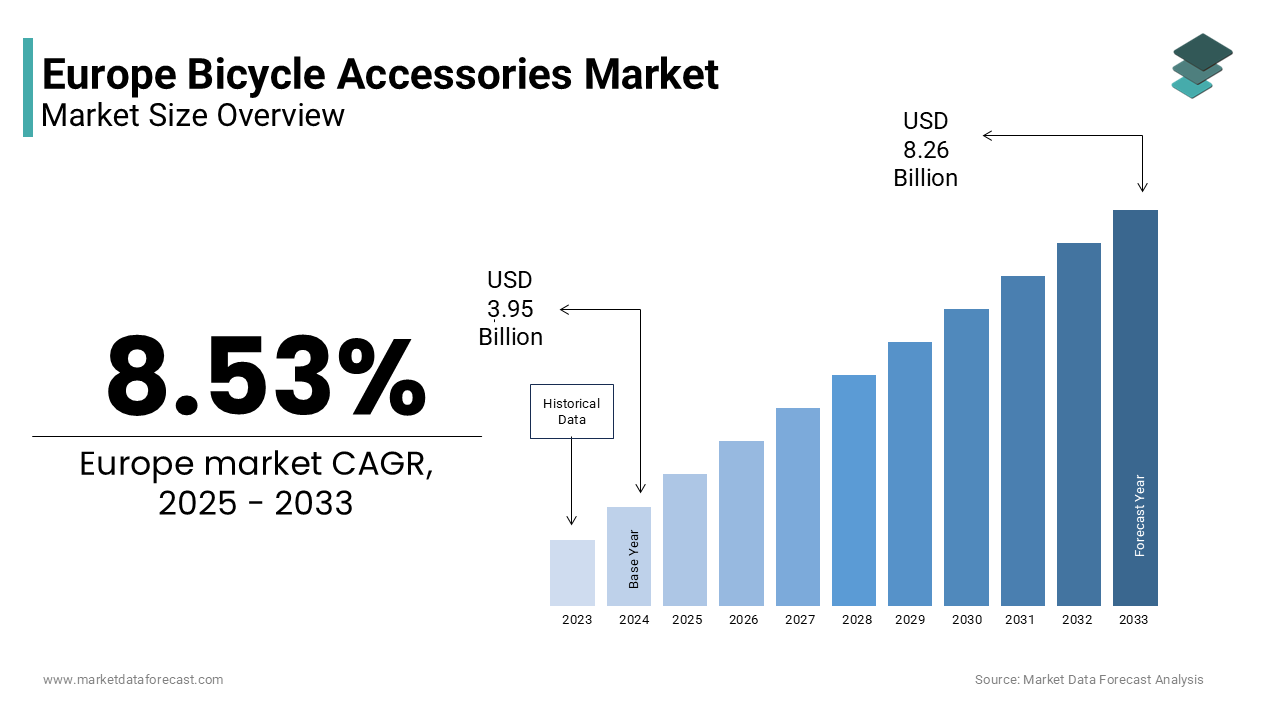
Bicycle accessories are products designed to enhance safety, comfort, performance, and utility for cyclists, including lighting systems, helmets,, locks, carrierss, navigation devices and smart connectivity gear. In a region where cycling is deeply embedded in urban mobility culture, health policy, and environmental strategy accessories have evolved from optional add-ons to essential components of daily commuting and recreational riding. Urban travel patterns in many European cities show a notable inclination toward bicycle use, according to research. A considerable segment of the population across Europe has adopted regular cycling habits, which fosters consistent market demand for both dependable and novel cycling accessories, as per sources. Furthermore, the European Commission’s Urban Mobility Framework encourages member states to invest in cycling infrastructure and safety equipment as part of its zero-pollution ambition. Observations within specific regions suggest that targeted safety initiatives, such as those promoting helmet use and reflective equipment, are associated with a decrease in the incidence of cycling-related head injuries. These converging social, regulatory, and infrastructural dynamics position bicycle accessories as critical enablers of safe, sustainable and smart urban mobility across Europe.
MARKET DRIVERS
Expansion of Cycling Infrastructure and Urban Mobility Policies
The systematic development of protected bike lanes, bike sharing systems and low-emission zones across European cities has amplified demand for functional and safety-oriented bicycle accessories, which in turn boosts the growth of the European bicycle accessories market. According to sources, numerous cities have implemented urban mobility strategies that prioritise dedicated financial support for the development of cycling networks. This infrastructure growth has increased daily cycling rates and consequently the need for reliable lighting, locks, and puncture protection systems. Urban areas featuring extensive networks of bicycle lanes tend to observe higher levels of cyclist participation compared to regions with less developed infrastructure. The integration of safety and tracking technologies, such as lighting systems and location hardware, has become standardised feature in large-scale bicycle-sharing programs. The enforcement of nighttime visibility requirements by municipalities is shifting accessories from discretionary items to compulsory necessities, which is fueling steady retail and replacement demand throughout the region.
Rise of E-Bikes and Integration of Smart Connectivity Features
The rapid adoption of electric bicycles across the region has caused demand for advanced accessories that support extended range navigation, theft prevention and data tracking, and thereby fuel the expansion of the European bicycle accessories market. E-bike riders travel longer distances at higher speeds, necessitating enhanced safety gear such as high-lumen lighting, reflective wear and robust locks. Simultaneously, the integration of Bluetooth-enabled accessories, such as smart helmets with turn signal indicators, GPS bike computers and tire pressure monitoring systems, has created a new premium segment. Companies have tailored their cycling computers to display battery range and motor assist levels, further embedding electronics into the riding experience. This convergence of electrification and digitalisation transforms accessories from passive tools into active components of a connected mobility ecosystem.
MARKET RESTRAINTS
Price Sensitivity and Fragmented Consumer Preferences
Many European consumers remain highly price-conscious, particularly in Southern and Eastern Europe, where disposable income constraints limit discretionary spending on premium accessories. This limits the growth of the European bicycle accessories market. According to sources, Household spending on sports and recreational gear in certain Eastern European countries is comparatively low when measured against the general European average, which may influence consumer willingness to purchase premium home improvement items like advanced lighting or smart lock systems. Besides, the market is fragmented by divergent national regulations and riding styles. Dutch city cyclists prioritise panniers and chain guards, while Alpine riders demand mudguards and high visibility gear, making standardised product development challenging. As per sources, a significant percentage of individuals who cycle indicate that cost is the main challenge they face when considering the purchase of certified safety accessories, such as helmets that meet recognised safety standards. This price-performance trade-off leads many consumers to opt for uncertified or counterfeit products sold online, which may lack essential safety features. The resulting market segmentation suppresses volume for quality brands and complicates European marketing strategies.
Lack of Standardisation in Smart Accessory Compatibility
The proliferation of proprietary communication protocols and mounting systems among smart bicycle accessories creates interoperability challenges that deter adoption and frustrate users, thereby inhibiting the expansion of the European bicycle accessories market. A cyclist using a Garmin GPS computer may find it incompatible with a Shimano Di2 lighting system or unable to sync with third-party smart lock due to differing Bluetooth profiles or app ecosystems. There is currently no universal technical standard for data exchange between electric bike motors, components, and mobile software. This lack of uniformity results in varying methods for communication between hardware and digital interfaces. The fragmentation forces consumers to remain within single-brand ecosystems, limiting choice and inflating costs. As per research, a portion of e-bike owners abandoned plans to purchase additional smart accessories due to compatibility concerns. Moreover, small accessory innovators struggle to gain market access without costly certification for each major bike or motor platform. The smart accessory segment's growth in Europe will be hindered by technical silos and consumer hesitation until the region adopts open standard frameworks, much like the automotive industry's OBD-II system.
MARKET OPPORTUNITIES
Mandatory Safety Legislation and Helmet Lighting Requirements
Several European countries are enacting or strengthening legislation that mandates specific accessories, thereby creating predictable and scalable demand. This creates fresh prospects for the European bicycle accessories market growth. A review of transport guidelines in one nation indicates that the operation of bicycles after sunset necessitates specific safety equipment, including both forward and rearward-facing lights that comply with established local standards. Compliance with this regulation is monitored through routine roadside inspections. In a separate region, recent regulatory changes have been enacted that mandate integrated lighting systems and reflective pedal surfaces for all electric bicycles used within urban environments. Furthermore, an analysis of potential policy shifts at a multinational level suggests a future consideration of unified safety practices for younger cyclists across various member states. This proposed initiative, if implemented, could influence the market dynamics for youth-oriented safety gear. These regulatory shifts transform accessories from optional purchases into legal necessities. Manufacturers are responding with modular systems that meet multiple national standards in a single unit reducing compliance complexity for retailers. This policy-driven certainty offers vendors stable volume forecasts and justifies investment in certified safety innovation.
Growth of Bike Tourism and Long Distance Cycling Routes
The formalisation of transnational cycling tourism corridors is driving demand for high durability utility and comfort accessories tailored to multi-day travel, which offers new opportunities for the European bicycle accessories market. Cyclists on these routes require pannier rackss, pumps, multitools weather-resistanttant gear that can withstand varied terrain and climate. Companies have expanded their European distribution to supply waterproof panniers and steel racks designed for loaded touring. Besides, regional tourism boards include accessory rental packages with bike hire services. This institutional support transforms recreational cycling into an organised travel segment with consistent accessory needs across seasons and geographies.
MARKET CHALLENGES
Counterfeit and Non-Compliant Products in Online Marketplaces
The surge in e-commerce has enabled a flood of uncertified, low-quality bicycle accessories, particularly helmets, locks, and lights, which continues to be a major barrier to the European bicycle accessories market. These products fail to meet European safety standards, yet they are marketed as compliant. According to research, Reports indicate a significant number of cycling products have been identified as failing to meet established safety requirements. A substantial portion of these safety-deficient items is attributed to distribution through major international e-commerce marketplaces. Many counterfeit helmets lack proper impact absorption shells, while non-compliant lights emit insufficient lumens or lack steady mode as required under national traffic laws. Independent testing suggests that a majority of budget-friendly helmets may fail to provide the impact protection claimed by the labelling. Observations show a pattern of products displaying fraudulent certification marks despite failing to satisfy the corresponding safety standards. Enforcement remains fragmented as national market surveillance authorities lack resources to monitor digital sellers effectively. This affects consumer trust and puts pressure on legitimate brands to justify higher prices for certified safety, which ultimately compromises public health and market integrity.
Seasonality and Weather-Dependent Demand Fluctuations
Bicycle accessory sales in much of the region remain highly seasonal, with peak demand in spring and summer months and sharp declines during autumn and winter, particularly in Northern and Central regions, which further constrains the expansion of the European bicycle accessories market. Retail sales for safety equipment and lighting decrease significantly during the winter months in certain European regions as cycling activity declines. The frequency of urban cycling in northern climates experiences a sharp reduction during the colder seasons compared to the summer months. This seasonality strains inventory management for retailers and discourages investment in year-round marketing. Specialised items such as thermal gloves and studded tyres remain niche products rather than mainstream essentials. Colder weather and reduced daylight hours correlate with a downward shift in the purchase of cycling-related visibility gear. Seasonal patterns indicate that a majority of regular cyclists in specific northern territories limit their riding habits to the warmer times of the year. The absence of public investment in winter cycling infrastructure creates unpredictable revenue for accessory vendors, which stifles innovation and stability. This climatic dependency remains a structural barrier to consistent market growth across the continent.
REPORT COVERAGE
| REPORT METRIC | DETAILS |
| Market Size Available | 2025 to 2034 |
| Base Year | 2025 |
| Forecast Period | 2026 to 2034 |
| CAGR | 8.53% |
| Segments Covered | By Product Type, Bicycle Type, Sales Platform, and Region |
| Various Analyses Covered | Global, Regional, & Country Level Analysis; Segment-Level Analysis; DROC, PESTLE Analysis; Porter’s Five Forces Analysis; Competitive Landscape; Analyst Overview of Investment Opportunities |
| Regions Covered | UK, France, Spain, Germany, Italy, Russia, Sweden, Denmark, Switzerland, Netherlands, Turkey, and the Czech Republic |
| Market Leaders Profiled | Avon, Garmin Ltd., Trek Bicycle, Lezyne, Campagnolo, Endura, Giant Manufacturing Co. Ltd., Specialised Bicycle Components, Accell, and Eastman Chemical Co. |
SEGMENTAL ANALYSIS
By Product Type Insights
The components segment dominated the European bicycle accessories market in 2025. The dominance of the components segment is driven by its functional necessity across all cycling disciplines and regulatory mandates for safety and utility. This category includes lighting systems, lockss, racks, helmets, pumps and smart devices that are required for daily commuting, recreational riding and long-distance touring. Urban cyclists within the European Union often possess multiple essential components for their bicycles, such as lights, helmets, and locks, and these items are typically replaced every one and a half to two years. The European Commission’s Urban Mobility Framework has further institutionalised component use by funding city-level programs that distribute certified lights and reflective gear to low-income riders. Specific traffic rules in certain regions mandate that bicycles be equipped with functional front white and rear red lights that can be powered either through a dynamo or batteries, which helps create a consistent requirement for these items. Furthermore, the growing popularity of electric bicycles, which make up a significant portion of all bicycle sales, has led to a greater need for more sophisticated integrated accessories and tracking features. This combination of legal obligation, technological integration, and high replacement frequency ensures components remain the market’s backbone.
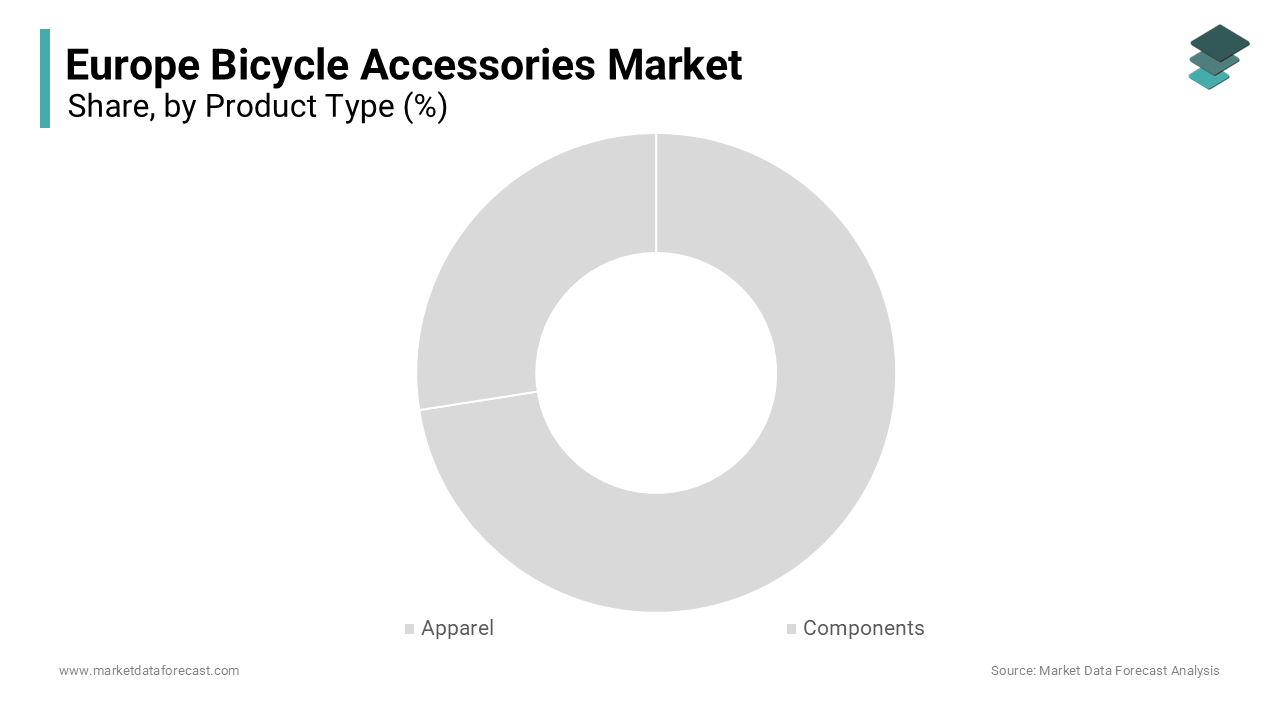
The apparel segment is expected to exhibit a noteworthy CAGR of 9.6% from 2026 to 2034 due to professionalisation of recreational cycling, rising health consciousness, and the influence of professional racing on consumer behaviour. Technical apparel, including moisture-wicking jerseys, padded shorts and aerodynamic jackets, is increasingly adopted by amateur riders participating in gran fondos and sportives. As per sources, a notable increase has been observed in the number of individuals participating organised cycling events across Europe. The total figure for participation has risen, indicating a growing interest in this activity. Besides, urban commuters are shifting toward performance-inspired casual wear with integrated reflectivity and ventilation. Brands have expanded their European retail footprint with city centre stores blending fashion and function. In the apparel industry, a significant majority of new product lines are now incorporating sustainable materials and dyes. This development reflects an alignment with principles that support a circular economy. This convergence of sport lifestyle and sustainability transforms apparel from seasonal gear into a year-round fashion and performance category.
By Bicycle Type Insights
The E-bicycles segment led the European bicycle accessories market in 2025. The supremacy of the E-bicycles segment is credited to its rapid adoption across urban commuters, older riderss, and cargo users who rely heavily on accessories for safe, ty ra, range and utility. According to research, E-bikes constitute a notable portion of all bicycle sales in the European UniE-bikebike riders travel longer distances at higher average speeds, necessitating enhanced lightingg, high-capacity locks, and integrated navigation systems. E-bike owners tend to acquire more accessories shortly after purchase compared to individuals who own conventional bikes. Municipal policies further drive demand. Specific safety features, such as rear-view mirrors, white front lights, and reflective side strips, are required for e-cargo bikes utilised for last-mile delivery in the Netherlands. Additionally, e-bikes require specialised components like torque sensors, battery covers and motor protection kits that are not needed on traditional bicycles. This structural dependency on accessories for performance and compliance cement bikes as the dominant platform in the market.
The hybrid bicycles segment is predicted to witness the highest CAGR of 11.2% during the forecast period, owing to its versatility as commuter and leisure bikes in mid-sized cities and suburban areas, where infrastructure supports mixed terrain riding. Hybrids bridge the gap between road and mountain bikes, offering upright geometry,comfort, rt and rack compatibility, making them ideal for daily errands, school runs and weekend trails. A notable trend in recent purchasing habits is the increased preference for hybrid bicycles among consumers in specific regions of Europe. Buyers are often prioritising comfort and practicality in their choice of new bikes, rather than solely focusing on speed or off-road capability. This user profile drives demand for utility accessories such as panniers,, racks, rs child seats, and kickstands. Companies have launched modular rack systems specifically for hybrid frames with integrated lighting mounts. Furthermore, urban development strategies appear to be encouraging this form of cycling. Certain governmental programs in some countries are providing financial incentives for individuals who purchase hybrid or electric bikes. This policy and lifestyle align positions hybrids as the gateway segment for mainstream accessory adoption.
By Sales Platform Insights
The offline sales segment remained the largest segment in the European bicycle accessories market in 2025. The prominence of the offline sales segment is because of the importance of expert advice, product testing,and immediate availability, especially safety-critical items like helmets and locks. Physical speciality stores are a primary channel for accessory purchases, a trend that is particularly notable within the independent bike shop segment. These establishments commonly offer various fitting services for items like helmets, apparel, and lighting systems, which helps ensure compliance with common safety standards. The role of local bike shops is further supported by the legal authorisation they hold in some regions to certify lighting system compliance during routine safety examinations, which emphasises a significant aspect of in-person retail experiences. In addition, consumers often buy accessories at the point of bicycle purchase, where staff bundle compatible components. This trust-based advisory model sustains offline dominance despite the convenience of e-commerce.
The online sales segment is estimated to register the fastest CAGR of 13.4% over the forecast period. The rapid expansion of the online sales segment is propelled by the rise of direct-to-consumer brands,, e-commerce logistics, and the demand for niche and premium accessories not available in local stores. Online platforms store offers extensive catalogues with detailed technical specifications, user reviews, and video tutorials that empower informed purchasing. Younger adult cyclists demonstrate a preference for online platforms when selecting smart accessoriesfavouringng the transparency and variety found there. Besides same-day delivery in major cities such as Berlin, Paris, and Amsterdam has reduced the immediacy advantage of physical stores. A clear pattern emerges wherein sales of indoor training equipment increase significantly during the winter period. The full statements are available from the source organisations. This blend of convenience selection and seasonal flexibility positions online as the high-velocity growth channel for the future.
By Sales Channel Insights
The aftermarket segment held the leading share of the European bicycle accessories market in 2025,as most cyclists upgrade customise, or replace components after purchase based on evolving needs and performance feedback. Observations regarding the purchasing habits of European cyclists indicate that a majority of certain safety and security items are acquired separately from the initial bicycle purchase. This suggests a tendency for individuals to personalise their bicycles with accessories such as lighting systems, helmets, and locks after the initial point of sale. This behaviour stems from personal preference, brand loyalty, ty and the desire for higher quality than OEM specifications. Urban commuters often replace basic reflectors with high-lumen LED systems while mountain bikers upgrade stock grips and pedals for better control. The data further implies a notable expenditure by the typical European cyclist on items obtained following the original sale. This level of spending on aftermarket accessories appears to be considerably higher in Europe compared to the general international trend. Independent bike shops thrive on this dynamic, offering installation services personalised recommendations that build long-term customer relationships. Additionally, safety regulations frequently change faster than OEM production cycles, which requires riders to retrofit compliant lights or mirrors post-purchase. This user-driven customisation culture ensures the aftermarket remains the primary engine of volume and innovation.
The OEM segment is likely to experience the fastest CAGR of 10.8% from 2026 to 2034. The swift expansion of the OEM segment is fuelled by the integration of smart and safety features directly into new bicycle models—particularly e-bikes and urban commuters. Manufacturers include integrated front and rear LED lights, dynamo hubs, GPS tracker, and anti-theft sensors as standard on mid to high-end models to meet European safety expectations and reduce post-purchase friction. In the Netherlands, all new e-cargo bikes sold by manufacturers must adhere to specific national lighting and mirror requirements, which functionally integrate these components with the base product. Furthermore, the European Commission is considering a general safety regulation for bicycles that could potentially require built-in lighting and reflectivity for all new models marketed within the European Union. This regulatory environment is supported by industry trends, as a significant majority of e-bikes shipped to Europe have included pre-installed mounts and wiring, facilitating the addition of accessories. This shift toward factory-fitted solutions enhances user experience while creating new revenue streams for OEMs through bundled accessory packages.
REGIONAL ANALYSIS
Germany Bicycle Accessories Market Analysis
Germany outperformed other countries in the European bicycle accessories market and accounted for a 22.6% share in 2025. The supremacy of the German market is attributed to its extensive cycling infrastructure, strict safety laws, and high-bike adoption. A significant majority of local jurisdictions in Germany maintain infrastructure specifically designated for bicycle use. The adoption of electric bicycles has also been substantial in recent times. Regulations concerning road traffic require bicycles to be equipped with front and rear lights featuring a steady mode, as well as reflective pedals. This creates a consistent need for components that meet the required certification standards. Observations suggest that most cyclists in urban areas regularly use safety equipment, such as helmets and lights, which is potentially linked to strong public awareness initiatives and consistent adherence to rules. Germany also hosts major accessory manufacturers that supplyy certified lighting and locks across Europe. This combination of regulatory rigour,r, consumer compliance and domestic manufacturing cements Germany as the market’s central hub.
Netherlands Bicycle Accessories Market Analysis
The Netherlands was the next prominent country in the European bicycle accessories market and captured an 18.7% share in 2025. The expansion of the Netherlands market is attributed to its unparalleled cycling infrastructure and leadership in e-cargo bikes. Bicycle usage has become the primary mode of urban transportation in major metropolitan areas. The government mandates that all e cargo bikes used for commercial delivery be equipped with mirrors, white front lights, and side reflectors under the Vehicle Regulation Act. The widespread adoption of electric cargo bikes is fostering specialised market for robust components and safety accessories. Brands offer integrated pannier systems designed specifically for Dutch bike racks. Furthermore, government financial incentives are facilitating the acquisition of electric cargo bikes and their integrated equipment. This policy-driven utility cycling ecosystem creates a high-volume volume stable market for functional and safety-oriented accessories.
United Kingdom Bicycle Accessories Market Analysis
The United Kingdom is also a major player in the European bicycle accessories market, owing to strong recreational cycling participation and growing urban commuting. A significant number of adults participate in cycling activities frequently. This consistent engagement, which includes participation in various long-distance cycling events, helps stimulate the market for performance-oriented apparel and navigation devices. Urban cycling infrastructure and public bike rental programs have contributed to a noticeable rise in the number of daily commuters utilising bicycles in the London area. Regulations mandate specific safety equipment for nighttime cycling. These rules support steady consumer demand for appropriate front and rear lighting solutions. Despite Brexi,, the UK aligns with European safety standards, enabling seamless import of certified accessories. Companies have expanded UK distribution to serve both amateur racers and city riders. This dual engine of sport and utility ensures balanced and resilient market growth.
France Bicycle Accessories Market Analysis
France is moving ahead steadfastly in the European bicycle accessories market due to aggressive government incentives and national cycling strategies. The bonus vélo program provides subsidies up to four hundred euros for e-bikes and hybrids, directly boosting accessory sales as buyers customise new bikes. A significant volume of applications for financial assistance was processed within the year. The current legislation includes provisions that all new structures must incorporate safe storage areas for bicycles, equipped with appropriate illumination and charging access. These requirements have led to a noticeable increase in the need for security devices and accessories compatible with electric bicycles. Furthermore, a national initiative has set an ambitious target for the proportion of journeys made by bicycle, which will likely necessitate widespread adoption of related equipment. Cities distribute free certified lights tolow-income residentss through municipal programs. This top-down policy framework creates predictable and scalable demand across urban and suburban populations.
Sweden Bicycle Accessories Market Analysis
Sweden is likely to grow in the European bicycle accessories market from 2026 to 2034, owing to its commitmento tyear-roundundd cycling and stringent safety norms. A notable portion of city dwellers cycle regularly, influenced by infrastructure features like temperature-controlled lanes, clear pathways, and reflective markers. Regulations require specific lighting and reflective components on all bicycles, a rule wththat leads widespread accessory usage. A strong emphasis on safety has resulted in high rates of helmet usage among children, with the practice also actively promoted for adults. Brands have tailored high-visibility apparel and lighting systems for Nordic conditions. Besides, Sweden’s Vision Zero policy treats cycling safety as a public health priority with annual national campaigns promoting certified gear. This culture of safety and resilience makes Sweden a high-compliance high quality market per capita.
COMPETITIVE LANDSCAPE
The European bicycle accessories market features a dynamic competitive landscape combining legacy safety brands, innovative smart tech startups, and mass market rretailerss each responding to diverse consumer needs and regulatory environments. Established players like ABUS and Busch & Müller dominate high-trust categories such as locks and lighting through decades of certification compliance and OEM integration. Meanwhile, Decathlon leverages scale and vertical integration to democratize access to certified gear across price segments. The market is increasingly bifurcated between premium smart accessories—featuring connectivity and data—and essential safety items mandated by law. Competition is not solely price-based but centres on regulatory credibility echnical compatibility with e-bikes, and alignment with sustainability expectations. Regional differences further shape rivalryy with Northern EEurope favouring all-weatherutility gear and Southern Europe prioritising lightweight performance apparel. Success requires balancing innovation with compliance and local relevance within a fragmented yet policy-driven continent.
KEY MARKET PLAYERS
Some of the notable key players in the European bicycle accessories market are
- Avon
- Garmin Ltd.
- Trek Bicycle
- Lezyne
- Campagnolo
- Endura
- Giant Manufacturing Co. Ltd.
- Specialised Bicycle Components
- Accell
- Eastman Chemical Co.
Top Players in the Market
- ABUS is a German leader in bicycle security solutions with a strong presence across Europe through its high-security locks, helmets, and lighting systems. The company supplies certified anti-theft products that comply with stringent European standards, including Sold Secure and ART ratings. In early two thousand twenty four ABUS launched a new generation of smart locks featuring Bluetooth connectivity and alarm systems integrated with mobile applications to deter theft in urban bike fleets. The company also expanded its helmet line with MIPS technology and enhanced ventilation for commuter and e-bike users. These innovations reinforce ABUS’s reputation for safety excellence while supporting global exports to North America and Asia where European safety certification is highly valued.
- Busch & Müller is a renowned German manufacturer specialising in high-performance bicycle lighting systems widely adopted in European urban and e-bike markets. The company’s dynamo-powered LED lights meet strict German StVZO regulations and are standard on many OEM e-bikes across Germany, theNetherlandss and Belgium. In late two thousand twenty three Busch & Müller introduced a new line of integrated bike lighting systems with automatic dimming sensors and daytime running lights compliant with upcoming European General Safety Regulation proposals. The company also partnered with major e-bike brands to co-develop plug-and-play lighting harnesses that reduce installation complexity. These actions strengthen its position as the technical benchmark for certified bicycle lighting in Europe and beyond.
- Decathlon is a French multinational retailer and brand developer with an extensive in-house portfolio of bicycle accessories under labels such as B’Twin and Rockrider. The company leverages its pan-European retail network to offer affordable yet certified accessories, including helmets,slights,ts lock,, apparel ppar,el to mass market cyclists. In two thousand twenty four Decathlon enhanced its sustainable accessory line using recycled polyester in apparel and bio-based plastics in helmet shells,, algning with the European Green Deal. The company also launched a modular e-bike accessory system with interchangeable racks, pannierss, and lighting mounts designed for urban commuters. By combining vertical integration,o sustainability,, d acceaccessibilityDecathlon drives mainstream adoption while exporting its private label model globally.
Top Strategies Used by the Key Market Participants
Key players in tthe Europeanbicycle accessories market focus on aligning products with national and emerging European safety regulations, such as StVZO German lighting rules and proposed General Safety Regulation mandates. They invest in smart connectivfeaturesatu r,es, including Bluetooth locks, GPS integration on and automatic ligh,ti ng to e-bike bider expectations. Companies strengthen OEM partnerships to embed accessories directly into new bicycle models, particularly fore-bikess and urban commuters. Sustainability is prioritised through the use of recycled materials bio bio-based polymers,, and circular design principles to comply with the European Green Deal and consumer demand. Additionall,y vendors expand direct to consumer and retail channels witlocaliseded product bundles that address regional riding conditions and regulatory requirements across diverse European markets.
MARKET SEGMENTATION
This research report on the European bicycle accessories market has been segmented and sub-segmented based on categories.
By Product Type
- Apparel
- Components
By Bicycle Type
- MTB
- ATB
- Hybrids
- E-Bicycles
- Others
By Sales Platform
- Online
- Offline
By Sales Channel
- OEM
- Aftermarket
By Country
- UK
- France
- Spain
- Germany
- Italy
- Russia
- Sweden
- Denmark
- Switzerland
- Netherlands
- Turkey
- Czech Republic
- Rest of Europe