- Product Description Description
- Table of Contents TOC
- List of Table & Figure LOT
- Get Free Sample PDF Sample PDF
Market Size, 2025
$1.71 BnMarket Estimate, 2026
$1.82 BnMarket Forecast, 2034
$3.02 BnCAGR, 2026–2034
6.54%Europe Biodegradable Food Service Disposables Market Size, Growth, Trends & Forecast (2026–2034)
The Europe biodegradable food service disposables market size was calculated to be USD 1.71 billion in 2025, is anticipated to be worth USD 1.82 billion in 2026, and is projected to reach USD 3.02 billion by 2034, registering a compound annual growth rate (CAGR) of 6.54% during the forecast period from 2026 to 2034. Driven by EU Single-Use Plastics Directives, mounting consumer eco-consciousness, and a widespread shift across the hospitality and foodservice sectors, the European market continues to expand steadily.
Key Executive Metrics (At-a-Glance)
- 2025 Base Valuation: USD 1.71 Billion
- 2026 Current Valuation: USD 1.82 Billion
- 2034 Forecast Valuation: USD 3.02 Billion
- Compound Annual Growth Rate (CAGR): 6.54% (2026–2034)
- Dominant Raw Material Segment: Pulp and Paper (accounted for 45.3% of the total market share in 2025 due to cost-effectiveness, versatility, and rapid decomposition capabilities)
- Fastest-Growing Raw Material Segment: Biopolymers (projected to experience explosive growth with a CAGR of 12.5% driven by material science innovations)
- Dominant Product Type Segment: Plates & Bowls (captured 35.5% of the total market share in 2025 across casual and formal dining settings)
- Fastest-Growing Product Type Segment: Cutlery (fastest-growing product category with a CAGR of 11.8% backed by quick-service restaurants and food delivery services)
- Dominant Distribution Channel Segment: B2B Direct Sales (top-performing channel accounting for 60.1% of the market in 2025 across institutional catering and hospitality)
- Fastest-Growing Distribution Channel Segment: B2C Channel (most dynamic category with a CAGR of 13.2% propelled by online retail platforms and home entertaining trends)
- Dominant Region: Germany (led with 22.4% of the total market share in 2025 supported by advanced waste management infrastructure and strict single-use bans)
Core Market Drivers
- Stringent Environmental Regulations and Bans: Implementation of the Single-Use Plastics Directive prohibiting standard plastic items and enforcing eco-friendly alternatives.
- Rising Consumer Awareness: Over 60% of European consumers prioritizing sustainable packaging, accelerating restaurant and hotel transitions.
Primary Market Restraints & Challenges
- High Production Costs: Specialized manufacturing processes for materials like PLA increasing prices by up to 30% compared to conventional plastics.
- Inadequate Waste Management Infrastructure: Only 30% of European municipalities possessing industrial composting facilities, leading to landfill diversion issues.
Europe Biodegradable Food Service Disposables Market Segmentation Breakdown
| Segment Category | Largest Segment | Fastest-Growing Segment |
|---|---|---|
| By Raw Material Type | Pulp and Paper (45.3% Share in 2025) | Biopolymers (12.5% CAGR) |
| By Product Type | Plates & Bowls (35.5% Share in 2025) | Cutlery (11.8% CAGR) |
| By Distribution Channel | Direct Sales / B2B (60.1% Share in 2025) | B2C / Online Retail (13.2% CAGR) |
Major Industry Players Profiled
Key sustainable packaging pioneers and environmental leaders dominating the European market include Vegware Ltd., Huhtamäki Oyj, Biopac (U.K.) Ltd., Bionatic GmbH & Co. KG, I.L.P.A. S.p.A. Group, The Jim Pattison Group, GreenGood USA, Gold Plast S.p.A., Eco Guardian, and Bunzl plc.
Europe Biodegradable Food Service Disposables Market Size
The Europe biodegradable food service disposables market size was calculated to be USD 1.71 billion in 2025 and is anticipated to be worth USD 3.02 billion by 2034 from USD 1.82 billion in 2026, growing at a CAGR of 6.54% during the forecast period.
Biodegradable food service disposables are single-use products such as plates, cups, cutlery and containers which are designed for food service settings that can naturally decompose into non-toxic components like water, carbon dioxide, and biomass through microbial activity under specific environmental conditions. These products, made from materials such as pulp, biopolymers, leaves, and wood minimizing their ecological footprint. Moreover, the European Union’s Single-Use Plastics Directive was implemented in 2021 and has further accelerated this transition by banning certain single-use plastic items, thereby creating a significant opportunity for biodegradable substitutes.
As per the UK Department for Environment, Food & Rural Affairs, more than 60% of European consumers now prioritize eco-friendly packaging when making purchasing decisions and are drawing attention to the importance of sustainability in shaping market dynamics. Additionally, the hospitality and foodservice sectors have emerged as key adopters of these products, with the French Ministry of Ecological Transition reporting that 70% of restaurants in France have transitioned to biodegradable disposables. In spite of challenges such as high production costs and inadequate waste management infrastructure, the market continues to expand, supported by advancements in material science and government incentives aimed at fostering a circular economy.
MARKET DRIVERS
Stringent Environmental Regulations and Bans on Single-Use Plastics
The implementation of stringent environmental regulations across Europe has been a key driver for the biodegradable food service disposables market. According to the European Parliament, the Single-Use Plastics Directive was enforced in 2021 which bans a wide range of plastic items including cutlery, plates, and straws has made a substantial demand for sustainable alternatives. By 2026, the directive aims to reduce plastic waste by 50% and is expected to drive the adoption of biodegradable disposables. For instance, the Italian Ministry of Ecological Transition estimates that the ban will create a market opportunity worth €2 billion annually for biodegradable products. Countries like France and Germany have already taken proactive measures to support this transition. As per the French Environment and Energy Management Agency, subsidies and incentives for businesses adopting biodegradable packaging have resulted in a 20% increase in market share for such products in 2022. Similarly, the German Federal Ministry for the Environment reports that public procurement policies favoring eco-friendly alternatives have accelerated the adoption of biodegradable disposables in institutional settings.
Rising Consumer Awareness and Eco-Consciousness
Another significant driver is the growing consumer awareness and preference for eco-friendly products also acts a major propellent for the Europe biodegradable food service disposables. In line with the European Consumer Organization, above 70% of European consumers are willing to pay a premium for sustainable packaging solutions. This shift in consumer behaviour is particularly seen in urban areas where disposable income levels are higher. For example, the UK Department for Environment, Food & Rural Affairs remarks that sales of biodegradable food service disposables increased by 30% in metropolitan regions such as London and Manchester in 2022. The hospitality industry has also responded to this trend. The Spanish Confederation of Hotels said that luxury hotels in Spain have replaced 40% of their traditional disposables with biodegradable alternatives since 2021. Moreover, the rise of eco-tourism has further amplified demand. As iterated by the European Travel Commission, eco-tourism accounts for 20% of total tourism revenue in Europe, with travellers increasingly seeking environmentally responsible accommodations. This pattern has prompted businesses to adopt biodegradable disposables as part of their sustainability initiatives.
MARKET RESTRAINTS
High Production Costs and Pricing Challenges
Elevated production costs associated with these products is mainly affecting the rise of the Europe biodegradable food service disposables market. The European Commission states that biodegradable materials such as PLA (polylactic acid) and bagasse require specialized manufacturing processes which increase production expenses by up to 30% compared to conventional plastics. This cost disparity is reflected in the final pricing and makes biodegradable disposables less competitive in price-sensitive markets. For instance, data from the UK Department for Environment, Food & Rural Affairs indicates that biodegradable plates and cutlery are priced 25% to 40% higher than their non-biodegradable counterparts and is deterring budget-conscious consumers and businesses. Further, the impact of high expenditure is particularly noticed in Eastern European countries having relatively lower disposable income levels. In according with the Eurostat, households in Romania and Bulgaria allocate only 10% to 15% of their monthly expenditure to dining out and food services, leaving limited room for premium-priced eco-friendly alternatives. Consequently, the adoption rate of biodegradable disposables in these regions remains sluggish and is posing a significant challenge to market expansion.
Limited Waste Management Infrastructure
The lack of adequate waste management infrastructure to support the proper disposal and composting of biodegradable food service disposables also serves as a major restraint for the European market. Based on the information published by the European Bioplastics Association, only 30% of European municipalities have industrial composting facilities capable of processing biodegradable materials effectively. This limitation results in a large proportion of biodegradable disposables being sent to landfills where they fail to decompose under anaerobic conditions. For instance, the Dutch Waste Management Association shows that 60% of biodegradable waste in the Netherlands ends up in landfills due to insufficient composting facilities. The absence of standardized labelling further exacerbates the issue. As per the European Standardization Committee, inconsistent labelling practices confuse consumers and waste handlers, leading to improper sorting and disposal. This inefficiency erodes the environmental benefits of biodegradable disposables and hinders market growth.
MARKET OPPORTUNITIES
Increasing Adoption in the Hospitality Sector
The hospitality industry’s growing emphasis on sustainability presents a significant opportunity for the biodegradable food service disposables market. According to the study by the European Hotel Managers Association, greater than 70% of hotels and restaurants in Europe have committed to reducing their environmental footprint by 2026. This has led to higher investments in biodegradable food service disposables, particularly in high-end establishments. For example, the Spanish Confederation of Hotels reveals that luxury hotels in Spain have replaced 40% of their traditional disposables with biodegradable alternatives since 2021. Moreover, the surge in eco-tourism has further amplified demand. As per the European Travel Commission, eco-tourism accounts for 20% of total tourism revenue in Europe, with travellers increasingly seeking environmentally responsible accommodations. This trend has prompted businesses to adopt biodegradable disposables as part of their sustainability initiatives, creating a lucrative market opportunity.
Advancements in Material Science and Innovation
Technological advancements in material science offer another promising avenue for market growth. According to the European Bioplastics Association, innovations in biopolymer production have reduced costs by 20% over the past five years, making biodegradable disposables more affordable and accessible. For instance, the Italian Ministry of Ecological Transition emphasizes that the development of durable yet compostable biopolymers has increased their adoption in fast-food chains and retail outlets. Additionally, government incentives for research and development have accelerated innovation. As mentioned by the German Federal Ministry for the Environment, funding programs for sustainable materials have resulted in the introduction of new biodegradable product lines, further expanding market opportunities.
MARKET CHALLENGES
Supply Chain Vulnerabilities and Raw Material Scarcity
The vulnerability of supply chains and the scarcity of raw materials required for production is a pressing challenge for the Europe biodegradable food service disposables market. European Commission remarks that the production of biopolymers such as PLA relies heavily on agricultural feedstocks like corn and sugarcane which are subject to price volatility and supply disruptions. For example, the UK Department for Business, Energy & Industrial Strategy stresses that global corn prices increased by 25% in 2022 due to adverse weather conditions and that is impacting the availability and affordability of biodegradable materials. Geopolitical tensions and trade restrictions have further strained supply chains. In conformity with the European Chemical Industry Council, imports of key raw materials from Asia were disrupted in 2022 which led to production delays and increased costs for manufacturers. These challenges pose significant barriers to scaling up production and meeting rising demand.
Consumer Misconceptions and Lack of Awareness
Lack of widespread consumer awareness regarding the benefits and proper disposal of biodegradable food service disposables is another critical challenge for the European challenge. According to a survey conducted by the European Consumer Organization, over 60% of respondents were unaware of the differences between biodegradable, compostable, and recyclable products. This knowledge gap often leads to improper disposal practices, undermining the environmental benefits of these products. For instance, the French Ministry of Ecological Transition reports that only 30% of biodegradable disposables are disposed of in appropriate composting facilities, while the remainder ends up in landfills, where they degrade anaerobically and release methane. Misconceptions about biodegradability also contribute to skepticism among consumers. According to the German Environmental Agency, nearly 45% of consumers believe that biodegradable products decompose naturally in any environment, which is not accurate. Such misunderstandings reduce consumer confidence and slow down-market penetration.
REPORT COVERAGE
| REPORT METRIC | DETAILS |
| Market Size Available | 2025 to 2034 |
| Base Year | 2025 |
| Forecast Period | 2026 to 2034 |
| CAGR | 6.54% |
| Segments Covered | By Raw Material Type, Product Type, Distribution Channel, And Region |
| Various Analyses Covered | Global, Regional & Country Level Analysis; Segment-Level Analysis; DROC, PESTLE Analysis; Porter’s Five Forces Analysis; Competitive Landscape; Analyst Overview of Investment Opportunities |
| Regions Covered | UK, France, Spain, Germany, Italy, Russia, Sweden, Denmark, Switzerland, Netherlands, Turkey, and Czech Republic |
| Market Leaders Profiled | Vegware Ltd., Huhtamäki Oyj, Biopac (U.K.) Ltd., Bionatic GmbH & Co. KG, I.L.P.A. S.p.A. Group, The Jim Pattison Group, GreenGood USA, Gold Plast S.p.A., Eco Guardian, Bunzl plc. |
SEGMENTAL ANALYSIS
By Raw Material Type Insights
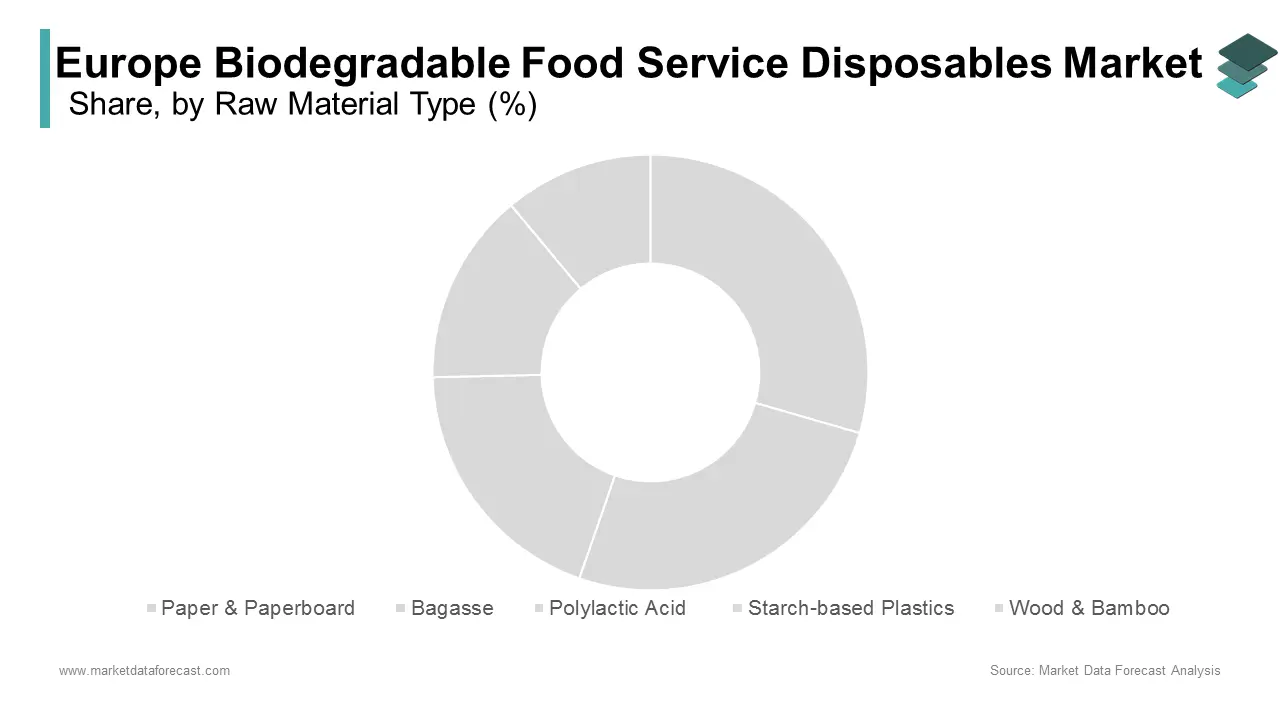
The Pulp and paper segment was the most dominant in the raw material category of the Europe biodegradable food service disposables market and accounted for 45.3% of the total market share in 2025. The material's versatility, cost-effectiveness, and widespread availability are the reason behind the dominance of this segment. As per the UK Department for Environment, Food & Rural Affairs, pulp-based products are preferred for their ability to decompose within 90 days in industrial composting facilities and is making them a sustainable choice. Furthermore, the German Environmental Agency said that pulp and paper disposables are used in over 60% of institutional catering services which brings focus on their importance in commercial applications. Also, the affordability of pulp and paper compared to other biodegradable materials also contributes to its leadership. In line with the French Ministry of Ecological Transition, pulp-based plates and containers are priced 15% to 20% lower than biopolymer alternatives that is making them accessible to a broader consumer base. This affordability when coupled with robust regulatory support ensures the segment's continued dominance.
The Biopolymers segment is experiencing explosive growth in the Europe biodegradable food service disposables market, with a CAGR of 12.5% projected between 2026 and 2034 and is driven by advancements in biopolymer technology and increasing consumer demand for durable yet eco-friendly alternatives. In accordance with the Italian Ministry of Ecological Transition, biopolymer-based disposables are gaining traction in the retail sector, with sales increasing by 30% in 2022. Further, the versatility of biopolymers which can be molded into various shapes and sizes, enhances their appeal. As stated by the Swedish Environmental Protection Agency, biopolymer-based cutlery and clamshells are replacing traditional plastics in fast-food chains and is contributing to their rapid adoption. Additionally, government incentives such as subsidies for biopolymer production have further accelerated growth, positioning this segment as a key driver of market expansion.
By Product Type Insights
The Plates segment remained the largest amongst all in the Europe biodegradable food service disposables market and captured 35.5% of the total market share in 2025 due to the widespread use of plates in both casual and formal dining settings. The German Federal Ministry for the Environment emphasizes that biodegradable plates are used in over 70% of outdoor events and festivals and is reflecting their popularity among event organizers. The inexpensiveness and aesthetic appeal of biodegradable plates also contribute to their dominance. As mentioned by the French Environment and Energy Management Agency, biodegradable plates are priced competitively compared to traditional plastic alternatives and is making them an attractive option for budget-conscious consumers. Furthermore, the rise of eco-consciousness among millennials has fueled demand, ensuring sustained growth for this segment.
The Cutlery segment is the fastest-growing product category, with a CAGR of 11.8% during the forecast period. This progress is because of the surging adoption of biodegradable cutlery in quick-service restaurants and food delivery services. According to the UK Department for Environment, Food & Rural Affairs, biodegradable cutlery accounted for 25% of total cutlery sales in 2022, reflecting its rising popularity. The convenience and portability of biodegradable cutlery make it an ideal choice for on-the-go dining. As per the Italian Ministry of Ecological Transition, food delivery platforms have witnessed a 40% increase in orders specifying biodegradable cutlery, underscoring its growing demand. Additionally, regulatory support such as bans on single-use plastic cutlery has further accelerated adoption, positioning this segment as a key growth driver.
By Distribution Channel Insights
The business-to-business (B2B) segment was the top performing distribution channel and accounted for 60.1% of the Europe biodegradable food service disposables market in 2025. This position in the market is credited to the widespread adoption of biodegradable disposables in institutional catering, hospitality, and corporate events. According to the German Federal Ministry for the Environment, B2B channels account for over 70% of total sales in the hospitality sector which is reflecting their importance in commercial applications. The scalability and cost-efficiency of B2B distribution further enhance its dominance. As per the French Environment and Energy Management Agency, bulk purchasing agreements in B2B channels reduce per-unit costs, making biodegradable disposables more accessible to businesses. Additionally, the growing emphasis on sustainability in corporate social responsibility (CSR) initiatives has fueled demand, ensuring sustained growth for this segment.
The business-to-customer (B2C) segment is the market's most dynamic category, with a CAGR of 13.2% estimated between 2026and 2034. This rise is propelled by increasing consumer awareness and the rising popularity of online retail platforms. The UK Department for Environment, Food & Rural Affairs states that online sales of biodegradable disposables increased by 50% in 2022 and is showing the segment's rapid expansion. The convenience of e-commerce platforms and the growing trend of home entertaining have further accelerated adoption. As per the Italian Ministry of Ecological Transition, over 60% of consumers prefer purchasing biodegradable disposables online, citing ease of access and variety as key factors. Additionally, government campaigns promoting eco-friendly lifestyles have bolstered consumer demand, positioning the B2C segment as a key growth driver.
REGIONAL ANALYSIS
Germany led the Europe biodegradable food service disposables market and held for 22.4% of the total market share in 2025. This authority in the market is due to the country's robust regulatory framework and strong emphasis on sustainability. As stated by the European Environment Agency, Germany implemented a nationwide ban on single-use plastics in 2021 and is driving the adoption of biodegradable alternatives. The nation’s advanced waste management infrastructure further supports market growth. According to the German Waste Management Association, above 80% of biodegradable disposables are processed in industrial composting facilities and is ensuring optimal environmental benefits. Additionally, the presence of key manufacturers and distributors enhances Germany's market dominance.
France stands as the next major player in the European market and is expected to move forward at a CAGR of 10.4% during the forecast period. The proactive approach of this country to environmental policies has been instrumental in driving its market growth. In line with the European Foodservice Packaging Association, France introduced a tax incentive program for businesses adopting biodegradable packaging which is resulting in a 25% increase in adoption rates. The hospitality sector plays a pivotal role in France's market leadership. According to the French Environment and Energy Management Agency, more than 70% of hotels and restaurants have transitioned to biodegradable disposables, reflecting their commitment to sustainability.
Italy holds a notable position in the market. The country's vibrant tourism industry has significantly contributed to market growth. As per the European Travel Commission, Italy attracts over 60 million tourists annually, creating a substantial demand for eco-friendly disposables in hotels and restaurants. Government initiatives have further accelerated adoption. The Italian Environmental Protection Agency revealed that subsidies for biodegradable product manufacturers have reduced production costs, making these products more accessible to consumers.
The United Kingdom is a significant market with Cities like London lead in adopting biodegradable disposables in hospitality. The stringent environmental regulations in the country have been a key propellent of market growth. According to the European Bioplastics Association, the UK implemented a plastic packaging tax in 2022, incentivizing businesses to adopt biodegradable alternatives. The rise of eco-conscious consumers has also fueled demand. The British Retail Consortium identifies that over 65% of consumers prioritize sustainability when purchasing food service disposables, underscoring the segment's importance.
Spain possess a comparatively smaller share but is advancing in this market. The country's thriving hospitality sector has been a major growth driver. In conformity with the Spanish Confederation of Hotels, over 80% of luxury hotels have adopted biodegradable disposables, reflecting their commitment to sustainability. Government support has further bolstered market growth. The Spanish Environmental Protection Agency states that subsidies for biodegradable product manufacturers have reduced production costs, making these products more competitive in the market.Top of Form
KEY MARKET PLAYERS
Major Players of the Europe biodegradable food service disposables market include Vegware Ltd., Huhtamäki Oyj, Biopac (U.K.) Ltd., Bionatic GmbH & Co. KG, I.L.P.A. S.p.A. Group, The Jim Pattison Group, GreenGood USA, Gold Plast S.p.A., Eco Guardian, Bunzl plc
DETAILED SEGMENTATION OF EUROPE BIODEGRADABLE FOOD SERVICE DISPOSABLES MARKET INCLUDED IN THIS REPORT
This research report on the europe biodegradable food service disposables market has been segmented and sub-segmented based on raw material type, product type, distribution channel, & region.
By Raw Material Type
- Paper & Paperboard (coated & uncoated)
- Bagasse (sugarcane pulp)
- Polylactic Acid (PLA)
- Starch-based Plastics
- Wood & Bamboo
By Product Type
- Plates & Bowls
- Cups & Lids
- Trays & Clamshells
- Cutlery (Forks, Knives, Spoons, Stirrers, Chopsticks)
- Straws
- Food Containers & Wraps
By Distribution Channel
- Online Retail
- Supermarkets & Hypermarkets
- Specialty Stores
- Direct Sales (B2B)
By Region
- UK
- France
- Spain
- Germany
- Italy
- Russia
- Sweden
- Denmark
- Switzerland
- Netherlands
- Turkey
- Czech Republic
- Rest of Europe