Europe Bioplastics Market Size, Share, Trends, & Growth Forecast Report By Type (Bio-based Biodegradables, Bio-based Non Biodegradables), Feedstock, Processing Technology, Application and Country (UK, France, Spain, Germany, Italy, Russia, Sweden, Denmark, Switzerland, Netherlands, Turkey, Czech Republic and Rest of Europe), Industry Analysis From 2025 to 2033
Market Size, 2025
$5.79 BnMarket Estimate, 2026
$6.93 BnMarket Forecast, 2034
$29.23 BnCAGR, 2026–2034
19.71%Europe Bioplastics Market Report Summary
The Europe bioplastics market was valued at USD 5.79 billion in 2025, is estimated to reach USD 6.93 billion in 2026, and is projected to reach USD 29.23 billion by 2034, growing at a CAGR of 19.71% during the forecast period from 2026 to 2034.
The growth of the Europe bioplastics market is driven by stringent EU regulations on single-use plastics, rising adoption of sustainable packaging, and increasing corporate commitments toward net-zero and Scope 3 emissions reduction. Strong policy support under the EU Circular Economy Action Plan, growing investments in compostable and bio-based materials, and rising consumer preference for eco-friendly alternatives are further accelerating market expansion. In addition, innovation in second-generation feedstocks and scaling of industrial composting infrastructure are strengthening the long-term outlook of the market.
Key Market Trends
- Growing replacement of conventional plastics with compostable and bio-based packaging across retail and FMCG sectors.
- Rising adoption of bioplastics by multinational brands to meet ESG and carbon disclosure requirements.
- Rapid innovation in second-generation feedstocks derived from agricultural and forestry residues.
- Increasing integration of bioplastics into public procurement, food service packaging, and institutional applications.
- Rising focus on certification, lifecycle assessment, and harmonized EU labeling standards.
Segmental Insights
- Based on type, the bio-based non-biodegradable segment held the largest share of the Europe bioplastics market in 2024. Its dominance is attributed to drop-in compatibility with existing manufacturing and recycling infrastructure, making materials such as bio-PE and bio-PET highly attractive for large-scale industrial adoption.
- Based on feedstock, the sugarcane and sugar beet segment dominated the market in 2024 due to high availability, mature processing infrastructure, and strong carbon reduction performance.
- The cellulosic biomass segment is anticipated to register the fastest growth at a CAGR of 19.2%, driven by EU prioritization of non-food feedstocks and investments in circular bioeconomy projects.
- Based on application, the flexible packaging segment accounted for the largest market share in 2024, supported by widespread use in food packaging, retail bags, and e-commerce materials.
Regional Insights
- Germany led the Europe bioplastics market in 2024, supported by advanced chemical manufacturing, strong circular economy policies, high composting infrastructure availability, and widespread industrial adoption.
- Italy remains a major growth hub due to its early legislative support for compostable materials and the presence of leading bioplastics producers such as Novamont.
- France continues to experience strong demand growth driven by aggressive anti-waste legislation and public investment in bio-based materials under national sustainability programs.
- The Netherlands and Sweden are emerging as innovation hubs, supported by advanced research ecosystems, strong waste separation systems, and integration of bioplastics into public procurement and industrial strategies.
Competitive Landscape
The Europe bioplastics market is moderately competitive and innovation-driven, featuring a mix of large chemical manufacturers and specialized bio-material innovators. Competition is based on feedstock sustainability, certification compliance, lifecycle performance, and ability to align with EU regulatory frameworks. Companies are focusing on non-food feedstocks, advanced material performance, partnerships with brand owners, and validation of end-of-life performance to strengthen market positioning.
Major companies operating in the Europe bioplastics market include BASF SE, NatureWorks LLC, TotalEnergies Corbion, DowDuPont / Danimer Scientific, Braskem, Green Dot Bioplastics, Plantic Technologies, FKuR Kunststoff GmbH, Corbion NV, and Bioworld AG.
Europe Bioplastics Market Size
The europe bioplastics market size was valued at USD 4.83 billion in 2024 and is anticipated to reach USD 5.79 billion in 2025 from USD 24.40 billion by 2033, growing at a CAGR of 19.71% during the forecast period from 2025 to 2033.
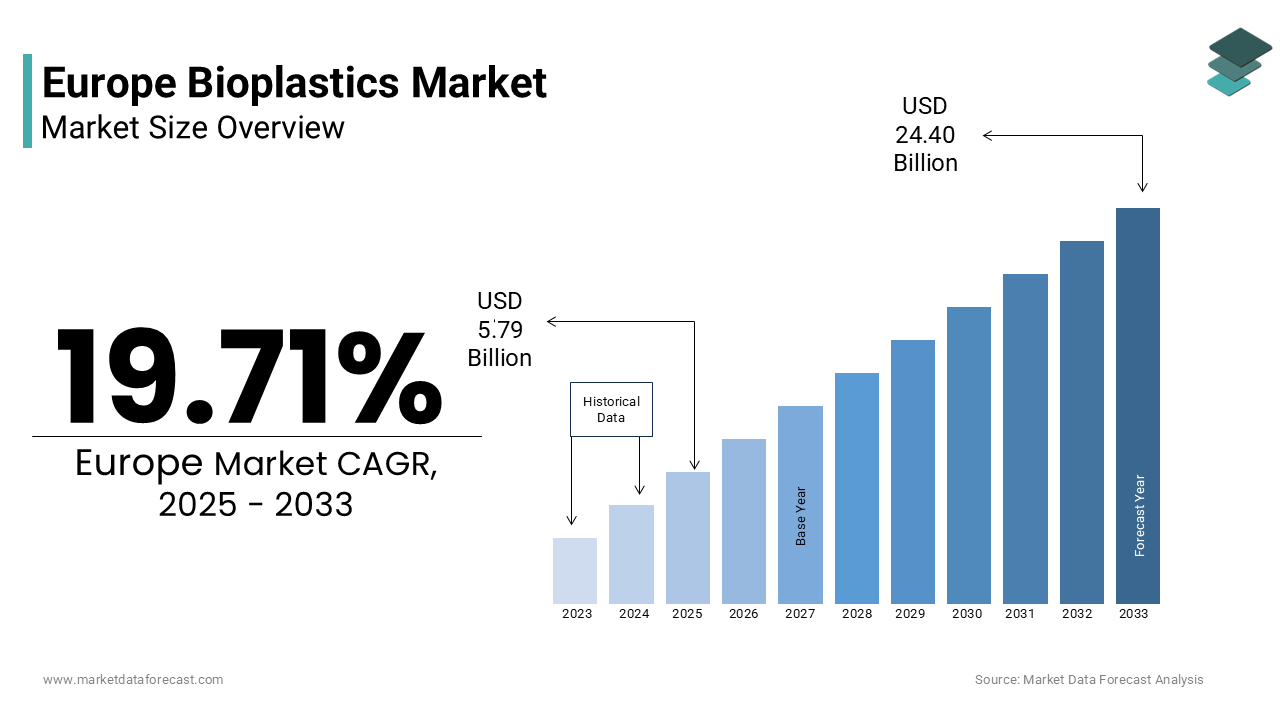
The bioplastics are focused on polymers derived wholly or partially from renewable biological sources such as starch cellulose vegetable oils and microbial fermentation. Unlike conventional plastics, these materials are designed to reduce dependency on fossil feedstocks and mitigate end of life environmental impacts through compostability or enhanced biodegradability under controlled conditions. As per Eurostat, the European Union generated 52 million metric tons of plastic waste in 2023 with only 32% recovered for recycling highlighting the urgency for alternative solutions. The European Commission’s Circular Economy Action Plan explicitly identifies bioplastics as a strategic innovation vector with binding targets for bio-based content in single use packaging by 2030.
MARKET DRIVERS
EU Regulatory Frameworks Mandating Sustainable Packaging and Plastics Reduction
The binding legislative instruments that phase out fossil based single use plastics and incentivize renewable alternatives is majorly fuelling the growth of Europe bioplastics market. As per the European Commission, the Single Use Plastics Directive banned ten common plastic items as of 2021 and requires that all beverage bottles contain at least 30% recycled content by 2030. The Packaging and Packaging Waste Regulation proposed in 2023 mandates that all plastic packaging placed on the EU market contain a minimum of 10% bio-based content by 2030 rising to 30% by 2040. France has already implemented its Anti Waste Law requiring compostable bioplastics for fruit and vegetable trays with non-compliance subject to fines up to 1 500 euros per violation, as documented by the French Ministry of Ecological Transition. Similarly, Italy’s CONAI system offers reduced waste management fees for packaging made from certified bioplastics.
Corporate Commitments to Net Zero and Scope 3 Emissions Reduction
Major European industries are integrating bioplastics into their decarbonization strategies to address upstream and downstream emissions across value chains. The corporate commitments to net zero and scope 3 emissions reductions is also boosting the tor is also accelerating the growth of Europe bioplastics market. The corporate commitments to net zero and scope 3 emissions reduction is also boosting the growth of Europe bioplastics market. According to the European Corporate Sustainability Reporting Directive, over 10,000 large companies must now disclose Scope 3 emissions which include raw material extraction and end of life management. In 2023, L’Oreal reported that its use of bio sourced polyethylene reduced cradle to gate carbon emissions by 2.1 kilograms per kilogram of material, as verified by a life cycle assessment conducted with Quantis. The European Dairy Association estimates that switching yogurt cups from polystyrene to PLA could cut sector wide emissions by 180,000 metric tons annually. These corporate and financial commitments transform bioplastics from niche materials into strategic assets in Europe’s industrial climate transition.
MARKET RESTRAINTS
Insufficient Industrial Composting Infrastructure Across Member States
Despite the proliferation of certified compostable bioplastics, Europe lacks the necessary waste management infrastructure to process them effectively leading to contamination and landfilling. The insufficient industrial composting infrastructure across member states is declining the growth of Europe bioplastics market. As per the European Environment Agency, only 12% of EU municipalities offer separate collection for compostable packaging and just 8% have access to industrial composting facilities capable of processing bioplastics at scale. A 2024 study by the Technical University of Munich found that 63% of compostable packaging ends up in incineration or mixed waste streams. The European Compost Network confirms that current composting capacity can handle only 300,000 metric tons annually, while bioplastic production is projected to exceed 1.2 million tons by 2027.
Feedstock Competition with Food and Agricultural Land Use
The reliance of first-generation bioplastics on food crops, such as corn sugarcane and potatoes raises concerns about indirect land use change and food security. The feedstock competition with food and agricultural land use is additionally declining the growth of Europe bioplastics market. In 2023, the EU consumed 3.2 million hectares of agricultural land for non-food biomass including bioplastics feedstock to rise under packaging mandates. The European Food Safety Authority has warned that scaling first generation bioplastics without strict sustainability safeguards could displace food production particularly in Southern Europe, where water stress is acute. A 2024 OECD report estimated that meeting the EU’s 2030 bio based packaging targets with current feedstocks would require an additional 1.1 million hectares of cropland equivalent to the size of Lebanon. While certification schemes like ISCC exist adoption remains inconsistent. This tension between circular economy goals and agricultural sustainability creates policy and public acceptance risks that constrain market expansion.
MARKET OPPORTUNITIES
Scale Up of Second Generation Feedstocks from Agricultural and Forestry Residues
Europe is rapidly advancing non-food biomass utilization through second generation bioplastics derived from lignocellulosic waste straw and wood residues. The scale up of second generation feedstocks from agricultural and forestry residues is creating new opportunities for the growth of Europe bioplastics market. As per the European Bioeconomy Forum, over 22 pilot and demonstration plants using agricultural residues for PLA and PHA production became operational between 2022 and 2024 in countries like Finland Sweden and Spain. The European Union’s Innovation Fund awarded 480 million euros in 2023 to the LignoValue project in the Netherlands, which converts hardwood residues into bio-based polyesters. According to the Joint Research Centre, second generation feedstocks could reduce greenhouse gas emissions by up to 85% compared to fossil plastics while utilizing 50 million metric tons of annual EU crop residues currently burned or left to decompose. The Circular Plastics Alliance has set a target for 20% of bioplastics to be produced from non-food biomass by 2030. Companies like Corbion and BASF are already scaling fermentation processes using wheat straw and beet pulp. This shift alleviates food competition concerns and aligns bioplastics with the EU’s farm to fork and circular bioeconomy strategies.
Integration of Bioplastics into EU Public Procurement and Institutional Packaging
Public sector demand presents a high impact opportunity to scale bioplastics through mandatory green procurement policies. This is additional factor, which is ascribed to bolster the growth of Europe bioplastics market. As per the European Commission’s Green Public Procurement, criteria updated in 2023 all food service packaging purchased by EU institutions must be either reusable or made from at least 50% certified bio-based materials. The European Parliament cafeteria alone replaced 1.2 million single use items annually with compostable bioplastic alternatives in 2023. National governments are following suit, France now requires all school canteens to use compostable trays and cutlery while Italy’s public hospitals have adopted bioplastic IV bags and medicine packaging. The European Cities Climate Pact has enrolled over 200 municipalities committed to sourcing bioplastic waste bags for organic collection. This institutional anchoring not only drives volume but also normalizes bioplastics as standard rather than alternative materials in everyday use.
MARKET CHALLENGES
Fragmented Certification and Labeling Standards Across Member States
The absence of harmonized definitions and verification protocols for terms like “biodegradable” “compostable” and “bio based” creates consumer confusion and market fragmentation. The fragmented certification and Lebling standards across member state is one of challenges for the growth of Europe bioplastics market. As per the European Consumer Organisation, only 11 EU countries recognize the same compostability standard EN 13432 while others maintain divergent national labels such as Germany’s “Seedling” and Italy’s “Compostable OK.” In 2023, the European Commission’s Market Surveillance Report found that 38% of products labeled as compostable did not meet required disintegration timelines under industrial conditions. Retailers like Carrefour and Edeka have expressed frustration over inconsistent municipal acceptance rules forcing them to tailor packaging by region. A 2024 Eurobarometer survey revealed that 54% of consumers mistakenly believe “bio based” means “biodegradable” leading to improper disposal.
Higher Production Costs and Limited Economies of Scale
Bioplastics remain significantly more expensive than conventional plastics due to immature supply chains and lack of production scale. The higher production costs and limited economics of scale is additionally to impede the growth of Europe bioplastics market in coming years. According to the European Chemical Industry Council, PLA costs approximately 2,800 euros per metric ton compared to 1 100 euros for polypropylene. PHA, a next generation microbial bioplastic can exceed 5,000 euros per ton. These premiums are prohibitive for price sensitive sectors like retail and agriculture. A 2024 study by the Fraunhofer Institute for Environmental Safety and Energy Technology found that bioplastics must achieve production volumes above 200,000 metric tons annually to reduce costs by 30% through economies of scale, yet only three European facilities currently exceed this threshold.
REPORT COVERAGE
| REPORT METRIC | DETAILS |
| Market Size Available | 2024 to 2033 |
| Base Year | 2024 |
| Forecast Period | 2025 to 2033 |
| CAGR | 19.71% |
| Segments Covered | By Type, Feedstock, Processing Technology, Application and Region |
| Various Analyses Covered | Global, Regional & Country Level Analysis; Segment-Level Analysis; DROC, PESTLE Analysis; Porter’s Five Forces Analysis; Competitive Landscape; Analyst Overview of Investment Opportunities |
| Regions Covered | United Kingdom, France, Spain, Germany, Italy, Russia, Sweden, Denmark, Switzerland, the Netherlands, Turkey, and the Czech Republic |
| Market Leaders Profiled | BASF SE, NatureWorks LLC, TotalEnergies Corbion, DowDuPont / Danimer Scientific, Braskem, Green Dot Bioplastics, Plantic Technologies, FKuR Kunststoff GmbH, Corbion NV, and Bioworld AG. |
SEGMENTAL ANALYSIS
By Type Insights
The bio-based segment was accounted in holding 58.3% of the Europe bioplastics market share in 2024 due to their drop-in compatibility with existing recycling streams and performance parity with fossil-based polymers. These materials, such as bio-PE and bio-PET are chemically identical to conventional plastics but derived from renewable feedstocks like sugarcane ethanol by enabling immediate integration into current packaging and automotive production lines without retooling. According to the European Chemical Industry Council, over 75% of Europe’s bio-based polymer capacity is dedicated to non-biodegradable resins, with Braskem’s bio-PE plant in France supplying major brands like L’Oreal and Nestle. The European Commission’s Packaging and Packaging Waste Regulation explicitly recognizes bio-based content as a compliance pathway even, when the material is not compostable, provided it reduces fossil carbon dependency. This regulatory endorsement and technical compatibility make bio-based non-biodegradables the pragmatic choice for large-scale industrial decarbonization.
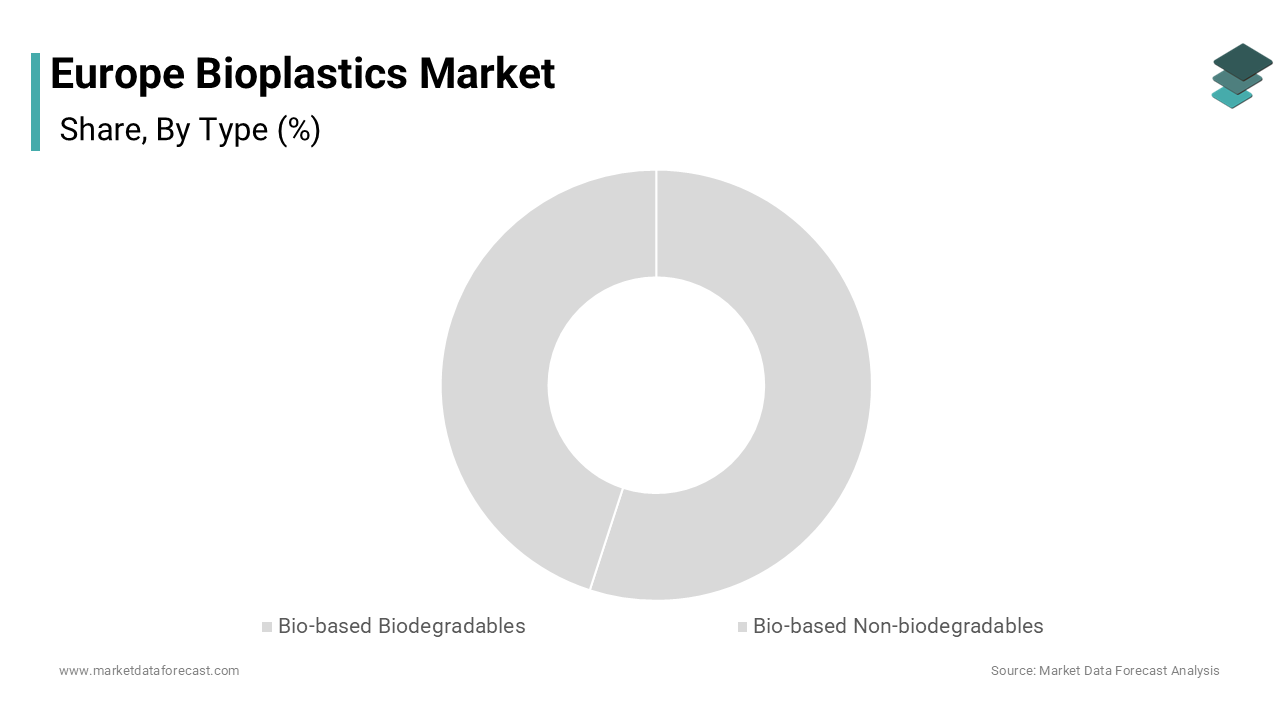
The bio-based segment is projected to witness a fastest CAGR of 16.4% from 2025 to 2033 with the single-use packaging bans, mandatory compostable requirements, and municipal organic waste collection mandates. France’s Anti-Waste Law mandates that all disposable food service ware be compostable by 2025, which is affecting over 120 000 food businesses. Italy’s CONAI system offers a 30% reduction in waste management fees for certified compostable packaging, incentivizing adoption among SMEs. The European Compost Network reports that industrial composting capacity is projected to triple by 2027, supported by 1.2 billion euros in EU cohesion funds. Companies like Novamont and Corbion have expanded PLA production in Italy and the Netherlands to meet this surge. Additionally, the EU Ecolabel now includes criteria for biodegradability in soil and marine environments, accelerating innovation in next-generation PHA. This policy-driven pull, combined with infrastructure investment, positions biodegradables as the most dynamically growing segment despite current scale limitations.
By Feedstock Insights
The sugarcane and sugar beet segment was accounted in holding 42.3% of the Europe bioplastics feedstock market share in 2024 with their high sucrose yield, established refining infrastructure, and carbon-negative potential when processed with renewable energy. As per Eurostat, the EU produces over 130 million metric tons of sugar beet annually, with surplus volumes increasingly diverted to bio-based chemical production under the Common Agricultural Policy’s crop diversification incentives. Braskem’s I’m Green™ bio-PE derived from Brazilian sugarcane but processed in European facilities accounts for over 60% of bio-based polymer demand in packaging, according to the European Bioplastics Association. A 2024 study by the Joint Research Centre found that sugarcane-based ethanol in bioplastics achieves a net carbon removal of 2.5 kilograms of CO₂ per kilogram of polymer, when co-generated with bagasse-based electricity. This combination of agricultural abundance, processing maturity, and verified climate benefit solidifies sugarcane and sugar beet as Europe’s dominant renewable feedstocks.
The cellulosic biomass segment is expected to witness a fastest CAGR of 19.2% from 2025 to 2033 with the EU policies prioritizing non-food biomass and circular bioeconomy principles. As per the survey, 20% of all bioplastics must derive from second-generation feedstocks by 2030 to avoid competition with food systems. The EU Innovation Fund allocated 480 million euros in 2023 to the LignoValue project in the Netherlands, which converts hardwood residues into bio-based polyesters. In Sweden, St1 and UPM are scaling pilot plants that transform forest thinnings into PHA using microbial fermentation, with yields projected to reach 50 000 metric tons by 2026. According to the European Forest Institute, Europe generates over 50 million metric tons of unused agricultural straw annually enough to produce 5 million tons of PLA. The Renewable Energy Directive II classifies cellulosic feedstocks as advanced biofuels, granting double counting toward renewable targets and attracting private investment. This alignment with food security, waste valorization, and deep decarbonization ensures rapid scaling of non-food biomass in Europe’s bioplastics future.
By Application Insights
The flexible packaging segment was accounted in holding 47.3% of the Europe bioplastics market share in 2024 with its ubiquity in food retail, e-commerce, and consumer goods. As per the European Flexible Packaging Association, over 65% of bioplastic films are used for fresh produce bags, stand-up pouches, and shrink wraps that comply with EU single-use plastic restrictions. Retailers like Carrefour and Aldi have transitioned fruit and vegetable packaging to certified compostable PLA films by affecting over 15,000 stores, across Europe. The European Food Safety Authority has approved over 300 bioplastic formulations for direct food contact, which is accelerating adoption in sensitive categories like bakery and deli. In 2023, Germany’s dual system Green Dot reported a 34% increase in bioplastic film collection from households, indicating growing consumer acceptance. Additionally, bio-based PE films offer identical performance to fossil LDPE but with 30% lower carbon footprint as verified by Quantis. This blend of regulatory compliance, functional parity, and retail scale ensures flexible packaging remains the largest application domain.
The automotive and assembly operations segment is expected to witness a fastest CAGR of 14.8% from 2025 to 2033 owing to the OEM sustainability targets, lightweighting demands, and EU vehicle end-of-life regulations. BMW’s iX model uses PHA-based door panels and PLA-reinforced trunk liners, reducing interior weight by 12% while maintaining durability. The EU End-of-Life Vehicles Directive mandates 95% material recovery by 2035, incentivizing the use of mono-material biocomposites that simplify disassembly. In 2024, Faurecia (Forvia) launched a dashboard substrate made from flax fiber and bio-PET, cutting lifecycle emissions by 40% compared to glass-filled polypropylene. The European Commission’s Net-Zero Industry Act further supports this shift by classifying bio-based automotive polymers as strategic clean tech.
REGIONAL ANALYSIS
Germany Bioplastics Market Analysis
Germany was the top performer of the Europe bioplastics market by holding 24.3% of share in 2024 with its advanced chemical industry circular economy policies, and robust waste management infrastructure. The country hosts major production facilities, including BASF’s ecovio® plant and Corbion’s PLA line, supported by the Federal Ministry for Economic Affairs through the Bioeconomy Innovation Program. According to the German Environment Agency, over 80% of municipalities collect organic waste separately, creating demand for certified compostable bioplastics in food packaging and waste bags. The Green Dot system provides financial incentives for bio-based packaging through reduced licensing fees. Germany also leads in automotive integration with BMW and Mercedes-Benz incorporating bioplastics into interior trims and under-hood components. A 2024 Fraunhofer study confirmed that German consumers exhibit the highest willingness to pay a premium for compostable packaging among EU nations.
Italy Bioplastics Market Analysis
Italy bioplastics market growth is likely to grow with its pioneering role in compostable bioplastics, strong agricultural base, and national legislation favoring bio-based solutions. The country is home to Novamont, Europe’s largest bioplastics producer, which operates five plants using starch and vegetable oils to manufacture Mater-Bi for packaging, agriculture, and catering. As per the Italian Ministry of Ecological Transition, Law 123 of 2021 mandates that all single-use shopping bags and fruit trays be made from compostable bioplastics, a policy that eliminated over 120 000 tons of conventional plastic annually. The Po Valley’s abundant maize and sugar beet crops provide secure local feedstock, with over 350,000 hectares dedicated to non-food biomass. This integrated ecosystem of production policy and infrastructure makes Italy a model for circular bioplastics deployment.
France Bioplastics Market Analysis
France bioplastics market is likely to grow with the aggressive anti-waste legislation, strong public research investment in sugarcane-based bio-polymers. The Anti-Waste for a Circular Economy Law bans non-compostable fruit trays, tea bags, and disposable tableware, directly stimulating demand for PLA and PHA. According to ADEME, France’s ecological agency, the law has diverted over 90 000 tons of plastic from landfills since 2022. Public research institutions like INRAE and CEA have partnered with TotalEnergies and Tereos to scale bio-PET from sugar beet ethanol, with a 100 000-ton annual facility operational in Grandpuits. The French government’s France 2030 plan allocated 1.5 billion euros to green chemistry, including bioplastics R&D. Paris and Lyon have implemented city-wide organic collection using bioplastic bags, achieving 78% participation. A 2024 Eurobarometer survey ranked France highest in consumer trust for compostable packaging labels. This combination of regulatory foresight, agricultural integration, and public engagement ensures sustained market expansion.
Netherlands Bioplastics Market Analysis
The Netherlands bioplastics market growth is likely with its port logistics, chemical cluster, and circular economy to become a bioplastics innovation hub. Rotterdam’s port hosts key players like Corbion and Avantium, with the Chemelot campus in Geleen serving as a testbed for PHA and PEF production. According to the Dutch Ministry of Infrastructure, the National Waste Management Plan mandates 100% separate organic collection by 2025, requiring certified compostable bags and trays. The Netherlands is also home to the European Bioplastics Secretariat and the KIDV packaging institute, which coordinate cross-sector standards. In 2023, Amsterdam banned non-compostable food containers in public events, affecting over 500 vendors annually. A 2024 Wageningen University study found that Dutch supermarkets achieve 85% correct disposal of bioplastic packaging due to clear labeling and consumer education. This ecosystem of infrastructure policy and knowledge exchange positions the Netherlands, as a scalable and replicable model for bioplastics circularity.
Sweden Bioplastics Market Analysis
Sweden bioplastics market growth with its fossil-free industrial strategy, forest-based feedstock advantage, and advanced waste-to-value systems. As per the Swedish Environmental Protection Agency, the country aims for 100% fossil-free materials in packaging by 2030, with bioplastics central to this transition. Companies like St1 and RISE Research Institutes are scaling PHA production from forest residues by leveraging Sweden’s 23 million hectares of sustainably managed woodland. The national waste authority Avfall Sverige reports that 99% of households have access to composting, with bioplastic bags widely used for food waste collection. In 2024, Volvo introduced seat fabrics made from cellulose-based biopolyesters in its EX90 electric SUV. The Swedish Energy Agency provides grants covering up to 50% of capital costs for bio-based material startups. A 2024 OECD review highlighted Sweden as the EU leader in integrating bioplastics into circular public procurement. This alignment of renewable resources, climate policy, and industrial innovation ensures Sweden’s outsized influence relative to its population size
COMPETITIVE LANDSCAPE
Competition in the Europe bioplastics market is characterized by a dual-layer structure where established chemical giants and specialized biotech firms compete on complementary strengths. Large players like BASF and TotalEnergies leverage scale global distribution and drop-in compatibility to serve mass markets with bio-based non-biodegradables. In contrast niche innovators such as Novamont and Corbion differentiate through certified compostability advanced material science and deep integration with municipal waste systems. The market is highly policy-sensitive with regulatory shifts in packaging mandates composting infrastructure and green public procurement acting as primary growth catalysts or constraints. Technical barriers remain significant including feedstock cost performance parity and end-of-life verification, limiting entry to well-capitalized or research-intensive firms. Collaboration is as critical as competition with industry alliances like the Circular Plastics Alliance driving pre-competitive R&D and standardization. This environment rewards companies that combine scientific rigor regulatory agility and circular ecosystem engagement.
KEY MARKET PLAYERS
Some of the companies that are playing a dominating role in the europe bioplastics market include
- BASF SE
- NatureWorks LLC
- TotalEnergies Corbion
- DowDuPont / Danimer Scientific
- Braskem
- Green Dot Bioplastics
- Plantic Technologies
- FKuR Kunststoff GmbH
- Corbion NV
- Bioworld AG
Top Players in the Market
Novamont S.p.A.
Novamont S.p.A. is an Italian pioneer in biodegradable and compostable bioplastics with global influence through its Mater-Bi technology platform. The company supplies resins for packaging agriculture and food service across more than 70 countries and has been instrumental in shaping EU standards for compostability. In Europe, Novamont operates five production facilities and collaborates closely with municipalities to integrate bioplastic waste bags into organic collection systems. In 2024, the company launched a new generation of PHA-starch hybrids derived from non-food crops that degrade in marine environments. It also expanded its partnership with the Ellen MacArthur Foundation to advance circular design principles. These actions reinforce Novamont’s role as both an innovator and policy enabler in the global transition to bio-based materials.
Corbion N.V.
Corbion N.V. is a Dutch leader in lactic acid and polylactic acid production with a strong footprint in Europe and strategic partnerships worldwide. The company supplies high-purity PLA to major packaging and textile brands seeking certified bio-based and compostable solutions. Corbion operates a large-scale PLA plant in Thailand and a lactic acid facility in the Netherlands powered by renewable energy. In 2024 Corbion introduced a food-grade PLA grade optimized for high-barrier flexible films meeting stringent EU migration limits. It also joined the European Circular Plastics Alliance to co-develop collection and composting protocols.
BASF SE
BASF SE is a German chemical giant that integrates bioplastics into its broader portfolio of sustainable materials through its ecovio® and BASF Bio-based product lines. The company leverages its global R&D network to develop certified compostable polymers for films injection molding and coatings used in retail and agriculture. In Europe BASF collaborates with waste management firms to ensure its bioplastics align with industrial composting standards. BASF enhanced its mass balance-certified bio-based PBAT with improved elongation properties for compostable shopping bags. It also partnered with the Fraunhofer Institute to validate end-of-life pathways under real-world conditions. These initiatives position BASF as a trusted technical partner bridging conventional polymer performance with circular economy requirements.
Top Strategies Used by the Key Market Participants
Key players in the Europe bioplastics market focus on vertical integration by securing non-food feedstock sources such as agricultural residues and vegetable oils to ensure supply security and sustainability credibility. They actively engage in policy dialogues to shape harmonized certification standards for compostability and bio-based content across EU member states. Companies invest in end-of-life validation through partnerships with waste management operators to prove real-world biodegradability and avoid greenwashing accusations. Strategic collaborations with brand owners and retailers enable co-development of application-specific grades that meet functional and regulatory requirements. Additionally, they prioritize renewable energy in production and transparent life cycle assessments to substantiate carbon reduction claims under the EU Green Claims Directive.
RECENT MARKET DEVELOPMENTS
- In March 2024, Novamont S.p.A. launched a new generation of PHA-starch hybrid resins derived from non-food crops that fully biodegrade in marine environments within twelve months. This innovation addresses microplastic concerns and expands application potential in fishing and coastal sectors.
- In April 2024, Corbion N.V. joined the European Circular Plastics Alliance to co-develop standardized collection and composting protocols for PLA packaging across member states. This action strengthens end-of-life infrastructure and consumer trust.
- In January 2024, BASF SE partnered with the Fraunhofer Institute to conduct real-world validation studies on the biodegradation of ecovio® films in diverse European composting facilities. This scientific backing reinforces credibility under the EU Green Claims Directive.
MARKET SEGMENTATION
This europe bioplastics market research report is segmented and sub-segmented into the following categories.
By Type
- Bio-based Biodegradables
- Starch-based
- Polylactic Acid (PLA)
- Polyhydroxyalkanoates (PHA)
- Polyesters (PBS, PBAT, PCL)
- Other Bio-based Biodegradables
- Bio-based Non-biodegradables
- Bio Polyethylene Terephthalate (PET)
- Bio Polyethylene
- Bio Polyamides
- Bio Polytrimethylene Terephthalate
- Other Bio-based Non-biodegradables
By Feedstock
- Sugarcane / Sugar Beet
- Corn
- Cassava and Potato
- Cellulosic and Wood Waste
- Others (Algae and Microbial Oil)
By Processing Technology
- Extrusion
- Injection Molding
- Blow Molding
- 3D Printing
- Others (Thermoforming, etc.)
By Application
- Flexible Packaging
- Rigid Packaging
- Automotive and Assembly Operations
- Agriculture and Horticulture
- Construction
- Textiles
- Electrical and Electronics
- Other Applications
By Country
- UK
- France
- Spain
- Germany
- Italy
- Russia
- Sweden
- Denmark
- Switzerland
- Netherlands
- Turkey
- Czech Republic
- Rest of Europe
Frequently Asked Questions
What is the Europe bioplastics market?
The Europe bioplastics market includes production, demand, and use of biodegradable and bio-based plastics across industries such as packaging, consumer goods, automotive, and textiles.
What are bioplastics?
Bioplastics are plastics derived from renewable biological sources (like corn, sugarcane) or designed to biodegrade, reducing environmental impact compared to traditional plastics.
What are the key drivers of the Europe bioplastics market?
Growth is driven by environmental regulations, increasing plastic pollution awareness, sustainable packaging demand, and government incentives for bio-based materials.
Which segments dominate the Europe bioplastics market?
Major segments include bio-based biodegradable plastics (e.g., PLA, PHA) and bio-based non-biodegradable plastics (e.g., bio-PET, bio-polyethylene), with packaging being the largest application.
Which countries lead bioplastics adoption in Europe?
Germany, France, Italy, Spain, and the Netherlands are key contributors due to strong manufacturing bases and sustainability initiatives.
What are the challenges faced by the Europe bioplastics market?
Challenges include higher production costs, limited feedstock availability, recycling infrastructure gaps, and customer price sensitivity.
How does policy impact the market?
Stringent EU regulations on single-use plastics and incentives for sustainable materials adoption are boosting the bioplastics market.
What are common applications of bioplastics?
Applications include packaging materials, consumer products, automotive components, textiles, agriculture films, and biomedical items.
What is the future outlook for the Europe bioplastics market?
The market is expected to grow steadily due to sustainability commitments, innovation in bio-based polymers, and increasing adoption across industries.
What is the difference between bio-based and biodegradable plastics?
Bio-based plastics are derived from renewable resources, while biodegradable plastics break down under environmental conditions; some materials can be both.
Access the study in MULTIPLE FORMATS
Purchase options starting from
$ 2000
Didn’t find what you’re looking for?
TALK TO OUR ANALYST TEAM
Need something within your budget?
NO WORRIES! WE GOT YOU COVERED!
Call us on: +1 888 702 9696 (U.S Toll Free)
Write to us: sales@marketdataforecast.com