- Product Description Description
- Table of Contents TOC
- List of Table & Figure LOT
- Get Free Sample PDF Sample PDF
Market Size, 2025
$10.17 BnMarket Estimate, 2026
$10.51 BnMarket Forecast, 2034
$13.66 BnCAGR, 2026–2034
3.24%Europe Biosolids Market Size, Growth, Trends & Forecast (2026–2034)
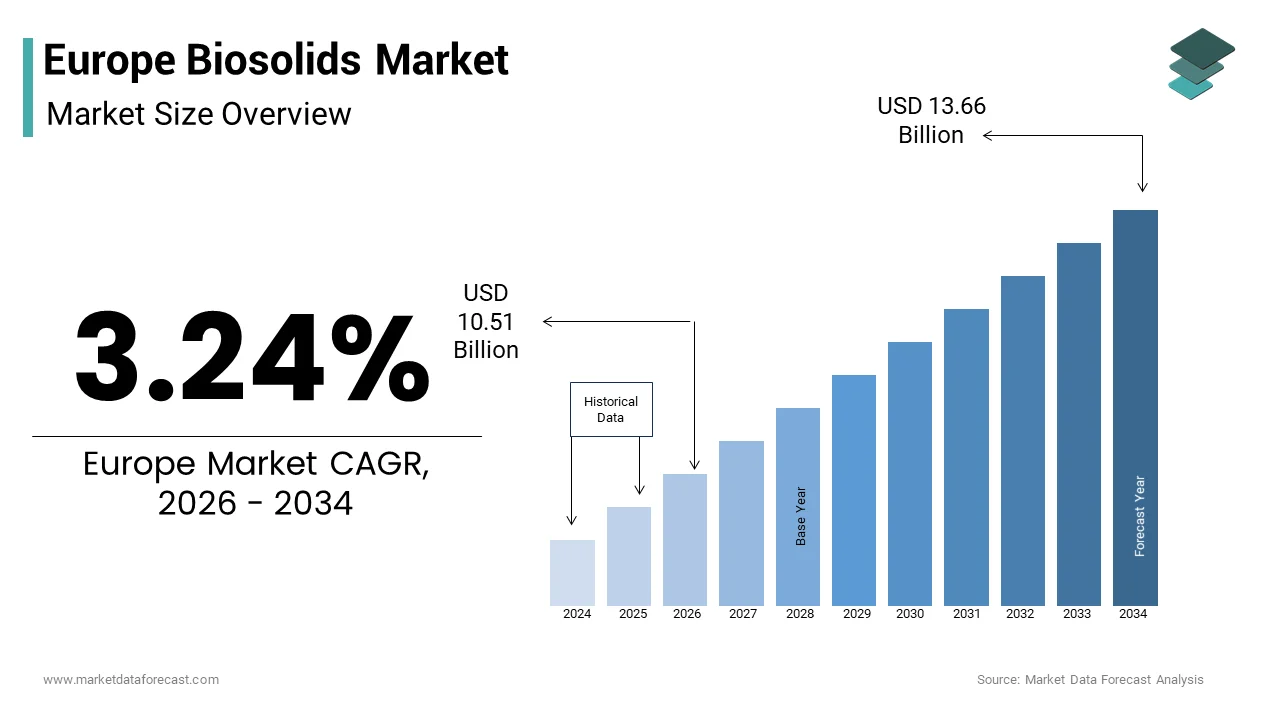
The Europe biosolids market size was valued at USD 10.17 billion in 2025, is anticipated to reach USD 10.51 billion in 2026, and is projected to scale up to USD 13.66 billion by 2034, registering a compound annual growth rate (CAGR) of 3.24% from 2026 to 2034. Growth is primarily propelled by strict European Union regulations encouraging circular economy models and nutrient recovery, rising agricultural demand for organic soil amendments, and advancements in thermal and nutrient extraction technologies.
Key Executive Metrics (At-a-Glance)
- 2025 Base Valuation: USD 10.17 Billion
- 2026 Current Valuation: USD 10.51 Billion
- 2034 Forecast Valuation: USD 13.66 Billion
- Compound Annual Growth Rate (CAGR): 3.24% (2026–2034)
- Dominant Form Segment: Cake form biosolids (holding 62% share)
- Fastest-Growing Form Segment: Pelletized biosolids (projected at an 8.9% CAGR)
- Dominant Class Segment: Class B biosolids (holding 55% share)
- Fastest-Growing Class Segment: Class A-EQ segment (projected at a 9.4% CAGR)
- Dominant Application Segment: Agricultural land application
- Fastest-Growing Application Segment: Energy production (projected at a 10.2% CAGR)
- Leading Country Market: Germany (holding 21.3% share in 2024)
Core Market Drivers & Restraints
- Key Drivers: Stringent EU circular economy regulations, demand for phosphorus security and organic fertilizers, carbon sequestration initiatives, and cost-effective dewatering infrastructure.
- Market Restraints: Public perception and odor concerns limiting acceptance, and stringent micropollutant and heavy metal standards increasing operational treatment costs.
Europe Biosolids Market Segmentation Breakdown
| Segment Category | Largest / Leading Segment | Fastest-Growing Segment |
|---|---|---|
| By Form | Cake | Pellets |
| By Class | Class B | Class A-EQ |
| By Application | Agricultural Land Application | Energy Production |
| By Country | Germany | United Kingdom / Netherlands |
Major Industry Players Profiled
Key market leaders shaping the European biosolids landscape include Synagro, SUEZ (Veolia), GeoEnvironment Technologies, Waterschap Vallei en Veluwe, Ragn Sells AB, Casella Organics, BIODISK Corporation, and Wm. H. Reilly & Company.
Europe Biosolids Market Size
The Europe biosolids market size was valued at USD 10.17 billion in 2025 and is anticipated to reach USD 10.51 billion in 2026 to reach USD 13.66 billion by 2034, growing at a CAGR of 3.24%, from 2026 to 2034.
Current Introduction: Definition of the Europe Biosolids Market
The Biosolids are the treatment, processing, and beneficial reuse of nutrient-rich organic residues derived from municipal wastewater treatment plants. These biosolids are stabilized through digestion, composting, or thermal processes, which are primarily utilized as soil conditioners and fertilizers in agriculture, land restoration, and urban green infrastructure. The market operates under a rigorous regulatory framework that prioritizes pathogen reduction, contaminant control, and environmental safety. According to Eurostat, Europe generates approximately 10 million metric tons of dry biosolids annually from over 22,000 urban wastewater treatment facilities serving more than 90% of the EU population. As per the European Environment Agency, over 60% of treated biosolids in the EU are applied to agricultural land, reflecting a long-standing policy preference for resource recovery over landfilling or incineration. Furthermore, the European Commission’s Urban Wastewater Treatment Directive mandates advanced sludge management practices, while the Circular Economy Action Plan explicitly identifies biosolids as a strategic source of organic matter and phosphorus.
MARKET DRIVERS
Stringent EU Regulations Promoting Circular Economy and Nutrient Recovery
The policy instruments that prioritize resource recovery over disposal are fuelling the growth of Europe biosolids market. The Urban Wastewater Treatment Directive requires sludge stabilization and restricts landfilling, effectively mandating beneficial reuse. In Germany, the Fertilizer Ordinance permits biosolids application on cropland only if heavy metal concentrations remain below strict thresholds, with cadmium under 0.8 milligrams per kilogram and mercury under 0.2 milligrams per kilogram,, ram by ensuring soil safety while enabling nutrient return. This regulatory architecture transforms biosolids from a disposal liability into a control-value-bearing input for sustainable agriculture.
Growing Agricultural Demand for Organic Soil Amendments and Phosphorus Security
Farmers across Europe are increasingly adopting biosolids to improve soil structure, water retention, and long-term fertility amid declining organic matter levels. Biosolids application can increase soil organic matter by up to 25% over five years in long term trials by the Swedish University of Agricultural Sciences. Equally, phosphorus is a finite resource, where the EU imports over 90% of its needs, according to the European Fertilizing Products Regulation. Biosolids contain 2 to 4% phosphorus by dry weight, offering a domestic alternative to mined phosphate rock. In Finland, national agri-environmental schemes reimburse farmers for biosolids use to offset synthetic fertilizer costs, contributing to a 31% increase in applications between 2020 and 2024, as per the Natural Resources Institute Finland.
MARKET RESTRAINTS
Public Perception and Odor Concerns Limiting Land Application Acceptance
Despite regulatory support, biosolids face persistent social resistance due to misconceptions about safety and nuisance factors like odor. According to a 2024 Eurobarometer survey on waste and recycling, only 39% of EU citizens support the use of treated sewage sludge in food crop production, with opposition highest in Southern and Eastern Europe. In Italy, local protests blocked biosolids spreading on vineyards near Bologna in 2023, citing fears of wine contamination, even though national law permits use on non-root crops. Odor emissions during land application—often linked to incomplete stabilization—trigger complaints; the UK’s Environment Agency recorded over 1,200 nuisance complaints related to biosolids in 2023 alone. France’s regulatory authority ANSES notes that 22% of biosolids treatment facilities operate under odor control orders. These socio-environmental tensions constrain expansion into new agricultural zones and increase operational costs for odor mitigation, such as enclosed digesters or polymer conditioning, thereby limiting the scalability of land application despite its agronomic merits.
Stringent Micropollutant and Heavy Metal Standards Increasing Treatment Costs
Emerging contaminants such as pharmaceuticals, microplastics, and per and polyfluoroalkyl substances are triggering stricter biosolids quality requirements, escalating processing expenses. According to the European Chemicals Agency, over 150 pharmaceutical compounds have been detected in sewage sludge, with ibuprofen and carbamazepine among the most persistent. In response, Germany’s updated Sludge Ordinance, effective in 2024, requires all wastewater plants serving more than 100,000 people to implement advanced phosphorus recovery and reduce organic micropollutants by 80% before land application. This mandates costly upgrades like ozonation or activated carbon filtration, increasing treatment costs by an estimated €45 to €70 per ton of dry solids as per the German Water Association. Similarly, Sweden now bans biosolids use on food crops if perfluorooctanoic acid exceeds 0.1 micrograms per kilogram, a threshold so low it necessitates high-resolution mass spectrometry monitoring. These evolving standards, while environmentally justified, impose financial and technical burdens that challenge the economic viability of biosolids reuse, particularly for smaller municipalities.
MARKET OPPORTUNITIES
Advancement in Thermal and Nutrient Recovery Technologies
Innovations in biosolids processing are unlocking new value streams beyond traditional land application. According to the European Institute for Energy Research, pyrolysis and gasification technologies can convert biosolids into biochar—a stable carbon-rich soil enhancer—and renewable syngas, with pilot plants in Denmark and Austria achieving 95% pathogen and microplastic destruction. Simultaneously, phosphorus recovery via struvite crystallization is gaining traction; the Netherlands’ Amersfoort wastewater plant recovers over 1,200 metric tons of struvite annually, marketed as a slow-release fertilizer under the brand name Phoskraft. As per the European Commission’s Strategic Action Plan on Phosphorus, such technologies could supply 20% of the EU’s agricultural phosphorus demand by 2035. France’s SUEZ subsidiary has commissioned a €25 million thermal drying facility near Lyon that produces Class A biosolids pellets for urban landscaping, reducing transport volume by 70%. These advancements transform biosolids into engineered products with controlled composition, expanding applications into horticulture, mine reclamation, and circular nutrient markets.
Integration of Biosolids into National Soil Health and Carbon Sequestration Programs
Biosolids are increasingly recognized as tools for climate mitigation through soil carbon enhancement. According to the European Joint Programme on Agricultural Soil Management, applying one ton of stabilized biosolids per hectare can sequester up to 0.3 tons of CO2 equivalent annually by boosting microbial activity and organic matter retention. In the UK, the Environment Agency’s 2024 Net Zero Agriculture Strategy includes biosolids in its official carbon accounting framework for farms, enabling participation in carbon credit schemes. Ireland’s Department of Agriculture now lists biosolids as an eligible input under its new Soil Restoration Grant, covering 50% of application costs for degraded grasslands. Similarly, Finland’s carbon farming initiative provides €30 per hectare for biosolids use on peat soils, which are responsible for 30% of the country’s agricultural emissions as per the Finnish Environment Institute. By aligning biosolids with climate policy, governments are creating financial incentives that transcend traditional waste management paradigms and position organic residuals as active agents of ecological restoration.
MARKET CHALLENGES
Fragmented Regulatory Standards Across Member States
The absence of harmonized EU-wide biosolids quality and use criteria creates operational inefficiencies and market distortions. According to the European Commission’s 2024 Sludge Management Review, 14 member states permit biosolids on all crop types, while 9 restrict use to non-food applications, and 4—including Austria and Luxembourg—effectively ban agricultural use altogether. In Poland, biosolids application requires local council approval, a process that averages 8 months, whereas in Spain, national law allows unrestricted use if pathogens are reduced by 99%. This patchwork complicates cross-border transport and deters private investment in large-scale recovery infrastructure. A wastewater utility operating in Belgium and France must comply with cadmium limits of 1.5 and 0.8 milligrams per kilogram, respectively, necessitating separate treatment streams. Until the EU adopts binding quality standards under the revised Sewage Sludge Directive—currently under negotiation—biosolids valorization will remain constrained by legal uncertainty and administrative fragmentation.
Contamination Risks from Industrial and Household Chemical Inputs
Biosolids quality is inherently vulnerable to upstream chemical discharges that bypass municipal pretreatment controls. According to the European Environment Agency, over 40% of EU wastewater treatment plants receive industrial effluents containing heavy metals, solvents, or persistent organic pollutants, which concentrate in sludge during treatment. In 2023, Germany’s Federal Environment Agency detected perfluorooctanesulfonic acid in 67% of biosolids samples from mixed catchments, exceeding proposed EU safety thresholds. Similarly, microplastic concentrations in biosolids average 12,000 particles per gram, as confirmed by a 2024 study from the University of Barcelona, raising concerns about long term soil accumulation. While the Industrial Emissions Directive mandates pretreatment, enforcement is inconsistent; Italy’s environmental protection agency reported that only 31% of textile and electronics factories in Lombardy complied withsludge-relatedd discharge limits in 2023. This contamination risk not only threatens soil and water quality but also undermines public and policymaker confidence in biosolids as a safe circular resource, necessitating costly feedstock monitoring and source control measures.
REPORT COVERAGE
| REPORT METRIC | DETAILS |
| Market Size Available | 2025 to 2034 |
| Base Year | 2025 |
| Forecast Period | 2026 to 2034 |
| CAGR | 3.24% |
| Segments Covered | By Form, Class, Application, and By Country |
| Various Analyses Covered | Global, Regional & Country Level Analysis, Segment-Level Analysis, DROC, PESTLE Analysis, Porter’s Five Forces Analysis, Competitive Landscape, Analyst Overview on Investment Opportunities |
| Regions Covered | UK, France, Spain, Germany, Italy, Russia, Sweden, Denmark, Switzerland, Netherlands, Turkey, the Czech Republic, and the Rest of Europe |
| Market Leaders Profiled | Synagro, GeoEnvironment Technologies, Casella Organics, BIODISK Corporation, Wm. H. Reilly & Company. |
SEGMENTAL ANALYSIS
By Form Segment Insights
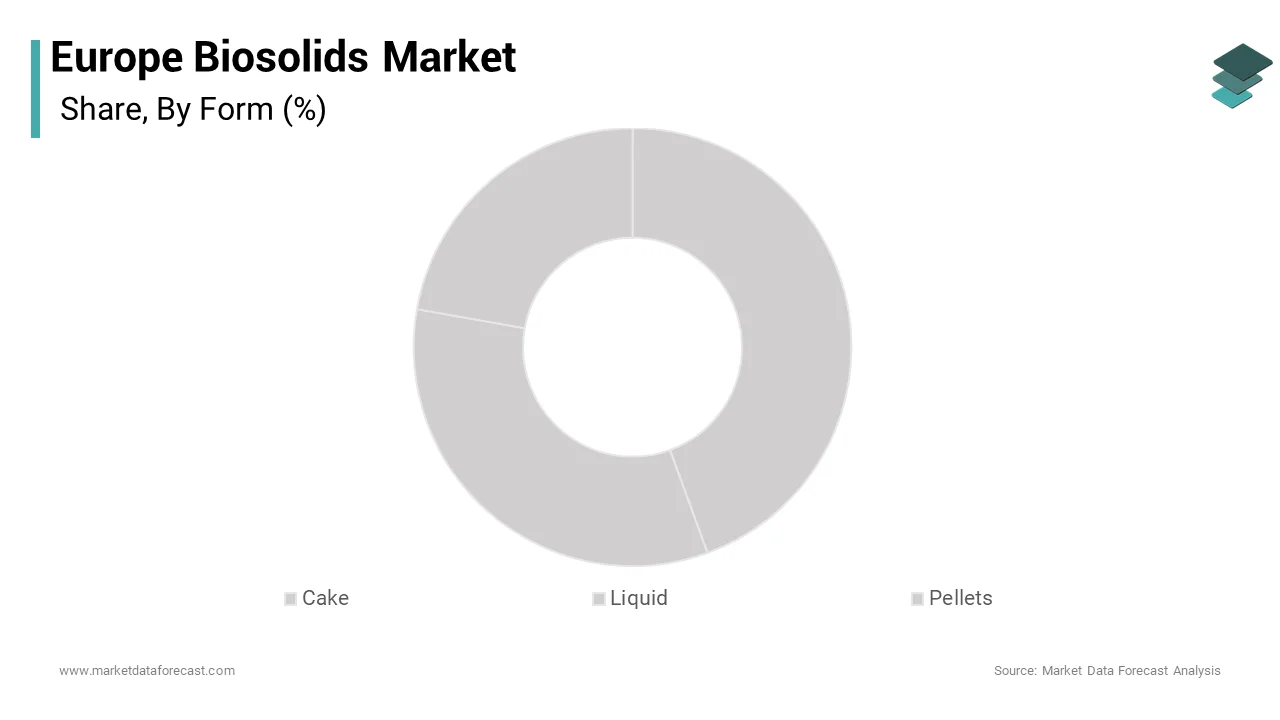
Cake form biosolids account for 62% of the Europe Biosolids Market by physical form, according to the European Water Association’s 2024 sludge management inventory. This dominance stems from its balance of moisture reduction, transport efficiency, and compatibility with existing land application infrastructure.
Key Driver One: Cost-Effective Dewatering Infrastructure Across Municipal Plants
Most European wastewater treatment facilities are equipped with belt filter presses or centrifuges that produce biosolids cake with 20 to 30% dry solids content. According to the European Environment Agency, over 85% of large treatment plants in the EU utilize mechanical dewatering as a standard practice, avoiding the high energy costs of thermal drying. In Germany, the average cost to produce cake is €35 per dry ton, compared to €120 for pellets, as reported by the German Water Association. France’s national water agency notes that 74% of biosolids applied to farmland in 2023 were in cake form due to direct compatibility with agricultural spreaders. This widespread infrastructure alignment ensures cake remains the default output for municipalities prioritizing operational economy over premium product development.
Key Driver Two: Established Regulatory Acceptance for Agricultural Use
National guidelines across Europe explicitly recognize dewatered cake as suitable for land application when pathogen and contaminant thresholds are met. According to the UK’s Sludge Use in Agriculture Regulations, cake form biosolids meeting Class B criteria may be applied to non-root crops with minimal buffer requirements. Similarly, Spain’s Royal Decree 1310/1990 permits the application of cake and forage fields, provided metal concentrations remain below defined limits. The Netherlands’ Rijkswaterstaat confirms that over 90% of biosolids distributed to farmers in 2023 were dewatered cake, supported by decades of agronomic monitoring data showing no significant soil accumulation of regulated substances. This regulatory familiarity reduces approval delays and fosters trust among farmers, reinforcing cake’s position as the backbone of Europe’s biosolids reuse strategy.
Pelletized biosolids are the fastest growing form in the Europe Biosolids Market, projected to expand at a compound annual growth rate of 8.9% from 2024 to 203,0 according to the European Fertilizer Association’s 2024 nutrient recycling outlook.
Key Growth Factor One: Commercialization as Branded Organic Fertilizers
Pellets offer uniform composition, odor control, and retail packaging potential, enabling biosolids to enter commercial fertilizer markets. According to the French Ministry of Agriculture, pelletized biosolids branded as “BioNutra” and “EcoPhos” accounted for 18% of organic fertilizer sales in horticulture and viticulture in 2024, up from 7% in 2021. In Sweden, the company Ragn Sells markets certified biosolids pellets under the “Svegro” label, approved for use on food crops due to stringent thermal treatment. The European Commission’s Fertilizing Products Regulation now includes processed biosolids iCE-marketed organic blends, provided they meet pathogen and contaminant thresholds. This regulatory opening allows utilities to generate revenue beyond cost recovery, transforming biosolids from a municipal byproduct into a consumer-facing soil amendment.
Key Growth Factor Two: Reduced Transport Emissions and Urban Application Suitability
Pellets contain 90% dry solids, reducing transport weight by up to 70% compared to cake and lowering carbon footprint per ton delivered. According to the Dutch Environmental Assessment Agency, switching from cake to pellets for biosolids distribution in the Randstad region cut logistics emissions by 41% in 2023. Additionally, pellets’ dust-free, odor-controlled nature makes them ideal for urban landscaping, sports fields, and green infrastructure projects where public acceptance is critical. The City of Copenhagen now uses biosolids pellets exclusively in municipal parks after a 2022 public consultation showed 78% support for the granular format versus 32% for traditional cake. This combination of environmental efficiency and social acceptability is accelerating pellet adoption in high-density regions.
By Class Segment Insights
Class B biosolids represent 55% of the Europe Biosolids Market by treatment class according to the European Commission’s 2024 sludge quality monitoring report. This category includes biosolids treated to significantly reduce but not eliminate pathogens, suitable for restricted agricultural use.
Key Driver One: Lower Treatment Costs and Widespread Infrastructure Compatibility
Class B treatment—typically achieved through anaerobic digestion or lime stabilization—is far less capital and energy-intensive than Class A processes. According to the German Association of Municipal Utilities, 78% of German wastewater plants produce Class B biosolids due to the high cost of thermal or advanced oxidation systems required for Class A. In Poland, where municipal budgets are constrained, over 90% of biosolids are classified as Class B, applied only to non-food crops with mandatory waiting periods before harvest as per national law. The European Environment Agency confirms that Class B remains the default for small and medium treatment plants serving populations under 100,000, which constitute 68% of all EU facilities. This economic pragmatism ensures Class B’s continued dominance despite stricter emerging standards.
Key Driver Two: Regulatory Acceptance for Non-Sensitive Agricultural Use
EU member states with extensive arable land readily accept Class B biosolids for cereal, forage, and fiber crops under controlled protocols. According to France’s National Institute for Agricultural Research, Class B biosolids applied to wheat fields show no detectable pathogen transfer to grain when 30 day pre harvest intervals are observed. Spain’s Ministry of Ecological Transition permits Class B use on olive groves and vineyards covering over 2.5 million hectares, provided soil pH remains above 6.5 to immobilize metals. In Romania, Class B biosolids from Bucharest’s Glina plant fertilize 12,000 hectares of sunflower fields annually under a state-monitored program. This agronomic integration, backed by decades of field data, sustains demand for Class B as a cost-effective soil conditioner in low-risk cropping systems.
The class A-EQ segment is likely to grow with an expected CAGR of 9.4% throughout the forecast period. Class A-EQ biosolids undergo advanced treatment, such as composting at 55°C for 15 days or thermal drying above 80°C, which eliminates detectable pathogens. According to the UK’s Environment Agency, Class A-EQ products may be used on salad crops, school grounds, and residential gardens without restrictions. In the Netherlands, Rijkswaterstaat certified 14 biosolids products as Class A-EQ in 2023 by enabling use in organic farming trials under Eurostat’s agri-environmental indicators. Sweden’s Environmental Protection Agency now requires Class A-EQ for all biosolids applied within 500 meters of water bodies, driving upgrades at 22 treatment plants. This regulatory flexibility unlocks high-value applications previously inaccessible to conventional biosolids, particularly in urban and sensitive ecological zones. The European Commission’s Fertilizing Products Regulation allows Class A-EQ biosolids to be included in CE-marked organic fertilizers if heavy metals and micropollutants meet strict thresholds.
By Application Segment Insights
The agricultural land application segment accounted for a dominant share of the Europe biosolids market in 2024. The European Commission’s Common Agricultural Policy 2023–2027 includes biosolids as an eligible input under eco schemes that reward soil organic carbon enhancement. According to the Joint Research Centre, biosolids application increases soil organic matter by 0.2 to 0.5% annually, directly contributing to CAP conditionality requirements. In France, the “4 Per 1000” initiative provides €40 per hectare for organic amendments, including biosolids, leading to a 27% increase in applications between 2022 and 2024, as per the Ministry of Agriculture. With synthetic fertilizer prices remaining 40% above 2020 levels as per the European Fertilizer Association, biosolids offer a cost-stable alternative rich in nitrogen, phosphorus, and organic carbon. According to Germany’s Farmers Association, biosolids reduce fertilizer expenditures by €120 to €180 per hectare on cereal farms. In Spain, cooperatives in Castilla y León distribute biosolids free of charge to members in exchange for application logistics, covering over 85,000 hectares in 2023. The Netherlands’ Fertilizers Act grants nitrogen credit for biosolids, allowing farmers to offset synthetic use under national caps. These financial advantages, combined with nutrient security, make biosolids indispensable for cost-conscious and environmentally regulated farming operations across the continent.
The energy production from the segment is projected to expand at a CAGR of 10.2% throughout the forecast period. Wastewater plants are increasingly integrating biosolids into renewable energy systems to meet municipal climate targets. According to Sweden’s Energy Agency, 92% of large treatment plants now capture biogas from biosolids digestion, with 68% upgrading it to vehicle fuel. In Denmark, the Aarhus Marselisborg plant achieves energy neutrality by co-digesting biosolids with food waste, supplying electricity annually to the grid, as confirmed by Dansk Energi. Germany’s Renewable Energy Sources Act provides feed-in tariffs for biosolids-derived biogas, incentivizing 41 new co-digestion facilities in 2023 alone. This alignment with national energy transition roadmaps transforms biosolids from soil inputs into carbon-neutral fuel sources. Advanced thermal processes like pyrolysis and gasification simultaneously recover phosphorus and produce energy, addressing two strategic EU priorities. According to the European Institute for Energy Research, the AquaGreen plant in Copenhagen recovers 95% of phosphorus as struvite while generating 1.8 megawatts of thermal energy from biosolids. In Switzerland, the Eawag institute reports that mono incineration of biosolids yields 8 to 12 megajoules per kilogram, sufficient to power the treatment process with surplus export. The European Commission’s Critical Raw Materials Act identifies recovered phosphorus as a strategic material, accelerating investment in integrated facilities. This dual output model, energy plus nutrient makes thermal valorization economically compelling for utilities facing land application constraints.
COUNTRY ANALYSIS
Germany Biosolids Market Analysis
Germany was the top performer of the Europe Biosolids Market by holding 21.3% ofthe share in 2024, with the advanced wastewater infrastructure, strict fertilizer regulations, and a strong circular economy ethos. Over 1.2 million dry tons of biosolids are produced annually, with 72% used in agriculture under the Fertilizer Ordinance, which sets among the world’s strictest limits for cadmium and organic pollutants. Germany also leads in thermal recovery, with 18 mono incineration plants recovering phosphorus from ash. The federal government’s Climate Protection Act mandates all large treatment plants to achieve energy neutrality by 2045, accelerating biogas and pyrolysis adoption. This combination of regulatory precision, technological investment, and agricultural integration solidifies Germany’s position as Europe’s biosolids innovation and implementation leader.
United Kingdom Biosolids Market Analysis
The United Kingdom biosolids market growth is likely to grow, with the strengthening of a mature land application program covering over 700,000 hectares of farmland annually, supported by the Sludge Use in Agriculture Regulations. Over 85% of biosolids are treated to Class B or higher, with growing investment in Class A-EQ production for unrestricted use. The UK’s Net Zero Strategy explicitly includes biosolids in carbon farming initiatives by enabling participation in soil carbon markets. In 2023, Thames Water launched a £45 million thermal drying facility producing odor-free pellets for horticulture. Additionally, Scotland’s Zero Waste Plan bans biosolids landfilling, mandating reuse or energy recovery. This policy coherence across environmental, agricultural, and climate domains ensures robust and diversified biosolids utilization.
France Biosolids Market Analysis
France's biosolids market growth is likely to grow with the agricultural valorization, with 78% of biosolids applied to crops under the National Waste Prevention Program. France leads in biosolids composting, operating over 120 dedicated facilities that produce stabilized amendments for vineyards and cereal farms. Paris’s Seine Aval plant recovers phosphorus via struvite crystallization at an industrial scale, supplying 1,500 tons annually to local farmers. Moreover, new regulations require all treatment plants over 100,000 population equivalents to implement micropollutant removal by 2026, spurring investment in ozonation. France’s blend of agronomic tradition and regulatory foresight sustains its central role in biosolids circularity.
Netherlands Biosolids Market Analysis
The Netherlands Biosolids Market growth is likely to grow with a pioneer in high-value biosolids processing, with near zero landfilling and 88% agricultural reuse. Dutch policy bans biosolids incineration unless contaminated, prioritizing nutrient return to soils. The nation leads in Class A-EQ certification, with 14 CE-marked biosolids fertilizers approved for organic farming. Amsterdam’s Waterschap Amstel Gooi en Vecht operates a full-scale struvite recovery plant producing “Phoskraft,” marketed across Benelux. Additionally, the Netherlands mandates phosphorus recovery from all large plants by 2030 under the National Circular Economy Program. This systemic integration of biosolids into nutrient security and soil health frameworks makes the Netherlands a benchmark for advanced circular management.
Sweden Biosolids Market Analysis
Sweden's biosolids market is growing steadily with its dual focus on energy recovery and ecological safety. Over 90% of biosolids are used in agriculture, but only after rigorous testing for per and polyfluoroalkyl substances, with strict bans on food crop application if contaminants exceed 0.1 micrograms per kilogram. Simultaneously, Sweden leads in biogas production, with biosolids co-digested to fuel 300 public buses in Stockholm alone, as per the Swedish Energy Agency. The national phosphorus strategy requires all treatment plants to recover at least 60% of phosphorus by 2035. This balanced approach,h prioritizing both climate action and environmental protection, positions Sweden as a model for sustainable biosolids governance in high environmental standard jurisdictions.
COMPETITIVE LANDSCAPE
Competition in the Europe Biosolids Market is defined by a unique blend of public water authorities, specialized private operators, and integrated environmental service conglomerates. Unlike conventional markets driven by pricing, competition here centers on regulatory compliance, technological sophistication, and public acceptance. Public utilities dominate volume due to their control over wastewater infrastructure, while private firms differentiate through brandehigh-qualityity biosolids products for premium agricultural and landscaping segments. The market is highly fragmented by national regulations, with leaders in Germany and the Netherlands excelling in thermal recovery and nutrient extraction, while France and the UK lead in land application scale. Innovation is concentrated on micropollutant removal, odor control, and carbon footprint reduction. Success requires deep collaboration with farmers, regulators, and researchers to ensure biosolids are perceived not as residual waste but as a trusted, circular input for soil health and food security in a resource-constrained Europe.
KEY MARKET PLAYERS
These are the market players that dominate the Europe biosolids market.
- Synagro
- SUEZ (now part of Veolia following merger integration)
- GeoEnvironment Technologies
- Waterschap Vallei en Veluwe
- Ragn Sells AB
- Casella Organics
- BIODISK Corporation
- Wm. H. Reilly & Company
Top Players In The Market
- SUEZ has been a cornerstone of the Europe Biosolids Market through its integrated wastewater and resource recovery operations across France, Spain, and Central Europe. The company manages over 200 treatment plants that process municipal sludge into agricultural biosolids and recovered phosphorus products. SUEZ completed the integration of its biosolids division into Veolia’s circular economy platform, enabling wider distribution of its branded pelletized fertilizer “Phoslab” across the Benelux and Germany. It also launched a digital traceability system linking biosolids batches to farm application records by enhancing compliance with EU fertilizer regulations. These actions reinforce its role as a leader in transforming sewage residuals into certified, traceable soil nutrients aligned with European sustainability mandates.
- Ragn Sells AB is a prominent Nordic player in the Europe Biosolids Market, specializing in advanced thermal treatment and organic fertilizer production in Sweden and Finland. The company operates high temperature drying and pelletizing facilities that convert biosolids into Class A-EQ compliant products such as “Svegro,” approved for use in sensitive agricultural and urban green spaces. Ragn Sells commissioned a new phosphorus recovery line at its Himmerfjärdsverket plant, enabling struvite extraction from dewatered sludge for sale to organic farms. It also partnered with the Swedish University of Agricultural Sciences to validate long-term soil carbon benefits of its biosolids pellets. These initiatives position Ragn Sells at the intersection of nutrient security, climate action, and premium soil amendment markets in Northern Europe.
- Waterschap Vallei en Veluwe, a Dutch regional water authority, exemplifies the public utility model driving biosolids innovation in Europe. It processes over 100,000 dry tons of sludge annually into certified biosolids used on Dutch farmland under strict contaminant controls. In 2024, the authority launched “BioCirkel,” a CE-marked pelletized biosolids product co-developed with research institute WUR, meeting criteria for use in organic potato cultivation. It also implemented real-time microplastic and pharmaceutical screening at its Amersfoort facility to ensure compliance with emerging Dutch safety thresholds. By treating biosolids as a public good rather than waste, the water board demonstrates how decentralized, science-led governance can achieve high reuse rates while maintaining public trust and environmental integrity.
Top Strategies Used by the Key Market Participants
Key players in the Europe Biosolids Market focus on advanced treatment technologies to produce Class A-EQ and pelletized products meeting stringent EU fertilizer standards. They invest in phosphorus and nutrient recovery systems to align with critical raw material strategies. Companies develop digital traceability platforms to ensure regulatory compliance and farm-level accountability. Public-private partnerships with agricultural research institutes validate agronomic and environmental benefits through long-term field trials. Additionally, they pursue CE certification under the Fertilizing Products Regulation to access commercial organic fertilizer markets and expand beyond traditional municipal distribution models.
MARKET SEGMENTATION
This research report on the Europe biosolids market is segmented and sub-segmented into the following categories.
By Form
- Cake
- Liquid
- Pellets
By Class
- Class A
- Class A-EQ
- Class B
By Application
- agricultural land application
- non-agriculture land application
- energy production
By Country
- UK
- France
- Spain
- Germany
- Italy
- Russia
- Sweden
- Denmark
- Switzerland
- Netherlands
- Turkey
- Czech Republic
- Rest of Europe