- Product Description Description
- Table of Contents TOC
- List of Table & Figure LOT
- Get Free Sample PDF Sample PDF
Europe Biotechnology Market Size
The europe biotechnology market size was valued at USD 0.49 trillion in 2024 and is anticipated to reach USD 0.57 trillion in 2025 from USD 1.69 trillion by 2033, growing at a CAGR of 14.60% during the forecast period from 2025 to 2033.
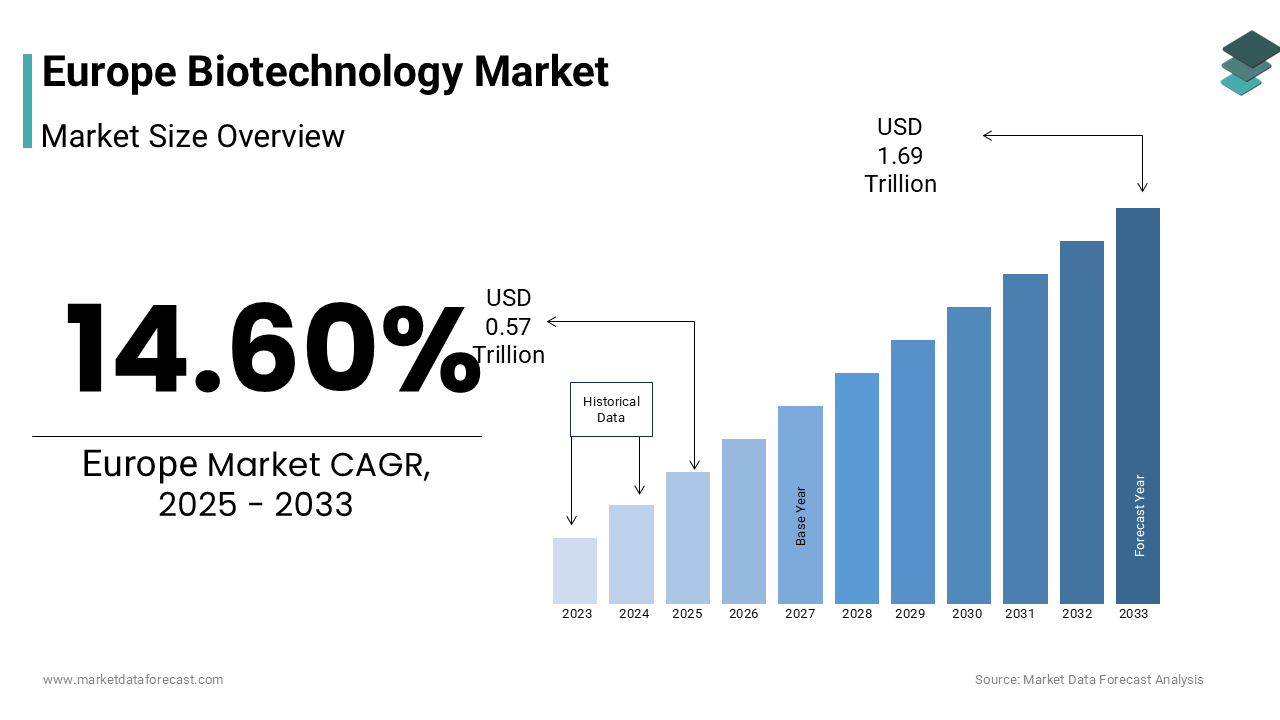
Biotechnology is the use of living organisms, biological systems, or their components to develop products and technologies. Stringent regulatory oversight guides the European sector's focus on red biotechnology, particularly its work in advanced therapies, diagnostics, and biopharmaceuticals. The European Union fosters innovation through coordinated frameworks such as Horizon Europe and the European Innovation Council while national ecosystems in Germany France the United Kingdom and Switzerland serve as primary hubs. According to Eurostat's provisional data for 2024, the total government budget for R&D (GBARD) was €127.9 billion across the EU. The health sector, which includes biotechnology, received about 7% of this total. As per sources, a portion of new active substances approved in 2024 were biologics, which emphasizes the sector’s centrality to modern therapeutics. Apart from these, The European Commission's communication on "Boosting Biotechnology and Biomanufacturing in the EU" (March 2024) emphasized the role of these sectors in advancing the EU's strategic autonomy and economic security. In October 2023, the Commission had also identified biotechnology as a critical technology for the EU's economic security. This supports biotechnology as a pillar of both economic competitiveness and public health resilience.
MARKET DRIVERS
Rising Prevalence of Chronic and Rare Diseases Fuels Demand for Advanced Biologics
The escalating burden of chronic and rare conditions in the region encourages the growth rate of the Europe biotechnology market. This offers targeted mechanisms unattainable through conventional small molecule drugs. According to the World Health Organization, non communicable diseases accounted for a porion of all deaths in the European Region with cardiovascular disorders cancer and diabetes as leading contributors. Simultaneously, the European Organisation for Rare Diseases estimates that millions of Europeans are affected by rare conditions a portion of which are genetic and manifest in childhood. Biologics including monoclonal antibodies gene therapies and recombinant proteins address these complex pathologies with high specificity. In addition, the European Medicines Agency granted marketing authorization to advanced therapy medicinal products. This therapeutic imperative driven by unmet medical needs continues to anchor biotechnology as indispensable to Europe’s healthcare evolution.
Strong Public and Private Investment in Genomic and Precision Medicine Initiatives
Region’s strategic commitment to genomic science and precision medicine has accelerated the expansion of the Europe biotechnology market. According to sources, genomic medicine has become a major focus in many European countries, with numerous national initiatives advancing genome sequencing efforts. The United Kingdom is among the leaders by having successfully sequenced a large number of whole genomes from NHS patients, which supports progress in gene-based diagnostic and therapeutic development, as per research. France has similarly invested heavily in building advanced sequencing platforms across the country, which shows promising improvements in diagnosing rare diseases, according to sources. These coordinated efforts generate high quality datasets that de risk biotech R&D and accelerate biomarker discovery. Europe is not only advancing scientific capability but also creating demand pull for biotechnology solutions that interpret and act on complex molecular information by embedding genomics into routine care.
MARKET RESTRAINTS
Stringent and Prolonged Regulatory Approval Pathways Delay Market Access
The European regulatory framework for biotechnology products, while ensuring high safety standards, often imposes lengthy and complex approval timelines that hinder timely patient access, commercial viability, and the growth of the European biotechnology market. Unlike the United States, where the Food and Drug Administration offers expedited pathways the European Medicines Agency requires parallel scientific advice national reimbursement assessments and health technology evaluations that can extend time to market by several months beyond clinical validation. According to a study, the median review time for advanced therapy medicinal products was significant number of days excluding pre submission consultations and post approval risk management planning. In the case of gene therapies developers must navigate additional requirements under the Clinical Trials Regulation and the EU Tissues and Cells Directives. As per a source many small and medium-sized biotech firms face significant challenges due to regulatory uncertainties, causing delays in launching their products across Europe. This procedural complexity disproportionately affects innovative startups with limited resources thereby constraining the pace at which breakthrough therapies reach patients despite scientific readiness.
Ethical and Societal Resistance to Certain Biotechnological Applications
Public skepticism and ethical debates surrounding specific biotechnology domains, notably gene editing synthetic biology and human tissue engineering, continue to impede research translation and policy support in several European countries, which hampers the expansion of the Europe biotechnology market. The European Group on Ethics in Science and New Technologies reiterated in its 2021 opinion that germline genome editing remains ethically unacceptable in the EU aligning with the Oviedo Convention which 29 European states have ratified. Consequently, clinical development in this area is effectively prohibited limiting Europe’s role in next generation genetic medicine. Similarly public opposition has influenced national legislation as seen in Germany where the Embryo Protection Act strictly forbids the creation of embryos for research purposes restricting stem cell based innovation. According to sources, only a small share of EU citizens expressed strong support for synthetic biology applications in healthcare with concerns centered on unintended ecological and social consequences. Such sentiment translates into cautious funding allocations and restrictive oversight further fragmenting the innovation landscape and deterring private investment in frontier biotechnologies.
MARKET OPPORTUNITIES
Expansion of Cross Border Health Data Infrastructure Enables Real World Evidence Generation
The maturation of the region’s health data ecosystem is fuelling new opportunities for the growth of the Europe biotechnology market. This helps firms to generate robust real world evidence essential for regulatory approval and value demonstration. Under the European Health Data Space framework adopted in 2025, member states are establishing health data access bodies (HDABs) that allow for secure secondary use of pseudonymized patient records for research purposes. Denmark’s national biobank, combined with electronic health records, has become a key resource supporting numerous biotech collaborations, significantly speeding up study initiation times, as per research. Similarly, Estonia’s genomic and health data platform is playing a crucial role in validating new therapies efficiently by leveraging large patient datasets, according to sources. These infrastructures lower evidence generation costs accelerate trial recruitment and enhance post marketing surveillance thereby transforming how biotech innovations are evaluated and adopted across Europe.
Growing Integration of Artificial Intelligence in Bioprocessing and Drug Discovery
The convergence of artificial intelligence with biotechnology is causing efficiency gains in target identification protein engineering and manufacturing optimization, which in turn opens fresh prospects for the expansion of the Europe biotechnology market. Many biotech companies across Europe are adopting AI-driven platforms to enhance antibody design and cell line development, significantly shortening preclinical research timelines, as per research. In Switzerland, collaborations between academic institutions and industry have led to innovative AI-powered systems that improve bioreactor efficiency and increase antibody production, according to sources. France is also fostering AI innovation in biotech through dedicated initiatives supporting startups focused on advanced protein modeling, with some quickly advancing to clinical development stages, as per research. The European Medicines Agency also published a reflection paper in September 2024 outlining principles for validating AI algorithms in regulatory submissions signaling institutional readiness. This synergy between computational power and biological insight is redefining R&D productivity and positioning Europe at the forefront of intelligent biomanufacturing.
MARKET CHALLENGES
Fragmented Intellectual Property Enforcement Across Jurisdictions
Inconsistent interpretation and enforcement of intellectual property rights across national courts affects innovation incentives and expansion of the Europe biotechnology market. The Unified Patent Court handles disputes for participating states but 11 EU members including Spain and Poland remain outside its jurisdiction creating parallel litigation risks. As per research, biotech patents are frequently involved in complex cross-border litigation cases across Europe, often leading to prolonged resolution times. According to sources, conflicting patent rulings in different European countries can significantly delay the commercialization of innovative biotech products. Small enterprises lack the resources to sustain multi jurisdictional legal battles leading many to avoid high risk markets or license technologies prematurely. This legal uncertainty discourages long term R&D investment particularly in platform technologies where patent scope is inherently complex and contested.
Critical Shortage of Specialized Talent in Emerging Biotech Disciplines
A deficit of professionals skilled in interdisciplinary domains such as bioinformatics, cell and gene therapy manufacturing, and regulatory science for advanced therapies continues to be a major challenge for the European biotechnology market. According to research, a portion of biotech employers reported difficulty recruiting qualified personnel with expertise in viral vector production or AI driven drug design. The mismatch stems from academic curricula lagging behind industry needs and limited vocational training in Good Manufacturing Practice for novel modalities. As per research, many biotech facility expansion projects in Ireland have faced delays due to staffing shortages, particularly in clean room operations. In Sweden, a notable gap exists in practical technical skills among recent biotechnology graduates, especially in areas like single cell sequencing and flow cytometry automation, according to sources. A shortage of skilled workers, due to a lack of targeted education reform and cross-sector training, will continue to impede the growth and commercialization of the European biotechnology industry
REPORT COVERAGE
| REPORT METRIC | DETAILS |
| Market Size Available | 2024 to 2033 |
| Base Year | 2024 |
| Forecast Period | 2025 to 2033 |
| Segments Covered | By Technology, Application, and Region. |
| Various Analyses Covered | Global, Regional, & Country Level Analysis; Segment-Level Analysis, Drivers, Restraints, Opportunities, Challenges, PESTLE Analysis, Porter’s Five Forces Analysis, Competitive Landscape, Analyst Overview of Investment Opportunities |
| Regions Covered | UK, France, Spain, Germany, Italy, Russia, Sweden, Denmark, Switzerland, the Netherlands, Turkey, the Czech Republic, and the Rest of Europe. |
| Key Market Players | BioNTech SE, Lonza Group AG, Evotec SE, Roche Holding AG, Novartis AG, AstraZeneca PLC, Sanofi S.A., Bayer AG, Novo Nordisk A/S, GlaxoSmithKline plc (GSK), Qiagen N.V., Genmab A/S, Merck KGaA, UCB S.A., and Boehringer Ingelheim. |
SEGMENTAL ANALYSIS
By Technology Insights
In 2024, the DNA sequencing segment dominated the European biotechnology technology segment by accounting for 42.3% share. Its foundational role in precision medicine large scale genomic initiatives and diagnostic innovationhas largely attributed to the growth of the DNA sequencing segment in the regional market. As per the European Commission, sequencing accounted for a share of biotechnology technology expenditure, which reflectes its integration into national healthcare strategies. The primary driver is the operationalization of population genomics programs such as the UK’s 100000 Genomes was completed in December 2018, with results returned to the NHS by July 2019, according to sources. Apart from these, the European Reference Networks for rare diseases rely on cross border sequencing data with healthcare units contributing to shared diagnostic platforms. This institutional embedding ensures sustained demand beyond research into clinical care pathways.
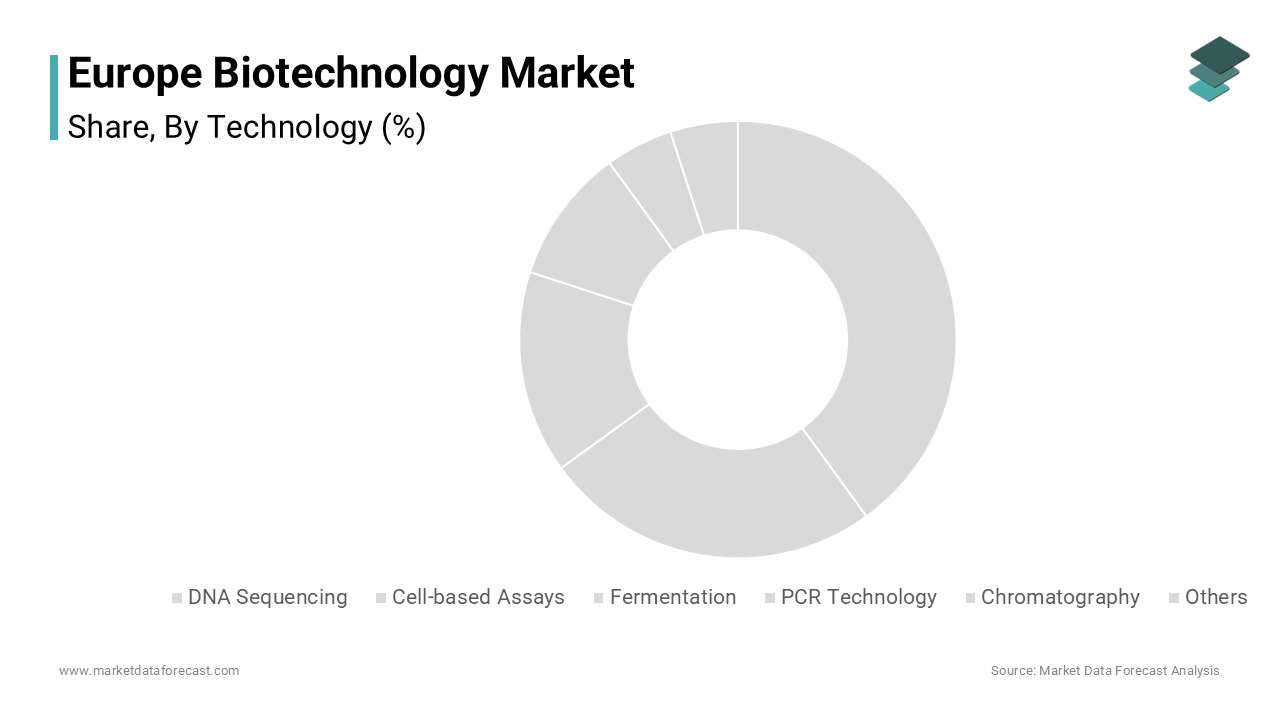
The cell-based assays segment is on the rise and is expected to be the fastest growing segment in the global market by witnessing a CAGR of 18.7% share of 2024. The growth of the cell-based assays segment is due to rising demand for physiologically relevant drug screening models and regulatory shifts favoring human cell derived toxicity testing. The European Union implemented a comprehensive ban on the marketing of cosmetics tested on animals (including ingredients) in March 2013 and has since intensified promotion of human cell based alternatives for pharmaceutical and chemical safety assessment. This policy environment has spurred adoption in both industry and academia. As per research, there is a growing trend in Germany towards including cell-based assay data in new chemical dossiers, reflecting increased adoption of advanced testing methods. Furthermore, the European Medicines Agency recently updated its guidance to encourage the use of 3D organoid and induced pluripotent stem cell models for drug development in oncology and neurology, accelerating industry adoption, according to sources. Some companies have expanded their GMP-compliant assay production capabilities to meet increasing demand from pharmaceutical partners, as per research. These converging regulatory scientific and commercial forces underpin the segment’s rapid growth trajectory.
By Application Insights
The health application segment led the European biotechnology market by capturing a substantial share in 2024. The prominence of the health application segment is propelled by the Europe’s aging population and high burden of complex diseases which necessitate biotechnology derived solutions. As per sources, a notable share of biotechnology activity was directly linked to human health applications including biologics advanced therapies and in vitro diagnostics. According to research, biologics constituted a share of oncology treatments approved in the EU. National health systems increasingly reimburse these innovations with Germany and the United Kingdom have implemented programs to accelerate patient access to orphan biologics and innovative therapies, as per research. Apart from these, the EU’s response to pandemic threats reinforced health biotech through initiatives allocated funds to strengthen vaccine and therapeutic manufacturing capacity, as per sources. This policy and clinical alignment ensures health remains the core application domain.
The bioinformatics segment is expected to exhibit a noteworthy CAGR of 22.1% from 2025 to 2033 owing to exponential data generation from genomics proteomics and digital pathology requiring advanced computational interpretation. According to research, the volume of biological data stored in European public repositories grew, which necessitates scalable analytical infrastructure. The European Health Data Space regulation mandates that member states enable secondary use of health data for research which has triggered national investments in bioinformatics cores. Denmark is using AI-driven variant interpretation for genomic sequencing, notably for oncology with a system from QIAGEN, and is a world leader in rare disease research, as per sources. These developments position bioinformatics not as a support function but as a strategic enabler of data driven biotechnology.
REGIONAL ANALYSIS
Germany Biotechnology Market Insights
Germany was the top performer in the European biotechnology market and accounted for 24.9% share in 2024. The domination of Germany is primarily driven by a dense innovation ecosystem robust manufacturing base and strong public research funding. The country accounted for a portion of Europe’s biotechnology activity, according to sources. Central to this dominance is the Biotechnology 2030 strategy which allocated amount to support startups scale ups and technology transfer. Germany hosts numerous biotech firms concentrated in clusters such as Munich Berlin and Rhine Neckar with a portion engaged in therapeutic development. Additionally, the country’s dual vocational training system produces highly skilled bioprocess technicians with the Fraunhofer Society operating pilot scale GMP facilities that de risk scale up for SMEs. This integration of science policy and industry infrastructure sustains Germany’s preeminent position.
United Kingdom Biotechnology Market Insights
The United Kingdom is the next prominent region in the Europe biotechnology market by occupying a share of 19.5% in 2024. Factors such as world class academic institutions streamlined regulatory pathways and strategic public investment has majorly contributed to the growth of the United Kingdom. As per studies, the country hosts many life science companies with biotechnology representing a portion of early stage therapeutic pipelines. The United Kingdom’s Medicines and Healthcare products Regulatory Agency has implemented a pathway that significantly shortens approval times for new biologics, improving market access compared to the broader European average, as per research. The country’s Life Sciences Vision initiative has made substantial financial commitments to research and development, with focused investment in genomics and cell and gene therapy manufacturing, according to sources. In 2024, the Cell and Gene Therapy Catapult had supported numerous clinical programs and expanded production capacity to meet growing patient treatment needs, as per research. Despite Brexit the UK maintains scientific collaboration through Horizon Europe association ensuring continued access to pan European research networks.
France Biotechnology Market Insights
France is a also a major region in the Europe biotechnology market with centralized strategic planning and strong emphasis on sovereign health capabilities. As per research, France’s biotech sector is a significant source of employment and continues to attract strong private investment. The country’s long-term investment plans prioritize health biotechnologies, with a focus on mRNA vaccines and therapies following the establishment of specialized research centers, according to sources. France also leads in rare disease biotech with companies focused on orphan therapies benefiting from the National Plan for Rare Diseases 2023–2027 which mandates early access to innovative treatments. The proportion of advanced therapy clinical trials in France has also been steadily increasing, reflecting growing innovation in this area, as per research. This policy coherence between research funding regulatory support and clinical implementation reinforces France’s strategic foothold.
Switzerland Biotechnology Market Insights
Switzerland witnessed moderate growth in the European biotechnology market owing to its cluster of global pharmaceutical leaders academic excellence and favorable innovation climate. Switzerland, a non-EU member, participates in Horizon Europe and upholds EU regulatory standards via mutual recognition agreements. As per sources, the country hosted 420 biotech firms with aa portion collaborating with Novartis or Roche on platform technologies. Switzerland leads in cell therapy manufacturing with the University Hospital Zurich operating one of Europe’s largest GMP facilities for CAR T cell production treating many patients in 2024. The Swiss National Science Foundation funded biotechnology projects with emphasis on protein engineering and synthetic biology. Apart from these, the country’s dual education system produces specialized bioprocess engineers with a portion employment rates in the sector, as per research. This synergy of industry academia and policy ensures outsized influence relative to population size.
Netherlands Biotechnology Market Insights
The Netherlands is predicted to grow in the European biotechnology market from 2025 to 2033 with strengths in industrial biotechnology biopharmaceuticals and cross sectoral innovation. According to studies, the biotech sector contributed notably to GDP and supported high value jobs. The country excels in viral vector manufacturing with companies like Batavia Biosciences and Amsterdam based Univercells scaling modular production platforms to meet European demand for gene therapies. The Dutch government committed significant amount to the Biotech Campus Delft which housed many companies and some shared GMP facilities. The Netherlands also leads in regulatory science. This combination of infrastructure policy and international collaboration cements the Netherlands as a pivotal biotech hub.
COMPETETIVE LANDSCAPE
The Europe biotechnology market features a multifaceted competitive environment where large integrated firms coexist with agile specialized startups and academic spin outs. Competition is less about price and more about scientific differentiation regulatory agility manufacturing scalability and alignment with public health priorities. Large companies leverage global distribution and established regulatory dossiers while smaller entities compete through niche therapeutic focus or disruptive platform technologies. National innovation policies create uneven playing fields with Germany France and Switzerland offering superior funding and infrastructure compared to Southern and Eastern European regions. Cross border collaboration is essential yet complicated by divergent intellectual property regimes and reimbursement systems. The absence of a unified European biotech champion has led to strategic acquisitions by non European entities raising concerns about technology outflow. Nevertheless, Europe remains a global leader in cell and gene therapy mRNA science and diagnostics driven by world class research institutions and a strong ethical governance framework that shapes responsible innovation.
KEY MARKET PLAYERS
A few of the major companies in the europe biotechnology market include
- BioNTech SE
- Lonza Group AG
- Evotec SE
- Roche Holding AG
- Novartis AG
- AstraZeneca PLC
- Sanofi S.A.
- Bayer AG
- Novo Nordisk A/S
- GlaxoSmithKline plc (GSK)
- Qiagen N.V.
- Genmab A/S
- Merck KGaA
- UCB S.A.
- Boehringer Ingelheim
Top Players in the Europe Biotechnology Market
Novo Nordisk
Novo Nordisk is a Denmark headquartered global leader in biopharmaceuticals with deep roots in protein engineering and recombinant therapeutics. The company plays a pivotal role in the European biotechnology ecosystem through its extensive R&D infrastructure in Denmark and strategic manufacturing sites across Germany and France. Novo Nordisk contributes significantly to global markets with its insulin analogs GLP 1 receptor agonists and emerging RNA interference platforms. This investment aligns with EU health security goals and reinforces Novo Nordisk’s commitment to scalable sustainable biomanufacturing while supporting clinical supply for global trials in obesity and rare endocrine disorders.
Roche Diagnostics
Roche Diagnostics a division of the Swiss headquartered F Hoffmann La Roche Group is a cornerstone of Europe’s molecular diagnostics and precision medicine landscape. The company integrates biotechnology with advanced analytics to deliver companion diagnostics next generation sequencing workflows and digital pathology solutions used across academic hospitals and reference labs. Roche’s contribution to the global market includes standardized NGS panels and liquid biopsy platforms adopted in over 100 countries. This innovation reduces turnaround time for oncology biomarker results by 50 percent and strengthens Roche’s position as an enabler of data driven personalized therapy across fragmented European healthcare systems.
BioNTech
BioNTech is a Mainz based biotechnology pioneer renowned for its mRNA platform that catalyzed a paradigm shift in vaccine and therapeutic development. The company’s scientific leadership extends globally through partnerships with Pfizer Sanofi and Genentech for oncology infectious disease and autoimmune applications. Within Europe BioNTech operates one of the continent’s most advanced mRNA manufacturing networks with facilities in Germany France and Turkey. This facility supports both commercial supply and clinical trials for individualized neoantigen therapies.
Top Strategies Used by the Key Market Participants
Key players in the Europe biotechnology market prioritize vertical integration by controlling critical segments of the value chain from target discovery to commercial manufacturing to ensure supply chain resilience and intellectual property protection. They actively pursue public private partnerships with national governments and EU institutions to co fund high risk R&D in advanced therapies and pandemic preparedness. Strategic site localization is another core approach with companies establishing regional manufacturing and regulatory hubs to comply with evolving health sovereignty mandates. Continuous investment in platform technologies such as mRNA viral vectors and AI driven protein design enables rapid pipeline diversification. Additionally firms engage in proactive regulatory science by collaborating with the European Medicines Agency to shape guidelines for novel modalities thereby accelerating approval pathways and market access.
MARKET SEGMENTATION
This research report on the europe biotechnology market has been segmented based on the following categories.
By Technology
- DNA Sequencing
- Cell-based Assays
- Fermentation
- PCR Technology
- Chromatography
- Others
By Application
- Health
- Food & Agriculture
- Natural Resources & Environment
- Industrial Processing
- Bioinformatic
- Others
By Country
- UK
- France
- Spain
- Germany
- Italy
- Russia
- Sweden
- Denmark
- Switzerland
- Netherlands
- Turkey
- Czech Republic
- Rest of Europe