- Product Description Description
- Table of Contents TOC
- List of Table & Figure LOT
- Get Free Sample PDF Sample PDF
Market Size, 2025
$21.49 BnMarket Estimate, 2026
$2.55 BnMarket Forecast, 2034
$33.11 BnCAGR, 2026–2034
4.92%Executive Summary: European Bitumen Market
- Market Scope: Regional analysis of Europe's bitumen sector, detailing product grades, application utilities, green transition pressures, and country-level profiles.
- Market Valuation: Valued at USD 21.49 billion in 2025, reaching USD 2.55 billion in 2026, and projected to expand to USD 33.11 billion by 2034, growing at a CAGR of 4.92% from 2026 to 2034.
- Primary Growth Drivers: Substantial regional investments in road infrastructure maintenance, transportation connectivity, and the rapid shift toward high-performance polymer-modified bitumen (PMB).
Key Market Segment Metrics
| Category | Leading Segment (Base Position) | Fastest-Growing / High-Growth Segment |
|---|---|---|
| By Product Type | Paving Grade Bitumen (held 60.7% market share in 2024, anchored by its extensive use in road construction and maintenance) | Polymer-Modified Bitumen (PMB) (projected at a 12.3% CAGR, driven by superior durability and EU Green Deal alignment) |
| By Application | Road Construction (dominated with 85.5% share in 2024, supported by large public infrastructure budgets like the CEF) | Waterproofing Adhesives (expected to register a 9.1% CAGR, driven by rising Western European energy-efficient building standards) |
| By Country / Region | Germany (market leader with 20.8% share in 2024, backed by a massive road network and high infrastructure outlays) | France (projected at a 6.2% CAGR, propelled by urban transit projects like Grand Paris and sustainable material shifts) |
Major Market Players & Industry Landscape
Market Structure: Consolidated industrial landscape anchored by major energy corporations and chemical refiners transitioning toward bio-bitumen alternatives and low-emission production technologies.
Key Companies: Shell Plc, BP PLC, TotalEnergies, Nynas AB, Suncor Energy Inc., Chevron Corporation, Valero Energy Corporation, Exxon Mobil Corporation, China Petroleum & Chemical Corporation, Bouygues SA, Villas Austria GmbH, and Gazprom Neft.
Europe Bitumen Market Size
The European bitumen market size was valued at USD 21.49 billion in 2025 and is anticipated to reach USD 2.55 billion in 2026 from USD 33.11 billion by 2034, growing at a CAGR of 4.92% during the forecast period from 2026 to 2034.

Bitumen is a viscous, black, and sticky material derived primarily from crude oil distillation and is renowned for its adhesive and waterproofing properties. According to Eurostat, over 90% of bitumen produced in Europe is utilized in road construction and maintenance, playing an important role in the transportation sector. The European Union’s stringent environmental regulations and sustainability goals have significantly influenced the market landscape. Under frameworks like the European Green Deal, there is increasing emphasis on reducing carbon emissions from bitumen production and exploring eco-friendly alternatives such as polymer-modified bitumen (PMB) and bio-bitumen. According to the European Asphalt Pavement Association, the use of PMBs has grown by 15% over the past five years, driven by their superior performance and durability. According to the Food and Agriculture Organization, rising urbanization and population growth have increased the demand for robust infrastructure in Eastern Europe, where road networks are being expanded. According to the International Energy Agency, Europe accounts for nearly 20% of global bitumen consumption, reflecting its strategic importance.
MARKET DRIVERS
Increasing Road Infrastructure Development
The growing focus on road infrastructure development and maintenance with rising urbanization and transportation demands is driving Europeanrope bitumen market growth. According to Eurostat, over 50% of the EU’s total road network requires regular maintenance, with an estimated 70% of bitumen consumption dedicated to road construction and repairs. As per the European Investment Bank, approximately €100 billion is allocated annually for infrastructure projects under the Connecting Europe Facility (CEF), which is significantly boosting bitumen demand. According to the European Asphalt Pavement Association, Eastern European countries, such as Poland and Romania, are expanding their road networks by 8-10% annually to accommodate increasing vehicle traffic. This surge in infrastructure spending ensures sustained demand for bitumen in regions with aging road systems, reinforcing its critical role in supporting economic connectivity and mobility across Europe.
Rising Adoption of Polymer-Modified Bitumen (PMB)
The increasing adoption of polymer-modified bitumen (PMB) is driven by its superior performance characteristics and alignment with sustainability goals. According to the European Asphalt Pavement Association, the use of PMBs has grown by 15% over the past five years, with their application in high-performance road surfaces reducing maintenance costs by up to 30%. PMBs offer enhanced durability, resistance to deformation, and improved temperature stability, making them ideal for heavy-traffic roads and extreme weather conditions. According to the International Energy Agency, stringent environmental regulations under the European Green Deal have encouraged the shift toward sustainable alternatives like PMBs, which reduce lifecycle emissions. PMBs are becoming integral to modern road construction, with governments prioritizing long-lasting and eco-friendly materials, which is propelling the growth of the European bitumen market.
MARKET RESTRAINTS
Stringent Environmental Regulations
The increasing stringency of environmental regulations aimed at reducing carbon emissions and promoting sustainable materials is impeding the regional market expansion. As per the European Environment Agency, bitumen production contributes significantly to greenhouse gas emissions, with estimates suggesting that refining processes account for approximately 10% of the EU’s industrial carbon footprint. According to the European Green Deal, industries are mandated to cut emissions by 55% by 2030, whereas manufacturers need to adopt cleaner technologies. According to the International Energy Agency, rising taxes on fossil fuel-based products have increased production costs by up to 15% over the past five years. These regulatory pressures, coupled with public resistance to environmentally harmful materials, are hindering the market growth rate.
Fluctuating Crude Oil Prices
The volatility of crude oil prices directly impacts the cost of bitumen production. According to the European Commission’s Directorate-General for Energy, crude oil price fluctuations have caused bitumen prices to vary by as much as 25% annually over the past decade. This unpredictability creates financial uncertainties for both manufacturers and end-users in large-scale infrastructure projects where budgeting is critical. According to the International Monetary Fund, geopolitical tensions and supply chain disruptions have exacerbated price instability, with crude oil prices surging by over 40% in certain periods. Such volatility increases project delays and reduces profit margins for stakeholders. Consequently, the dependency on crude oil as a primary raw material remains a key challenge that is limiting the market's ability to achieve consistent growth amidst economic uncertainties.
MARKET OPPORTUNITIES
Development of Sustainable Bitumen Alternatives
The development and adoption of sustainable alternatives, such as bio-bitumen and recycled materials, are due to stringent environmental regulations. According to the European Environment Agency, incorporating recycled asphalt pavement (RAP) into new road projects can reduce raw material usage by up to 30%, significantly lowering carbon emissions. According to the Food and Agriculture Organization, the bio-bitumen, derived from renewable sources like vegetable oils and waste biomass, has gained traction with pilot projects showing a potential 20% reduction in lifecycle greenhouse gas emissions. According to the European Green Deals, the circular economy practices have further accelerated investments in these innovations. According to Eurostat, countries like Germany and France are leading this transition with over €500 million allocated annually for sustainable road construction projects by creating a lucrative growth avenue for eco-friendly bitumen solutions.
Expansion of Smart Road Technologies
Another major opportunity is the integration of bitumen with smart road technologies, which aligns with Europe’s focus on intelligent transportation systems. According to the European Investment Bank, over €20 billion is being invested in smart infrastructure projects, including roads equipped with solar panels, sensors, and electric vehicle charging lanes, all requiring specialized bitumen formulations. The International Energy Agency notes that polymer-modified bitumen (PMB) and other advanced variants are critical for these applications, offering durability and adaptability to high-tech road surfaces. Furthermore, the European Asphalt Pavement Association reports that smart road projects have grown by 12% annually since 2020, particularly in urbanized regions like Scandinavia and Western Europe. As governments prioritize innovation to enhance road safety and efficiency, the demand for high-performance bitumen is expected to surge, positioning the market at the forefront of technological advancements in infrastructure development.
REPORT COVERAGE
| REPORT METRIC | DETAILS |
| Market Size Available | 2025 to 2034 |
| Base Year | 2025 |
| Forecast Period | 2026 to 2034 |
| CAGR | 4.92% |
| Segments Covered | By Product Type, Application, and Country |
| Various Analyses Covered | Global, Region, Country-Level Analysis, Segment-Level Analysis; DROC, PESTLE Analysis; Porter’s Five Forces Analysis; Competitive Landscape; Analyst Overview of Investment Opportunities |
| Regions Covered | UK, France, Spain, Germany, Italy, Russia, Sweden, Denmark, Switzerland, the Netherlands, Turkey, the Czech Republic, and the Rest of Europe |
| Market Leaders Profiled | Shell Plc, BP PLC, Total S.A., Nynas AB, Royal Dutch Shell, Suncor Energy Inc., Chevron Corporation, Valero Energy Corporation, Exxon Mobil Corporation, China Petroleum and Chemical Corporation, Bouygues SA, Villas Austria GmbH, Gazprom Neft. |
SEGMENTAL ANALYSIS
By Product Insights
The paving grade bitumen segment led the market and held 60.7% of the European bitumen market share in 2024. Its widespread use in road construction and maintenance, which accounts for over 90% of bitumen applications, is propelling the domination of the segment in the European market. The International Energy Agency notes that aging infrastructure, with 30% of Europe’s roads requiring urgent repairs, ensures consistent demand. Additionally, its compatibility with recycled asphalt pavement (RAP) supports sustainability goals under the EU Green Deal. Cost-effectiveness, versatility, and alignment with public infrastructure budgets make paving grade bitumen indispensable for maintaining Europe’s transportation networks.
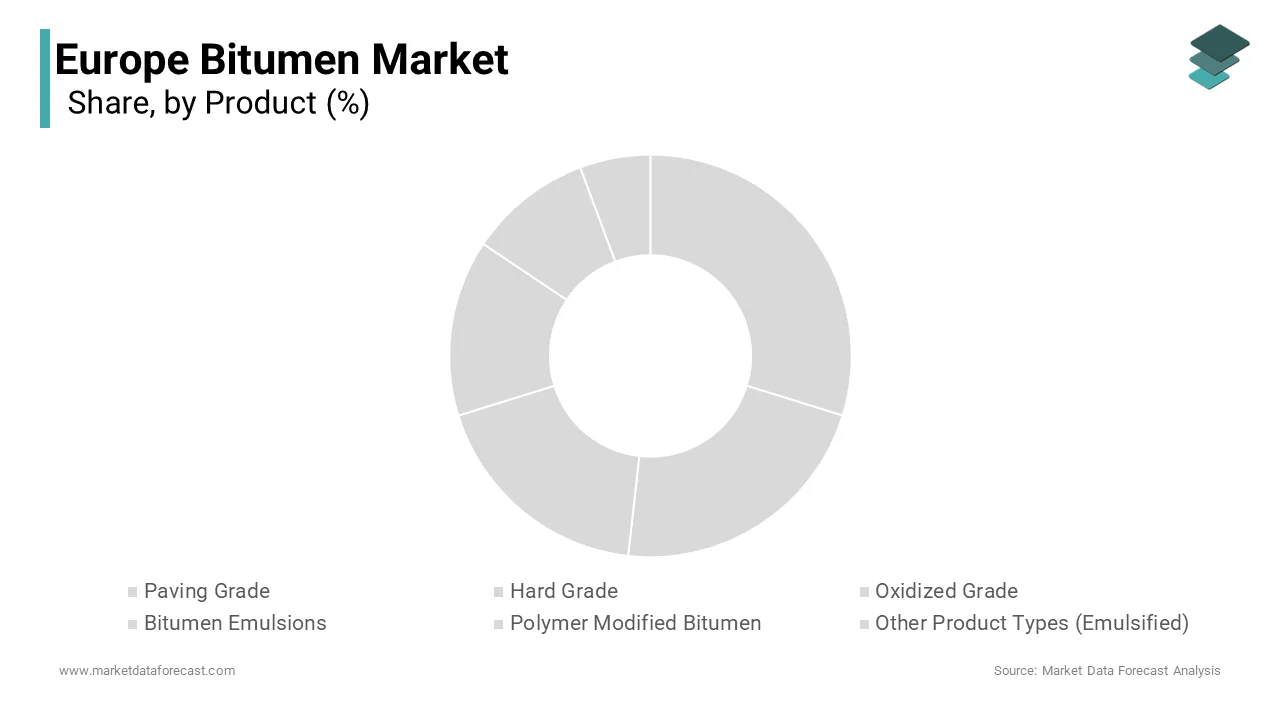
The polymer-modified bitumen (PMB) segment is expected to have the fastest CAGR of 12.3% from 2025 to 2033. This growth is fueled by its superior performance, including enhanced durability and resistance to deformation, which reduces lifecycle maintenance costs by up to 30%, per the International Energy Agency. Increasing adoption in high-traffic roads and extreme weather conditions, particularly in Germany and France. PMBs align with the EU Green Deal objectives, which are promoting sustainable and long-lasting materials. PMBs are revolutionizing road construction by ensuring their rapid expansion in the European bitumen market.
By Application Insights
The road construction segment dominated the market and held 85.5% of the European bitumen market share in 2024. This dominance is driven by the extensive use of bitumen in building and maintaining Europe’s road networks, with over 50% of roads requiring regular repairs, as per the European Asphalt Pavement Association. According to the International Energy Agency, annual investments of €100 billion under the Connecting Europe Facility ensure sustained demand. Bitumen's cost-effectiveness, durability, and compatibility with recycled materials like RAP make it indispensable for sustainable infrastructure development. Road construction remains critical to Europe’s transportation and economic growth as governments prioritize connectivity and mobility.
The waterproofing adhesives segment is anticipated to witness a CAGR of 9.1% from 2025 to 2033, owing to the rising urbanization and demand for energy-efficient buildings in Western Europe. According to the Food and Agriculture Organization, stringent building codes emphasize sustainability, boosting oxidized bitumen adoption for roofing and insulation. Innovations in formulation technologies enhance performance by making these products more competitive. Waterproofing adhesives play a vital role in modern construction by ensuring durable, weather-resistant solutions while aligning with Europe’s sustainability goals.
COUNTRY ANALYSIS
Germany Market Analysis
Germany led the European bitumen market with a 20.8% share in 2024. The growth is driven by the country’s extensive road network, which spans over 650,000 kilometers, according to the Federal Highway Research Institute. Germany’s focus on sustainable infrastructure under the EU Green Deal has accelerated investments in polymer-modified bitumen (PMB) and recycled asphalt projects. As per the European Investment Bank, Germany allocates approximately €15 billion annually for road maintenance and upgrades by ensuring consistent demand. Additionally, advancements in refining technologies and strong industrial growth have positioned Germany as a hub for high-performance bitumen products with its dominance in the regional market.

The French bitumen market is estimated to have a CAGR of 6.2% during the forecast period. Its robust infrastructure development plans, including the Grand Paris project, which involves constructing 200 kilometers of new metro lines. The European Asphalt Pavement Association estimates that France spends over €10 billion annually on road maintenance, driving bitumen demand. Furthermore, France’s commitment to reducing carbon emissions has increased the adoption of eco-friendly bitumen alternatives like bio-bitumen and PMBs. France continues to play a pivotal role in urbanization and government initiatives prioritizing sustainable construction in leveraging the European bitumen market.
Turkey Market Analysis
Turkey is likely to experience a steady growth rate in the coming years. Its strategic position as a bridge between Europe and Asia has fueled infrastructure projects by including the expansion of highways and airports. According to the International Road Federation, Turkey has invested over $35 billion in transportation infrastructure since 2020, significantly boosting bitumen consumption. Additionally, Turkey’s growing construction sector, supported by government incentives, has increased demand for waterproofing adhesives and industrial coatings. Turkey remains a key driver of growth in the European bitumen market with ongoing urbanization and large-scale projects like Istanbul’s new airport.
COMPETITIVE LANDSCAPE
KEY MARKET PLAYERS
These are the market players that are dominating the European bitumen market.
- Shell Plc
- BP PLC
- Total S.A.
- Nynas AB
- Royal Dutch Shell
- Suncor Energy Inc.
- Chevron Corporation
- Valero Energy Corporation
- Exxon Mobil Corporation
- China Petroleum
- Chemical Corporation
- Bouygues SA
- Villas Austria GmbH
- Gazprom Neft
MARKET SEGMENTATION
This research report on the European bitumen market is segmented and sub-segmented into the following categories.
By Product Type
- Paving Grade
- Hard Grade
- Oxidized Grade
- Bitumen Emulsions
- Polymer Modified Bitumen
- Other Product Types (Emulsified)
By Application
- Road Construction
- Waterproofing Adhesives
- Other Applications (Industrial Coatings)
By Country
- UK
- Russia
- Germany
- Italy
- France
- Spain
- Sweden
- Denmark
- Poland
- Switzerland
- Netherlands
- Rest of Europe