- Product Description Description
- Table of Contents TOC
- List of Table & Figure LOT
- Get Free Sample PDF Sample PDF
Europe Blanket Market Size
The europe blanket market size was valued at USD 2.44 billion in 2024 and is anticipated to reach USD 2.55 billion in 2025 from USD 3.55 billion by 2033, growing at a CAGR of 4.13% during the forecast period from 2025 to 2033.
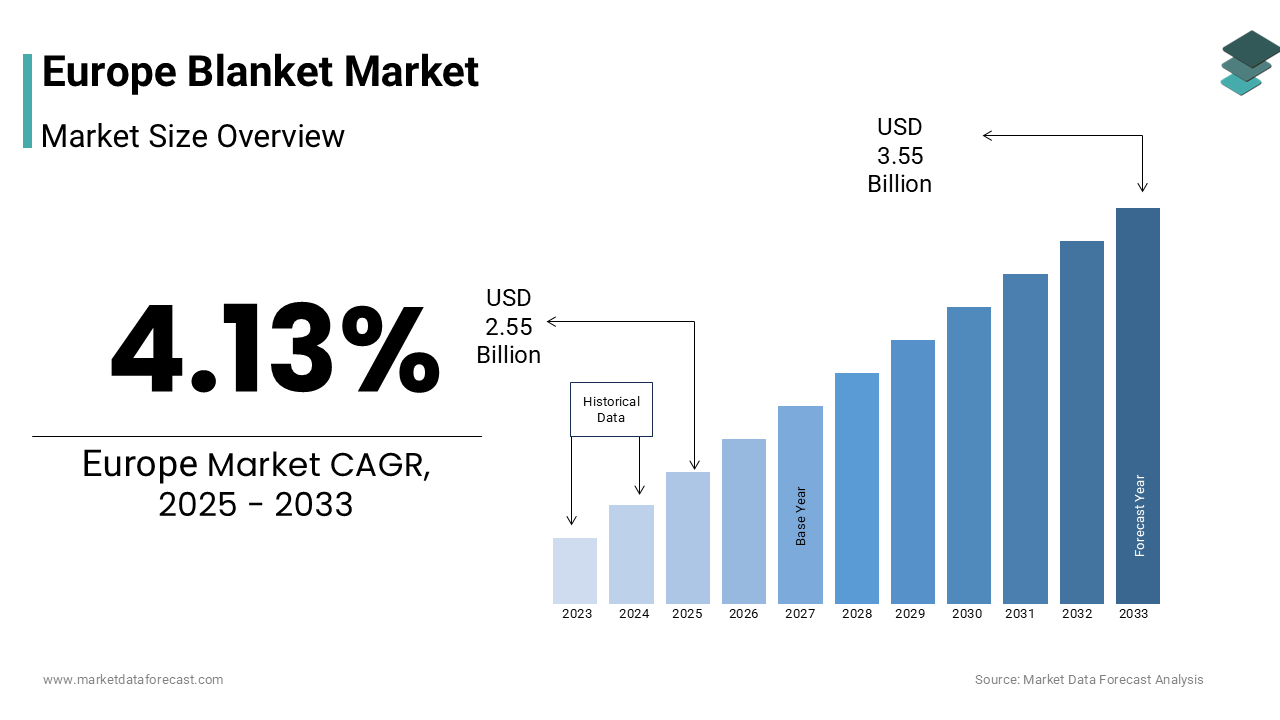
Blanket refers to the woven and non-woven textile coverings designed primarily for thermal insulation and comfort during rest or leisure. These products span conventional wool, cotton, and synthetic variants alongside emerging categories such as weighted blankets and smart thermal textiles. As of recent years, consumer behavior across European households has increasingly prioritized home comfort and wellness, driven by colder seasonal patterns and extended indoor occupancy trends. According to Eurostat, household spending on clothing and footwear was 4.0% of total household expenditure, and furnishings, household equipment and routine household maintenance was 4.9%. The cultural emphasis on sustainable living has also influenced material choices, with a growing share of consumers preferring blankets made from organic or recycled fibers. As per sources, a portion of textile manufacturers in Western Europe have integrated circular economy principles into their production processes. These contextual elements collectively shape the functional and environmental dynamics of the Europe blanket market, distinct from global counterparts.
MARKET DRIVERS
Rising Emphasis on Home Wellness and Sleep Quality Drives Blanket Demand
Consumers are increasingly aligning home textile purchases with health and wellness objectives, particularly in relation to sleep hygiene, which drives the growth of the Europe blanket market. Weighted blankets, for instance, have gained traction due to their purported anxiety-reducing and sleep-enhancing effects. A 2024 survey by the European Sleep Research Society, a portion of adults across Germany, France, and the Netherlands reported using specialized bedding products to manage sleep disturbances. This behavioral shift is reinforced by clinical interest in non-pharmaceutical sleep aids. Furthermore, national health campaigns in countries like Sweden and Finland have promoted sleep environment optimization as part of public wellness strategies. These developments have spurred product innovation, with European brands such as BekaertDeslee and John Lewis introducing blankets embedded with temperature-regulating fibers or pressure distribution technologies. Consequently, demand is no longer driven solely by climatic necessity but by a convergence of physiological comfort and therapeutic intent, reshaping product development and marketing strategies across the region.
Expansion of Sustainable and Circular Textile Practices Fuels Market Growth
Environmental consciousness among European consumers has significantly influenced the expansion of the Europe blanket market. There is a marked preference for eco-friendly materials and production methods. According to research, the European Union is advancing toward a circular textile economy, with policy frameworks emphasizing durability, recyclability, and increased use of recycled fibers in all textile products by the end of the decade. In response, blanket manufacturers have accelerated adoption of organic cotton, recycled polyester, and biodegradable alternatives. As per sources, a growing share of newly launched textile products in the European market, including home furnishing items such as blankets, now feature certified sustainability attributes that reflect eco-conscious production standards and material sourcing.Moreover, household recycling behaviors support this shift. Countries have implemented nationwide textile collection schemes. This infrastructure enables post-consumer blanket recycling, feeding secondary raw material streams. Brands have launched take-back programs specifically for bedding items. These systemic changes reflect a broader alignment between regulatory frameworks, consumer ethics, and industrial innovation, which creates a self-reinforcing cycle that sustains demand for environmentally responsible blankets across Europe.
MARKET RESTRAINTS
Stringent Environmental Regulations Increase Production Complexity
Mounting burden from evolving regulatory frameworks aimed at curbing textile waste and chemical usage restricts the growth of the Europe blanket market. According to research, European textile policy now enforces extended producer responsibility, requiring manufacturers to address the full lifecycle of their products and strengthen accountability for waste management and recycling outcomes. As per sources, compliance with these rules necessitates investment in reverse logistics, material tracing, and eco-design, which smaller blanket producers often lack the capital to implement. Besides, the REACH regulation continues to restrict the use of certain dyes and finishes. Research indicates that many small and medium-sized textile companies in Southern Europe are experiencing higher operational costs due to the need for reformulation, certification, and stricter compliance procedures. According to research, the planned introduction of digital product passports will make it mandatory for textile producers to disclose details such as material composition and environmental footprint, promoting transparency across supply chains. As per sources, studies suggest that adapting to expanded traceability and reporting requirements may increase administrative and operational expenses for textile manufacturers, particularly those producing finished goods like blankets. These regulatory layers, while environmentally justified, create operational and financial barriers, particularly for artisanal and regional manufacturers, thereby constraining market fluidity and innovation speed.
Volatility in Raw Material Supply Chains Disrupts Consistent Output
Vulnerability towards fluctuations in the availability and pricing of key raw materials such as cotton, wool, and polyester further constrain the expansion of the Europe blanket market. Moreover, synthetic fiber costs have been affected by energy market instability. According to research, industrial energy costs across the European Union continue to rise, creating additional financial pressure on textile manufacturers and influencing overall production planning within the sector. Wool supply has also tightened. As per sources, declining sheep populations in key producing countries such as Spain and Romania are affecting the availability of natural fibers, leading to tighter raw material supply for wool-based textiles. These disruptions force manufacturers to either absorb cost increases or pass them to consumers, risking demand elasticity. This supply-side fragility affects inventory planning and limits the ability to respond swiftly to seasonal or trend-driven demand surges, and thereby acting as a structural restraint on market responsiveness.
MARKET OPPORTUNITIES
Integration of Smart Textiles Offers Untapped Commercial Potential
The convergence of textile engineering and digital health technologies offers an opportunity for the Europe blanket market. The specific mechanism is the development of smart blankets embedded with sensors or responsive materials. These products can monitor vital signs, regulate temperature, or deliver therapeutic stimuli, which aligns with Europe’s aging population and growing telehealth infrastructure. According to research, a significant proportion of older adults in the European Union live independently, creating opportunities for smart home and assistive technologies tailored to senior well-being and safety. As per sources, projects in the Netherlands have shown that smart blankets integrated with health monitoring sensors can reduce emergency incidents in assisted living environments by providing early detection and real-time data tracking. Academic institutions such as the University of Manchester and ETH Zurich are advancing phase change materials that absorb, release, or reflect heat based on ambient conditions. Hence, this technological edge positions the region to lead in premium smart blanket commercialization if scaled through public-private collaboration.
Growth of Niche Wellness Tourism Fuels Demand for Premium Blankets
Region’s expanding wellness tourism sector provides a potential opportunity for high-end blanket manufacturers targeting boutique hotels, spas, and retreat centers, which drives the growth of the Europe blanket market. Wellness tourism in the EU grew annually, according to soures, with countries like Italy, Portugal, and Austria emerging as key destinations. These establishments prioritize sensory comfort and sustainability, often sourcing locally made organic or artisanal blankets as part of their experiential branding. The trend is supported by certification schemes such as Green Key and EU Ecolabel, which require sustainable procurement practices. Consequently, regional producers like Lodner in Italy and Klippan Yllefabrik in Sweden have developed hospitality-specific blanket lines featuring traceable wool and natural dyes. This B2B channel not only commands higher margins but also serves as a visibility platform, which influences consumer purchases post-stay, and thereby creates a dual revenue stream and brand amplification avenue for specialized blanket makers.
MARKET CHALLENGES
Labor Shortages in Textile Manufacturing Impede Scalability
A persistent shortage of skilled labor in textile production, particularly in weaving, finishing, and quality control roles, challenges the growth of the Europe blanket market. According to studies, only a portion of vocational education programs in the EU included textile crafts in their curriculum. This educational gap has resulted in an aging workforce. Consequently, manufacturers face difficulties in maintaining consistent output and adopting advanced machinery that requires technical proficiency. Eastern European countries, once seen as reservoirs of textile labor, are also experiencing outmigration. These demographic and structural constraints limit the ability of European blanket producers to scale operations, meet seasonal peaks, or respond to custom orders on time. The region’s capacity for agile and high-quality blanket production will continue to weaken due to the persistent labor barrier, unless targeted policies on skills development are implemented.
Consumer Confusion Over Sustainability Claims Affects Trust
The struggle of consumers to discern credible sustainability claims, which leads to skepticism and purchase hesitation, is impeding the expansion of the Europe blanket market. As per sources, a portion of shoppers encountered conflicting or vague eco-labels on bedding products, such as terms like eco-friendly or green without verifiable standards. This confusion is exacerbated by the proliferation of over 120 textile-related certification schemes across the EU, many with overlapping or non-transparent criteria. Furthermore, greenwashing incidents have damaged brand credibility. In addition, as per studies, regulatory bodies in some European countries, such as Norway, are tightening enforcement against misleading sustainability claims, reflecting a broader shift toward accountability in product labeling. Such cases contribute to a trust deficit. This ambiguity not only suppresses premium segment growth but also disincentivizes genuine investment in sustainable innovation, as ethical producers struggle to differentiate themselves. The market will lack transparency and consumers will lack confidence until the upcoming EU Green Claims Directive implements harmonized labeling and enforcement.
REPORT COVERAGE
| REPORT METRIC | DETAILS |
| Market Size Available | 2024 to 2033 |
| Base Year | 2024 |
| Forecast Period | 2025 to 2033 |
| Segments Covered | By Material Type, Product Type, Sales Channel, and Region. |
| Various Analyses Covered | Global, Regional, & Country Level Analysis; Segment-Level Analysis, Drivers, Restraints, Opportunities, Challenges, PESTLE Analysis, Porter’s Five Forces Analysis, Competitive Landscape, Analyst Overview of Investment Opportunities |
| Regions Covered | UK, France, Spain, Germany, Italy, Russia, Sweden, Denmark, Switzerland, the Netherlands, Turkey, the Czech Republic, and the Rest of Europe. |
| Key Market Players | BUDDEMEYER S/A, WestPoint Home LLC, URBANARA GmbH, Frette, Oleana |
SEGMENTAL ANALYSIS
By Material Type Insights
In 2024, the polyester segment held the largest share of 42.1% of the Europe blanket market. Its cost efficiency durability and adaptability to functional enhancements such as thermal regulation and moisture wicking has majorly contributed to the growth of the polyester segment. The material’s synthetic nature allows for consistent quality and scalable production which aligns with the demands of mass retail and e commerce channels across the region. A further driver of this dominance is the integration of recycled polyester derived from post consumer plastic bottles. Furthermore, polyester blankets require less water and energy during laundering compared to natural fibers. These environmental and economic efficiencies have made polyester the default choice for both private label retailers and branded manufacturers seeking to balance performance sustainability and affordability in a cost conscious market.
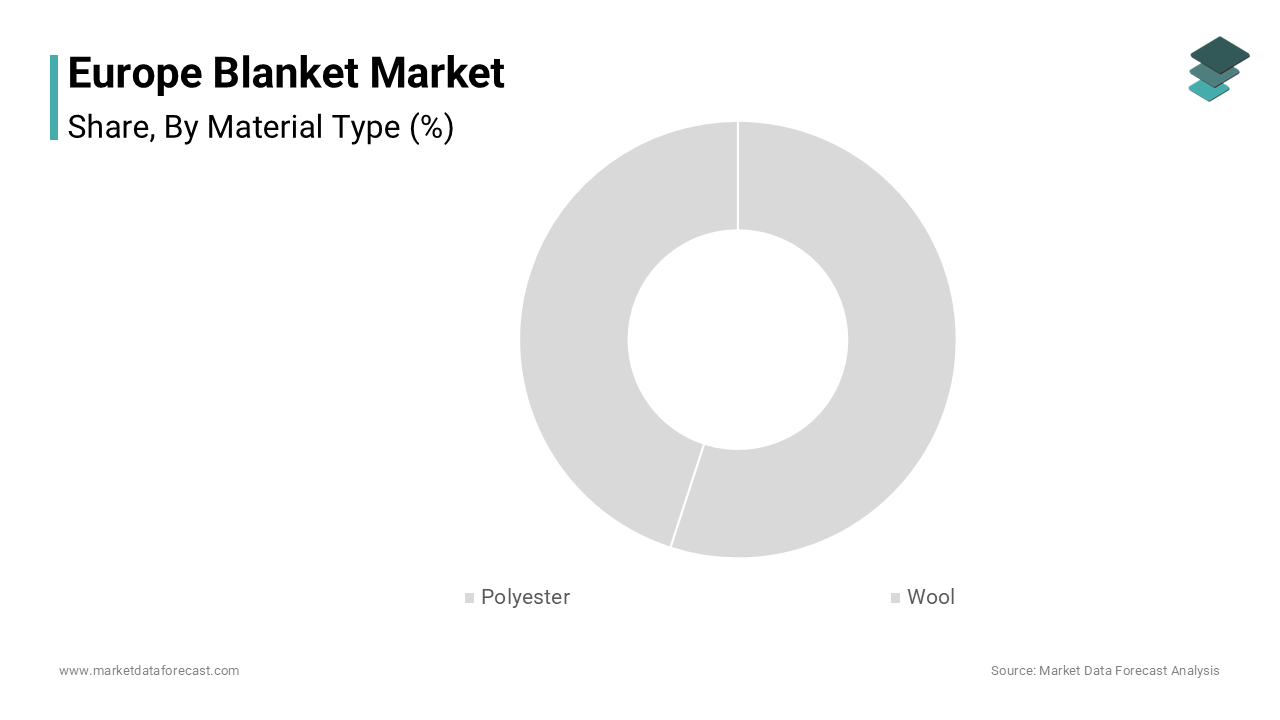
The wool segment is estimated to register the fastest CAGR of 6.8% from 2025 to 2033 owing to a resurgence in demand for natural premium and locally sourced home textiles. This growth is supported by rising consumer preference for biodegradable materials with inherent thermal and hypoallergenic properties. According to studies, wool blanket sales in the EU increased with particularly strong uptake in Alpine and Nordic countries. A different factor driving this expansion is the alignment of wool with EU circular economy policies. Furthermore, regional provenance plays a vital role. Certification schemes such as the Responsible Wool Standard have also gained traction. These developments position wool not merely as a heritage fiber but as a strategic asset in the premium sustainable home textile segment.
By Product Type Insights
The regular blankets segment led the Europe blanket market and accounted for substantial share in 2024. Their universal utility affordability and compatibility with diverse interior aesthetics has boosted the expansion of the regular blankets segment in the regional market. Unlike electric variants they require no power source maintenance or safety certification making them accessible across all demographic and income groups. The dominance is further reinforced by seasonal gifting traditions particularly in Southern and Central Europe where blankets are common during winter holidays and weddings. Moreover, the rise of home centric lifestyles post pandemic has sustained baseline demand. This consistent functional relevance combined with low price sensitivity ensures the regular blanket remains the structural backbone of the market.
The electric blankets segment is anticipated to witness the fastest CAGR of 9.4% during the forecast period due to aging demographics energy cost volatility and advances in low voltage heating technology. As per studies, millions of EU households reported difficulty maintaining adequate indoor temperatures during winter with electric blankets emerging as a targeted low consumption alternative to central heating. A pivotal factor is the integration of smart safety features such as auto shut off temperature sensors and flame retardant fabrics which have alleviated historical safety concerns. Apart from these, the proliferation of dual control and app enabled variants caters to couples and tech savvy consumers. These converging health energy and technological trends position electric blankets as a high growth niche within an otherwise mature market.
By Sales Channel Insights
The online retailers segment was the leading segment of the Europe blanket market by occupying 36.1% share in 2024. The prominence of the online retailers segment is because of the broader digitalization of home goods consumption and the convenience of comparative shopping for standardized products. According to the research, online sales of home textiles including blankets grew. The dominance stems from algorithm driven personalization fast delivery and extensive product filtering by material size and certification which aligns with the informed purchasing behavior of European consumers. Platforms offer large number of blanket SKUs enabling niche brands to access pan European audiences without physical infrastructure. Moreover, subscription and loyalty programs have increased repeat purchases. This digital advantage compounded by post pandemic e commerce adoption ensures online retail remains the primary gateway for blanket distribution.
The specialty stores segment is likely to experience the fastest CAGR of 8.1% over the forecast period due to experiential retail demand for tactile evaluation and the rise of conscious consumerism. These stores which include concept home boutiques organic textile shops and wellness lifestyle outlets offer curated selections that emphasize provenance craftsmanship and material transparency. A further growth driver is the desire for sensory engagement. Besides, specialty stores often collaborate with local artisans and sustainable brands creating community based loyalty. Regulatory support also plays a role. These factors position specialty stores as high trust high margin channels in an increasingly values driven market
REGIONAL ANALYSIS
Germany Blanket Market Analysis
Germany outperformed other regions in the Europe blanket market by accounting for 22.5% share in 2024. The domination of Germany is primarily driven by high household income strong domestic manufacturing and a culture of energy conscious living. The country’s cold winters and widespread use of intermittent heating systems create consistent demand for thermal bedding. A defining feature of the German market is its regulatory rigor. Furthermore, the aging population amplifies demand for therapeutic products. Domestic brands such as Badenia and Billerbeck dominate shelf space through vertical integration and R&D investment. This combination of consumer discipline regulatory domination and industrial capability strengthens Germany’s leading position.
United Kingdom Blanket Market Analysis
The United Kingdom was the second largest region in Europe blanket market and captured 18.5% share in 2024. The growth of the United Kingdom is propelled by strong retail competition heritage brand loyalty and rising interest in sleep wellness. British consumers exhibit a marked preference for natural fibers with cotton and wool blankets representing a portion of premium sales, according to the British Textile Confederation in 2024sources. A key market dynamic is the influence of health oriented media. Furthermore, the UK’s extensive online retail infrastructure supports rapid product turnover. In 2024, online channels accounted for a portion of all blanket sales the highest in Europe, according to research. Brands like John Lewis and Brinkhaus leverage storytelling around British wool sourcing. Despite post Brexit supply chain adjustments the UK maintains robust demand through cultural affinity for home comfort and well established distribution networks.
France Blanket Market Analysis
France grew steadily in the Europe blanket market due to its emphasis on design aesthetics artisanal quality and regional textile heritage. French consumers prioritize blankets as decorative and sensory elements of interior styling rather than purely functional items. A significant driver is the government’s support for traditional crafts. Besides, sustainability regulations are shaping material choices. Urbanization also plays a role. This fusion of artisanship regulation and urban lifestyle sustains France’s influential market position.
Italy Blanket Market Analysis
Italy expanded moderately in the Europe blanket market, with its legacy in luxury textiles high quality raw materials and fashion driven home décor trends. Italian blanket production is concentrated in regions like Tuscany and Lombardy where centuries old mills produce fine wool cashmere and silk blends for both domestic and export markets. Domestically consumers favor lightweight yet warm blankets suitable for the country’s mild winters and stone built homes which retain cold. As per sources, a share of Italian households prefer blankets under 1.5 kilograms for ease of handling and storage. The Made in Italy label remains a powerful differentiator. Moreover, collaborations between fashion houses and home textile brands such as Frette and Missoni Home have elevated blankets to lifestyle accessories. These factors rooted in craftsmanship brand equity and climatic suitability ensure Italy’s sustained relevance in the premium segment.
Sweden Blanket Market Analysis
Sweden is predicted to grow in the Europe blanket market from 2025 to 2033 due to its prominence in sustainable innovation functional design and cold climate necessity. With average winter temperatures below zero degrees Celsius for four months annually blankets are essential household items rather than seasonal accessories. A defining trait of the Swedish market is its integration of circular principles. Public procurement policies also drive demand. Brands like Klippan Yllefabrik and IKEA leverage local wool and closed loop dyeing systems with the latter sourcing its blanket cotton from Better Cotton Initiative farms. This alignment of climate need policy rigor and ethical consumption cements Sweden’s role as a benchmark for sustainable blanket markets in Europe.
COMPETETIVE LANDSCAPE
The Europe blanket market features a competitive landscape characterized by a mix of heritage textile manufacturers premium retail brands and agile niche players. Competition is primarily driven by innovation in sustainable materials functional performance and brand authenticity rather than price alone. Established companies leverage regional sourcing artisanal craftsmanship and compliance with EU environmental directives to differentiate their offerings. Meanwhile newer entrants focus on digital first models wellness integration and circular business practices to capture younger demographics. The absence of dominant monopolies encourages continuous product evolution and strategic partnerships. Regulatory burdens such as the EU Strategy for Sustainable Textiles further intensify competition by raising entry barriers for non compliant actors. As a result, the market rewards transparency technological adaptation and deep alignment with European consumer values around sustainability health and quality of life.
KEY MARKET PLAYERS
A few of the major companies in the Europe blanket market include
- BUDDEMEYER S/A
- WestPoint Home LLC
- URBANARA GmbH
- Frette
- Oleana
Top Players in the Europe Blanket Market
John Lewis Partnership
John Lewis Partnership is a prominent British retailer with a strong presence in the European home textiles sector. The company is known for its high quality wool and cotton blankets that emphasize British sourcing and ethical production. This initiative reinforced its commitment to transparency and sustainability. Apart from these, John Lewis expanded its in house sleep lab research to develop blankets with enhanced thermal regulation properties. These efforts have strengthened its reputation as a trusted premium brand across Northern and Western Europe while influencing global consumer expectations for responsible bedding products.
Klippan Yllefabrik
Klippan Yllefabrik is a Swedish heritage textile manufacturer recognized for its durable wool blankets and commitment to circular production. The company sources 100 percent of its wool from Scandinavian farms and uses renewable energy in its weaving facilities. It also partnered with the Swedish Environmental Protection Agency to pilot a take back program for end of life blankets. These actions align with EU textile sustainability mandates and have elevated Klippan’s profile in eco conscious markets across Europe and North America. Its emphasis on Nordic design and environmental integrity continues to shape premium blanket standards globally.
BekaertDeslee
BekaertDeslee is a Belgian innovator in technical and wellness oriented home textiles with a significant footprint in the European blanket market. The company specializes in functional blankets incorporating temperature regulation moisture management and pressure distribution technologies. This product targets the growing sleep tech segment and supports telehealth initiatives across aging European populations. BekaertDeslee also invested in a closed loop recycling facility in Flanders to process post industrial textile waste into new blanket fibers. These strategic moves demonstrate its focus on merging health science with textile engineering to meet evolving consumer and institutional demands in Europe and beyond.
Top Strategies Used by the Key Market Participants
Key players in the Europe blanket market employ product differentiation through material innovation such as recycled fibers and biodegradable textiles to meet stringent environmental regulations. They invest in vertical integration to secure sustainable raw material supplies and ensure traceability. Strategic collaborations with research institutions and public health agencies enable the development of wellness oriented blankets with therapeutic benefits. Companies also enhance digital engagement through immersive e-commerce experiences and personalized recommendations. Besides, they expand specialty retail and direct to consumer channels to strengthen brand storytelling and consumer trust. These strategies collectively reinforce market positioning while aligning with Europe’s circular economy and digital transformation agendas.
MARKET SEGMENTATION
This research report on the Europe blanket market has been segmented based on the following categories.
By Material Type
- Polyester
- Wool
By Product Type
- Regular Blankets
- Electric Blankets
By Sales Channel
- Online Retailers
- Specialty Stores
By Country
- UK
- France
- Spain
- Germany
- Italy
- Russia
- Sweden
- Denmark
- Switzerland
- Netherlands
- Turkey
- Czech Republic
- Rest of Europe