- Product Description Description
- Table of Contents TOC
- List of Table & Figure LOT
- Get Free Sample PDF Sample PDF
Market Size, 2025
$7.50 BnMarket Estimate, 2026
$8.06 BnMarket Forecast, 2034
$14.33 BnCAGR, 2026–2034
7.47%Europe Blister Packaging Market Report Summary
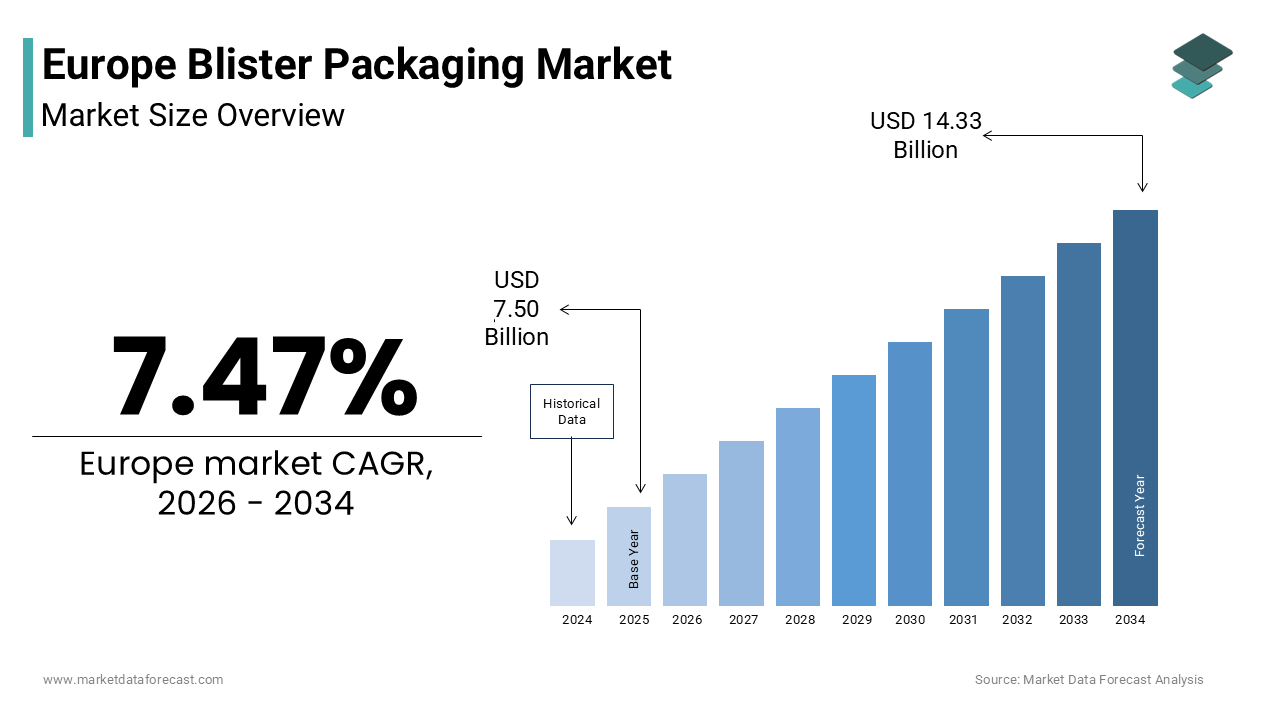
The Europe blister packaging market was valued at USD 7.50 billion in 2025, is expected to reach USD 8.06 billion in 2026, and is projected to reach USD 14.33 billion by 2034, growing at a CAGR of 7.47% during the forecast period from 2026 to 2034. The growth of the Europe blister packaging market is driven by stringent pharmaceutical packaging regulations, rising geriatric population, and increasing demand for unit-dose medication systems. Blister packaging continues to dominate pharmaceutical distribution across Europe due to its tamper-evident properties, dose accuracy, and compatibility with EU Good Manufacturing Practice requirements. Despite growing environmental concerns, its importance in healthcare supply chains remains strong. Additionally, the rising adoption of recyclable mono-material blister formats, increasing e-commerce for healthcare products, and expanding compliance packaging programs are further strengthening market growth.
Key Market Trends
- Strong reliance on blister packaging in pharmaceutical distribution across Europe
- Growing demand for tamper-evident and child-resistant packaging
- Increasing adoption of compliance packaging for elderly patients
- Rising innovation in recyclable mono-material blisters
- Growing integration of blister packs with e-commerce-ready secondary packaging
- Increased focus on sustainable packaging aligned with EU regulations
Segmental Insights
- Based on process, the thermoforming segment dominated the market with 60.3% share in 2025, supported by its cost efficiency, high-speed production, and suitability for most solid oral pharmaceutical formats.
- Based on material, the plastic films segment led the market with 59.5% share in 2025, due to the widespread use of PVC and polypropylene in pharmaceutical cavities, compatibility with high-speed production, and support for anti-counterfeiting features.
- Based on end-user industry, the pharmaceutical segment held the dominant share of the market in 2025, supported by regulatory mandates, widespread use of unit-dose formats, and increasing prescription volumes driven by chronic disease management.
Regional Insights
- Germany dominated the Europe blister packaging market with 23.2% share in 2025, driven by its strong pharmaceutical manufacturing base, advanced packaging infrastructure, and leadership in recyclable blister innovation.
- France held the second-largest share, supported by government-backed medication adherence programs, reimbursement of compliance packaging, and strong regulatory enforcement.
- United Kingdom continues to show strong growth, driven by NHS prescription volumes, rapid adoption of recyclable blisters, and pharmacy return schemes.
- Italy benefits from high generics consumption, an aging population, and high-volume thermoformed blister demand.
- Spain is emerging as a sustainability-focused market, with environmental impact assessments accelerating the shift toward recyclable blister formats and strong adoption in public healthcare systems.
Competitive Landscape
The Europe blister packaging market is highly competitive and regulation-driven. Market players compete primarily on material innovation, regulatory compliance, sustainability credentials, and technical performance, rather than pricing alone. The shift toward recyclable mono-material blisters, integration of serialization and anti-counterfeiting technologies, and compliance with EU Packaging and Packaging Waste Regulations are reshaping competitive dynamics. Long-term partnerships with pharmaceutical manufacturers play a critical role in supplier selection. Leading players in the market include Amcor plc, Constantia Flexibles GmbH, Klöckner Pentaplast, Sonoco Products Company, WestRock Company, Tekni-Plex Inc., Perlen Packaging AG, Gerresheimer AG, Berry Global Inc., Mondi Group, Winpak Ltd., and Bilcare.
 Download Free Sample Report
Europe Blister Packaging Market Size
The europe blister packaging market size was valued at USD 7.50 billion in 2025 and is anticipated to reach USD 8.06 billion in 2026 from USD 14.33 billion by 2034, growing at a CAGR of 7.47% during the forecast period from 2026 to 2034.
Blister packaging refers to a pre-formed plastic packaging system predominantly used for pharmaceuticals, consumer healthcare products, and small retail items, where individual sealed cavities or pockets protect contents from external contamination, moisture, and tampering. The format typically combines a thermoformed polymer such as polyvinyl chloride or polypropylene with a lidding material like aluminum foil or paperboard to ensure product integrity and regulatory compliance. As per the European Medicines Agency, more than 85% of solid dose pharmaceuticals in the European Union are distributed in blister formats due to their unit dose accuracy and anti‑counterfeiting features. As per the estimations of the European Commission, around 320,000 tonnes of pharmaceutical packaging waste is generated annually across the bloc, with blister packs accounting for a significant share because of their composite material structure. Despite this environmental footprint, blister packaging remains indispensable in the healthcare supply chain, which is not only for its protective capabilities but also for its role in patient adherence through calendarized dosage designs. Its widespread adoption is further reinforced by stringent EU Good Manufacturing Practice guidelines, which mandate tamper‑evident and child‑resistant features for certain medications. Blister configurations readily accommodate these requirements through specialized lidding and cavity engineering, solidifying their position as the dominant packaging format in Europe’s pharmaceutical sector.
MARKET DRIVERS
Stringent Regulatory Requirements Drive Adoption in Pharmaceutical Applications
European Union pharmaceutical regulations have long mandated tamper-evident and child-resistant packaging for prescription medications, which is creating sustained demand for advanced blister formats and driving the growth of the European blister packaging market. According to EURPACK, child-resistant packaging is required for medicines to prevent children from accessing harmful substances. This regulatory stance has led to the widespread deployment of push-through and peel-push blister designs across member states. As per updated EU guidelines, blister packaging is widely adopted as a primary format for solid oral drugs, which reflects compliance-driven adoption. Furthermore, the EU Falsified Medicines Directive requires unique serialization and anti-tampering devices on all prescription medicine packs, a provision that blister packs fulfil efficiently through integrated foil seals and QR-enabled lidding. Blister packaging is also a dominant format in hospital pharmacies due to its compatibility with automated dispensing systems and dose tracking. These regulatory imperatives not only standardize packaging formats but also elevate technical specifications for material barrier properties and seal integrity, thereby reinforcing the market’s structural dependence on high-performance blister solutions.
Rising Geriatric Population Fuels Demand for Unit Dose Medication Systems
Europe’s rapidly aging demographic is a critical non-market driver influencing blister packaging consumption through increased reliance on chronic disease management and daily medication regimens, which is further boosting the expansion of the European blister packaging market. As per Eurostat, in 2024 individuals aged 65 and above constituted 21.6% of the European Union’s total population. Older adults account for disproportionate pharmaceutical usage, with OECD reporting that consumption of medicines for chronic conditions such as antihypertensives and antidiabetics has steadily increased among this age group. Blister packs are particularly suited to this demographic as they support adherence through clearly labeled daily or weekly compartments and reduce dosing errors. According to MedPath, non-adherence costs European healthcare systems an estimated 125 billion euros annually, with packaging design identified as a modifiable factor. In Germany, approximately 19 million people aged 65 and older represented over 23% of the population in 2024. Public health insurers increasingly reimburse compliance packaging, including blister cards, for patients managing polypharmacy. In France, national health authorities have endorsed blister-based adherence programs in long-term care facilities, where a significant proportion of residents require assistance with medication. This demographic trend solidifies blister packaging as a clinical and logistical necessity rather than merely a commercial choice.
MARKET RESTRAINTS
Environmental Regulations Impose Material Limitations and Recycling Challenges
The European Union’s sustainability agenda under the Packaging and Packaging Waste Directive presents a restraint on conventional blister packaging due to its multi-material composition. Blister packs typically combine polyvinyl chloride with aluminum foil, creating a laminated structure that is difficult to separate and recycle. According to the European Environment Agency, recycling rates for plastic-based pharmaceutical packaging remain low, with blister formats contributing significantly due to sorting incompatibility in municipal waste streams. The European Commission has set a target that all packaging placed on the EU market must be reusable or recyclable in an economically viable manner, yet current blister technology falls short without costly redesign. Extended Producer Responsibility schemes now require pharmaceutical companies to finance end-of-life management, with non-compliant formats incurring higher fees. Germany’s dual system operator Der Grüne Punkt notes that composite packaging such as blisters has higher recycling costs compared to mono-material alternatives. Furthermore, the European Chemicals Agency has flagged certain plasticizers used in flexible PVC blisters for restriction under REACH due to health concerns. These regulatory pressures compel manufacturers to explore alternatives such as mono-material polypropylene blisters, which currently command less than 8% of the market due to higher production costs and inferior barrier properties as per the European Association of Pharmaceutical Full Line Suppliers.
Supply Chain Volatility Affects Raw Material Availability and Cost Stability
The Europe blister packaging market faces persistent pressure from fluctuations in polymer and aluminum prices driven by geopolitical disruptions and energy market instability. Blister production relies heavily on polyvinyl chloride and aluminum foil, both of which experienced cost surges following the 2022 energy crisis. According to Eurostat, industrial electricity prices in the European Union rose sharply in 2023 compared to 2020, directly inflating thermoforming and foil lamination expenses. The European Plastics Converters Association reported that PVC resin prices increased significantly between 2021 and 2023 due to chlorine supply constraints. Simultaneously, the European Aluminium Association confirmed that primary aluminum production declined in 2023 as smelters curtailed output amid uncompetitive power costs. This dual material vulnerability creates pricing instability for packaging converters who operate on narrow margins. A survey by the European Federation of Pharmaceutical Industries and Associations revealed that many packaging suppliers delayed capital investments in 2023 due to uncertain input costs. Moreover, the EU’s Carbon Border Adjustment Mechanism imposes tariffs on imported aluminum, further tightening supply. These dynamics constrain the market’s ability to scale efficiently and force brand owners to absorb cost increases or seek alternative formats less dependent on volatile commodities.
MARKET OPPORTUNITIES
Development of Mono-Material and Recyclable Blister Solutions Opens New Avenues
Technological innovation in mono-material blister structures presents a significant opportunity for the European blister packaging market. Unlike traditional PVC-aluminum laminates, mono-material blisters made entirely from polypropylene or polyethylene terephthalate glycol offer improved recyclability while maintaining necessary barrier properties. According to the European Association of Plastics Recyclers, trials in the Netherlands and Austria demonstrated that PP-based blisters achieved recovery rates far higher than conventional formats. The European Medicines Agency has initiated pilot programs to validate the stability of moisture-sensitive drugs in these new formats, with early data showing comparable performance for most tested molecules. Major pharmaceutical companies including Novartis and Sanofi have committed to transitioning at least 30% of their blister portfolio to recyclable mono-material solutions by 2027 as outlined in their corporate sustainability roadmaps. Furthermore, the European Commission’s Circular Plastics Alliance has allocated funding for packaging redesign initiatives including blister-specific material innovation. As per the European Organisation of Pharmaceutical Packaging Manufacturers, mono-material blister production capacity in the EU is projected to grow at a compound annual rate of 19% through 2028 driven by these structural shifts.
Expansion of E-Commerce for Consumer Healthcare Products Demands Protective Secondary Packaging Integration
The rapid growth of online pharmacy and direct-to-consumer health retail in Europe is reshaping blister packaging requirements by requiring integration with e-commerce-friendly secondary solutions, which is another prominent opportunity in the European blister packaging market. As per Eurostat, online sales of pharmaceuticals and wellness products in the European Union grew significantly in 2023, with Germany, France, and the United Kingdom accounting for the majority of transactions. Unlike traditional pharmacy dispensing, e-commerce channels require blister packs to withstand extended logistics cycles including parcel sorting, vibration, and compression. This has spurred demand for blister cards embedded in recyclable paperboard sleeves or cartons with impact-resistant features. According to the European Retail Round Table, e-pharmacy returns due to damaged packaging declined after major retailers adopted reinforced blister carriers. Moreover, consumer preference for sustainable unboxing experiences has led companies like Perrigo and Bayer to introduce blister formats with minimal ink coverage and FSC-certified overwraps. The European Consumer Organisation reports that a majority of online health product buyers consider packaging sustainability as a key purchase factor. As per the European Association of E-Commerce Providers, cross-border health product shipments are projected to double by 2028, necessitating harmonized blister packaging standards across EU postal and courier networks.
MARKET CHALLENGES
Complex Recycling Infrastructure Hampers End-of-Life Management of Multi-Layer Blister Packs
Despite growing environmental awareness, Europe lacks standardized collection and reprocessing systems capable of handling multi-layer blister packaging which combines plastic and aluminum in inseparable layers, which is challenging the growth of the European blister packaging market. According to the European Environment Agency, blister waste recycling remains below 10% across the European Union due to its exclusion from most municipal sorting protocols. According to the Germany’s Federal Environment Agency, only a few specialized facilities in the EU have the capability to delaminate and recover aluminum from pharmaceutical blisters, with total annual capacity far short of the estimated waste generated annually. Even when collected, mixed blister waste often contaminates paper or plastic streams, reducing overall recycling efficiency. The European Waste Framework Directive’s 2030 target of 65% municipal waste recycling is unlikely to be met for pharmaceutical packaging without targeted infrastructure investment. France’s Circular Economy Law mandates that producers finance dedicated take-back schemes, yet implementation remains fragmented with only a limited number of member states operating pharmacy-based blister collection programs. This systemic gap undermines sustainability claims and exposes manufacturers to reputational and regulatory risks as extended producer responsibility fees escalate in markets where non-recyclable packaging incurs punitive tariffs.
Technical Limitations in Barrier Performance of Sustainable Alternatives Restrict Widespread Substitution
The transition to eco-friendly blister materials faces significant technical hurdles, particularly in replicating the moisture and oxygen barrier properties of traditional PVC-aluminum laminates which are critical for drug stability, and this is also challenging the growth of the European blister packaging market. According to the European Directorate for the Quality of Medicines and HealthCare, many solid oral pharmaceuticals require water vapor transmission rates below strict thresholds, a benchmark that most mono-material or paper-based alternatives fail to meet consistently. Accelerated stability testing has shown that polypropylene blisters without aluminum coating exhibited higher moisture ingress rates under tropical conditions, rendering them unsuitable for many APIs. Similarly, trials revealed that cellulose-based blister prototypes degraded in mechanical strength after shelf-life simulation, compromising seal integrity. These performance gaps limit adoption to low-sensitivity products such as vitamins or analgesics, which constitute only 35% of the prescription market as per the European Generic Medicines Association. Until breakthroughs in nanocoating or plasma deposition technologies achieve regulatory validation and cost parity, sustainable alternatives will remain niche. The European Medicines Agency currently lists fewer than 15 approved drug products using fully recyclable blister formats, underscoring the scale of the technical challenge facing the industry’s decarbonization ambitions.
REPORT COVERAGE
| REPORT METRIC | DETAILS |
| Market Size Available | 2025 to 2034 |
| Base Year | 2025 |
| Forecast Period | 2026 to 2034 |
| CAGR | 7.47% |
| Segments Covered | By Process, Material, End-User Industry, and Country |
| Various Analyses Covered | Regional & Country Level Analysis, Segment-Level Analysis, DROC, PESTLE Analysis, Porter’s Five Forces Analysis, Competitive Landscape, Analyst Overview on Investment Opportunities |
| Countries Covered | UK, France, Spain, Germany, Italy, Russia, Sweden, Denmark, Switzerland, the Netherlands, Turkey, the Czech Republic, and the Rest of Europe. |
| Market Leaders Profiled | Amcor plc, Constantia Flexibles GmbH, Klöckner Pentaplast, Sonoco Products Company, WestRock Company, Tekni-Plex Inc., Uflex Limited, Perlen Packaging AG, Gerresheimer AG, Berry Global Inc., Mondi Group, Winpak Ltd., and Bilcare |
SEGMENTAL ANALYSIS
By Process Insights
The thermoforming segment dominated the market by accounting for 60.3% of the regional market share in 2025. The dominance of the thermoforming segment in this regional market is driven primarily by its cost efficiency, high production speed, and compatibility with a broad range of pharmaceutical and consumer goods. According to the European Organisation of Pharmaceutical Packaging Manufacturers, thermoforming lines can produce up to 700 blisters per minute compared to cold forming’s average of 300, which directly translates into lower unit costs for high volume runs. Additionally, thermoformed blisters using polyvinyl chloride or polypropylene offer sufficient barrier protection for the majority of solid oral dose medications, which constitute over 80% of Europe’s prescription drug formats as per the European Medicines Agency. The technology’s adaptability to automated filling and sealing machinery used by major contract packagers such as Catalent and Recipharm further entrenches its position. Moreover, regulatory acceptance of thermoformed blisters under EU Good Manufacturing Practice guidelines ensures seamless integration into established supply chains without requiring revalidation of drug stability protocols. These operational and compliance advantages collectively sustain thermoforming’s market leadership despite increasing environmental scrutiny.
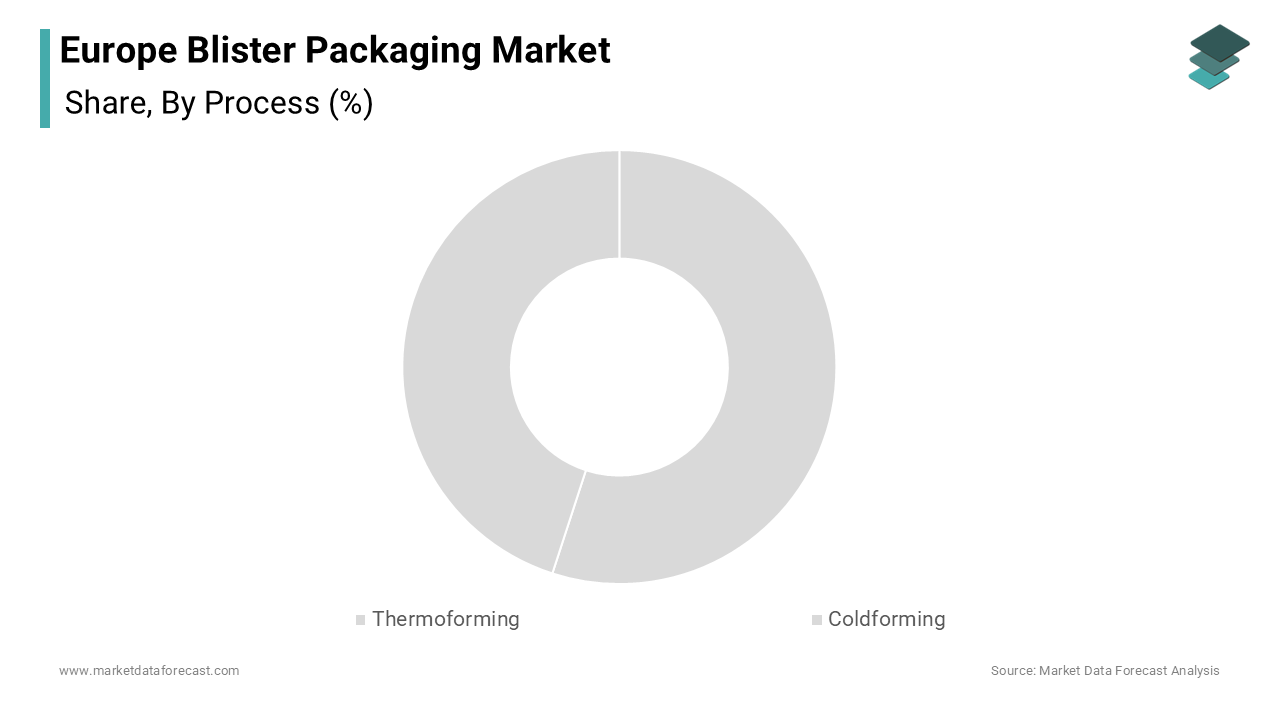
The cold forming segment is the fastest growing process segment in the Europe blister packaging market and is anticipated to register a CAGR of 7.12% over the forecast period owing to its superior barrier properties, essential for highly sensitive or moisture-prone pharmaceuticals. Unlike thermoformed blisters, cold formed variants use pure aluminum as the base material, offering near zero water vapor and oxygen transmission rates. As per the European Directorate for the Quality of Medicines and HealthCare, many biologic and high potency drugs approved in the EU require packaging with water vapor transmission below strict thresholds, a benchmark only cold formed aluminum blisters consistently achieve. Furthermore, the rise of personalized medicine and oncology therapeutics, sectors growing at over 9% annually in Europe according to the European Federation of Pharmaceutical Industries and Associations, demands packaging that ensures long term stability without secondary desiccants. Germany and France lead adoption, with cold forming widely used in oncology blister formats. As drug complexity increases, cold forming’s niche but critical role expands beyond legacy applications into next generation therapies.
By Material Insights
The plastic films segment led the market by holding 59.5% of the European blister packaging market share in 2025 owing to the widespread use of polyvinyl chloride and increasingly polypropylene in pharmaceutical blister cavities due to their clarity, formability, and cost effectiveness. As per the European Plastics Converters Association, plastic films are extensively used in pharmaceutical packaging, with blister applications representing the single largest end use. The material’s compatibility with high-speed thermoforming lines enables mass production of unit dose packs for common medications such as analgesics, antibiotics, and cardiovascular drugs. Furthermore, plastic films support the integration of anti-counterfeiting features such as holographic printing and UV inks, which are mandated under the EU Falsified Medicines Directive. While environmental pressures exist, the industry has responded with recyclable mono-material polypropylene solutions now approved for many active pharmaceutical ingredients by the European Medicines Agency. These functional and regulatory advantages ensure plastic films remain the backbone of Europe’s blister packaging infrastructure despite the push toward circularity.
The aluminum segment is the fastest growing material segment in the Europe blister packaging market and is predicted to witness a CAGR of 7.22% over the forecast period. This growth is not driven by volume dominance but by high value applications in cold formed blisters for moisture sensitive and high potency drugs. According to the European Aluminium Association, demand for pharmaceutical grade aluminum foil in blister lidding and cold formed bases has risen, reflecting increased production of biologics and biosimilars. The European Medicines Agency reports that biosimilar approvals in the EU have grown steadily, with nearly all requiring aluminum based primary packaging due to stringent stability criteria. Additionally, aluminum’s 100% recyclability without quality loss aligns with the EU Packaging and Packaging Waste Regulation’s 2030 design requirements, giving it a sustainability edge over multi-layer plastic composites. Countries such as Germany and Switzerland, where cold chain and stability validation costs are absorbed by premium pricing, have seen aluminum blister adoption rise significantly in hospital administered therapies. This convergence of performance necessity, regulatory alignment, and circular economy compatibility propels aluminum’s accelerated growth trajectory.
By End-User Industry Insights
The pharmaceutical segment commanded for the highest share of the European blister packaging market in 2025. This near total dominance arises from the regulatory and clinical necessity of unit dose packaging for solid oral medications. As per the European Medicines Agency, blister packs are the mandated format for most prescription solid dose drugs distributed through community pharmacies and hospitals across the EU. The format’s tamper evident nature, child resistant capabilities, and dose tracking functionality are non-negotiable under EU Directive 2001 83 EC and its subsequent amendments. Furthermore, the rise in chronic disease management has expanded the use of compliance blister cards, especially among the elderly. Eurostat data confirms that patients aged 65 and above account for a majority of prescription fills in Europe, with adherence packaging reducing medication errors. Major pharmaceutical hubs in Germany, France, and the UK process billions of blister cards annually according to national pharmacy federations. Even with generic drug price pressures, the per unit blister cost remains a minor component of total therapy expense, allowing sustained investment in advanced formats. This structural entrenchment ensures the pharmaceutical segment’s continued hegemony.
The consumer goods segment is the fastest growing end user category in the Europe blister packaging market and is predicted to expand at a promising CAGR in the European market over the forecast period owing to the format’s adoption for premium small format retail items such as dental care, electronics, batteries, and confectionery where product visibility, theft deterrence, and portion control are critical. As per Eurostat, online sales of health and personal care products in Europe grew significantly in 2023, with blister packs preferred for their compactness and shelf ready presentation. Retailers such as dm drogerie and Boots have expanded blister based private label offerings, particularly in oral hygiene. Additionally, the European Consumer Organisation reports that a majority of shoppers perceive blister packaging as more hygienic for single use items, a perception amplified post pandemic. The shift toward sustainable mono-material blisters has also reduced brand owner resistance, with companies such as Colgate Palmolive and Philips launching recyclable polypropylene blisters across EU markets in 2024. As e-commerce and convenience driven retail expand, blister packaging moves beyond pharma into curated consumer experiences, driving this dynamic growth.
REGIONAL ANALYSIS
Germany Blister Packaging Market Analysis
Germany dominated the blister packaging market in Europe in 2025 by capturing 23.2% of the regional market share. The dominating spot of Germany in the European blister packaging market is attributed to its position as the continent’s pharmaceutical production hub. Home to global players like Bayer, Merck, and Boehringer Ingelheim as well as leading packaging converters such as Constantia Flexibles and Amcor, Germany is a major producer of prescription drugs in the EU. The country’s blister market is characterized by high adoption of both thermoformed and cold formed formats, with aluminum cold formed blisters widely used for oncology and biologic drugs. Stringent national adherence to EU Good Manufacturing Practice and early implementation of the Falsified Medicines Directive have accelerated investments in serialization-enabled blister lines. Furthermore, Germany’s dual system for packaging waste recovery operated by Der Grüne Punkt has spurred R&D into mono-material recyclable blisters, with pilot programs showing promising recovery rates in Bavaria and Baden Württemberg. Supported by national funding from the Federal Ministry for Economic Affairs and Climate Action, Germany remains the innovation engine driving technical and regulatory standards across Europe.
France Blister Packaging Market Analysis
France held the second largest player of the Europe blister packaging market in 2025. The growth of France in the European blister packaging market is driven by a public healthcare system that prioritizes medication adherence and safety. The French National Health Insurance Fund reimburses compliance packaging, including blister cards, for millions of patients managing chronic conditions, a policy that has elevated blister usage across solid dose dispenses. The country’s strong regulatory enforcement of child resistant packaging under EU guidelines has made thermoformed PVC aluminum blisters the standard for most prescription drugs. France’s anti-waste law for a circular economy mandate that all pharmaceutical packaging be recyclable by 2025, which is prompting major players like Sanofi to partner with Citeo on take-back schemes that collected thousands of tonnes of blister waste in 2023. The Lyon and Paris regions host Europe’s densest network of hospital pharmacies, where unit dose blister systems reduce dispensing errors significantly. This blend of public policy, clinical practice, and environmental regulation solidifies France’s position as a model market for functional and responsible blister packaging.
United Kingdom Blister Packaging Market Analysis
The United Kingdom is estimated to account for a promising share of the European blister packaging market over the forecast period as the UK is maintaining strong pharmaceutical packaging demand despite its departure from the EU regulatory framework. The Medicines and Healthcare products Regulatory Agency continues to align with EU standards on tamper evident and child resistant packaging, ensuring continuity in blister format adoption across the National Health Service, which dispenses over a billion prescription items annually. The UK’s blister market is distinguished by rapid uptake of recyclable mono-material solutions, with retailers like Boots and Superdrug requiring all private label health products to use polypropylene blisters by 2025. The Waste and Resources Action Programme reports that UK pharmacies collected hundreds of tonnes of blister packaging through patient return schemes in 2023, showing strong growth from the previous year. Additionally, the UK’s strong generics sector led by companies like Teva and Dr Reddy’s drives high volume thermoformed blister production primarily in the Midlands and Scotland. Though no longer bound by EU directives, the UK’s Medicines and Healthcare products Regulatory Agency has adopted stricter environmental guidelines for packaging licensing, accelerating innovation in sustainable blister design and securing its role as a responsive and evolving market.
Italy Blister Packaging Market Analysis
Italy is expected to grow at a healthy CAGR in the Europe blister packaging market over the forecast period owing to its status as one of the largest consumers of generic pharmaceuticals in the EU. Generics account for a majority of prescription volumes, with cost-conscious public procurement favoring high efficiency thermoformed blister formats. Italy’s national health service processes hundreds of millions of blister cards annually, with Lombardy and Lazio serving as key distribution corridors. The country’s blister market is characterized by price sensitivity, which has slowed cold forming adoption but accelerated investments in high-speed PVC and PP thermoforming lines. Environmental initiatives are gaining traction, with blister-related recycling trials expanding in regions such as Emilia Romagna. Furthermore, Italy’s aging population—24.1% aged 65 and above per ISTAT—drives demand for compliance blister cards, with regional health authorities subsidizing adherence programs for cardiovascular and diabetes medications. This combination of volume-driven generics uses and demographic pressure sustains Italy’s significant market presence.
Spain Blister Packaging Market Analysis
Spain is anticipated to account for a notable share of the Europe blister packaging market during the forecast period. Spain is emerging as a leader in sustainable packaging transition within Southern Europe. The Spanish Agency of Medicines and Medical Devices mandates that all new drug packaging submissions include an environmental impact assessment, a policy implemented in 2022 that has accelerated the shift toward mono-material recyclable blisters. According to the Spanish Packaging Waste Management Organization, thousands of tonnes of pharmaceutical packaging were collected in 2023, with blister formats included in a dedicated hospital take-back pilot covering multiple autonomous communities. Spain’s blister market benefits from strong domestic pharmaceutical production, with companies like Almirall and Esteve operating advanced packaging lines in Catalonia and Andalusia. The country also leads in elderly care integration, with blister-based adherence systems deployed in a majority of public nursing homes as per the Ministry of Health, reducing hospital readmissions. Furthermore, Spain’s proximity to North Africa makes it a strategic export hub for blister packaged generics serving Mediterranean and Latin American markets. These factors position Spain not just as a volume player but as a forward-looking market where regulatory foresight and social care convergence drive packaging evolution.
COMPETITIVE LANDSCAPE
The Europe blister packaging market features intense competition among multinational packaging specialists regional converters and vertically integrated pharmaceutical suppliers. Leading players differentiate through regulatory expertise material science capabilities and sustainability credentials rather than price alone. The market is characterized by long term supply agreements with pharmaceutical giants where validation timelines and compliance history heavily influence vendor selection. Innovation in recyclable formats and digital compliance features has become the primary battleground with companies racing to commercialize mono material blisters that meet both drug stability and circular economy criteria. Smaller regional players compete by offering agile production for niche or local drug portfolios but face pressure from rising raw material costs and evolving waste legislation. Overall competition is less about market share capture and more about technological leadership and regulatory alignment within a highly standardized and safety critical environment.
KEY MARKET PLAYERS
Some of the companies that are playing a dominating role in the Europe Blister Packaging Market include
- Amcor plc
- Constantia Flexibles GmbH
- Klöckner Pentaplast (K 2019 / Klockner Pentaplast Group)
- Sonoco Products Company
- WestRock Company
- Dow / DuPont (materials suppliers)
- Honeywell International Inc
- Tekni-Plex, Inc.
- Uflex Limited
- Perlen Packaging AG
- Gerresheimer AG
- Berry Global, Inc.
- Mondi Group
- Winpak Ltd.
- Bilcare / Bilcare Ltd
Top Players in the Market
Amcor plc
Amcor plc plays a pivotal role in the Europe blister packaging market through its extensive portfolio of pharmaceutical and healthcare packaging solutions. Headquartered in Switzerland the company operates multiple high tech converting facilities across Germany France and the UK specializing in both thermoformed and cold formed blister systems. In recent years Amcor has intensified its focus on sustainable packaging launching recyclable mono material polypropylene blisters compliant with EU circular economy directives. The company collaborates closely with major European pharmaceutical firms to integrate serialization and anti-counterfeiting features into its blister formats. Amcor’s investment in barrier coated PP technology has enabled it to offer high performance alternatives to traditional PVC aluminum laminates enhancing its position as an innovation leader in the global pharmaceutical packaging sector.
Constantia Flexibles Group GmbH
Constantia Flexibles Group GmbH is a major European player renowned for its advanced pharmaceutical blister solutions with manufacturing sites in Austria Germany and Spain. The company emphasizes patient centric design and regulatory compliance offering both standard and specialty blister formats including child resistant and adherence enhancing configurations. To strengthen its market position Constantia Flexibles has accelerated development of its EcoFoil line which features fully recyclable mono material structures validated for moisture sensitive drugs by multiple European regulatory bodies. The company also expanded its digital printing capabilities in 2023 enabling secure variable data integration for track and trace compliance. Its commitment to sustainability and regulatory alignment has solidified its standing as a preferred partner for top tier pharmaceutical brands across Europe and beyond.
WestRock Company
WestRock Company has established a significant footprint in the Europe blister packaging market through its healthcare packaging division which supplies high integrity blister and lidding solutions to pharmaceutical and consumer health clients. Operating facilities in the Netherlands and Italy the company leverages its global material science expertise to develop barrier optimized recyclable substrates tailored to European regulations. In 2023 WestRock launched its NextGen Blister platform featuring paper based and mono polymer alternatives designed to meet the EU Packaging and Packaging Waste Regulation targets. The company also enhanced its digital serialization services to support compliance with the Falsified Medicines Directive. By aligning its innovation pipeline with Europe’s sustainability and safety mandates WestRock has reinforced its contribution to the global pharmaceutical packaging ecosystem.
Top Strategies Used by the Key Market Participants
Key players in the Europe blister packaging market prioritize sustainability driven innovation by developing fully recyclable mono material blister structures to comply with EU environmental regulations. They invest heavily in digital integration including serialization and QR code enabled track and trace systems to meet anti-counterfeiting mandates under the Falsified Medicines Directive. Strategic partnerships with pharmaceutical companies facilitate co development of compliance focused packaging that enhances patient adherence. Expansion of high-speed thermoforming and cold forming production capacity in Central and Western Europe ensures reliable supply for growing drug portfolios. Additionally, companies are upgrading barrier coating technologies to maintain drug stability in eco-friendly formats without relying on aluminum laminates thereby balancing performance with circularity goals.
MARKET SEGMENTATION
This europe blister packaging market research report is segmented and sub-segmented into the following categories.
By Process
- Thermoforming
- Coldforming
By Material
- Plastic Film
- Paper and Paperboard
- Aluminum
- Others
By End-User Industry
- Consumer Goods
- Pharmaceutical
- Industrial
- Other End-user Industries
By Country
- UK
- France
- Spain
- Germany
- Italy
- Russia
- Sweden
- Denmark
- Switzerland
- Netherlands
- Turkey
- Czech Republic
- Rest of Europe