- Product Description Description
- Table of Contents TOC
- List of Table & Figure LOT
- Get Free Sample PDF Sample PDF
Market Size, 2025
$0.77 BnMarket Estimate, 2026
$0.83 BnMarket Forecast, 2034
$1.50 BnCAGR, 2026–2034
7.69%Europe Blue Hydrogen Market Size, Growth, Trends & Forecast (2026–2034)
The Europe blue hydrogen market size was calculated at USD 0.77 billion in 2025, is anticipated to reach USD 0.83 billion in 2026, and is projected to reach USD 1.50 billion by 2034, registering a compound annual growth rate (CAGR) of 7.69% during the forecast period from 2026 to 2034. Driven by pressing industrial decarbonization imperatives under the EU Emissions Trading System, policy frameworks like Carbon Contracts for Difference, and the development of North Sea offshore CO₂ storage, the market continues to expand steadily as a critical interim pillar in Europe's clean energy transition.
Key Executive Metrics (At-a-Glance)
- 2025 Base Valuation: USD 0.77 Billion
- 2026 Current Valuation: USD 0.83 Billion
- 2034 Forecast Valuation: USD 1.50 Billion
- Compound Annual Growth Rate (CAGR): 7.69% (2026–2034)
- Dominant Technology Segment: Steam Methane Reforming / SMR (holding a substantial share in 2025 due to legacy infrastructure)
- Fastest-Growing Technology Segment: Auto Thermal Reforming / ATR (predicted to witness the highest CAGR of 24.3% from 2026 to 2034)
- Dominant Application Segment: Refinery (holding a 52.9% market share in 2025)
- Fastest-Growing Application Segment: Chemical (estimated to register the fastest CAGR of 28.1% from 2026 to 2034)
- Regional Highlights: Germany led the market with a 24.2% share in 2025, closely followed by the Netherlands with 19.8%.
Core Market Drivers
- Industrial Decarbonization: Heavy industries (steel, chemicals, refining) needing low-carbon high-temperature thermal energy where direct electrification remains impractical.
- Supportive Policy Frameworks: Mechanisms like Carbon Contracts for Difference (CCfDs), the EU Hydrogen Backbone, and Innovation Fund grants de-risking capital investments.
- Offshore Storage Availability: Vast saline aquifers beneath the North Sea offering permanent, scalable CO₂ sequestration options with minimal public friction.
Primary Market Restraints & Challenges
- High Capital Intensity: Prohibitive upfront costs and energy penalties associated with integrating large-scale carbon capture and storage (CCS) systems.
- Methane Leakage & Net Accounting: Public skepticism and strict taxonomy criteria regarding upstream methane slip from imported natural gas eroding net climate advantages.
- Feedstock Volatility & Permitting: Vulnerability to natural gas price shocks alongside regulatory fragmentation across member states for cross-border CO₂ transport.
Europe Blue Hydrogen Market Segmentation Breakdown
| Segment Category | Largest Segment in 2025/2026 | Fastest Growing Segment / Growth Rate |
|---|---|---|
| By Technology | Steam Methane Reforming / SMR | Auto Thermal Reforming / ATR (24.3% CAGR) |
| By Application | Refinery (52.9% share in 2025) | Chemical (28.1% CAGR) |
| By Region | Germany (24.2% share in 2025) | Netherlands & United Kingdom (Driven by North Sea CCS integration) |
Major Industry Players Profiled
Key prominent companies operating in the Europe blue hydrogen market include Linde PLC, Shell PLC, Air Liquide SA, Air Products & Chemicals Inc., ENGIE SA, Equinor ASA, and Exxon Mobil Corp.
Europe Blue Hydrogen Market Size
The Europe blue hydrogen market size was calculated at USD 0.77 billion in 2025 and is anticipated to reach USD 1.50 billion by 2034, from USD 0.83 billion in 2026, growing at a CAGR of 7.69% during the forecast period.
Blue hydrogen is produced predominantly from natural gas through steam methane reforming or autothermal reforming, coupled with carbon capture and storage to mitigate emissions. Unlike green hydrogen, which relies on renewable-powered electrolysis, blue hydrogen leverages existing fossil infrastructure while significantly curbing carbon output, typically capturing a significant majority of CO₂ emissions depending on plant efficiency and capture technology maturity. The European Commission’s official guidance recognizes the contribution that blue hydrogen can make to achieving the continent’s climate objectives. Industrial clusters in the Netherlands, Germany, and Norway are pioneering integrated blue hydrogen projects linked to offshore CO₂ storage beneath the North Sea. According to sources, Europe currently leads the world in the number of proposed blue hydrogen initiatives. Natural gas remains a dominant input. The European Union remains a substantial importer of natural gas, both via pipelines and in liquefied form. Specific geological formations within the continent have been identified as having extensive capacity to safely and permanently store large volumes of carbon dioxide underground. These foundational conditions position blue hydrogen not as an endgame solution but as a critical interim pillar in Europe’s industrial decarbonization architecture.
MARKET DRIVERS
Industrial Decarbonization Imperatives Are Accelerating Blue Hydrogen Adoption
The push for industrial decarbonization is accelerating the expansion of the Europe blue hydrogen market. Europe’s heavy industry accounts for nearly 20 percent of the continent’s total carbon emissions, with sectors such as steel, chemicals, and refining facing stringent regulatory pressure under the EU Emissions Trading System. As per research, the EU's total production-based greenhouse gas emissions were around 3.6 billion tonnes of CO₂ equivalent in 2022, with manufacturing responsible for about 1.0 billion tonnes of CO₂ equivalent. Blue hydrogen offers a technically viable pathway, particularly for ammonia and methanol production, where electrification remains impractical. In addition, the European Commission approved large-scale industrial decarbonization projects under the Innovation Fund, allocating a substantial amount to hydrogen-based retrofits, many of which prioritize blue hydrogen during the initial operational phase. The steel industry plans to replace blast furnaces with hydrogen direct reduction units, initially sourcing blue hydrogen from a facility powered by natural gas with a notable percentage of carbon capture. Similarly, many companies are advancing blue hydrogen hubs, targeting notable kilotonnes of annual CO₂ avoidance. According to studies, the majority of future hydrogen production is expected to be green hydrogen (produced using renewable electricity) rather than blue hydrogen (produced from natural gas with carbon capture). This industrial reliance on high-temperature thermal energy, where renewables alone cannot substitute fossil input immediately, creates a structural demand anchor for blue hydrogen throughout the decade.
Policy Alignment Through the EU Hydrogen Backbone and Carbon Contracts for Difference
The European policy framework has evolved to explicitly accommodate blue hydrogen through mechanisms that de-risk capital expenditure and guarantee offtake stability and ultimately boost the growth of the Europe blue hydrogen market. Central to this is the Carbon Contracts for Difference scheme, which compensates industrial users for the green premium incurred when selecting low-carbon hydrogen over conventional natural gas. The German government established a new support mechanism to encourage industrial decarbonization. This system, known as Carbon Contracts for Difference (CCfDs), aims to accelerate the transition to climate-friendly production methods in energy-intensive industries. Complementing fiscal instruments, the European Union plans to create a hydrogen pipeline network by converting existing natural gas infrastructure. This strategy includes repurposing a significant amount of the current natural gas pipeline network for hydrogen transport. A major part of this initiative focuses on establishing cross-border corridors to connect hydrogen production sites with key industrial centers. Reusing existing pipelines offers substantial cost savings compared to constructing new ones, which is a primary driver for this approach. This cost-effective development is intended to accelerate the deployment of clean hydrogen and support the EU's climate objectives. Apart from these, the inclusion of blue hydrogen under the Renewable and Low Carbon Fuels Regulation enables it to count toward mandatory blending targets in certain sectors. This regulatory inclusion, combined with streamlined permitting under the Net Zero Industry Act, creates a favourable macroeconomic environment that incentivizes early mover advantage. The policy scaffolding thus does more than subsidize. It institutionalizes blue hydrogen as a transitional commodity with embedded market access.
MARKET RESTRAINTS
High Capital Intensity and Unproven Commercial Viability of Carbon Capture Systems
The commercial deployment of carbon capture units integrated with hydrogen production remains financially prohibitive and operationally uncertain at scale, which restrains the expansion of the Europe blue hydrogen market. This is despite technological maturity in laboratory settings. According to research, the number of operational carbon capture and storage (CCS) facilities is increasing globally. Europe is developing its Carbon Capture and Storage (CCS) infrastructure, but currently has fewer operational sites than other regions, as per sources. Currently, large-scale blue hydrogen plants specifically designed for consistent, high carbon capture efficiency are not operational. Building a blue hydrogen facility with carbon capture requires a significantly larger initial investment compared to a grey hydrogen plant. This cost differential is exacerbated by energy penalties. Capturing CO₂ significantly impacts the energy efficiency of a production facility. When applied to hydrogen production (creating "blue hydrogen" from natural gas), the process still requires energy for capture and compression, which can lead to a slight reduction in net hydrogen output from the original natural gas input. Moreover, long-term storage liability remains legally ambiguous in several EU member states, which deters private investment. The capital intensity of blue hydrogen will continue to hinder market entry past pilot phases unless there are standardized modular capture designs and risk-sharing mechanisms between governments and operators.
Public and Institutional Skepticism Over Net Emissions Accounting and Methane Leakage
Persistent credibility issues are among the major obstacles for the Europe blue hydrogen market. These issues stem from concerns about lifecycle emissions, particularly methane slip during natural gas extraction and transport. According to a 2023 assessment by the European Commission’s Joint Research Centre, upstream methane emissions from imported liquefied natural gas, constituting over 60 percent of the EU supply, average 2.7 percent of total volume, significantly higher than pipeline gas at 1.2 percent. When factoring in these fugitive emissions, the net carbon advantage of blue hydrogen diminishes sharply. As per research, blue hydrogen derived from LNG with 2.5 percent methane leakage exhibits only a 9 to 12 percent reduction in greenhouse gases compared to grey hydrogen over a 20-year horizon. This affects its classification as a low-carbon fuel under the EU Taxonomy, which sets science-based technical screening criteria, including specific emissions performance thresholds, to classify economic activities as environmentally sustainable and channel investments toward achieving net-zero emissions by 2050. Environmental organizations, including ClientEarth and Carbon Tracker, have filed formal objections. This institutional mistrust constrains access to green bonds and ESG financing, limiting scalability despite industrial demand.
MARKET OPPORTUNITIES
Offshore CO₂ Storage Infrastructure in the North Sea Presents a Strategic Scalability Lever
The region’s geological advantage lies in the vast saline aquifers beneath the North Sea, which offer unparalleled capacity for permanent CO₂ sequestration and thereby drive the growth of the Europe blue hydrogen market. This is essential for scaling blue hydrogen without onshore public opposition. According to research, Geological formations like the Utsira Sand formation have a substantial capacity for storing large amounts of carbon dioxide. This subsea reservoir is already Operational. Projects have safely utilized subsea reservoirs for CO₂ storage for an extended period. The Upcoming projects aim to establish new links between industrial CO₂ sources and offshore storage locations. Crucially, projections for storage in the North Sea indicate a significant increase in capacity across several nations within the next decade. This infrastructure enables clustered industrial zones to share transport and injection assets, which reduces per tonne storage costs. Unlike onshore storage, which faces permitting delays and community resistance, offshore sequestration benefits from existing oil and gas regulatory frameworks and minimal surface impact, which creates a de facto corridor for blue hydrogen expansion without societal friction.
Hydrogen Ready Industrial Retrofits Unlock Dual Fuel Flexibility and Risk Mitigation
The wave of industrial equipment upgrades that are explicitly designed to operate on both natural gas and hydrogen blends provides transitional flexibility without full system replacement, which generates fresh prospects for the expansion of the Europe blue hydrogen market. According to studies, the adoption of hydrogen in industrial applications is a growing trend in Europe, with initiatives like the H2Global scheme providing funding for dual-fuel burner installations in various sectors, including chemical and steel plants, to facilitate the transition to lower-carbon energy sources. In the refining sector, Companies such as Honeywell and Linde are developing new technologies, including modular blue hydrogen units, aimed at improving the efficiency and integration of hydrogen into existing refining infrastructure. This approach mitigates technology lock-in risk. If green hydrogen costs decline faster than anticipated, these facilities can pivot without stranded assets. Moreover, standards bodies such as the European Committee for Standardization (CEN) and the International Organization for Standardization (ISO) are actively developing and updating various guidelines and technical specifications to address the unique safety and performance requirements of emerging hydrogen technologies and infrastructure, which is expected to help create a harmonized procurement signal across the bloc. This retrofit wave transforms blue hydrogen from a temporary stopgap into a strategic enabler of phased decarbonization.
MARKET CHALLENGES
Feedstock Volatility and Geopolitical Dependence on Natural Gas Undermine Cost Predictability
Its economic viability remains tightly coupled to natural gas price stability, which challenges the growth of the Europe blue hydrogen market. A vulnerability was starkly exposed during the 2022 energy crisis. According to Eurostat, the average EU wholesale natural gas price surged dramatically in August 2022, reaching an all-time high of over €300 per megawatt hour, which was many times the five-year pre-war average, rendering blue hydrogen production temporarily uneconomical. Although prices moderated to approximately €35 per megawatt hour by early 2025, they remain highly sensitive to geopolitical shifts. This sensitivity is particularly relevant given the significant shift in import sources, with Norway being the top supplier (over 33% of imports in 2025) and the EU reducing reliance on Russia, as per sources. Unlike green hydrogen, whose primary input cost, renewable electricity, is trending downward due to solar and wind cost deflation, blue hydrogen lacks a similar deflationary trajectory. As per the International Energy Agency, green hydrogen production is currently more expensive than blue hydrogen, but the cost gap is expected to narrow by 2030, with green hydrogen potentially becoming competitive in some regions. Current estimates for the levelized cost of blue hydrogen production typically range from USD 2.8-3.5 per kg, depending on natural gas and carbon capture costs. This volatility deters long-term offtake agreements, as industrial buyers seek price certainty. Blue hydrogen remains exposed to external supply shocks that could derail decarbonization timelines, without diversified feedstock options or strategic gas reserves dedicated to its production.
Regulatory Fragmentation in Carbon Transport and Storage Permitting Across Member States
Despite EU-level policy support, the deployment of blue hydrogen is hampered by Inconsistent national regulations governing CO₂ transport pipelines, and offshore storage licensing also holds back the expansion of the Europe blue hydrogen market. According to the European Commission’s 2023 Implementation Report on the revised Directive on the Geological Storage of CO₂, significant progress has been made across the EU, with countries like the Netherlands, Denmark, and Norway leading in the development of storage sites and frameworks. The report highlights the urgent need and market opportunity for more CO₂ storage sites, especially in the North Sea region. Member States such as France and Spain have reported changes to their legislation implementing the CCS Directive, including establishing permitting procedures and designating competent authorities, while Poland has also enacted recent regulations to accelerate the development of the technology. The Porthos project in Rotterdam received the necessary permits around the 2021/2022 timeframe, following a lengthy legal process that ended with the Council of State's approval in August 2023. The project is on track to be fully operational in 2026. Similarly, the Northern Endurance Partnership in the UK had its carbon storage license application approved by the Oil and Gas Authority (OGA), which is now the North Sea Transition Authority (NSTA). The project has also reached financial close, with construction expected to begin in mid-2026 and operations in 2028. This fragmentation increases transaction costs and deters integrated value chains: a blue hydrogen producer in Germany cannot legally ship CO₂ to a Norwegian aquifer without navigating three distinct regulatory regimes. Blue hydrogen scalability will remain constrained by bureaucratic inertia rather than technical feasibility until the European Parliament harmonizes storage liability and transport tariffs under a single regulatory umbrella.
REPORT COVERAGE
| REPORT METRIC | DETAILS |
| Market Size Available | 2025 to 2034 |
| Base Year | 2025 |
| Forecast Period | 2026 to 2034 |
| CAGR | 7.69% |
| Segments Covered | By Technology, Application, and Region |
| Various Analyses Covered | Global, Regional & Country Level Analysis; Segment-Level Analysis; DROC, PESTLE Analysis; Porter’s Five Forces Analysis; Competitive Landscape; Analyst Overview of Investment Opportunities |
| Regions Covered | UK, France, Spain, Germany, Italy, Russia, Sweden, Denmark, Switzerland, Netherlands, Turkey, and the Czech Republic |
| Market Leaders Profiled | Linde PLC, Shell PLC, Air Liquide SA, Air Products & Chemicals Inc., ENGIE SA, Equinor ASA, Exxon Mobil Corp. |
SEGMENTAL ANALYSIS
By Technology Insights
The Steam Methane Reforming (SMR) segment was the largest segment in the Europe blue hydrogen market and captured a substantial share in 2025. The supremacy of the SMR segment is attributed to its widespread deployment in existing industrial infrastructure and its relatively mature technology stack compared to alternatives. SMR benefits from decades of operational refinement in refineries and ammonia plants, particularly in Germany and the Netherlands, where legacy natural gas networks and hydrogen pipelines are already integrated. Moreover, policy frameworks prioritize SMR-based blue hydrogen in early tenders due to its scalability and compatibility with existing CO₂ transport corridors like the Porthos network. These structural advantages ensure SMR remains the cornerstone of Europe’s transitional hydrogen economy through at least 2030.
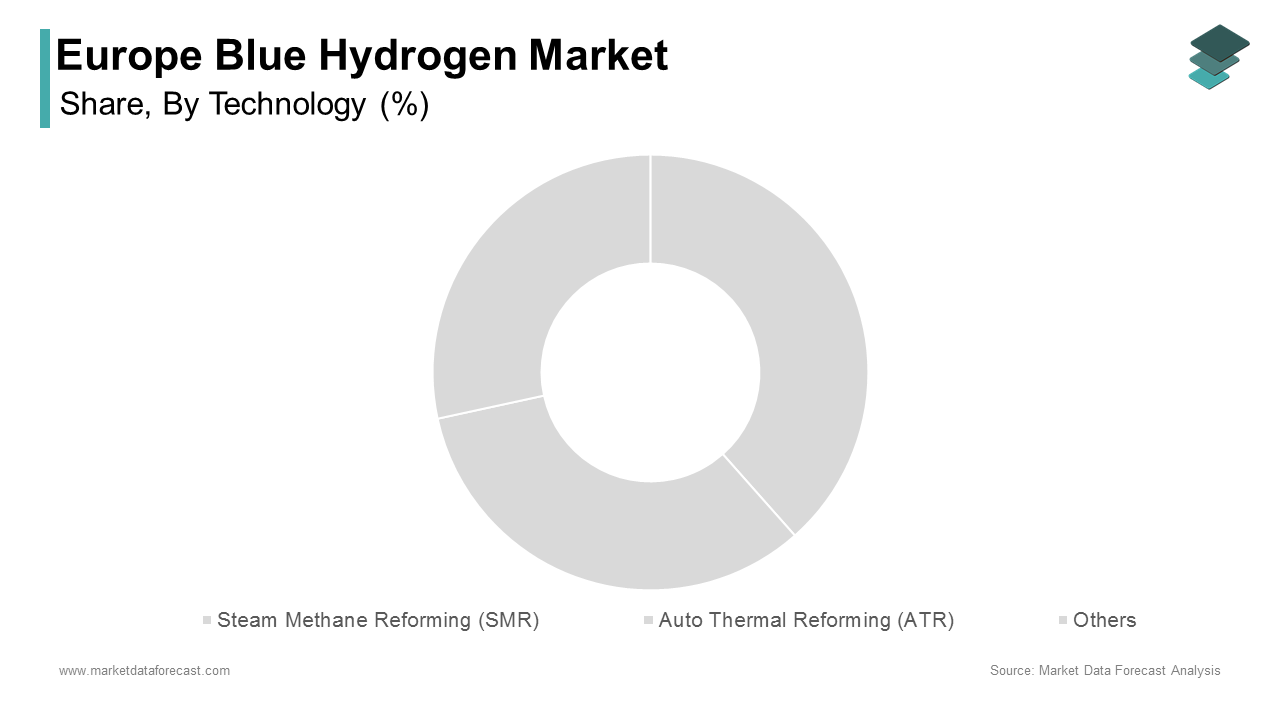
The Auto Thermal Reforming (ATR) segment is predicted to witness the highest CAGR of 24.3 percent between 2026 and 2034. ATR’s growth is driven by its inherent advantage in achieving higher CO₂ capture rates due to operation at elevated pressures and the integration of oxygen instead of air, which yields a more concentrated CO₂ stream ideal for geological storage. This technical edge aligns with tightening EU emissions standards under the Industrial Emissions Directive. Equinor’s H2H Saltend project in the United Kingdom, set to commence operations around 2026/2027, will utilize a 600-megawatt ATR unit capable of reducing CO₂ emissions by nearly 1 million tonnes annually, illustrating the technology's industrial scalability. Moreover, there is a trend in large-scale blue hydrogen is a pivot toward high-efficiency technologies like ATR, which, when combined with carbon capture, can capture over 95-99% of CO₂ emissions, a superior rate to conventional SMR processes. This shift is further accelerated by falling oxygen production costs from cryogenic air separation units, which reduce ATR’s operational overhead and enhance its long-term competitiveness.
By Application Insights
The refinery segment led the Europe blue hydrogen market by holding a 52.9% share in 2025. The dominance of the refinery segment is fuelled by the sector’s regulatory and technical dependence on hydrogen for hydrotreating and hydrocracking processes, which remove sulfur and upgrade heavy crude fractions to meet EU fuel standards. As per research, refineries represent a major existing consumer of hydrogen in the EU, with demand expected to intensify due to evolving environmental regulations aimed at reducing the carbon intensity of fuels. Energy companies like TotalEnergies are converting facilities into multi-energy platforms—such as the Grandpuits site—to support decarbonization efforts, allowing the incorporation of hydrogen for desulfurization and other processes. The European Union's comprehensive strategy, including the ReFuelEU Aviation initiative, mandates a gradual uptake of Sustainable Aviation Fuels (SAF), including synthetic e-fuels, which will create new demand for renewable hydrogen (H₂). Crucially, refineries already possess the spatial footprint, safety protocols, and gas handling infrastructure to integrate carbon capture, reducing retrofit complexity. This confluence of regulatory pressure, infrastructure readiness, and process necessity cements refining as the anchor application for blue hydrogen through the current decade.
The chemical segment is estimated to register the fastest CAGR of 28.1% from 2026 to 2034. The expansion of the chemical segment is propelled by the sector’s urgent need to decarbonize ammonia and methanol production, processes that collectively account for a portion of EU industrial emissions. Europe is actively transforming its ammonia production process to be more environmentally friendly. This transition includes major companies adopting blue hydrogen plants to capture carbon dioxide emissions and financial incentives helping chemical companies switch to cleaner hydrogen methods by reducing financial risks. The European Union is also using new trade rules to favor ammonia made with low-emission techniques over high-emission imports. These economic and policy tailwinds transform the chemical segment from a niche adopter into the primary growth engine for blue hydrogen deployment.
REGIONAL ANALYSIS
Germany Blue Hydrogen Market Insights
Germany outperformed other regions in the European blue hydrogen market and accounted for a 24.2% share in 2025. The prominence of the German market is primarily driven by its industrial density, policy ambition, and infrastructure investments. Germany's updated hydrogen strategy emphasizes low-carbon hydrogen with substantial financial backing, initially focusing on blue hydrogen. According to research, major industrial regions are establishing considerable capacity for blue hydrogen production, targeting readiness by 2030. A significant part of the current natural gas pipeline infrastructure is being made ready for transporting hydrogen. Germany depends on reliable natural gas imports from nearby countries via pipelines, which ensures a steady supply for blue hydrogen. Most planned blue hydrogen projects have obtained the required permits for connecting to the grid. This combination of fiscal support, infrastructure readiness, and industrial demand, particularly from the steel and chemical sectors, strengthens Germany’s dominance in the transitional hydrogen economy.
The Netherlands Blue Hydrogen Market Insights
The Netherlands held the second largest position in the Europe blue hydrogen market and captured a 19.8% share in 2025. The growth of the Netherlands in the regional market is propelled by its strategic North Sea access, industrial clustering, and pioneering CO₂ transport infrastructure. Rotterdam alone hosts a share of the EU’s announced blue hydrogen projects, leveraging its port’s status as Europe’s largest petrochemical hub. According to reports and official data, the Netherlands is advancing its national hydrogen strategy, which includes significant public and private investment. The Porthos project, a major CO₂ transport and storage initiative, has reached a final investment decision and is projected to be operational by 2026. This system is designed to capture and store notable tonnes of CO₂ annually from industrial partners, including Shell, ExxonMobil, and Air Liquide. The Netherlands is strategically positioned to benefit from depleted gas fields beneath the North Sea, which the Netherlands Organisation for Applied Scientific Research (TNO) estimates can store millions of tonnes of CO₂. This integrated ecosystem of capture, storage, and cross-border connectivity positions the Netherlands as Europe’s blue hydrogen logistics nexus.
United Kingdom Blue Hydrogen Market Insights
The United Kingdom is another key player in the Europe blue hydrogen market, with its advanced offshore CO₂ storage capabilities and cluster-based decarbonization model. The country possesses billions of tonnes of storage capacity in saline aquifers. The UK government is pursuing a strategy to develop a domestic low-carbon hydrogen industry using both blue and green production methods. This approach involves significant investment in industrial clusters and new facilities while also exploring the use of existing gas infrastructure for hydrogen transport. Natural gas supply remains secure, with a share sourced from domestic North Sea fields, which reduces import dependency. This policy certainty, combined with geological advantage, cements the UK’s role as a blue hydrogen leader.
Norway Blue Hydrogen Market Insights
Norway is moving ahead steadfastly in the European blue hydrogen market and is uniquely positioned as both a producer and enabler through its abundant natural gas reserves and a world-class CO₂ storage infrastructure. Unlike most EU nations, Norway is a net energy exporter, with Equinor producing billions of cubic meters of natural gas, a share of which is low methane intensity pipeline quality, according to sources. This feedstock advantage enables cost-effective blue hydrogen production. Norway has a proven track record of securely storing large amounts of carbon dioxide (CO₂) over several decades, demonstrating the viability of the technology on a large scale. This successful experience has helped establish trust in the technical feasibility of carbon capture and storage (CCS), which in turn encourages international collaboration and cross-border projects. Building on this expertise, commercial services for shipping and injecting CO₂ are under development by a major industry collaboration. This project is designed to provide businesses with a solution for managing their emissions, starting with a significant initial capacity that can be expanded in the future to meet growing demand. The Norwegian government is also financially supporting the growth of a hydrogen economy with a substantial long-term investment. This dual role as a clean gas supplier and carbon sink makes Norway indispensable to Europe’s blue hydrogen value chain.
France Blue Hydrogen Market Insights
France is anticipated to grow in the Europe blue hydrogen market from 2026 to 2034 due to a cautious but strategic embrace of blue hydrogen as a bridge to green. The French government’s National Hydrogen Strategy, most recently updated in April 2026 (not revised in 2023), outlines a total public funding envelope of €9 billion by 2030, with a focus on low-carbon hydrogen produced by electrolysis using renewable and nuclear energy. France’s natural gas import dependency creates feedstock risk, but long-term contracts with Norway and Algeria mitigate short-term volatility. The country’s regulatory stance remains stringent. Governments and international bodies are increasingly establishing specific, verifiable low-carbon intensity standards for hydrogen production to qualify for public subsidies, with various agencies, such as the U.S. Department of Energy, setting a target of 4 kilograms of CO₂ equivalent per kilogram of H₂ on a well-to-gate basis. Nevertheless, the chemical sector is driving adoption. While France prioritizes green hydrogen long term, its industrial decarbonization deadlines necessitate blue hydrogen as a transitional tool, ensuring steady, if measured growth through the decade.
COMPETITION OVERVIEW
The Europe blue hydrogen market features intense but collaborative competition among energy majors, technology providers, and industrial conglomerates. Unlike conventional sectors, rivalry is tempered by the necessity for shared infrastructure such as CO₂ pipelines and storage sites, which encourages joint ventures and public-private partnerships. Companies differentiate through technological integration, feedstock sourcing advantages, and proximity to high-demand industrial zones. The absence of mature revenue models has led players to prioritize first mover credibility over immediate profitability,y securing government grants and policy support as critical competitive assets. Innovation focuses on improving carbon capture efficiency by reducing methane leakage and lowering levelized hydrogen costs. Regulatory alignment across member states remains a key battleground with firms lobbying for harmonized standards on emissions accounting, hydrogen blending, and cross-border CO₂ transport. This dynamic creates a landscape where strategic positioning and ecosystem influence often outweigh traditional market metrics.
Top Strategies Used by the Key Market Participants
Key players in the Europe blue hydrogen market are primarily pursuing strategic alliances with industrial off-takers to secure long-term hydrogen purchase agreements, thereby de-risking capital investment. They are also investing in repurposing existing natural gas infrastructure for hydrogen transport and CO₂ pipelines to reduce deployment costs and accelerate timelines. Another important strategy involves co-developing integrated clusters where multiple emitters share centralized carbon capture and storage facilities to achieve economies of scale. Companies are actively engaging in policy advocacy to shape regulatory frameworks such as carbon contracts for difference and hydrogen certification schemes. Besides, they are adopting modular, scalable plant designs to allow phased capacity expansion aligned with demand growth and technological learning.
KEY MARKET PLAYERS
A few major players of the Europe blue hydrogen market include
- Linde PLC
- Shell PLC
- Air Liquide SA
- Air Products & Chemicals Inc
- ENGIE SA
- Equinor ASA
- Exxon Mobil Corp
Leading Players in the Market
Equinor
Equinor is a leading force in the European blue hydrogen market through its integrated approach combining natural gas expertise with carbon capture and storage. The company spearheads the H2H Saltend project in the United Kingdom, which will produce blue hydrogen for industrial use while storing CO₂ beneath the North Sea. Equinor also co-leads the Northern Lights initiative, a first-of-its-kind open access CO₂ transport and storage infrastructure serving multiple European countries. These initiatives position Equinor as a critical enabler of large-scale blue hydrogen deployment not only in Europe but globally by demonstrating replicable business models for carbon management.
Air Liquide
Air Liquide plays a pivotal role in scaling Europe’s blue hydrogen ecosystem through technology integration and strategic partnerships. The company operates one of the continent’s largest hydrogen production facilities in Antwerp, Belgium, where it is retrofitting a steam methane reformer with carbon capture to supply blue hydrogen to chemical and refining customers. Its global engineering capabilities also support blue hydrogen feasibility studies in North America and Asia, establishing a transcontinental footprint anchored in European operational experience.
Shell
Shell actively shapes the European blue hydrogen landscape by leveraging its downstream infrastructure and decarbonization commitments. The company is a key participant in the Porthos project in the Netherlands, where it will supply captured CO₂ from its Moerdijk refining and chemicals complex for offshore storage. Shell is also developing the NortH2 initiative, which includes a transitional blue hydrogen phase before full green conversion. Through collaborations with industrial clusters in Germany and the UK, the company is creating demand corridors that link production capture and end use. Shell’s global advocacy for carbon pricing and hydrogen standards further amplifies its influence beyond regional boundaries.
MARKET SEGMENTATION
This research report on the Europe blue hydrogen market has been segmented and sub-segmented based on technology, application, and region.
By Technology
- Steam Methane Reforming (SMR)
- Auto Thermal Reforming (ATR)
- Others
By Application
- Refinery
- Chemical
- Others
By Region
- UK
- France
- Spain
- Germany
- Italy
- Russia
- Sweden
- Denmark
- Switzerland
- Netherlands
- Turkey
- Czech Republic
- Rest of Europe