- Product Description Description
- Table of Contents TOC
- List of Table & Figure LOT
- Get Free Sample PDF Sample PDF
Market Size, 2025
$0.36 BnMarket Estimate, 2026
$0.38 BnMarket Forecast, 2034
$0.58 BnCAGR, 2026–2034
5.44%Europe Bone Growth Stimulators Market Summary
Europe bone growth stimulators market was valued at USD 0.34 billion in 2024, estimated at USD 0.36 billion in 2025, and is projected to reach USD 0.55 billion by 2033 (CAGR 5.44%, 2025–2033), driven by rising fragility fractures, increasing spinal fusion volumes, and demand for non-surgical bone healing solutions.
Market Highlights
- 2024 (actual): USD 0.34 billion
- 2025 (est): USD 0.36 billion
- 2033 (forecast): USD 0.55 billion
- CAGR (2025–2033): 5.44%
Quick growth drivers
- High prevalence of osteoporotic and fragility fractures across Europe’s aging population.
- Rising spinal fusion surgeries for degenerative disc disease and instability.
- Clinical preference for non-invasive adjunct therapies to avoid revision surgeries.
- Improved recognition of non-union risk in elderly, diabetic, and vascular-compromised patients.
- Cost-avoidance focus by health systems seeking to reduce repeat surgical interventions.
Principal restraints
- Fragmented reimbursement frameworks across EU member states limiting equitable access.
- Regional reimbursement disparities (full coverage in Germany vs. private-pay markets).
- Absence of standardized EU-wide clinical protocols for stimulator use.
- Limited comparative effectiveness data affecting payer confidence.
High-value opportunities
- Digitally connected bone growth stimulators with adherence tracking and telehealth integration.
- Expansion into diabetic and vascular-compromised fracture management.
- Home-based stimulation therapy models aligned with post-acute care decentralization.
- Value-based reimbursement pathways supported by real-world outcome data.
Key operational challenges
- Low surgeon awareness and inconsistent training on biophysical stimulation modalities.
- Regulatory ambiguity under EU MDR between device and therapeutic classification.
- Weak post-market evidence generation incentives.
- Modality confusion (ultrasound vs. electromagnetic use in spine vs. long bone cases).
Fastest-growing segments
- Platelet-rich plasma (PRP): 12.4% CAGR — rising adoption in orthobiologics and dental applications.
- Home care end use: 10.5% CAGR — portable non-invasive devices and telemonitoring.
- Oral & maxillofacial applications: 11.8% CAGR — implantology and bone augmentation growth.
- Smart connected stimulators: strong future upside with digital health integration.
Regional leadership & dynamics
Germany (lead, 26.5%)
- Full statutory reimbursement.
- High spinal fusion volumes and strong clinical trial activity.
France (15.1%)
- Protocol-driven adoption in spine and maxillofacial surgery.
- Strong surgical society influence.
United Kingdom
- Selective NHS reimbursement with strong cost-effectiveness focus.
- Growing use in trauma and fracture liaison services.
Italy & Nordics
- Italy: regional reimbursement variability with strong private clinic demand.
- Sweden: value-based care model with outcome-linked stimulator use.
What wins commercially (competitive edge)
- Strong clinical evidence and registry-backed outcomes.
- Reimbursement-aligned indications in spine and non-union cases.
- Non-invasive, easy-to-use home therapy platforms.
- Digital adherence monitoring and real-world data capture.
- Surgeon education and protocol integration with orthopedic societies.
Top strategic ask for executives
- Invest in post-market real-world evidence to unlock reimbursement expansion.
- Accelerate connected and home-based stimulator platforms.
- Target high-risk patient subgroups (elderly, diabetics, vascular disease).
- Drive EU-level clinical guideline standardization to reduce adoption variability.
Leading players
Orthofix Medical · DJO LLC · Zimmer Biomet · Bioventus · Medtronic · IGEA · Ossatec · Elizur
Europe Bone Growth Stimulators Market Size
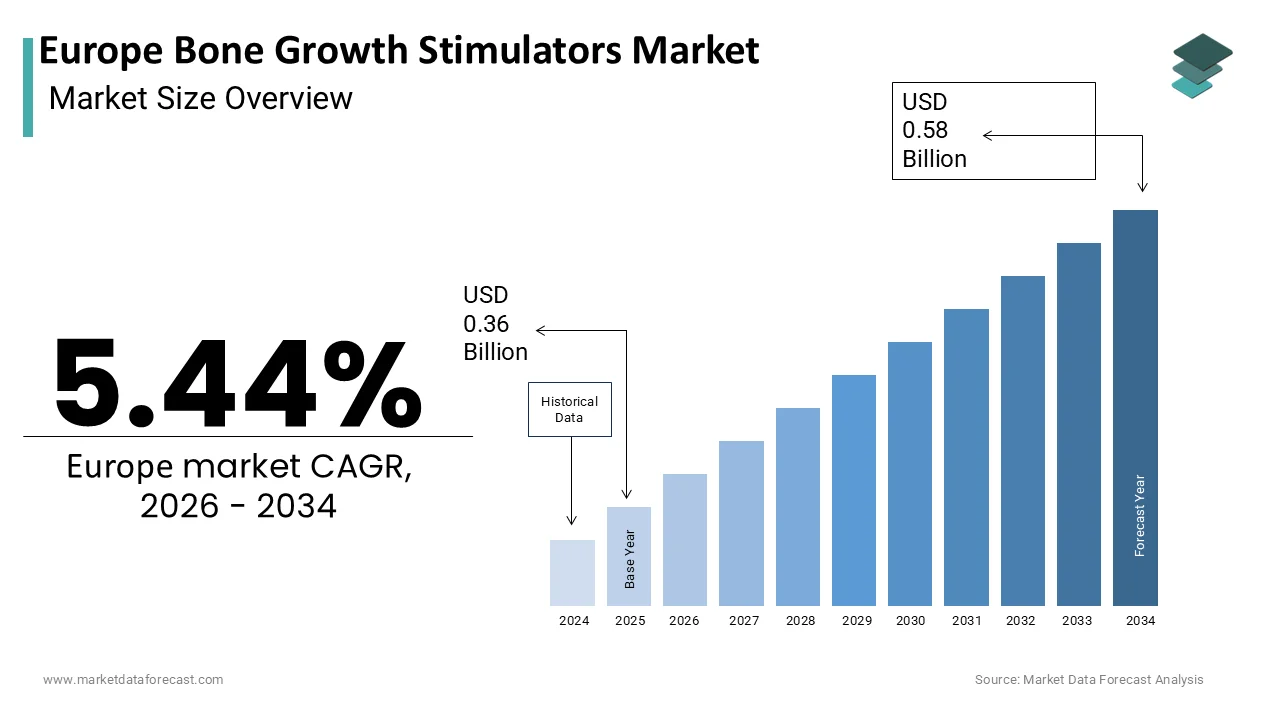
The Europe Bone Growth Stimulators Market is projected to grow from USD 0.36 billion in 2025 to USD 0.38 billion in 2026 and reach USD 0.58 billion by 2034, registering a CAGR of 5.44% during the forecast period from 2026 to 2034.
Bone growth stimulators are medical devices that employ electrical, electromagnetic, or ultrasonic energy to accelerate bone healing in cases of non-union or delayed union or spinal fusion. These non-invasive or minimally invasive systems are prescribed when biological healing fails to progress within expected timelines, offering an alternative to revision surgery. Unlike general orthopedic implants, bone growth stimulators function as therapeutic adjuncts, modulating cellular activity at the fracture site to enhance osteogenesis. A notable number of fractures occur annually across the region. A proportion of these fractures may not heal correctly, potentially leading to complex medical situations requiring intervention. The aging population is particularly prone to certain types of fractures. Impaired healing can be a concern in older individuals due to underlying health conditions. Surgical procedures on the spine, which often involve techniques to promote bone fusion, are performed frequently. These clinical and demographic realities, rather than commercial dynamics, form the foundational demand structure for bone growth stimulation technologies across the continent.
MARKET DRIVERS
High Prevalence of Osteoporotic and Fragility Fractures in Aging Populations
The escalating burdenosteoporosis-relatedated fragility fractures among the elderly is one of the major drivers of the European bone growth stimulators market. A substantial population across the European Union is affected by osteoporosis. Women over 50 have a significant lifetime risk of experiencing an osteoporotic fracture. Hip and vertebral fractures are particularly common and present a major concern. Hundreds of thousands of hip fractures occur annually within the EU. A notable percentage of these fractures can develop delayed or non-union (fail to heal properly), which is linked to factors such as reduced blood supply and cell activity in older bone tissue. In countries with aging populations, orthopedic centers frequently monitor fracture healing progress within an eight-week timeframe. Triggers indicating non-union often result in the prescription of medical stimulators. Adjunctive biophysical stimulation is considered a method to manage high-risk non-unions and potentially help patients avoid subsequent surgical procedures. Repeat surgeries for these conditions carry a considerable mortality risk for elderly patients. This clinical imperative, driven by demographic inertia and geriatric vulnerability, ensures consistent and growing demand for non-invasive healing solutions that align with Europe’s emphasis on conservative, complication-reducing interventions in elderly care.
Rising Volume of Spinal Fusion Surgeries Across Specialized Centers
The expanding adoption of spinal fusion procedures for degenerative disc disease and spinal instability is also a major accelerator for the European bone growth stimulators market. A significant number of spinal fusion procedures are carried out within the EU annually, demonstrating this treatment's common use. A specific technique, posterior lumbar interbody fusion, is currently the most prevalent type of fusion surgery performed in the region. Pseudarthrosis, or failed fusion, remains a potential complication across these procedures. The likelihood of this complication can vary considerably and appears linked to various patient risk factors. To mitigate this, leading neurosurgical and orthopedic centers in Sweden, the Netherlands, and France increasingly prescribe electromagnetic or capacitive coupling stimulators as standard postoperative protocol. Moreover, national health technology assessments in Germany and Switzerland now recognize improved fusion rates with stimulation, facilitating faster reimbursement approvals. The procedural growth, fueled by aging populations and rising diagnoses of degenerative spine conditions, directly translates into higher adoption of bone growth technologies as integral components of modern spinal care pathways.
MARKET RESTRAINTS
Limited and Inconsistent Reimbursement Coverage Across EU Member States
The fragmented and often restrictive reimbursement landscape varies markedly between countries, which is a major restraint in the European bone growth stimulators market. Germany and Sweden offer full or partial statutory health insurance coverage for prescribed stimulators, a stark contrast to Spain, Greece, and Portugal, where these are considered non-essential or experimental, and patients must pay the full price. In Italy, regional health authorities independently decide coverage, which results in a patient in Lombardy receiving full reimbursement while one in Sicily pays entirely out of pocket. This inconsistency not only suppresses market penetration but also creates ethical and clinical disparities, as non-union patients in low-reimbursement regions are either denied therapy or undergo higher-risk revision surgeries. Disparities in patient access and stifled innovation will persist in the EU until common HTA criteria are established.
Lack of Standardized Clinical Protocols for Stimulator Application
The absence of universally accepted clinical guidelines for the timing, type, and duration of bone growth stimulator use remains a serious barrier to consistent adoption across the region. This obstructs the expansion of the European bone growth stimulators market. The European Federation of National Associations of Orthopaedics and Traumatology (EFORT) acknowledges that biophysical stimulation is effective, but it has not issued specific mandatory protocols; instead, treatment decisions are left to the discretion of individual surgeons. The ambiguity leads to underutilization in early delayed union cases, where intervention is most effective. Furthermore, confusion persists between device modalities; some centers prescribe ultrasonic systems for spinal fusion despite stronger evidence for electromagnetic use in axial applications. The European Medicines Agency does not regulate these Class IIb devices as drugs, so comparative effectiveness data are not required for market entry. The absence of a consensus on best practices, such as through the European Reference Network for Rare Bone Disorders, will result in inconsistent stimulator use, thereby hindering both patient outcomes and market scalability.
MARKET OPPORTUNITIES
Integration of Smart Monitoring and Telehealth in Stimulator Platforms
The convergence of these medical devices with digital health technologies to enable remote monitoring and personalized therapy provides new opportunities for the European bone growth stimulators market. Next-generation devices now incorporate Bluetooth connectivity, usage sensors, and mobile applications that track compliance, treatment duration, on patient-reported outcomes in real time. The European Union is actively working towards the digital transformation of health and care, with policies and funded projects encouraging the widespread integration of digital health technologies such as telemedicine and remote monitoring to support the management of chronic conditions and improve care delivery across the region. Denmark maintains a long-standing commitment to national digital healthcare infrastructure and is continuing to invest in integrating new digital solutions and data use across the healthcare sector, with a focus on enhancing patient care, quality of treatment, and system efficiency through strong governance and coordinated initiatives. Similarly, Germany’s statutory health insurers have begun reimbursing connected medical devices that demonstrate improved outcomes, opening a pathway for premium pricing. This digital integration not only enhances clinical efficacy through adherence reinforcement but also generates real-world evidence to support health technology assessments. Companies that embed data analytics, telehealth interfaces, and AI-driven dose adjustment into their platforms are positioned to lead a new value-based segment focused on outcomes rather than device delivery alone.
Expansion into Adjunctive Use for Diabetic and Vascular Impairment Cases
The targeted application of these medical devices in patients with compromised healing due to diabetes or peripheral vascular disease is another key prospect for the expansion of the European bone growth stimulators market. Diabetes is associated with a higher risk of impaired bone healing in adults. Impaired angiogenesis and collagen synthesis are factors that may contribute to a reduced rate of fracture union in diabetic individuals. Pulsed electromagnetic field therapy has shown potential to support improved fracture healing times in patients with diabetic tibial fractures. Biophysical stimulation is being considered in guidelines related to the management of complex lower limb fractures in individuals with diabetes. National diabetic foot clinics in the UK and the Netherlands are now trialing stimulator protocols as part of multidisciplinary limb salvage programs. This clinical niche, though currently underpenetrated, offers a compelling route for market expansion grounded in comorbidity management and cost avoidance rather than pure device sales.
MARKET CHALLENGES
Persistent Gaps in Surgeon Awareness and Training on Biophysical Modalities
The insufficient familiarity among orthopedic and spinal surgeons with the mechanisms, indications, and evidence base for these medical devices degrades the growth of the European bone growth stimulators market. Unlike pharmaceuticals or implants, these devices are not routinely emphasized in surgical residency curricula across Europe. The knowledge gap leads to underutilization or inappropriate modality selection, for instance, using low-intensity pulsed ultrasound for spinal fusion despite limited evidence. Continuing medical education on the topic remains fragmented; while Germany and Sweden offer accredited workshops, Southern and Eastern European countries lack structured training programs. The absence of hands-on demonstration and outcome tracking further discourages trial. Integrating new, proven technologies systematically into surgical training and professional frameworks is essential for consistent clinical uptake; failure to do so perpetuates reliance on invasive surgeries and hinders patient access to non-operative solutions.
Regulatory Ambiguity Between Medical Device and Therapeutic Classification
The classification of bone growth stimulators under the EU Medical Device Regulation as Class IIb devices, without recognition as active therapeutic interventions, is also a challenge for the European bone growth stimulators market. Unlike pharmaceuticals, these devices are not required to demonstrate comparative effectiveness long-term functional outcomes during the conformity assessment process. The regulatory leniency allows market entry with minimal clinical proof but simultaneously weakens the evidence base needed for health technology assessments and premium reimbursement. Payers in countries increasingly demand real-world performance data before granting coverage, yet manufacturers lack the incentive to invest in post-market studies under the current framework. This paradox, easy market access but difficult reimbursement, stalls innovation investment and confuses clinicians about which devices are truly effective. The market will continue to be saturated with unproven devices, undermining faith in clinically validated technology, until regulators standardize classification based on therapeutic impact.
REPORT COVERAGE
| REPORT METRIC | DETAILS |
| Market Size Available | 2025 to 2034 |
| Base Year | 2025 |
| Forecast Period | 2026 to 2034 |
| Segments Covered | By Product, Application, End-User Region. |
| Various Analyses Covered | Global, Regional, and Country-Level Analysis, Segment-Level Analysis, Drivers, Restraints, Opportunities, Challenges; PESTLE Analysis; Porter’s Five Forces Analysis, Competitive Landscape, Analyst Overview of Investment Opportunities |
| Countries Covered | UK, France, Spain, Germany, Italy, Russia, Sweden, Denmark, Switzerland, Netherlands, Turkey, Czech Republic, Rest of Europe |
| Market Leaders Profiled | DJO LLC, |
SEGMENTAL ANALYSIS
By Product Insights
The bone growth stimulation devices segment held the largest share of 58.1% of the European bone growth stimulators market in 2025. The dominance of the bone growth stimulation devices segment is driven by their non-invasive nature, established clinical protocols, and regulatory acceptance across healthcare systems. These devices, encompassing electromagnetic, capacitive coupling, and low-intensity pulsed ultrasound technologies, are widely used as first-line adjuncts in spinal fusion and nonunion cases. The modality’s dominance is further reinforced by strong reimbursement in key markets. Unlike biologics, these devices avoid donor site morbidity, disease transmission risks, and complex storage logistics, making them operationally simpler for hospitals. This combination of safety, efficacy, policy support, and ease of integration into standard care pathways ensures sustained leadership for device-based stimulation across Europe.
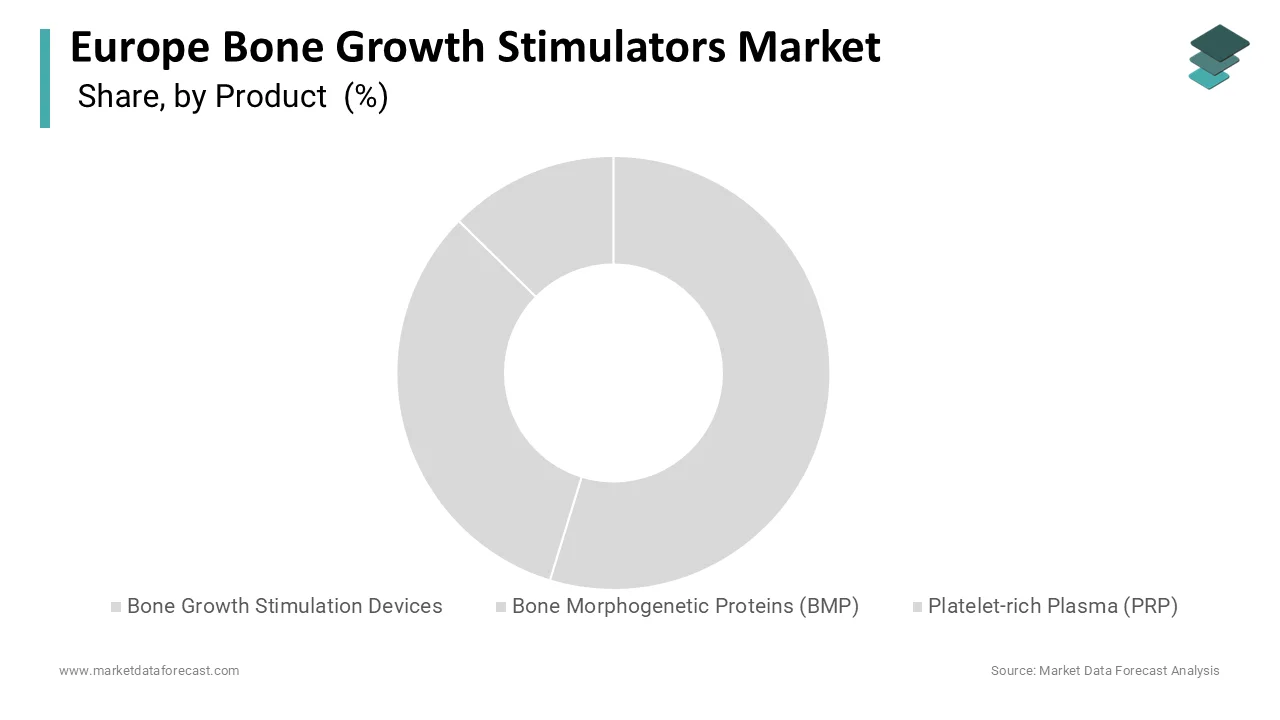
The platelet-rich plasma segment is expected to exhibit a noteworthy CAGR of 12.4% from 2025 to 2033. The rapid acceleration of the platelet-rich plasma segment is propelled by rising adoption in orthobiologic protocols, particularly in sports medicine and maxillofacial reconstruction. PRP leverages the patient’s own growth factors, such as platelet-derived growth factor and transforming growth factor beta, to enhance bone and soft tissue healing without immunogenic risk. Platelet-rich plasma (PRP) is being incorporated into post-fracture rehabilitation regimens in European football clubs. The use of PRP in alveolar ridge augmentation has increased due to improved graft integration rates. National regulatory bodies classify PRP as a minimally manipulated autologous product, enabling point-of-care preparation without full medical device authorization. Furthermore, cost pressures are driving a shift from expensive recombinant proteins toward affordable autologous alternatives. So, this segment is transitioning from experimental to mainstream, fueled by surgeon preference, patient demand for biological solutions, and favorable regulatory positioning.
By Application Insights
The spinal fusion surgeries segment was the largest in the European bone growth stimulators market by capturing a 49.2% share in 2025. The supremacy of the spinal fusion surgeries segment is credited to high procedural volumes and the critical need to ensure solid arthrodesis. According to research, a large number of spinal fusions were performed in the EU in 2023, with lumbar procedures accounting for a notable share of cases. Pseudarthrosis remains a significant complication, occurring in a portion of cases depending on patient risk factors such as smoking, obesity, and multi-level constructs. To mitigate this, leading neurosurgical centers in France, Switzerland, and the Netherlands integrate bone growth stimulators as standard postoperative care for high-risk patients. Germany’s statutory health system reimburses stimulator use for spinal indications when documented non-union risk exists, which creates a structured adoption pathway. The convergence of aging demographics, rising diagnosis of degenerative spine disease, and payer recognition of cost avoidance through reduced revision rates solidifies spinal fusion as the dominant and most predictable application segment.
The oral and maxillofacial surgeries segment is predicted to witness the highest CAGR of 11.8% from 2025 to 2033 due to the rising prevalence of dental implant procedures, jaw reconstruction, and alveolar cleft repairs—procedures that require reliable bone regeneration in confined anatomical spaces. Bone morphogenetic proteins and platelet-rich plasma are increasingly used to enhance graft osseointegration, with PRP adoption growing due to its point-of-care feasibility. Besides, the aging population is increasing the demand for full arch restorations, which rely heavily on bone augmentation. Unlike spinal or long bone applications, maxillofacial procedures are often performed in outpatient clinics with direct patient payment, bypassing complex hospital procurement hurdles. This commercial flexibility, combined with high patient willingness to pay for aesthetic and functional outcomes, fuels rapid segment expansion.
By End User Insights
The hospitals and clinics segment led the European bone growth stimulators market by occupying a substantial share in 2025. It is serving as the primary site for both surgical intervention and postoperative stimulator management. These institutions handle complex trauma, spinal fusions, and revision orthopedic cases where bone growth stimulation is clinically indicated. According to studies, most level one trauma centers in Western Europe have formal protocols for non-union management that include device or biologic stimulation. Large university hospitals in Germany, France, and Sweden maintain dedicated bone healing units that integrate imaging, biomarker tracking, and stimulator therapy under multidisciplinary oversight. Reimbursement systems are also hospital-centric. In Italy and Spain, stimulator rental costs are bundled into the surgical DRG payment, incentivizing institutional adoption. Furthermore, the storage and handling requirements for biologics necessitate controlled environments only available in hospital pharmacies. This ecosystem of clinical complexity, regulatory compliance, and payment alignment ensures that hospitals and specialized orthopedic clinics remain the dominant channel for bone growth stimulator delivery across Europe.
The home care segment is estimated to register the fastest CAGR of 10.5% from 2025 to 2033, owing to Europe’s broader shift toward decentralized post-acute care patient-centric recovery models. Non-invasive stimulators, particularly portable electromagnetic and ultrasound units, are well-suited for home use due to ease of operation and minimal supervision needs. Home-based bone stimulation is becoming a component of integrated care pathways for elderly fracture patients. Home therapy involving stimulation is utilized for patients experiencing non-union conditions, often with remote monitoring provided by nursing staff. The home use of therapy equipment is covered by some insurers, which can lead to reductions in costs associated with hospital stays and rehabilitation. The rise of telehealth further enables adherence tracking through connected devices, with usage data transmitted to clinicians in real time. Home care is becoming a fundamental element of bone healing management, moving beyond a niche option, due to health systems prioritizing both cost efficiency and patient convenience, particularly benefiting geriatric and rural populations.
COUNTRY LEVEL ANALYSIS
Germany Bone Growth Stimulators Market Analysis
Germany was the top performer in the European Bone Growth Stimulators Market by accounting for a 26.5% share in 2025. The dominance of the German market is driven by its advanced orthopedic infrastructure, universal health coverage, and high procedural volumes. The country performs over thousands of spinal fusions annually and records more than that for non-union cases, according to sources. Statutory health insurance fully reimburses electromagnetic and ultrasound stimulators for approved indications. Germany also hosts leading research institutions such as Charité Berlin and the University of Heidelberg, which conduct pivotal trials on next-generation stimulation protocols. This combination of clinical rigor, payer support, and scientific leadership establishes Germany not only as the market volume leader but also as the gold standard for evidence-based adoption across the EU.
France Bone Growth Stimulators Market Analysis
France followed closely in the European bone growth stimulators market by capturing a share of 15.1% in 2025, with demand heavily shaped by its concentration of specialized spine centers and proactive surgical societies. The country performs a significant number of spinal fusions each year, and the Société Française de Chirurgie Vertébrale mandates stimulator use in high-risk cases such as smokers and multi-level constructs. France also leads in maxillofacial applications. Numerous university dental hospitals routinely use PRP and BMP in implantology, which is supported by national training programs. The centralized health system enables rapid diffusion of clinical guidelines by ensuring consistent stimulator adoption across public hospitals. This surgeon-driven, protocol-anchored ecosystem sustains France’s position as a high-value, clinically sophisticated market within Western Europe.
United Kingdom Bone Growth Stimulators Market Analysis
The United Kingdom is another key player in the European bone growth stimulators market. It is navigating a unique balance between high trauma incidence and constrained National Health Service resources. A significant volume of long bone fractures is treated yearly. A small percentage of these fractures advance to non-union, creating several complex cases that necessitate advanced intervention. Reimbursement for stimulators is applied selectively. Guidance on cost-effectiveness indicates that using stimulators to prevent revision surgery is a more economical option. Major trauma centers in London and Manchester now embed stimulator protocols in fracture liaison services for osteoporotic patients. Besides, the UK’s departure from EU regulatory frameworks has accelerated the adoption of UKCA-marked autologous therapies like PRP, which bypass lengthy CE certification. Though budget-conscious, the NHS’s focus on long-term cost avoidance through non-surgical healing supports measured but growing stimulator utilization.
Italy Bone Growth Stimulators Market Analysis
Italy is growing steadily in the European bone growth stimulators market, with demand driven by one of Europe’s oldest populations, a portion aged 65 or older, and correspondingly high rates of fragility fractures. The country records a considerable number of hip fractures annually, and delayed union is common due to comorbidities and nutritional deficits. Reimbursement is decentralized. Regions provide full coverage for stimulators in spinal and trauma cases, while Southern regions often deny access due to budget constraints. This creates a north-south divide in adoption, with Milan and Bologna hosting advanced bone healing clinics while Sicily relies on revision surgery. Nevertheless, Italy’s strong orthopedic tradition and high density of private clinics, particularly in dental and maxillofacial sectors, sustain baseline demand. The national osteoporosis strategy now includes non-union prevention as a key metric, potentially driving future standardization and market expansion.
Sweden Bone Growth Stimulators Market Analysis
Europe, Sweden is likely to grow notably in the European bone growth stimulators market from 2025 to 2033 due to its data-driven, outcome-focused approach to bone healing. Spinal fusions are performed in a particular country with a relatively lower frequency compared to other nations in Europe. The country achieves high success rates for these procedures. Systematic use of adjunctive stimulation is a contributing factor to the positive outcomes. Non-union cases are subject to review by regional committees. These committees direct the use of stimulator trials before considering surgical revision. The national electronic health record system links stimulator usage to long-term mobility outcomes, informing continuous protocol refinement. Sweden’s public healthcare system fully reimburses devices when prescribed through certified pathways, and home care delivery is standard for elderly patients. This closed loop of indication, intervention, and outcome tracking, embedded in Sweedn’s value-based healthcare model, makes it a policy and clinical exemplar that influences best practices across Northern Europe despite its modest market size.
COMPETITIVE LANDSCAPE
The European Bone Growth Stimulators Market features a competitive landscape led by established global medtech firms alongside specialized orthobiologic companies. Competition is centered on clinical credibility, technological differentiation, and health system integration rather than pricing. Regulatory compliance under the EU Medical Device Regulation is a baseline requirement, but insufficient for market success; companies must demonstrate real-world efficacy through national registries and health technology assessments. Reimbursement varies significantly across countries, creating a fragmented commercial environment where market access strategies must be localized. Large players leverage their existing hospital relationships in spine and trauma to bundle stimulators with implants and navigation systems, while niche firms focus on autologous therapies like PRP that benefit from simplified regulatory pathways. Innovation is shifting toward connected devices, remote monitoring, and expanded indications in comorbid populations. Despite moderate procedural growth, wth the market remaining highly specialized with barriers to entry including surgeon trust, clinical validation, and payer engagement, making sustained presence dependent on long-term clinical partnership and outcome transparency.
KEY MARKET PLAYERS
A few prominent companies operating in the europe bone growth stimulators market are
- DJO LLC,
- Orthofix International N.V.,
- Zimmer Biomet Holdings Inc.,
- Elizur, Bioventus LLC.
- Ossatec Benelux BV,
- Verve Consulting Inc,.
- IGEA S.p.A.
TOP LEADING PLAYERS IN THE MARKET
- Orthofix Medical Inc. is a global innovator in orthobiologic and stimulation technologies with a strong foothold in the European bone healing ecosystem. The company’s portfolio includes the PhysioStim and SpinalStim systems—pulsed electromagnetic field devices widely used for non-union fractures and spinal fusion adjunct therapy. Orthofix collaborates closely with orthopedic societies across Germany,y Ita, and the UK to integrate its devices into clinical care pathways. The digital enhancement aligns with Europe’s telehealth expansion and strengthens Orthofix’s value proposition by linking device use to measurable outcomes. Its commitment to real-world evidence generation and surgeon education continues to reinforce its reputation as a trusted partner in conservative bone healing strategies across the continent.
- Medtronic plc is a leading global medical technology company with significant influence in the European bone growth stimulators market through its comprehensive spine and orthopedic solutions. The company offers the EBI Bone Healing System, a stem that utilizes capacitive coupling technology for spinal fusion support and is widely adopted in specialized centers across France, Sweden, and the Netherlands. Medtronic integrates its stimulation platforms with intraoperative imaging and navigation tools to create seamless surgical ecosystems. The educational investment enhances surgeon confidence and standardizes best practices. Medtronic’s global scale and deep integration into hospital workflows ensure its continued leadership in high complexity spinal applications throughout Europe.
- Bioventus LLC is a prominent player in orthobiologics with growing relevance in Europe through its portfolio of bone healing solutions, including EXOGE,N low-intensity pulsed ultrasound device for fracture non-unions. The company emphasizes non-invasive approaches and has established partnerships with national fracture liaison services in the UK and Denmark to promote early intervention in osteoporotic patients. Bioventus actively supports health economic studies demonstrating cost avoidance through reduced revision surgeries. The initiative strengthens the evidence base for expanded indications and facilitates reimbursement negotiations. Bioventus’s focus on clinical utility patient patient-centric design, and health system value positions it as a key contributor to the evolution of conservative bone healing in Europe.
TOP STRATEGIES USED BY THE KEY MARKET PARTICIPANTS
Key players in the European Bone Growth Stimulators Market prioritize clinical evidence generation through multicenter registries and post-market studies to support reimbursement and guideline inclusion. They invest in digital integration by embedding Bluetooth connectivity, usage monitoring, and mobile health applications into devices to enhance adherence and enable remote care. Strategic collaborations with orthopedic and spinal societies facilitate surgeon education and protocol standardization across countries. Companies also tailor market access strategies to national health systems, focusing on health economic arguments that demonstrate cost avoidance from reduced revision surgeries. Additionally, they expand indications through targeted research in high-need populations such as diabetics and the elderly, aligning product development with Europe’s demographic and clinical realities.
MARKET SEGMENTATION
This research report on the europe bone growth stimulators market has been segmented and sub-segmented into the following categories.
By Product
-
Bone Growth Stimulation Devices
- External
- Implanted
- Ultrasonic
- Bone Morphogenetic Proteins (BMP)
- Platelet-rich Plasma (PRP)
By Application
- Spinal Fusion Surgeries
- Delayed Union & Non-union Bone Fractures
- Oral and Maxillofacial Surgeries
- Other Applications
By End User
- Hospitals and Clinics
- Home Care
- Academic & Research Institutes
- CROs
By Country
- UK
- France
- Spain
- Germany
- Italy
- Russia
- Sweden
- Denmark
- Switzerland
- Netherlands
- Turkey
- Czech Republic
- Rest of Europe