Europe Building Automation Systems Market Size, Share, Trends, & Growth Forecast Report By Component (Hardware, Software, Services), System Type, Communication Technology, Installation Type, End User, and Country (UK, France, Spain, Germany, Italy, Russia, Sweden, Denmark, Switzerland, Netherlands, Turkey, Czech Republic and Rest of Europe), Industry Analysis From 2026 to 2034
Market Size, 2025
$18.71 BnMarket Estimate, 2026
$20.39 BnMarket Forecast, 2034
$40.60 BnCAGR, 2026–2034
8.99%Europe Building Automation Systems Market Report Summary
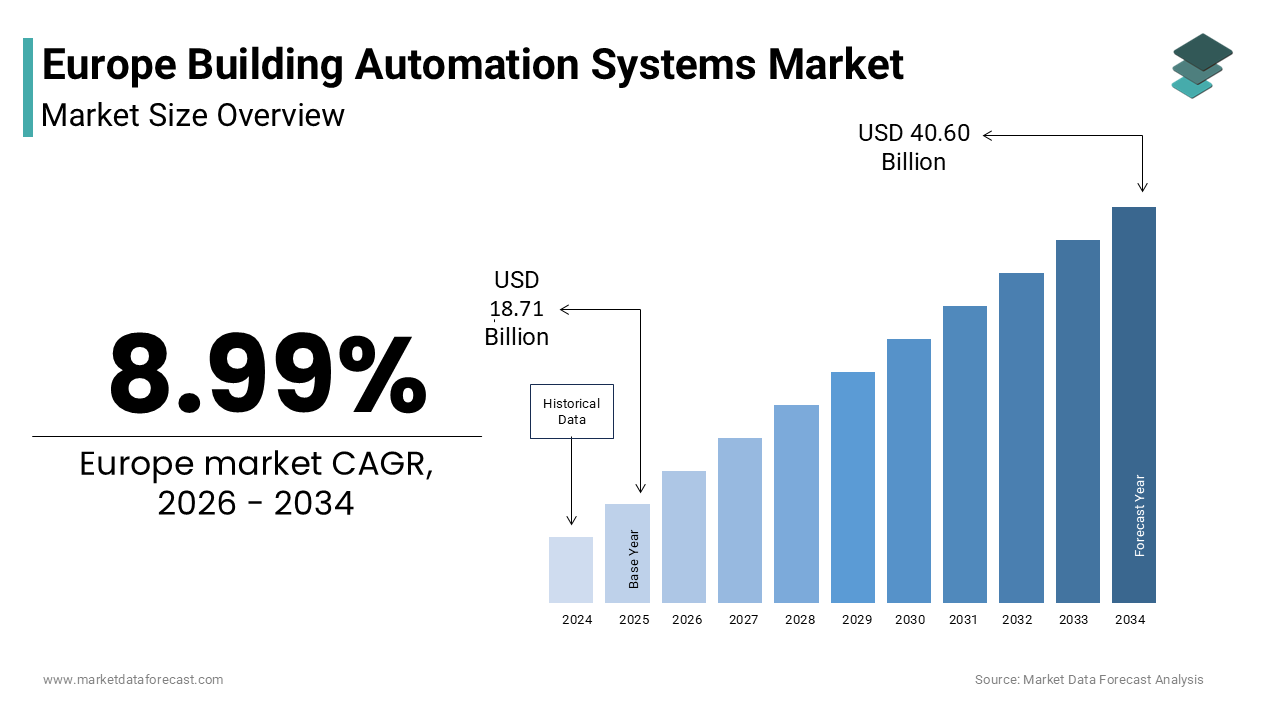
The Europe building automation systems (BAS) market was valued at USD 18.71 billion in 2025, is estimated to reach USD 20.39 billion in 2026, and is projected to reach USD 40.60 billion by 2034, growing at a CAGR of 8.99% during the forecast period from 2026 to 2034. The growth of the Europe building automation systems market is driven by stringent energy efficiency regulations, increasing demand for smart energy management solutions, and the need to modernize aging building infrastructure across the region. The rising focus on reducing carbon emissions, coupled with regulatory mandates such as the Energy Performance of Buildings Directive, is accelerating the adoption of automation technologies. Moreover, the integration of IoT, AI-driven analytics, and cloud-based building management platforms is transforming BAS into a critical tool for enhancing operational efficiency, occupant comfort, and sustainability across commercial and institutional buildings.
Key Market Trends
-
Increasing adoption of smart energy management systems to optimize energy consumption and reduce operational costs.
-
Growing demand for AI-driven and IoT-enabled building automation platforms for predictive maintenance and real-time monitoring.
-
Rising implementation of wireless communication technologies to simplify installation in retrofit projects.
-
Expansion of software-as-a-service (SaaS) and recurring revenue models in building automation solutions.
-
Strong emphasis on cybersecurity and data protection compliance in connected building infrastructure.
Segmental Insights
- Based on component, the hardware segment dominated the Europe building automation systems market and accounted for the largest share in 2025. This dominance is attributed to the essential role of controllers, sensors, actuators, and other physical devices that form the backbone of automation systems, particularly in retrofit projects requiring replacement of legacy infrastructure.
- Based on system type, the HVAC control systems segment held the largest share of the Europe building automation systems market in 2025. The segment’s leadership is driven by the high energy consumption associated with heating, ventilation, and air conditioning systems, making them a primary focus for energy optimization and regulatory compliance.
- Based on communication technology, the wired segment accounted for a major share of the market in 2025 due to its reliability, security, and suitability for mission-critical applications such as fire safety and industrial facilities.
- Based on installation type, the retrofit segment dominated the Europe building automation systems market in 2025. This is mainly due to the large number of aging buildings across Europe that require modernization to meet current energy efficiency and sustainability standards.
- Based on end user, the commercial buildings segment held the largest share of the Europe building automation systems market in 2025. The dominance of this segment is driven by the need for energy efficiency, improved occupant comfort, and enhanced asset value across office spaces, retail centers, and hospitality facilities.
Regional Insights
The Europe building automation systems market is experiencing strong growth across major countries due to regulatory mandates, technological advancements, and increasing investments in smart infrastructure.
-
Germany dominated the Europe building automation systems market in 2025, driven by stringent energy efficiency regulations, strong industrial automation expertise, and high adoption of smart building technologies across commercial and industrial sectors.
-
The United Kingdom is witnessing steady growth due to increasing adoption of AI-driven building management systems, smart city initiatives, and rising demand for energy-efficient infrastructure in urban areas.
-
France remains a key market supported by regulatory mandates such as energy reduction targets for commercial buildings and strong government investments in sustainable infrastructure.
-
Italy is experiencing notable growth driven by extensive retrofit activities and government incentives aimed at improving building energy performance.
-
The Netherlands is emerging as a high-growth market due to advanced digital infrastructure, strong sustainability initiatives, and integration of building automation with smart city ecosystems.
Competitive Landscape
The Europe building automation systems market is moderately consolidated, with a mix of global technology leaders and regional solution providers competing based on innovation, interoperability, and compliance capabilities. Leading companies are focusing on developing AI-powered analytics, cloud-based platforms, and open-protocol systems to enhance integration and scalability. Strategic partnerships, acquisitions, and investments in cybersecurity and smart building technologies are further shaping the competitive landscape. Prominent players in the Europe building automation systems market include Siemens AG, Schneider Electric SE, ABB Ltd., Robert Bosch GmbH, Legrand SA, Danfoss A/S, Kieback & Peter GmbH & Co. KG, Priva Holding B.V., Belimo Holding AG, and Fr. Sauter AG.
Europe Building Automation Systems Market Size
The Europe building automation systems market size was valued at USD 18.71 billion in 2025 and is anticipated to reach USD 20.39 billion in 2026 from USD 40.60 billion by 2034, growing at a CAGR of 8.99% during the forecast period from 2026 to 2034.
Building Automation Systems (BAS), also known as Building Management Systems (BMS), are centralized, networked systems of hardware and software that monitor and control a building's facility services. These sophisticated networks leverage sensors controllers and software platforms to optimize energy utilization enhance occupant comfort and streamline facility management operations. Approximately 40 percent of energy consumed in the European Union is used in buildings, according to Eurostat energy balances and EEA Greenhouse Gas Inventory data from 2023. Around 85 percent of buildings in the European Union were constructed before the year 2000 and 75 percent demonstrate poor energy performance as per European Commission assessments. The annual energy renovation rate remains notably low at 1 percent despite urgent decarbonization imperatives. Buildings account for approximately 50 percent of the European Union gas consumption while heating cooling and domestic hot water represent roughly 80 percent of energy usage in European households according to official European Union statistics. The revised Energy Performance of Buildings Directive entered into force on 28 May 2024 establishing regulatory frameworks that necessitate digital monitoring systems and smart readiness indicators for non residential structures. These contextual dynamics position building automation as an essential enabler for achieving climate neutrality targets by 2050 while addressing operational efficiency demands across diverse European building typologies.
MARKET DRIVERS
Stringent EU Energy Efficiency Directives and Nearly Zero Energy Building Mandates Drive Compliance Based Adoption
Stringent EU energy efficiency directives and mandatory near-zero energy building standards are forcing widespread adoption of compliant technologies, which drives the growth of the Europe building automation systems market. The latest European energy legislation requires all new buildings to meet a zero-emission standard within the next decade, with public structures reaching this milestone even sooner. Member state implementations referencing EN 15232 standards compel developers to transition from standalone thermostats toward networked supervisory software embedding open application programming interfaces for fifteen minute data logging aligned with ISO 52120 one specifications. Germany's Gebäudeenergiegesetz and France's RE2020 frameworks already integrate these benchmarks making compliance driven building automation system deployments an unavoidable construction cost element. The directive requires non residential buildings to renovate the 16 percent worst performing assets by 2030 and 26 percent by 2033 creating sustained demand for automation upgrades that document real time energy performance. Digital energy performance certificates and building renovation passports further necessitate automated data collection infrastructure. As per European Union policy timelines member states must transpose these requirements into national legislation by 29 May 2026 accelerating procurement cycles for compliant building automation solutions. This regulatory momentum transforms automation from discretionary investment into fundamental compliance prerequisite particularly for commercial landlords pursuing favorable green finance terms and institutional operators managing public building portfolios subject to mandatory disclosure regimes.
Rising Demand for Smart Energy Management in Commercial Buildings Fuels Operational Efficiency Investments
Hybrid work patterns have rendered office utilization unpredictable, prompting European landlords to deploy artificial intelligence-based HVAC scheduling, and thereby propelling the expansion of the Europe building automation systems market. This system maps calendar bookings to occupancy sensors, reducing energy waste in documented case studies. The European Union Taxonomy framework restricts green bond eligibility to assets ranking within the top 15 percent efficiency tier encouraging sub metering and model predictive control implementations to maintain certification and protect access to lower cost capital as per European Commission sustainable finance guidelines. Commercial building operators increasingly leverage granular occupancy data streams to throttle ventilation adjust lighting profiles and alert facility teams in real time minimizing server overhead while maximizing actionable insights. Sub metering capabilities enable landlords to pass utility costs through to tenants under green lease agreements cutting common area energy intensity by double digit percentages and supporting lease renewal negotiations with verified savings documentation. The integration of video surveillance and access analytics with environmental controls enables single occupancy data streams to serve both safety and energy objectives shortening payback periods for mid size office deployments. Research indicate that lowering day-to-day running costs is the main reason businesses invest in smart building platforms, leading to a focus on tools that provide clear financial returns through energy savings and more efficient maintenance.
MARKET RESTRAINTS
High Upfront Installation and Integration Costs Create Financial Barriers for Widespread Adoption
High initial installation and integration costs hinder the growth of the Europe building automation systems market. Upgrading existing mid-rise commercial buildings in Europe involves a range of costs for equipment and setup that often compete with other office improvement priorities. This creates a challenge in rental agreements where the owner pays for the technology while the occupant receives the energy savings. Legacy pneumatic or proprietary direct digital control networks demand additional gateway hardware and custom coding efforts inflating engineering fees despite European Investment Bank support programs that predominantly reach well staffed municipal entities. The financial burden extends to specific applications such as data integration solutions and artificial intelligence machine learning technologies where procurement costs remain prohibitive for small and medium sized enterprise building owners. Financial considerations remain the most significant hurdle for both current and potential users of smart building systems, who frequently point to high initial investment and setup expenses as the main reason for hesitation. This financial barrier proves particularly acute in Southern and Eastern European markets where capital availability constraints and conservative investment appetites moderate deployment velocity. Split incentive dynamics between landlords and tenants further complicate justification for automation investments when energy savings accrue to occupants while capital expenditure responsibilities rest with property owners. These economic frictions elongate decision cycles and necessitate innovative funding mechanisms such as energy performance contracting or green lease structures to align stakeholder incentives and enable project execution.
Cybersecurity and Data Privacy Concerns Impede Confidence in Connected Building Infrastructure
Concerns over data security are slowing the adoption of connected infrastructure and the expansion of the Europe building automation systems market. New European cybersecurity laws now treat building control systems as critical infrastructure. This requires operators to follow strict rules for reporting security incidents, separating their networks, and ensuring all software updates are securely encrypted. Facilities constructed before IEC 62443 security standards often lack hardware headroom for cryptographic operations pushing owners toward partial or complete controller replacement while General Data Protection Regulation constraints limit cloud analytics pathways for vendors without stringent consent workflows. Concerns regarding data privacy and digital security are a major secondary barrier to adoption, particularly among those who already use building automation and are aware of potential vulnerabilities. The convergence of information technology and operational technology networks creates expanded attack surfaces that require specialized security expertise scarce among traditional facility management teams. Legacy building automation protocols such as BACnet and Modbus were designed with interoperability priorities rather than security considerations creating vulnerabilities that demand overlay protection measures or complete system modernization. Research shows that if these systems are compromised, attackers can steal sensitive information about when a building is occupied, gain illegal access credentials, or even shut down essential services like power and water. These risk perceptions necessitate comprehensive security assessments and incremental modernization strategies that balance operational continuity with compliance obligations particularly for critical infrastructure assets subject to enhanced regulatory scrutiny under European Union resilience frameworks.
MARKET OPPORTUNITIES
Wireless Technology Adoption Narrows Historical Gap with Wired Infrastructure Through Installation Efficiency Gains
Rapid deployment capabilities are allowing wireless solutions to bridge the historical performance gap with traditional wired networks, which is anticipated to fuel the growth of the Europe building automation systems market. Building owners value installation speed that avoids ceiling disturbances in occupied spaces while BACnet over Internet Protocol version six with transport layer security protocols satisfy Network and Information Security two cybersecurity requirements. Mature projects continue defaulting to wired Ethernet for life safety loops requiring hard supervision yet affordable battery powered sensors prove adequate for temperature and occupancy tasks dominating routine energy optimization. Vendors now ship dual radio controllers auto selecting between Wi Fi six and Thread protocols enabling installers to mix node types as building materials or radio interference dictate. Private fifth generation network pilots in German automotive facilities demonstrate how ultra reliable low latency links synchronize heating ventilation and air conditioning set points with robotic manufacturing cells trimming energy peaks without jeopardizing production targets. As per technology adoption research facilities overlaying BACnet over Internet Protocol traffic on shared spectrum secure compliance with encryption mandates at no extra licensing cost reducing total cost of ownership for large campus deployments and creating compelling value propositions for retrofit applications.
Services Segment Expansion Through Recurring Revenue Models Creates Sustainable Growth Pathways
Scaling the business through recurring service revenue unlocks significant possibilities for the expansion of the Europe building automation systems market. Leading manufacturers including Schneider Electric and Honeywell now package predictive maintenance algorithms within software as a service tiers increasing customer stickiness and offsetting margin pressure from component imports. Open protocol adoption notably BACnet over Internet Protocol lowers integration barriers for third party value add applications enabling market expansion via specialist monitoring modules rather than large capital renewals. Cloud based building management platforms enable remote diagnostics firmware updates and performance analytics creating ongoing engagement opportunities beyond initial installation. As per sources, recurring revenue models smooth income volatility while deepening customer relationships through continuous value delivery. Facility managers benefit from reduced on site troubleshooting requirements and access to specialized expertise without permanent staffing commitments. The services opportunity extends to cybersecurity management where ongoing certificate updates vulnerability assessments and incident response planning create sustained engagement cycles aligned with evolving regulatory requirements. Energy performance verification services supporting green finance reporting and sustainability certification maintenance further expand the addressable services market particularly for commercial landlords managing portfolios subject to environmental social and governance disclosure obligations.
MARKET CHALLENGES
Shortage of Skilled Building Automation System Technicians in Secondary Cities Constrains Deployment Velocity
Technician shortages are curbing the rollout speed of smart building systems in regional cities, which challenges the growth of the Europe building automation systems market. Certified building automation specialists remain scarce in provincial European towns elongating commissioning timelines and inflating total project costs. The technician shortage proves particularly acute in Central and Eastern European secondary cities where training infrastructure lags behind deployment demand and experienced professionals concentrate in major metropolitan hubs. Self commissioning wireless devices mitigate this constraint to some degree yet complex integration tasks involving legacy system interfacing or custom programming still require specialized expertise unavailable through remote support channels alone. The skills gap extends to cybersecurity competencies where operational technology security knowledge remains limited among traditional building services personnel creating vulnerabilities during system configuration and ongoing management. Educational institutions and industry associations are expanding certification programs yet graduation rates cannot immediately match deployment velocity particularly given the simultaneous demands of new construction and retrofit projects across the European building stock. This workforce constraint necessitates vendor investment in simplified configuration tools remote assistance capabilities and partner enablement programs to extend technical reach while maintaining quality standards across diverse geographic markets.
Legacy System Integration Complexity Creates Technical Barriers for Modernization Projects
The intricate nature of legacy system integration poses significant technical issues for the modernization initiatives and the Europe building automation systems market. Legacy pneumatic or proprietary direct digital control networks demand additional gateway hardware and custom coding efforts inflating engineering fees and extending project timelines. Many older facilities lack structured cabling infrastructure or adequate power availability at sensor locations necessitating creative workarounds that compromise system reliability or performance. The convergence of information technology and operational technology networks creates expanded attack surfaces requiring specialized security expertise scarce among traditional facility management teams. Legacy building automation protocols such as BACnet and Modbus were designed with interoperability priorities rather than security considerations creating vulnerabilities that demand overlay protection measures or complete system modernization. Facilities built before IEC 62443 security standards often lack hardware headroom for cryptographic operations pushing owners toward partial or complete controller replacement. These technical frictions elongate decision cycles and necessitate phased modernization strategies that balance operational continuity with performance improvements particularly for critical infrastructure assets subject to enhanced regulatory scrutiny under European Union resilience frameworks
REPORT COVERAGE
| REPORT METRIC | DETAILS |
| Market Size Available | 2025 to 2034 |
| Base Year | 2025 |
| Forecast Period | 2026 to 2034 |
| CAGR | 8.99% |
| Segments Covered | By Component, System Type, Communication Technology, Installation Type, End User and Region. |
| Various Analyses Covered | Global, Regional & Country Level Analysis, Segment-Level Analysis, DROC, PESTLE Analysis, Porter’s Five Forces Analysis, Competitive Landscape, Analyst Overview of Investment Opportunities |
| Country Covered | UK, France, Spain, Germany, Italy, Russia, Sweden, Denmark, Switzerland, the Netherlands, Turkey, the Czech Republic, and the Rest of Europe. |
| Market Leaders Profiled | Siemens AG, Schneider Electric SE, ABB Ltd., Robert Bosch GmbH, Legrand SA, Danfoss A/S, Kieback & Peter GmbH & Co. KG, Priva Holding B.V., Belimo Holding AG, and Fr. Sauter AG. |
SEGMENTAL ANALYSIS
By Component Insights
The hardware segment held the majority share of 48.4% of the Europe building automation systems market in 2025. This supremacy of the segment is attributed to the foundational requirement for physical infrastructure including controllers sensors actuators and field devices that constitute the backbone of any automation deployment. Hardware procurement represents the largest capital expenditure component in retrofit projects where legacy pneumatic systems require complete replacement with networked digital controllers. The integration of Internet of Things enabled sensors with edge computing capabilities further elevates hardware value as facilities demand granular data collection for artificial intelligence driven optimization. As per studies, hardware specifications increasingly prioritize interoperability through open protocols such as BACnet and Modbus enabling seamless integration with existing building management platforms while supporting future scalability requirements across diverse European building typologies.
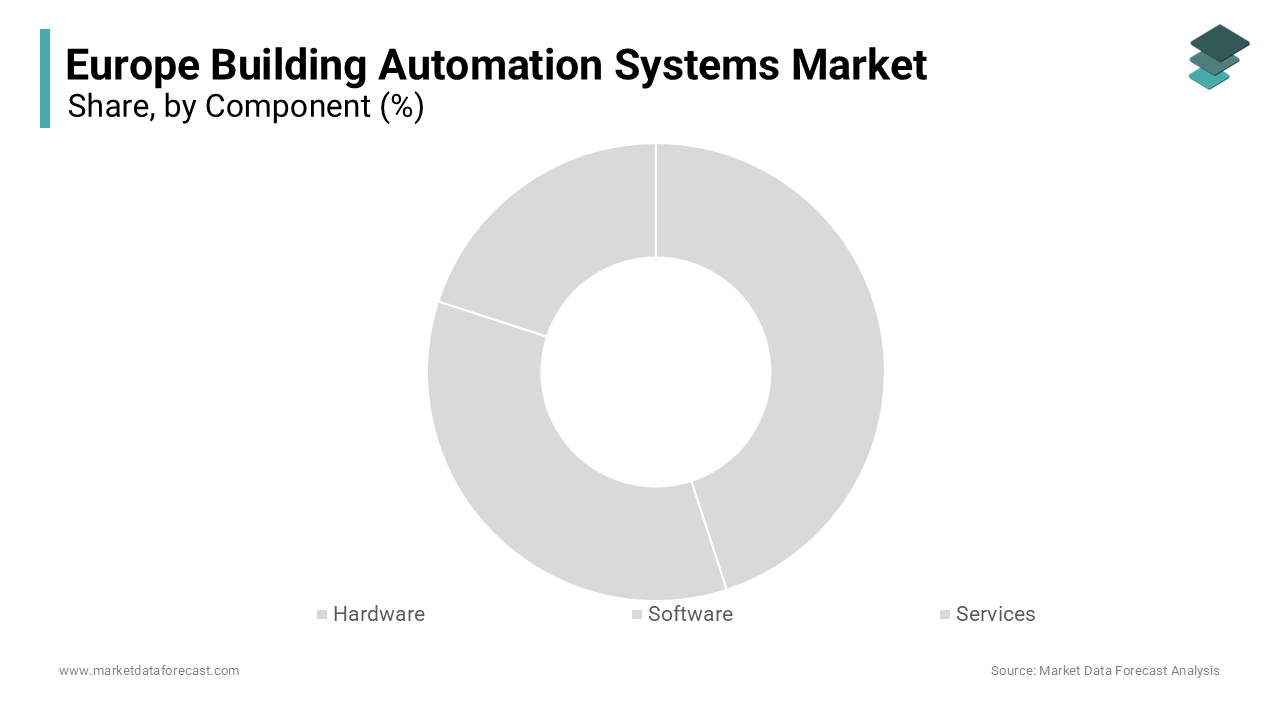
The services segment is on the rise and is expected to be the fastest growing segment in the market by witnessing a CAGR of 9.3% from 2026 to 2034 due to a strategic industry shift from transactional hardware sales toward recurring revenue models encompassing installation maintenance support and cloud based analytics subscriptions. Facility operators increasingly outsource specialized expertise for system commissioning predictive maintenance and cybersecurity management as internal technical resources remain constrained across secondary European markets according to industry workforce surveys. Software as a service platforms enable remote diagnostics firmware updates and performance benchmarking without on site technician visits reducing total cost of ownership for distributed building portfolios. As per sources, recurring services engagements deepen customer relationships while providing stable cash flows that offset hardware margin pressures from component import competition. Energy performance verification services supporting green finance reporting and sustainability certification maintenance further expand the addressable services market particularly for commercial landlords managing portfolios subject to environmental social and governance disclosure obligations under European Union sustainable finance frameworks.
By System Type Insights
The HVAC control systems segment was the largest segment in the Europe building automation systems market and accounted for a 40.5% share in 2025 owing to the critical role of heating ventilation and air conditioning infrastructure in achieving European Union energy efficiency targets where buildings consume a notable share of total energy and generate greenhouse gas emissions. Advanced HVAC controllers leverage occupancy sensors weather forecasts and machine learning algorithms to optimize setpoints reducing energy consumption in documented case studies according to studies. The integration of heat pump controls with renewable energy sources and district heating networks further elevates system complexity and value as European nations pursue decarbonization pathways aligned with climate neutrality objectives by 2050. As per research, HVAC modernization represents the highest return on investment automation upgrade due to substantial utility cost savings and improved occupant comfort metrics that support tenant retention and premium rental valuations across competitive European commercial real estate markets.
The security and access control systems segment is expected to exhibit a noteworthy CAGR of 9.5% over the forecast period. This acceleration is fuelled by converging priorities around occupant safety operational resilience and data driven facility management in post pandemic European building operations. The integration of biometric verification video analytics and occupancy sensors with environmental controls enables unified data streams that simultaneously enhance physical security and optimize energy utilization according to smart building technology research. The convergence of information technology and operational technology networks creates expanded attack surfaces requiring specialized security expertise that drives demand for integrated platforms offering unified management consoles according to facility security surveys. Landlords are increasingly leveraging occupancy-aware access systems to throttle ventilation, adjust lighting profiles, and alert facility teams in real time, according to research. These systems minimize server overhead and maximize actionable insights that support safety, compliance, and operational efficiency across diverse European building portfolios.
By Communication Technology Insights
The wired communication technologies segment dominated the Europe building automation systems market and captured a 64.6% share in 2025 because of the historical preference for reliable high bandwidth connections in mission critical applications including life safety systems fire alarms and emergency lighting where uninterrupted signal transmission remains non negotiable according to European building safety regulations. Ethernet based protocols including BACnet over Internet Protocol and Modbus TCP provide deterministic performance essential for industrial facilities data centers and healthcare environments where system latency could compromise operational continuity according to facility engineering standards documentation. The European Union Network and Information Security two directive mandates network segmentation and encrypted firmware updates that wired infrastructures support through dedicated physical pathways reducing vulnerability to wireless interception according to cybersecurity compliance assessments. As per sources, structured cabling represents a sunk investment in new construction projects where marginal costs for additional automation nodes remain low compared to wireless gateway procurement and spectrum licensing requirements. The persistence of legacy direct digital control networks in European building stock further sustains wired technology demand as facility managers prioritize backward compatibility during phased modernization initiatives according to building automation lifecycle management research.
The wireless communication platforms segment is predicted to witness the highest CAGR of 9.6% between 2026 to 2034 owing to compelling installation economics where wireless sensor meshes reduce labor requirements by up to 50 percent versus cabled alternatives according to facility deployment cost analyses particularly valuable in occupied spaces where ceiling disturbances disrupt tenant operations. The emergence of standardized protocols including Matter Thread and Wi Fi six enables interoperability across vendor ecosystems reducing integration complexity and total cost of ownership according to research. Battery powered sensors with ten year operational lifespans eliminate maintenance visits while supporting flexible reconfiguration as space utilization patterns evolve according to studies. Private fifth generation network pilots in German automotive facilities demonstrate how ultra reliable low latency links synchronize heating ventilation and air conditioning set points with manufacturing processes trimming energy peaks without jeopardizing production targets. Wireless solutions increasingly satisfy European Union cybersecurity requirements through transport layer security encryption and certificate based authentication enabling compliance with Network and Information Security two mandates at no extra licensing cost for large campus deployments according to cybersecurity framework evaluations.
By Installation Type Insights
The retrofit installations segment led the Europe building automation systems market and occupied a 55.7% share in 2025. This leading position of the segment is credited to the structural reality that a notable share of European buildings were constructed before the year 2000 and require substantial automation upgrades to meet contemporary energy performance standards. Wireless self commissioning devices prove particularly valuable in retrofit scenarios where structured cabling infrastructure remains inadequate and power availability at sensor locations proves constrained according to facility engineering surveys. European Investment Bank support programs and national cohesion funds lower capital barriers for public sector retrofits particularly in Central and Eastern European markets where modernization backlogs remain substantial according to sources. Retrofit projects increasingly prioritize open protocol controllers and cloud based analytics platforms that enable incremental modernization without complete system replacement aligning with budget constraints and operational continuity requirements across diverse European building portfolios.
The retrofit installation segment is estimated to register the fastest CAGR of 9.1% during the forecast period. This swift expansion of the segment is propelled by converging regulatory financial and operational imperatives driving automation adoption across Europe aging building stock. The mandatory Smart Readiness Indicator labeling framework obliges building owners to digitize legacy heating ventilation and air conditioning and lighting assets creating compliance driven retrofit demand according to European Union building performance documentation. Green finance mechanisms including sustainability linked loans tie interest margins to verified real time energy performance transforming automation retrofits from discretionary upgrades into compliance prerequisites for landlords pursuing favorable debt terms according to research. Wireless sensor technologies and self commissioning controllers reduce installation complexity and project timelines enabling facility teams to complete upgrades during seasonal maintenance windows without disrupting tenant operations according to deployment best practices research. Municipalities exploiting cohesion fund grants often stipulate completion deadlines achievable only with pre programmed wireless kits that integrate with existing actuators accelerating retrofit velocity across European institutional portfolios according to public infrastructure modernization case studies.
By End User Insights
The commercial buildings segment remained prominent in the Europe building automation systems market and held a 46.8% share in 2025. The prominence of this segment is supported by the concentration of high value automation deployments across office complexes retail centers hospitality venues and mixed use developments where operational efficiency tenant experience and sustainability credentials directly impact asset valuation. Hybrid work patterns have rendered office utilization unpredictable prompting landlords to deploy artificial intelligence based heating ventilation and air conditioning scheduling that maps calendar bookings to occupancy sensors reducing energy waste in documented case studies. Commercial landlords increasingly leverage granular occupancy data to pass utility costs through to tenants under green lease agreements cutting common area energy intensity by double digit percentages and supporting lease renewal negotiations with verified savings documentation that enhances tenant retention across competitive European metropolitan markets.
The institutional and government facilities segment is anticipated to witness the fastest CAGR of 9.4% from 2026 to 2034. This swift growth of the segment is driven by mandated decarbonization timelines where public sector buildings must achieve climate neutrality targets ahead of private sector counterparts. The Energy Performance of Buildings Directive requires member states to renovate three percent of public building floor area annually creating sustained demand for automation upgrades that document compliance with energy performance certificates. Public hospitals universities and municipal facilities increasingly stipulate open protocol controllers to future proof against vendor lock in pushing suppliers to guarantee long term firmware support that aligns with Network and Information Security two patch cycles. Institutional projects benefit from dedicated funding streams including European Structural and Investment Funds that lower capital barriers for comprehensive automation deployments particularly in Central and Eastern European markets where public building stock modernization backlogs remain substantial according to public infrastructure financing assessments. The integration of building automation data with municipal energy dashboards further enables cross facility benchmarking and portfolio level optimization that supports evidence based policy making across European public administration frameworks.
REGIONAL ANALYSIS
Germany Building Automation Systems Market Analysis
Germany outperformed other countries in the Europe building automation systems market and accounted for a 37.3% share in 2025. The dominance of the German market is attributed to the country's robust industrial automation heritage stringent energy efficiency regulations under the Gebäudeenergiegesetz and substantial investments in smart building infrastructure. German manufacturers prioritize open protocol controllers and interoperable software platforms aligning with ISO 52120 one specifications to ensure future proof deployments. As per research commercial landlords in Frankfurt Munich and Berlin increasingly mandate real time energy monitoring systems to satisfy green finance covenants and tenant sustainability expectations. The integration of renewable energy sources with building automation controls further elevates system complexity and value supporting Germany's climate neutrality pathway by 2045.
United Kingdom Building Automation Systems Market Analysis
The United Kingdom was the next prominent country in the Europe building automation systems market in 2025. The expansion of the UK market is driven by post Brexit regulatory frameworks that mirror European Union energy performance directives. Commercial building operators leverage artificial intelligence driven optimization platforms to reduce energy consumption by in documented case studies as per research. London's Ultra Low Emission Zone expansion and Manchester's smart city roadmap create sustained demand for integrated environmental monitoring and access control systems. Wireless sensor adoption accelerates in retrofit scenarios where heritage building constraints limit cabling options. The UK's strong cybersecurity framework aligned with the Network and Information Security two directive elevates demand for encrypted building automation platforms particularly in healthcare and financial sector facilities. Green lease structures increasingly tie rental premiums to verified energy performance data creating compelling commercial incentives for automation investments across major metropolitan markets.
France Building Automation Systems Market Analysis
France is also a major player in the Europe building automation systems market due to the Tertiary Decree requiring buildings exceeding 1000 square meters to reduce energy consumption by 40 percent by 2030 according to French Ministry of Ecological Transition policy documentation. This mandate automatically pulls building automation into retrofit scopes because manual logs cannot satisfy the OPERAT platform disclosure requirements. Public sector modernization programs allocate substantial amount for institutional building upgrades creating sustained procurement pipelines for compliant automation solutions. French facility managers increasingly specify open protocol controllers to ensure vendor neutrality and long term firmware support aligned with evolving cybersecurity standards. The RE2020 environmental regulation for new buildings mandates digital monitoring infrastructure embedding smart readiness indicators from design phase. The integration of district heating networks with building automation controls enables predictive load management reducing municipal peak demand by double digit percentages. Commercial landlords leverage granular sub metering to pass utility costs through tenants under green lease agreements supporting lease renewal negotiations with verified savings documentation.
Italy Building Automation Systems Market Analysis
Italy expanded steadily in the market for building automation systems in Europe owing to substantial retrofit activity driven by the Superbonus tax incentive program. A notable share of Italian buildings require energy performance upgrades to meet European Union decarbonization targets creating a multi decade modernization pipeline. Italian facility managers prioritize wireless sensor deployments that minimize installation disruption in occupied heritage structures according to retrofit best practices research. The integration of solar photovoltaic systems with building automation controls enables real time energy trading and demand response participation enhancing asset value. Southern Italian municipalities exploit cohesion fund grants to automate public school and hospital facilities accelerating deployment velocity in previously underserved markets. Commercial landlords increasingly bundle apartment level smart thermostat data into community dashboards demonstrating compliance with municipal building emissions caps a feature that eases access to local retrofit rebates.
Netherlands Building Automation Systems Market Analysis
The Netherlands is expected to be the most lucrative region in the Europe building automation systems market over the forecast period due to advanced district heating integration and circular economy procurement frameworks. Dutch municipalities mandate building automation systems that interface with municipal energy dashboards enabling portfolio level optimization and evidence based policy making. Dutch facility managers prioritize modular controller architectures that support incremental modernization without complete system replacement aligning with circular economy principles. The integration of building automation data with mobility platforms enables occupancy aware ventilation scheduling that aligns with public transport usage patterns optimizing energy utilization. Commercial landlords leverage verified energy savings documentation to access sustainability linked loans with favorable interest margins strengthening the business case for automation investments across diverse building typologies.
COMPETITIVE LANDSCAPE
The Europe building automation systems market exhibits medium concentration with five global incumbents collectively capturing substantial revenue share while regional specialists and emerging technology providers gain traction in niche segments. Competitive dynamics center on software ecosystem depth cybersecurity credentials and open protocol interoperability rather than hardware specifications alone. Leading vendors differentiate through artificial intelligence driven analytics predictive maintenance algorithms and sustainability reporting capabilities that address customer priorities around operational efficiency regulatory compliance and environmental social and governance disclosure. The convergence of information technology and operational technology networks expands competitive boundaries enabling software firms and telecommunications providers to challenge traditional building automation incumbents. Regional system integrators leverage local expertise and established customer relationships to win retrofit contracts particularly in secondary European markets where technician availability and heritage building constraints create deployment complexities. Competitive intensity increases around wireless technology adoption where installation economics and spectrum management capabilities determine project success. Vendor alliances around emerging standards such as Matter and Thread accelerate interoperability adoption reducing integration barriers for customers while diluting hardware centric competitive advantages. The strategic emphasis on recurring revenue models transforms competitive dynamics from transactional hardware sales toward long term customer relationships anchored by continuous value delivery through software updates analytics insights and managed services.
KEY MARKET PLAYERS
Some of the companies that are playing a dominating role in the Europe Building Automation Systems Market include
- Siemens AG
- Schneider Electric SE
- ABB Ltd.
- Robert Bosch GmbH
- Legrand SA
- Danfoss A/S
- Kieback & Peter GmbH & Co. KG
- Priva Holding B.V.
- Belimo Holding AG
- Fr. Sauter AG
Top Players in the Europe Building Automation Systems Market
Siemens AG
Siemens AG maintains a prominent position in the Europe building automation systems market through its comprehensive Desigo CC platform that integrates heating ventilation and air conditioning lighting security and energy management into unified supervisory control. The company's strategic emphasis on software defined building operations enables customers to deploy artificial intelligence driven optimization algorithms that reduce energy consumption. Siemens recently enhanced its Desigo CC V5.2 release with native Network and Information Security two compliance features including automated network segmentation and encrypted controller traffic according to company documentation. The organization's open application programming interface strategy facilitates third party analytics integration expanding platform value without vendor lock in concerns. Siemens collaborates with European research institutions to advance digital twin capabilities that simulate building performance before physical deployment accelerating project commissioning timelines. The company's commitment to open protocols such as BACnet and Modbus ensures interoperability with legacy infrastructure supporting phased modernization pathways for diverse European building portfolios.
Schneider Electric SE
Schneider Electric SE strengthens its Europe building automation systems market presence through the EcoStruxure Building platform that delivers IoT enabled plug and play architecture connecting hardware software and services for optimized facility operations. The company's strategic focus on recurring software as a service revenue models transforms one time controller sales into multi year analytics subscriptions enhancing customer stickiness and financial predictability. Schneider Electric recently introduced EcoStruxure Building Graph enabling advanced automation through connected integrated solutions that unlock unique value opportunities according to corporate announcements. The organization's partnership ecosystem facilitates specialized value add applications ranging from predictive maintenance to sustainability reporting expanding platform addressability. Schneider Electric prioritizes cybersecurity certifications including IEC 62443 compliance for edge controllers strengthening competitive positioning for essential services projects under European Union resilience frameworks. The company's commitment to open innovation principles ensures customer flexibility while delivering measurable energy savings that support green finance eligibility and regulatory compliance across diverse European building segments.
Johnson Controls International plc
Johnson Controls International plc advances its Europe building automation systems market contribution through the OpenBlue digital ecosystem that delivers artificial intelligence powered forecasting autonomous control and performance optimization for commercial and institutional facilities. The company's strategic emphasis on cloud based building management platforms enables remote diagnostics firmware updates and energy analytics reducing on site technician requirements and total cost of ownership. The organization's open application programming interface strategy facilitates third party analytics integration expanding platform value while maintaining customer flexibility. The company's commitment to interoperable standards ensures seamless integration with legacy infrastructure supporting phased modernization pathways that align with European building decarbonization timelines and regulatory compliance requirements.
Top Strategies Used by Key Market Participants
Key players in the Europe building automation systems market prioritize software centric business models that convert hardware transactions into recurring analytics subscriptions enhancing revenue predictability and customer retention. Leading vendors invest heavily in open protocol architectures and application programming interface ecosystems that facilitate third party value add applications expanding platform addressability without vendor lock in concerns. Strategic acquisitions of specialized software firms enable incumbents to rapidly incorporate artificial intelligence machine learning and cybersecurity capabilities that address evolving customer requirements and regulatory mandates. Partnerships with telecommunications providers accelerate wireless technology adoption particularly for retrofit applications where installation labor represents significant project cost components. Leading organizations prioritize cybersecurity certifications including IEC 62443 compliance to strengthen competitive positioning for essential services projects under European Union Network and Information Security two frameworks. Vendor collaboration around emerging standards such as Matter and Thread accelerates interoperability adoption reducing integration complexity and total cost of ownership for customers. Leading players establish regional research and development centers to tailor solutions to local regulatory requirements and building typologies enhancing market relevance and deployment velocity across diverse European geographies.
MARKET SEGMENTATION
This research report on the Europe Building Automation Systems Market has been segmented and sub-segmented based on the following categories.
By Component
- Hardware
- Software
- Services
By System Type
- HVAC Control Systems
- Lighting Control Systems
- Security and Access Control Systems
- Energy Management Systems
- Fire and Life-Safety Systems
By Communication Technology
- Wired
- Wireless
By Installation Type
- New-Build
- Retrofit
By End User
- Residential
- Commercial
- Industrial
- Institutional / Government
By Country
- UK
- France
- Spain
- Germany
- Italy
- Russia
- Sweden
- Denmark
- Switzerland
- Netherlands
- Turkey
- Czech Republic
- Rest of Europe
Access the study in MULTIPLE FORMATS
Purchase options starting from
$ 2000
Didn’t find what you’re looking for?
TALK TO OUR ANALYST TEAM
Need something within your budget?
NO WORRIES! WE GOT YOU COVERED!
Call us on: +1 888 702 9696 (U.S Toll Free)
Write to us: sales@marketdataforecast.com