- Product Description Description
- Table of Contents TOC
- List of Table & Figure LOT
- Get Free Sample PDF Sample PDF
Market Size, 2025
$10.54 BnMarket Estimate, 2026
$10.98 BnMarket Forecast, 2034
$15.24 BnCAGR, 2026–2034
4.18%Europe Building Thermal Insulation Market Size, Growth, Trends & Forecast (2026–2034)
The Europe building thermal insulation market size was calculated at USD 10.54 billion in 2025, is anticipated to reach USD 10.98 billion in 2026, and is projected to reach USD 15.24 billion by 2034, registering a compound annual growth rate (CAGR) of 4.18% during the forecast period from 2026 to 2034. Driven by EU energy efficiency legislation (including the revised Energy Performance of Buildings Directive), rising residential heating costs, and deep retrofit initiatives, the market continues to expand steadily across the region.
Key Executive Metrics (At-a-Glance)
- 2025 Base Valuation: USD 10.54 Billion
- 2026 Current Valuation: USD 10.98 Billion
- 2034 Forecast Valuation: USD 15.24 Billion
- Compound Annual Growth Rate (CAGR): 4.18% (2026–2034)
- Dominant Material Segment: Mineral Wool (holding 42.3% of the market share in 2025 due to non-combustible safety compliance and acoustic performance)
- Fastest-Growing Material Segment: Aerogels (projected at a CAGR of 12.4% from 2026 to 2034, driven by ultra-thin retrofit demands in space-constrained urban environments)
- Dominant Application Segment: Walls (capturing 48.2% of the market share in 2025 due to large surface heat-loss areas and strict retrofit U-value mandates)
- Fastest-Growing Application Segment: Roof & Ceiling (projected at a CAGR of 7.9% from 2026 to 2034, supported by green roof integration and combined solar photovoltaic retrofits)
- Regional Highlights: Germany led the market in 2025, capturing 22.3% of the regional share owing to robust regulatory frameworks, public subsidy programs, and a dense inventory of pre-1990 buildings requiring deep retrofits.
Core Market Drivers
- EU Legislative Mandates: Revised Energy Performance of Buildings Directive (EPBD) compelling deep energy renovations across member states.
- Economic Energy Pressures: Soaring residential electricity and gas prices transforming insulation into an immediate cost-saving and energy security imperative.
- Post-Grenfell Safety Regulations: Stringent height-based fire safety rules favoring non-combustible insulation materials like stone and glass wool.
Primary Market Restraints & Challenges
- High Upfront Investment: Substantial initial costs and long payback periods deterring widespread private retrofit adoption, particularly in Southern and Eastern Europe.
- Raw Material Volatility: Price fluctuations and supply disruptions in natural gas, polystyrene precursors, and mineral wool feedstocks.
- Labor Deficits & Regulatory Fragmentation: Acute shortages of skilled insulation contractors alongside divergent national building codes and certification timelines.
Europe Building Thermal Insulation Market Segmentation Breakdown
| Segment Category | Largest Segment in 2025/2026 | Fastest Growing Segment / Growth Rate |
|---|---|---|
| By Material | Mineral Wool (42.3% share in 2025) | Aerogels (12.4% CAGR from 2026 to 2034) |
| By Application | Walls (48.2% share in 2025) | Roof & Ceiling (7.9% CAGR from 2026 to 2034) |
| By Region | Germany (22.3% share in 2025) | France, Italy & Poland (Driven by national subsidy schemes like MaPrimeRénov and Superbonus frameworks) |
Major Industry Players Profiled
Key prominent companies operating in the Europe building thermal insulation market include Saint-Gobain, Knauf Insulation, Rockwool International, Owens Corning, Kingspan Group, BASF, Recticel, URSA Insulation, Paroc Group, Steico SE, Soprema Group, Johns Manville, Dow, and Huntsman Corporation.
Europe Building Thermal Insulation Market Size
The Europe building thermal insulation market size was calculated to be USD 10.54 billion in 2025 and is anticipated to be worth USD 15.24 billion by 2034, growing from USD 10.98 billion in 2026 at a CAGR of 4.18% during the forecast period.
Building thermal insulation is materials and systems integrated into envelopes of residential, commercial, and public structures to minimize heat transfer, reduce energy demand, and enhance indoor environmental quality. These solutions range from mineral wool and expanded polystyrene to advanced aerogels and vacuum-insulated panels, which are engineered to meet stringent thermal performance criteria under evolving regulatory frameworks. According to the European Commission, buildings account for approximately 40% of final energy consumption and 36% of greenhouse gas emissions across the European Union. As per Eurostat, over 35% of the EU building stock was constructed before 1970 with minimal or no thermal insulation. The revised Energy Performance of Buildings Directive now mandates that all new buildings be nearly zero energy by 2021 and requires member states to renovate at least 3% of public buildings annually. This regulatory momentum, coupled with rising heating costs and public awareness of energy poverty, positions thermal insulation not merely as a construction material but as a strategic instrument of energy security, climate resilience, and social equity across the European built landscape.
MARKET DRIVERS
EU Energy Efficiency Legislation Mandates Deep Building Retrofits
The European Union’s binding energy efficiency legislation serves as the foremost driver of thermal insulation demand by compelling systematic upgrades to the existing building stock. The EU energy efficiency legislation is driving the growth of Europe building thermal insulation market. The revised Energy Performance of Buildings Directive requires all buildings undergoing major renovation to meet minimum energy performance standards, which inherently necessitate enhanced thermal insulation in walls, roofs, and floors. According to the European Commission, over 220 million residential and 12 million non-residential buildings in the EU require deep energy retrofits by 2030 to align with the Fit for 55 climate package. National building codes in countries like Germany, France, and the Netherlands now enforce U values below 0.20 watts per square meter kelvin for renovated external walls, a threshold unattainable without high-performance insulation. Similarly, France’s MaPrimeRenov scheme subsidized insulation measures in over 800000 dwellings between 2021 and 2023. These policy instruments transform insulation from a discretionary upgrade into a legal and financial prerequisite for property modernization, ensuring sustained volume demand across residential and public sectors, irrespective of market cycles.
Rising Residential Heating Costs Accelerate Retrofit Decision Making
Soaring residential energy prices have intensified homeowner and landlord urgency to reduce heating demand through thermal insulation retrofits, which is additionally accelerating the growth of Europe building thermal insulation market. According to Eurostat, the average household electricity price in the EU rose by 21% between 2021 and 2023, while natural gas prices surged by over 50% during the same period due to geopolitical supply disruptions. In Germany, the Federal Network Agency recorded average heating bills exceeding 2400 euros annually for a standard 70 square meter apartment in 2023, prompting widespread investment in envelope efficiency. The European Environment Agency estimates that proper wall and roof insulation can reduce space heating needs by 40 to 60% in temperate climates. This economic pressure has shifted insulation from a long-term sustainability choice to an immediate cost-saving imperative, driving both public subsidy uptake and private market activity across Southern and Central Europe.
MARKET RESTRAINTS
High Upfront Investment Deters Widespread Retrofit Adoption
The substantial initial cost of comprehensive thermal insulation retrofits for many European property owners, particularly in Southern and Eastern member states, is limiting the growth of Europe building thermal insulation market. A full external wall insulation system on a typical single-family home can cost between 15000 and 25000 euros, according to the Buildings Performance Institute Europe, with payback periods often exceeding 10 to 15 years without subsidies. As per the European Central Bank’s 2023 Household Finance and Consumption Survey, over 45% of homeowners in Italy, Spain, and Greece cited a lack of accessible financing as the primary obstacle to energy renovations. Unlike new construction, where insulation is integrated into baseline budget,s retrofits require discretionary capital that competes with other household expenditures. The European Commission notes that only 12% of EU residential buildings underwent any form of energy renovation between 2016 and 2021, primarily due to financial constraints.
Fluctuating Availability and Pricing of Raw Materials Disrupt Supply Chains
The persistent volatility due to supply chain instability in key raw materials, such as natural gas, polystyrene precursors, and mineral wool feedstocks, is degrading the growth of Europe building thermal insulation market. During the 2022 energy crisis,s European EPS producers faced gas prices exceeding 200 euros per megawatt hour, leading to temporary plant shutdowns and price increases of 35 to 50%. Similarly, glass wool insulation relies on silica sand and recycled glass, whose logistics were disrupted by port congestion and rail shortages in 2023, as reported by the European Mineral Wool Association. These fluctuations force contractors to delay projects or substitute materials, compromising performance. The European Construction Industry Federation states that 38% of renovation contractors experienced insulation material shortages in 202,3 leading to average project delays of six to eight weeks. Although the EU Raw Materials Initiative aims to secure supply, the dependence on fossil-based inputs and limited recycling infrastructure for synthetic insulants perpetuates vulnerability.
MARKET OPPORTUNITIES
Integration of Insulation into Prefabricated and Modular Construction Systems
The rapid adoption of off-site construction methods for advanced thermal insulation integration at the manufacturing stage is setting up new opportunities for the growth of Europe building thermal insulation market. Prefabricated wall panels, roof cassettes, and modular units increasingly incorporate high-performance insulation as a core structural component rather than a site-applied add-on. Companies like Denmark’s Volumen and Germany’s ALHO embed vacuum-insulated panels and phenolic foam directly into factory-assembled envelopes, ensuring consistent U values below 0.15 watts per square meter kelvin. The Fraunhofer Institute for Building Physics confirms that factory-installed insulation reduces thermal bridging by up to 30% compared to on-site methods due to controlled environmental conditions and precision cutting. Moreover, the European Commission’s New European Bauhaus initiative actively promotes modular design as a pathway to scalable decarbonization.
Revival of Historic Building Stock Through Compatible Insulation Solutions
Europe’s vast heritage building inventory offers a unique growth avenue for specialized thermal insulation technologies that balance energy performance with architectural preservation. The revival of historic building stock through compatible insulation solutions is additionally to leverage the growth of Europe building thermal insulation market. As per the European Commission, over 30% of buildings in EU city centers are listed as cultural heritage and exempt from standard retrofit mandates unless solutions respect historical integrity. This constraint has spurred innovation in breathable wood fiber insulation, lime-based plasters, and internal vacuum-insulated panels that avoid altering facades or compromising moisture dynamics. The German Federal Office for Building and Regional Planning reports that over 15000 protected buildings underwent energy retrofits using heritage-compatible insulation in 2023, primarily in Bavaria and North Rhine-Westphalia. In France, the Bâtiment Bas Carbone label now includes pathways for historic structures using bio-based insulants with verified hygrothermal performance.
MARKET CHALLENGES
Labor Shortages and Skills Gaps Impede Quality Installation
The acute shortage of skilled workers trained in modern insulation techniques and building physics principles is one of the challenges for the growth of Europe's building thermal insulation market. According to Eurofound, the EU faces a projected deficit of over 200000 qualified construction workers by 2026, with insulation specialists among the most scarce due to low vocational enrollment and aging demographics. In Germany, the Federal Employment Agency reported that 68% of insulation contractor vacancies remained unfilled for more than 90 days in 2023. Poor installation directly compromises performance studies by the Fraunhofer Institut, whiche, which shows that gaps, compression, and thermal bridging during on-site application can reduce effective R values by 25 to 40%. This risk is amplified with advanced materials like aerogels and VIP,s which demand precise handling and sealing protocols. Without coordinated upskilling through national apprenticeship reforms and digital training, such as augmented reality installation, do the energy savings promised by high-performance materials remain unrealized across millions of retrofits?
Regulatory Fragmentation Across Member States Complicates Product Compliance
The significant divergence in national building codes and material approval processes creates complexity for insulation manufacturers operating across borders, which is also limiting the growth of Europe building thermal insulation market. While the Construction Products Regulation mandates CE marking based on harmonized European standards, national authorities often impose additional testing requirements for fire performance, moisture resistance, or embodied carbon. According to the European Insulation Manufacturers Association, product certification timelines vary from 8 weeks in the Netherlands to over 26 weeks in Spain and Greece due to differing administrative procedures and test lab accreditation. Fire safety rules are particularly fragmented; France bans certain organic insulants above 18 meters, while Germany permits them with additional cladding. This regulatory patchwork increases compliance costs by 15 to 25%, as per industry estimates, and delays market access for innovative bio-based or recycled content products. The European Commission’s 2023 Single Market Barometer identified construction product approval as one of the top 5 obstacles to cross-border trade.
REPORT COVERAGE
| REPORT METRIC | DETAILS |
| Market Size Available | 2025 to 2034 |
| Base Year | 2025 |
| Forecast Period | 2026 to 2034 |
| CAGR | 4.18% |
| Segments Covered | By Material, Application, And Region |
| Various Analyses Covered | Global, Regional & Country Level Analysis; Segment-Level Analysis; DROC, PESTLE Analysis; Porter’s Five Forces Analysis; Competitive Landscape; Analyst Overview of Investment Opportunities |
| Regions Covered | UK, France, Spain, Germany, Italy, Russia, Sweden, Denmark, Switzerland, Netherlands, Turkey, and the Czech Republic |
| Market Leaders Profiled | Saint-Gobain, Knauf Insulation, Rockwool International, Owens Corning, Kingspan Group, BASF, Recticel, URSA Insulation, Paroc Group, Steico SE, Soprema Group, Johns Manville, Dow, Huntsman Corporation |
SEGMENTAL ANALYSIS
By Material Insights
The mineral wool segment was the largest by accounting for 42.3% of the Europe building thermal insulation market share in 2025, with its non-combustible nature, high acoustic performance,,e and compatibility with stringent EU fire safety regulations, particularly in multi-family and public buildings. The post Grenfell regulatory shift toward non-combustible materials in high-rise construction is eventually escalating the growth of the segment. Following the 2017 tragedy, the United Kingdom banned combustible insulation on residential buildings over 18 meters, and similar restrictions followed in France, Germany, and the Netherlands. As per the European Fire Safety Alliance, over 22 EU member states now mandate non-combustible insulation for buildings above specific height thresholds, typically between 10 and 20 meters. Mineral wool classified as A1 or A2 under EN 13501 1 meets these requirements without additional fire barriers. This regulatory alignment has made mineral wool the de facto standard for social housing, hospitals, and schools across Western and Northern Europe, where occupant safety outweighs marginal cost differences. According to the European Environment Agency, over 2.1 million tons of mineral wool were recycled in 2023, representing a 38% increase from 2020. The industry’s closed-loop production model aligns with the EU Construction and Demolition Waste Management Protocol, which targets 70% reuse by 2030. Furthermore, the material’s durability and proven performance over 50 years without degradation support the EU’s push for long-life building components.
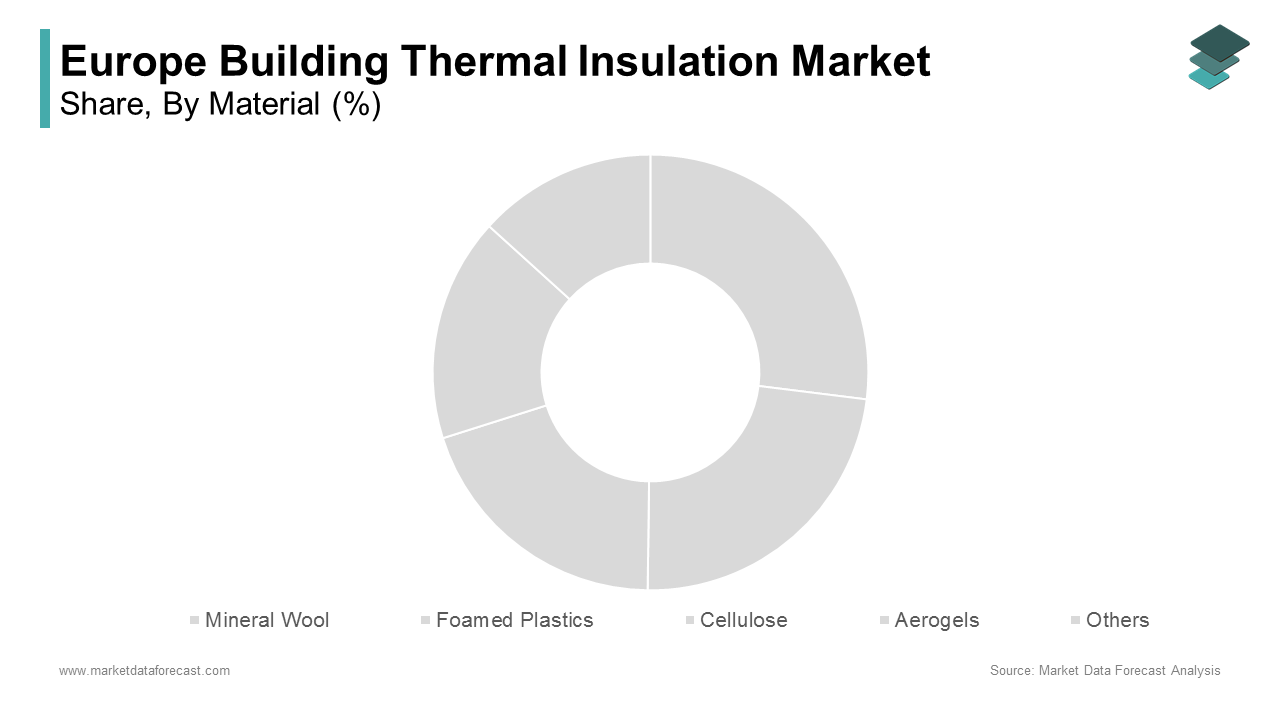
The aerogels segment is likely to grow with an expected CAGR of 12.4% from 2026 to 2034, with the urgent need for ultra-thin high-performance insulation in urban retrofit projects where space constraints prohibit conventional systems. The material’s exceptional thermal conductivity of 0.013 to 0.018 watts per meter kelvin, nearly half that of mineral wenablesabling equivalent insulation performance at one third the thickness. In dense European cities like Amsterdam and Vienna, where facade setbacks and interior floor area are legally protected,cted aerogels offer the only viable path to deep energy retrofits without altering building geometry. Similarly, the Dutch government’s “Slimmer Renoveren” program allocates premium subsidies for projects using insulation with lambda values under 0.020 by encouraging adoption in constrained row houses.
By Application Insights
The walls segment was the largest by accounting for 48.2% of the Europe building thermal insulation market share, 20sincehat external walls constitute the largest surface area of heat loss in most building typologies, particularly in older European housing stock constructed before modern energy codes. The regulatory focus on building envelope performance under the revised Energy Performance of Buildings Directive, which mandates minimum U values for renovated walls typically below 0.25 watts per square meter kelvin, will eventually boost the growth of this segment. As per the German Energy Agency, over 70% of residential energy retrofits in 2023 included external wall insulation as the primary measure due to its disproportionate impact on heating demand. In solid masonry buildings common across Italy, Spain, and France, walls alone account for 55 to 65% of total heat loss according to the European Commission’s building typology database. Consequently, wall insulation delivers the highest return on investment among retrofit measures, with studies by the Technical University of Denmark showing a 40 to 50% reduction in space heating energy after comprehensive wall treatment. The compatibility of wall systems with aesthetic and urban planning objectives is. External thermal insulation composite systems allow for integrated finishes that preserve or enhance street-level character while improving performance. In Germany, over 90% of new multi-family developments use ETICS with textured renders or brick slips to meet local zoning aesthetics, as confirmed by the German Construction Industry Association. Similarly, Scandinavian countries mandate colored insulation renders that blend with historic palettes. This dual functionality, simultaneously addressing energy efficiency and urban design, makes wall insulation uniquely positioned to gain municipal and homeowner acceptance across diverse European contexts, where retrofit aesthetics often determine project viability.
The roof and ceiling application segment is projected to expand at a CAGR of 7.9% from 2026 to 2034, with the technical ease of roof retrofits and the increasing deployment of integrated renewable energy systems that demandhigh-performancee substrates. Unlike external wall insulation, roof upgrades rarely require planning permission, heritage approvals, or scaffolding affecting neighboring properties. In Spain and Italy, national “green roof” incentives now bundle photovoltaic panel installation with insulation upgrades, recognizing that solar yield increases by 8 to 12% when panels are mounted over well-insulated surfaces due to lower operating temperatures. The Spanish Institute for Energy Diversification reports that over 320000 residential roofs received combined PV and insulation retrofits in 2023 under the PREE 5000 scheme. This synergy transforms roofs from passive envelopes into active energy generation platforms requiring robust thermal layers to maximize system efficiency and building comfort. Cities like Copenhagen, Rotterdam, and Berlin mandate vegetation or water retention layers on new flat roofs to manage stormwater and mitigate urban heat island effects. These systems require high compressive strength insulation beneath to prevent structural loading issues while maintaining thermal performance. According to the Danish Building Research Institute, over 45% of new commercial buildings in Copenhagen since 2022 feature blue roofs with XPS or PIR insulation rated for long-term water resistance. Similarly, the City of Paris’s Climate Action Plan targets 100 hectares of green roofs by 2030, all requiring integrated insulation compliant with thermal and root penetration standards.
REGIONAL ANALYSIS
Germany Building Thermal Insulation Market Analysis
Germany was the top performer of the Europe building thermal insulation market by capturing 22.3% of the market share in 2025. The country’s position is anchored in its comprehensive regulatory framework, aggressive public subsidy programs, and dense stock of pre 1990 buildings requiring deep energy retrofits. Over 17 million residential units in Germany were constructed before 1977 with minimal insulation, as per the German Energy Agency. Industrial capacity is equally robust; companies like Knauf and Rockwool operate over 25 production facilities across the country, supplying mineral wool and gypsum-based systems. Furthermore, Germany leads in training with over 1200 certified energy consultant offices guiding homeowners through technical choices. This ecosystem of policy, finance, manufacturing, and expertise ensures Germany remains the central engine of insulation demand and innovation in continental Europe.
France Building Thermal Insulation Market Analysis
France was positioned second by capturing 17.3% of the Europe building thermal insulation market share in 2025 with its bold national renovation strategy and social equity focus. According to France’s Ministry of Ecological Transition, the country aims to renovate 700000 homes annually by 2026 with thermal insulation as the cornerstone measure. The flagship MaPrimeRénov scheme provided grants to over 1 million households between 2020 and 202,3 with income-based subsidies covering up to 90% of insulation costs for low-income families. This has catalyzed domestic production of wood fiber and hemp insulati, on, with companies like ACTIS and ISOVER expanding bio-composite lines. Additionally, the Tertiary Decree compels all large non-residential buildings to cut energy use by 60% by 2030, driving commercial insulation demand.
United Kingdom Building Thermal Insulation Market Analysis
The United Kingdom's growth is likely to grow with its post Grenfell fire safety overhaul and net zero retrofit mandates. According to the UK Department for Levelling Up Housing and Communities, over 3 million homes still rely on solid walls with no cavity insulation, which is the most challenging but high-impact retrofit target. The Social Housing Decarbonisation Fund has allocated 3.8 billion pounds to upgrade 600000 social dwellings by 2035, with internal wall insulation as a primary solution where external cladding is prohibited. Fire regulation now effectively bans organic insulation above 11 meters in residential buildings, leading to near universal use of stone wool in high-rise retrofits. Concurrently, the Future Homes Standard requires all new builds from 2026 to produce 75 to 80% less CO2 than current levels, necessitating advanced roof and floor insulation packages.
Italy Building Thermal Insulation Market Analysis
Italy's building thermal insulation market growth is likely to grow with its generous fiscal incentive structure and high concentration of historic buildings. According to the Italian Revenue Agency, the Superbonus 110% tax deduction, though scaled back in 2023, financed over 2.4 million energy retrofits between 2020 and 2022, with external thermal insulation accounting for 78% of interventions. Even under revised rules, homeowners can still deduct 90% of insulation costs over 10 years. Italy’s building stock includes over 12 million pre 1946 structure,s many iUNESCO-protecteded centers, where external alterations are restricted. This has spurred innovation in internal insulation systems using aerogels and wood fiber boards that preserve facade integrity. Additionally, seismic retrofitting programs in central and southern regions increasingly integrate thermal insulation into structural reinforcement packages. This fusion of cultural preservation, fiscal policy, and technical adaptation ensures Italy remains a high-volume and technically nuanced market for insulation solutions.
Poland Building Thermal Insulation Market Analysis
Poland is building the thermal insulation market growth with the rapid urbanization, energy poverty reduction, and EU cohesion funding. According to Poland’s National Fund for Environmental Protection, over 500000 homes were insulated under the “Clean Air” program between 2019 and 2023, with grants covering up to 90% of costs for low-income households replacing coal stoves with heat pumps and insulation. The government mandates that all new residential buildings comply with passive house equivalent standards from 2023 onward, accelerating demand for high-performance materials. Furthermore, the EU Recovery and Resilience Facility funds have allocated 4.2 billion euros to building modernization with insulation as a core component.
COMPETITION OVERVIEW
Competition in the Europe building thermal insulation market is characterized by a mix of multinational material producers and regional specialists competing on performance, sustainability, and regulatory compliance rather than price alone. The landscape is highly fragmented, with over 200 manufacturers, but dominated by a few integrated players like Rockwool, Saint Gobain, and Knauf that control raw material sourcing productio,n and technical support networks. Differentiation centers on fire safety ratings, thermal conductivity, recycled content, and compatibility with heritage or modular construction. Regulatory complexity across member states creates both barriers and opportunities as companies tailor formulations to national fire and energy codes. The market is shifting from commodity supply to solution provision with vendors offering digital design support, installation, and end-of-life recycling services. Innovation in aerogels, wood fiber, and vacuum-insulated panels is enabling niche entrants to capture high-value segments, particularly in urban retrofits and passive house projects.
KEY MARKET PLAYERS
A few major players in the Europe building thermal insulation market include
- Saint-Gobain
- Knauf Insulation
- Rockwool International
- Owens Corning
- Kingspan Group
- BASF
- Recticel
- URSA Insulation
- Paroc Group
- Steico SE
- Soprema Group
- Johns Manville
- Dow
- Huntsman Corporation
Top Strategies Used by the Key Market Participants
Key players in the Europe building thermal insulation market prioritize product innovation by developing low embodied carbon and bio-based materials compliant with the EU Green Deal objectives. They invest in digital tools for thermal simulation lifecycle assessment and retrofit planning to support architects and contractors. Companies are expanding production capacity in Central and Eastern Europe to reduce logistics emissions and respond to regional subsidy programs. Strategic partnerships with public housing authorities and energy agencies enable large-scale retrofit deployment under national decarbonization schemes. Additionally, they emphasize circularity through take-back programs, high recycled content, and certifications aligned with BREEAM, DGNB, and EU Taxonomy criteria to differentiate sustainability credentials in public and private procurement.
Leading Players in the Europe Building Thermal Insulation Market
- Rockwool International is a global leader in stone wool insulation with deep integration across Europe’s residential, commercial, and industrial construction sectors. The company supplies high-performance non-combustible insulation solutions that align with EU fire safety and energy efficiency mandates. Rockwool expanded its production capacity at its facility in Vamdrup, Denmark,k to meet rising demand for sustainable building materials in Northern and Western Europe. The company also launched its “Building Tomorrow” initiative, which provides digital tools for architects and contractors to calculate thermal and acoustic performance in compliance with national energy codes. Rockwool actively contributes to circular economy goals by recycling over 200000 tons of construction waste annually into new insulation products.
- Saint-Gobain plays a pivotal role in the Europe building thermal insulation market through its comprehensive portfolio of mineral wool, expanded polystyrene,e and bio-based solutions under brands like ISOVER and Placo. The company integrates insulation into holistic building envelope systems that address thermal, acoustic, and moisture management requirements. In 2025, Saint-Gobain inaugurated a new research center in Chambéry, France, dedicated to developing low embodied carbon insulation using recycled glass and agricultural fibers. The company also enhanced its digital platform EQUER to enable real-time lifecycle assessment of insulation choices in line with the EU’s Level(s) framework. Saint-Gobain’s global reach spans 75 countries, where it promotes high-performance building standards through technical partnerships with governments and certification bodies. Its innovation in sustainable materials and system integration cements its position as a key enabler of Europe’s green building transition worldwide.
- Knauf Insulation is a major European manufacturer of glass wool and bio-based insulation products known for its focus on health, indoor air quality, and circularity. The company serves markets across residential retrofit infrastructure and industrial applications with solutions compliant with EU REACH and CE marking requirements. In 2023, Knauf launched its new ECOSE Technology powered glass wool range across Germany and the Netherlands, featuring binder systems derived from renewable materials and zero added formaldehyde. The company also partnered with municipal housing associations in Spain and Italy to deliver large-scale social housing retrofits under national energy poverty programs. Knauf’s global operations span over 40 countries, where it advocates for healthy building standards through collaborations with the World Green Building Council.
MARKET SEGMENTATION
This research report on the Europe building thermal insulation market has been segmented and sub-segmented based on material, application, and region.
By Material
- Mineral Wool
- Glass Wool
- Stone Wool
- Foamed Plastics
- Expanded Polystyrene (EPS)
- Extruded Polystyrene (XPS)
- Polyurethane (PU)
- Polyisocyanurate (PIR)
- Other Foamed Plastics
- Cellulose
- Aerogels
- Others
By Application
- Floor & Basement
- Walls
- Roof & Ceiling
By Region
- UK
- France
- Spain
- Germany
- Italy
- Russia
- Sweden
- Denmark
- Switzerland
- Netherlands
- Turkey
- Czech Republic
- Rest of Europe