- Product Description Description
- Table of Contents TOC
- List of Table & Figure LOT
- Get Free Sample PDF Sample PDF
Market Size, 2025
$2.21 BnMarket Estimate, 2026
$2.33 BnMarket Forecast, 2034
$3.54 BnCAGR, 2026–2034
5.38 %Europe Burritos Market Report Summary
The Europe burritos market was valued at USD 2.21 billion in 2025, is expected to reach USD 2.33 billion in 2026, and is projected to reach USD 3.54 billion by 2034, growing at a CAGR of 5.38% during the forecast period from 2026 to 2034. The growth of the Europe burritos market is primarily driven by the rising popularity of global cuisines, expansion of quick-service restaurants, and increasing demand for convenient handheld meals among urban consumers. Burritos, traditionally a Mexican dish consisting of a wheat tortilla wrapped around fillings such as beans, meats, vegetables, and cheese, have gained significant popularity across European food service and retail sectors. The increasing influence of food tourism, digital media, and international restaurant chains has further accelerated the adoption of Mexican-inspired cuisine across Europe.
Key Market Trends
-
Increasing demand for global and ethnic cuisines, particularly Mexican-inspired food.
-
Rapid growth of convenience foods and on-the-go meal formats among urban consumers.
-
Expansion of plant-based and vegan burrito options aligned with sustainability trends.
-
Rising adoption of online food delivery platforms and ghost kitchen models.
-
Increasing innovation in fusion burritos using local European ingredients.
Segmental Insights
-
By Source, The protein-based segment dominated the Europe burritos market by accounting for 52.7% of the market share in 2025. This dominance is attributed to strong consumer preference for meat-based meals, where chicken, beef, and pork fillings are widely perceived as more satisfying and nutritious.
-
The bean-based segment is expected to grow at the fastest CAGR of 8.4% during the forecast period, driven by increasing adoption of flexitarian diets, plant-based protein consumption, and sustainability concerns.
-
By Product Type, The meat segment held the largest share of 58.3% of the Europe burritos market in 2025. Meat-based burritos remain highly popular due to consumer perception that authentic Mexican cuisine traditionally includes seasoned meats such as carnitas, barbacoa, and grilled chicken.
-
The vegan burrito segment is projected to grow at the fastest CAGR of 11.2% from 2026 to 2034, supported by the rapid growth of vegan lifestyles and increasing awareness regarding animal welfare, sustainability, and plant-based nutrition across Europe.
-
By Distribution Channel, The supermarkets and hypermarkets segment accounted for 45.6% of the Europe burritos market share in 2025. The dominance of this segment is driven by the widespread availability of frozen burritos and ready-to-eat meals in major retail chains.
Regional Insights
The Europe burritos market is expanding across several countries due to increasing acceptance of international cuisines and growth in fast casual dining.
-
United Kingdom accounted for the largest share of the Europe burritos market at 23.3% in 2025, driven by strong quick-service restaurant infrastructure and high demand for convenient meals among urban consumers.
-
Germany held the second-largest market share of 19.3%, supported by growing interest in international street food and rising demand for plant-based burrito options.
-
France is witnessing increasing demand due to rising popularity of fusion cuisine and street food culture, especially among students and younger consumers.
-
Italy is experiencing steady growth driven by increasing adoption of ethnic fast-food concepts as alternatives to traditional snacks such as panini and pizza slices.
-
Spain is expected to witness strong growth due to cultural ties with Latin American cuisine, tourism-driven food trends, and expanding food delivery services.
Competitive Landscape
The Europe burritos market is highly competitive and includes a mix of global food manufacturers, quick-service restaurant chains, and regional food processors. Companies compete by focusing on fresh ingredients, customizable menus, digital ordering platforms, and sustainable sourcing practices. Major companies operating in the Europe burritos market include General Mills, Inc.; Conagra Brands, Inc.; Kellogg Company; Nestlé S.A.; McCain Foods Limited; Dr. Oetker Group; Greencore Group plc; and Iceland Foods Ltd.
 Download Free Sample Report
Europe Burritos Market Size
The Europe burritos market size was valued at USD 2.21 billion in 2025 and is anticipated to reach USD 2.33 billion in 2026 from USD 3.54 billion by 2034, growing at a CAGR of 5.38% during the forecast period from 2026 to 2034.
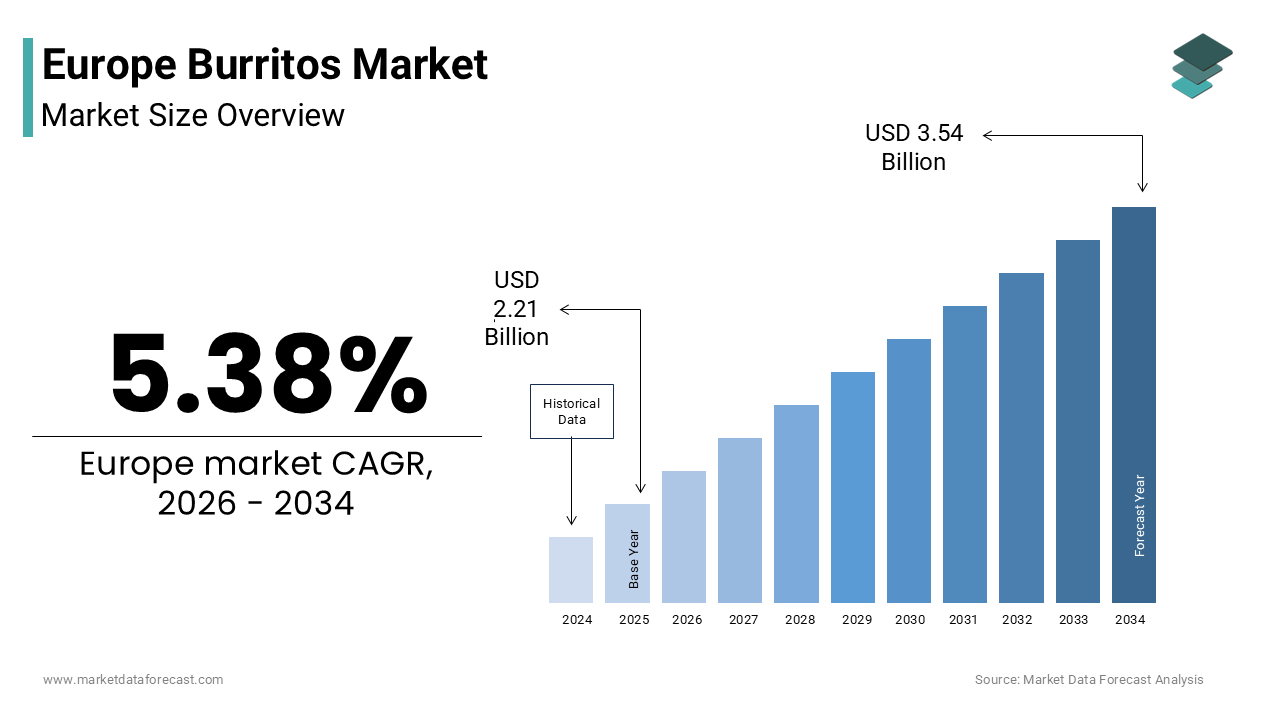
Burritos is a versatile Mexican culinary format consisting of a wheat flour tortilla wrapped around diverse fillings such as beans meats cheeses and vegetables, which has gained significant traction across European food service and retail channels. The European Union has witnessed a notable rise in Mexican inspired food establishments with data from the European Food Service Association indicating that over 4500 restaurants featuring Latin American menus opened across major cities between 2020 and 2023. Consumer behavior in Europe increasingly favors flexible dining formats with Eurostat reporting that many urban residents prioritize meals that can be consumed on the go or during short breaks. The regulatory environment within Europe supports food innovation through clear labeling standards for allergens and nutritional content which shapes product development for burrito manufacturers. According to the European Commission dietary guidelines emphasize balanced macronutrient intake which encourages burrito formulations that incorporate whole grains lean proteins and fresh produce. The growing influence of food tourism and digital media has accelerated acceptance of Mexican cuisine among younger demographics who view burritos as an authentic yet adaptable meal option.
MARKET DRIVERS
Rising Popularity of Global Cuisines and Culinary Exploration
The intensifying consumer appetite for international flavors driven by increased travel exposure and digital content consumption, which is a major factor propelling the growth of Europe burritos market. European diners are increasingly seeking authentic yet accessible global dishes, which has elevated burritos from niche ethnic fare to a mainstream quick service staple. According to the European Travel Commission, over 55% of European adults have visited Mexico or Latin American destinations in the past decade fostering familiarity with regional cuisines and flavor profiles. This experiential knowledge translates into demand for burritos that replicate traditional preparations while accommodating local taste preferences. Furthermore, social media platforms amplify this trend as food influencers showcase burrito customization and flavor combinations encouraging trial among younger demographics. The versatility of the burrito format allows operators to incorporate regional ingredients such as Mediterranean vegetables or Northern European proteins creating fusion offerings that resonate with local palates.
Expansion of Convenience Food Culture and On The Go Consumption
The robust growth of convenience-oriented eating habits among European urban populations, who prioritize speed portability and minimal preparation time is additionally fuelling the growth of Europe burritos market. Burritos serve as an ideal solution for busy professionals students and commuters seeking a complete meal that can be consumed without utensils or formal seating. According to Eurostat data on time use surveys, over 40% of working age adults in major European cities report eating at least one meal per day while engaged in other activities such as commuting or working. This behavioral shift has accelerated demand for handheld formats like burritos that deliver balanced nutrition in a single portable package. The rise of food delivery applications has further amplified accessibility with platforms like Deliveroo and Uber Eats reporting an increase in Mexican food orders, across European countries. Data from the European Convenience Food Federation indicates that ready to eat handheld meals have outpaced traditional sit-down dining growth in urban centers. Furthermore, the modular nature of burritos allows for rapid customization which aligns with consumer expectations for personalized meal experiences.
MARKET RESTRAINTS
Cultural Adaptation Challenges and Ingredient Sourcing Complexities
The complexity of adapting authentic Mexican preparations to European taste preferences, while maintaining ingredient integrity and supply chain reliability is limiting the growth of Europe burritos market. Traditional burrito components, such as specific chili varieties beans and corn tortillas may not be readily available or culturally familiar, across all European regions, which necessitates reformulation or substitution. According to the Food and Agriculture Organization of the United Nations, import dependencies for specialty agricultural products can increase lead times and costs by up to 30% compared to locally sourced alternatives. This sourcing challenge is compounded by European consumer expectations for fresh and seasonal ingredients which may conflict with the preserved or frozen components often used in authentic burrito preparations. Furthermore, regional variations in flavor preferences require extensive market testing and product iteration which elevates development costs and time to market. Small and medium sized enterprises often lack the resources to navigate these complexities limiting their ability to scale authentically.
Stringent Food Safety Regulations and Labeling Requirements
The rigorous regulatory environment governing food preparation labeling and allergen disclosure within the European Union, which increases operational complexity for burrito manufacturers and food service operators is additionally hindering the growth of Europe burritos market. European regulations mandate detailed ingredient declarations nutritional information and allergen warnings, which require substantial documentation and quality control investments. According to the European Food Safety Authority, non-compliance with labeling standards can result in product recalls and fines exceeding 100000 euros, creating significant financial risk for smaller operators. The requirement for multilingual packaging and country specific nutritional declarations further complicates production and distribution logistics for pan European brands. Furthermore, the precautionary principle embedded in European food law means that emerging scientific concerns can trigger rapid policy changes creating uncertainty for long term product planning. The need for transparent sourcing and traceability also increases administrative burdens for operators who must verify supplier credentials and production practices.
MARKET OPPORTUNITIES
Integration of Plant Based and Sustainable Ingredient Innovations
The development of plant based and sustainably sourced formulations that align with European environmental values and dietary shifts is certainly creating new opportunities for the growth of Europe burritos market. Manufacturers can differentiate their offerings by incorporating legumes whole grains and vegetable forward fillings that appeal to flexitarian and vegan consumers, while reducing environmental footprint. According to the European Plant Based Foods Association sales of meat alternative products have grown by 21% annually over the past three years reflecting strong consumer demand for sustainable protein options. Burrito formats are inherently adaptable to plant-based ingredients, allowing operators to create compelling vegetarian and vegan versions without compromising flavor or texture. Data from the European Environment Agency indicates that food production accounts for approximately 30% of household carbon emissions creating regulatory and consumer pressure for lower impact meals. Companies that pioneer carbon neutral burrito lines or partner with regenerative agriculture suppliers can leverage eco labeling to attract environmentally conscious consumers. Furthermore, the European Commission Farm To Fork Strategy encourages reduction of animal product consumption providing policy tailwinds for plant forward innovations. Retailers in countries like Germany and the Netherlands are increasingly demanding suppliers who demonstrate tangible commitments to sustainability enabling preferential placement for eco conscious burrito offerings.
Expansion Through Digital Ordering and Ghost Kitchen Models
The rapid digitalization of food service for burrito brands to scale efficiently through virtual kitchens and delivery optimized formats that minimize overhead while maximizing reach is eventually to gear up new opportunities for the growth of Europe burritos market. Operators can leverage ghost kitchen facilities to produce burritos, exclusively for delivery platforms reducing real estate costs and enabling rapid entry, across multiple European cities. According to the European Digital Food Service Report, over 60% of urban consumers now order meals via mobile applications at least twice weekly creating substantial demand for delivery friendly formats. Burritos are inherently portable and travel well making them ideal for the ghost kitchen model which prioritizes speed and packaging integrity. Data from major delivery platforms indicates that Mexican inspired cuisines rank, among the top five most ordered categories. Furthermore, digital channels enable precise consumer targeting and personalized promotions which enhance customer acquisition and retention. The integration of data analytics allows operators to optimize menus based on real time ordering patterns reducing waste and improving margin performance.
MARKET CHALLENGES
Intense Competition from Established Quick Service and Local Cuisine Formats
The fierce competition from deeply entrenched quick service categories and beloved local cuisines that dominate consumer spending and menu real estate, which is one of the challenges for the growth of Europe burritos market. In many European countries, national food traditions such as Italian pasta German sausages or French sandwiches create strong consumer loyalty that is difficult to displace with imported formats. Additionally, the proliferation of local fast casual concepts offering regionally inspired wraps and rolls provides direct substitution threats at competitive price points. Data from market share analyses reveals that new ethnic food formats typically require 18 to 24 months to achieve meaningful penetration in mature European markets due to consumer inertia and brand recognition barriers. Overcoming this challenge requires significant investment in consumer education and experiential marketing to differentiate burritos as a unique and valuable meal option. Without clear positioning and sustained promotional support the burrito category risks remaining a niche interest rather than achieving mainstream ubiquity across diverse European culinary landscapes.
Supply Chain Vulnerabilities and Ingredient Cost Volatility
The vulnerability of supply chains to geopolitical disruptions climate variability and commodity price fluctuations that affect ingredient availability and cost stability. The supply chain vulnerabilities and ingredient cost volatility is significantly to decline the growth of Europe burritos market. Key burrito components such as wheat flour beans avocados and spices are subject to dynamics that can create sudden cost escalations or shortages. According to the International Food Policy Research Institute, agricultural commodity prices have experienced volatility exceeding 25% in recent years due to weather events and trade policy shifts. The reliance on imported specialty ingredients further amplifies exposure to currency fluctuations and logistics bottlenecks which can erode margins for operators with fixed menu pricing. Data from the European Logistics Association indicates that freight costs for perishable goods have increased by 15% annually complicating budget forecasting for food service businesses. Furthermore, the requirement for fresh and high-quality inputs necessitates robust cold chain infrastructure, which adds complexity and expense to distribution networks. Small and medium sized operators often lack the purchasing power to negotiate favorable supply terms or hedge against price volatility limiting their ability to compete with larger chains. Ensuring supply chain resilience through diversified sourcing and strategic inventory management remains an imperative for market participants to mitigate ongoing operational risks.
REPORT COVERAGE
| REPORT METRIC | DETAILS |
| Market Size Available | 2025 to 2034 |
| Base Year | 2025 |
| Forecast Period | 2026 to 2034 |
| CAGR | 5.38% |
| Segments Covered | By Source, Product Type, Distribution Channel and Region. |
| Various Analyses Covered | Global, Regional & Country Level Analysis, Segment-Level Analysis, DROC, PESTLE Analysis, Porter’s Five Forces Analysis, Competitive Landscape, Analyst Overview of Investment Opportunities |
| Country Covered | UK, France, Spain, Germany, Italy, Russia, Sweden, Denmark, Switzerland, the Netherlands, Turkey, the Czech Republic, and the Rest of Europe. |
| Market Leaders Profiled | General Mills, Inc., Conagra Brands, Inc., Kellogg Company, Nestlé S.A., McCain Foods Limited, Dr. Oetker Group, Greencore Group plc, and Iceland Foods Ltd.. |
SEGMENATAL ANALYSIS
By Source Insights
The protein-based segment was the largest by holding 52.7% of the Europe burritos market share in 2025. The growth of the segment is driven by the deep-rooted cultural expectation that a main meal must include substantial animal protein to be considered filling and nutritious. European dining habits, particularly in Western and Northern regions prioritize meat as the centerpiece of lunch and dinner which translates directly to burrito consumption patterns. According to data from the European Food Information Council, European consumers still identify meat as an essential component of a balanced main meal despite rising plant-based trends. This mindset ensures that chicken beef and pork remain the default fillings for burritos in both quick service restaurants and retail frozen sections. The psychological association between meat content and value for money further reinforces this preference as customers perceive protein-heavy burritos as more worth the price point than vegetable-only alternatives. Furthermore, the versatility of various meats allows for diverse flavor profiles ranging from spicy chorizo to grilled chicken catering to a broad spectrum of palates.
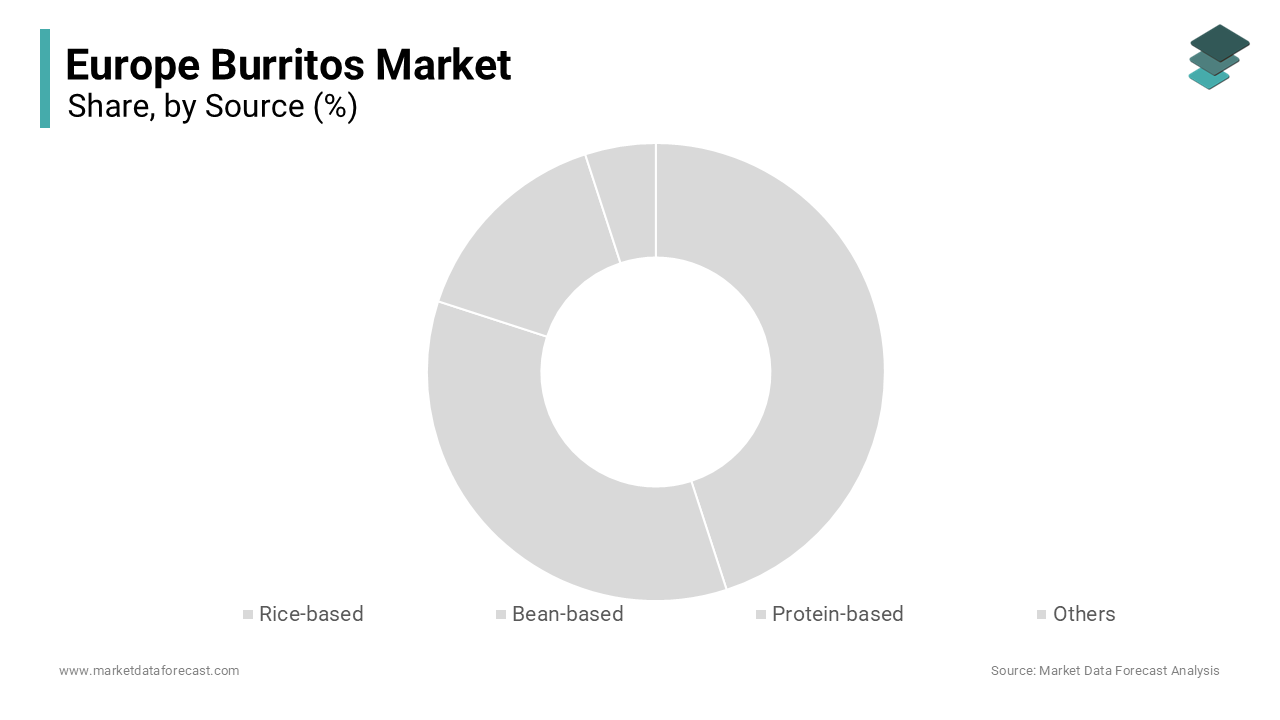
The leading status of the protein-based segment is the maturity and reliability of supply chains dedicated to meat processing and distribution, across Europe. Decades of established infrastructure for sourcing poultry beef and pork ensure consistent quality availability and competitive pricing for food service operators. According to the European Meat Industry Association, the continent boasts one of the most efficient meat logistics networks globally by enabling rapid delivery of fresh or frozen protein fillings to thousands of outlets daily. This logistical ease reduces operational complexity for restaurant chains and retailers, who can rely on standardized portion sizes and cooking times for meat ingredients. The familiarity of kitchen staff with handling and preparing various cuts of meat also lowers training costs and minimizes preparation errors compared to newer plant-based alternatives. Additionally, the widespread acceptance of meat safety standards and labeling regulations provides a clear framework for compliance reducing legal risks for businesses. This entrenched ecosystem creates a high barrier to entry for non-meat segments seeking to achieve similar levels of operational efficiency and cost effectiveness in the near term.
The bean-based segment is projected to witness a fastest CAGR of 8.4% during the forecast period with the rapid growth of the bean-based segment is the significant shift toward flexitarian diets where consumers actively reduce meat intake without completely eliminating it leading to increased demand for plant-based protein sources like beans. European public health campaigns have heavily promoted the consumption of legumes as a sustainable and healthy alternative to red meat. According to the European Commission, dietary guidelines recommend increasing pulse consumption to at least two servings per week to improve cardiovascular health and reduce carbon footprints. This regulatory and educational push has normalized beans as a primary protein source rather than just a side dish. Consumers view bean-filled burritos as a guilt-free indulgence that aligns with their ethical and health goals. The affordability of beans compared to meat also appeals to cost-conscious demographics facing inflationary pressures.
By Product Type Insights
The meat product type segment held 58.3% of the Europe burritos market share in 2025 owing to the strong consumer belief that authentic Mexican cuisine fundamentally relies on high-quality meat preparations, such as carnitas al pastor and barbacoa. European diners often equate the presence of seasoned meat with the legitimacy of the dining experience making meatless versions seem like inferior substitutes to many. This preference is reinforced by decades of marketing that have established specific meat flavors as the benchmark for taste satisfaction. Data from taste preference studies conducted across major European countries shows that seasoned beef and chicken remain the top requested fillings by a significant margin over plant-based options. The rich umami profiles provided by slow-cooked meats are difficult to replicate fully with current plant technologies ensuring continued loyalty to meat variants. Furthermore, the social aspect of sharing meat-heavy meals remains a staple of European dining culture.
The vegan product type segment is swiftly emerging at a fastest CAGR of 11.2% from 2026 to 2034 with the profound shift in European consumer values toward ethical consumption and animal welfare. A growing number of Europeans are adopting vegan lifestyles not just for health but as a moral stance against industrial animal farming. Data from the Vegan Society indicates that the number of vegans in Europe has quadrupled in the last five years creating a rapidly expanding customer base for entirely plant-based meals. Retailers and restaurants are responding by dedicating entire menu sections to vegan options to capture this loyal demographic. The stigma previously associated with vegan food as bland or insufficient is disappearing replaced by a sense of pride in choosing cruelty-free options.
By Distribution Channel Insights
The supermarkets and hypermarkets channel segment was the largest by holding 45.6% of the Europe burritos market share in 2025 with the well-developed frozen food infrastructure in Europe which allows consumers to stock up on burritos for convenient home consumption. European households rely heavily on freezers for meal prep and emergency dinners making the frozen aisle a critical touchpoint for burrito sales. According to the European Frozen Food Association, over 75% of European homes own a freezer and regularly purchase frozen ready meals for weekday dinners. This behavior aligns perfectly with the shelf-stable nature of frozen burritos which offer long storage life and quick preparation times. Data from retail scanner data indicates that frozen Mexican meals are among the top three fastest-growing categories in the frozen section of major chains like Carrefour and Tesco. The ability of supermarkets to offer bulk packs and multi-buy promotions further encourages large volume purchases by families. Additionally, the centralized distribution networks of hypermarkets ensure consistent product availability across vast geographic areas.
The online sales channels segment is lucratively to witness a fastest CAGR of 13.5% from 2026 to 2034. The growth of the segment is propelling with the ubiquitous presence of food delivery platforms such as Deliveroo Uber Eats and Just Eat, which have transformed how Europeans access restaurant-style burritos. These apps provide instant access to a wide variety of burrito joints that may not be physically close to the consumer effectively expanding the market reach for operators. The user-friendly interfaces and real-time tracking features of these apps reduce friction in the ordering process encouraging impulse purchases. The integration of loyalty programs and personalized recommendations further drives repeat business. The rise of direct-to-consumer DTC models and subscription services offered by specialized burrito brands and meal kit providers is also leveraging the growth of the segment. Companies are bypassing traditional intermediaries to sell directly to customers via their own websites offering curated bundles and recurring delivery schedules. Burrito brands leverage this model to offer exclusive flavors and fresh ingredients delivered straight to the doorstep often with eco-friendly packaging that appeals to modern sensibilities. Data from DTC brand performance metrics shows that customer lifetime value is significantly higher for subscribers compared to one-time app users. This model also allows brands to gather valuable data on consumer preferences enabling rapid product iteration and targeted marketing.
REGIONAL ANALYSIS
United Kingdom Burritos Market Analysis
The United Kingdom was the top performer of the Europe burritos market by capturing 23.3% of share in 2025 due to its highly developed quick service restaurant sector and early adoption of Mexican culinary trends. The nation serves as the primary gateway for international food concepts where major global chains and local innovators drive demand for diverse burrito formats. According to the British Food Service Federation, the number of Mexican themed outlets in London and Manchester has increased by 35% over the past three years reflecting robust consumer appetite. The prevalence of busy lifestyles in major cities fuels the demand for portable meals making burritos a staple for office workers and students. Furthermore the UK acts as a trendsetter for the rest of Europe often introducing new flavor innovations and plant-based variations first. The strong presence of food delivery infrastructure amplifies accessibility ensuring that burritos are available even in residential suburbs. Continuous investment in marketing and localization by key players ensures that the burrito remains relevant and exciting.
Germany Burritos Market Analysis
Germany was ranked second by capturing 19.3% of the Europe burritos market with its robust economy and growing interest in international street food concepts, among younger people. The German market distinguishes itself through a strong emphasis on quality ingredients and sustainability which influences burrito formulations towards organic and locally sourced fillings. The country's strong vegetarian and vegan movements have accelerated the adoption of plant-based burritos making Germany a key testing ground for meat-free innovations. German consumers are increasingly influenced by health trends and prefer options that are perceived as wholesome and balanced. The government's support for sustainable agriculture aligns with the farm-to-table narratives adopted by premium burrito brands. Furthermore, the dense network of bakeries and cafes is increasingly incorporating burrito-like wraps into their menus expanding distribution points.
France Burritos Market Analysis
France burritos market growth is swiftly growing at an anticipated CAGR in coming years with the embracing non-traditional cuisines alongside its culinary heritage. The prestige of gastronomy, which pushes burrito providers to elevate their offerings with high-quality cheeses charcuterie and fresh produce. The prevalence of student populations in cities like Paris Lyon and Bordeaux has created a vibrant demand for affordable yet tasty handheld meals. French consumers are increasingly open to fusion concepts that blend Mexican techniques with French ingredients such as duck confit or goat cheese burritos. The rise of food trucks and street food festivals has further normalized the consumption of burritos in public spaces.
Italy Burritos Market Analysis
Italy burritos market growth is likely to grow with the increasing integration of foreign fast-food habits into daily life. According to the Italian National Institute of Statistics, the consumption of ready-to-eat ethnic meals has seen double-digit growth as urban Italians seek quick lunch solutions during work breaks. Burritos are gaining traction as a novel alternative to panini and pizza al taglio offering a different texture and flavor profile. The rising popularity of spicy foods and bold flavors among younger Italians has fueled demand for authentic Mexican styles. Italian food manufacturers are renowned for their adaptability and are beginning to produce high-quality tortillas and fillings domestically reducing reliance on imports. The strong café culture is also evolving with many bars now serving hot burritos as a morning or afternoon snack.
Spain Burritos Market Analysis
Spain burritos market growth is likely to witness a fastest CAGR in coming years with its geographic proximity to Latin America and historical cultural ties that facilitate the acceptance of Mexican cuisine. According to the Spanish Ministry of Agriculture Fisheries and Food imports of Mexican ingredients have increased by 20% annually reflecting rising production and consumption levels. The prevalence of tourism in coastal areas and major cities exposes locals to diverse culinary trends accelerating the normalization of burritos. Spanish consumers appreciate the communal aspect of dining and burritos fit well into social gatherings and beach outings. The strong agricultural sector allows for the sourcing of fresh vegetables and peppers enhancing the quality of local burrito offerings. Additionally, the rise of delivery apps in Madrid and Barcelona has made burritos a popular choice for late-night meals. The emergence of homegrown chains specializing in Tex-Mex cuisine has further stimulated domestic demand.
COMPETITIVE LANDSCPAE
The competition in the Europe burritos market is characterized by intense rivalry between global fast casual chains and agile local operators who compete through flavor authenticity and service speed. Major players distinguish themselves by emphasizing fresh ingredients transparent sourcing and customizable meal options that appeal to health-conscious European diners. The landscape is dynamic as companies continuously invest in digital platforms and delivery networks to capture the growing demand for convenient dining solutions. Price competition remains significant but leading firms mitigate this by focusing on premiumization and unique flavor profiles that justify higher price points. Sustainability has emerged as a critical battleground where competitors showcase their commitments to reducing waste and supporting local farmers. The entry of new niche brands offering artisanal or fusion burritos adds further pressure on established entities to innovate constantly.
KEY MARKET PLAYERS
Some of the companies that are playing a dominating role in the Europe transport management system market include
- General Mills, Inc.
- Conagra Brands, Inc.
- Kellogg Company
- Nestlé S.A.
- McCain Foods Limited
- Dr. Oetker Group
- Greencore Group plc
- Iceland Foods Ltd.
Top Players in the Europe Burritos Market
Chipotle Mexican Grill
Chipotle Mexican Grill stands as a transformative force in the Europe burritos market by introducing its signature fast casual model that emphasizes fresh ingredients and customizable meals. The company contributes significantly to the global market through its standardized operational framework and commitment to food with integrity which resonates with European consumers. Recently Chipotle has strengthened its position by aggressively expanding its footprint in key urban centers like London and Paris while adapting menus to include locally sourced organic produce. They have also invested heavily in digital ordering platforms and loyalty programs to enhance customer engagement across the region. Their strategic focus on sustainability and transparent sourcing aligns perfectly with European values regarding ethical consumption.
Restaurant Brands International
Restaurant Brands International operates as a leading global quick service restaurant operator with a strong presence in the Europe burritos market through its Tim Hortons and Firehouse Subs portfolios that increasingly feature burrito style items. The company serves international markets by leveraging its extensive franchise network to introduce Mexican inspired offerings in non traditional locations. Restaurant Brands International has recently enhanced its European operations by launching pilot concepts that blend local flavors with classic burrito formats to appeal to diverse palates. They have actively pursued technology driven solutions such as automated kitchen equipment and mobile apps to improve service speed and accuracy. The company focuses on value driven menu innovations that attract price sensitive consumers during economic fluctuations.
Grupo Telepizza
Grupo Telepizza functions as a major European food service provider with significant involvement in the burrito sector through its strategic diversification beyond pizza into broader Mexican inspired categories. The company supports the regional market by offering accessible and affordable burrito options through its vast delivery network and physical outlets across Spain and neighboring countries. Grupo Telepizza has recently strengthened its market position by acquiring or partnering with specialized Mexican brands to expand its product portfolio and expertise. They have implemented rigorous quality control systems to ensure consistency in taste and ingredient freshness across all locations. Their strategy includes leveraging existing logistics infrastructure to offer rapid delivery of hot burritos directly to consumer homes.
Top Strategies Used by the Key Market Participants
Key players in the Europe burritos market primarily employ localization strategies to adapt menus to regional taste preferences and dietary requirements such as vegan or gluten free options. Companies are increasingly investing in digital transformation including mobile apps and delivery partnerships to enhance customer convenience and order accuracy. Another major strategy involves sustainable sourcing initiatives where brands prioritize organic ingredients and ethical supply chains to align with European environmental values. Market participants are also focusing on store format innovation by opening smaller express locations in high traffic urban areas to maximize reach. Strategic marketing campaigns highlighting customization and freshness help differentiate brands in a crowded sector. Furthermore,, companies leverage data analytics to optimize inventory management and predict consumer trends. These collective efforts enable key players to build brand loyalty and respond effectively to evolving consumer expectations and regulatory landscapes.
MARKET SEGMENTATION
This research report on the Europe Burritos Market has been segmented and sub-segmented based on the following categories.
By Source
- Rice-based
- Bean-based
- Protein-based
- Others
By Product Type
- Meat
- Vegetarian
- Vegan
By Distribution Channel
- Retail
- Supermarkets/Hypermarkets
- Convenience Stores
- Online Sales Channels
- Others
By Country
- UK
- France
- Spain
- Germany
- Italy
- Russia
- Sweden
- Denmark
- Switzerland
- Netherlands
- Turkey
- Czech Republic
- Rest of Europe