- Product Description Description
- Table of Contents TOC
- List of Table & Figure LOT
- Get Free Sample PDF Sample PDF
Market Size, 2025
$56.36 BnMarket Estimate, 2026
$60.02 BnMarket Forecast, 2034
$99.19 BnCAGR, 2026–2034
6.48%Europe Cabinet Market Report Summary
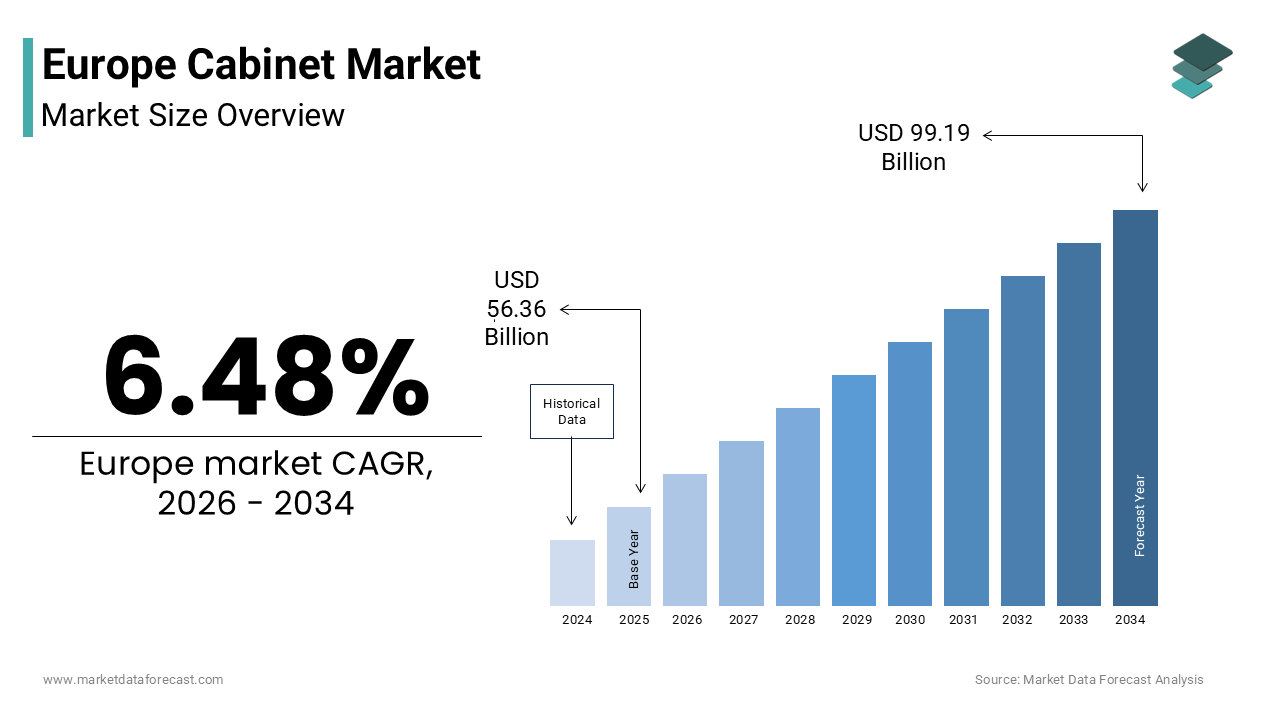
The Europe cabinet market was valued at USD 56.36 billion in 2025, is estimated to reach USD 60.02 billion in 2026, and is projected to reach USD 99.19 billion by 2034, growing at a CAGR of 6.48% during the forecast period from 2026 to 2034. The growth of the Europe cabinet market is driven by increasing residential renovation activity, rising demand for modular storage solutions, and strong adoption of fitted cabinetry across modern interior design. Expanding kitchen modernization trends, sustainability regulations governing wood sourcing and emissions, and the integration of smart home features within cabinetry systems are further supporting market expansion. Moreover, the growing use of prefabricated construction methods and circular furniture business models is enhancing the demand for standardized yet customizable cabinet solutions across residential and commercial sectors in Europe.
Key Market Trends
-
Rising demand for built-in and modular cabinetry is driven by residential renovation and kitchen modernization across Europe.
-
Increasing adoption of low-emission and sustainably sourced wood panels is aligned with EU environmental and circular economy regulations.
-
Growing integration of digital configurators and smart kitchen technologies requires precision-engineered cabinet solutions.
-
Expansion of modular and prefabricated cabinetry for off-site construction and rapid housing development projects.
-
Emergence of circular economy models including refurbishment, take-back schemes, and recyclable cabinet materials.
Segmental Insights
- Based on product, the kitchen cabinets segment was the largest and held 64.7% of the Europe cabinet market share in 2025. The segment’s dominance is attributed to frequent kitchen renovation cycles, the central functional importance of kitchens in European homes, and rising demand for integrated appliance-ready storage solutions.
- Based on material, the wood segment led the Europe cabinet market in 2025 owing to its widespread use across kitchen and bathroom cabinetry, aesthetic appeal, machinability for customization, and compatibility with low-emission engineered wood innovations.
- Based on application, the residential segment accounted for a significant share of the Europe cabinet market in 2025. Strong homeownership rates, renovation activity, and consumer preference for personalized interior storage solutions continue to support segment growth across the region.
Regional Insights
The Europe cabinet market is experiencing steady growth across major economies supported by renovation investments, housing modernization initiatives, and strong furniture manufacturing capabilities.
-
Germany was a leading contributor to the Europe cabinet market, driven by its robust furniture manufacturing base, renovation activity, and strong demand for fitted kitchen systems.
-
France and the United Kingdom continue to demonstrate stable demand, supported by residential remodeling, smart home adoption, and growth in interior design services.
-
Italy remains a design-driven market, benefiting from premium cabinetry demand, luxury residential projects, and strong export-oriented furniture production.
-
Central and Eastern European markets such as Poland and the Czech Republic are witnessing gradual expansion, supported by housing development and increasing modular furniture adoption.
Competitive Landscape
The Europe cabinet market is characterized by a fragmented yet competitive environment comprising global furniture brands, regional manufacturers, and specialized cabinetry producers competing on customization, sustainability, and delivery efficiency. Leading companies are focusing on modular cabinet systems, digital configuration platforms, automated manufacturing expansion, and circular product design to strengthen market positioning. Strategic partnerships with construction firms, appliance manufacturers, and interior designers are further enhancing value creation across residential and commercial projects. Prominent players in the Europe cabinet market include Nobia AB, Howdens Joinery Group Plc, Nobilia-Werke J. Stickling GmbH & Co. KG, Häcker Küchen GmbH & Co. KG, Poggenpohl Möbelwerke GmbH, Schmidt Groupe, Ballingslöv International AB, Wren Kitchens Ltd., Magnet Ltd. (Nobia Group), and IKEA Systems B.V.
Europe Cabinet Market Size
The Europe cabinet market size was valued at USD 56.36 billion in 2025 and is anticipated to reach USD 60.02 billion in 2026 from USD 99.19 billion by 2034, growing at a CAGR of 6.48% during the forecast period from 2026 to 2034.
Cabinet refers predominantly to fixed or modular furniture units designed for storage, display, or functional organization in residential, commercial, and institutional settings. These include kitchen cabinets, bathroom vanities, office storage systems, and laboratory or industrial enclosures, each engineered to meet specific ergonomic, aesthetic, and regulatory standards. The Europe cabinet market is deeply intertwined with construction activity, interior design trends, and sustainability mandates governing material sourcing and emissions. Eurostat indicates that housing completions in key Member States, notably Germany, France, and Poland, are driving demand for fitted cabinetry, despite overall fluctuations in new dwelling transactions. Additionally, the European Commission's updated Energy Performance of Buildings Directive compels the construction of zero-emission public buildings, driving demand for sustainable and low-emission materials in the cabinetry sector. Various sources suggests that the European Union furniture sector continues to be a major employer, with kitchen and built-in furniture remaining a dominant segment in production value. Unlike generic furniture, cabinets in Europe are increasingly specified as built in architectural elements, reflecting a cultural preference for space efficiency, durability, and seamless interior integration.
MARKET DRIVERS
Sustained Growth in Residential Renovation and Kitchen Modernization
The persistent trend of home renovation, particularly kitchen upgrades, serves as a primary driver of the Europe cabinet market. Unlike new construction, which fluctuates with economic cycles, renovation remains resilient due to aging housing stock and evolving lifestyle expectations. According to research, the European building stock is largely composed of aging residential structures built before the widespread adoption of energy efficiency measures, which suggests a substantial and ongoing need for the modernization of interior living spaces to meet contemporary standards. Research from federal institutes suggests that while Germany’s construction and renovation industry remains a key economic pillar, residential building projects have slowed despite a sustained interest in housing modernization. Similarly, homeowners in France are increasingly focusing their renovation efforts on improving energy efficiency and overall home comfort, often supported by national subsidies that prioritize sustainable upgrades and the long-term viability of the housing stock. The rise of smart kitchens, featuring integrated appliances and motion activated lighting, further necessitates custom cabinetry with precise cutouts and cable management. This continuous refresh cycle, supported by low interest rates and green renovation subsidies, ensures steady demand independent of new housing starts.
Stringent EU Regulations on Formaldehyde Emissions and Sustainable Materials
European environmental legislation has fundamentally reshaped cabinet manufacturing by mandating low emission materials and traceable supply chains, which is among the key accelerators of the Europe cabinet market. European environmental regulations have tightened the limits on chemical emissions from furniture materials, leading manufacturers to adopt advanced resin technologies and binders that significantly reduce the release of volatile organic compounds into the home. The majority of wood-based panel production within the European Union is moving toward stricter emission standards, reflecting the industry's alignment with new environmental health directives and consumer safety requirements. Additionally, new European regulations regarding deforestation require companies to provide rigorous proof that their timber products are legally sourced and do not contribute to forest degradation, leading to more transparent and traceable supply chains. Major international furniture retailers have reached a point where nearly all the wood used in their products is sourced from forests that meet high environmental and social standards or is derived from recycled materials. These regulations not only protect indoor air quality but also align with consumer preferences. Survey data across the European Union indicates that a significant majority of consumers now weigh the ecological footprint of a product as a primary factor in their buying decisions. As a result, compliance has become a competitive differentiator, driving innovation in bio based adhesives, recycled content panels, and circular design principles that extend product lifespans.
MARKET RESTRAINTS
Volatility in Wood and Panel Raw Material Costs
Volatile prices for wood, MDF, and particleboard are putting significant pressure on the European cabinet market. Costs for these core inputs are heavily influenced by global trade policies, energy expenses, and forest management constraints. The restriction of timber imports from Russia, combined with the growing use of wood for renewable energy, has created long-term structural shifts in the European softwood market, keeping price levels sensitive to geopolitical and energy-related supply constraints. Simultaneously, high energy requirements for manufacturing wood-based panels mean that production costs remain closely tied to fluctuations in the natural gas market, posing a continued challenge for the profitability of the panel industry. These increases directly impact small and medium cabinet makers who lack the scale to hedge or absorb input shocks. Economic uncertainty and shifts in consumer spending have led many German furniture manufacturers to take a cautious approach toward capital investment and the expansion of their production facilities. Moreover, just in time inventory practices, common in Western Europe, leave a minimal buffer against sudden price jumps, forcing price pass throughs that dampen consumer demand. This volatility undermines long term planning and discourages investment in automation, particularly among artisanal producers who form the backbone of Southern Europe’s cabinet sector.
Labor Shortages in Skilled Carpentry and Cabinet Assembly
A critical shortage of trained carpenters, joiners, and cabinet assembly personnel is constraining production capacity and quality consistency across the European cabinet market. Ongoing labor landscape imbalances across the European Union have resulted in a significant shortage of qualified tradespeople, particularly in specialized craft sectors where the demand for skilled labor continues to outpace the available workforce. Vocational training pipelines have weakened as younger generations shift toward service or digital careers. Vocational training systems in Europe are undergoing a period of transition as traditional manufacturing roles face competition from other sectors, leading to fluctuations in the number of new entrants into woodworking and furniture-making careers. This gap is especially acute in custom cabinetry, where precision fitting, veneer matching, and hand finishing require years of experience. The availability of specialized installers remains a critical factor in the completion of residential renovation projects in Scandinavia, where the timing of home improvements is often impacted by broader fluctuations in the labor market. Even automated factories depend on skilled technicians for machine calibration and quality control, roles increasingly difficult to fill. Robust end-user demand cannot prevent delivery bottlenecks and diminished craftsmanship if the industry fails to improve vocational prestige and reskill workers.
MARKET OPPORTUNITIES
Integration of Modular and Prefabricated Cabinetry in Offsite Construction
The rise of offsite and modular construction paves the way for standardized yet customizable cabinet systems, which are likely to promote the growth of the Europe cabinet market. European cities are grappling with housing shortages, leading to the increased use of prefabricated volumetric modules. These units are delivered complete with installed kitchens and bathrooms. Offsite construction is experiencing strong growth in European residential projects, with Germany, the Netherlands, and the UK leading adoption driven by the need for sustainable, faster solutions. These modules require cabinets engineered for factory integration, transport resilience, and rapid on site connection. Companies like Nobia and Bulthaup have developed snap fit cabinet frames with pre routed utility channels that reduce on site labor. Additionally, the use of industrial and modular systems is significantly reducing construction times and helping address housing shortages in the Netherlands. Furthermore, BIM compatible cabinet libraries enable seamless digital coordination between architects and manufacturers. Urban density is increasing and construction timelines are compressing. Consequently, the shift toward industrialized cabinetry will accelerate, blending mass production with personalized finishes.
Expansion of Circular Business Models and Take Back Schemes
The region’s circular economy mandate is opening new revenue models centered on cabinet reuse, refurbishment, and material recovery, which is expected to boost the expansion of the Europe cabinet market. The EU’s Ecodesign for Sustainable Products Regulation will require furniture to be durable, repairable, and recyclable, pushing brands toward modular designs with replaceable fronts and standardized hardware. In response, companies like IKEA and Vitsœ have launched take back programs. Recent sustainability analyses indicate that IKEA is advancing its circularity goals by facilitating the reuse and repair of products, while French startups are increasingly bridging the gap between consumers and refurbished furniture. The Ellen MacArthur Foundation emphasizes that applying circular principles across major industries is crucial for reducing global carbon emissions, as exemplified by municipal strategies like Berlin's focus on sustainable procurement. Municipalities are also supporting this shift. The rising rejection of throwaway culture means that modular, repairable cabinets will generate higher long-term ethical and financial returns.
MARKET CHALLENGES
Fragmented Fire and Safety Standards Across Member States
Divergent national fire safety and structural stability requirements for cabinetry create compliance complexity and cost inefficiencies, which hold back the growth of the Europe cabinet market. This is the case despite EU harmonization efforts. Load-bearing elements require CE marking under the Construction Products Regulation, whereas non-structural cabinets in kitchens and labs fall under differing national regulations. European countries maintain distinct national quality benchmarks and fire safety classifications for furniture and surfaces, leading to a landscape where regional certifications remain influential despite broader European standardization efforts. Manufacturers operating across European borders face increased financial burdens and administrative hurdles resulting from the requirement to satisfy multiple national testing protocols and certification bodies. For example, a cabinet certified for Italian kitchens may require revalidation for Portuguese schools due to differing chemical resistance rules. This fragmentation discourages SMEs from exporting and slows innovation, as R&D resources divert to documentation rather than design. In the absence of a standardized EU framework for interior cabinetry, manufacturers are navigating operational complexities that hinder market entry and inflate costs.
Rising Consumer Expectations for Personalization and Lead Time Compression
European consumers increasingly demand bespoke cabinet solutions, custom dimensions, unique finishes, and integrated smart features, while simultaneously expecting delivery within weeks, not months. This paradox acts as a major barrier to the European cabinet market. This paradox strains traditional production models built on batch manufacturing and seasonal collections. Modern European consumers increasingly favor personalized kitchen designs, though a significant gap remains between the desire for custom-built cabinetry and the expectation for rapid delivery and installation. Meeting this requires massive investments in flexible automation, real time configurators, and agile logistics, capabilities beyond most regional workshops. Even large players struggle. Despite the potential for digital twins to optimize complex, customized production, the widespread adoption of this technology remains limited among European furniture manufacturers due to the high barriers to entry and technical complexity. The tension between mass customization and speed is exacerbated by supply chain fragility, delayed hinge shipments can halt entire kitchen deliveries. The industry risks losing customers to imports or flat-pack options if it fails to adopt collaborative supply networks and modern digital infrastructure, rendering its superior local craft irrelevant.
REPORT COVERAGE
| REPORT METRIC | DETAILS |
| Market Size Available | 2025 to 2034 |
| Base Year | 2025 |
| Forecast Period | 2026 to 2034 |
| CAGR | 6.48% |
| Segments Covered | By Product, Material, Application, Type and Region |
| Various Analyses Covered | Regional & Country Level Analysis, Segment-Level Analysis, DROC, PESTLE Analysis, Porter’s Five Forces Analysis, Competitive Landscape, Analyst Overview on Investment Opportunities |
| Countries Covered | UK, France, Spain, Germany, Italy, Russia, Sweden, Denmark, Switzerland, the Netherlands, Turkey, the Czech Republic, and the Rest of Europe. |
| Market Leaders Profiled | Medtronic, Stryker, Fresenius SE & Co. KGaA, Koninklijke Philips N.V., F. Hoffmann-La Roche Ltd, General Electric Company, Siemens Healthineers AG, BD, Boston Scientific Corporation, and Johnson & Johnson Services, Inc. |
SEGMENTAL ANALYSIS
By Product Insights
The kitchen cabinets segment led the Europe cabinet market and accounted for a 64.7% share in 2025. The leading position of the segment is driven by their central role in residential renovation, new construction, and evolving culinary lifestyles. The kitchen is increasingly viewed as the social and functional heart of the home, prompting homeowners to invest heavily in durable, aesthetically refined storage solutions. New residential construction across the European Union has faced a downward trend, although the delivery of modern dwellings remains a primary driver for the built-in furniture and appliance sectors. Despite ambitious government targets for new housing, the German residential construction market has experienced a contraction, impacting the volume of new-build kitchen installations. Beyond new builds, renovation remains a powerful engine. Homeowners in France are increasingly investing in property improvements, with a strong emphasis on comprehensive renovations and energy-efficient upgrades that often incorporate modernized interior spaces. The rise of open plan living further amplifies demand for seamless, handle less designs that integrate with living spaces. Additionally, EU energy efficiency mandates push builders toward factory assembled kitchen modules that minimize on site waste and installation time. This combination of demographic, architectural, and regulatory forces ensures kitchen cabinets remain the dominant product category.
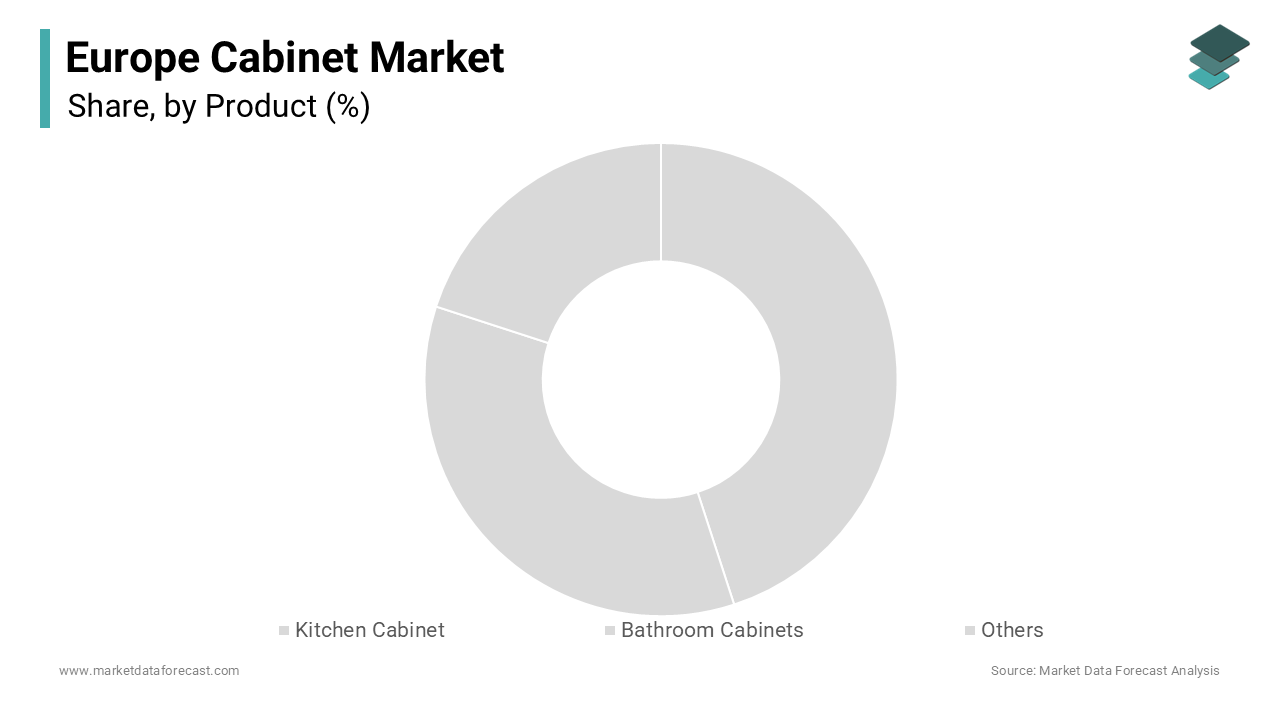
The bathroom cabinets segment is on the rise and is expected to be the fastest growing segment in the market by witnessing a CAGR of 5.9% from 2026 to 2034 due to rising standards of hygiene, wellness oriented interior design, and the modernization of aging housing stock. Unlike kitchens, many European bathrooms, especially in Southern and Eastern Europe, historically featured minimal storage, but contemporary trends emphasize organized, spa like environments. The significant proportion of aging housing stock across Europe presents a substantial opportunity for the home improvement sector, as older residences often require modern storage solutions to meet contemporary lifestyle needs. Tax incentives have historically driven the Italian home renovation market. Nevertheless, consumer interest remains high for durable bathroom furnishings that combine aesthetic appeal with technical resilience. Similarly, Health-conscious design in Northern Europe emphasizes the importance of maintaining clean and organized living environments, which influences consumer preferences for functional bathroom storage. Manufacturers are responding with water resistant materials like HPL and thermoformed polymers that meet EN 312 standards for humidity resistance. Wellness and functionality are converging in private living spaces. Consequently, bathroom cabinetry is transitioning from a mere utility to an essential design element.
By Material Insights
The wood segment remained the largest segment in the Europe cabinet market and held a substantial share in 2025. The supremacy of the segment is attributed to its aesthetic warmth, structural versatility, and deep cultural resonance in European interior design. Solid wood, plywood, and engineered wood products like particleboard and MDF form the backbone of both kitchen and bathroom cabinetry across the region. According to sources, the vast majority of kitchen cabinetry in Western Europe continues to rely on wood-derived cores finished with durable decorative surfaces, reflecting the regional industry’s deep integration with the wood-processing supply chain. Germany remains a leading producer of wood-based panels, serving as a critical supplier for the domestic furniture manufacturing sector and supporting the high volume of cabinetry production. Consumer preference plays a key role. Throughout the European Union, there is a strong cultural and consumer preference for wood-based products, which are widely perceived as durable and high-quality options for interior environments. Furthermore, stringent EU regulations on formaldehyde emissions have driven innovation in low emission binders, making modern wood composites safer and more sustainable. The material’s compatibility with CNC machining also enables high precision customization, reinforcing its dominance in both mass market and bespoke segments.
The plastic and polymer based cabinets segment is expected to exhibit a noteworthy CAGR of 6.3% over the forecast period owing to demand for moisture resistant, lightweight, and easily moldable alternatives, particularly in bathrooms, laboratories, and rental housing. High pressure laminate, ABS, and recycled PET panels offer superior resistance to humidity and chemicals compared to traditional wood, making them ideal for wet environments. The integration of recycled materials into interior products is gaining momentum due to European Union sustainability targets. Despite this interest, the sector must still overcome market challenges related to sourcing and cost-competitiveness. Large-scale housing providers in the Netherlands are exploring durable and easy-to-maintain furnishing solutions for their renovation projects to reduce long-term operational and replacement costs. Similarly, Scandinavian countries prioritize hygienic, non porous surfaces in public health facilities. Municipal housing projects in Sweden are increasingly focused on high-performance materials that meet strict environmental standards, with a growing emphasis on long-term durability in communal and residential spaces. Advances in texture and color replication have also narrowed the aesthetic gap with wood, allowing polymers to enter premium segments. Sustainability and performance are converging. As a result, this material class is redefining expectations for modern cabinetry.
By Application Insights
The residential application segment dominated the Europe cabinet market and captured a significant share in 2025. The prominence of the segment is supported by the continent’s strong culture of homeownership, renovation, and interior personalization. Unlike commercial settings where standardization prevails, residential projects demand tailored solutions that reflect individual taste, spatial constraints, and lifestyle needs. Homeownership remains the most common tenure status across the European Union, particularly in Eastern and Southern member states, where the desire to maintain property value continues to drive a significant portion of the home improvement landscape. Significant financial investment continues to flow into the modernization of existing German housing, with kitchen and bathroom refurbishments representing a major segment of consumer spending on home improvements. The rise of remote work has further intensified focus on home environments. Beyond technical and energy-related upgrades, French homeowners are increasingly motivated by the desire to enhance their quality of life and the functionality of their living spaces when undertaking home improvements. Additionally, government subsidies provide direct financial incentives for energy efficient kitchen replacements. This sustained investment in private living spaces, combined with generational shifts toward experiential home design, anchors residential demand as the market’s core pillar.
The commercial application segment is predicted to witness the highest CAGR of 5.7% between 2026 to 2034. The swift growth of the segment is fuelled by urbanization, hospitality expansion, and institutional modernization. Hotels, restaurants, offices, and healthcare facilities require durable, code compliant cabinetry that balances functionality with brand aesthetics. According to research, the robust recovery of international tourism across the European continent has revitalized the hospitality sector in major Mediterranean destinations, prompting property owners to reinvest in their facilities to remain competitive. Hospitality operators in Spain are increasingly focused on property modernization and the upgrading of guest amenities to justify higher room rates and meet the evolving expectations of international travelers. Significant European Union financial support is being directed toward the modernization of healthcare systems, driving the adoption of advanced clinical environments and specialized furnishings designed to improve patient safety and hygiene. Meanwhile, co working operators like WeWork specify modular, sound dampening storage units to support flexible office layouts. Unlike residential buyers, commercial clients prioritize lifecycle cost, fire ratings, and rapid installation, spurring demand for metal and polymer composites. Service sector investment is rebounding post-pandemic. Commercial cabinetry is emerging as a dynamic growth frontier.
COMPETITIVE LANDSCAPE
The Europe cabinet market features a highly fragmented yet stratified competitive environment where global brands, regional specialists, and artisanal workshops coexist. At the premium end, Italian and German manufacturers compete on design heritage, material innovation, and bespoke craftsmanship, often serving high net worth clients and luxury developers. Mid tier segments are dominated by integrated players like Nobia and Poggenpohl that leverage scale, digital configurators, and efficient logistics to deliver consistent quality across multiple countries. Budget offerings face pressure from flat pack retailers and private label imports, though EU sustainability rules create barriers for non compliant entrants. Competition is not primarily price based but centers on speed of delivery, customization depth, environmental credentials, and after sales support. Regulatory complexity spanning fire safety, formaldehyde emissions, and circularity—favors established players with compliance expertise. Meanwhile, the rise of offsite construction demands cabinets engineered for modular building systems, pushing traditional makers toward industrial collaboration. Overall, the market rewards those who balance automation with personalization and sustainability with performance.
KEY MARKET PLAYERS
Some of the companies that are playing a dominating role in the Europe Cabinet Market include
- Nobia AB
- Howdens Joinery Group Plc
- Nobilia-Werke J. Stickling GmbH & Co. KG
- Häcker Küchen GmbH & Co. KG
- Poggenpohl Möbelwerke GmbH
- Schmidt Groupe
- Ballingslöv International AB
- Wren Kitchens Ltd.
- Magnet Ltd. (Nobia Group)
- IKEA Systems B.V
Top Players in the Europe Cabinet Market
Nobia AB
Nobia AB is a leading European kitchen cabinet manufacturer headquartered in Sweden with a strong presence across Germany, the United Kingdom, and the Nordic region. The company contributes significantly to the global market through its portfolio of premium and mid tier brands such as Kvik, Godmorgon, and HTH. Nobia emphasizes modular design, sustainability, and digital customization tools that allow consumers to configure cabinets online. It also expanded its automated production facility in Poland to serve Central European markets more efficiently, reinforcing its commitment to localized manufacturing and reduced carbon logistics.
Schüller Group
Schüller Group, based in Germany, is a major player in high quality fitted kitchen cabinets known for precision engineering and design innovation. The company exports its products to numerous countries and plays a key role in setting technical benchmarks for European cabinetry. Schüller has invested heavily in Industry 4.0 integration, enabling mass customization without compromising lead times. The company also enhanced its B2B digital platform for kitchen planners, offering real time rendering and material compliance data aligned with EU Construction Products Regulation requirements.
Snaidero Group
Snaidero Group, an Italian designer and manufacturer of luxury kitchen systems, holds a distinctive position in the global high end cabinet segment. Renowned for collaborations with architects and the use of advanced materials like Fenix NTM and ceramic composites, Snaidero blends Italian aesthetics with functional ergonomics. The company supplies bespoke kitchens to premium residential and hospitality projects worldwide. It also opened a new showroom and training center in Milan to showcase smart kitchen integrations and sustainable design principles, strengthening its influence in Europe’s luxury interior market.
Top Strategies Used by the Key Market Participants
Key players in the Europe cabinet market prioritize compliance with EU environmental regulations by using low emission wood panels and recyclable materials. They invest in digital customization platforms that enable real time visualization and configuration for both consumers and professionals. Vertical integration of supply chains ensures control over raw material quality and delivery timelines. Companies expand automated production facilities in Central and Eastern Europe to reduce costs while maintaining proximity to key markets. Circular design principles are increasingly adopted, featuring modular construction and take back programs. Strategic showrooms in design capitals like Milan and Paris reinforce brand prestige. Partnerships with appliance manufacturers enable seamless smart kitchen integration. Training programs for installers and designers enhance service quality and customer satisfaction. These strategies collectively drive differentiation in a mature and competitive landscape.
MARKET SEGMENTATION
This research report on the Europe cabinet market has been segmented and sub-segmented based on the following categories.
By Product
- Kitchen Cabinet
- Bathroom Cabinets
- Others
By Material
- Wood
- Metal
- Plastic & Polymers
- Others
By Application
- Residential
- Commercial
By Type
- New Construction
- Retrofit/Remodeling
By Country
- UK
- France
- Spain
- Germany
- Italy
- Russia
- Sweden
- Denmark
- Switzerland
- Netherlands
- Turkey
- Czech Republic
- Rest of Europe