- Product Description Description
- Table of Contents TOC
- List of Table & Figure LOT
- Get Free Sample PDF Sample PDF
Market Size, 2025
$781 MnMarket Estimate, 2026
$820 MnMarket Forecast, 2034
$1,209 MnCAGR, 2026–2034
4.97%Europe Calcium Sulfate Market Report Summary
The Europe calcium sulfate market size was valued at USD 781.89 million in 2025, is estimated to reach USD 820.75 million in 2026, and is projected to reach USD 1,209.85 million by 2034, growing at a CAGR of 4.97% from 2026 to 2034. Market growth is driven by rising construction activities, increasing demand for gypsum-based building materials, expanding use of calcium sulfate in soil conditioning, and its growing adoption across industrial applications. The shift toward environmentally friendly construction materials, rising renovation activity across Europe, and the expanding use of calcium sulfate in food, pharmaceuticals, and manufacturing further support market expansion.
Key Market Trends
- Increasing demand for gypsum-based plasters, wallboards, and cement additives driven by Europe’s steady construction output.
- Growing adoption of calcium sulfate as a sustainable and recyclable building material supporting green construction initiatives.
- Expanding industrial applications in agriculture, food processing, pharmaceuticals, and manufacturing.
- Rising focus on improved soil conditioning and moisture control in modern farming practices.
- Strong interest in high-purity calcium sulfate grades due to their use in medical, laboratory, and specialty industrial products.
Segmental Insights
- Based on form, the hydrated calcium sulfate (gypsum) segment held the largest share of the Europe calcium sulfate market in 2025, supported by its widespread use in construction, plaster production, wallboards, and soil conditioning.
- Based on grade, the technical grade segment dominated the regional market in 2025 due to its extensive utilization in construction, industrial processing, and manufacturing applications.
- Based on end use industry, the building and construction segment accounted for the dominant share of the Europe calcium sulfate market in 2025, driven by the region’s growing construction, refurbishment, and infrastructure development activities.
Regional Insights
Europe continues to experience strong demand for calcium sulfate across major economies, driven by robust construction activity and increasing adoption of sustainable building materials.
- Germany emerged as the largest national market, accounting for 22.8% of the regional share in 2025, supported by advanced construction practices, extensive gypsum board usage, and strong industrial manufacturing demand.
Competitive Landscape
The Europe calcium sulfate market is characterized by the presence of established building material manufacturers and gypsum producers with extensive distribution networks and strong product portfolios. Companies are focusing on production capacity expansion, advanced gypsum processing technologies, and sustainable material development to strengthen market positioning. Key players in the Europe calcium sulfate market include Knauf Group, Saint-Gobain Group, USG Corporation, LafargeHolcim, Etex Group, Carmeuse Group SA, Graymont Limited, American Gypsum Company LLC, National Gypsum Company, and Anhydritec (Minersa Group)
 Download Free Sample Report
Europe Calcium Sulfate Market Size
The Europe calcium sulfate market size was valued at USD 781.89 million in 2025 and is projected to reach USD 1,209.85 million by 2034 from USD 820.75 million in 2026, growing at a CAGR of 4.97%.
Calcium sulfate is commonly encountered as gypsum or anhydrite, depending on its hydration state, and serves as a critical raw material across multiple industrial and consumer sectors in Europe. In the European context, calcium sulfate is primarily utilised in construction for plaster and drywall production, in agriculture as a soil conditioner and in food and pharmaceutical applications as a firming agent or calcium supplement.
The compound’s relevance stems from its natural abundance, low toxicity and versatile functional properties. Europe’s construction sector consumed approximately 24 million metric tons of gypsum in 2023, driven by renovation mandates under the EU’s Energy Performance of Buildings Directive. Simultaneously, the European Commission approved the use of calcium sulfate as a food additive under Regulation EC 1333/2008, reinforcing its role in food safety compliance. Industrial consumption patterns are further shaped by circular economy directives that incentivise the use of flue gas desulfurization gypsum, a byproduct of coal-fired power stations, thereby linking calcium sulfate demand to energy transition infrastructure. These intersecting regulatory, industrial and environmental frameworks define the nuanced operational landscape of the European calcium sulfate market.
MARKET DRIVERS
Expanding Renovation Activities in the EU Construction Sector
The sustained momentum in building renovation across Europe is driving the European calcium sulfate market growth. As per the European Environment Agency, existing buildings account for roughly 40% of the EU’s total energy consumption and 36% of its greenhouse gas emissions. In response, the revised Energy Performance of Buildings Directive mandates that member states increase annual renovation rates from the current 1% to at least 2% by 2030. Gypsum-based drywall and plasterboard products, which rely heavily on calcium sulfate dihydrate, are integral to interior refurbishment due to their fire resistance, acoustic insulation and ease of installation. France reported a significant rise in residential renovation permits in 2023, which indicates growing momentum in the sector. Germany’s Federal Ministry for Economic Affairs and Climate Action disclosed that public funding for building modernisation exceeded 4 billion euros in 2025, which is directly stimulating demand for interior finishing materials. Since each square meter of standard plasterboard contains approximately 7 to 9 kilograms of calcium sulfate, the scale of this renovation wave translates into significant material uptake. Consequently, the construction-driven demand for calcium sulfate is not merely cyclical but structurally embedded within Europe’s decarbonization roadmap.
Regulatory Endorsement in Food and Pharmaceutical Applications
Calcium sulfate benefits from strong regulatory acceptance across Europe’s tightly controlled food and pharmaceutical sectors, which is reinforcing its demand in high-value applications and further contributing to the regional market growth. The European Food Safety Authority recognises calcium sulfate as a safe source of bioavailable calcium and permits its use in products ranging from tofu to bakery items and brewing. As per the European Commission’s food additive database, calcium sulfate carries the designation E516 and is authorised without maximum usage limits in several food categories under Regulation EC 1333 2008. This permissive stance aligns with growing consumer interest in mineral fortification. Surveys indicate that a significant share of EU adults regularly use dietary supplements, with calcium among the most consumed minerals. In pharmaceutical formulations, calcium sulfate acts as an excipient in tablet manufacturing and as a bone graft extender in orthopaedic surgery. The European Medicines Agency lists calcium sulfate-based products in its approved excipient registry, citing its biocompatibility and osteoconductive properties. Regulatory data highlights that numerous orthopaedic medical devices containing calcium sulfate have received CE marking in recent years. This dual validation creates a resilient and diversified demand base that insulates the compound from volatility in any single sector.
MARKET RESTRAINTS
Volatility in Raw Material Sourcing from Industrial Byproducts
A significant restraint facing the European calcium sulfate market stems from the declining and inconsistent supply of flue gas desulfurization gypsum, a key secondary source derived from coal-fired power generation. As per the European Network of Transmission System Operators for Electricity, coal-based power generation in the EU fell by 23% between 2022 and 2025 as member states accelerated coal phaseouts in line with the European Green Deal. Germany announced significant coal capacity reductions in 2023, which reflects its ongoing energy transition efforts. Since flue gas desulfurization gypsum accounts for nearly 60% of the gypsum feedstock used by European plasterboard manufacturers. As per Eurogypsum, this energy transition directly constrains raw material availability. While natural gypsum mining exists, it faces permitting delays and environmental scrutiny under the EU’s Industrial Emissions Directive. For instance, gypsum quarry approvals in Poland declined in recent years due to groundwater protection concerns. Consequently, producers face rising input costs and supply chain uncertainty, which may limit production scalability despite stable end-user demand. The market’s heavy reliance on a byproduct stream tied to a retiring energy technology introduces structural fragility that cannot be easily offset through alternative sourcing in the short term.
Stringent Environmental Regulations on Mining and Waste Disposal
Environmental legislation governing mineral extraction and industrial waste management imposes substantial operational constraints on calcium sulfate producers in Europe, which further hinders the regional market growth. The EU’s Mining Waste Directive requires operators to implement comprehensive waste management plans for extractive activities, including gypsum mining, to prevent soil and water contamination. Compliance costs have risen sharply, with the European Commission estimating that adherence to updated waste storage standards increased operational expenses for non-metal mining operations between 2021 and 2025. Additionally, calcium sulfate waste generated from food or pharmaceutical manufacturing is classified under the EU Waste Framework Directive as non-hazardous only if it meets strict purity thresholds. Industrial testing in France has shown that a portion of calcium sulfate batches exceeded allowable trace metal limits, which requires costly disposal as hazardous waste. Spain’s Ministry for Ecological Transition further tightened landfill criteria in 2025, banning the disposal of sulfate-rich materials in non-lined sites to mitigate groundwater sulfate accumulation. These regulatory layers not only escalate compliance burdens but also complicate circular economy initiatives, as recycled calcium sulfate must undergo rigorous requalification before reuse. Consequently, environmental governance, while essential for sustainability, inadvertently curtails the material’s cost-effective and flexible deployment across sectors.
MARKET OPPORTUNITIES
Circular Economy Integration in Building Material Supply Chains
The EU’s advancing circular economy agenda presents a compelling opportunity for the European calcium sulfate market. The European Commission’s Circular Economy Action Plan targets high recycling rates for construction and demolition waste, which is creating demand for secondary raw materials like recycled gypsum. Calcium sulfate from demolished drywall can be decontaminated and reprocessed into new plasterboard, reducing reliance on virgin sources. According to Saint-Gobain, increased incorporation of post-consumer gypsum across its European plants diverts substantial volumes of waste annually. The Netherlands leads this initiative with strong gypsum recycling performance, as per the Dutch Ministry of Infrastructure and Water Management. Furthermore, the EU’s Level(s) framework now includes indicators for material reuse in building certification, which is incentivising developers to specify products with recycled content. Finland’s building code revisions in 2023 introduced measures to boost circularity in public infrastructure projects, directly benefiting calcium sulfate reprocessors. As digital material passports gain regulatory traction under the Ecodesign for Sustainable Products Regulation, traceability of calcium sulfate streams will improve, enabling more efficient reverse logistics. This systemic shift transforms calcium sulfate from a linear commodity into a circular asset and unlocking new revenue models and sustainability credentials for market participants.
Emerging Applications in Sustainable Agriculture and Soil Health
The European Union’s Farm to Fork Strategy is catalysing fresh demand for calcium sulfate in regenerative agriculture by promoting soil amendment practices that enhance fertility without synthetic inputs, which is another promising opportunity for the European calcium sulfate market. Calcium sulfate improves soil structure, supplies essential calcium and sulfur nutrients and mitigates sodicity in irrigated croplands, and these are critical advantages as EU farmers confront degraded arable land. Sodicity affects agricultural soils in parts of southern Europe, which is reducing crop yields in impacted areas. Italy’s field trials have documented yield improvements in durum wheat where calcium sulfate was applied compared to untreated controls. Moreover, the EU’s Common Agricultural Policy supports practices that improve soil organic matter and structure, with calcium sulfate included in several member state implementation plans. According to sources, the broad use of calcium sulfate in almond and olive groves is under sustainable soil management initiatives. Unlike lime, calcium sulfate does not alter soil pH, which is making it suitable for a broader range of crops and regions. As the bloc aims to reduce fertiliser dependency by 20% by 2030, calcium sulfate’s dual role as a nutrient source and soil conditioner positions it as a strategic input in Europe’s agroecological transition.
MARKET CHALLENGES
Competition from Alternative Building Materials in Lightweight Construction
The growing adoption of alternative interior finishing systems in European construction is a persistent challenge to the European calcium sulfate market. Engineered wood panels, magnesium oxide boards and cement fiberboards are increasingly specified in low-carbon building projects due to their superior moisture resistance, lower embodied energy, or faster installation times. As per the European Construction Institute, non-gypsum drywall alternatives are steadily capturing a larger share of the EU interior wall market, which has been rising notably since 2020. According to Sweden’s Green Building Council, certified sustainable commercial buildings increasingly opt for wood-based interior systems to meet stringent bio-based material quotas. Additionally, modular and prefabricated construction favours lightweight, non-friable panels that do not require on-site jointing, which is a key limitation of gypsum board. The Netherlands has seen reduced plasterboard use in residential modular units since 2022, according to the Dutch Association of Building Material Suppliers. These shifts reflect bigger changes in construction methodology that prioritise speed, durability and whole life carbon metrics over traditional cost and fire performance advantages of calcium sulfate products. Without innovation in product form, the market risks gradual erosion in its core application segment.
Fragmented Regulatory Approvals Across EU Member States
Despite EU-wide frameworks, divergent national interpretations of chemical and food safety regulations create compliance complexity for calcium sulfate suppliers, which is hindering the regional market growth. While the European Food Safety Authority sets overarching standards, individual member states retain the authority to impose additional restrictions on food-grade additives. Austria’s Agency for Health and Food Safety required extra heavy metal screening for imported calcium sulfate beyond EU baseline requirements, which is delaying market entry. Similarly, in pharmaceutical applications, national competent authorities vary in their acceptance of calcium sulfate as a medical device component. Italy’s Medicines Agency maintains stricter purity thresholds than the European Pharmacopoeia, excluding certain industrial-grade sources from orthopaedic use. These discrepancies increase administrative burdens and inventory segmentation for pan-European distributors. For instance, regulatory fragmentation is a top barrier to cross-border scale for mineral additive suppliers. Furthermore, Brexit has introduced a parallel approval regime in the UK, where the Medicines and Healthcare products Regulatory Agency now operates independently of EU processes. Such regulatory heterogeneity not only inflates compliance costs but also slows the adoption of innovative calcium sulfate formulations, which ultimately constrains market agility and competitiveness in an otherwise integrated economic bloc.
REPORT COVERAGE
| REPORT METRIC | DETAILS |
| Market Size Available | 2025 to 2034 |
| Base Year | 2025 |
| Forecast Period | 2026 to 2034 |
| CAGR | 4.97% |
| Segments Covered | By Form, Grade, End User Industry, and Region |
| Various Analyses Covered | Global, Regional, & Country Level Analysis; Segment-Level Analysis; DROC, PESTLE Analysis; Porter’s Five Forces Analysis; Competitive Landscape; Analyst Overview of Investment Opportunities |
| Regions Covered | UK, France, Spain, Germany, Italy, Russia, Sweden, Denmark, Switzerland, Netherlands, Turkey, and the Czech Republic |
| Market Leaders Profiled | Knauf Group, Saint-Gobain Group, USG Corporation, LafargeHolcim, Etex Group, Carmeuse Group SA, Graymont Limited, American Gypsum Company LLC, National Gypsum Company, and Anhydritec (Minersa Group) |
SEGMENTAL ANALYSIS
By Form Insights
The hydrated calcium sulfate (gypsum) segment occupied the largest share of 2.8% of the European calcium sulfate market in 2025, owing to its irreplaceable role in construction and building materials and its extensive use in plasterboard and drywall manufacturing. Each standard plasterboard panel is predominantly composed of calcium sulfate dihydrate by weight, which makes it the backbone of interior finishing systems across residential and commercial buildings. Germany is a leading producer of plasterboard, supporting substantial demand for hydrated calcium sulfate. Additionally, EU energy efficiency mandates have intensified renovation activity, which is further anchoring demand for gypsum-based products. France’s energy renovation program, MaPrimeRénov, allocated substantial funding in 2023 to subsidise home retrofits, many of which involve gypsum drywall installations for thermal and acoustic improvements. This regulatory and infrastructural alignment solidifies hydrated calcium sulfate’s market leadership far beyond seasonal or cyclical trends.
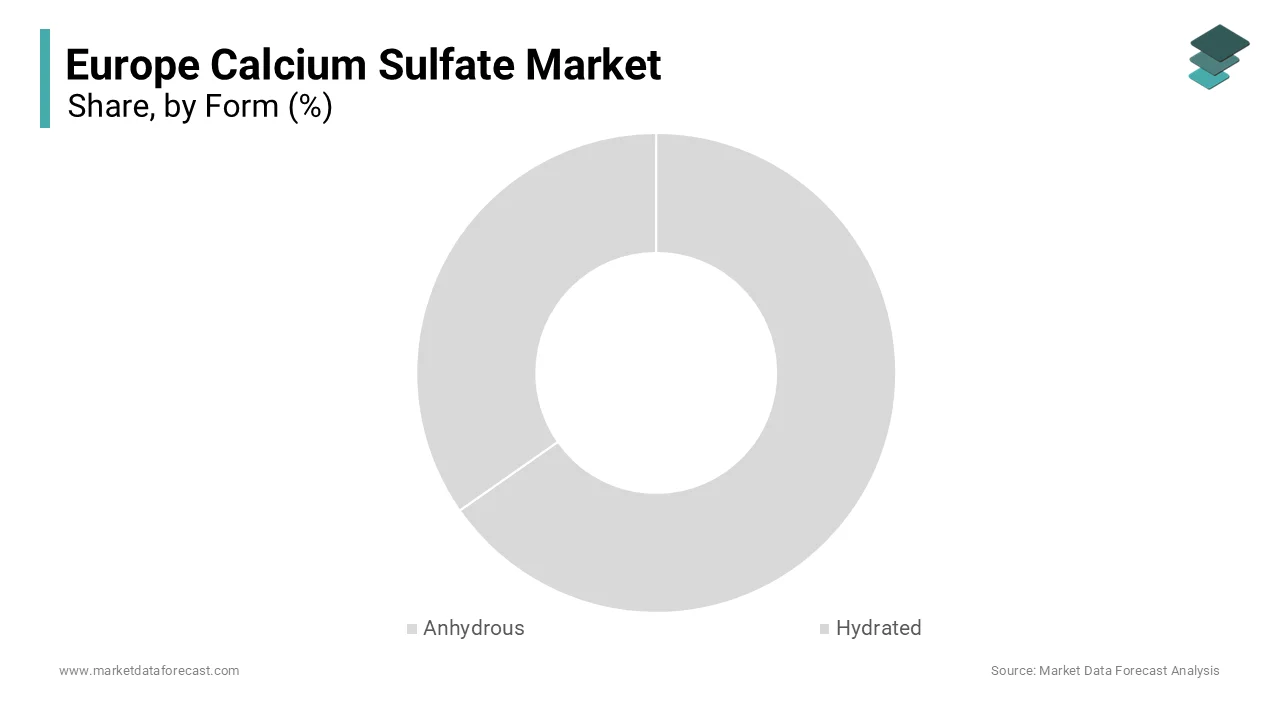
The anhydrous calcium sulfate segment is emerging as the fastest growing form in Europe, and the growth of the anhydrous calcium sulfate segment in the European market is primarily driven by its utility as a desiccant and functional additive in high precision industrial applications. Unlike its hydrated counterpart, anhydrite offers superior moisture absorption capacity without releasing water, which makes it ideal for use in pharmaceutical drying processes and speciality cement formulations. The European pharmaceutical industry’s increasing adoption of moisture-sensitive active ingredients has elevated demand for reliable desiccants. Anhydrous calcium sulfate is also gaining traction in self-levelling floor compounds, where its controlled rehydration kinetics improve setting time and compressive strength. Saint-Gobain’s 2025 product portfolio expansion in anhydrite-based flooring solutions across Benelux and Scandinavia reflects this trend. Moreover, the EU’s push for low-carbon cements under the Industrial Emissions Directive has spurred R&D into anhydrite as a supplementary cementitious material, which is reducing clinker dependency. Poland’s Cement Producers Association noted an increase in anhydrite blended cement trials in 2023. These niche yet high-value applications are accelerating the segment’s growth at a rate outpacing the broader market.
By Grade Insights
The technical grade segment had the most dominating share of the European calcium sulfate market in 2025. The dominance of the technical grade segment in the regional market is attributed to its cost-effectiveness, abundance and suitability for non-ingested applications such as wallboard, cement retarders and soil conditioners. The European construction industry’s reliance on gypsum-based products remains unmatched, with plasterboard production at high volumes, according to the European Construction Industry Federation. Technical grade material constitutes the bulk of this volume due to its compliance with EN 13279 standards for building gypsum while avoiding the stringent purity costs of food or pharma grades. Additionally, flue gas desulfurization gypsum supplies more than half of the raw material to plasterboard manufacturers, which is reinforcing scale economics. Germany’s building materials sector consumed millions of metric tons of technical-grade calcium sulfate in 2023, which is driven by public infrastructure renewal under the Federal Ministry of Housing’s Modernisation Offensive. Agricultural usage further bolsters this segment, especially in southern Europe, where soil sodicity mitigation programs in Spain and Italy utilise low-purity calcium sulfate for large-scale field applications. These dual industrial and agronomic channels ensure technical grade’s sustained market pre-eminence.
The pharma-grade segment is the fastest-expanding segment in Europe. The rising demand for orthopaedic surgery and advanced drug delivery systems is propelling the growth of the pharma-grade segment in the European market. This ultra-pure form meets stringent pharmacopeial standards, including limits on heavy metals and microbial contamination, which enables its use as a biocompatible bone void filler. Regulators in Europe have approved numerous calcium sulfate-based medical devices in recent years, with Germany and France among the leading jurisdictions for certifications. The ageing European population intensifies this trend. According to Eurostat, 21.6% of the EU’s population was aged 65 or older in 2025, which is driving orthopaedic intervention volumes. Germany’s health authorities reported increases in bone graft procedures in 2023 as many are employing calcium sulfate matrices. Additionally, pharma-grade calcium sulfate serves as a tablet diluent and disintegrant in solid oral dosage forms. With the European pharmaceutical excipients market representing a multibillion-euro opportunity, the demand for high-purity mineral excipients is accelerating. Continuous innovation in resorbable implant technology and regulatory harmonisation under the EU Medical Devices Regulation further amplify growth momentum in this premium segment.
By End Use Industry Insights
The building and construction segment occupied the dominating share of the European market in 2025. The growth of the building and construction segment in the European market is attributed to the structural dependence on gypsum-based interior systems. Plasterboard remains the material of choice for partition walls and ceilings due to its fire resistance, sound insulation and ease of installation. In 2023, the EU27 completed a substantial number of residential units, according to Eurostat, with interior finishes widely utilising gypsum drywall. Germany’s construction sector remained resilient in 2023, which is sustaining high-volume gypsum consumption. Additionally, EU energy efficiency mandates have intensified renovation activity, which is further anchoring demand for gypsum-based products. France’s ANAH agency funded a large volume of home renovations in 2023 under its MaPrimeRénov scheme, directly stimulating plasterboard uptake. Moreover, prefabricated construction, which uses gypsum panels for modular wall systems, expanded in Scandinavia in 2023. Given that a typical 100 square meter apartment requires substantial quantities of calcium sulfate in drywall alone, the scale of construction activity ensures this segment’s entrenched leadership across all application categories. This regulatory and infrastructural alignment solidifies hydrated calcium sulfate’s market leadership far beyond seasonal or cyclical trends.
The agriculture segment is the fastest-growing end-use segment for calcium sulfate in Europe. The growth of the agriculture segment is likely to be driven by the soil health mandates under the EU’s Farm to Fork Strategy and Common Agricultural Policy reforms. Calcium sulfate serves as a dual source of calcium and sulfur as two essential nutrients increasingly deficient in European croplands due to decades of intensive farming without adequate replenishment. Calcium sulfate improves soil structure, supplies essential calcium and sulfur nutrients and mitigates sodicity in irrigated croplands, which are critical advantages as EU farmers confront degraded arable land. Agricultural agencies in southern and central Europe report widespread nutrient imbalances, including sulfur deficiencies that can reduce yields in affected regions. Italy has reported increased calcium sulfate applications on durum wheat fields, with field trials documenting yield improvements compared to untreated controls. Spain’s Sustainable Soil Management Program has supported calcium sulfate use across extensive orchard areas to combat sodicity and improve water infiltration. Unlike agricultural lime, calcium sulfate does not raise soil pH, which makes it compatible with acid-loving crops like potatoes and berries, as these are key commodities in the Netherlands and Denmark. With the EU targeting a 20% reduction in synthetic fertiliser use by 2030, naturally derived soil amendments like calcium sulfate are strategically positioned as sustainable alternatives, which is driving robust segmental expansion.
REGIONAL ANALYSIS
Germany Market Analysis
Germany stood as the largest national market for calcium sulfate in Europe by holding 22.8% of the regional market share in 2025. The dominance of Germany in the European market is driven by its robust construction sector and advanced industrial base. Germany’s plasterboard production reached 327,000 metric tons in 2023, which is reflecting one of the highest outputs in Europe. This output supports both new builds and extensive renovation programs, including the federal government’s funding initiatives for energy-efficient housing retrofits. Beyond construction, Germany leads in high-purity applications as its pharmaceutical and chemical industries rely on calcium sulfate, with Germany’s average price around 160 USD per metric ton in 2023, which indicates its importance in pharma and technical-grade uses. The nation’s coal phaseout has reduced flue gas desulfurization gypsum supply, prompting increased imports from Poland and the Netherlands, yet domestic demand remains resilient due to stringent building codes requiring fire-rated interior systems. Germany’s commitment to circular economy principles also drives gypsum recycling, with recycling volumes increasing by 17% in 2023, which is further stabilising long-term demand.
France Market Analysis
France occupied a substantial share of the European calcium sulfate market in 2025. The growth of the French market in Europe is primarily propelled by aggressive public policy supporting building renovation. The national MaPrimeRénov scheme disbursed 2.6 billion euros in subsidies in 2023, which is enabling over 630,000 energy retrofit projects that extensively utilise gypsum drywall, according to France’s Ministry of Ecological Transition. The construction sector accounted for around 70% of total calcium sulfate consumption in the country, with LafargeHolcim and Placo Saint-Gobain operating major production facilities. Agricultural demand is also rising as France’s sulfur-deficient arable lands, particularly in the Grand Est region, have seen a 15% increase in calcium sulfate use since 2021, as reported by the French National Institute for Agricultural Research. Additionally, France maintains strict food additive regulations but permits calcium sulfate in tofu and wine production, which supports steady food-grade volumes. The convergence of climate policy, construction activity, and soil management ensures France’s continued market prominence.
Italy Market Analysis
Italy is estimated to account for a prominent share of the European calcium sulfate market during the forecast period owing to its dual reliance on construction and agriculture. The country’s building sector consumed approximately 2 million metric tons of gypsum in 2023, which is driven by seismic retrofitting mandates following recent earthquakes in central regions, as noted by Italy’s National Institute of Statistics. Simultaneously, Italian agriculture is a major driver as calcium sulfate is widely applied to correct soil sodicity in irrigated olive groves and vineyards, which cover over 3.2 million hectares. The Council for Agricultural Research and Economics documented a 15% rise in calcium sulfate sales to farmers in southern Italy in 2023, which is correlated with EU Common Agricultural Policy subsidies for soil health. Italy also hosts Europe’s largest food-grade calcium sulfate production facility in Emilia Romagna, supplying tofu manufacturers across the continent. Unlike northern European nations, Italy’s warm climate and irrigation practices exacerbate sodium accumulation in soils, creating a structural and recurring need for gypsum-based amendments that underpin long-term market stability.
United Kingdom Market Analysis
The United Kingdom maintains a significant share of the European calcium sulfate market despite its post-Brexit regulatory divergence. Construction remains the core driver, with plasterboard demand sustained by housing shortages and office-to-residential conversions in urban centres. The UK’s Department for Levelling Up reported 181,000 new homes completed in 2023, each requiring an average of 700–750 kilograms of calcium sulfate for interior finishes. British Gypsum, which is a subsidiary of Saint-Gobain, operates three major plants producing over 2 million metric tons annually. The UK’s departure from EU structures has introduced independent approval pathways as its Medicines and Healthcare products Regulatory Agency now separately assesses calcium sulfate for medical use, slowing some pharma innovations but reinforcing domestic supply chains. Agricultural applications are growing modestly, particularly in East Anglia’s arable belt, where sulfur deficiency affects around 35–40% of soils, according to the Agriculture and Horticulture Development Board. While overall growth is tempered by economic caution, infrastructure resilience and housing policy sustain the UK’s top five ranking.
Spain Market Analysis
Spain is estimated to hold a notable share of the European calcium sulfate market during the forecast period, owing to the surging agricultural demand and recovery in construction. After a decade of post-crisis stagnation, Spain’s building permits increased in 2023, which is reviving plasterboard consumption. However, the standout growth comes from agriculture as Spain’s semi-arid climate and intensive irrigation have led to widespread soil sodicity, particularly in Andalusia and Murcia, where many irrigated lands exhibit high sodium adsorption ratios. In response, the government’s Sustainable Soil Program expanded distribution of calcium sulfate to large areas of almond, citrus, and olive farms, with deployments higher than in 2022. Unlike other EU nations, Spain permits the use of lower-purity technical-grade calcium sulfate in agriculture, which is enabling cost-effective large-scale deployment. This agronomic urgency, combined with modest construction recovery, positions Spain as a high-growth, structurally unique market within Europe.
COMPETITIVE LANDSCAPE
KEY MARKET PLAYERS
Some of the notable key players in the European calcium sulfate market are
- Knauf Group
- Saint-Gobain Group
- USG Corporation
- LafargeHolcim
- Etex Group
- Carmeuse Group SA
- Graymont Limited
- American Gypsum Company LLC
- National Gypsum Company
- Anhydritec (Minersa Group)
TOP STRATEGIES USED BY THE KEY MARKET PLAYERS
Key players in the European calcium sulfate market prioritise vertical integration to control raw material sourcing, particularly through partnerships with power plants for flue gas desulfurization gypsum, and ownership of natural gypsum quarries. Companies invest heavily in recycling infrastructure to comply with EU circular economy directives and reduce dependency on virgin resources. Product differentiation through low-carbon certified plasterboard and high-purity pharma-grade variants enables premium positioning. Strategic collaborations with construction firms and agricultural agencies expand application reach beyond traditional segments. Additionally, firms align manufacturing with stringent EU environmental standards such as the Industrial Emissions Directive to ensure regulatory compliance and operational continuity across member states.
COMPETITION OVERVIEW
The European calcium sulfate market features intense competition among multinational building material giants, regional gypsum specialists, and industrial byproduct aggregators. While large players dominate through scaland an integrateddd supply chain, smaller local producers retain niche relevance in agricultural and food-grade segments. Competition is increasingly defined not by price but by sustainability credentials, production innovation compliance with evolving EU regulations. The shift toward circular economy models has heightened rivalry in gypsum recycling capabilities, with companies racing to establish closed-loop systems. Simultaneously, diversification into high-growth sectors such as orthopaedic biomaterials and soil health solutions is creating new competitive dimensions. Regulatory fragmentation across member states further complicates market access, favouring incumbents with established compliance frameworks. Overall, the competitive landscape remains dynamic with technological adaptation and environmental stewardship emerging as decisive success factors rather than mere production volume.
TOP PLAYERS IN THE MARKET
- Saint-Gobain operates as a leading multinational in the European calcium sulfate market through its Placo and Gyproc brands, which deliver a wide portfolio of gypsum-based plasterboard and construction systems. The company leverages integrated production from natural and flue gas desulfurization gypsum sources across France, Germany, the Netherlands, and the countries. In 2025, SaiSaint-Gobain expanded its circular economy initiatives by launching a new drywall recycling facility in Poland capable of processing 100000 metric tons of post-consumer gypsum annually. This move reinforces its sustainability positioning and secures long-term raw material flexibility. The company also introduced low-carbon plasterboard variants compliant with the EU’s Level(s) building assessment framework, further aligning with green construction mandates.
- Knauf Group maintains a strong footprint in Europe through its vertically integrated gypsum operations and extensive distribution network spanning over 30 countries. The company sources calcium sulfate from both natural quarries and industrial byproducts, emphasising product innovation in fire-resistant and acoustic panels. In early 2025, Knauf inaugurated a state-of-the-art production line in Italy dedicated to manufacturing high-strength anhydrite-based self-levelling compounds for premium flooring applications. It also intensified collaboration with architectural firms to promote gypsum-based drylining in modular construction. These efforts reflect Knauf’s strategic focus on high-performance niche segments and sustainable building solutions across the European Union.
- LafargeHolcim contributes significantly to the calcium sulfate value chain through its dual role as a cement producer and gypsum supplier. The company utilises calcium sulfate primarily as a set retarder in Portland cement and also markets industrial-grade gypsum to third-party plasterboard manufacturers. In late 2023, LafargeHolcim integrated calcium sulfate recovery units into its cement plants in Spain and Germany to capture byproduct gypsum from flue gas desulfurization retrofits. It also launched a new blended cement product in 2025 containing optimised anhydrite ratios to enhance early strength development. These initiatives underscore its commitment to resource efficiency and circular material flows within Europe’s low-carbon industrial strategy.
MARKET SEGMENTATION
This research report on the European calcium sulfate market has been segmented and sub-segmented based on categories.
By Form
- Anhydrous
- Hydrated
By Grade
- Technical Grade
- Food Grade
- Pharma Grade
- Others
By End-Use Industry
- Food and Beverages
- Cosmetic and Personal Care
- Building and Construction
- Chemical and Petrochemical
- Pulp and Paper
- Agriculture
- Pharmaceutical and Healthcare
- Others
By Country
- UK
- France
- Spain
- Germany
- Italy
- Russia
- Sweden
- Denmark
- Switzerland
- Netherlands
- Turkey
- Czech Republic
- Rest of Europe