- Product Description Description
- Table of Contents TOC
- List of Table & Figure LOT
- Get Free Sample PDF Sample PDF
Europe Call Center Market Report Summary
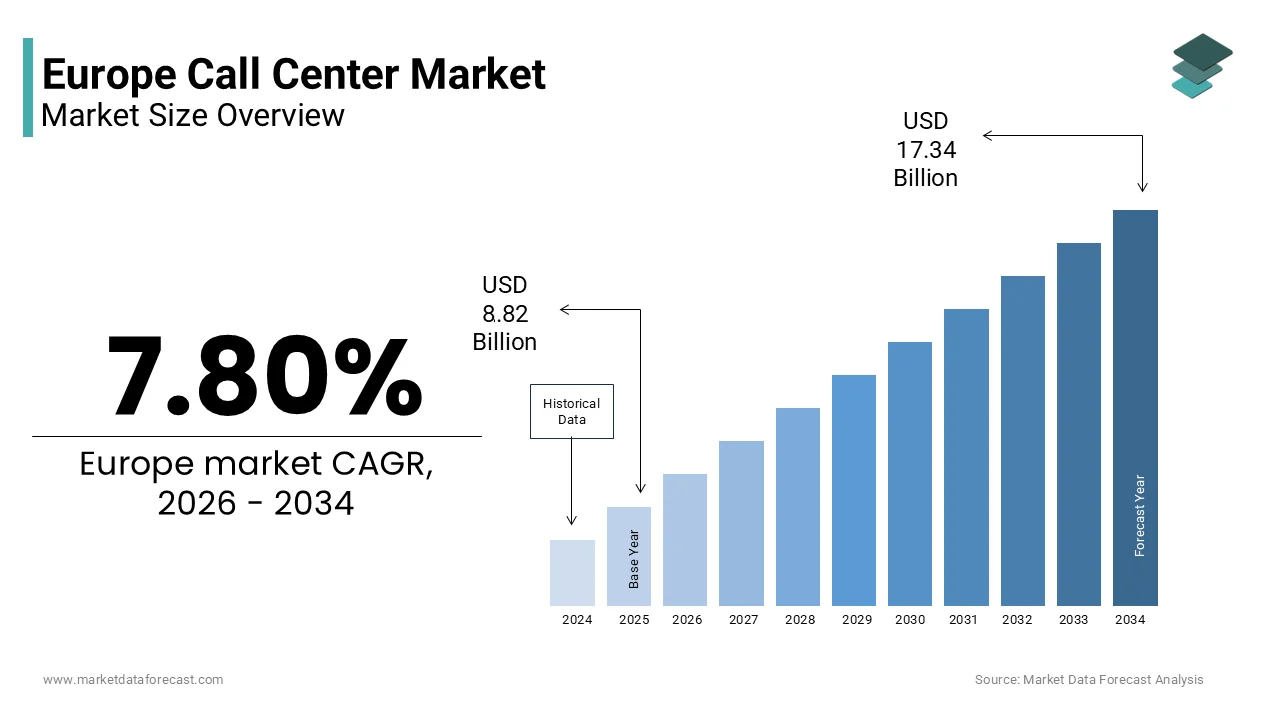
The Europe call center market was valued at USD 8.82 billion in 2025, is estimated to reach USD 9.51 billion in 2026, and is projected to reach USD 17.34 billion by 2034, growing at a CAGR of 7.80% during the forecast period. The growth of the Europe call center market is driven by the increasing demand for customer experience management, rising adoption of omnichannel communication platforms, and the expansion of outsourcing services across industries. Businesses across banking, retail, telecommunications, and healthcare sectors are increasingly investing in call center solutions to improve customer engagement and operational efficiency. In addition, the growing integration of cloud based contact center platforms, artificial intelligence powered chatbots, and advanced analytics is transforming customer support operations across Europe.
Key Market Trends
- Growing adoption of cloud based contact center platforms that enable scalable and flexible customer service operations.
- Increasing use of artificial intelligence, chatbots, and automated voice systems to enhance customer interaction and reduce operational costs.
- Rising demand for omnichannel customer support solutions that integrate voice, email, chat, and social media communication.
- Expansion of business process outsourcing services across industries seeking cost effective and specialized customer support solutions.
- Growing emphasis on data analytics and customer experience management to improve service quality and operational performance.
Segmental Insights
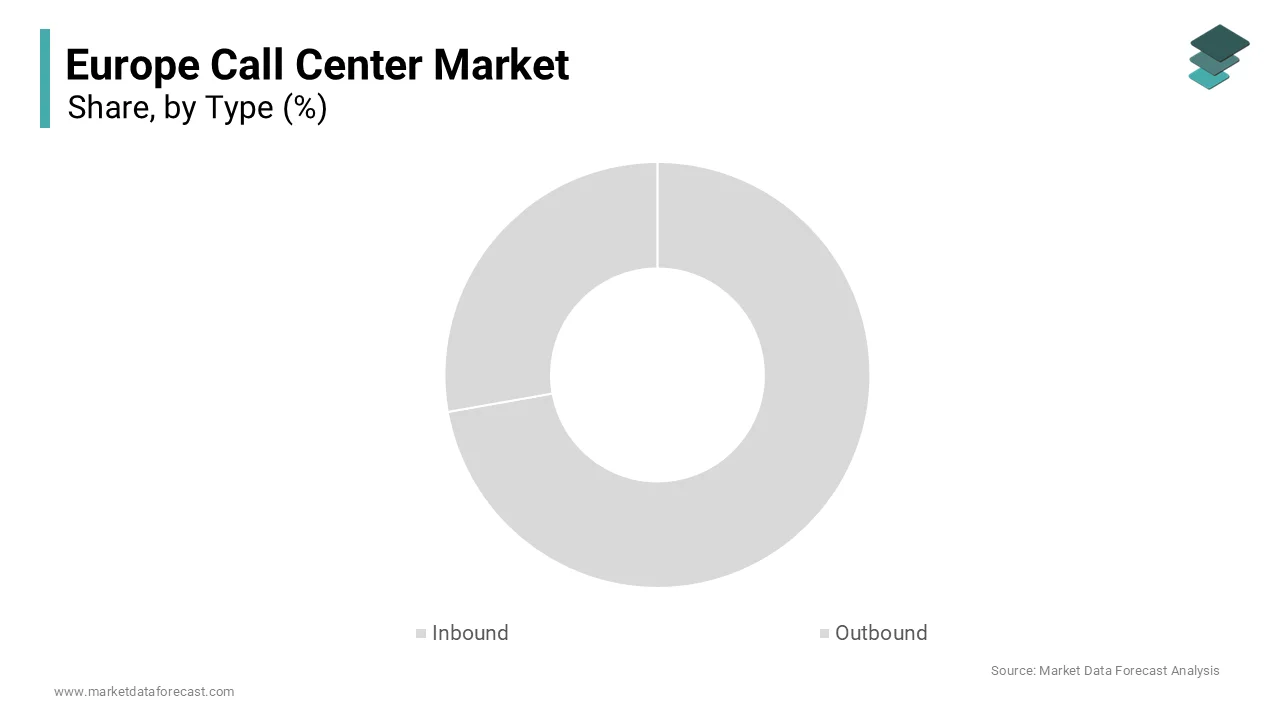
- Based on type, the inbound call center segment accounted for a prominent share of the Europe call center market in 2024. The dominance of this segment is attributed to the increasing volume of customer inquiries, technical support requests, and service related interactions handled by organizations across multiple industries.
- Based on end user, the banking, financial services, and insurance segment held 28.3% of the Europe call center market share in 2024. The significant share of this segment is driven by the high demand for customer support services related to financial transactions, account management, fraud detection, and technical assistance.
Regional Insights
- The Europe call center market is experiencing steady growth across several countries due to the increasing focus on improving customer experience and expanding digital communication channels.
- The United Kingdom was the largest contributor to the Europe call center market and accounted for 22.3% of the regional market share in 2024. The country’s strong presence of outsourcing providers, advanced digital infrastructure, and high demand for customer support services across financial and telecommunications sectors are key factors supporting market growth.
- Other European countries are also witnessing increasing investments in contact center technologies and outsourcing services to enhance customer engagement and operational efficiency.
Competitive Landscape
The Europe call center market is highly competitive with the presence of global customer experience management providers, outsourcing companies, and technology solution providers. Companies are focusing on integrating cloud based platforms, artificial intelligence powered automation, and advanced analytics to enhance customer service capabilities. Strategic partnerships, digital transformation initiatives, and expansion of multilingual support services are helping companies strengthen their presence in the European market. Prominent players in the Europe call center market include Teleperformance, Concentrix, Foundever (Sitel Group), Capita plc, Transcom, NICE Ltd, TELUS International, Genesys, Cisco Systems Inc, Sutherland Global Services, SupportYourApp, Ascensos, and Conectys.
Europe Call Center Market Size
The Europe call center market size was valued at USD 8.82 billion in 2025 and is projected to reach USD 17.34 billion by 2034 from USD 9.51 billion in 2026, growing at a CAGR of 7.80%.
The call center has evolved into a sophisticated customer experience ecosystem encompassing voice digital messaging and artificial intelligence driven interactions that serve, as the primary interface between enterprises and consumers, across the continent. According to Eurostat, data approximately 82% of individuals in the European Union used the internet for interacting with public authorities or purchasing goods in 2023 creating a massive volume of digital inquiries that require specialized handling. The European Commission states that consumer protection regulations, such as the General Data Protection Regulation impose strict requirements on data handling and consent management, which fundamentally shape operational protocols within these centers. Furthermore, as per the Organisation for Economic Co-operation and Development the service sector accounts for gross value added in most European economies making effective customer engagement a critical determinant of national economic health.
MARKET DRIVERS
Escalating Consumer Expectations for Omnichannel and Instantaneous Support
The shifting paradigm in consumer behavior where European customers demand immediate and consistent service across multiple digital touchpoints is solely a major driving factor for the growth of Europe call center market. Modern consumers no longer accept long wait times or disjointed experiences when switching between phone email and social media channels expecting instead a unified journey, where context is preserved. According to the European Consumer Organisation over 65% of consumers in the European Union indicated in 2023 that they would switch to a competitor after just two instances of poor service. This pressure forces enterprises to invest heavily in advanced contact center platforms that unify communication streams and provide agents with a holistic view of customer history. As per findings from the European Retail Round Table, retailers implementing true omnichannel support strategies reported a 30% increase in customer loyalty scores and a 20% reduction in churn rates compared to those relying on siloed channels. The proliferation of smartphones and high-speed mobile internet, across Europe further accelerates this trend with messaging apps like WhatsApp becoming preferred channels for instant support. Companies that fail to integrate these channels risk losing significant market share to agile competitors who prioritize seamless digital engagement. The imperative to meet these heightened expectations drives continuous investment in technology and training making omnichannel capability a fundamental requirement rather than a differentiator in the competitive European landscape.
Strategic Shift Towards Outsourcing to Optimize Operational Costs and Focus on Core Competencies
The growing tendency among European enterprises to outsource non-core customer interaction functions to specialized third party providers is also escalating the growth of Europe call center market. Organizations increasingly recognize that maintaining in house contact centers involves substantial overheads related to infrastructure recruitment training and technology upgrades, which can be better managed by dedicated service providers. According to the European Outsourcing Association, large corporations in Western Europe expanded their outsourcing contracts in 2023, specifically to leverage the scalability and cost efficiencies offered by external partners. This shift allows companies to convert fixed costs into variable costs enabling them to scale operations up or down based on seasonal demand fluctuations without the burden of permanent staffing commitments. As per data from the Confederation of European Business, firms that adopted strategic outsourcing models reported an average reduction of 25% in operational expenditures while simultaneously improving service level agreements due to the specialized expertise of providers. Furthermore, outsourcing enables access to global talent pools and advanced technologies such as artificial intelligence and predictive analytics that might be prohibitively expensive to develop internally. The complexity of navigating diverse European labor laws and languages also makes partnering with established regional providers an attractive option for multinational corporations seeking compliance and local market knowledge.
MARKET RESTRAINTS
Stringent Data Privacy Regulations Under GDPR Create Compliance Complexities
The rigorous data protection standards mandated by the General Data Protection Regulation to the operational flexibility and expansion of call centers is limiting the growth of Europe call center market. These regulations impose strict controls on the collection storage and processing of personal data requiring explicit consent from customers and granting them the right to access rectify or erase their information, which complicates routine contact center workflows. According to the European Data Protection Board, authorities issued fines totaling over one billion euros in 2023 for various data protection violations with several cases involving improper handling of customer data by contact centers. The requirement to maintain detailed records of processing activities and implement robust security measures increases operational costs and administrative burdens particularly for smaller operators lacking dedicated compliance teams. As per analysis from the Centre for Information Policy Leadership, nearly 70% of contact center managers report that GDPR compliance requirements have slowed down the adoption of new customer analytics tools due to fears of inadvertent violations. Furthermore, restrictions on cross border data transfers limit the ability of European companies to utilize offshore support centers outside the European Economic Area without implementing complex legal safeguards such as standard contractual clauses. These legal complexities necessitate significant investments in encryption data masking and regular audits which can erode profit margins.
Acute Shortage of Skilled Multilingual Agents and High Employee Turnover Rates
The persistent scarcity of qualified personnel possessing the necessary linguistic capabilities and soft skills combined with notoriously high attrition rates is also degrading the growth of Europe call center market. The diverse linguistic landscape of Europe requires agents who are fluent in multiple languages and culturally adept yet the supply of such talent often fails to meet the surging demand from expanding digital service sectors. According to the European Centre for the Development of Vocational Training, the customer service sector faces a shortfall of skilled agents annually with recruitment difficulties exacerbated by the perception of call center work, as low status and high stress. This shortage drives up wage pressures and forces companies to operate with understaffed teams leading to longer wait times and degraded service quality. As per data from the European Foundation for the Improvement of Living and Working Conditions, annual turnover rates in the European contact center industry average around 45%, significantly higher than the general service sector average resulting in constant cycles of recruitment and training that drain resources. The emotional toll of handling difficult customer interactions contributes to burnout making retention a chronic challenge.
MARKET OPPORTUNITIES
Integration of Generative Artificial Intelligence for Enhanced Agent Assistance and Automation
The advent of generative artificial intelligence to revolutionize agent productivity and customer self service capabilities through advanced natural language processing and automated content generation is specifically amplifying the growth of Europe call center market. Unlike traditional rule based bots generative, AI can understand context synthesize information from multiple sources and generate human like responses in real time enabling more sophisticated interactions. These systems can provide agents with real time suggestions draft responses and summarize call transcripts instantly reducing handle times and improving accuracy. The technology also enables the creation of dynamic knowledge bases that update automatically ensuring agents always have access to the latest product information and policy changes. Furthermore, generative AI can personalize interactions by analyzing customer sentiment and history to tailor communication styles effectively. The opportunity lies in deploying these tools not just to replace humans but to augment their capabilities allowing agents to focus on high value empathetic interactions.
Expansion of Nearshore Outsourcing Hubs Within Eastern and Southern Europe
The strategic relocation of contact center operations from high-cost Western European nations to nearshore destinations in Eastern and Southern Europe for service providers to balance cost efficiency with cultural and linguistic proximity. This factor is also to enhance the growth of Europe call center market. Countries such as Poland, Romania, Bulgaria, Portugal, and Greece are emerging as preferred locations due to their highly educated multilingual workforces favorable time zone alignment and lower operational costs compared to traditional hubs. According to the European Outsourcing Association, investment in nearshore contact center facilities in these regions increased in 2023, as companies sought to mitigate risks associated with offshore locations, while achieving significant savings. These destinations offer native speakers of major European languages as well as niche languages that are difficult to source elsewhere ensuring high quality service delivery. Furthermore, the European Union membership of many of these countries ensures regulatory alignment and ease of data transfer under GDPR frameworks removing legal barriers to operation. The cultural affinity between nearshore agents and Western European customers also leads to higher customer satisfaction scores and better rapport. This trend towards nearshoring allows enterprises to build resilient distributed networks that can withstand local disruptions while optimizing their cost structures.
MARKET CHALLENGES
Escalating Cybersecurity Threats Targeting Customer Data and Communication Channels
The increasing sophistication of cyberattacks aimed at compromising sensitive customer data and disrupting communication channels is one of the challenges for the growth of Europe call center market. As contact centers become more digitized and interconnected, they present attractive targets for malicious actors seeking to steal personal information conduct fraud or launch ransomware attacks that can paralyze operations. According to the European Union Agency for Cybersecurity, the number of cyber incidents targeting the customer service sector increased by 50% in 2023 with phishing scams and social engineering attacks being the most prevalent methods used to deceive agents into revealing credentials. The reliance on cloud-based platforms and remote access technologies expands the attack surface making it difficult to secure every endpoint effectively. As per findings from the ENISA Threat Landscape report, major data breaches in the service sector involved unauthorized access to customer databases resulting in significant financial losses and regulatory penalties. The challenge is compounded by the human element as agents often serve as the first line of defense, yet may lack adequate training to identify subtle signs of compromise. Furthermore, the integration of third party applications and APIs introduces additional vulnerabilities that can be exploited if not rigorously monitored. Mitigating these risks requires continuous investment in advanced threat detection systems regular security audits and comprehensive staff training programs.
Complexity of Managing Multilingual and Multicultural Customer Interactions
The intricate task of delivering consistent and culturally appropriate service, across the diverse linguistic and cultural is additionally to inhibit the growth of Europe call center market. With over 24 official languages and countless dialects and cultural nuances ensuring that every customer receives high quality support in their preferred language requires immense logistical coordination and resource allocation. According to the European Commission, language barriers remain a primary source of customer frustration with over 40% of consumers reporting dissatisfaction, when forced to communicate in a non-native language during service interactions. This diversity necessitates the recruitment and training of agents with specific language proficiencies and cultural competencies which is both costly and time consuming. As per data from the European Language Council, the shortage of agents proficient in less common languages often leads to long wait times and reliance on interpretation services that can degrade the quality of the interaction. Furthermore, cultural differences in communication styles expectations and conflict resolution approaches require tailored training programs to prevent misunderstandings that could escalate complaints. The challenge is further exacerbated by the need to maintain consistent brand voice and service standards across all regions while adapting to local preferences.
REPORT COVERAGE
| REPORT METRIC | DETAILS |
| Market Size Available | 2025 to 2034 |
| Base Year | 2025 |
| Forecast Period | 2026 to 2034 |
| CAGR | 7.80% |
| Segments Covered | By Type, End User, and Region |
| Various Analyses Covered | Global, Regional, & Country Level Analysis; Segment-Level Analysis; DROC, PESTLE Analysis; Porter’s Five Forces Analysis; Competitive Landscape; Analyst Overview of Investment Opportunities |
| Regions Covered | UK, France, Spain, Germany, Italy, Russia, Sweden, Denmark, Switzerland, Netherlands, Turkey, and the Czech Republic |
| Market Leaders Profiled | Teleperformance, Concentrix, Foundever (Sitel Group), Capita plc, Transcom, NICE Ltd, TELUS International, Genesys, Cisco Systems Inc, Sutherland Global Services, SupportYourApp, Ascensos, and Conectys |
SEGMENTAL ANALYSIS
By Type Insights
The inbound call center segment was accounted in holding a prominent share of the Europe call center market in 2024 owing to the fundamental necessity for enterprises to maintain robust customer support channels that handle inquiries complaints and technical issues in real time. The first major driving factor is the escalating volume of customer interactions generated by the expansive e-commerce sector across Europe which requires immediate resolution capabilities to prevent cart abandonment and ensure satisfaction. According to Eurostat, over 82% of individuals in the European Union purchased goods or services online in 2023 creating a massive influx of post purchase queries regarding delivery returns and product usage that must be managed efficiently. These inbound interactions are critical for retaining customers in a highly competitive digital marketplace where service quality often dictates brand loyalty. As per data from the European Banking Authority, banks are required to maintain 24/7 support channels to address fraud alerts and transaction disputes leading to a consistent high volume of inbound calls. The complexity of European consumer protection laws further necessitates skilled human agents to navigate nuanced legal requirements during these interactions.
The outbound call center segment is projected to register a fastest CAGR of 9.4% from 2025 to 2033. The strategic shift towards proactive customer engagement and data driven sales initiatives that leverage advanced analytics to target specific demographics. The increasing adoption of predictive dialing systems integrated with artificial intelligence, which significantly enhance agent productivity and conversion rates for telemarketing and lead generation campaigns. According to the European Direct Marketing Association, organizations utilizing AI powered outbound solutions reported an increase in successful contact rates and an improvement in sales conversions in 2023 compared to traditional manual dialing methods. These technologies allow companies to optimize call timing and script personalization based on real time customer data maximizing the effectiveness of every interaction. The growing emphasis on customer retention strategies, such as proactive outreach for renewal reminders upselling opportunities and satisfaction surveys to reduce churn is additionally to promote the growth of the segment. Furthermore, the recovery of the travel and hospitality sectors post pandemic has spurred a surge in outbound campaigns aimed at re-engaging lapsed customers and promoting new packages.
By End User Insights
The banking financial services and insurance vertical segment held 28.3% of the Europe call center market share in 2024 with the need for secure reliable and compliant communication channels to manage sensitive financial transactions and regulatory obligations. According to the European Central Bank, fraud losses in the European Union exceeded 1.2 billion euros in 2023, prompting financial institutions to invest heavily in sophisticated call center infrastructure capable of real time identity verification and threat response. These centers serve as the first line of defense against cybercrime making them indispensable for maintaining trust and security in the financial system. The complex regulatory landscape, including MiFID II and GDPR which mandates detailed record keeping and specific disclosure protocols during every customer interaction. As per data from the European Insurance and Occupational Pensions Authority, insurance providers utilize call centers extensively for claims processing policy renewals and compliance reporting ensuring that all communications meet strict legal standards. The high value of each customer interaction in this sector justifies significant investment in advanced technologies and highly trained agents. Furthermore, the shift towards digital banking has increased the volume of support tickets related to app usage and online transaction errors.
The healthcare end-user segment is projected to grow at a CAGR of 10.8% during the forecast period with the increasing digitization of health services and the rising demand for remote patient monitoring and telehealth support across the continent. The widespread implementation of national telemedicine programs, which rely on call centers to triage patients schedule virtual appointments and provide follow up care thereby reducing the burden on physical hospitals. According to the European Commission, many member states have expanded their telehealth infrastructure since 2023 creating a massive need for specialized contact centers capable of handling medical inquiries with empathy and accuracy. The aging population, which generates a sustained increase in demand for home care coordination medication reminders and chronic disease management support s also to escalate the growth of Europe call center market. Furthermore, the integration of artificial intelligence for symptom checking and appointment scheduling that enhances the efficiency of these centers by allowing them to handle higher volumes without compromising care quality.
REGIONAL ANALYSIS
United Kingdom Call Center Market Analysis
The United Kingdom call center market was the largest contributor by occupying 22.3% of share in 2024 owing to the nation's mature outsourcing ecosystem strong linguistic advantages and proactive government policies that foster innovation in customer experience management. According to the UK Department for Business and Trade, the contact center industry contributes over 10 billion pounds annually to the national economy employing hundreds of thousands of people across diverse regions. The presence of major global technology hubs in London Manchester and Glasgow attracts significant investment in cloud-based platforms and artificial intelligence tools that enhance operational efficiency. Furthermore, the establishment of clear regulatory frameworks by Ofcom ensures high service standards and consumer protection, which builds trust among international clients seeking reliable partners. The nation's strong legal framework combined with active participation in shaping global customer service standards creates a favorable environment for solution providers. Additionally, the collaboration between academia and industry through initiatives like the Institute of Customer Service accelerates the development of best practices and skilled workforces.
Germany Call Center Market Analysis
Germany call center market was positioned second by capturing 18.5% of share in 2024 with the industrial strength and rigorous approach to data privacy and quality. According to the Federal Ministry for Economic Affairs and Climate Action, German enterprises allocated over 300 million euros to customer experience technologies in 2023, focusing on omnichannel integration and data security. Furthermore, the German government's Digital Strategy aims to modernize public administration services driving demand for multilingual support centers that can assist citizens and businesses efficiently. The nation's emphasis on engineering precision drives demand for highly reliable and technically sophisticated communication systems. Additionally, the shortage of skilled labor motivates companies to adopt automation and AI tools to augment human agents.
France Call Center Market Analysis
France call center market is esteemed to witness a fastest CAGR in coming years with the ambitious national strategies and significant public investment in digital infrastructure. This position reflects the French government's determination to establish the country, as a European hub for customer experience innovation through comprehensive policy frameworks and funding programs. According to the French National Strategy for Digital Trust, the government committed over two hundred million euros to support the modernization of contact centers in 2023 including grants for AI adoption and cybersecurity enhancements. The establishment of dedicated clusters in Paris Lyon and Nantes fosters collaboration between technology providers and enterprise users accelerating the deployment of advanced solutions. Furthermore, the French regulator ARCEP has introduced strict quality of service metrics that compel operators to invest in robust infrastructure and skilled personnel. The focus on sovereign capabilities also drives demand for local solution providers who can guarantee data residency and adherence to national security standards. Additionally, the integration of customer experience metrics into corporate governance prepares a future workforce capable of leveraging these technologies effectively.
Netherlands Call Center Market Analysis
The Netherlands call center market growth is driven by its advanced digital infrastructure and progressive regulatory environment. This standing reflects the nation's role as a gateway to Europe with world class connectivity and a highly digitized society that facilitates rapid adoption of cloud based contact center services. The government's Digital Trust Center provides guidance on cybersecurity and ethical AI usage building confidence among merchants and consumers to adopt new technologies. Furthermore, the presence of major data centers operated by global cloud providers ensures low latency and high availability for contact center applications serving the entire region. This mature digital ecosystem is complemented by a strong tradition of public private partnerships that drive innovation in customer journey mapping and analytics. Additionally, the country's open approach to international collaboration attracts multinational corporations seeking to test and deploy contact center solutions in a supportive environment.
Spain Call Center Market Analysis
Spain call center market growth is likely to grow with the nation's reputation as a preferred destination for nearshore outsourcing and multilingual support. According to the Spanish Ministry of Economy, over 50% of major European companies have established nearshore operations in Spain in 2023, leveraging the country's large pool of bilingual and trilingual agents. The nation's robust telecommunications infrastructure centered around Madrid and Barcelona drives cutting edge developments in voice over IP and unified communications. Furthermore, the Spanish government's National Plan for Digital Skills emphasizes training programs specifically designed for the contact center industry ensuring a steady supply of qualified talent. The high level of digital literacy among the population and widespread mobile usage facilitate the seamless adoption of omnichannel solutions across various demographics.
COMPETITIVE LANDSCAPE
The competition in the Europe call center market is characterized by intense rivalry between global technology giants and specialized regional providers vying for dominance through innovation and regulatory compliance. Multinational corporations leverage their extensive research and development resources to offer comprehensive cloud-based suites that appeal to large enterprises seeking integrated customer experience management. Meanwhile European based firms differentiate themselves by emphasizing deep local market knowledge strict adherence to General Data Protection Regulation requirements and superior multilingual support capabilities. Price competition remains moderate since buyers prioritize reliability security and vendor stability over initial costs given the critical nature of customer communications. Strategic acquisitions of niche AI startups enable established players to rapidly expand their technical capabilities and talent pools. Customer retention strategies focus on delivering measurable improvements in customer satisfaction scores and operational metrics through ongoing optimization services.
KEY MARKET PLAYERS
Some of the notable key players in the Europe call center market are
- Teleperformance
- Concentrix
- Foundever (Sitel Group)
- Capita plc
- Transcom
- NICE Ltd
- TELUS International
- Genesys
- Cisco Systems Inc
- Sutherland Global Services
- SupportYourApp
- Ascensos
- Conectys
Top Players in the Market
- NICE Ltd stands as a global leader in the Europe call center market by providing advanced cloud based customer experience and workforce optimization solutions. The company contributes globally through its CXone platform which unifies artificial intelligence driven analytics with omnichannel routing to enhance agent productivity. Recent actions include the expansion of its generative AI capabilities specifically tailored for European languages to ensure compliance with local data privacy regulations. NICE has also partnered with major telecommunications providers across the continent to integrate seamless voice and digital interactions. These initiatives strengthen its market position by addressing the critical need for real time insights and automated quality management, while adhering to strict European Union standards for data sovereignty and consumer protection.
- Genesys operates as a pivotal force in the Europe call center market delivering comprehensive cloud contact center solutions that prioritize empathetic customer journeys. The company contributes to the global market by offering an open ecosystem that integrates seamlessly with third party applications and legacy systems used by European enterprises. Recent actions involve launching new AI powered orchestration tools designed to predict customer intent and route interactions to the most suitable agents automatically. Genesys has also established dedicated innovation hubs in London and Paris to collaborate with local businesses on customizing solutions for specific industry verticals like banking and retail. These strategic moves reinforce its position by enabling organizations to deliver personalized experiences at scale while maintaining operational flexibility and reducing total cost of ownership for clients throughout the region.
- Cisco Systems Inc serves as a key player in the Europe call center market leveraging its robust networking infrastructure to power secure and reliable unified communications. The company contributes globally through its Webex Contact Center platform which combines voice video and messaging into a single intelligent interface for seamless collaboration. Recent actions include enhancing its artificial intelligence features to provide real time agent assistance and automated sentiment analysis during live customer interactions. Cisco has also strengthened its partnerships with European cloud providers to ensure low latency and high availability for contact center deployments across diverse geographic locations. These efforts solidify its market standing by offering enterprise grade security and scalability that meet the rigorous demands of large multinational corporations operating within the complex regulatory landscape of the European Union.
Top Strategies Used by Key Market Participants
Key players in the Europe call center market primarily focus on integrating generative artificial intelligence to automate routine tasks and provide real time guidance to human agents. Companies invest heavily in developing omnichannel platforms that unify voice email chat and social media interactions into a single seamless customer journey. Strategic partnerships with local telecommunications providers enable vendors to ensure low latency connectivity and compliance with regional data sovereignty laws. Product differentiation through advanced analytics and predictive modeling allows firms to offer proactive customer service solutions that anticipate needs before they arise. Additionally, emphasis on cybersecurity and data privacy frameworks helps participants build trust with European clients, who prioritize strict adherence to General Data Protection Regulation standards.
MARKET SEGMENTATION
This research report on the European call center market has been segmented and sub-segmented based on categories.
By Type
- Inbound
- Outbound
By End User
- IT and telecom
- BFSI
- Healthcare
- Retail
- Others
By Country
- UK
- France
- Spain
- Germany
- Italy
- Russia
- Sweden
- Denmark
- Switzerland
- Netherlands
- Turkey
- Czech Republic
- Rest of Europe