- Product Description Description
- Table of Contents TOC
- List of Table & Figure LOT
- Get Free Sample PDF Sample PDF
Market Size, 2025
$0.24 BnMarket Estimate, 2026
$0.26 BnMarket Forecast, 2034
$0.41 BnCAGR, 2026–2034
5.77%Executive Summary: Europe Camelina Sativa Market
- Market Scope: Comprehensive market assessment of the European Camelina sativa sector covering product types, application segments, country-level performance, and strategic industrial integration.
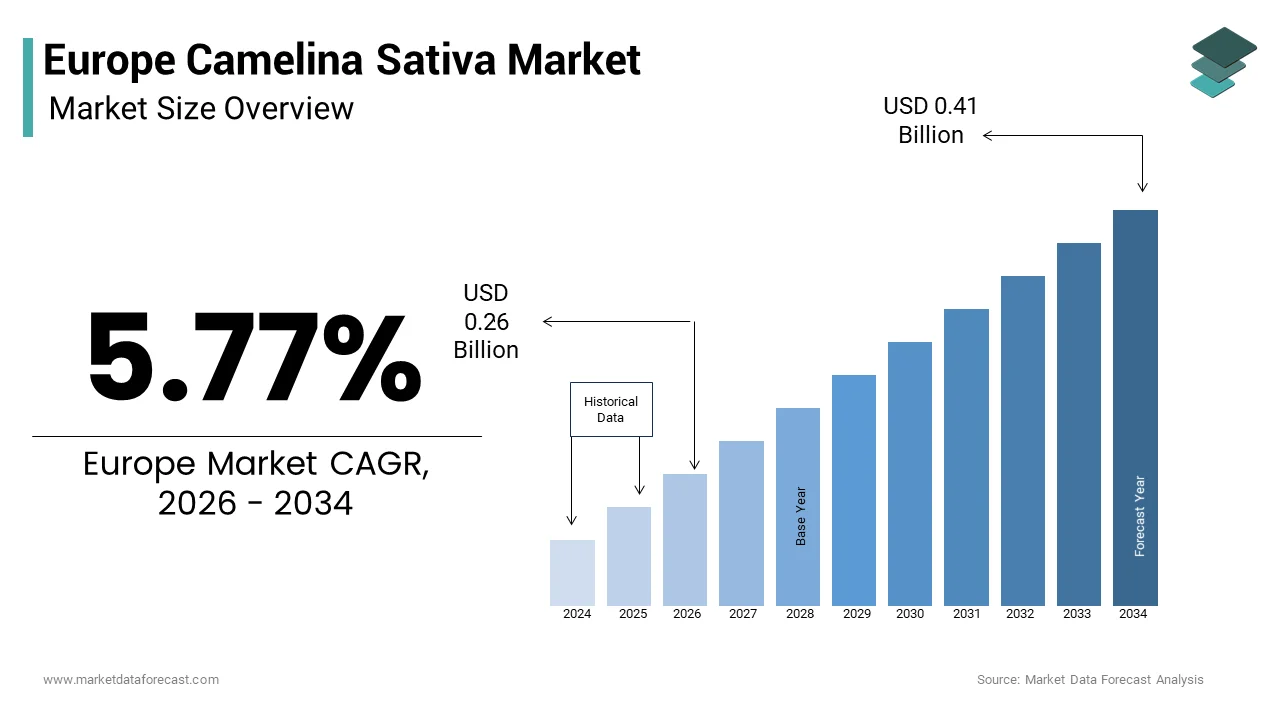
- Market Valuation: Valued at USD 0.24 billion in 2025, estimated at USD 0.26 billion in 2026, and projected to reach USD 0.41 billion by 2034, expanding at a compound annual growth rate (CAGR) of 5.77% during the forecast period from 2026 to 2034.
- Primary Growth Drivers: Strategic alignment with the EU Green Deal and Farm to Fork Strategy, increasing demand for climate-resilient crops, rising interest in plant-derived omega-3 fatty acids for functional foods, and the urgent need for sustainable aviation fuel (SAF) feedstocks.
Key Market Segment Metrics (2026–2034)
| Category | Leading Segment Focus | Fastest-Growing / High-Impact Focus |
|---|---|---|
| By Product Type | Industrial Grade (dominant due to biofuel and lubricant demand) | Human Food (premium omega-3 functional ingredients) |
| By Application | Biodiesel (RED II-compliant advanced biofuel feedstock) | Jet Fuel (CAGR of 19.1% driven by ReFuelEU mandates) |
| By Country | Germany (23.9% market share, innovation hub) | France (strong agri-industrial growth) |
Major Market Players & Strategic Landscape
Market Structure: Nascent and intensifying; characterized by partnerships between energy majors (Neste, TotalEnergies) and specialized lipid processors (AAK). Strategies focus on securing traceable supply chains, agronomic optimization, and vertical integration to overcome infrastructure gaps.
Key Companies: Shxchangyu, Neste Oyj, AAK AB, TotalEnergies SE, Shunyou, and Xasinuote.
Europe Camelina Sativa Market Size
The Europe camelina sativa market size was valued at USD 0.24 billion in 2025 and is anticipated to reach USD 0.26 billion in 2026 from USD 0.41 billion by 2034, estimated to be growing at a CAGR of 5.77%, from 2026 to 2034.
Current Introduction of the Europe Camelina Sativa Market
Camelina sativa is commonly known as false flax or gold of pleasure is an ancient oilseed crop native to Northern Europe and Central Asia that has reemerged as a sustainable agricultural and industrial resource. In the European context, camelina is cultivated primarily for its oil-rich seeds, which contain high levels of omega-3 fatty acids (notably alpha-linolenic acid), tocopherols, and phytosterols, making it valuable for human nutrition, animal feed, and bio-based industrial applications. The plant thrives in marginal soils with low water and nutrient requirements, aligning with the EU’s agroecological transition goals under the Common Agricultural Policy. Unlike major oilseeds such as rapeseed or sunflower, camelina serves as a break crop in cereal rotations, reducing pest pressure and improving soil health. According to the European Commission’s Joint Research Centre, camelina cultivation expanded across the EU in 2024, with notable trials underway in Germany, France, and Sweden. This revival is driven not by traditional commodity demand but by strategic interest in climate resilient crops that support circular bioeconomy objectives.
MARKET DRIVERS
Integration into EU Green Deal and Sustainable Agriculture Frameworks
The alignment of camelina sativa with the European Union’s Green Deal and Farm to Fork Strategy that prioritize climate resilient crops and reduced dependency on imported protein and oil sources is primarily driving the growth of the Europe Camelina sativa market. Camelina requires minimal inputs and sequesters carbon efficiently due to its deep root system and short growing cycle. As per the European Environment Agency, agricultural systems incorporating non-food oilseed break crops like camelina can reduce nitrogen leaching compared to continuous cereal monocultures. Furthermore, the EU’s Protein Plan encourages diversification of domestic oilseed production to cut reliance on soy imports, much of which is linked to deforestation outside Europe. Camelina fits this mandate perfectly: its meal after oil extraction contains high protein levels suitable for poultry and aquaculture feed. National agricultural agencies in Germany and Sweden have included camelina in subsidy schemes, offering farmers financial incentives for cultivation.
Rising Demand for Plant Based Omega 3 Fatty Acids in Functional Foods
Growing consumer awareness of heart and brain health has intensified demand for plant derived omega-3 fatty acids, which is positioning camelina oil as a premium functional ingredient in the European food and nutraceutical sectors and contributing to the regional market expansion. Camelina oil contains high levels of alpha-linolenic acid (ALA), offering a sustainable alternative to fish oil and flaxseed. According to the European Food Safety Authority, adequate ALA intake is associated with reduced cardiovascular risk, and EFSA has authorized a health claim for ALA since 2011. In 2024, the European functional food market exceeded significant value, with omega-3 fortified products showing strong growth, particularly in Germany, the UK, and Nordic countries. Companies like AAK and Cargill have begun sourcing camelina oil for dietary supplements, salad dressings, and infant formula blends. Its natural antioxidant content enhances oxidative stability, extending shelf life without synthetic additives, which is a key advantage in clean label formulations.
MARKET RESTRAINTS
Limited Agronomic Infrastructure and Farmer Adoption Barriers
A significant restraint on the Europe camelina market results from the absence of established agronomic infrastructure and limited farmer familiarity with the crop. Unlike mainstream oilseeds such as rapeseed, camelina lacks dedicated seed cleaning, storage, and processing facilities across most EU regions. Farmers face challenges in sourcing certified seed, managing harvest timing due to uneven ripening, and accessing reliable buyers, creating economic uncertainty. According to the German Agricultural Society, only a small percentage of arable farmers in pilot regions had prior experience with camelina, and many cited lacks of market guarantees as the primary deterrent. Additionally, while camelina is eligible for EU greening payments, bureaucratic complexities discourage smallholders. Without coordinated investment in supply chain logistics, the crop remains confined to research trials and isolated ventures, preventing economies of scale and consistent raw material supply.
Regulatory Ambiguity Around Novel Food and Feed Approvals
The Europe camelina market faces regulatory constraints due to fragmented and evolving approvals for its use in human food and animal feed. Although camelina oil was authorized as a novel food in 2019, its protein rich meal remains restricted in monogastric animal feed due to glucosinolate content. As per the European Commission’s Feed Materials Register, camelina meal is currently approved only for ruminants and fish, excluding poultry and pig markets. Moreover, health claims for camelina oil beyond general ALA benefits require costly dossier submissions to EFSA, which few small producers can afford. In 2024, EFSA noted that inconsistent national interpretations of feed safety thresholds further complicate cross border trade. This regulatory patchwork discourages large scale investment in processing capacity and restricts product innovation, as manufacturers cannot fully leverage the crop’s dual oil and protein potential. Until harmonized, science-based regulations are implemented, camelina’s market potential will remain partially unrealized.
MARKET OPPORTUNITIES
Expansion into Sustainable Aviation Fuel and Bio‑lubricant Production
A transformative opportunity for the Europe Camelina sativa market lies in its application as a non-food feedstock for advanced biofuels and bio based industrial products. Camelina oil’s properties make it an excellent candidate for HEFA pathways used in sustainable aviation fuel. Under the EU’s ReFuelEU Aviation initiative, airlines must blend SAF into operations, creating urgent demand for certified non-food biomass. In 2024, companies like Neste and TotalEnergies launched pilot projects using camelina oil for SAF production. Simultaneously, camelina oil’s oxidative stability and biodegradability position it as a green alternative to mineral oils in hydraulic fluids and lubricants. The European Bioplastics Association estimates bio lubricant demand will grow significantly through 2030. By tapping into these high value industrial channels, camelina can achieve price premiums that justify farmer adoption and drive large scale cultivation aligned with EU decarbonization mandates.
Development of High Value Nutraceutical and Cosmetic Derivatives
The Europe camelina market holds significant untapped potential in the premium nutraceutical and natural cosmetics sectors, where its unique phytochemical profile commands high margins. Beyond bulk oil, camelina contains rare compounds such as camelinin and sinapine, which exhibit anti-inflammatory and skin barrier enhancing properties. According to Cosmetics Europe, the natural and organic cosmetics market in the EU grew strongly in 2024, with consumers increasingly seeking traceable, plant-based actives. Brands like Weleda and Dr Hauschka have initiated R&D partnerships with camelina growers to develop certified organic facial oils and serums. Encapsulated camelina oil is also gaining traction in dietary supplements targeting cognitive health. The European nutraceutical market, valued at billions of euros, favours ingredients with strong sustainability narratives and clinical backing, both of which camelina provides.
MARKET CHALLENGES
Price Volatility and Competition from Established Oilseeds
A persistent challenge confronting the Europe camelina market is its vulnerability to price fluctuations and intense competition from subsidized, high yielding oilseeds like rapeseed and sunflower. Camelina yields average significantly lower than rapeseed, making it economically uncompetitive without premium pricing or policy support. According to the European Oilseed Alliance, camelina fetched only modest prices in 2024 despite higher processing costs. Import competition from Ukrainian or Canadian oilseeds further depresses local prices. Without stable offtake agreements or guaranteed minimum prices from industrial buyers, farmers perceive camelina as a financial risk. This structural disadvantage impedes scaling and leaves the crop dependent on niche markets rather than achieving mainstream agricultural integration.
Lack of Standardized Quality Metrics and Traceability Systems
The absence of harmonized quality standards and digital traceability frameworks poses a critical challenge to the credibility and scalability of the Europe camelina market. Currently, there are no EU wide specifications for camelina oil acidity, peroxide value, or glucosinolate content in meal, leading to inconsistent product quality. As per the European Industrial Hemp Association, lack of standardization increases testing costs and delays market entry for new applications. Furthermore, without blockchain or QR code enabled traceability from farm to final product, brands cannot substantiate sustainability or origin claims demanded by eco conscious consumers. In 2024, a pilot project by the Swedish Board of Agriculture demonstrated that traceable camelina oil commanded a price premium, yet such systems remain rare. Until industry wide protocols are adopted, the market will struggle to meet transparency expectations of food, feed, and biofuel sectors, limiting its ability to secure long term contracts and premium positioning.
REPORT COVERAGE
| REPORT METRIC | DETAILS |
| Market Size Available | 2024 to 2033 |
| Base Year | 2024 |
| Forecast Period | 2025 to 2033 |
| CAGR | 5.77% |
| Segments Covered | By Product Type, Application, and By Country |
| Various Analyses Covered | Global, Regional & Country Level Analysis, Segment-Level Analysis, DROC, PESTLE Analysis, Porter’s Five Forces Analysis, Competitive Landscape, Analyst Overview on Investment Opportunities |
| Regions Covered | UK, France, Spain, Germany, Italy, Russia, Sweden, Denmark, Switzerland, Netherlands, Turkey, the Czech Republic, and the Rest of Europe |
| Market Leaders Profiled | Shxchangyu, Neste Oyj, AAK AB, TotalEnergies SE, Shunyou, Xasinuote |
SEGMENTAL ANALYSIS
By Product Insights
The industrial grade segment dominated the market by holding the largest share of the Europe Camelina sativa market in 2025. The dominance of industrial grade segment in the European market is attributed to its strategic role in bio-based industrial applications and policy-driven demand. Unlike food-grade material, which faces regulatory and consumer acceptance hurdles, industrial-grade oil is readily utilized in biodiesel, lubricants, and polymer production without stringent purity requirements. The EU’s Renewable Energy Directive II mandates renewable energy integration, creating a stable off-take environment for non-food oilseeds like camelina. According to the European Commission’s Joint Research Centre, most camelina produced in the EU in 2024 was directed toward industrial uses, particularly in Germany and Sweden where pilot biorefineries are operational. Its compatibility with hydrotreating infrastructure and classification as an advanced biofuel feedstock under RED II further enhance its attractiveness.
The human food segment is the fastest growing category within the Europe camelina market and is estimated to register a promising CAGR during the forecast period. The rising consumer demand for plant-based omega-3 sources and clean label functional ingredients is majorly driving the growth of the human food segment in the regional market. Camelina oil’s high alpha-linolenic acid (ALA) content and natural tocopherol profile position it as a premium alternative to flaxseed and fish oil. According to the European Food Safety Authority, EFSA-authorized health claims for ALA have spurred product innovation, with new camelina-based food items launched in 2024. Brands in Germany, Denmark, and Switzerland are leading this trend, offering cold-pressed organic camelina oil with traceable farm origins. The clean label movement, where consumers prefer recognizable ingredients, further amplifies appeal.
By Application Insights
The biodiesel segment remained the dominant application driving the Europe camelina market and held the largest share of the Europe Camelina sativa market in 2025. The growth of the biodiesel segment in the regional market is driven by binding EU climate legislation and the crop’s qualification as a RED II-compliant advanced biofuel feedstock. Camelina’s ability to grow on marginal land without displacing food crops satisfies sustainability criteria, which is making it eligible for double counting toward renewable energy targets. In 2024, the European Biodiesel Board reported that advanced biofuels accounted for a growing share of total biodiesel consumption, with camelina contributing through partnerships with refiners like Neste and TotalEnergies. National policies such as Sweden’s reduction obligation system and Germany’s biofuel quotas further incentivize adoption.
The jet fuel segment is the fastest growing segment in the Europe camelina market and is anticipated to register a CAGR of 19.1% over the forecast period owing to the EU’s ReFuelEU Aviation Regulation, which mandates sustainable aviation fuel integration. Camelina oil is a proven feedstock for HEFA synthetic paraffinic kerosene, already certified for commercial flights by ASTM International. In 2024, airlines like Lufthansa and KLM conducted trial flights using camelina-derived SAF blends, demonstrating technical viability. The European Aviation Safety Agency has fast tracked approval pathways for non-food feedstocks, while Horizon Europe funding supports SAF crop development. With airlines under pressure to decarbonize and limited scalable feedstocks available, camelina’s agronomic suitability positions it as a cornerstone of Europe’s sustainable aviation strategy.
COUNTRY ANALYSIS
Germany Camelina Sativa Market Analysis
Germany led the camelina sativa market in Europe with 23.9% of the regional market share in 2025. The leading position of Germany in the European market is attributed to its robust agricultural research infrastructure and strong policy alignment with the EU Green Deal. Institutions like the Julius Kühn Institute have developed high-yielding cultivars adapted to Central European climates. Cultivation is concentrated in Brandenburg and Saxony, supported by subsidies under the Common Agricultural Policy. Industrial players such as BASF and Verbio integrate camelina into pilot biorefineries for biodiesel and biolubricants. Demonstration farms funded by the Federal Ministry of Food and Agriculture highlight camelina’s role in crop rotation and soil health, cementing Germany as Europe’s innovation hub.
Sweden Camelina Sativa Market Analysis
Sweden captured the second largest share of the Europe Camelina sativa market in 2025. The growth of Sweden in the European market is driven by its pioneering use of camelina in advanced biofuels and carbon-negative agriculture. The Swedish Board of Agriculture classifies camelina as a “climate crop” eligible for enhanced subsidies. Cultivation is concentrated in Skåne, with optimized sowing techniques boosting yields. State-owned energy company Preem and airline SAS have partnered on SAF initiatives using Swedish-grown camelina, supported by the fossil-free vehicle mandate. Sweden’s net zero target by 2045 creates a favorable ecosystem for non-food oilseeds, positioning it as a critical testbed for scalable camelina value chains.
France Camelina Sativa Market Analysis
France is estimated to witness a prominent CAGR in the Europe Camelina sativa market during the forecast period owing to its vast arable land and strong agri-industrial base. The French National Institute for Agricultural Research (INRAE) has developed camelina varieties with improved shatter resistance. Cultivation expanded in the Grand Est region, supported by contracts with TotalEnergies for biofuel feedstock. France’s Protein Plan encourages camelina as a domestic protein source, with meal trials underway in poultry feed. The Ministry of Agriculture includes camelina in its “energy cover crops” scheme, enabling farmers to receive green payments. This dual focus on energy and feed, backed by industrial off-take agreements, positions France as a high-potential growth market.
Denmark Camelina Sativa Market Analysis
Denmark is predicted to account for a notable share of the Europe Camelina sativa market over the forecast period. The focus of Denmark on high-value human nutrition and circular farming systems is propelling the market expansion in Denmark. Danish agtech firms like AAK source organic camelina oil for nutraceutical and cosmetic blends, capitalizing on Denmark’s strong organic sector. Camelina was integrated into regenerative agriculture trials on Zealand Island, serving as a break crop in cereal rotations. The Danish Agriculture & Food Council promotes camelina as part of its “green protein” strategy, while universities in Copenhagen lead research on omega-3 bioavailability. Denmark’s emphasis on quality, traceability, and health positioning distinguishes it as a leader in the premium food segment.
United Kingdom Camelina Sativa Market Analysis
The UK is navigating a unique post-Brexit landscape with renewed interest in domestic oilseed resilience. The Department for Environment, Food and Rural Affairs (DEFRA) included camelina in its Sustainable Farming Incentive pilot in 2024. Cultivation is concentrated in East Anglia, supported by Rothamsted Research, which has trialed camelina in low-input systems. UK-based Farrington Oils launched cold-pressed camelina oil for the health food market, while collaborations with Rolls-Royce explore SAF potential. Despite reduced EU funding access, the UK’s focus on food security and net zero goals ensures camelina remains a strategic crop, with growth driven by private-public partnerships and niche premiumization.
COMPETITIVE LANDSCAPE
The competition in the Europe Camelina sativa market is nascent yet intensifying, characterized by a blend of energy majors, specialty oil producers, and agri tech startups vying to establish dominant value chains. Unlike mature commodity markets, competition here centers on securing reliable feedstock, proving sustainability credentials, and unlocking high value applications. Large corporations like Neste and TotalEnergies leverage their refining infrastructure and policy influence to scale industrial demand, while niche players like AAK focus on premium food and cosmetic segments where traceability and purity command price premiums. Barriers to entry remain high due to limited processing capacity, regulatory complexity, and the need for long term farmer contracts. However, the absence of a single dominant cultivar or standardized quality protocol creates opportunities for agile innovators. Success hinges on building integrated ecosystems that connect field to final product while aligning with EU green policies, making collaboration as critical as competition in this emerging bioeconomy frontier.
KEY MARKET PLAYERS
These are the market players that are dominating the Europe Camelina Sativa Market.
- Shxchangyu
- Neste Oyj
- AAK AB
- TotalEnergies SE
- Shunyou
- Xasinuote
Top Players In The Market
- Neste is a pivotal player in the Europe Camelina sativa market through its strategic integration of camelina oil into renewable fuel production. As a global leader in sustainable aviation fuel and renewable diesel, Neste sources non-food feedstocks to meet stringent EU sustainability criteria under RED II. The company has established pilot supply chains with camelina growers in Sweden and Germany, validating the crop’s compatibility with its NEXBTL refining technology. In recent years, Neste has co funded agronomic trials to optimize camelina yields and oil profiles for fuel applications. These initiatives reinforce its commitment to circular bioeconomy principles while securing scalable, low-carbon feedstock diversification essential for meeting ReFuelEU mandates and expanding its global renewable product portfolio.
- AAK holds a significant position in the Europe Camelina sativa market by specializing in high quality camelina oil for human nutrition and natural cosmetics. Headquartered in Sweden, the company leverages its expertise in plant-based lipids to develop cold pressed, organic camelina oil rich in omega-3 fatty acids and tocopherols. AAK collaborates directly with European farmers to ensure traceable, non-GMO supply chains aligned with clean label demands. Recently, it launched a branded camelina oil ingredient for dietary supplements and premium skincare formulations targeting health-conscious consumers in Germany, France, and the Nordics. This focus on value added applications strengthens AAK’s role as a bridge between sustainable agriculture and premium end markets globally.
- TotalEnergies actively shapes the Europe Camelina sativa market through its investments in advanced biofuels and biorefining infrastructure. The energy giant incorporates camelina oil into its biofuel blending strategy to comply with EU renewable transport directives and decarbonize its product slate. In France, TotalEnergies partners with agricultural cooperatives to trial camelina cultivation under contract farming models, ensuring consistent feedstock quality. The company has also supported research into camelina meal valorization for animal feed, enhancing the crop’s economic viability. These integrated efforts position TotalEnergies at the forefront of industrial-scale deployment of camelina, linking European agriculture to global energy transition goals.
Top Strategies Used by the Key Market Participants
Key players in the Europe Camelina sativa market are forging direct partnerships with farmers and cooperatives to secure traceable and sustainable raw material supply chains. They are investing in agronomic research to develop high yielding, climate resilient camelina varieties tailored to European growing conditions. Companies are diversifying end use applications by developing both industrial grade oil for biofuels and food grade oil for nutraceuticals and cosmetics. Strategic collaborations with academic institutions and government agencies are being leveraged to validate environmental benefits and access policy driven subsidies. Additionally, firms are pursuing vertical integration by linking cultivation, processing, and final product manufacturing to enhance quality control and capture greater value across the chain.
MARKET SEGMENTATION
This research report on the European camelina sativa market is segmented and sub-segmented into the following categories.
By Product Type
- Food
- Industrial Grade
By Application
- Food Industry
- Chemical Industry
- Biodiesel
- Textile
- Cosmetics
- Jet Fuel
- Others
By Country
- UK
- France
- Spain
- Germany
- Italy
- Russia
- Sweden
- Denmark
- Switzerland
- Netherlands
- Turkey
- Czech Republic