- Product Description Description
- Table of Contents TOC
- List of Table & Figure LOT
- Get Free Sample PDF Sample PDF
Market Size, 2025
$19.18 BnMarket Estimate, 2026
$19.73 BnMarket Forecast, 2034
$24.60 BnCAGR, 2026–2034
2.86%Europe Cane Sugar Market Size, Growth, Trends & Forecast (2026–2034)
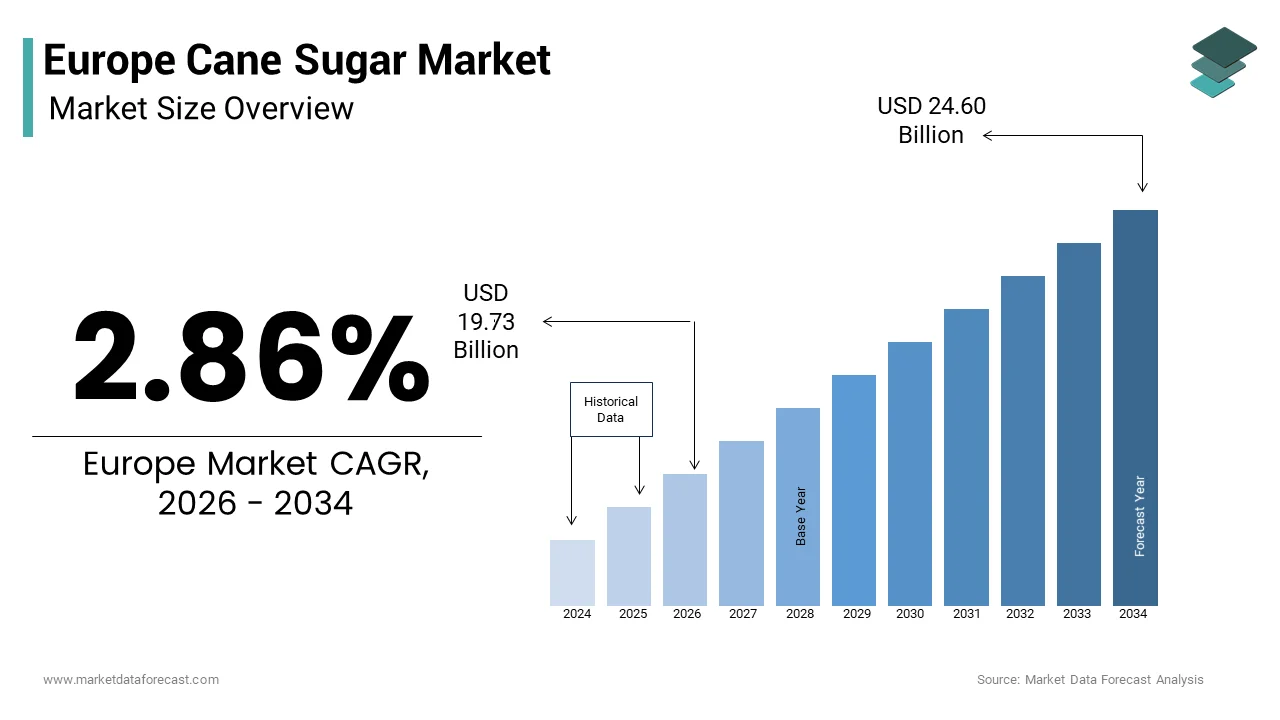
The Europe cane sugar market size was valued at USD 19.18 billion in 2025, is anticipated to reach USD 19.73 billion in 2026, and is projected to scale up to USD 24.60 billion by 2034, registering a compound annual growth rate (CAGR) of 2.86% during the forecast period from 2026 to 2034. Driven by expanding industrial food processing demand, rising consumer preferences for natural and minimally processed ingredients, and a resilient food manufacturing base, the European cane sugar sector continues to grow steadily despite public health and regulatory headwinds.
Key Executive Metrics (At-a-Glance)
- 2025 Base Valuation: USD 19.18 Billion
- 2026 Current Valuation: USD 19.73 Billion
- 2034 Forecast Valuation: USD 24.60 Billion
- Compound Annual Growth Rate (CAGR): 2.86% (2026–2034)
- Dominant Ingredient Segment: White Cane Sugar (dominant share in 2025 for industrial food manufacturing)
- Fastest-Growing Ingredient Segment: Specialty and Brown Cane Sugar (projected at 5.8% CAGR)
- Dominant Form Segment: Crystallized Sugar Form
- Fastest-Growing Form Segment: Liquid Syrup Form (projected at 6.2% CAGR)
- Dominant End-User Segment: Food Processing Industry
- Fastest-Growing End-User Segment: Foodservice (projected at 5.5% CAGR)
- Dominant Country Markets: Germany (23.3% share in 2025) and the United Kingdom
Core Market Drivers
- Industrial Food Processing Demand: High-volume requirements across European confectionery, bakery, beverage, and dairy manufacturing sectors relying on cane sugar's functional properties.
- Clean Label & Natural Preference: Growing consumer preference for natural, minimally processed, and traditionally produced ingredients over highly refined or artificial alternatives.
- Specialty & Gourmet Applications: Surging demand for distinct cane varieties (demerara, muscovado) in artisanal baking and premium beverages.
Primary Market Restraints & Challenges
- Public Health Policies: Stringent government regulations, sugar taxes, and WHO guidelines targeting reduced free sugar intake and product reformulation.
- Commodity Price Volatility: Severe global supply chain fluctuations driven by weather patterns, geopolitical factors, and climate variability in key tropical origins.
- Alternative Sweetener Competition: Rapid expansion of natural high-intensity sweeteners (stevia, monk fruit, allulose) and substitutes in industrial food applications.
Europe Cane Sugar Market Segmentation Highlights
| Segment Category | Largest Market Segment | Fastest-Growing Market Segment |
|---|---|---|
| By Ingredient | White Cane Sugar (Dominant Share) | Specialty & Brown Cane Sugar (5.8% CAGR) |
| By Form | Crystallized Sugar Form | Liquid Syrup Form (6.2% CAGR) |
| By End-User | Food Processing Industry | Foodservice Segment (5.5% CAGR) |
| By Country | Germany (23.3% share in 2025) | United Kingdom (19.3% CAGR metrics) |
Major Industry Players Profiled
Key enterprises dominating the European cane sugar market include Sudzucker AG, Associated British Foods plc (AB Sugar), Florida Crystals Corporation (ASR Group), Tereos S.A., Wilmar International Limited, Louis Dreyfus Company B.V., Cosan S.A., Bunge Limited, and Murugappa Group (EID Parry).
Europe Cane Sugar Market Size
The Europe cane sugar market size was valued at USD 19.18 billion in 2025 and is anticipated to reach USD 19.73 billion in 2026 to reach USD 24.60 billion by 2034, growing at a CAGR of 2.86% during the forecast period from 2026 to 2034.
The cane sugar importation, refining, and distribution of raw cane sugar sourced primarily from tropical producing nations including Brazil, India, Thailand and African Caribbean Pacific countries. This market functions as a critical component within the broader European sweetener landscape where cane sugar complements domestically produced beet sugar to meet industrial and consumer demand. The region maintains sophisticated refining infrastructure concentrated in coastal locations that process imported raw cane into refined sugar for food manufacturing and retail distribution. According to the European Commission, imports of cane sugar into the European Union are projected to reach 2.23 million tonnes during the 2025 and 2026 marketing year representing a significant increase from previous periods. The European agricultural framework regulates cane sugar imports through tariff rate quotas and preferential trade agreements that balance domestic beet production with international supply commitments. Per capita sugar consumption across European nations varies considerably with data from the Food and Agriculture Organization indicating that average annual consumption stands at approximately 31.8 kilograms per person. Public health initiatives across the continent increasingly emphasize reduced sugar intake with the World Health Organization recommending that free sugars constitute less than 10% of total daily energy consumption. This regulatory and health context shapes market dynamics as manufacturers reformulate products while maintaining consumer appeal.
MARKET DRIVERS
Expanding Industrial Food Processing Demand Across European Manufacturing Hubs
The escalating demand from industrial food processing sectors by creating consistent high volume requirements for reliable sweetener inputs is escalating the growth of Europe cane sugar market. European food manufacturers across confectionery, bakery, beverage and dairy segments depend on cane sugar for its functional properties including crystallization control, moisture retention and flavor enhancement that cannot be easily replicated by alternative sweeteners. According to the Confederation of European Food and Drink Industries, the food and beverage sector represents the largest industrial employer in Europe with over 4.7 million workers relying on consistent ingredient supplies including sugar for production continuity. The growth of ready to eat meals, packaged snacks and functional beverages has intensified demand for cane sugar as a versatile ingredient that supports texture, preservation and taste profiles desired by consumers. Cane sugar offers distinct advantages for industrial applications including consistent particle size, predictable solubility and compatibility with automated processing equipment that enhances production efficiency. The expansion of private label product lines by major European retailers has further amplified demand as these brands require cost effective yet high quality ingredients to compete with established manufacturers.
Rising Consumer Preference for Natural and Minimally Processed Ingredients
The growing consumer preference for natural and minimally processed ingredients by differentiating cane sugar from highly refined alternatives and artificial sweeteners in purchasing decisions is additionally accelerating the growth of Europe cane sugar market. European shoppers increasingly scrutinize ingredient labels seeking recognizable components perceived as wholesome and traditional, which positions raw and minimally processed cane sugar favorably against chemically derived sweetening options. As per the European Consumer Organisation, surveys conducted across multiple member states reveal that 68% of consumers actively avoid products containing artificial additives or highly processed ingredients when making food purchases. This behavioral shift benefits cane sugar suppliers who can emphasize the natural origin and traditional production methods associated with their products. The clean label movement has gained particular traction in Northern European markets where transparency and ingredient simplicity command premium pricing and brand loyalty. Cane sugar producers leverage this trend by sustainable farming practices, traceability programs and minimal processing techniques that align with consumer values. The demand for organic certified cane sugar has also expanded significantly with data from the Research Institute of Organic Agriculture showing that organic food sales in Europe reached 54.5 billion Euros in 2023, reflecting broad acceptance of certified natural products.
MARKET RESTRAINTS
Stringent Public Health Policies Targeting Sugar Consumption Reduction
The implementation of stringent public health policies targeting sugar consumption reduction by creating regulatory and fiscal pressures that dampen demand across multiple product categories is limiting the growth of Europe cane sugar market. European governments have introduced sugar taxes, mandatory front of pack labeling and marketing restrictions aimed at curbing excessive sugar intake linked to obesity and metabolic diseases. According to the World Health Organization Regional Office for Europe, 14 European countries have implemented fiscal measures on sugar sweetened beverages since 2017 with additional nations considering similar legislation. These policies directly impact industrial demand for cane sugar as manufacturers reformulate products to reduce sugar content or substitute with alternative sweeteners to avoid tax liabilities and negative consumer perception. The European Commission's Farm to Fork Strategy explicitly targets a reduction in average sugar consumption across the bloc creating long term headwinds for traditional sweetener markets. Data from the European Public Health Alliance indicates that products reformulated with reduced sugar content now represent over 30% of new launches in the confectionery and beverage segments across major European markets. Smaller manufacturers face particular challenges adapting to these regulations due to limited research and development resources for alternative formulation strategies. The cumulative effect of these health policies restricts market expansion by shifting demand toward low sugar and sugar free alternatives while increasing compliance costs for companies maintaining traditional sugar based products. This regulatory environment necessitates strategic adaptation from cane sugar suppliers who must diversify offerings or target niche segments less affected by consumption reduction initiatives.
Volatility in Global Commodity Prices and Supply Chain Disruptions
Severe volatility in global cane sugar prices coupled with supply chain disruptions acts as a significant restraint on the Europe cane sugar market by introducing cost uncertainty and logistical challenges that complicate procurement and pricing strategies. Cane sugar trades as a globally priced commodity subject to fluctuations driven by weather events, currency movements and geopolitical developments in major producing regions that directly impact European import costs. As per the International Sugar Organization, global raw sugar prices experienced variations exceeding 40% within a single marketing year due to drought conditions in Thailand and policy shifts in India affecting export availability. This price instability forces European refiners and food manufacturers to absorb margin pressures or implement frequent price adjustments that risk consumer backlash and retailer resistance. The World Meteorological Organization attributes increasing climate variability to shifting precipitation patterns that disrupt cane harvest cycles in Brazil and other key origins creating unpredictable supply flows to European ports. Logistics challenges including port congestion, freight cost increases and regulatory documentation requirements further compound supply chain vulnerabilities for cane sugar imports. Smaller importers lacking hedging capabilities or diversified sourcing options face heightened exposure to these disruptions potentially compromising their ability to fulfill contracts with industrial customers. The combined pressure of price volatility and logistical uncertainty restrains market fluidity by discouraging long term supply commitments and limiting investment in capacity expansion during periods of acute instability.
MARKET OPPORTUNITIES
Integration of Sustainable Certification and Traceability Technologies
The integration of sustainable certification programs and advanced traceability technologies by enabling premium positioning and meeting evolving regulatory requirements for supply chain transparency is substantially creating new opportunities for the growth of Europe cane sugar market. European buyers increasingly mandate proof of sustainable farming practices, ethical labor conditions and environmental stewardship before engaging in procurement contracts creating demand for certified cane sugar with verified credentials. This measurable environmental impact resonates with European brands seeking to demonstrate tangible sustainability progress to consumers and regulators. The European Union Deforestation Regulation further accelerates adoption of traceability systems by requiring geolocation data for agricultural commodities including sugar to verify deforestation free supply chains. Companies investing in blockchain based tracking or satellite monitoring gain competitive advantages through enhanced credibility and secured access to sustainability conscious customers. This opportunity extends beyond compliance to value creation as certified cane sugar commands price premiums of 15 to 25% compared to conventional equivalents according to industry analysis.
Development of Specialty Cane Sugar Varieties for Premium Applications
The development of specialty cane sugar varieties tailored for premium food and beverage applications by unlocking higher value segments beyond commodity sweetener is additionally escalating the growth of Europe cane sugar market. European consumers and artisanal producers increasingly seek distinctive sugar products including demerara, muscovado and turbinado varieties that deliver unique flavor profiles, color characteristics and functional properties for gourmet applications. These niche products appeal to craft bakeries, premium chocolate makers and specialty beverage producers who value the complex taste notes and visual appeal of minimally processed cane sugars. Research from the European Culinary Institute indicates that 58% of professional chefs prefer specialty cane sugars for dessert preparation due to their enhanced caramelization properties and distinctive aromatic qualities. Technology advancements in milling and crystallization allow producers to preserve natural molasses content and crystal structure that differentiate specialty sugars from highly refined alternatives. This opportunity enables cane sugar suppliers to diversify revenue streams, reduce exposure to commodity price cycles and build brand equity through product innovation. The premium positioning of specialty cane sugars also aligns with European consumer trends toward experiential consumption and culinary exploration creating sustained demand growth.
MARKET CHALLENGES
Intensifying Competition from Alternative Sweeteners and Sugar Substitutes
Intensifying competition from alternative sweeteners and sugar substitutes, across multiple application segments as manufacturers seek to reduce sugar content, while maintaining sweetness and functionality. This is one of the major challenges for the growth of Europe cane sugar market. The rapid advancement of natural high intensity sweeteners including stevia, monk fruit and allulose provides food manufacturers with viable alternatives that deliver sweetness with minimal caloric impact aligning with health conscious consumer preferences. According to the European Food Safety Authority, approvals for novel sweetening ingredients have increased by 35% over the past five years expanding the portfolio of options available to product developers
These alternatives increasingly match cane sugar in functional properties including solubility, stability and taste profile reducing the technical barriers to substitution in industrial applications. The challenge is compounded by consumer education campaigns highlighting the benefits of reduced sugar consumption which further incentivize reformulation away from traditional cane sugar. Cane sugar suppliers face pressure to demonstrate unique value propositions beyond sweetness including functional benefits, natural positioning or sustainability credentials to maintain relevance in evolving product formulations. This competitive dynamic requires strategic investment in research and development to identify niche applications where cane sugar retains advantages or to develop blended solutions that incorporate alternative sweeteners while preserving cane sugar content. Without proactive adaptation, the Europe cane sugar market risks gradual displacement in key growth segments as alternative sweetening technologies continue to advance.
Complex Regulatory Landscape Governing Agricultural Imports and Trade Compliance
The complex regulatory landscape governing agricultural imports and trade compliance represents a critical challenge for the Europe cane sugar market by increasing administrative burdens, compliance costs and supply chain friction for market participants. European Union trade policies incorporate multiple layers of regulation including tariff rate quotas, preferential trade agreements, sustainability mandates and food safety requirements that cane sugar imports must satisfy to access the market. According to the European Commission, compliance with the EU Deforestation Regulation requires importers to provide geolocation coordinates for every plot of land where cane sugar is produced creating significant data collection and verification obligations. These requirements strain existing supply chain infrastructures particularly for smaller importers lacking technological resources to implement detailed traceability systems. The cost of verifying compliance adds an estimated 12 to 18% to overall procurement expenses according to analysis by the Confederation of European Food and Drink Industries. Furthermore, the threat of penalties and shipment rejections for non-compliance creates risk aversion that may limit sourcing flexibility and increase reliance on established suppliers. The regulatory burden also extends to labeling requirements, nutritional declarations and marketing claims that must align with evolving European food information regulations. This complexity stifles agility and innovation as companies divert resources toward administrative adherence rather than product development or market expansion.
REPORT COVERAGE
| REPORT METRIC | DETAILS |
| Market Size Available | 2025 to 2034 |
| Base Year | 2025 |
| Forecast Period | 2026 to 2034 |
| CAGR | 2.86% |
| Segments Covered | By Ingredient, Category, Form, End-User, and Region |
| Various Analyses Covered | Global, Regional, & Country Level Analysis; Segment-Level Analysis; DROC, PESTLE Analysis; Porter’s Five Forces Analysis; Competitive Landscape; Analyst Overview of Investment Opportunities |
| Regions Covered | UK, France, Spain, Germany, Italy, Russia, Sweden, Denmark, Switzerland, Netherlands, Turkey, and the Czech Republic |
| Market Leaders Profiled | Florida Crystals Corporation (ASR Group), Wilmar International Limited, Louis Dreyfus Company B.V., Biosev SA, Dalmia Bharat Group, Global Organics Ltd., DO-IT Food Ingredients B.V., Cosan S.A., Tereos S.A., Balrampur Commercial Enterprises Limited, Murugappa Group (EID Parry), Mitr Phol Sugar Corporation Ltd., Tongaat Hulett Limited, Sudzucker AG, Thai Roong Ruang Sugar Group Co., Ltd., Associated British Foods plc (AB Sugar), DCM Shriram Ltd., Bunge Limited, Dhampur Sugar Mills Ltd, Bajaj Group (BHSL) |
SEGMENTAL ANALYSIS
By Ingredient Insights
The white cane sugar segment was the largest by holding a dominant share of the Europe cane sugar market in 2025, across industrial applications, consumer preference for neutral sweetness, and compatibility with standardized food manufacturing processes that require consistent crystallization and solubility properties. The primary force sustaining the white cane sugar segment is its indispensable role in industrial food manufacturing where functional consistency and process reliability determine production efficiency and product quality. European food processors across confectionery, bakery, beverage and dairy sectors depend on white cane sugar for its predictable behavior during mixing, heating and cooling cycles that cannot be easily replicated by alternative sweeteners or less refined sugar varieties. According to the Confederation of European Food and Drink Industries, over 85% of industrial food manufacturers in Europe specify white cane sugar as their preferred sweetener for standardized production lines due to its uniform particle size and controlled moisture content that ensures batch to batch consistency. This functional requirement drives massive procurement volumes as manufacturers prioritize operational stability over ingredient novelty. White cane sugar's neutral flavor profile allows it to enhance other ingredients without introducing competing taste notes, a critical attribute for products where brand identity depends on consistent sensory characteristics. This industrial reliance creates a self perpetuating cycle where equipment design, formulation protocols and quality control systems are optimized specifically for white cane sugar, raising switching costs for manufacturers considering alternative ingredients. The result is a deeply entrenched market position that remains resilient despite evolving consumer trends toward natural or minimally processed alternatives.
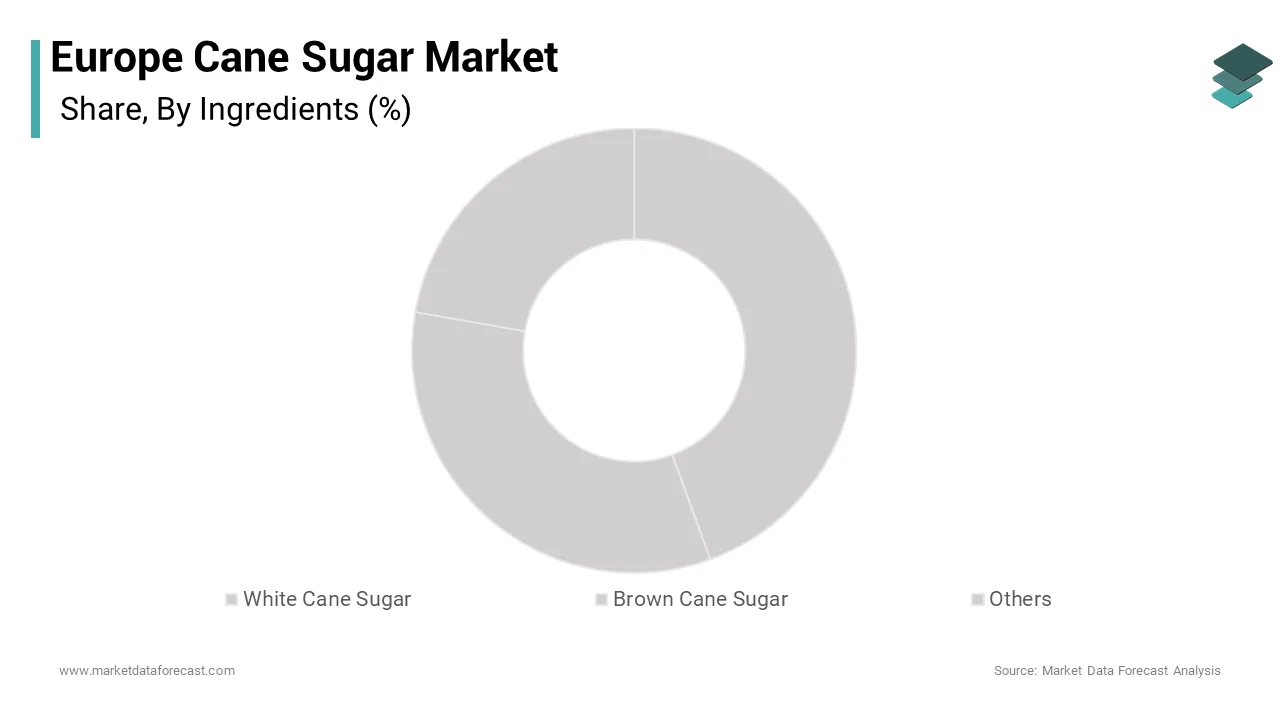
The specialty and brown cane sugar segment is swiftly emerging at a fastest CAGR of 5.8% during the forecast period. The explosive growth of the specialty and brown cane sugar segment is primarily driven by the surging consumer demand for clean label products that utilize minimally processed ingredients perceived as more natural and wholesome than highly refined alternatives. European shoppers increasingly scrutinize ingredient lists seeking recognizable components with simple production narratives, a trend that positions brown and specialty cane sugars favorably against white refined options. According to the European Food Information Council, products marketed with minimal processing claims experienced higher sales growth compared to conventional equivalents during the past three years, reflecting broad consumer receptivity to less refined ingredients. Specialty cane sugars including demerara, muscovado and turbinado retain natural molasses that delivers complex flavor notes and trace minerals, attributes that resonate with consumers seeking authentic taste experiences. The perception of brown sugars as less chemically altered aligns with broader wellness trends that prioritize ingredient transparency and traditional production methods. Retailers have responded by expanding assortments of specialty sugars in both mainstream and premium channels, increasing accessibility and visibility for these products.
By Form Insights
The crystallized sugar form segment was the largest by holding a significant share of the Europe cane sugar market in 2025. The preeminence of the crystallized sugar segment is underpinned by its superior handling efficiency and storage stability within industrial food manufacturing environments where operational reliability and inventory management determine production economics. European food processors favor crystallized sugar for its predictable flow characteristics, resistance to caking under controlled humidity and compatibility with automated dosing systems that minimize labor requirements and production errors. According to the European Association of Food Engineers, over 90% of industrial sugar handling equipment installed in European facilities during the past decade was designed specifically for crystalline formats, creating substantial switching costs for manufacturers considering alternative forms. This infrastructure lock in reinforces demand for crystallized sugar as companies optimize processes around its physical properties. Crystallized sugar's extended shelf life under ambient conditions reduces waste and simplifies inventory planning compared to liquid alternatives that require temperature control and have shorter usability windows. The segment's dominance is further strengthened by established quality control protocols that measure crystalline properties including particle size distribution and moisture content, providing manufacturers with reliable specifications for production consistency. This operational certainty translates into risk mitigation for large scale food production where ingredient variability can compromise product quality and brand reputation. The cumulative effect of these industrial preferences creates a self reinforcing cycle where equipment design, supply chain logistics and quality systems are optimized for crystallized sugar, cementing its position as the default form for European cane sugar consumption.
The liquid syrup form segment is expected to witness fastest CAGR of 6.2% during the forecast period. The rapid expansion of the liquid syrup segment is largely propelled by burgeoning demand from industrial beverage manufacturers who prioritize process efficiency, consistent sweetness delivery and reduced production complexity in high volume operations. European beverage producers of soft drinks, juices, ready to drink teas and alcoholic beverages increasingly specify liquid cane sugar syrup for its immediate solubility, precise dosing capabilities and compatibility with continuous flow production systems that minimize downtime and labor requirements. Liquid syrup eliminates the energy and time required to dissolve crystallized sugar by reducing production cycle times by an estimated 15 to 20%, according to analysis by the European Food Processing Technology Institute. This efficiency gain translates into significant cost savings at industrial scales, where marginal improvements compound across millions of production units. The consistency of liquid syrup also supports precise nutritional labeling and quality control, critical attributes for manufacturers navigating stringent European food information regulations. Furthermore, liquid formats reduce dust generation in production environments, improving workplace safety and reducing equipment maintenance requirements. These operational advantages create strong incentives for beverage manufacturers to specify liquid cane sugar syrup, driving sustained demand growth for the format across the European market.
By End User Insights
The food processing industry segment was accounted in holding a significant share of the Europe cane sugar market in 2025. The growth of food processing industry segment is driven by the enormous scale of industrial food production across Europe that creates consistent, high volume demand for standardized sweetener inputs capable of supporting automated manufacturing processes and stringent quality control protocols. European food processors operate facilities that convert raw cane sugar into finished goods at volumes that dwarf retail or foodservice consumption, establishing the segment as the primary offtaker for cane sugar supplies. This industrial scale necessitates sweeteners with predictable functional properties including consistent crystallization behavior, controlled moisture content and reliable solubility that ensure batch to batch product uniformity. The food processing industry's preference for standardized ingredients creates stable, long term procurement relationships that provide revenue visibility for cane sugar suppliers while encouraging investment in supply chain resilience and quality assurance systems. Furthermore, industrial customers often require customized specifications including particle size distributions, packaging formats and delivery schedules that smaller end user segments cannot support economically. This specialization reinforces the segment's dominance by raising barriers to entry for alternative suppliers and creating switching costs that protect established relationships.
The foodservice segment is likely to register a fastest CAGR of 5.5% throughout the forecast period. The robust recovery of European hospitality sectors following pandemic related disruptions combined with the sustained expansion of specialty cafe culture that increases demand for sweetened beverages and dessert offerings is significantly boosting the growth of the segment. European restaurants, cafes, bars and hotels have rebounded strongly with consumer spending on dining out exceeding pre pandemic levels in most major markets by creating renewed demand for commercial sweetener supplies. According to the European Hospitality Association, foodservice revenue across the European Union grew by 14% in 2024 compared to the previous year, reflecting strong consumer willingness to spend on out of home consumption experiences. This recovery directly translates into increased procurement of cane sugar for beverage preparation, dessert finishing and culinary applications where commercial operators prioritize consistent quality and operational efficiency. The expansion of specialty coffee shops and artisanal dessert venues has further amplified demand as these establishments often utilize premium cane sugar varieties to differentiate their offerings and justify premium pricing. The growth is particularly pronounced in urban centers, where changing work patterns including hybrid employment models have increased midday dining and coffee consumption, creating sustained demand throughout the day rather than concentrated peak periods. Furthermore, the rise of experiential dining where presentation and ingredient quality influence consumer choices has elevated the importance of premium cane sugar varieties in foodservice applications.
COUNTRY ANALYSIS
Germany Cane Sugar Market Analysis
Germany was the top performer of the Europe cane sugar market by holding 23.3% of share in 2025 due to its massive industrial food processing base, sophisticated refining infrastructure and robust domestic consumption patterns. The growth of the market is driven by the mature confectionery and bakery sector that maintains consistent demand for high quality cane sugar inputs, alongside growing interest in sustainable and specialty varieties. This industrial scale creates stable offtake for refiners while encouraging investment in supply chain resilience and quality assurance systems. Domestic consumption remains strong with data from the Federal Office for Agriculture and Food indicating that per capita sugar consumption stands at approximately 33.5 kilograms annually, among the highest rates in Europe. The strong retail sector that promotes both conventional and premium sugar products by making them accessible to diverse consumer segments. Innovation in sugar reduction and sustainable sourcing is particularly advanced in Germany, driven by stringent consumer expectations and regulatory pressures. The presence of major multinational headquarters and specialized research centers fosters a culture of continuous improvement and product development.
United Kingdom Cane Sugar Market Analysis
The United Kingdom cane sugar market growth is likely to grow at an anticipated CAGR of 19.3%, of share in 2025 with its sophisticated refining capacity, strong retail sector and evolving consumer preferences that balance traditional confectionery demand with health conscious reformulation trends. The British market serves as a critical entry point for cane sugar imports with major refining facilities located in ports including London, Liverpool and Immingham that process raw cane from tropical producing nations. The UK market demonstrates particular strength in premium and specialty sugar segments where consumer willingness to pay for quality and sustainability credentials supports higher value product offerings. Data from the Office for National Statistics indicates that household expenditure on sugar and sweeteners remains stable despite public health campaigns, reflecting the ingredient's enduring role in British culinary traditions. The rise of craft bakeries, artisanal chocolatiers and specialty beverage producers has further amplified demand for distinctive cane sugar varieties that deliver unique flavor profiles and storytelling potential. Retail innovation including private label premium ranges and eco-friendly packaging has enhanced the accessibility and appeal of cane sugar products across diverse consumer segments. The UK's regulatory framework including post Brexit trade arrangements continues to evolve, creating both challenges and opportunities for cane sugar importers who must navigate changing tariff structures and compliance requirements.
France Cane Sugar Market Analysis
France cane sugar market growth is expected to have steady pace throughout the forecast period with a strong emphasis on gastronomic excellence, premium product positioning and a thriving artisanal food culture that values distinctive ingredients capable of elevating culinary creations. The French market is distinguished by its high regard for terroir and origin specific products, reflecting the nation's broader culinary philosophy that prioritizes quality, authenticity and storytelling in ingredient selection. France boasts a dense network of artisanal chocolatiers, premium bakeries and specialty beverage producers who increasingly select cane sugar varieties for their unique flavor contributions and minimal processing narratives. The consumers demanding superior quality and ethical sourcing, pushing manufacturers to adopt rigorous certification standards and transparency initiatives. The strong retail presence of gourmet brands in department stores and specialty boutiques ensures high visibility and accessibility for premium cane sugar offerings. France's reputation for culinary arts enhances the perceived value of products utilizing quality cane sugar, allowing for premium pricing strategies that support margin expansion.
Italy Cane Sugar Market Analysis
Italy cane sugar market is to grow with the rich culinary heritage, artisanal food production and strong consumer preference for high quality ingredients that deliver authentic taste experiences. The Its intense demand for cane sugar in traditional confectionery, premium coffee preparation and artisanal dessert production, where ingredient quality directly influences product reputation and consumer loyalty. The extraordinary cultural significance of sweet foods in Italian social life with occasions ranging from daily coffee rituals to festive celebrations creating consistent demand for quality cane sugar. According to the Italian Food Industry Association, the confectionery and bakery sectors alone consume over 250000 metric tons of sugar annually, with cane sugar representing a significant portion due to its functional properties in traditional recipes. The domestic per capita consumption of sweet products remains notably high with Italian citizens purchasing sugar containing items frequently, as daily indulgences or sophisticated gifts. The rise of specialty coffee culture has further amplified demand for premium cane sugar varieties that complement espresso based beverages without overwhelming delicate flavor profiles. The strong retail presence of artisanal brands in gourmet markets and specialty stores ensures high visibility for premium cane sugar offerings. Italy's reputation for culinary excellence enhances the perceived value of products utilizing quality cane sugar by allowing for premium pricing strategies that support margin expansion. This combination of cultural tradition, quality expectations and evolving consumer preferences ensures Italy remains a critical and high value segment of the European cane sugar market.
Netherlands Cane Sugar Market Analysis
The Netherlands cane sugar market growth is likely to grow with the premier logistical gateway and processing center for cane sugar imports in Europe. The Port of Rotterdam serves as the largest entry point for agricultural commodities on the continent, handling nearly 40% of all European cane sugar imports which establishes the country as the critical throat of the supply chain. The country's advanced logistics infrastructure and favorable trade policies that attract multinational corporations to establish their European headquarters there. According to the Dutch Sugar Industry Association, the Netherlands processes over 300000 metric tons of cane sugar annually, focusing heavily on the production of refined sugar and specialty varieties for industrial and retail applications. The domestic consumption of sugar containing products is also significant with a steady demand for both traditional and innovative confectionery items.
COMPETITIVE LANDSCAPE
The Europe cane sugar market features intense competition among a concentrated group of integrated refiners and trading companies who compete through operational excellence and sustainability leadership. Südzucker Tereos and Nordzucker dominate the landscape leveraging scale and infrastructure to serve both industrial and retail customers across the continent. Competition centers on sustainability credentials as European regulations and consumer preferences increasingly favor ethically sourced and traceable cane sugar products. Companies invest heavily in certification programs farmer support initiatives and digital monitoring systems to demonstrate compliance and build brand equity. Innovation in product development represents another key competitive arena with players racing to create specialty cane sugar derivatives that address clean label and premiumization trends. Processing efficiency and supply chain agility determine cost competitiveness particularly during periods of raw material volatility and logistical disruption. The rise of private label brands and specialty importers introduces additional competitive pressure on traditional players to maintain quality leadership and customer loyalty. Geographic proximity to ports and refining infrastructure provides logistical advantages that influence sourcing and distribution strategies.
KEY MARKET PLAYERS
Prominent players that are in the Europe cane sugar market are
- Florida Crystals Corporation (ASR Group)
- Wilmar International Limited
- Louis Dreyfus Company B.V.
- Nordzucker AG
- Biosev SA
- Dalmia Bharat Group
- Global Organics Ltd.
- DO-IT Food Ingredients B.V.
- Cosan S.A.
- Tereos S.A.
- Balrampur Commercial Enterprises Limited
- Murugappa Group (EID Parry )
- Mitr Phol Sugar Corporation Ltd.
- Tongaat Hulett Limited
- Sudzucker AG
- Thai Roong Ruang Sugar Group Co., Ltd.
- Associated British Foods plc (AB Sugar)
- DCM Shriram Ltd.
- Bunge Limited
- Dhampur Sugar Mills Ltd
- Bajaj Group (BHSL)
Top Players In The Market
- Südzucker AG operates as a leading European sugar producer with significant involvement in cane sugar refining and distribution across the continent. The company maintains integrated supply chains that source raw cane sugar from tropical producing nations and process it into refined products for industrial and retail customers. Recent strategic actions include investment in sustainable sourcing programs that support farmer livelihoods and environmental stewardship in origin countries. Südzucker has expanded its specialty sugar portfolio to meet growing demand for premium and organic cane sugar varieties in European countries. The company actively collaborates with food manufacturers to develop customized sweetening solutions that align with clean label trends. These initiatives reinforce Sudzucker's position as a preferred supplier for European customers seeking reliable and responsible cane sugar supplies.
- Tereos serves as a major global cooperative with extensive cane sugar refining operations throughout Europe and significant presence in producing regions. The company manages integrated supply chains from farm to factory ensuring quality control and traceability for European customers. Recent initiatives include expansion of renewable energy production at refining facilities using bagasse biomass to reduce carbon footprint. Tereos has launched new traceability platforms that provide European buyers with transparent information about cane sugar origins and sustainability credentials. The cooperative actively invests in farmer training programs that improve yields and promote climate resilient agricultural practices.
- Nordzucker AG operates as a prominent European sugar company with growing involvement in cane sugar importation and refining to complement its beet sugar production. The company leverages coastal refining infrastructure to process imported raw cane sugar for industrial food manufacturers across the continent. Recent strategic developments include partnerships with sustainable certification bodies to offer verified ethical cane sugar products to European brands. Nordzucker has invested in digital supply chain technologies that enhance traceability and compliance with European deforestation regulations. The company actively collaborates with customers to develop reduced sugar formulations that maintain sensory appeal while meeting health guidelines. These initiatives position Nordzucker as a flexible and responsible partner for European food producers seeking diversified sweetening solutions.
Top Strategies Used By Key Market Participants
Key players in the Europe cane sugar market employ vertical integration strategies to control supply chains from farm to refinery ensuring quality consistency and supply security. Sustainability certification programs represent a core strategic focus as companies align with European Union regulations and consumer expectations for ethical sourcing. Investment in refining infrastructure enables manufacturers to increase capacity and improve operational efficiency across European facilities. Product diversification into specialty and organic cane sugar varieties allows companies to capture premium market segments and reduce exposure to commodity price cycles. Digital traceability technologies enhance transparency and compliance with deforestation regulations while building consumer trust through verified sourcing claims. Strategic partnerships with retailers and food manufacturers secure long term distribution channels and market access. Direct farmer engagement programs strengthen supply chain resilience by improving yields and promoting climate smart agricultural practices in producing regions.
MARKET SEGMENTATION
This research report on the Europe cane sugar market is segmented and sub-segmented into the following categories.
By Ingredient Type
- White Cane Sugar
- Brown Cane Sugar
- Others
By Category
- Organic
- Conventional
By Form
- Crystallized Sugar
- Liquid Syrup
By End-User
- Retail
- Supermarkets and Hypermarkets
- Convenience Stores
- Online Retail Stores
- Other Distribution Channel
- Foodservice
- Food Processing industry
- Bakery and Confectionery
- Cakes and Pastries
- Cookies
- Candies
- Chocolates
- Others
- Dairy
- Ice Cream
- Yogurt
- Milkshakes
- Others
- Beverages
- Carbonated Drinks
- Fruit Juices
- Coffee and Tea Sweeteners
- Alcoholic Beverages
- Others
- Sauces and Condiments
- Savory Snacks
- Other Applications
By Country
- UK
- France
- Spain
- Germany
- Italy
- Russia
- Sweden
- Denmark
- Switzerland
- Netherlands
- Turkey
- Czech Republic
- Rest of Europe