- Product Description Description
- Table of Contents TOC
- List of Table & Figure LOT
- Get Free Sample PDF Sample PDF
Market Size, 2025
$34.57 BnMarket Estimate, 2026
$35.81 BnMarket Forecast, 2034
$47.45 BnCAGR, 2026–2034
3.58%Europe Canned Food Market Report Summary
The Europe canned food market was valued at USD 34.57 billion in 2025, is estimated to reach USD 35.81 billion in 2026, and is projected to reach USD 47.45 billion by 2034, growing at a CAGR of 3.58% during the forecast period. Market growth is driven by increasing demand for convenient and long shelf life food products, rising urbanization, and busy consumer lifestyles. Canned foods are widely preferred due to their affordability, extended shelf life, and ease of storage. The growing demand for ready to eat meals, along with improvements in food preservation technologies and packaging, is further supporting market expansion across Europe.
Key Market Trends
- Rising demand for convenient and ready to eat food products is driving market growth.
- Increasing consumer preference for long shelf life and easy storage solutions is supporting adoption.
- Growing innovation in packaging and preservation techniques is enhancing product quality.
- Expansion of retail and e commerce channels is improving product availability.
- Rising demand for healthy and organic canned food options is influencing product development.
Segmental Insights
- Based on type, the canned vegetables segment was the largest and held 36.3% of the Europe canned food market share in 2025. This dominance is attributed to high consumption, affordability, and wide availability across households.
- Based on distribution channel, the supermarkets segment accounted for 54.1% of the Europe canned food market share in 2025. The segment’s growth is driven by strong retail presence, product variety, and consumer convenience.
Regional Insights
- The Europe canned food market is experiencing steady growth across key countries, supported by changing lifestyles and food consumption patterns.
- Germany was the largest contributor in the Europe canned food market in 2025, driven by high demand for convenient food products, strong retail infrastructure, and a well established food processing industry.
Competitive Landscape
The Europe canned food market is highly competitive, with key players focusing on product diversification, quality improvement, and expansion of distribution networks to strengthen their market position. Companies are investing in innovative packaging, healthier product options, and branding strategies. Prominent players in the Europe canned food market include Dole Food Company Inc, Del Monte Pacific Ltd, ConAgra Foods Inc, H J Heinz Company, Pinnacle Foods Inc, B and G Food Holdings Corporation, Bolton Group International, La Doria, Campbell Soup, Nestlé, Zanlakol, CECAB Group, Princes Limited, and Bonduelle.
Europe Canned Food Market Size
The Europe canned food market size was valued at USD 34.57 billion in 2025 and is expected to reach USD 47.45 billion by 2034, growing from USD 35.81 billion in 2026. The market is projected to grow at a CAGR of 3.58%.

According to Eurostat, 34% of households in the European Union regularly purchase canned vegetables and legumes as part of their weekly grocery routine. Furthermore, as per the Food and Agriculture Organization of the United Nations, food loss and waste remain significant challenges in Europe, with canned foods offering a viable solution by reducing spoilage rates significantly compared to fresh produce. As per the European Commission, nearly 59 million tonnes of food are wasted annually in the EU, which underscores the importance of preservation technologies like canning. The market is also influenced by stringent regulatory frameworks, such as those established by the European Food Safety Authority, which ensure high standards of quality and safety. This dynamic landscape positions canned foods not merely as emergency staples but as essential components of healthy, sustainable, and culturally rich dietary patterns worldwide.
MARKET DRIVERS
Rising Consumer Preference for Convenience and Ready to Eat Solutions
The growing demand for convenience foods due to busy urban lifestyles and changing work patterns is primarily driving the growth of the European canned food market forward. Modern consumers increasingly prioritize time-saving meal solutions without compromising on nutritional value or taste. According to Statista, the revenue in the ready to eat meals segment in Europe is projected to reach 33.6 billion US dollars by 2027, which is reflecting a steady annual growth rate. This trend is particularly pronounced among younger demographics, such as millennials and Generation Z, who often lack the time for extensive meal preparation. A survey conducted by Mintel reveals that 72% of European consumers consider convenience as a key factor when making food purchases, indicating a strong market pull for easy-to-prepare options. Additionally, the rise of single-person households, which account for approximately 40% of all households in the European Union as reported by Eurostat, further amplifies the demand for portion-controlled canned products. Consequently, manufacturers are introducing innovative canned products such as gourmet soups and premium fish varieties to align with the desire for quick, high-quality dining experiences.
Growing Awareness Regarding Food Sustainability and Waste Reduction
Environmental consciousness and the urgent need to mitigate food waste have emerged as powerful drivers propelling the adoption of canned foods across Europe, which is further contributing to the European canned food market expansion. Canning extends shelf life from months to years, significantly reducing the volume of edible food that ends up in landfills. As per the European Environment Agency, food waste contributes to approximately 10% of global greenhouse gas emissions, making its reduction a priority. The Food and Agriculture Organization of the United Nations estimates that one-third of all food produced globally is lost or wasted, highlighting the importance of preservation. In response, many European consumers are seeking sustainable options; according to Nielsen, 73% of global consumers would change their consumption habits to reduce their environmental impact. This sentiment is reflected in the European market, where brands promote canned goods as eco-friendly due to the high recyclability of steel and aluminum. According to Metal Packaging Europe, the recycling rate for steel packaging in Europe exceeds 85%, demonstrating the circular economy potential of canned food containers.
MARKET RESTRAINTS
Persistent Negative Perceptions Regarding Nutritional Value and Additives
The enduring consumer misconception that canned products are inferior in nutritional quality compared to fresh or frozen alternatives is one of the significant impediment to the growth of the European canned food market. Many shoppers believe that thermal processing leads to substantial nutrient loss and associate canned goods with high levels of sodium and preservatives. According to a study published by the British Nutrition Foundation, while some water-soluble vitamins may decrease, other nutrients like fiber, protein, and fat-soluble vitamins remain stable. However, the belief persists, with surveys indicating that over 50% of European consumers express concern about the additive content in processed foods. The European Food Information Council notes that clear labeling and consumer education are essential to dispel these myths, yet the stigma remains a barrier to broader acceptance. Until these perceptions are effectively addressed through transparent communication, the market may face resistance from health-conscious segments who prefer fresh produce despite higher costs and shorter shelf life.
Stringent Regulatory Compliance and Packaging Safety Standards
The Europe canned food market operates within a highly regulated environment that can act as a restraint on market agility. The European Union enforces strict regulations regarding food contact materials, including migration limits for substances like Bisphenol A (BPA). As per the European Chemicals Agency, concerns about the endocrine-disrupting properties of BPA have led to tighter restrictions and a push for alternative coatings, which often come with higher production costs. Manufacturers must navigate complex regulatory frameworks, such as Regulation EC No 1935/2004, which ensures food contact materials do not endanger human health. Compliance requires extensive testing and documentation, increasing operational expenses and time to market. Additionally, the European Food Safety Authority continuously updates scientific opinions on additives, requiring manufacturers to adjust processes frequently. For instance, the recent scrutiny of certain epoxy resins has forced many producers to invest in research and development for safer alternatives, placing a financial burden on smaller players.
MARKET OPPORTUNITIES
Expansion into Premium and Gourmet Canned Product Segments
The development of premium and gourmet canned products catering to the demand for exotic culinary experiences is a major opportunity to the European canned food market. Consumers are increasingly willing to pay a premium for artisanal items such as organic vegetables and sustainably sourced seafood. According to Euromonitor International, the premiumization trend is gaining momentum, with sales of luxury food items growing faster than standard counterparts. For example, demand for canned tuna labeled as dolphin-safe or line-caught has risen as awareness of sustainable fishing grows. The Marine Stewardship Council reports that sales of certified sustainable seafood products in Europe have increased by 20% annually over recent years. Furthermore, the Research Institute of Organic Agriculture indicates that the European organic food market continues to expand, with canned legumes representing a growing share. By leveraging these trends, companies can attract discerning customers and drive overall market growth.
Integration of Smart Packaging and Digital Traceability Technologies
The integration of smart packaging is another lucrative opportunity for the European canned food market. Smart solutions like QR codes and near-field communication (NFC) tags provide real-time information about product origin and freshness. As per the European Smart Packaging Alliance, the adoption of intelligent packaging systems is expected to grow as brands seek to build trust. These technologies enable consumers to scan a code and access detailed supply chain information, which is valuable following past food safety scandals. Additionally, smart packaging facilitates better inventory management for retailers, reducing waste and improving efficiency. The use of blockchain technology for traceability ensures that data is immutable and verifiable, further strengthening consumer trust. By embracing these digital innovations, manufacturers can meet the expectations of tech-savvy consumers who demand greater insight into the products they consume.
MARKET CHALLENGES
Volatility in Raw Material and Energy Costs
Volatility in raw material and energy costs directly impacts production expenses and profit margins, which is primarily challenging the growth of the European canned food market. The manufacturing of canned foods relies on agricultural commodities and industrial materials like steel and aluminum. According to the Food and Agriculture Organization of the United Nations, global food prices experienced sharp increases recently, with the Food Price Index reaching 143 points in 2022 due to conflicts and climate events. In Europe, the energy crisis led to soaring natural gas prices, which are critical for thermal sterilization. Eurostat data indicates that industrial energy prices in the EU rose by over 30% in a single year, placing immense pressure on costs. These increased costs are difficult to pass on to price-sensitive consumers. Furthermore, tariffs on steel and aluminum imports can elevate packaging costs, requiring companies to engage in strategic sourcing and hedging to maintain competitiveness.
Intense Competition from Private Label and Alternative Preservation Methods
The Europe canned food market faces intense competition from private label brands and alternative methods like freezing and drying. Retailers have expanded private label offerings, which are often priced lower than national brands while maintaining quality. According to NielsenIQ, private label products account for more than 40% of total grocery sales in countries like Germany and the United Kingdom. This high penetration puts pressure on branded manufacturers to justify price premiums through innovation. Additionally, the advancement of freezing technologies has improved the quality of frozen foods, making them a viable substitute. Frozen produce is often perceived by consumers as retaining more nutrients than canned counterparts. The European Frozen Food Federation reports consistent growth in the frozen industry driven by cold chain improvements. To counter this, canned food manufacturers must emphasize unique advantages like ambient storage and long shelf life.
REPORT COVERAGE
| REPORT METRIC | DETAILS |
| Market Size Available | 2025 to 2034 |
| Base Year | 2025 |
| Forecast Period | 2026 to 2034 |
| CAGR | 3.58% |
| Segments Covered | By Type, Distribution Channel, and Region |
| Various Analyses Covered | Global, Regional, & Country Level Analysis; Segment-Level Analysis; DROC, PESTLE Analysis; Porter’s Five Forces Analysis; Competitive Landscape; Analyst Overview of Investment Opportunities |
| Regions Covered | UK, France, Spain, Germany, Italy, Russia, Sweden, Denmark, Switzerland, Netherlands, Turkey, and the Czech Republic |
| Market Leaders Profiled | Dole Food Company Inc., DelMonte Pacific Ltd, ConAgra Foods Inc., H.J. Heinz Company, Pinnacle Foods Inc., B&G Food Holdings Corporation, Bolton Group International, La Doria, Campbell Soup, Nestle, Zanlakol, CECAB Group, Princes Limited and Bonduelle |
SEGMENTAL ANALYSIS
By Type Insights
The canned vegetables segment dominated the market by commanding for the highest share of 36.3% of the European market in 2025. The dominance of canned vegetables segment in the European market is driven by the essential role vegetables play in the European diet and the effectiveness of canning in preserving their nutritional value. According to the World Health Organization, higher vegetable intake is a priority for disease prevention, prompting public health campaigns in Europe. Canned vegetables offer a practical solution as they are pre-washed and cooked, requiring minimal preparation. A study by the European Food Information Council indicates that 63% of European consumers cite convenience as a major reason for choosing processed vegetable products. The availability of diverse options such as beans, corn, and tomatoes allows for various culinary applications, while retailers favor these items for their high turnover and long shelf lives.
On the other hand, the canned ready-to-eat meals segment is projected to be the fastest-growing segment and is predicted to register a CAGR of 7.5% over the forecast period in the European market owing to the changing lifestyle patterns and the shift towards single-person households across Europe. Canned meals offer a complete dining solution that requires only heating, making them ideal for individuals living alone or working long hours. According to Eurostat, single-person households now constitute over 40% of all households in the European Union, creating a substantial market. Urban dwellers in cities like London and Paris often rely on these convenient formats; a report by Mintel highlights that 45% of urban consumers in Europe prefer ready-to-eat meals for weekday dinners. Manufacturers are responding by introducing diverse recipes like curries and stews that cater to varied tastes.
By Distribution Channel Insights
The supermarkets segment led the market by holding 54.1% of the regional market share in 2025 due to the extensive reach of supermarket chains and their ability to offer a wide variety of products under one roof. According to NielsenIQ, supermarkets account for the majority of food and beverage sales in Europe due to broad assortment and competitive pricing. The physical layout allows for easy comparison of brands, and the presence of private labels offers options at different price points. The European Retail Round Table reports that consolidation has enhanced supply chain efficiency, ensuring stock availability. Promotional activities such as loyalty programs and bundle deals further attract customers to this channel, maintaining its leading position.
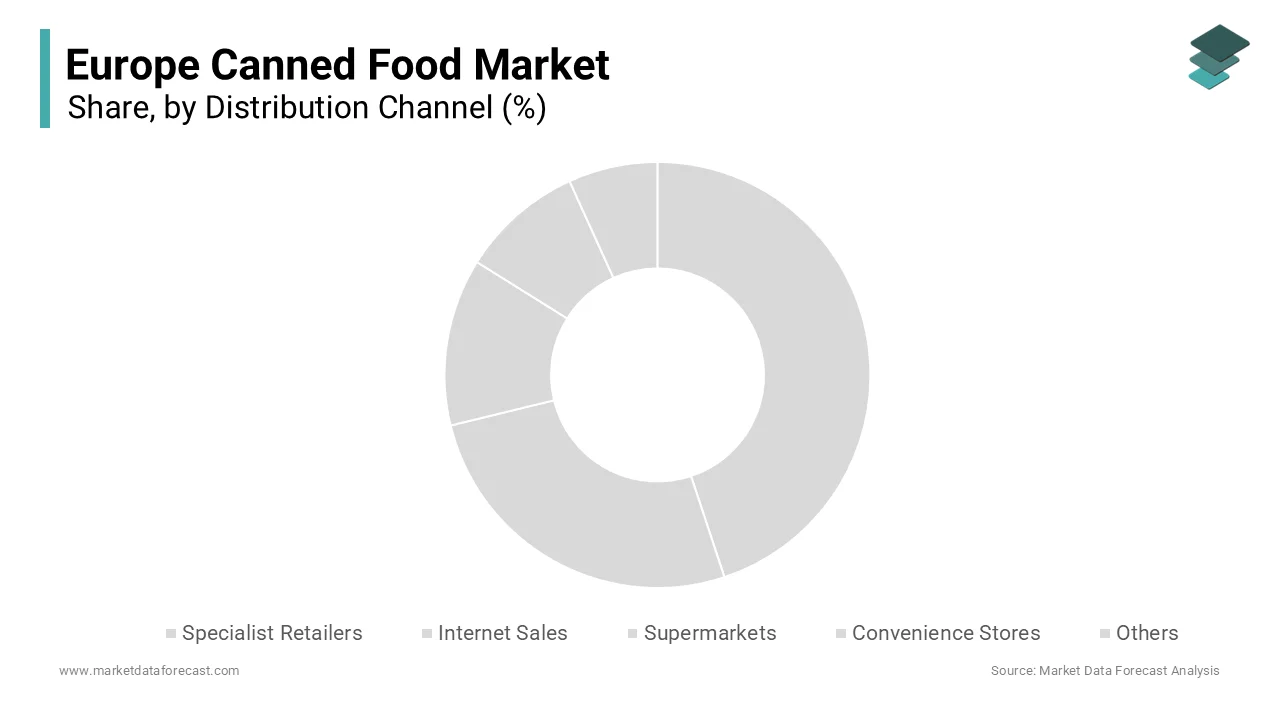
However, the internet sales segment is the fastest-growing distribution channel and is estimated to witness a CAGR of 9.1% over the forecast period in the European market owing to the increasing adoption of e-commerce platforms and digital literacy. According to Statista, the e-commerce grocery market in Europe has experienced double-digit growth as consumers become more comfortable with online shopping. User-friendly apps and subscription services for staple items like canned goods offer added convenience. The European E-commerce Report indicates that online food sales will continue to rise as logistics and delivery times improve. The ability to access niche and international brands not available in local stores also attracts online shoppers, reshaping consumer behavior in the canned food sector.
REGIONAL ANALYSIS
Germany Canned Food Market Analysis
Germany held the largest share of the Europe canned food market in 2025 due to the high penetration of private label products and a strong industrial base. According to the Federal Statistical Office of Germany, the food and beverage sector is one of the largest in the country. The emphasis on environmental responsibility has boosted demand due to the high recyclability of metal; Metal Packaging Europe reports that Germany achieves steel packaging recycling rates of over 95%. Major retail chains like Aldi and Lidl have democratized access to affordable canned goods through efficient supply chains and aggressive pricing strategies.
United Kingdom Canned Food Market Analysis
The United Kingdom represented the second-largest regional segment in the European market in 2025. Cultural traditions, such as the consumption of canned baked beans and soups, significantly support volume sales. According to the British Canners Association, the UK produces millions of cans annually for domestic consumption. The market is also driven by interest in ethnic cuisines, with canned Indian and Thai recipes becoming mainstream. The rise of single-person households has further boosted demand for portion-controlled meals. Additionally, the cost-of-living crisis led 31% of UK consumers to switch from fresh to canned produce to manage budgets effectively, according to recent consumer surveys.
France Canned Food Market Analysis
France is estimated to account for a prominent share of the European canned food market during the forecast period due to its strong agricultural heritage and appreciation for gourmet foods. Consumers have a longstanding appreciation for premium preserved items like foie gras and ratatouille. According to Agreste, the French Ministry of Agriculture, the country is a leading producer of canned vegetables and fruits. The demand for organic canned products is strong, with the Agency for the Transition of Ecological Energy reporting that organic canned goods represent a notable share of the market. French manufacturers focus on premium branding to differentiate their products, while government support for local sourcing enhances the appeal of domestically produced canned foods.
Italy Canned Food Market Analysis
Italy is expected to exhibit a healthy CAGR in the European canned food market over the forecast period due to its production of canned tomatoes, olives, and pasta dishes. Canned tomatoes are a cornerstone of Italian cooking; according to the Italian Union of Food Industries, the country is one of the largest exporters of canned tomatoes globally. The demand for legumes and artichokes remains strong due to their role in the Mediterranean diet, which is recognized by UNESCO. Italian manufacturers are also innovating with ready-to-eat risottos in cans to cater to busy consumers. The "Made in Italy" reputation enhances consumer trust both domestically and internationally.
Spain Canned Food Market Analysis
Spain is anticipated to account for a healthy share of the European canned food market over the forecast period. Spain is known for high-quality canned seafood, such as tuna and mussels. According to the Spanish Federation of Canned Food Industries, the sector generates significant annual revenue, with a 60% export rate for canned fish products. The country's extensive coastline and advanced fishing industry support its position as a global leader in seafood preservation. Domestic consumption is also high, with canned seafood being a staple in traditional "tapas" culture. Manufacturers are increasingly focusing on sustainability certifications to appeal to environmentally conscious global markets.
COMPETITIVE LANDSCAPE
The competition in the Europe canned food market is characterized by a fragmented landscape featuring a mix of multinational corporations regional specialists and private label brands. Established players compete intensely on product quality innovation and sustainability credentials to distinguish themselves from generic alternatives. Private label offerings from major retail chains exert significant pressure on branded manufacturers by providing cost effective options that maintain acceptable quality standards. This dynamic forces branded companies to invest heavily in marketing and research to justify price premiums through superior taste and ethical sourcing claims. The barrier to entry remains moderate due to strict regulatory requirements and high capital needs for processing facilities yet niche players can succeed by targeting specific dietary trends such as organic or gluten free segments. Competitive rivalry is further intensified by the threat of substitute products including frozen and dried foods which offer similar convenience benefits. Companies are increasingly engaging in strategic collaborations and acquisitions to expand their geographic reach and product portfolios. Price sensitivity among consumers during economic downturns amplifies competition prompting frequent promotional activities and discounting strategies. Overall the market demands continuous adaptation to changing consumer preferences and regulatory landscapes to maintain competitive advantage and ensure sustainable growth amidst these challenging conditions.
KEY MARKET PLAYERS
The following companies playing a leading role in the Europe canned food market
- Dole Food Company Inc.
- Del Monte Pacific Ltd
- ConAgra Foods Inc.
- H.J. Heinz Company
- Pinnacle Foods Inc.
- B&G Food Holdings Corporation
- Bolton Group International
- La Doria
- Campbell Soup
- Nestlé
- Zanlakol
- CECAB Group
- Princes Limited
- Bonduelle
Top Players in the Market
- Bonduelle stands as a prominent family owned enterprise specializing in plant based foods with a significant footprint in the European canned vegetable sector. The company focuses on sustainable agriculture and offers a diverse portfolio including canned beans corn and ready to eat meals. Recently Bonduelle has intensified its commitment to environmental stewardship by launching initiatives to reduce plastic usage and enhance recyclability of packaging materials. They have also expanded their organic product lines to cater to health conscious consumers across France Germany and the United Kingdom. By investing in local sourcing partnerships and innovative processing technologies Bonduelle ensures high quality standards while minimizing carbon footprints. Their strategic emphasis on nutritional transparency and clean label formulations strengthens consumer trust. The company actively engages in community programs promoting vegetable consumption which reinforces brand loyalty. These efforts collectively solidify their reputation as a leader in sustainable and nutritious canned food solutions within the competitive European landscape.
- Princes Group is a major independent food and drink company headquartered in the United Kingdom with extensive operations across Europe. The company produces a wide array of canned products including fish vegetables fruits and soups under various well known brands. Princes has recently focused on enhancing its supply chain resilience by diversifying sourcing locations and investing in automated manufacturing facilities. They have introduced new premium ranges featuring sustainably sourced seafood and exotic flavors to appeal to evolving consumer tastes. The group actively promotes responsible fishing practices and collaborates with marine conservation organizations to ensure long term resource availability. Their commitment to reducing food waste through efficient production processes and donation programs highlights their corporate social responsibility. By leveraging digital marketing strategies and expanding distribution channels Princes continues to strengthen its market presence. The company’s agility in adapting to dietary trends such as low sodium and organic options ensures sustained relevance and growth in the dynamic European canned food sector.
- Campbell Soup Company maintains a strong presence in the European market primarily through its iconic condensed soups and ready to eat meal offerings. The global food giant leverages its extensive research and development capabilities to innovate product formulations that align with local preferences. Recently Campbell has prioritized health and wellness by reformulating recipes to reduce sodium content and eliminate artificial preservatives. They have also invested in sustainable packaging solutions including recyclable steel cans and bio based materials to address environmental concerns. The company enhances its market position by collaborating with local retailers to optimize shelf placement and promotional activities. Campbell’s focus on digital engagement allows them to connect directly with consumers through personalized nutrition advice and recipe suggestions. By streamlining operations and focusing on core brands the company improves efficiency and profitability. Their strategic acquisitions and partnerships in the healthy snacks segment further diversify their portfolio. These actions demonstrate Campbell’s dedication to meeting consumer demands for convenience quality and sustainability in the European canned food industry.
Top Strategies Used by the Key Market Participants
Key players in the Europe canned food market predominantly employ product innovation and premiumization strategies to differentiate their offerings and capture higher value segments. Companies are increasingly focusing on clean label formulations by removing artificial additives and reducing sodium levels to align with health conscious consumer preferences. Strategic partnerships with local farmers and sustainable sourcing initiatives are widely adopted to ensure supply chain stability and enhance brand credibility regarding environmental responsibility. Expansion into organic and plant based product lines serves as a critical tactic to tap into growing niche markets driven by dietary shifts. Furthermore manufacturers are investing heavily in advanced packaging technologies such as smart labels and fully recyclable materials to improve convenience and meet regulatory sustainability mandates. Digital transformation through e commerce platforms and direct to consumer models enables brands to gather valuable data and personalize marketing efforts. Mergers and acquisitions are also utilized to consolidate market presence and access new distribution networks. These multifaceted strategies collectively aim to build resilience against raw material volatility and intense competition while fostering long term customer loyalty and brand equity in the evolving European landscape.
MARKET SEGMENTATION
This research report on the European canned food market has been segmented and sub-segmented into the following categories.
By Type
- Canned Meat Products
- Canned Sea Food
- Canned Vegetables
- Canned Fruit
- Canned Ready to Eat Meals
- Canned Desserts
- Canned Pasta/noodles
- Canned Soups
- Canned Cooking Sauces
By Distribution Channel
- Specialist Retailers
- Internet Sales
- Supermarkets
- Convenience Stores
- Others
By Country
- UK
- France
- Spain
- Germany
- Italy
- Russia
- Sweden
- Denmark
- Switzerland
- Netherlands
- Turkey
- Czech Republic
- Rest of Europe