- Product Description Description
- Table of Contents TOC
- List of Table & Figure LOT
- Get Free Sample PDF Sample PDF
Europe Canopy Market Report Summary
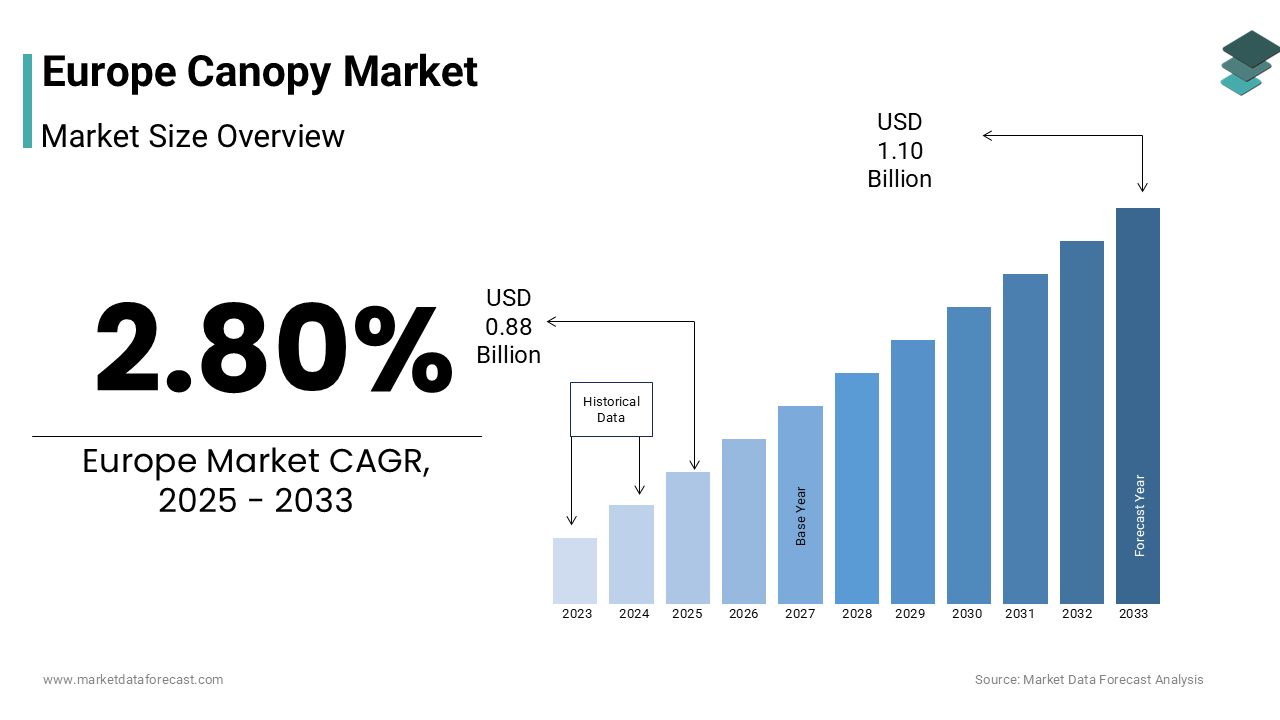
The European canopy market was valued at USD 0.86 billion in 2024, is estimated to reach USD 0.88 billion in 2025, and is projected to reach USD 1.10 billion by 2033, growing at a CAGR of 2.80% during the forecast period from 2025 to 2033. The growth of the European canopy market is driven by the rising adoption of outdoor shading solutions, expanding residential renovation activities, and increased demand for sustainable and weather-resistant materials. Moreover, the growing trend of outdoor leisure spaces and energy-efficient architecture is further stimulating canopy installations across both residential and commercial sectors.
Key Market Trends
- The growing popularity of customizable and retractable canopies across residential and commercial buildings.
- Increasing adoption of eco-friendly and UV-resistant materials, such as recycled polyester and coated fabrics.
- Rising use of canopies in public infrastructure projects, including walkways, parking areas, and recreational zones.
- Integration of smart and motorized canopy systems with remote control and automated weather sensors.
- Steady growth of construction activities and urban landscaping initiatives driving canopy installations.
Segmental Insights
- Based on type, the shade canopies segment dominated the Europe canopy market and accounted for a substantial share in 2024. The segment’s dominance is attributed to their widespread use in gardens, patios, and outdoor restaurants due to their affordability and flexibility.
- Based on material, the polyester cloth segment led the Europe canopy market, capturing 52.9% of the regional market share in 2024. Polyester’s lightweight nature, weather resistance, and cost-effectiveness make it the preferred material for both commercial and domestic use.
- Based on application, the residential segment held the largest share of 59.3% of the Europe canopy market in 2024. The growth of this segment is supported by increasing consumer spending on outdoor living spaces and home beautification projects.
- Based on industry verticals, the construction segment remained prominent, occupying 44.2% of the market share in 2024, driven by infrastructure modernization and sustainable building design trends across European nations.
Regional Insights
The European canopy market demonstrated notable growth across key economies, supported by favorable climate conditions and architectural modernization.
- Germany was the top performer in the European canopy market, accounting for 23.6% of the regional share in 2024, driven by the strong residential construction sector and demand for high-quality outdoor shading solutions.
- France and the United Kingdom are witnessing increasing adoption of retractable and modular canopy systems in both urban and suburban residential areas.
- Italy and Spain continue to expand their canopy usage in hospitality and tourism infrastructure due to the growing culture of outdoor dining and recreation.
- Nordic countries are adopting weather-resilient canopy systems to extend outdoor usability during colder seasons.
Competitive Landscape
The Europe canopy market is moderately fragmented, with leading companies focusing on product innovation, material sustainability, and customized designs to strengthen their presence. Partnerships with architects, builders, and commercial developers are becoming a key strategy for expanding market penetration. Major players in the Europe canopy market include Canopies UK Ltd., Eide Industries, Inc., SUN AIR Awnings, ADVANCED DESIGN AWNINGS & SIGNS, Lawrence Fabric, Inc., Impact Canopies USA, KD KANOPY, Inc., Sunbrella, Dickson Constant, and Serge Ferrari Group.
Europe Canopy Market Size
The Europe canopy market size was valued at USD 0.86 billion in 2024 and is anticipated to reach USD 0.88 billion in 2025 from USD 1.10 billion by 2033, growing at a CAGR of 2.80% during the forecast period from 2025 to 2033.
A canopy is a roof-like covering or structure that provides shelter, shade, or decoration, often made from fabric, metal, or natural materials. These include retractable awnings, pergolas with fabric or polycarbonate roofs, permanent shade sails, and architectural tensile membranes that provide weather protection, thermal regulation, and aesthetic enhancement. Unlike temporary shelters, modern canopies in Europe are engineered to meet stringent building codes for wind resistance, fire safety, and sustainability. According to the European Committee for Standardization, Certain permanent canopy installations may also need to meet relevant Eurocodes, such as aspects of EN 1991, for structural wind loading. Furthermore, as per studies, a portion of EU citizens spent more time in private outdoor areas post 2020, which accelerates retrofitting of balconies and terraces with canopies. This convergence of urban densification, climate adaptation, and lifestyle evolution defines the contemporary Europe canopy market.
MARKET DRIVERS
Urbanisation and Limited Outdoor Living Space in Dense Cities
Rapid urbanisation across Europe has significantly reduced private outdoor areas, which escalates the rise of Europe canopy market. As per the United Nations, a portion of Europe’s population resided in urban areas, with somecities reporting average residential terrace sizes below 8 square meters. This spatial constraint compels homeowners and developers to maximise usability through retractable or modular canopies that transform balconies into all weather lounges. Municipal policies further support adoption. Barcelona's 'Superblock' initiative mandates significant tree-based shade coverage in streets and public plazas, while encouraging businesses and residents to utilize new green spaces to boost commerce and social activity. This urban squeeze, coupled with regulatory encouragement, establishes canopies as essential infrastructure for contemporary European living.
Rising Temperatures and Climate Adaptation Imperatives
Escalating summer heatwaves are driving urgent investment in passive cooling solutions and this propels the expansion of the Europe canopy market. As per the Copernicus Climate Change Service, Europe experienced its hottest summer on record in 2023, with average temperatures 0.83 degrees Celsius above the 1991–2020 baseline. In response, national adaptation strategies now prioritise shade infrastructure. The European Investment Bank (EIB) allocated funds for public canopy installations in schools and elderly care facilities. As per research, fabric canopies reduce surface temperatures beneath them compared to exposed areas, lowering indoor cooling loads. These evidence based outcomes validate canopies not as luxuries but as public health interventions, which accelerates adoption across both private and civic domains.
MARKET RESTRAINTS
Stringent Building Regulations and Permitting Delays
Complex and fragmented building codes across European municipalities create barriers to the Europe canopy market growth. In France, a prior declaration of works is required for structures like canopies with a footprint between 5 and 20 square meters. Apart from these, fire safety standards under EN 13501 classify many common canopy fabrics as non compliant unless treated with flame retardants, increasing material costs, according to sources. In Germany, applications for external structures like canopies in historically protected districts may be rejected due to visual impact concerns, with decisions made at the local or state level according to aesthetic and preservation guidelines. These regulatory hurdles delay projects inflate budgets and discourage small scale adopters despite strong functional demand.
High Initial Investment and Limited Awareness of Long Term Benefits
The upfront cost of high quality canopies remains a key deterrent for the Europe canopy market. This affects residential and small business users across Europe. As per research, the cost of motorised retractable awnings across Southern Europe represents a notable share of annual household spending, especially among middle-income groups. This cost sensitivity is exacerbated by limited understanding of energy savings. According to sources, only a small portion of consumers are aware of the potential energy-saving benefits that such installations can provide during warm seasons. As per research, canopy adoption remains relatively limited in Central and Eastern European countries, which reflects differences in purchasing capacity and housing priorities. Moreover, financing options are scarce. According to sources, very few home improvement financing schemes in Europe currently include canopy installations as part of their eligible categories. Many potential users miss out on significant long-term economic and comfort benefits because they lack access to credit or receive unclear return-on-investment information.
MARKET OPPORTUNITIES
Integration with Smart Home and Building Automation Systems
The convergence of canopy technology with smart building ecosystems offers a potential growth opportunity for the Europe canopy market. Modern motorised canopies now feature sensors and connectivity that enable automatic deployment based on sunlight wind or rain detection, which aligns with EU energy efficiency directives. Companies have launched canopies with AI driven sun tracking that adjust angle and extension in real time by reducing HVAC energy use, as per studies. Furthermore, voice and app control via platforms enhance user convenience by appealing to tech savvy urban dwellers. This digital integration elevates canopies from passive covers to active energy management components.
Expansion of Green Public Procurement for Climate Resilient Infrastructure
Green Public Procurement frameworks is another factor setting up fresh opportunities for the expansion of the Europe canopy market. This prioritises climate adaptation in civic projects. As per broader EU initiatives on green construction and public procurement, shade structures in new or renovated public buildings are encouraged to use recycled or recyclable materials, and contribute to improved thermal performance, reflecting the EU's focus on circularity and building sustainability. In 2023, Sweden’s National Agency for Public Procurement continued to promote sustainable public procurement by providing guidance and criteria, which contracting authorities could use for projects such as shade installations. Similarly, The Netherlands has implemented various localized pilot projects and grassroots initiatives to address urban heat, which tests temporary cooling solutions including sun sails. These initiatives create stable, large scale demand while setting technical benchmarks for private developers. Hence, public procurement is becoming a powerful enabler for market innovation and scale.
MARKET CHALLENGES
Material Sustainability and End of Life Management
The environmental footprint of canopy materials, particularly synthetic fabrics and composite frames, poses a key challenge for the Europe canopy market. According to studies, the higher cost of bio-based acrylics and recycled aluminum is a major obstacle to their adoption, despite their availability as alternatives. Furthermore, the EU’s upcoming Ecodesign for Sustainable Products Regulation will require digital product passports detailing material composition and disassembly instructions by imposing new compliance burdens. Achieving Europe's zero-waste goals for the canopy market depends on the maturation of scalable recycling infrastructure and affordable circular materials.
Vulnerability to Extreme Weather Events and Durability Concerns
Increasing frequency of storms, hail, and high winds further constrains the expansion of the Europe canopy market. These conditions are exposing durability gaps in canopy designs, triggering liability concerns and consumer hesitation. As per the European Severe Storms Laboratory, the number of severe wind events exceeding 100 km/h in Central Europe rose over the decade. In 2023, severe convective storms caused billions of euros in insured losses across Europe, with Italy and Spain experiencing significant damage from events like flash floods, giant hail, and high winds. This performance gap erodes trust, especially among commercial users like café operators who face business interruption risks. High costs prevent the widespread adoption of superior, wind-resistant solutions from high-end manufacturers. Weather volatility will continue to challenge market confidence until resilience is considered a mandatory component, not an optional one.
REPORT COVERAGE
| REPORT METRIC | DETAILS |
| Market Size Available | 2024 to 2033 |
| Base Year | 2024 |
| Forecast Period | 2025 to 2033 |
| Segments Covered | By Type, Material, Application, Industry Vertical and Region. |
| Various Analyses Covered | Global, Regional, & Country Level Analysis; Segment-Level Analysis, Drivers, Restraints, Opportunities, Challenges, PESTLE Analysis, Porter’s Five Forces Analysis, Competitive Landscape, Analyst Overview of Investment Opportunities |
| Regions Covered | UK, France, Spain, Germany, Italy, Russia, Sweden, Denmark, Switzerland, Netherlands, Turkey, Czech Republic, Rest of Europe |
| Key Market Players | Fender Musical Instruments Corporation, Gibson Brands Inc., Yamaha Corporation, Ibanez, The ESP Guitar Company, Samick Guitars, and Cordoba Music Group. |
SEGMENTAL ANALYSIS
By Type Insights
In 2024, the shade canopies segment dominated the Europe canopy market and accounted for substantial share in 2024. Their widespread use in residential terraces, public spaces, and commercial outdoor areas as essential climate adaptation infrastructure has largely attributed to the shade canopies segment. As per the European Environment Agency, millions of private balconies and terraces in the EU are suitable for shade canopy installation, with retrofitting rates rising steadily. Municipal heat action plans further drive adoption. According to Spain’s Ministry for Ecological Transition, a portion of public playgrounds included permanent shade canopies to protect children from UV exposure. Besides, energy efficiency regulations like France’s RT 2020 incentivise external shading by granting thermal performance credits, directly boosting residential demand. The segment’s dominance is also supported by affordability and modularity. This combination of regulatory support, health awareness, and cost effectiveness ensures shade canopies remain the backbone of the European market.
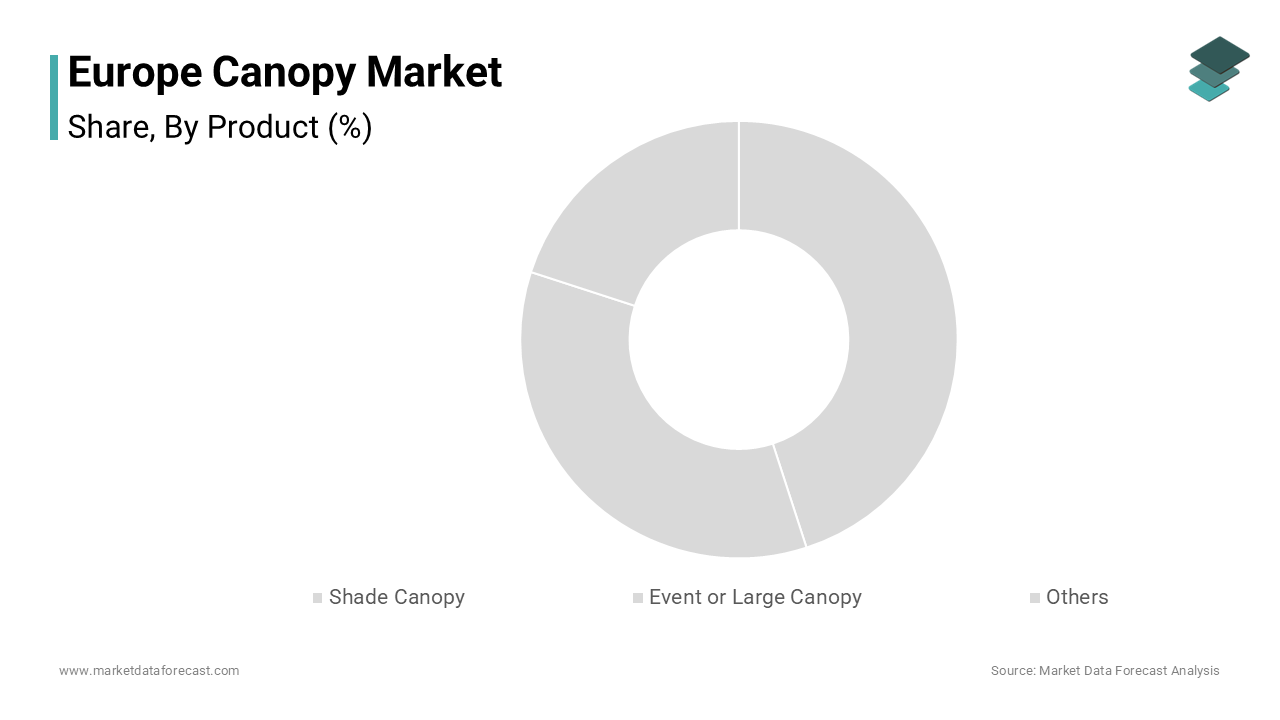
The event or large canopies segment is expected to exhibit a noteworthy CAGR of 11.3% from 2025 to 2033 due to the post pandemic revival of festivals, trade fairs, and outdoor hospitality. According to a 2023 report produced by YOUROPE, the European festival year experienced an overall improvement in ticket sales and logistical issues compared to 2022, following challenges presented by the COVID-19 pandemic. Furthermore, climate volatility necessitates larger shelters. Following the 2023 heatwave, Italy's Ministry of Health introduced new protocols, including a 'heat code' for emergency rooms, to manage the impact of high temperatures. Technological advances also contribute. Modern event canopies now feature rapid deployment systems and fire retardant ETFE membranes compliant with EN 13501 by reducing setup time, according to studies. So, this segment’s growth is structurally anchored in cultural, commercial, and climatic imperatives.
By Material Insights
The polyester cloth segment led the Europe canopy market by capturing 52.9% share of the regional market in 2024. Factors such as its optimal balance of cost performance and versatility across residential and light commercial applications has majorly contributed to the growth of polyester cloth segment. As per research, notable millions of square meters of acrylic coated polyester fabric were used in canopy production, primarily for retractable awnings and pergola covers. Its dominance is also due to UV resistance colourfastness and affordability, standard grades cost less than high end alternatives like PTFE while offering several years of service life. Apart from these, manufacturers have developed recyclable mono material variants, addressing circularity concerns. The material’s ease of fabrication also enables custom shapes and prints, supporting aesthetic personalisation in urban settings. This blend of economic accessibility, regulatory alignment, and design flexibility secures polyester cloth as the mainstream choice across Europe.
The ETFE (ethylene tetrafluoroethylene) segment is on the rise and is expected to be the fastest growing segment in the global market by witnessing a CAGR of 14.7% during the forecast period owing to its exceptional light transmission durability and sustainability credentials in high end architectural projects. As per the European Membrane Structures Association, ETFE usage in permanent canopies grew, primarily in transport hubs, sports arenas, and green buildings. Its high light transmittance of up to 95% can significantly reduce the need for artificial lighting, leading to energy savings. Furthermore, ETFE is recyclable and weighs notably less than glass by lowering structural support costs and embodied carbon. The EU's Level(s) framework, which incentivizes transparency and recyclability, is driving the adoption of ETFE in public infrastructure projects where long-term performance is prioritized over upfront costs.
By Application Insights
The residential application segment held the largest share of 59.3% of the Europe canopy market. The dominance of the residential application segment is because of the continent’s strong culture of private outdoor living and policy driven home retrofitting. As per sources, portion of EU households own or rent dwellings with balconies terraces or gardens, creating a vast addressable base. National energy efficiency schemes amplify adoption. Urban densification further intensifies demand. In some cities, a share of apartments include balcony canopy provisions in building permits according to municipal planning departments. Consumer trends also play a role. The rise of DIY installation kits and e commerce platforms like ManoMano has lowered entry barriers, particularly in Southern Europe where outdoor living is culturally embedded. This confluence of policy, urban form, and lifestyle sustains residential dominance.
The non residential canopy segment is likely to experience the fastest CAGR of 10.8% from 2025 to 2033. The growth of non residential canopy segment is fuelled by public health mandates, green building codes, and the outdoor economy. In Spain, the COOLSCHOOLS project is a research and innovation initiative that focuses on developing nature-based climate shelters in schools across several European cities, including Barcelona, building upon existing pilot programs from 2021 onwards. Commercial hospitality also contributes significantly. Following the COVID-19 pandemic, many Italian restaurants expanded their outdoor seating to accommodate social distancing rules. Besides, the EU Taxonomy for Sustainable Activities now classifies external shading in public buildings as a green investment, unlocking institutional financing. Over 400000 public buildings slated for climate adaptation retrofits by 2030 according to the European Commission. So, non residential demand is structurally poised for sustained acceleration.
By Industry Verticals Insights
The construction segment remained prominent in the Europe canopy market by occupying 44.2% share in 2024. As per research, a portion of canopy installations were executed as part of larger building projects rather than standalone retrofits. Regulatory drivers are pivotal. Moreover, Germany’s EnEV energy ordinance requires external shading to achieve compliance in commercial developments. Major construction firms like Vinci and Skanska now include canopy subcontracting as standard in tender packages, streamlining procurement. The segment also benefits from BIM integration. Canopy manufacturers provide digital models compatible with Revit and ArchiCAD, which enables precise coordination during design phases. This institutionalisation within the construction workflow ensures consistent volume and technical alignment with Europe’s decarbonisation agenda.
The hospitality segment is anticipated to witness the fastest CAGR of 12.5% due to the permanent expansion of outdoor dining and guest experience enhancement. As per research, outdoor seating capacity in EU restaurants and hotels increased and is considered an expectation rather than a pandemic adaptation. Luxury resorts in Spain and Greece are investing in high end retractable systems with integrated lighting and heating. Furthermore, municipal regulations in cities like Paris and Lisbon now permit year round outdoor service only if weather protection is installed, creating compliance driven demand. The renaissance of Europe’s hospitality sector, driven by a focus on experiential travel, has made canopies an essential part of the infrastructure to provide comfort and ambiance.
REGIONAL ANALYSIS
Germany Canopy Market Analysis
Germany was the top performer in the Europe canopy market by accounting for 23.6% share in 2024. Its rigorous energy efficiency policies and advanced manufacturing ecosystem has majorly contributed to the dominance of Germany. The country’s KfW Bank disbursed funds for residential shading retrofits under its climate protection programme, directly stimulating demand. Germany is also home to leading canopy manufacturers, which export engineered systems across Europe. This fusion of regulatory foresight, industrial capability, and performance validation strengthens Germany’s dominance in both innovation and deployment scale.
France Canopy Market Analysis
France was the second largest in the Europe canopy market and captured 19.6%. The growth of France is attributed to its RT 2020 and RE2020 building regulations that mandate solar protection in all new constructions. In 2023, the French Housing Agency (Anah) funded the renovation of notable number of homes through MaPrimeRénov. France's solar canopy program is a mandate for large commercial and industrial parking lots. The country’s strong culture of café terraces further amplifies commercial demand. Furthermore, France hosts major fabric producers like Dickson Constant, ensuring local material supply and R&D in recyclable textiles. Municipal heatwave response plans now require shade coverage in all new public playgrounds and bus stops, creating institutional pipelines. This blend of regulatory stringency, cultural practice, and domestic industry sustains France’s pivotal role in the regional market.
Italy Canopy Market Analysis
Italy is growing steadily in the European canopy market with high outdoor living intensity and climate vulnerability. As per ISTAT, 82 percent of Italian households use balconies or terraces daily during summer months, driving residential retrofitting. The Italian government's 2025 heat emergency protocol focused on measures to protect outdoor workers and activate special "heat codes" in hospital emergency rooms for vulnerable people. Italy’s hospitality sector is equally influential. Southern regions like Sicily and Puglia lead adoption due to extreme summer temperatures, with local governments offering subsidies for residential shading. Furthermore, Italian design firms integrate canopies as aesthetic elements in luxury architecture, which blends function with Mediterranean style. This synergy of climate urgency, lifestyle, and design ensures Italy’s robust market presence.
Spain Canopy Market Analysis
Spain is another key region in the Europe canopy market, with intense solar exposure and proactive climate adaptation policies. Some local governments in Spain, such as in Barcelona and Zaragoza, are independently implementing urban climate adaptation strategies that include increasing shade infrastructure. In tourism hotspots like Barcelona and Valencia, municipal bylaws now require all new hospitality venues to include weather resistant canopies for outdoor seating. Apart from these, Spain’s high rate of apartment living, fuels residential demand for balcony solutions. Local manufacturers have developed UV reflective fabrics tailored to Iberian conditions. This combination of environmental necessity, regulatory action, and urban form positions Spain as a high growth market with deep structural drivers.
United Kingdom Canopy Market Analysis
The United Kingdom is predicted to grow in the European canopy market due to post pandemic outdoor hospitality expansion and evolving building standards. As per research, outdoor dining areas across England have expanded considerably in recent years, with many establishments incorporating permanent canopies to ensure comfort and flexibility in all weather conditions. According to sources, updated housing regulations that emphasize solar overheating control have also encouraged greater interest in residential canopy solutions. As per research, new urban design initiatives in London have further promoted the inclusion of shaded outdoor zones within public spaces, driving demand at the community level. According to sources, recent periods of unusually warm weather have shifted public perception, leading to stronger consumer interest in shading installations. As per research, with ongoing housing development targets and climate-conscious planning efforts, the United Kingdom canopy market is gradually evolving from a niche offering to a growing mainstream trend.
COMPETITIVE LANDSCAPE
The Europe canopy market features a competitive landscape shaped by technological capability regulatory compliance and regional specialisation. German and Italian manufacturers dominate the high end segment with engineered solutions that meet stringent wind fire and thermal standards while Southern European firms focus on cost effective residential models. Competition is not solely price based but revolves around durability smart functionality and sustainability credentials. Large players like Warema and Hunter Douglas leverage scale and integration with building systems whereas niche designers compete through aesthetic customisation and heritage compatibility. The entry of smart home companies offering basic motorised shades adds pressure on mid tier brands. Public procurement creates opportunities but demands rigorous certification and local presence. Overall rivalry is intensifying as climate adaptation becomes mandatory yet fragmented regulations and material sustainability challenges constrain uniform growth. Innovation in circular design and digital services now defines competitive advantage.
KEY MARKET PLAYERS
A few of the major companies in the europe canopy market include
- Canopies UK Ltd.
- Eide Industries, Inc.
- SUN AIR Awnings
- ADVANCED DESIGN AWNINGS & SIGNS
- Lawrence Fabric, Inc.
- Impact Canopies USA
- KD KANOPY, Inc.
- Sunbrella
- Dickson Constant
- Serge Ferrari Group
Top Players in the Europe Canopy Market
Warema Renkhoff SE
Warema Renkhoff SE is a leading German manufacturer of external shading systems including retractable canopies awnings and pergolas with integrated smart controls. The company contributes significantly to the global market by pioneering motorised and sensor driven canopy solutions that align with energy efficiency standards. The company also expanded its production facility in Marktheidenfeld Germany to meet rising demand from Southern Europe and introduced a new line of recyclable acrylic fabrics developed in partnership with European textile innovators strengthening its commitment to circular design.
Markilux GmbH and Co KG
Markilux is a renowned German brand specialising in high end retractable canopies and terrace systems for residential and luxury hospitality applications. The company plays a vital role in the global canopy market by setting benchmarks in design engineering and weather resistance. It also collaborated with architects across France and Italy to develop custom canopy solutions for heritage buildings ensuring compliance with strict urban conservation rules. Besides Markilux strengthened its digital presence by launching an augmented reality app allowing customers to visualise canopy installations on their properties enhancing pre purchase confidence and engagement.
Hunter Douglas Europe BV
Hunter Douglas Europe BV is a major player offering architectural shading solutions including tensile canopies and large scale external cover systems for commercial and public infrastructure. The company contributes globally through its focus on sustainable materials and energy performance. The initiatives position Hunter Douglas at the intersection of public policy sustainability and large scale urban adaptation driving long term market relevance.
Top Strategies Used by the Key Market Participants
Key players in the Europe canopy market focus on product innovation through smart integration weather resilience and sustainable materials to meet regulatory and consumer demands. Companies invest in R and D to develop fabrics with higher UV resistance recyclability and fire safety compliance under EN standards. Strategic partnerships with architects urban planners and public agencies secure large scale institutional projects. Digital transformation is evident in augmented reality visualisation apps building automation compatibility and AI driven sun tracking systems. Geographic expansion targets Southern and Eastern Europe, where heat vulnerability and outdoor culture drive adoption. Furthermore, firms align with EU Green Deal objectives by obtaining environmental product declarations and participating in circular economy initiatives. These strategies collectively enhance differentiation compliance and customer value in a technically demanding market.
MARKET SEGMENTATION
This research report on the europe canopy market has been segmented based on the following categories.
By Type
- Shade Canopy
- Event or Large Canopy
- Others
By Material
- PTFE
- ETFE
- PVC
- Polyester Cloth
- Others
By Application
- Residential
- Non-residential
By Industry verticals
- Hospitality
- Event Management
- Construction
- Automotive
- Others
By Country
- UK
- France
- Spain
- Germany
- Italy
- Russia
- Sweden
- Denmark
- Switzerland
- Netherlands
- Turkey
- Czech Republic
- Rest of Europe