- Product Description Description
- Table of Contents TOC
- List of Table & Figure LOT
- Get Free Sample PDF Sample PDF
Market Size, 2025
$159.9 MnMarket Estimate, 2026
$162.1 MnMarket Forecast, 2034
$180.7 MnCAGR, 2026–2034
1.37%Executive Summary: Europe Caramel Colour Market
- Market Scope: Comprehensive analysis of the Europe caramel colour market covering product classes, application segments, country-level dynamics, growth drivers, restraints, and competitive landscapes.
- Market Valuation: Valued at USD 159.92 million (2025), estimated at USD 162.11 million (2026), and projected to reach USD 180.75 million by 2034, registering a steady CAGR of 1.37% during the forecast period (2026–2034).
- Primary Growth Drivers: High consumer preference for visual appeal and consistent coloring in food and beverages, surging demand from bakery, confectionery, and beverage sectors, rising disposable incomes, and technological advancements in food processing.
Key Market Segment Metrics (2026–2034)
| Category | Leading Segment (2025 Position) | Fastest-Growing Segment |
|---|---|---|
| By Type | Class IV Caramel Colour (dominant volume share driven by extensive use in carbonated soft drinks and colas) | Class I & Class III Caramel Colour (driven by clean-label demands in bakery and confectionery products) |
| By Application | Soft Drinks & Alcoholic Beverages (captures the largest consumption share across European markets) | Bakery Goods & Seasonings (expanding steadily through processed food innovations and packaged snacks) |
| By Region / Country | Germany (leads the European market, followed closely by France and the U.K.) | Eastern and Southern European hubs (growing via expanding food manufacturing and processing investments) |
Major Market Players & Market Structure
Market Structure: Moderately consolidated global food coloring and ingredient processing landscape featuring specialized chemical color houses and multinational ingredients suppliers competing on regulatory compliance, shade consistency, and custom formulations.
Key Companies: AIPU Food Industry Co., Ltd., Sethness Caramel Colour, DDW The Colour House, Givaudan, Asahi Group Foods, Ltd., Three-A Resources Bhd., KF Specialty Ingredients, Guangzhou Shuangqiao Co., Ltd., Philippine Aminosan Corporation, and Alliance Organics
 Download Free Sample Report
Europe Caramel Colour Market Size
The Europe caramel color market size was valued at USD 159.92 million in 2025 and is expected to reach USD 180.75 million by 2034 from USD 162.11 million in 2026. The market is growing at a CAGR of 1.37%.
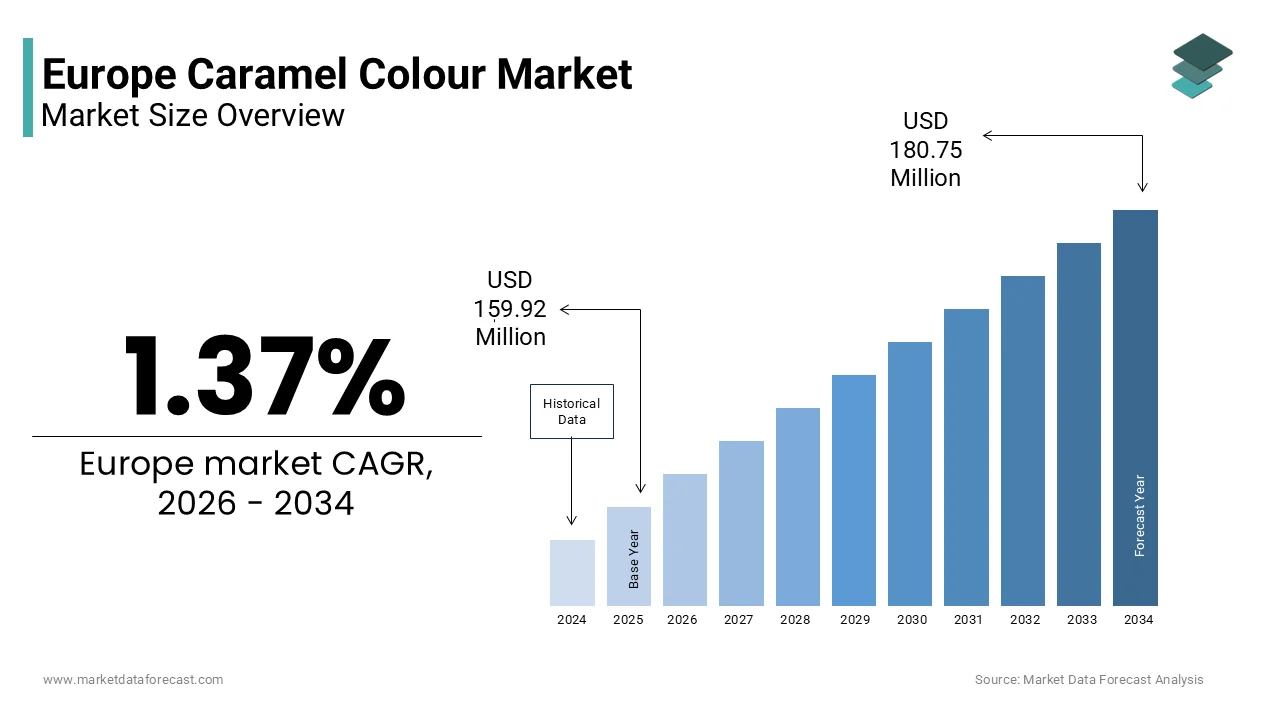
The Europe caramel colour market comprises the production and distribution of water-soluble food additives derived from the controlled heat treatment of carbohydrates primarily used to impart brown hues in beverages and baked goods. According to the European Food Safety Authority, caramel colours are classified into four classes, E150a, E150b, E150c, and E150d, according to the reactants used during manufacture. This market is distinct due to stringent regulatory frameworks that classify caramel colours into four classes based on reactants used during manufacturing. As per European Commission Regulation No 1333/2008, caramel colours are authorised food colours subject to specified conditions of use in food categories. The industry relies heavily on sugar beet and wheat starch sourced locally, which supports regional agricultural economies while minimizing import dependency. According to Eurostat, the European Union harvested more than 100 million metric tons of sugar beet in 2024, providing a substantial agricultural raw material base. These agricultural metrics directly influence production capacity and cost structures within the Europe caramel colour market. Furthermore, the shift toward clean-label ingredients has prompted manufacturers to innovate with natural processing methods. This evolution aligns with consumer preferences for transparency and sustainability, making the market dynamic and responsive to dietary trends while maintaining its essential function in visual appeal for processed foods.
MAJOR DRIVERS
Sustained Demand from Beverage Industry for Visual Consistency
The enduring preference for dark-coloured soft drinks and beers is a key factor propelling the expansion of the Europe caramel colour market by ensuring steady industrial procurement volumes. According to the British Soft Drinks Association, UK soft drink volume sales increased by 2.9% in 2023, demonstrating continued demand for soft drinks. This substantial volume requires consistent coloring agents to maintain brand recognition and consumer expectation of product appearance. The statistical stability in beverage production directly correlates with predictable demand for Class IV caramel colour, which is predominantly used in acidic environments like colas. Additionally, the craft beer sector has expanded rapidly, as reported by The Brewers of Europe, which noted continued development of independent brewing across Europe. Many of these breweries utilize caramel colour to achieve desired amber and stout hues without altering flavor profiles significantly. This dual demand from mass-market sodas and premium artisanal beers creates a resilient consumption base. Manufacturers benefit from long-term contracts with beverage giants who prioritize supply reliability over price fluctuations. Consequently, the Europe caramel colour market enjoys sustained revenue streams driven by the non-negotiable visual standards of liquid refreshments that define consumer purchase decisions in retail and hospitality channels.
Regulatory Acceptance of Specific Caramel Classes in Food Applications
Clear regulatory guidelines permitting the use of certain caramel classes in diverse food matrices support the Europe caramel colour market by reducing compliance uncertainty for manufacturers. According to the European Food Safety Authority, its safety re-evaluation concluded that caramel colours E150a, E150b, E150c, and E150d were not genotoxic or carcinogenic, and established a group acceptable daily intake of 300 mg per kg body weight per day, with a more restrictive 100 mg per kg body weight per day for E150c. This scientific validation allows food producers to incorporate these colours without fear of future bans or restrictions, which stabilizes investment in product development. The statistical approval of these classes covers a wide range of applications, including breads, confectionery, and ready meals, which constitute a large portion of the European diet. As per the European Commission, caramel colours E150a through E150d are authorised food colours subject to conditions of use for relevant food categories. This widespread application ensures that demand is not limited to a single sector but spread across multiple food categories. Furthermore, the distinction between permitted and restricted classes helps manufacturers optimize formulations for specific pH levels and processing conditions. This technical clarity enables efficient production planning and reduces waste associated with trial and error. Thus, the Europe caramel colour market benefits from a supportive regulatory environment that facilitates innovation and broadens the scope of permissible uses in everyday food items.
MARKET RESTRAINTS
Consumer Perception Linking Caramel Colour to Health Risks
Negative consumer associations with artificial additives and potential health concerns is a significant restraint for the Europe caramel colour market growth by driving demand toward natural alternatives. According to the European Food Safety Authority, the available toxicological evidence indicated that caramel colours were not genotoxic or carcinogenic, although specific acceptable daily intake limits were established. This evidence indicates that consumer concerns about caramel colour should be distinguished from the regulatory scientific assessment of its safety. The statistical decline in consumer trust directly translates to reduced specification of caramel colours in new product launches, particularly in segments targeting health-conscious demographics. Additionally, social media campaigns highlighting the presence of 4-methylimidazole in Class III and IV caramels have amplified public scrutiny. As per the European Food Safety Authority, 4-methylimidazole is present in E150c and E150d, and EU specifications establish maximum levels for its presence in these caramel colours. This reputational damage limits market growth as manufacturers face pressure to remove caramel colours even when they are legally safe. Retailers also respond by promoting free-from claims, which further marginalizes traditional colouring agents. Consequently, the Europe caramel colour market struggles to maintain its share in premium segments where transparency and naturalness are key selling points, resulting in a gradual erosion of volume in high-visibility categories.
Stringent Maximum Limits for Contaminants in Production Processes
Strict regulatory caps on process-related contaminants such as 4-methylimidazole and acrylamide constrain the Europe caramel colour market expansion by increasing production costs and limiting formulation flexibility. According to the European Food Safety Authority, EU specifications already establish maximum levels for 4-methylimidazole in E150c and E150d. These technical adjustments raise operational expenses as producers must implement additional filtration and monitoring steps to ensure compliance. The statistical burden of compliance is evident, as industry data shows a 15% increase in quality control costs for major caramel producers in 2024. Furthermore, the need to reduce contaminant levels can affect the intensity and stability of the colour produced, forcing formulators to use higher quantities to achieve desired shades. This inefficiency increases raw material consumption and reduces overall profit margins. Additionally, smaller manufacturers may lack the capital to upgrade facilities, leading to market consolidation and reduced competition. As per the European Commission, EU legislation establishes purity specifications for caramel colours, including limits for certain manufacturing by-products. These constraints limit the ability of the Europe caramel colour market to expand into new applications where cost sensitivity is high, thereby restricting growth potential despite stable demand in traditional sectors.
MARKET OPPORTUNITIES
Expansion into Plant-Based Meat Alternatives for Visual Appeal
The rapid growth of plant-based meat substitutes is a significant opportunity for the Europe caramel colour market by providing a solution for achieving realistic cooked meat appearances. According to ProVeg International, plant-based food sales across six major European markets reached EUR 5.4 billion in 2023, representing a 5.5% increase from 2022. Caramel colour offers a cost-effective and stable option for creating the Maillard reaction effect without actual cooking, which appeals to ready-to-eat product developers. The statistical rise in vegetarian and flexitarian populations drives this demand as consumers expect visual cues that align with traditional meat experiences. As per ProVeg International, plant-based retail food sales in major European markets continued to demonstrate substantial consumer demand, with Germany reaching EUR 1.68 billion in 2024. This trend allows caramel colour suppliers to diversify beyond beverages and enter the alternative protein sector. Furthermore, the ability of caramel colour to withstand high-temperature processing makes it ideal for extruded meat analogues. Manufacturers can leverage this functional benefit to secure contracts with emerging food-tech companies. Consequently, the Europe caramel colour market can capture new revenue streams by positioning its products as essential tools for sensory enhancement in the evolving landscape of sustainable protein sources.
Development of Clean-Label Caramel Colours from Organic Sources
The rising demand for organic-certified ingredients offers a promising opportunity for the Europe caramel colour market to differentiate products and command premium pricing. According to the Research Institute of Organic Agriculture, European organic food markets continued to expand, reflecting sustained consumer and producer interest in certified organic products. Developing caramel colours from organic sugar beet or cane syrup allows manufacturers to meet this demand while adhering to strict organic regulations. The statistical preference for organic labels enables brands to charge up to 25% more for certified products, as noted by the European Organic Certifiers Council. This margin expansion incentivizes investment in dedicated organic production lines that avoid synthetic reactants. Additionally, clean-label caramel colours appeal to manufacturers of baby food and health snacks who require minimal processing aids. By offering transparent and sustainably sourced options, suppliers can build loyalty with premium brands. This strategic shift aligns with broader sustainability goals and enhances brand equity. Thus, the Europe caramel colour market can leverage organic certification to access high-value niches that are less price-sensitive and more focused on ethical and health attributes.
MARKET CHALLENGES
Volatility in Raw Material Prices Due to Agricultural Fluctuations
Fluctuating costs of sugar beet and wheat starch is a significant challenge to the Europe caramel colour market by squeezing profit margins and disrupting pricing strategies. According to Eurostat, the European Union harvested more than 100 million metric tons of sugar beet in 2024, demonstrating the scale of the agricultural supply base for sugar beet-related industries. This surge in input costs forces manufacturers to either absorb losses or pass them on to customers who may resist price hikes. The statistical volatility in agricultural commodities makes long-term contracting difficult as suppliers struggle to guarantee fixed rates. Additionally, energy costs, which are critical for the heating process involved in caramel production, have remained high. These combined cost pressures reduce competitiveness against cheaper imports from regions with lower production expenses. Smaller producers may face liquidity issues if they cannot hedge effectively against price swings. Furthermore, inconsistent raw material quality affects yield and colour consistency, requiring additional processing adjustments. Consequently, the Europe caramel colour market faces ongoing financial strain that limits investment in innovation and expansion while threatening the viability of marginal operators in a cost-sensitive industry.
Competition from Natural Colouring Alternatives Like Beetroot and Carrot
Intense competition from natural colouring agents such as beetroot juice and carrot extract further challenges the Europe caramel colour market expansion by offering perceived healthier and cleaner options. According to the European Commission, beetroot red, E162, is an authorised food colour under the EU food additive framework, demonstrating the availability of alternative colouring agents within the European regulatory system. Beetroot provides a red-to-brown hue depending on concentration and pH, while carrot offers orange-to-yellow tones that can be blended for brown effects. The statistical shift toward these alternatives is driven by consumer preference for ingredients listed as vegetables rather than additives. Although natural colours may have lower stability or higher cost, their marketing appeal is strong. Manufacturers of caramel colour must invest in research to improve the perception of their products or risk losing shelf space. Consequently, the Europe caramel colour market faces a structural threat as the definition of acceptable ingredients evolves toward whole food sources, leaving synthetic or processed colours vulnerable to displacement.
REPORT COVERAGE
| REPORT METRIC | DETAILS |
| Market Size Available | 2025 to 2034 |
| Base Year | 2025 |
| Forecast Period | 2026 to 2034 |
| CAGR | 1.37% |
| Segments Covered | By Type, Application, and Region |
| Various Analyses Covered | Global, Regional, & Country Level Analysis; Segment-Level Analysis; DROC, PESTLE Analysis; Porter’s Five Forces Analysis; Competitive Landscape; Analyst Overview of Investment Opportunities |
| Regions Covered | UK, France, Spain, Germany, Italy, Russia, Sweden, Denmark, Switzerland, Netherlands, Turkey, and the Czech Republic |
| Market Leaders Profiled | AIPU Food Industry Co., Ltd., Sethness Caramel Colour, DDW The Colour House, Givaudan, Asahi Group Foods, Ltd., Three-A Resources Bhd., KF Specialty Ingredients, Guangzhou Shuangqiao Co., Ltd., Philippine Aminosan Corporation, and Alliance Organics |
SEGMENTAL ANALYSIS
By Type Insights
The class IV caramel color segment led the market by holding the major share of the European market in 2025 due to its exceptional stability in acidic environments and widespread use in carbonated soft drinks. The leadership of Class IV caramel color is further driven by its indispensable role in maintaining the visual identity of cola brands, which constitute a major portion of beverage sales. According to academic literature, E150d, also known as sulphite ammonia caramel, is principally used in cola beverages and represents a major application for caramel colour. Class IV caramel is uniquely suited for these low-pH applications as it does not precipitate or fade over time, ensuring product consistency on shelves. The statistical correlation between cola production volumes and Class IV usage demonstrates that market dominance is tied directly to beverage industry output. Furthermore, major multinational beverage companies have long-standing specifications that mandate Class IV for their flagship products, locking in demand. As per the European Commission, caramel colours E150a through E150d are authorised food colours subject to applicable food category conditions. This entrenched preference creates high barriers for alternative colours in this specific application. Consequently, the Europe caramel colour market sees Class IV as the primary revenue generator due to the sheer scale of soft drink manufacturing and the lack of viable substitutes that offer similar stability and cost efficiency in acidic matrices.
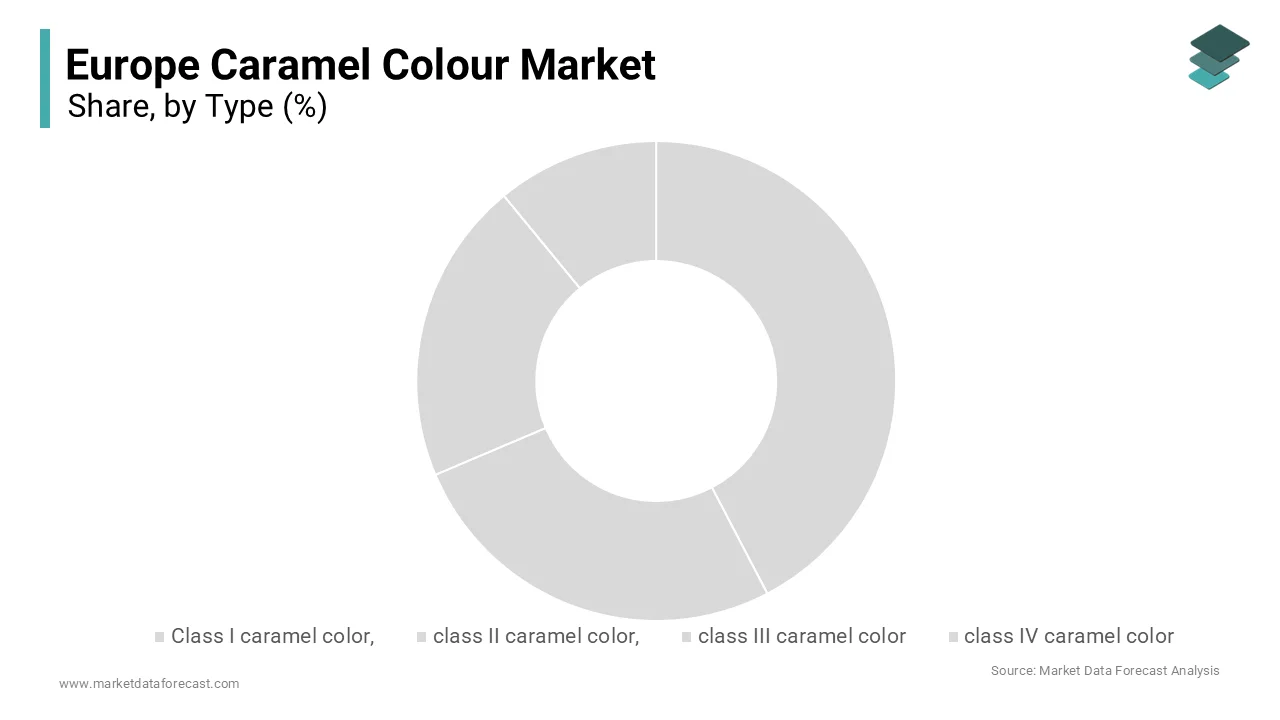
However, the class I caramel color segment is the fastest-growing segment in the Europe caramel colour market and is estimated to expand at a CAGR of 5.3% over the forecast period owing to the clean-label trends and its acceptance in organic food products and consumer demand for additives made without ammonia or sulfites, which aligns with clean-label preferences. According to the European Commission, E150a is plain caramel and is included among authorised food colours under the EU food additive framework. Class I caramel is produced solely by heating carbohydrates, making it suitable for applications where plain caramel is required. The statistical rise in organic certification drives formulators to consider Class I caramel where applicable. This shift is evident in the bakery and confectionery sectors where parents seek safer options for children. This regulatory and consumer alignment creates a niche but potentially expanding market. Manufacturers are investing in specialized production lines to meet this demand, ensuring high purity and traceability. Consequently, the Europe caramel colour market sees Class I as a growth opportunity for premium segments where health perceptions outweigh cost considerations, driving innovation and value addition.
By Application Insights
The soft drinks segment accounted for the major share of the global market in 2025. The growth of the soft drinks segment in the European market can be attributed to the massive volume of carbonated beverage consumption, the specific technical requirements of cola formulations and the enduring popularity of cola that requires substantial amounts of caramel colour for each liter produced. According to the British Soft Drinks Association, UK soft drink volume sales increased by 2.9% in 2023, demonstrating continued demand within the category. This high per capita consumption translates into substantial demand for caramel colour as each bottle requires precise dosing for brand consistency. The statistical magnitude of this volume ensures that soft drinks remain the primary outlet for caramel colour producers. Furthermore, the concentration of major beverage manufacturers in Europe creates centralized procurement hubs that drive large-scale contracts. As per academic literature, caramel colours are widely used in soft drinks, with E150d principally used in cola beverages. This structural advantage means that fluctuations in the soft drink sector have an outsized impact on the overall market. Producers prioritize capacity for Class IV caramel to serve this segment, ensuring supply security. Consequently, the Europe caramel colour market relies on the soft drinks sector for baseline revenue stability, making it the most critical application area for industry participants.
On the other end, the alcoholic beverages segment is the fastest-growing application segment in the Europe caramel colour market and is estimated to record a notable CAGR of 6.4% over the forecast period owing to the craft beer revolution, premium spirit production and the proliferation of craft breweries that use caramel colour to achieve diverse amber, stout, and porter hues. According to the German Brewers Association, breweries in Germany sold approximately 8.4 billion liters of beer in 2023 although sales declined by 4.5% from the previous year. Many producers experiment with different malt bills and add caramel colour to adjust final product appearance without altering flavor significantly. The statistical rise in brewery count directly correlates with increased demand for smaller-batch supplies of high-quality caramel. Additionally, consumer interest in visually distinct beers drives innovation in color shades. Suppliers are responding by offering specialized grades for brewing applications. Consequently, the Europe caramel colour market captures new growth from the artisanal alcohol sector, which values customization and quality over mass production efficiency.
REGIONAL ANALYSIS
Germany Market Analysis
Germany held the largest share of the Europe caramel colour market in 2025 and is likely to remain one of the leading markets for caramel colour in Europe over the next few years because of its large brewing industry and broad food manufacturing base. Germany holds a prominent position in the Europe caramel colour market as a major producer and consumer driven by its robust brewing and confectionery industries. The country is home to some of the world’s largest beer producers who utilize significant volumes of caramel colour for dark lagers and bocks. According to the German Brewers Association, breweries in Germany sold approximately 8.4 billion liters of beer in 2023, while around 1,500 breweries operated in the country. This substantial domestic consumption supports local caramel manufacturers who supply both bulk and specialized grades. Additionally, Germany’s strong confectionery sector, including chocolate and biscuit makers, drives demand for Class I and III caramels. The country’s strict adherence to food safety standards also makes it a hub for high-quality caramel production for export. Furthermore, Germany’s central location facilitates distribution to neighboring markets. These factors ensure that Germany remains a key pillar in the Europe caramel colour market through industrial scale and quality leadership.
France Market Analysis
France is likely to maintain a high-value position in the European caramel colour market over the next few years because of its large bakery sector and internationally important spirits industry. France occupies a significant niche in the Europe caramel colour market characterized by high demand from the bakery and spirits sectors, particularly cognac and armagnac production. The country’s culinary tradition emphasizes visual appeal in baked goods and aged spirits, which drives consistent usage of caramel colours. Additionally, the spirits industry is a major consumer as cognac producers use caramel to standardize the appearance of aged blends. France’s focus on gastronomy and luxury goods ensures that demand is driven by quality rather than just volume. Furthermore, the country has a growing organic food sector, which favors Class I caramel. These dynamics position France as a high-value market in the Europe caramel colour market driven by tradition and premiumization.
United Kingdom Market Analysis
The United Kingdom is likely to remain a mature and resilient market for caramel colour over the next few years because of its large soft drinks industry and continued demand for processed foods. The United Kingdom represents a mature and stable segment in the Europe caramel colour market driven by high consumption of soft drinks and processed foods despite post-Brexit trade adjustments. The country remains a key market for multinational beverage companies who maintain large production facilities locally. According to the British Soft Drinks Association, UK soft drink volume sales increased by 2.9% in 2023, demonstrating continued market demand. This volume sustains demand for Class IV caramel colour despite health trends. Additionally, the UK has a strong savory food sector, including sauces and gravies, which use caramel for browning. The country’s regulatory framework aligns closely with EU standards, ensuring continuity in ingredient specifications. Furthermore, the UK is a hub for food innovation where new product development drives trial of different caramel types. These factors ensure that the UK remains a critical market in the Europe caramel colour market through volume and innovation.
Italy Market Analysis
Italy is likely to retain a distinctive position in the Europe caramel colour market over the next few years because of its established beverage, confectionery, bakery, and processed food industries. Italy holds a specialized position in the Europe caramel colour market driven by its espresso coffee culture and confectionery industry, which utilize caramel for color and flavor enhancement. The country’s love for dark-roasted coffee and chocolate-based desserts creates steady demand for specific caramel grades. Additionally, the confectionery sector, including gelato and chocolate producers, uses caramel for visual appeal. Italy’s focus on traditional recipes means that caramel is often used in artisanal contexts. Furthermore, the country is a key exporter of processed food products, which embeds caramel colour in international supply chains. These cultural and industrial factors ensure that Italy remains a distinctive and stable market in the Europe caramel colour market.
Spain Market Analysis
Spain is likely to be a growing market for caramel colour over the next few years because of sustained tourism activity and demand for beverages and processed foods. Spain represents a growing segment in the Europe caramel colour market driven by increasing soft drink consumption and a vibrant tourism-led hospitality sector. The country’s warm climate supports year-round demand for refreshing beverages, which often contain caramel colour. Additionally, the hospitality industry, which serves millions of tourists annually, drives bulk procurement of colored beverages and sauces. According to the Spanish National Statistics Institute, hotel establishments recorded 363.6 million overnight stays in 2024, representing an increase of 4.9% compared with 2023. Spain’s agricultural base also supports local sugar beet production, which feeds into caramel manufacturing. Furthermore, the country is seeing a rise in craft beer production, which adds to demand. These factors position Spain as a dynamic growth market in the Europe caramel colour market driven by lifestyle and tourism.
COMPETITIVE LANDSCAPE
The competition in the Europe Caramel Colour Market is characterized by a mix of established multinational corporations and specialized regional producers who compete on quality consistency and regulatory compliance. Large players leverage their global scale and technical expertise to dominate the beverage sector while smaller firms focus on niche markets such as organic bakery products and artisanal spirits. The barrier to entry is moderate due to the need for specialized heating equipment and strict adherence to European food safety regulations which require significant capital investment. Competitive intensity is high as companies strive to differentiate through sustainability credentials and clean label certifications that appeal to modern consumers. Price competition remains relevant in bulk segments but value added services such as custom formulation and technical support are becoming key differentiators. Regulatory changes regarding contaminants like 4 methylimidazole further shape the competitive landscape by favoring companies with advanced purification technologies. This dynamic environment forces participants to continuously innovate and optimize operations to maintain profitability and market relevance in the face of shifting consumer preferences and stringent legal requirements.
KEY MARKET PLAYERS
Some of the notable companies in the Europe caramel colour market are
- AIPU Food Industry Co., Ltd.
- Sethness Caramel Colour
- DDW The Colour House
- Givaudan
- Asahi Group Foods, Ltd.
- Three-A Resources Bhd.
- KF Specialty Ingredients
- Guangzhou Shuangqiao Co., Ltd.
- Philippine Aminosan Corporation
- Alliance Organics
Top Players in the Market
- DDW The Color House maintains a strong presence in the Europe Caramel Colour Market through its specialized focus on high quality liquid and powder caramel colours for diverse food applications. The company leverages advanced manufacturing technologies to produce consistent and stable colours that meet stringent European safety standards. Recently DDW expanded its production capacity in Germany to enhance supply chain efficiency and reduce lead times for regional customers. This investment allows the firm to respond quickly to fluctuating demand from beverage and bakery sectors. Their commitment to sustainability includes sourcing raw materials from certified suppliers and optimizing energy usage in production processes. By offering technical support and custom formulation services DDW strengthens relationships with major food manufacturers. These actions solidify their reputation as a reliable partner for premium caramel colour solutions in the European market.
- Sethness Roquette plays a pivotal role in the Europe Caramel Colour Market by combining extensive global expertise with local European production capabilities. The company offers a comprehensive portfolio of caramel colours including organic and clean label options that cater to evolving consumer preferences. They recently launched a new line of ammonia free caramel colours specifically designed for the baking and confectionery industries in Europe. This innovation addresses the growing demand for cleaner ingredients while maintaining superior color performance. Sethness Roquette also invests in research and development to improve the stability of their products in various pH levels. Their strategic partnerships with local sugar beet processors ensure a sustainable and traceable raw material supply. These initiatives enhance their competitive edge and support long term growth in the European region.
- Givaudan contributes significantly to the Europe Caramel Colour Market through its integrated approach to flavor and color solutions which appeals to holistic product development needs. The company utilizes its broad network to source high quality carbohydrates for caramel production ensuring consistency and purity. Recently Givaudan introduced digital tools that help customers visualize and select the appropriate caramel colour for their specific applications. This technological advancement streamlines the formulation process and reduces time to market for new products. They also focus on regulatory compliance by continuously updating their product specifications to align with European Food Safety Authority guidelines. By leveraging their global scale and local insights Givaudan provides tailored solutions that meet the unique demands of European food and beverage manufacturers. These efforts reinforce their position as a key innovator in the market.
Top Strategies Used by Key Market Participants
Key players in the Europe Caramel Colour Market primarily employ product differentiation strategies by developing clean label and organic certified caramel colours to meet rising consumer demand for natural ingredients. Companies invest heavily in research and development to create ammonia free variants that appeal to health conscious buyers while maintaining technical performance. Another major strategy involves vertical integration where manufacturers secure direct contracts with sugar beet and wheat starch suppliers to ensure raw material stability and cost control. This approach mitigates risks associated with agricultural volatility and enhances supply chain transparency. Additionally participants focus on geographic expansion by upgrading existing facilities in key European hubs like Germany and France to improve logistics and service speed. Strategic collaborations with food technologists help customize solutions for specific applications such as craft beer or plant based meats. These combined tactics enable firms to build brand loyalty and capture premium pricing in a competitive landscape.
This research report on the Europe caramel colour market has been segmented and sub-segmented into the following categories.
By Type
- Class I caramel color,
- class II caramel color,
- class III caramel color
- class IV caramel color
By Application
- bakery goods
- soy sauces
- seasonings
- alcoholic beverages
- soft drinks and others
By Country
- UK
- France
- Spain
- Germany
- Italy
- Russia
- Sweden
- Denmark
- Switzerland
- Netherlands
- Turkey
- Czech Republic
- Rest of Europe