- Product Description Description
- Table of Contents TOC
- List of Table & Figure LOT
- Get Free Sample PDF Sample PDF
Market Size, 2025
$4.12 BnMarket Estimate, 2026
$4.31 BnMarket Forecast, 2034
$6.19 BnCAGR, 2026–2034
4.62%Europe Carbon Black Market Report Summary
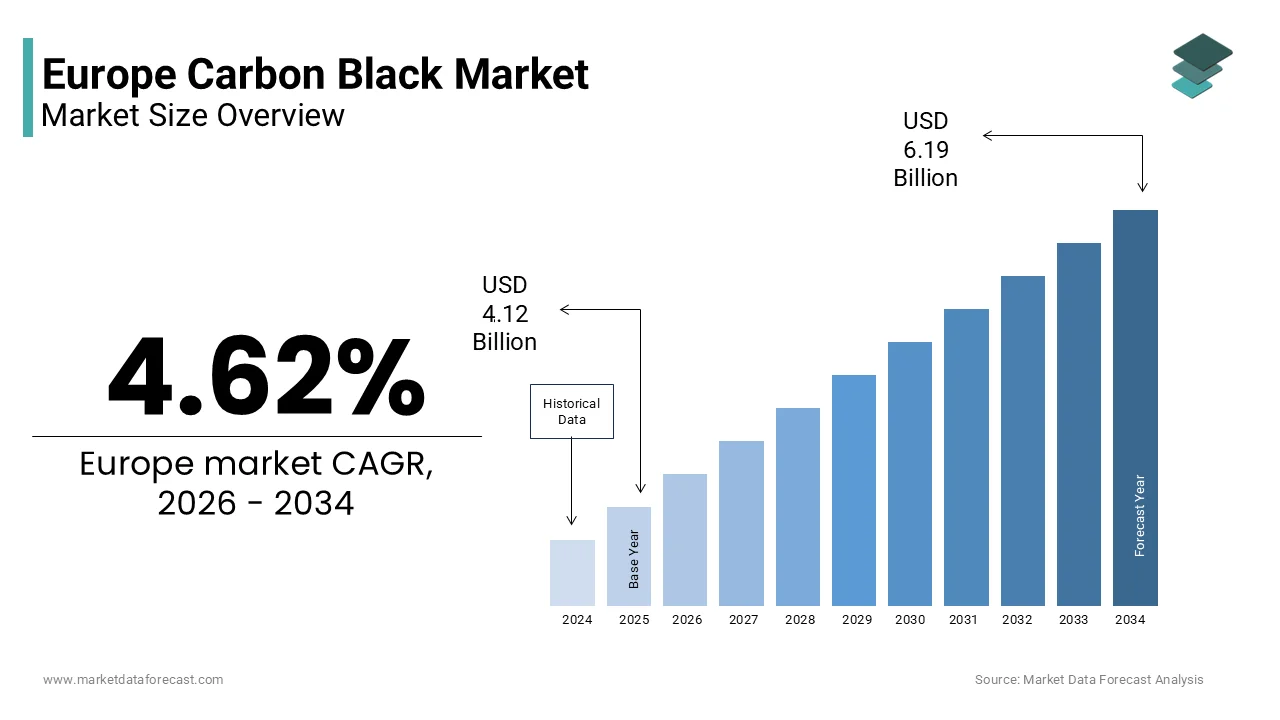
The Europe carbon black market was valued at USD 4.12 billion in 2025, is estimated to reach USD 4.31 billion in 2026, and is projected to reach USD 6.19 billion by 2034, growing at a CAGR of 4.62% during the forecast period from 2026 to 2034. The growth of the European carbon black market is driven by increasing demand from the automotive and tire manufacturing industries, rising production of industrial rubber products, and expanding applications in plastics, coatings, and inks. Carbon black continues to play a critical role in enhancing product durability, conductivity, and UV resistance. Additionally, growing investments in sustainable manufacturing technologies, coupled with the increasing adoption of electric vehicles and advanced industrial materials, are supporting market expansion across Europe.
Key Market Trends
-
Rising demand from the automotive industry is driving the consumption of carbon black for tire and rubber manufacturing.
-
Increasing production of electric vehicles is creating new opportunities for high-performance carbon black materials.
-
Growing use of carbon black in plastics, coatings, inks, and specialty applications is expanding market demand.
-
Advancements in sustainable production technologies and recovered carbon black are supporting environmental initiatives.
-
Rising investments in high-performance industrial materials are driving innovation in specialty carbon black products.
Segmental Insights
-
Based on type, the furnace black segment dominated the Europe carbon black market in 2025. The segment's leadership is attributed to its cost-effectiveness, consistent product quality, and widespread use in tire manufacturing, rubber products, plastics, and industrial applications.
-
Based on pigment source, the lamp black segment held the largest share of the Europe carbon black market in 2025. The segment's dominance is driven by its extensive use in inks, coatings, pigments, and specialty industrial applications requiring high tinting strength and color stability.
-
Based on application, the tires segment accounted for the largest share of the Europe carbon black market in 2025. The segment's growth is supported by continuous replacement demand, increasing vehicle production, and rising performance requirements for tires, particularly in the expanding electric vehicle market.
Regional Insights
-
The European carbon black market is witnessing steady growth due to increasing industrial production, strong automotive manufacturing activities, and expanding demand for high-performance materials.
-
Germany dominated the Europe carbon black market in 2025. The country's leadership is supported by its robust automotive industry, advanced manufacturing capabilities, and its position as a major hub for carbon black production and consumption in Europe.
Competitive Landscape
The Europe carbon black market is highly competitive, with manufacturers focusing on production efficiency, sustainable manufacturing technologies, specialty product development, and capacity expansion to strengthen their market positions. Companies are investing in low-emission production processes, recovered carbon black technologies, and strategic collaborations to meet the evolving requirements of the automotive, industrial, and specialty materials sectors. Key players operating in the Europe carbon black market include Cabot Corporation, Mitsubishi Chemical Holdings Corporation, OMSK Carbon Group, and Orion Engineered Carbons.
Europe Carbon Black Market Size
The Europe carbon black market size was valued at USD 4.12 billion in 2025 and is projected to reach USD 6.19 billion by 2034 from USD 4.31 billion in 2026, growing at a CAGR of 4.62%.
Carbon black is a fine black powder consisting essentially of amorphous carbon obtained through the incomplete combustion or thermal decomposition of gaseous or liquid hydrocarbons. This critical industrial material serves as reinforcing filler in rubber products particularly tires and acts as a pigment in plastics coatings and inks. The European market operates within a stringent regulatory framework governed by the European Chemicals Agency which classifies certain types of carbon black under specific hazard categories influencing handling and labeling requirements. According to Eurostat, the chemical industry remains a cornerstone of the European economy contributing approximately 18% to the total industrial output and supporting millions of jobs across the continent. As per the European Tyre and Rubber Manufacturers Association, Europe produces hundreds of millions of tires annually in Europe, highlighting the massive dependency of the automotive sector on high quality reinforcing agents like carbon black. The transition towards sustainable mobility and the circular economy has intensified scrutiny on the environmental footprint of carbon black production prompting manufacturers to explore alternative feedstocks such as pyrolysis oil from end of life tires. The International Energy Agency notes that Europe is aggressively pursuing decarbonization targets which directly impacts energy intensive industries including carbon black manufacturing. This dynamic landscape requires producers to balance operational efficiency with compliance to the European Green Deal while meeting the evolving performance demands of downstream applications in automotive construction and consumer goods sectors.
MARKET DRIVERS
Resilient Automotive Production and Tire Replacement Demand
The automotive industry remains the primary consumer of carbon black in Europe due to its essential role in enhancing the durability abrasion resistance and tensile strength of tire treads and sidewalls, which is a key market driver. Despite the shift towards electric vehicles the fundamental requirement for high performance tires persists driving steady demand for reinforcing fillers. According to the European Automobile Manufacturers Association, new car registrations in the European Union reached approximately 10.8 million units in 2025, indicating a continued focus on fleet renewal. Each passenger car tire contains roughly 20% to 30% carbon black by weight making it an indispensable component in tire formulation. As per the European Tyre and Rubber Manufacturers Association, the replacement tire market accounts for nearly 75% of total tire sales in Europe ensuring consistent demand regardless of new vehicle sales fluctuations. The increasing average age of vehicles on European roads which exceeds 10 years further amplifies the need for replacement tires thereby sustaining carbon black consumption. Additionally the trend towards larger wheel sizes and high performance tires for electric vehicles which bear greater loads requires advanced carbon black grades with superior reinforcement properties. This structural demand from both original equipment manufacturers and the aftermarket sector provides a stable foundation for the carbon black market despite broader economic uncertainties.
Expansion of Infrastructure and Construction Activities
Beyond the automotive sector, the construction and infrastructure development industry significantly contributes to the demand for carbon black particularly in the form of pigments and ultraviolet stabilizers for plastics and coatings, which is further contributing to the expansion of the European carbon black market. Carbon black is widely used in polyethylene pipes geotextiles and cable sheathing to protect against degradation from sunlight and environmental stress. According to ING Research, production in the EU construction sector is set to increase by 1.5% in 2026, driven by public investment in renewable energy infrastructure and urban renewal projects. The European Commission’s NextGenerationEU recovery plan allocates substantial funds for green building renovations and digital infrastructure which increases the consumption of durable plastic components containing carbon black. As per the European plastics industry, the production of plastic products for construction applications has shown resilience with a focus on long lasting materials that require effective UV protection. Carbon black’s ability to absorb ultraviolet radiation extends the lifespan of outdoor plastic installations reducing maintenance costs and waste. Furthermore the expansion of telecommunications networks requiring extensive cabling drives demand for black colored polymer compounds. The integration of carbon black into masterbatches for architectural coatings also supports aesthetic and protective functions in residential and commercial buildings. These diverse applications in the built environment ensure that the construction sector remains a vital driver for carbon black consumption across Europe.
MARKET RESTRAINTS
Stringent Environmental Regulations and Emission Standards
The rigorous environmental regulations aimed at reducing industrial emissions and protecting human health are major restraints to the European carbon black market growth. The European Union’s Industrial Emissions Directive mandates strict limits on particulate matter and polycyclic aromatic hydrocarbon emissions from carbon black manufacturing facilities requiring substantial capital investment in abatement technologies. According to the European Chemicals Agency, certain types of carbon black are classified as suspected carcinogens category 1B necessitating comprehensive risk management measures throughout the supply chain. This classification imposes additional labeling packaging and handling costs on producers and downstream users affecting overall profitability. As per the European Environment Agency, industrial facilities must undergo regular inspections and report emissions data transparently which increases administrative burdens and operational complexity. The REACH regulation further restricts the use of substances of very high concern pushing manufacturers to reformulate products or develop cleaner production methods. Compliance with these evolving standards often requires shutting down older less efficient plants leading to reduced capacity and supply tightness. The high cost of retrofitting existing facilities with best available techniques can deter new entrants and limit expansion plans for incumbent players. Consequently regulatory compliance acts as a major restraint by elevating production costs and limiting operational flexibility in a highly scrutinized industrial sector.
Volatility in Raw Material Prices and Supply Chain Disruptions
Volatility in global energy prices directly translates into unpredictable input costs for carbon black manufacturers squeezing margins and complicating pricing strategies, which are further hampering the European carbon black market expansion. According to the International Energy Agency, crude oil prices experienced significant fluctuations in recent years due to geopolitical tensions and supply chain disruptions affecting European refineries. As per Eurostat, the producer price index for chemical products in Europe has shown considerable variability reflecting the instability of raw material markets. When refinery margins are low producers may reduce throughput or shut down units decreasing the availability of key feedstocks like ethylene tar. This supply insecurity forces carbon black manufacturers to seek alternative sources or hold larger inventories tying up working capital. Additionally transportation bottlenecks and logistics challenges exacerbate supply chain fragility leading to delays and increased freight costs. The inability to fully pass on these cost increases to customers due to competitive pressure further strains financial performance. Small and medium sized enterprises are particularly vulnerable to these shocks as they lack the hedging capabilities and vertical integration of larger multinational corporations. This persistent volatility creates an uncertain operating environment that restrains long term investment and growth in the European carbon black sector.
MARKET OPPORTUNITIES
Adoption of Sustainable and Circular Economy Practices
Manufacturers are increasingly exploring the use of pyrolysis oil derived from end of life tires as an alternative to virgin fossil based feedstocks aligning with European sustainability goals, which is a promising opportunity for the regional market. According to the European Tyre and Rubber Manufacturers Association, nearly all end of life tires in Europe are recovered for material or energy purposes, with a growing portion being recycled into valuable materials including pyrolysis oil. This closed loop approach reduces reliance on finite resources and lowers the carbon footprint of carbon black production. As per the European Commission’s Circular Economy Action Plan, incentives for using secondary raw materials encourage innovation in recycling technologies and process optimization. Companies investing in carbon capture and utilization technologies can further enhance their environmental credentials and meet corporate sustainability targets. The development of bio based carbon black from renewable sources such as plant oils also opens new niche markets for eco conscious consumers. Partnerships between tire manufacturers carbon black producers and recycling firms facilitate the scaling of these innovative solutions. By positioning themselves as leaders in sustainability companies can differentiate their products and secure preferential access to green procurement contracts. This strategic shift not only mitigates regulatory risks but also captures value from the growing demand for environmentally responsible industrial materials.
Growth in Specialty Applications and High Performance Grades
The expanding use of specialty carbon black in high value applications such as conductive polymers batteries and premium coatings offers lucrative growth opportunities for market participants. The electrification of transport and the proliferation of electronic devices drive demand for conductive carbon black used in lithium ion battery electrodes and antistatic packaging. According to the European Battery Alliance, Europe aims to make the continent a global leader in sustainable battery technology, creating substantial demand for specialized conductive additives. Specialty carbon blacks with controlled particle size and surface chemistry provide essential electrical conductivity and mechanical stability in these advanced applications. As per the Federation of European Paint Associations, the coatings industry continues to innovate with high performance products requiring ultra fine carbon black pigments for deep jetness and gloss. The automotive sector’s shift towards electric vehicles also increases the need for lightweight conductive plastics for electromagnetic shielding. Manufacturers who can produce consistent high purity specialty grades command premium pricing and foster strong customer loyalty. Investment in research and development to tailor surface properties for specific applications enables companies to move beyond commoditized rubber grades. This diversification into high margin specialty segments helps offset stagnation in traditional rubber markets and enhances overall profitability. The technical barrier to entry in specialty grades protects incumbents and rewards innovation providing a clear pathway for sustainable growth.
MARKET CHALLENGES
High Energy Intensity and Decarbonization Pressures
The carbon black production process is inherently energy intensive involving high temperature reactions that generate significant greenhouse gas emissions posing a major challenge in Europe’s decarbonizing economy. Manufacturers face increasing pressure to reduce their carbon footprint in line with the European Green Deal and national climate targets. According to the International Energy Agency, the chemical sector is one of the largest industrial energy consumers in Europe accounting for approximately 10% of total final energy use. Transitioning to low carbon energy sources such as green hydrogen or renewable electricity requires massive capital expenditure and technological breakthroughs that are not yet commercially viable at scale. As per the European Commission’s Fit for 55 package, industrial facilities must purchase carbon allowances under the Emissions Trading System which raises operational costs significantly. The lack of affordable clean energy alternatives forces producers to rely on natural gas which remains subject to price volatility and supply risks. Developing carbon capture and storage infrastructure is complex and costly with limited availability in many European regions. These structural challenges make it difficult for carbon black manufacturers to achieve net zero targets without compromising competitiveness. The tension between maintaining production levels and reducing emissions creates a strategic dilemma that requires careful navigation and long term planning. Failure to adapt may result in stranded assets or loss of market share to regions with lower environmental standards.
Competition from Alternative Reinforcing Fillers
The intensifying competition from alternative reinforcing fillers such as silica and bio based materials that offer environmental benefits and comparable performance in certain applications is further challenging the carbon black market growth in Europe. Silica has gained significant traction in the tire industry particularly for green tires that offer lower rolling resistance and improved fuel efficiency. According to the European Tyre and Rubber Manufacturers Association, the adoption of silica reinforced tires has grown substantially driven by EU labeling regulations that mandate fuel efficiency standards. Silica’s ability to reduce energy consumption during vehicle operation aligns with sustainability goals making it a preferred choice for original equipment manufacturers. As per industry reports, the market share of silica in passenger car tires has increased steadily eroding the dominance of traditional carbon black grades. Additionally research into bio based fillers derived from rice husk ash and other agricultural waste presents a long term threat to fossil based carbon black. These alternatives appeal to eco conscious brands seeking to minimize their environmental impact and diversify supply chains. While carbon black remains superior in terms of cost and general reinforcement the shift towards high performance and sustainable materials challenges its position. Manufacturers must innovate to maintain relevance by developing hybrid systems or improving the sustainability profile of carbon black. This competitive dynamic forces continuous improvement and adaptation to prevent further substitution in key end use sectors.
REPORT COVERAGE
| REPORT METRIC | DETAILS |
| Market Size Available | 2025 to 2034 |
| Base Year | 2025 |
| Forecast Period | 2026 to 2034 |
| CAGR | 4.62% |
| Segments Covered | By Process Type, Grade, Application, and Region |
| Various Analyses Covered | Global, Regional, & Country Level Analysis; Segment-Level Analysis; DROC, PESTLE Analysis; Porter’s Five Forces Analysis; Competitive Landscape; Analyst Overview of Investment Opportunities |
| Regions Covered | UK, France, Spain, Germany, Italy, Russia, Sweden, Denmark, Switzerland, Netherlands, Turkey, and the Czech Republic |
| Market Leaders Profiled | Cabot Corporation, Mitsubishi Chemical Holdings Corporation, OMSK Carbon Group, Orion Engineered Carbons |
SEGMENTAL ANALYSIS
By Process Type Insights
The furnace black segment held the leading share of the European carbon black market in 2025 and is expected to remain the foundation of the European carbon black market over the next few years due to its widespread utility in high volume rubber products. This type accounts for the vast majority of global carbon black production and is the primary choice for tire manufacturing which is the largest end use sector in Europe. According to the European Tyre and Rubber Manufacturers Association, the industry produces hundreds of millions of tires annually in Europe with each tire containing significant quantities of furnace black for tread and sidewall reinforcement. The production process allows for precise control over particle size and structure enabling manufacturers to tailor properties for specific performance requirements such as abrasion resistance and tensile strength. As per industry technical data, furnace black grades like N330 and N220 are standard specifications for passenger and commercial vehicle tires ensuring consistent demand. The established infrastructure for furnace black production across major chemical hubs in Germany and France supports reliable supply chains for automotive OEMs. Additionally the ability to produce furnace black from various feedstocks including coal tar and pyrolysis oil aligns with emerging circular economy initiatives. The scalability of furnace black plants allows for economies of scale that keep production costs competitive compared to other types. This combination of performance reliability and economic efficiency sustains the leadership of the furnace black segment in the European market.

However, the acetylene black is anticipated to showcase a promising CAGR in the European carbon black market during the forecast period owing to the increasing demand for conductive materials in lithium ion batteries and specialized electronic applications associated with the electrification of transport. According to the European Battery Alliance, the continent is aggressively expanding its battery manufacturing capacity, creating substantial demand for high purity conductive additives. Acetylene black offers superior electrical conductivity and structural stability compared to standard furnace blacks making it ideal for battery electrodes and antistatic plastics. As per the International Energy Agency, electric vehicle sales in Europe represent a growing share of new car registrations, directly boosting the need for advanced battery components. The unique branched chain structure of acetylene black facilitates efficient electron transfer which is critical for high performance energy storage systems. Additionally the growth of the electronics sector requiring electromagnetic shielding and conductive polymers further drives adoption. Manufacturers are investing in specialized production facilities to meet the stringent purity requirements of the battery industry. The high value added nature of acetylene black encourages innovation and capacity expansion positioning it as the fastest growing segment despite its smaller overall volume compared to furnace black.
By Pigment Source Insights
The lamp black segment led the market by holding the major share of the European market in 2025. The dominance of lamp black segment in the European market can be credited to its widespread use in traditional printing inks coatings and artistic applications. This type is produced through the incomplete combustion of liquid hydrocarbons resulting in a coarse particle structure that provides excellent dispersibility and jetness. According to the Federation of European Paint Associations, the coatings industry remains a significant consumer of carbon black pigments for architectural and industrial applications where durability and color depth are essential. Lamp black is preferred in certain ink formulations for its rheological properties and ease of mixing with binders. As per historical industry data, lamp black has been used for centuries establishing a strong presence in niche markets such as restoration arts and specialty printing. The relatively simple production process allows for lower manufacturing costs compared to more complex pigment grades making it attractive for price sensitive applications. Additionally the availability of raw materials and established production sites in Europe ensure stable supply. While its market share in high performance applications is limited by finer alternatives lamp black maintains dominance in traditional sectors due to its proven performance and cost advantages. The continued demand for packaging inks and wood stains also supports its steady consumption across the region.
On the other hand, the vine black segment is estimated to progress at a prominent CAGR in the European market over the forecast period owing to the rising consumer preference for natural and organic products in cosmetics food packaging and artisanal goods. Vine black is produced by charring vine cuttings and other plant materials offering a bio based alternative to fossil derived pigments. According to industry analysis of natural ingredients, the market for organic and natural personal care products has grown significantly with consumers seeking ingredients with transparent and sustainable origins. Vine black’s unique warm undertone and fine texture make it desirable for high end cosmetic formulations such as eyeliners and mascaras. As per Mintel data, product launches featuring natural carbon black pigments have increased in the European beauty sector reflecting this trend. The alignment with the European Green Deal’s emphasis on bio based economies encourages manufacturers to explore renewable pigment sources. Additionally the artisanal food industry uses vine black for coloring confectionery and bakery products where natural labeling is a key selling point. Although production volumes are small compared to industrial grades the premium pricing and strong brand appeal drive rapid value growth. Innovations in purification and standardization of vine black are enhancing its applicability and consistency further accelerating adoption in niche but high value segments.
By Application Insights
The tires segment had the largest share of the European market in 2025 and is likely to maintain its dominance over the next few years, sustained by constant replacement demand and the evolving needs of the electric vehicle market. This dominance is driven by the essential role of carbon black as a reinforcing filler that enhances the durability abrasion resistance and longevity of tire treads and sidewalls. According to the European Tyre and Rubber Manufacturers Association, Europe produces hundreds of millions of tires annually requiring thousands of tons of carbon black for reinforcement. Each passenger car tire contains roughly 20% to 30% carbon black by weight making it an indispensable component in tire formulation. As per the European Automobile Manufacturers Association, the replacement tire market accounts for nearly 75% of total tire sales ensuring consistent demand regardless of new vehicle production fluctuations. The increasing average age of vehicles on European roads which exceeds 10 years further amplifies the need for replacement tires. Additionally the trend towards larger wheel sizes and high performance tires for electric vehicles which bear greater loads requires advanced carbon black grades. The strict safety and performance standards enforced by EU regulations mandate high quality reinforcement materials to ensure tire integrity. This structural dependency of the tire industry on carbon black sustains its position as the primary application segment driving the majority of market volume and revenue in Europe.
On the other side, the plastics segment is anticipated to record a healthy CAGR in the European market during the forecast period due to the expanding use of carbon black as a UV stabilizer and pigment in plastic products for construction automotive and packaging applications. According to industry reports, the production of plastic products for infrastructure and renewable energy projects is increasing driven by EU investment in green building and digital networks. Carbon black protects polyethylene pipes geotextiles and cable sheathing from degradation caused by sunlight extending their lifespan and reducing maintenance costs. As per the European Commission’s Circular Economy Action Plan, the demand for durable and recyclable plastic components is rising supporting the use of effective stabilizers. The electrification of vehicles also increases the need for conductive plastics used in battery casings and electronic components where carbon black provides essential electrical properties. Additionally the growth of agricultural films requiring UV protection boosts consumption in the farming sector. The versatility of carbon black in masterbatches allows for easy integration into various plastic processing methods. These diverse and expanding applications in high growth sectors ensure that the plastics segment outpaces traditional rubber applications in terms of growth rate.
REGIONAL ANALYSIS
Germany Carbon Black Market Analysis
Germany held the major share of the European market in 2025 and is expected to remain the primary hub for carbon black manufacturing and consumption in Europe as it continues to focus on high performance industrial production for the next few years. This leadership is driven by the country’s robust automotive industry which is the largest in Europe and a major consumer of tire reinforcement materials. According to the International Organization of Motor Vehicle Manufacturers, Germany produced over 4.1 million vehicles in 2025, creating substantial demand for carbon black in original equipment tires. The presence of leading chemical manufacturers and advanced research facilities fosters innovation in specialty carbon black grades for high performance applications. As per the German Chemical Industry Association, the sector invests heavily in sustainable production technologies aligning with national climate goals. The well developed infrastructure and skilled workforce support efficient manufacturing and distribution across the continent. Additionally Germany’s strong export orientation means that carbon black produced locally serves broader European markets. The government’s support for electric mobility and battery production further drives demand for conductive carbon black. Strict environmental regulations push manufacturers to adopt cleaner processes enhancing the quality and sustainability of products. These factors collectively establish Germany as the central hub for the European carbon black industry with significant influence on market trends and standards.
France Carbon Black Market Analysis
France is projected to maintain a steady market position for carbon black in the coming years, driven by its focus on sustainable industrial growth and high-tech applications. France is home to major tire manufacturers and automotive OEMs that drive consistent demand for reinforcing fillers. According to the French government, the automotive sector remains a key pillar of industrial production with millions of vehicles produced and assembled annually. France is also a leader in nuclear energy and aerospace which utilize specialized carbon black grades for composites and conductive applications. As per the Union des Industries Chimiques, the chemical industry in France is focusing on decarbonization and circular economy practices influencing carbon black production methods. The country’s commitment to sustainable mobility supports the growth of electric vehicles and associated battery technologies. Regulatory frameworks under the REACH regulation are strictly enforced ensuring high safety and environmental standards. The presence of major research institutions facilitates the development of innovative carbon black applications. Additionally France’s strategic location and logistics infrastructure enable efficient distribution to neighboring markets. Government incentives for green industrial projects encourage investment in low carbon production technologies. These dynamics sustain France’s prominent position in the regional market with a focus on quality and sustainability.
Italy Carbon Black Market Analysis
Italy is likely to experience sustained demand for carbon black as its manufacturing sector upgrades towards circular and green industrial standards over the next few years. Italy has a dense network of small and medium sized enterprises that produce specialized rubber and plastic products requiring carbon black. According to ISTAT, the Italian manufacturing sector contributes significantly to GDP with a focus on high quality finished goods. The automotive supply chain in Italy supports demand for tire components and technical rubber parts. As per the Italian Chemical Industry Federation, there is growing interest in sustainable materials and circular economy solutions influencing carbon black sourcing. The packaging industry which is a major exporter relies on carbon black for UV protection in plastic films and containers. Italy’s strategic location in the Mediterranean facilitates trade with North Africa and the Middle East expanding market reach. The government’s National Recovery and Resilience Plan includes funding for industrial modernization and green transition supporting technological upgrades. Skilled craftsmanship and design excellence drive demand for high performance pigments in consumer goods. These factors contribute to a dynamic market environment where innovation and tradition coexist sustaining steady demand for carbon black products.
Spain Carbon Black Market Analysis
Spain is expected to show continued growth in its carbon black market as it further establishes itself as a leading center for electric vehicle manufacturing in Europe. Spain has become a major hub for electric vehicle manufacturing attracting significant foreign investment. According to the Spanish Association of Automobile and Truck Manufacturers, vehicle production has increased with a focus on electrification. This shift drives demand for both traditional tire reinforcement and conductive carbon black for battery components. As per the Spanish Chemical Industry Association, there is increasing emphasis on sustainable production and recycling initiatives. The solar energy sector which is rapidly expanding in Spain uses carbon black in certain photovoltaic applications and protective coatings. The construction industry also contributes to demand through the use of carbon black in pipes and geomembranes. Spain’s strategic ports facilitate imports of raw materials and exports of finished products. Government policies promoting industrial decarbonization encourage the adoption of cleaner technologies. The growing tourism and service sectors indirectly support demand for automotive replacements and consumer goods. These developments position Spain as an emerging growth engine in the European carbon black market with strong potential for future expansion.
United Kingdom Carbon Black Market Analysis
The United Kingdom is anticipated to maintain a mature but technologically focused carbon black market as it shifts towards specialty applications over the next few years. The United Kingdom holds a mature market position for Carbon Black characterized by advanced industrial capabilities and strict regulatory standards. Although automotive production has declined compared to historical levels the UK remains a center for high value manufacturing and research. According to the Office for National Statistics, the chemical sector continues to innovate in specialty materials including conductive carbons for electronics. The UK’s commitment to net zero emissions drives investment in electric vehicles and renewable energy infrastructure boosting demand for specialized carbon black grades. As per the Chemical Industries Association, the industry focuses on sustainability and circular economy principles influencing sourcing and production. The aerospace and defense sectors require high performance composites that utilize carbon black. Post Brexit trade arrangements have adjusted supply chains but demand remains stable due to domestic production needs. The financial services sector in London supports investment in green technologies and industrial upgrades. Strong intellectual property protection encourages innovation in new applications. The focus on quality and compliance ensures that the UK market remains a significant contributor to the European landscape despite broader economic shifts.
COMPETITIVE LANDSCAPE
The competition in the Europe Carbon Black Market is characterized by a consolidated landscape dominated by a few large multinational corporations who compete on product quality technological innovation and sustainability credentials. High barriers to entry due to capital intensive production facilities and strict environmental regulations limit the number of active participants. Major players differentiate themselves through specialized product portfolios catering to niche applications such as conductive additives for batteries and high purity pigments for coatings. Price competition is moderate as customers prioritize consistent quality and supply reliability over lowest cost given the critical nature of carbon black in safety related applications like tires. The shift towards green manufacturing creates a new competitive frontier where companies vie to demonstrate lower carbon footprints and circular economy integration. Regulatory compliance with REACH and other European standards is a fundamental requirement that shapes competitive dynamics. Service excellence including technical support and custom formulation capabilities is crucial for retaining long term contracts with automotive OEMs. Innovation in sustainable feedstocks and production technologies allows leaders to command premium pricing and secure preferential supplier status. The market rewards companies that can balance economic efficiency with environmental responsibility and technical superiority.
KEY MARKET PLAYERS
Some of the notable companies in the Europe carbon black market are
- Cabot Corporation
- Mitsubishi Chemical Holdings Corporation
- OMSK Carbon Group
- Orion Engineered Carbons
Top Players in the Market
- Orion Engineered Carbons is a leading global supplier with a significant footprint in Europe providing high quality carbon black for tire and specialty applications. The company focuses on sustainable production methods and has recently invested in upgrading its facilities to reduce emissions and improve energy efficiency. Orion actively collaborates with tire manufacturers to develop advanced reinforcing fillers that enhance vehicle performance and durability. Their strategic initiatives include expanding the use of recycled feedstocks such as pyrolysis oil to support circular economy goals. Orion continues to innovate in specialty grades for plastics and coatings ensuring they meet stringent European regulatory standards. This commitment to sustainability and technical excellence strengthens their position as a preferred partner for automotive and industrial customers across the region.
- Birla Carbon operates extensively in Europe offering a diverse portfolio of carbon black products for rubber plastics and ink applications. The company leverages its global supply chain to ensure consistent quality and reliable delivery to European customers. Birla Carbon has recently strengthened its market position by investing in research and development centers focused on creating low environmental impact solutions. They prioritize customer collaboration to tailor products for specific needs such as conductive additives for batteries and UV stabilizers for construction materials. The company adheres to strict safety and environmental regulations while optimizing production processes for efficiency. Birla Carbon’s focus on innovation and sustainability drives its growth and reinforces its reputation as a key player in the European market.
- Cabot Corporation is a prominent participant in the Europe Carbon Black Market known for its high performance reinforcement and specialty carbon blacks. The company serves major automotive and industrial sectors with products that improve durability and functionality. Cabot has recently enhanced its European operations by implementing advanced manufacturing technologies that reduce carbon footprint and increase operational efficiency. They engage in strategic partnerships with original equipment manufacturers to co develop next generation materials for electric vehicles and sustainable packaging. Cabot emphasizes regulatory compliance and product safety ensuring alignment with European chemical laws. Their continuous investment in innovation and customer service solidifies their role as a trusted supplier of critical materials for various industrial applications throughout Europe.
Top Strategies Used by Key Market Participants
Key players in the Europe Carbon Black Market primarily focus on sustainability and circular economy initiatives to align with stringent environmental regulations. Companies invest heavily in research and development to create low emission production processes and integrate recycled feedstocks such as pyrolysis oil from end of life tires. Strategic partnerships with automotive manufacturers and tire producers are essential to co develop advanced materials that meet evolving performance and safety standards. Manufacturers also prioritize operational efficiency by upgrading facilities with energy saving technologies and automation to reduce costs and carbon footprints. Expansion into high value specialty segments such as conductive carbons for batteries and electronics helps diversify revenue streams beyond traditional rubber applications. Additionally key participants engage in rigorous regulatory compliance management to navigate complex European chemical laws. Digital transformation initiatives including supply chain optimization and predictive maintenance are adopted to enhance reliability and customer satisfaction. These strategies collectively enable companies to maintain competitiveness and drive sustainable growth in a regulated and dynamic market environment.
MARKET SEGMENTATION
This research report on the Europe carbon black market has been segmented and sub-segmented based on the following categories.
By Process Type
- Furnace black
- Channel
- Acetylene black
- Lampblack.
By Grade
- Specialty
- Conductive.
By Application
- Tires
- Coatings
- Plastics
- Printing inks
- Toners
By Country
- UK
- France
- Spain
- Germany
- Italy
- Russia
- Sweden
- Denmark
- Switzerland
- Netherlands
- Turkey
- Czech Republic
- Rest of Europe