- Product Description Description
- Table of Contents TOC
- List of Table & Figure LOT
- Get Free Sample PDF Sample PDF
Market Size, 2025
$279.09 BnMarket Estimate, 2026
$386.51 BnMarket Forecast, 2034
$5230 BnCAGR, 2026–2034
38.49%Europe Carbon Credit Market Report Summary
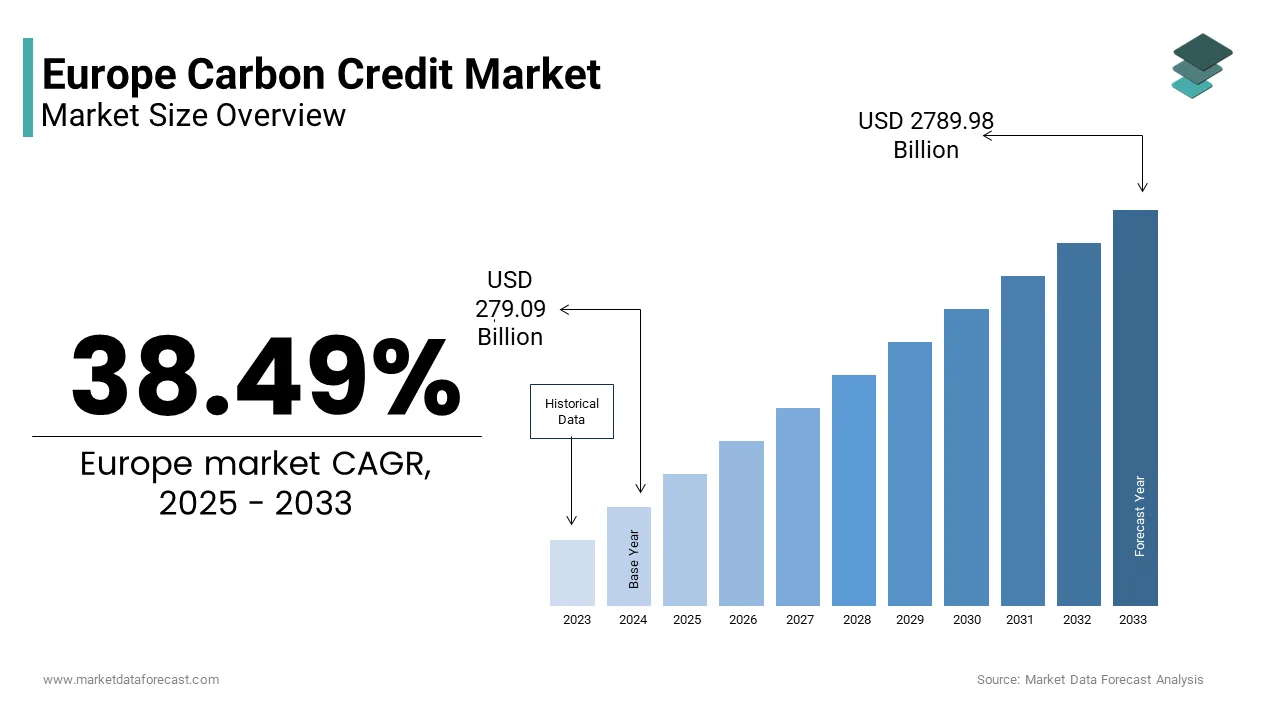
The European carbon credit market was valued at USD 279.09 billion in 2025, is estimated to reach USD 386.51 billion in 2026, and is projected to reach USD 5230.10 billion by 2034, growing at an exceptional CAGR of 38.49% during the forecast period from 2026 to 2034. The growth of the European carbon credit market is driven by stringent carbon emission regulations, the expansion of the EU Emissions Trading System (EU ETS), and increasing corporate commitments to achieve net-zero targets. Furthermore, the rapid development of voluntary carbon markets, along with the integration of digital monitoring, reporting, and verification (MRV) technologies, continues to strengthen Europe’s leadership in global carbon trading.
Key Market Trends
- Expansion of the EU ETS framework to include new sectors such as maritime transport and heavy industries.
- Rising corporate participation in voluntary carbon offset programs to meet sustainability goals.
- Growing interest in nature-based carbon credit projects, such as afforestation and renewable energy initiatives.
- Increased transparency and traceability through blockchain-based carbon credit trading platforms.
- Emergence of carbon credit investment funds and ESG-focused portfolios driving institutional participation in carbon markets.
Segmental Insights
- Based on type, the compliance segment dominated the Europe carbon credit market in 2025, holding a substantial share. This dominance is primarily due to the maturity of the EU Emissions Trading System, which remains the world’s largest regulated carbon market, setting strict emission caps for power plants, industrial facilities, and airlines.
- Based on project type, the avoidance and reduction segment held a prominent share of the Europe carbon credit market in 2024. The segment’s growth is supported by large-scale renewable energy, methane capture, and energy efficiency projects that contribute to emission reduction and credit generation across member states.
Regional Insights
The European carbon credit market demonstrates robust growth across major economies, supported by evolving regulatory frameworks and sustainability-focused investment trends.
- Germany outperformed other regions in the European carbon credit market, capturing 22.7% of the regional share in 2024, driven by its strong industrial decarbonization initiatives and active participation in both compliance and voluntary carbon trading schemes.
- The United Kingdom continues to develop its independent carbon trading system post-Brexit, aligning closely with EU standards to facilitate cross-border credit recognition.
- France and the Netherlands are witnessing rapid expansion in renewable energy-based carbon offset projects and increased corporate ESG reporting requirements.
- Nordic countries, including Sweden and Finland, are leading in sustainable forest management and reforestation projects that generate high-integrity carbon credits.
Competitive Landscape
The European carbon credit market is highly dynamic and competitive, with key players focusing on strategic partnerships, carbon offset project development, and digital marketplace innovation. Companies are also investing in climate finance mechanisms and blockchain-based verification systems to enhance transparency and efficiency in credit trading. Major players operating in the Europe carbon credit market include 3Degrees Group, Inc., Carbon Care Asia Ltd., Shell plc, TotalEnergies SE, BP plc, CarbonBetter, ClearSky Climate Solutions, EKI Energy Services Ltd., Finite Carbon, NativeEnergy, South Pole Group, Torrent Power Ltd., and WGL Holdings Inc.
Europe Carbon Credit Market Size
The Europe carbon credit market size was valued at USD 279.09 billion in 2025 and is anticipated to reach USD 386.51 billion in 2026 to USD 5230.10 billion by 2034, growing at a CAGR of 38.49% during the forecast period from 2026 to 2034.
Current Introduction of the Europe Carbon Credits Market
Carbon credits encompass the regulated and voluntary trading of emission reduction certificates that represent one metric ton of carbon dioxide or its equivalent in other greenhouse gases. These instruments function as financial tools enabling governments, corporations, and individuals to offset emissions by investing in verified climate mitigation projects such as renewable energy deployment, reforestation, methane capture, and industrial efficiency upgrades. The market operates under two primary frameworks as the mandatory EU Emissions Trading System (EU ETS), which covers over 10,000 power plants and industrial installations across 30 countries, and the voluntary carbon market, where companies pursue net-zero commitments beyond regulatory requirements. As per the European Environment Agency, the EU ETS has accounted for a significant portion of the bloc’s total greenhouse gas emissions, making it the world’s largest and most liquid carbon pricing mechanism. Concurrently, corporate climate pledges have surged. According to the European Corporate Leaders Group, a majority of Europe’s largest publicly traded companies have committed to science-based net-zero targets by 2050. This dual architecture, anchored in policy and amplified by private-sector ambition, positions carbon credits as a critical economic lever in Europe’s transition toward climate neutrality.
MARKET DRIVERS
Stringent EU Climate Legislation Is Mandating Emissions Reductions Across Sectors
The growth of the European carbon credits market is majorly driven by the European Union’s Fit for 55 packages has significantly tightened the cap on allowable emissions under the EU ETS. As per the European Commission, this revised trajectory is designed to substantially reduce emissions from covered sectors by 2030 compared to 2005 levels. This regulatory tightening directly increases demand for compliance-grade carbon allowances, as heavy emitters in power generation, cement, and steel must either reduce output, invest in decarbonization, or purchase additional credits. Furthermore, the impending inclusion of maritime transport in the EU ETS and the planned launch of a separate ETS2 for buildings and road transport will expand the market’s scope to new sectors. These legislative actions create a structural, non-discretionary demand driver that ensures sustained liquidity and price pressure in the compliance segment, forming the bedrock of Europe’s carbon pricing architecture.
Corporate Net-Zero Commitments Are Fuelling Voluntary Credit Procurement
A wave of corporate climate accountability is driving unprecedented demand in the voluntary carbon market, which is further boosting the growth of the European carbon credits market. As per the Science Based Targets initiative, a growing number of European companies have validated net-zero targets, requiring them to neutralize residual emissions through high-integrity carbon removal or avoidance credits. This trend is amplified by the EU’s Corporate Sustainability Reporting Directive, which mandates large firms to disclose climate strategies and offsetting activities. In response, corporations are procuring credits not only for compliance but also for brand credibility and investor relations. For instance, major European airlines now offer passengers the option to offset flight emissions through certified forestry or renewable energy projects. As per the European Investment Bank, voluntary carbon credit purchases by EU-based firms have shown strong growth. This convergence of regulatory transparency and stakeholder pressure transforms carbon credits from a niche environmental instrument into a mainstream component of corporate risk and reputation management.
MARKET RESTRAINTS
Inconsistent Quality Standards Undermine Trust in Voluntary Credits
Despite growing demand, the voluntary carbon market suffers from fragmented verification protocols and questionable additionality claims, which is hindering the expansion of the European carbon credits market. As per the European Court of Auditors, investigations have revealed that a significant portion of forestry-based credits issued under certain standards failed to deliver permanent or verifiable emissions reductions due to inadequate monitoring or double-counting. This lack of uniformity erodes buyer confidence and invites regulatory scrutiny. Although the EU is developing its own Carbon Removal Certification Framework to establish rigorous criteria for durability, measurement, and sustainability, full implementation is not expected before 2026. Until then, corporations face reputational risk when purchasing low-quality offsets, leading some major firms to temporarily pause voluntary credit use. This credibility gap constrains market growth and delays the scaling of nature-based solutions that depend on reliable carbon finance.
Limited Supply of High-Integrity Removal Credits Constrains Long-Term Strategies
While avoidance credits such as those from renewable energy are relatively abundant, durable carbon removal credits essential for achieving true net-zero are scarce and expensive, which is impeding the European carbon credits market growth. Technologies like direct air capture and biochar sequestration remain nascent in Europe. As per the European Clean Hydrogen Alliance, only a limited number of operational facilities are capable of issuing verified removal credits. Consequently, prices for high-quality removal credits remain significantly higher compared to avoidance credits. This supply bottleneck forces corporations to rely on interim offsetting strategies that do not align with long-term climate science. The European Commission has allocated substantial funding under the Innovation Fund to scale carbon removal infrastructure, but commercial deployment will take years. Until supply catches up with net-zero timelines, the market remains skewed toward short-term compliance rather than permanent atmospheric restoration.
MARKET OPPORTUNITIES
Integration of Carbon Contracts for Difference Can De-Risk Industrial Decarbonization
The EU’s Innovation Fund is pioneering Carbon Contracts for Difference (CCfD) to support first-of-a-kind low-carbon industrial projects, which is a prominent opportunity in the European carbon credits market. As per the European Commission, several CCfD agreements have been signed, mobilizing billions in private investment for hydrogen-based steelmaking and cement calcination. These contracts create predictable revenue streams from avoided emissions, which can be monetized as future carbon credits. By bridging the cost gap between conventional and green production, CCfDs transform carbon pricing from a compliance burden into an enabler of systemic transformation, unlocking capital for deep decarbonization in hard-to-abate sectors and generating a new class of high-integrity compliance credits.
Expansion of Nature-Based Solutions Through EU Green Deal Funding
The European Green Deal commitment to large-scale ecological restoration creates a pipeline for high-quality, biodiversity-enhancing carbon credits. Programs like the EU Forest Strategy and the Soil Health Law incentivize landowners to adopt regenerative practices that sequester carbon while improving ecosystem resilience. As per the Joint Research Centre, these initiatives could generate substantial verified carbon removal annually if properly monitored. The upcoming EU Carbon Removal Certification Framework will provide a trusted label for such credits, attracting corporate buyers seeking co-benefits in water quality, pollination, and rural employment. This alignment of climate, biodiversity, and rural development policies positions Europe to lead in premium, multi-impact carbon credits that deliver holistic environmental value.
MARKET CHALLENGES
Price Volatility in the EU ETS Undermines Long-Term Investment Signals
Despite its maturity, the EU ETS allowance price remains subject to sharp fluctuations driven by energy markets, geopolitical events and policy uncertainty, which is a significant challenge to the growth of the European carbon credits market. As per the European Energy Exchange, prices have experienced significant swings within short periods. Such volatility complicates financial planning for industrial emitters considering capital-intensive decarbonization projects, which require stable carbon price expectations over decades. While the Market Stability Reserve helps absorb surplus allowances, it cannot fully insulate the system from external shocks like natural gas price spikes or recession-driven demand drops. This unpredictability discourages early movers and may delay abatement investments, ultimately slowing the pace of emissions reduction despite ambitious regulatory targets.
Risk of Carbon Leakage Due to Global Competitiveness Pressures
Europe’s aggressive carbon pricing creates a competitive disadvantage for energy-intensive industries relative to regions with weaker climate policies, which is further challenging the expansion of the European carbon credits market. As per the European Central Bank, sectors such as aluminum and fertilizers face significant cost increases due to the EU ETS, raising concerns about production relocation to countries with laxer regulations, a phenomenon known as carbon leakage. Although the EU provides free allocation of allowances to at-risk sectors, this measure is being phased out under Fit for 55. The introduction of the Carbon Border Adjustment Mechanism (CBAM) aims to level the playing field by imposing carbon costs on imports, but its full implementation is gradual and excludes many downstream products. Until CBAM coverage is comprehensive, industries may resist deeper decarbonization or reduce output, limiting the domestic demand for compliance credits and weakening the market’s effectiveness as a climate tool.
REPORT COVERAGE
| REPORT METRIC | DETAILS |
| Market Size Available | 2025 to 2034 |
| Base Year | 2025 |
| Forecast Period | 2026 to 2034 |
| CAGR | 38.49% |
| Segments Covered | By Type, Project, And By Country |
| Various Analyses Covered | Global, Regional, and Country Level Analysis, Segment-Level Analysis, DROC, PESTLE Analysis, Porter’s Five Forces Analysis, Competitive Landscape, Analyst Overview of Investment Opportunities |
| Regions Covered | UK, France, Spain, Germany, Italy, Russia, Sweden, Denmark, Switzerland, Netherlands, Turkey, Czech Republic & Rest of Europe |
| Market Leaders Profiled | 3Degrees Group, Inc., Carbon Care Asia Ltd., Carbon Better, Clear Sky Climate Solutions, EKI Energy Services Ltd., Finite Carbon, Native Energy, South Pole Group, Torrent Power Ltd., WGL Holdings Inc. |
SEGMENTAL ANALYSIS
By Type Insights
The compliance carbon credits segment held the dominating position in the Europe carbon credits market in 2025 and captured 75.7% of the regional market share. This overwhelming leadership of compliance segment in the European market is driven by the legally binding nature of the EU Emissions Trading System (EU ETS), which mandates thousands of installations in power, industry, and aviation to surrender one allowance for every ton of CO₂ emitted. As per the European Commission, the inclusion of maritime transport and the planned launch of ETS2 for road transport and buildings will significantly broaden the buyer base. Price signaling also plays a role, with EU Allowance prices averaging 95 euros per ton in 2025, creating non-discretionary demand. Unlike voluntary purchases, compliance demand is inelastic and predictable, anchored in law rather than corporate goodwill, ensuring consistent market liquidity and institutional depth that underpins Europe’s carbon pricing architecture.
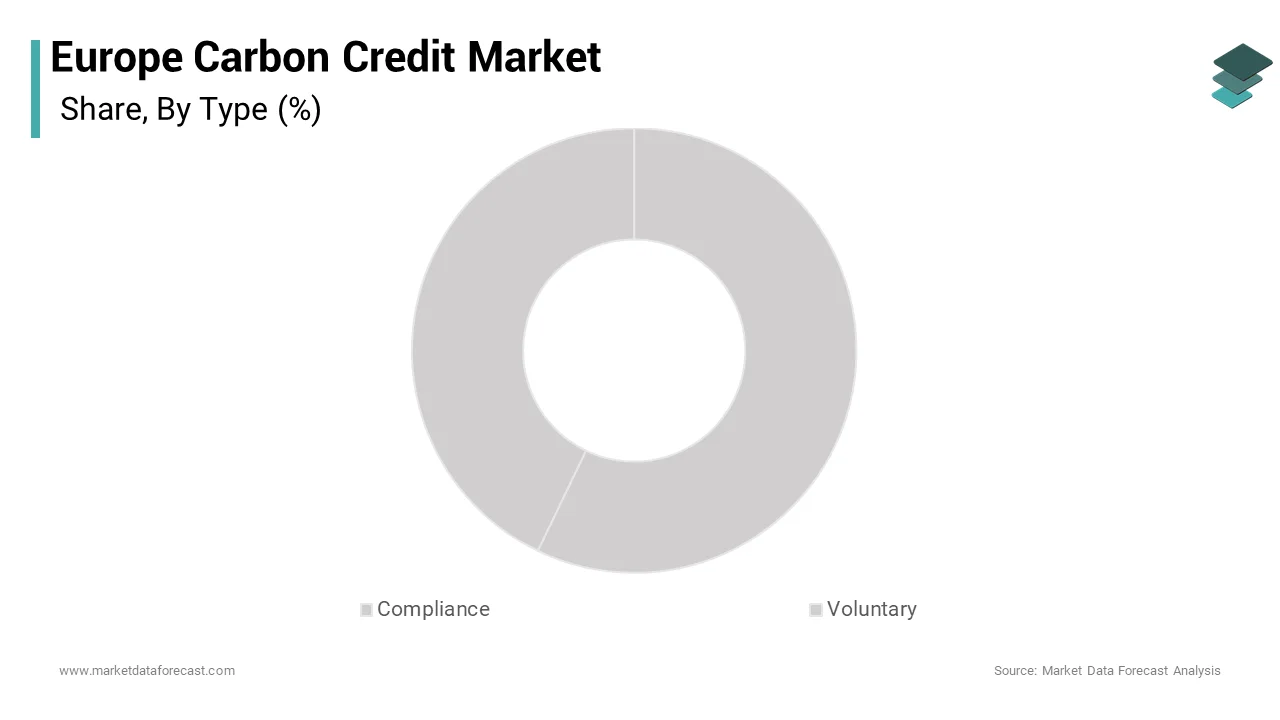
The voluntary carbon credits segment is estimated to witness a CAGR of 19.2% over the forecast period in the regional market owing to the corporate net-zero pledges. As per the Science Based Targets initiative, a growing number of European firms have committed to validated climate targets, requiring them to neutralize residual emissions through high-integrity offsets. Investor and consumer pressure also drives demand. The EU’s Corporate Sustainability Reporting Directive mandates large companies to disclose climate strategies, including offsetting activities, making carbon credit procurement a reputational necessity. Firms such as L’Oréal and Novo Nordisk now publish detailed carbon credit portfolios, driving demand for premium, certified removal projects.
By Project Insights
The avoidance and reduction projects segment captured 80.6% of the European market share in 2025. The growth of avoidance and reduction projects segment in the European market can be credited to their relative maturity, scalability, and lower cost compared to removal alternatives. Renewable energy projects, particularly wind and solar farms, generate verifiable emission reductions at scale and have been the backbone of standards like Verra’s Verified Carbon Standard for over a decade. As per the European Investment Bank, European corporations retired millions of avoidance credits in 2025, primarily from clean energy initiatives in Asia and Latin America. Cost efficiency also drives adoption, with avoidance credits typically trading between 10 and 40 euros per ton, offering immediate climate benefits by displacing fossil-based generation.
The removal and sequestration projects segment is estimated to register a CAGR of 30.3% over the forecast period in the European market. The scientific imperative for permanent carbon drawdown to achieve true net-zero is one of the major factors driving the growth of the removal and sequestration segment in the European market. As per the Science Based Targets initiative, companies must neutralize residual emissions exclusively with permanent removal credits by 2030. EU policy support also plays a role. The Innovation Fund has allocated billions to scale carbon removal technologies, including direct air capture and biochar. Although current supply is limited and prices exceed 300 euros per ton, the convergence of scientific rigor, regulatory validation, and public investment is creating a high-value niche where permanence defines market leadership.
By End Use Insights
The power segment dominated the market by capturing 33.9% of the regional market share in 2025. The dominance of power segment in the European market is attributed to its central role in the EU ETS since inception and its high emissions intensity. As per Eurostat, the power sector accounted for a significant portion of the EU’s total greenhouse gas emissions in 2025, making it the single largest compliance buyer. Utilities such as RWE and Enel are actively retiring coal assets and investing in renewables, using carbon credit revenues to fund this shift. Their need to surrender allowances each year creates a stable, high-volume demand stream that anchors the compliance market.
The aviation segment is the fastest growing end-use segment in the European carbon credits market and is estimated to witness a CAGR of 15.5% over the forecast period. The sector’s full integration into the EU ETS that requires airlines to surrender allowances for intra-European flights is one of the major factors propelling the growth of the aviation segment in the European market. As per Eurocontrol, European carriers operated millions of commercial flights in 2025, generating substantial CO₂ emissions. With Sustainable Aviation Fuel adoption still limited, carbon credits remain the most viable near-term compliance tool. Passenger-driven offsetting also contributes. As per the European Travel Commission, a notable share of travelers opted for carbon offset options in 2025. This dual demand positions aviation as a dynamic and rapidly expanding segment in Europe’s carbon market.
COUNTRY-LEVEL ANALYSIS
Germany Carbon Credits Market Analysis
Germany had the leading position in the European carbon credits market in 2025 and accounted for 20.6% of the regional market share. The status of Germany as the EU’s industrial powerhouse and heavy reliance on the EU ETS for compliance across steel, chemicals, and power generation are primarily driving the German market growth. As per the German Emissions Trading Authority, Germany hosts more registered installations under the EU ETS than any other member state. Additionally, the National Hydrogen Strategy has spurred demand for high-integrity removal credits to certify green hydrogen production. The government’s Climate Protection Program also allocates auction revenues from allowance sales to industrial decarbonization grants, creating a feedback loop that sustains active participation in the carbon market.
France Carbon Credits Market Analysis
France commanded for the promising share of the European carbon credits market in 2025. The growth of France in the European market can be credited to its leadership in corporate voluntary offsetting and strong government encouragement of private climate action alongside robust compliance demand from its nuclear-heavy power sector. The key driver is the French Climate Law of 2021, which mandates large companies to report and reduce emissions, pushing firms like TotalEnergies and LVMH to procure premium removal credits. As per France Stratégie, hundreds of French corporations published net-zero roadmaps in 2025, many featuring detailed carbon credit strategies. The presence of leading carbon project developers such as South Pole fosters a domestic ecosystem for high-quality offset design.
United Kingdom Carbon Credits Market Analysis
The United Kingdom is predicted to witness a healthy CAGR in the European carbon credits market over the forecast period. The growth of the UK in the European market is likely to be driven by its own UK Emissions Trading Scheme while maintaining strong ties to EU climate finance flows. Its market status is characterized by a hybrid approach: mandatory compliance under the UK ETS covers power and industry, while voluntary demand is amplified by London’s role as a global financial hub. As per the Investment Association, UK-based asset managers overseeing trillions in assets increasingly require portfolio companies to disclose and offset emissions. The presence of major offset retailers like Climate Impact Partners further strengthens the UK’s role as a conduit between European compliance and global voluntary markets.
Sweden Carbon Credits Market Analysis
Sweden is anticipated to account for a notable share of the European carbon credits market during the forecast period owing to its world-leading climate legislation and corporate sustainability culture. Its market status reflects a society-wide commitment to achieving net-zero by 2045, ahead of the EU target. The primary driver is the Swedish Climate Act, which legally binds public agencies and large enterprises to science-based reduction pathways. As per Statistics Sweden, a majority of the country’s largest firms had purchased carbon credits by 2025, with strong preference for domestic forestry and biochar projects. Sweden’s high carbon tax complements the EU ETS, creating layered incentives for decarbonization.
Netherlands Carbon Credits Market Analysis
The Netherlands is estimated to showcase a steady CAGR in the European carbon credits market during the forecast period. The growth of Netherlands is expected to be driven by its role of Netherlands as a major aviation and logistics center and high compliance demand from Schiphol Airport and the Port of Rotterdam, home to Europe’s largest industrial cluster. As per the Netherlands Enterprise Agency, Dutch refineries, chemical plants, and airlines collectively surrendered tens of millions of EU allowances in 2025. The Dutch government’s Climate Agreement mandates all large companies to develop CO₂ reduction plans, accelerating voluntary credit use among multinationals like Shell and Philips. The country also hosts leading carbon registries and trading desks, enhancing market liquidity.
COMPETITIVE LANDSCAPE
The competition in the Europe carbon credits market is intensifying as regulatory scrutiny reshapes the landscape from a fragmented voluntary space into a structured, standards-driven ecosystem. Traditional offset certifiers like Verra and Gold Standard compete not only on methodology rigor but on speed of adaptation to EU policy shifts, while new entrants focus on niche removal technologies or regional project development. Financial institutions and consultancies are also entering the market, offering integrated carbon management services that bundle credit procurement with emissions accounting. The primary differentiator is now trust built through transparency, third-party validation, and alignment with science-based criteria. As the EU moves to ban low-quality offsets and mandate removal credits for net-zero claims, players that can deliver verified, permanent, and socially beneficial credits will gain dominance. This transition is consolidating the market around high-integrity providers while marginalizing opaque or outdated schemes, creating a more professional but highly competitive environment.
KEY MARKET PLAYERS
A few of the market players in the Europe carbon credit market include
- 3Degrees Group, Inc.
- Carbon Care Asia Ltd.
- Verra
- Climate Impact Partners
- Gold Standard Foundation
- Shell plc
- Total Energies SE
- BP plc
- CarbonBetter
- ClearSky Climate Solutions
- EKI Energy Services Ltd.
- Finite Carbon
- NativeEnergy
- South Pole Group
- Torrent Power Ltd.
- WGL Holdings Inc.
Top Players In The Market
- Gold Standard is a Geneva-based nonprofit that sets rigorous certification standards for carbon credits with co-benefits in climate, health, and sustainable development. In Europe, it is widely recognized by corporations and governments for its emphasis on additionality, permanence, and community impact. The foundation contributes globally by certifying high-integrity projects in renewable energy, reforestation, and clean cooking across more than 80 countries. Recently, Gold Standard launched its “Net Zero Standard” to align corporate offsetting with the latest IPCC guidance, requiring removal credits for long-term claims. It also partnered with EU institutions to inform the design of the Carbon Removal Certification Framework. These actions reinforce its role as a global benchmark for credible climate action and strengthen its influence in shaping Europe’s voluntary carbon market integrity.
- Verra is a Washington DC headquartered but globally active standards body whose Verified Carbon Standard (VCS) Program dominates the international carbon credit landscape, including Europe. It provides robust methodologies for quantifying emission reductions from forestry, agriculture, and renewable energy projects. Verra’s contribution lies in its scalable verification infrastructure, which enables thousands of projects to generate tradable credits. To strengthen its European position, Verra introduced enhanced rules for avoidance credits in 2024 and accelerated development of its new Carbon Removal Certification pathway. It also established a European advisory council with regulators and NGOs to ensure alignment with EU sustainability directives. These steps enhance transparency and maintain Verra’s relevance amid tightening European oversight of voluntary markets.
- Climate Impact Partners is a leading European-origin carbon project developer and retailer headquartered in the United Kingdom with offices across the continent. The company designs, finances, and manages high-impact carbon offset projects and supplies credits to multinational corporations pursuing net-zero goals. Its global contribution includes channelling over 500 million euros into climate and community initiatives since inception. Recently, Climate Impact Partners launched a digital platform offering real-time project monitoring and blockchain-verified retirement tracking for European clients. It also pioneered a portfolio of EU-compliant removal credits from biochar and soil carbon projects. These innovations position the firm as a trusted intermediary between project integrity and corporate climate accountability in regulated and voluntary markets alike.
Top Strategies Used By The Key Market Participants
Key players in the Europe carbon credits market are prioritizing alignment with emerging EU regulatory frameworks such as the Carbon Removal Certification Framework and Corporate Sustainability Reporting Directive to ensure long term credibility. They are investing in digital platforms that provide transparent, real-time data on project performance, credit issuance, and retirement to build buyer trust. Companies are also diversifying their portfolios to include both high quality avoidance credits and scalable removal solutions to meet evolving corporate net zero standards. Strategic partnerships with scientific institutions and NGOs are being formed to validate methodologies and demonstrate co benefits in biodiversity and social equity. Additionally, firms are expanding advisory services to help corporations navigate complex compliance requirements and integrate carbon credits into broader decarbonization roadmaps.
MARKET SEGMENTATION
This research report on the Europe carbon credit market is segmented and sub-segmented into the following categories.
By Type
- Compliance
- Voluntary
By Project Type
-
- Avoidance/Reduction Projects
- Removal/Sequestration Projects
- Nature-based
- Technology-based
By End-use
- Power
- Energy
- Aviation
- Transportation
- Buildings
- Industrial
- Others
By Country
- United Kingdom
- France
- Spain
- Germany
- Italy
- Russia
- Sweden
- Denmark
- Switzerland
- Netherlands
- Rest of Europe