- Product Description Description
- Table of Contents TOC
- List of Table & Figure LOT
- Get Free Sample PDF Sample PDF
Market Size, 2025
$458.3 MnMarket Estimate, 2026
$491.96 MnMarket Forecast, 2034
$867 MnCAGR, 2026–2034
7.34%Executive Summary: Europe Carbon Dioxide Market
- Market Scope: Comprehensive European carbon dioxide market analysis covering production sources, end-use applications, regional leadership frameworks, and industrial adoption metrics.
- Market Valuation: Valued at USD 458.32 million (2025), estimated at USD 491.96 million (2026), and projected to reach USD 867.01 million by 2034, registering a robust CAGR of 7.34% (2026–2034).
- Primary Growth Drivers: Mandatory CO₂ use in food processing, greenhouse agriculture, welding, carbon capture, and circular-carbon initiatives. Key operational highlights include EU annual food-grade CO₂ consumption of ~1 million metric tons (serving beverage production, meat processing, and greenhouse cultivation), biogenic recovery yields (~0.95 tons of biogenic CO₂ per ton of ethanol produced), and the EU designating 14 cross-border CO₂ transport network projects as Projects of Common Interest and Projects of Mutual Interest.
Key Market Segment Metrics (2026–2034)
| Category | Leading Segment (2025 Position) | Fastest-Growing Segment |
|---|---|---|
| By Source | Hydrogen Production (dominated the European market with a 62.8% share in 2025) | Ethyl Alcohol Fermentation (projected to register the fastest CAGR of 18.3%) |
| By Application | Food and Beverages (held the leading market position in 2025) | Medical Applications (forecast to expand at the fastest CAGR of 15.7%) |
| By End User / Sector | Food Processing, Beverage, & Greenhouse Agriculture Sectors | Healthcare & Carbon Capture Infrastructure Sectors |
| By Region / Country | Germany (led the European market with a 24.4% share in 2025, followed by the United Kingdom with 19.5%) | Industrial European hubs expanding cross-border CO₂ transport networks |
Major Market Players & Market Structure
Market Structure: Highly competitive European industrial gas and carbon capture landscape featuring major global gas producers and specialized green-tech pioneers competing intensely on high-purity CO₂, biogenic carbon recovery, purification, liquefaction, carbon capture infrastructure, and supply resilience.
Key Companies: Air Liquide S.A., The Linde Group, The Messer Group GmbH, SOL Spa, Strandmøllen, ACAIL Gas, AKER Carbon Capture, Climeworks, Northern Lights JV DA, and Eni S.p.A.
Europe Carbon Dioxide Market Size
The Europe carbon dioxide market size was valued at USD 458.32 million in 2025 and is projected to reach USD 867.01 million by 2034 from USD 491.96 million in 2026, growing at a CAGR of 7.34%.
Carbon dioxide refers to a commercial product with diverse industrial uses and serves as a greenhouse gas subject to emissions trading and capture technologies. Unlike emissions trading, which deals with CO₂ as a liability, this market treats CO₂ as a critical industrial gas used for refrigeration, carbonation, pH control, welding shielding and enhanced oil recovery. In 2026, the market operates at the intersection of supply chain resilience, circular economy mandates and decarbonization policy. According to sources, the annual consumption of food-grade CO₂ in the European Union is closer to 1 million metric tons (or slightly more), and is used primarily by beverage producers, meat processors, and greenhouse growers. As per the European Food Safety Authority, CO₂ is classified as E290. Furthermore, the EU Emissions Trading System (EU ETS) is the primary mechanism that regulates large emitters' CO₂ emissions by setting a diminishing cap on emissions and enabling the trading of allowances, effectively making CO₂ a valuable commodity. This duality, coupled with recurring supply disruptions, positions the CO₂ market not as a niche gas segment but as a strategic component of Europe’s industrial and food security infrastructure.
MARKET DRIVERS
Mandatory Use of CO₂ in Food Processing and Beverage Carbonation
CO₂ is extensively used in the region’s food and beverage industry, where it serves as a preservative, propellant, and carbonating agent under strict regulatory approval, a practice which contributes to the growth of the European carbon dioxide market. Carbon dioxide is indeed an approved food additive with the E number E290 as per the European Union regulations and is considered safe by the EFSA. The number of specific "food applications" (e.g., carbonated drinks, modified atmosphere packaging, leavening agent) is extensive and likely in the hundreds. In addition, the meat processing sector alone produces substantial metric tons of CO₂ to extend shelf life and inhibit microbial growth. Scalable substitutes for CO₂ do not exist in these applications. Nitrogen is ineffective for carbonation, and mechanical freezing lacks the efficiency of CO₂ snow. This regulatory and functional irreplaceability ensures consistent baseline demand regardless of economic cycles, making food and beverage the market’s most stable and dominant driver.
Expansion of Industrial Demand in Greenhouse Agriculture and Welding
CO₂ is increasingly vital in controlled environment agriculture, and metal fabrication also bolsters the expansion of the European carbon dioxide market. According to sources, many commercial greenhouses enrich ambient air with CO₂ to boost photosynthesis, which raises yields for tomatoes, cucumbers and leafy greens. The European Commission’s Farm to Fork Strategy encourages such efficiency measures to reduce land use pressure, making CO₂ enrichment a policy-supported practice. Simultaneously, the welding industry relies on CO₂ as a shielding gas in metal inert gas processes, with notable metric tons consumed annually for automotive and construction manufacturing. Unlike argon, CO₂ is cost-effective and provides deeper weld penetration for steel. The reliable provision of CO₂ has become a strategic necessity, rather than a secondary output, due to the growing demands from Europe's reshoring industries and expanding high-tech agricultural sector, both critical for productivity and food independence.
MARKET RESTRAINTS
WHAT FACTORS ARE LIMITING THE GROWTH OF THE EUROPE CARBON DIOXIDE MARKET?
Volatility in CO₂ Supply Due to Dependence on Ammonia and Hydrogen Production
The majority of the region’s food-grade CO₂ is recovered as a byproduct from ammonia and hydrogen plants that use natural gas reforming, which is a process highly sensitive to energy prices and maintenance schedules, and this hinders the growth of the European carbon dioxide market. According to the European Chemical Industry Council, unplanned shutdowns of fertiliser facilities caused three major CO₂ shortages in 2022, 2023 and early 2025, disrupting beverage production and meat packaging across the continent. In September 202,3, a 10-day outage at a Yara plant in Norway reduced European CO₂ availability by 25% forcing breweries to halt production as reported by the Brewers of Europe. CO₂ supply cannot be scaled easily because, unlike dedicated gas production, its availability is tied to the economic factors of other, unrelated industries. When natural gas prices spike, ammonia plants curtail operations, eliminating CO₂ output. This structural fragility creates recurring supply insecurity that no amount of storage can fully mitigate, given CO₂’s gaseous state and high liquefaction costs.
Stringent Purity and Certification Requirements for Food and Medical Grades
Rigorous quality controls that limit sourcing flexibility and increase compliance costs further hamper the expansion of the European carbon dioxide market. Food and medical grade CO₂ must meet purity with strict limits on contaminants like carbon monoxide, sulfur dioxide and hydrocarbons. Every batch requires certification from accredited laboratories and traceability from source to end user. As per research, a portion of potential CO₂ sources, including biogas and direct air capture, are disqualified from food use due to impurity profiles or lack of certification infrastructure. This regulatory gatekeeping prevents rapid diversification of supply even as new carbon capture projects emerge. Consequently, the market remains reliant on a narrow band of traditional producers despite policy encouragement for circular CO₂, which slows innovation and heightens vulnerability to single-point failures.
MARKET OPPORTUNITIES
WHAT NEW OPPORTUNITIES ARE EMERGING IN THE EUROPE CARBON DIOXIDE MARKET?
Integration of Captured CO₂ from Bioenergy and Waste-to-Energy Plants
The region’s push for circular carbon creates an opportunity for the European carbon dioxide market. This can help in sourcing CO₂ from sustainable biogenic sources instead of fossil-based ammonia plants. Numerous biogas and waste-to-energy facilities across the EU emit millions of metric tons of biogenic CO₂ annually, currently vented but eligible for food-grade use if purified. Some of the companies have piloted purification units at biogas plants, which produceE2E290-compliantO₂ with lower lifecycle emissions. This shift not only diversifies supply but also aligns CO₂ sourcing with the EU’s climate neutrality goals, creating a premium market for green-certified carbon dioxide.
Development of CO₂ Infrastructure Under the EU’s Carbon Capture Utilisation Strategy
The European Union’s Net Zero Industry Act and Carbon Capture and Utilisation Strategy are leading to dedicated CO₂ transport and storage networks that are setting up new prospects for the expansion of the European carbon dioxide market. The European Commission has adopted a list of 14 cross-border CO₂ transport network projects designated as Projects of Common Interest (PCIs) and Projects of Mutual Interest (PMIs) under the revised TEN-E Regulation. Utilisation in industrial clusters presents an alternative to permanent storage for the CO₂ transported through these networks. This emerging infrastructure decouples CO₂ supply from ammonia production, creating a more resilient and diversified market aligned with Europe’s industrial decarbonization roadmap.
MARKET CHALLENGES
WHAT ARE THE MAIN CHALLENGES FACING THE EUROPE CARBON DIOXIDE MARKET?
High Energy Intensity and Cost of CO₂ Liquefaction and Transportation
Liquefying CO₂ for efficient storage and transport requires significant energy, which drives up costs and thus impedes the growth of the European carbon dioxide market. According to studies, liquefaction contributes to the total delivered cost of C, O₂, with energy prices directly impacting affordability. Furthermore, CO₂ must be transported in specialised cryogenic tankers with a limited range. This geographic constraint makes remote regions like Ireland and the Balkans highly vulnerable to shortages. Unlike natural gas, CO₂ lacks a continent-wide pipeline grid and cannot be stored long term without boil-off losses. The market will remain fragmented and cost-sensitive until dedicated CO₂ pipelines and low-carbon liquefaction technologies scale up.
Public and Regulatory Ambiguity Around the Use of Captured CO₂ in Food
Consumer acceptance of CO₂ sourced from waste or industrial capture remains uncertain in the region, which slows the expansion of the European carbon dioxide market. According to a study, a share of Europeans expressed hesitation about consuming products carbonated with CO₂ from non-traditional sources even when certified safe. This perception gap stems from confusion between captured CO₂ and emissions; many consumers equate captured carbon with pollution rather than purification. Regulatory clarity exists, but communication lags. The European Food Safety Authority confirms biogenic CO₂ is chemically identical to conventional CO₂, O₂, and labelling requirements do not distinguish sources. Invisible demand barriers currently limit premium pricing and adoption within the circular CO₂ market. These will persist until industry and regulators coordinate transparency campaigns.
REPORT COVERAGE
| REPORT METRIC | DETAILS |
| Market Size Available | 2025 to 2034 |
| Base Year | 2025 |
| Forecast Period | 2026 to 2034 |
| CAGR | 7.34% |
| Segments Covered | By Source, Application, and Region |
| Various Analyses Covered | Global, Regional, & Country Level Analysis; Segment-Level Analysis; DROC, PESTLE Analysis; Porter’s Five Forces Analysis; Competitive Landscape; Analyst Overview of Investment Opportunities |
| Regions Covered | UK, France, Spain, Germany, Italy, Russia, Sweden, Denmark, Switzerland, Netherlands, Turkey, and the Czech Republic |
| Market Leaders Profiled | Air Liquide S.A., The Linde Group, The Messer Group GmbH, SOL Spa, Strandmøllen, ACAIL Gas, AKER Carbon Capture, Climeworks, Northern Lights JV DA, and Eni S.p.A. |
SEGMENTAL ANALYSIS
By Source Insights
The hydrogen production segment dominated the European carbon dioxide market and occupied a 62.8% share in 2025. The dominance of the hydrogen production segment is attributed to the fact that most of Europe’s hydrogen is produced via steam methane reforming. It is a process that inherently generates high-purity CO₂ as a byproduct. The majority of food-grade CO₂ in the EU is recovered from ammonia and hydrogen plants operated by companies like Yara, BAS, F and Borealis. These facilities collectively emitted millions of metric tons of recoverable CO₂ in 2025, most of which was purified for industrial use. The integration of CO₂ capture into hydrogen infrastructure is further reinforced by the EU’s Renewable and Low Carbon Hydrogen Regulation, which incentivises carbon management even in blue hydrogen projects. The well-established hydrogen-ammonia complex continues to serve as Europe's primary CO₂ source by default, as other economically feasible options are lacking, even with its known susceptibility to volatile natural gas markets and operational interruptions.
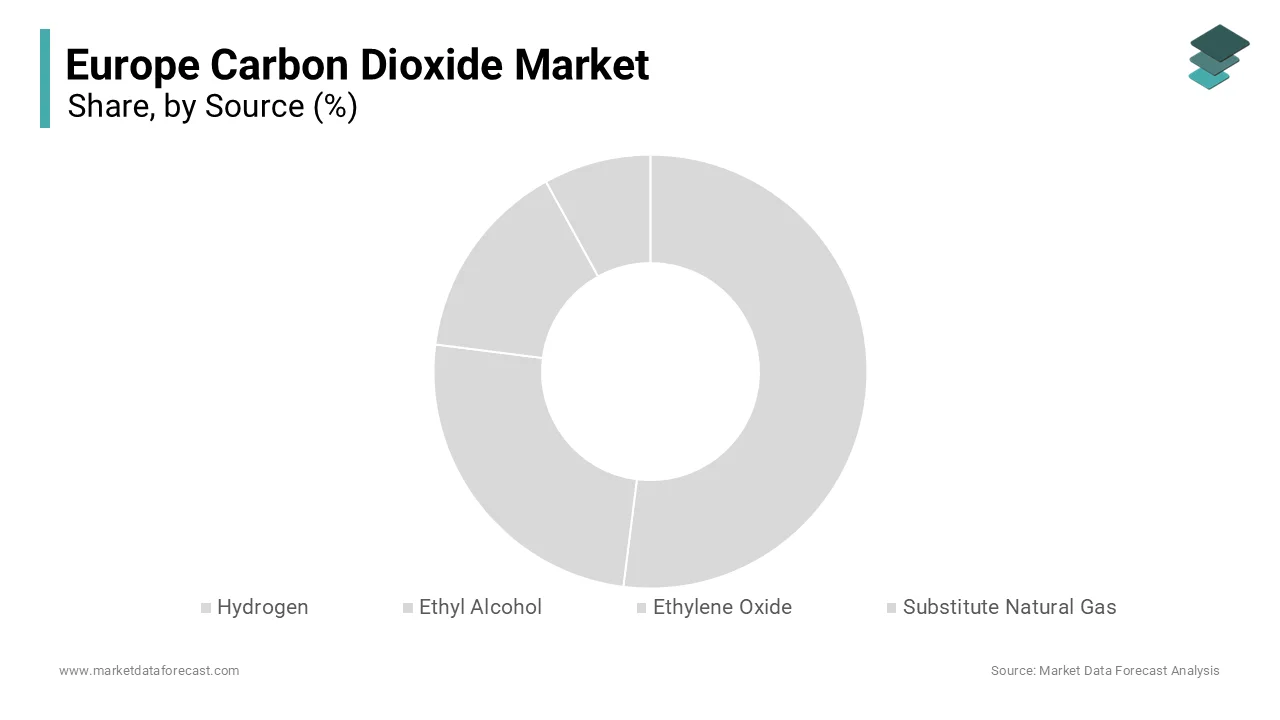
The ethyl alcohol fermentation segment is estimated to register the fastest CAGR of 18.3% from 2026 to 2034 due to the expansion of bioethanol production for renewable fuel blending under the EU’s Renewable Energy Directive III, which mandates renewable energy in transport. During fermentation, each ton of ethanol produced yields approximately 0.95 tons of biogenic CO₂, chemically pure and immediately suitable for food-grade applications. Unlike hydrogen-derived CO₂, this source is not tied to fossil gas markets and qualifies as renewable carbon under EU taxonomy rules. This segment is set to transform Europe's CO₂ supply landscape, driven by circular economy policies that favour biogenic over fossil carbon sources.
By Application Insights
The food and beverage segment led the European carbon dioxide market by capturing a substantial share in 2025. The supremacy of the food and beverages segment is because of CO₂’s irreplaceable role in carbonation, modified atmosphere packaging, and cryogenic freezing across the continent’s robust agri-food sector. The EU produced billions of litres of beer in 2025, requiring notable metric tons of food-grade CO₂. Simultaneously, the meat industry uses CO₂ to extend shelf life. Unlike industrial uses, CO₂ in food is regulated as a processing aid (E290) with no scalable substitutes; nitrogen cannot carbonate, and mechanical freezers lack the speed of CO₂ snow. This functional and regulatory indispensability, combined with Europe’s high per capita consumption of carbonated drinks and processed foods, ensures that food and beverage remains the anchor application for the CO₂ market.
The medical application segment is anticipated to witness the fastest CAGR of 15.7% during the forecast period, owing to rising demand for high-purity CO₂ in minimally invasive surgeries, laparoscopy and respiratory therapy. During laparoscopic procedures, CO₂ is used to insufflate the abdominal cavity, providing surgeons with a clear operating field. Apart from these, medical CO₂ is critical in cryotherapy for dermatology and as a calibration gas for blood gas analysers in hospitals. The European Pharmacopoeia mandates purity levels with strict limits on moisture and hydrocarbons, driving investment in advanced purification. The ongoing demographic shift in Europe, combined with the rising adoption of outpatient and robotic surgeries in healthcare systems, is driving up demand for medical-grade CO₂. This segment, divergent from food applications, commands top-tier pricing and extended supply commitments, thus guaranteeing reliable growth even when industry performance is weak.
REGIONAL ANALYSIS
Germany Market Analysis
Germany was the leading country in the European carbon dioxide market and accounted for a 24.4% share in 2025. Its world-leading chemical industry and dense food processing sector are propelling Germany’s domination in the regional market. According to research, a portion of the country’s CO₂ is sourced from hydrogen and ammonia plants in Ludwigshafen and Marl operated by BASF and Evonik. The country also leads in greenhouse agriculture with large hectares of CO₂-enriched horticulture in North Rhine-Westphalia and Lower Saxony. Strong industrial clustering ensures short transport distances and integrated supply chains. The German government's push for carbon capture from biogas and waste incineration ensures Germany's dominant role, both in CO₂ consumption volume and in establishing the technical and regulatory standards for the European market.
United Kingdom Market Analysis
The United Kingdom was the second-largest player in the European carbon dioxide market and occupied a 19.5% share in 2025. The growth of the UK was driven by its massive beverage industry and advanced healthcare system. The UK produced billions of litres of beer in 2025, requiring significant metric tons of CO₂ for carbonation. Soft drink giants like Coca-Cola Europacific Partners operate multiple bottling plants that rely on a continuous CO₂ supply. The UK faced severe shortages due to fertiliser plant outages, prompting the government to classify CO₂ as a critical raw material. In response, companies like CF Industries invested in dedicated CO₂ storage and purification at its Billingham facility. This dual demand from consumer and medical sectors, combined with policy recognition of CO₂’s strategic importance, ensures the UK remains a high-intensity and resilient market.
France Market Analysis
France is a key player in the European carbon dioxide market, with its strong position in sourcing biogenic CO₂ from bioethanol and its extensive use in agriculture. It is Europe’s key bioethanol producer with major plants recovering notable metric tons of CO₂ annually from beet and wheat fermentation. Companies have integrated purification units to supply food and greenhouse customers. The country also hosts major ammonia producers that supply industrial CO₂ to neighbouring countries. France's strong policy alignment in renewable fuels, circular carbon, and food sovereignty is enabling the pioneering of a sustainable CO₂ value chain that is decoupled from the supply of fossil hydrogen.
Netherlands Market Analysis
The Netherlands expanded steadily in the European carbon dioxide market. Its role as Europe’s horticultural capital and gas logistics hub fuels the demand for CO₂ in the Netherlands. According to sources, a share of the country’s hectares of greenhouses use CO₂ enrichment, which consumes large metric tons annually, primarily sourced from the Port of Rotterdam’s industrial cluster. Air Liquide and Linde operate large-scale CO₂ purification and liquefaction plants that serve both local growers and export markets via barge and truck. The country’s dense canal network and central location enable efficient distribution across Belgium, Germany and the UK. This unique fusion of agricultural demand, nd industrial supply, and logistics infrastructure makes the Netherlands a critical node in Europe’s CO₂ ecosystem.
Italy Market Analysis
Italy is anticipated to grow in the European carbon dioxide market over the forecast period, owing to its vibrant beverage sector and expanding protected agriculture in the south. Also, Italy produced millions of hectoliters of beer while soft drink consumption remains among the key in Europe, requiring notable metric tons of CO₂ annually. Unlike northern Europe, Italy relies more on imported liquid CO₂ due to fewer domestic hydrogen plants, but benefits from Mediterranean shipping routes for supply. The Italian government’s National Recovery and Resilience Plan include funding for biogas CO₂ capture projects in agricultural regions. The Italian market is expected to grow consistently due to rising demand in the consumer and farming industries, in the face of supply chain constraints.
COMPETITIVE LANDSCAPE
HOW ARE LEADING COMPANIES SHAPING THE EUROPE CARBON DIOXIDE MARKET?
The European carbon dioxide market features an oligopolistic structure dominated by global industrial gas majors and a few regional specialists. Competition is defined not by price but by supply chain resilience, product certification, and geographic coverage. The market’s unique vulnerability—dependence on unrelated industries like ammonia and ethanol—creates high barriers to entry due to the need for integrated production, purification, and distribution infrastructure. Global players leverage scale and technology while regional firms compete on local responsiveness and niche applications like greenhouse enrichment. Regulatory complexity acts as both a shield and a filter—only vendors with accredited quality systems can serve the food and medical sectors. New entrants face steep hurdles in certification logistics and customer trust, yet gain traction in biogenic CO₂ where policy support exists. Overall, the market rewards those who view CO₂ not as a commodity but as a critical input for food security, healthcare and industrial decarbonization.
KEY MARKET PLAYERS
Some of the notable key players in the European carbon dioxide market are
- Air Liquide S.A.
- The Linde Group
- The Messer Group GmbH
- SOL Spa
- Strandmøllen
- ACAIL Gas
- AKER Carbon Capture
- Climeworks
- Northern Lights JV DA
- Eni S.p.A.
TOP STRATEGIES USED BY THE KEY MARKET PLAYERS
Key players in the European carbon dioxide market employ five core strategies to ensure supply security and regulatory alignment. First, they diversify CO₂ sources by integrating recovery from bioethanol, biogas and waste-to-energy plants to reduce dependence on fossil-based hydrogen production. Second, they invest in advanced purification and liquefaction infrastructure to meet stringent food and medical grade standards under European Pharmacopoeia and EFSA regulations. Third, they expand cryogenic logistics networks with regional filling stations and dedicated tanker fleets to overcome transport limitations. Fourth, they develop certified green CO₂ product lines with full traceability to meet corporate sustainability demands. Fifth, they form public-private partnerships with governments and agricultural cooperatives to secure long-term offtake agreements and access to subsidy programs. These strategies reflect a market where reliability, purity, and circularity are paramount.
TOP PLAYERS IN THE MARKET
- Linde plc is a global industrial gases leader with extensive operations across Europe, producing and distributing high-purity carbon dioxide for food, beverage, medical, a nd industrial applications. The company operates integrated CO₂ recovery units at hydrogen and ammonia plants in Germany, France and the Netherlands, ensuring a stable supply of food-grade gas. Linde has strengthened its European position by investing in biogenic CO₂ purification from bioethanol and waste-to-energy sources to align with circular economy mandates. The initiatives reflect Linde’s strategy of combining supply chain resilience with sustainability to serve Europe’s regulated and quality-sensitive markets while maintaining leadership in over 100 countries globally.
- Air Liquide is a French multinational that plays a pivotal role in the European carbon dioxide market through its network of production, purification, and distribution facilities across the continent. The company supplies CO₂ to major beverage producers,, rs meat packers, and greenhouse operators with a focus on reliability and regulatory compliance. Air Liquide has reinforced its market presence by integrating CO₂ capture at biogas plants in Sweden and Spain and developing cryogenic transport solutions for remote regions. Air Liquide is a key enabler of Europe's low-carbon industrial shift, a position it secures by operationalising circularity and ensuring stringent food safety across all activities.
- Messer Group is a leading European industrial gas supplier with deep expertise in carbon dioxide logistics and application engineering. Headquartered in Germany, the company serves food processors, breweries and healthcare facilities across Central and Eastern Europe with tailored CO₂ solutions. Messer has enhanced its competitive edge by expanding its fleet of cryogenic tankers and building regional filling stations to reduce delivery lead times. The localised approach, combined with technical support for CO₂ utilisation in greenhouses and welding, ensures Messer meets both regulatory standards and operational needs across diverse European markets.
Europe Carbon Dioxide Market News
- In March 202,4, Lindp, a global industrial gases company, launched a blockchain traceable Green CO₂ product line sourced from renewable bioethanol plants in France and Germany. This launch is anticipated to meet corporate sustainability demands and strengthen the European carbon dioxide market presence.
- In May 2025, Air Liquide SA, a French gas supplier, partnered with the Dutch government to purify and distribute CO₂ from the Afvalzorg waste-to-energy facility to greenhouse growers in the Netherlands. This partnership is anticipated to advance circular carbon utilisation and strengthen the European carbon dioxide market presence.
- In February 2025, Messer Group GmbH, a German industrial gas provider, commissioned a new CO₂ purification unit at an ethyl alcohol plant in Poland to supply food-grade gas to Central European beverage producers. This commissioning is anticipated to diversify supply sources and strengthen the European carbon dioxide market presence.
- In June 2025, Linde plc expanded its cryogenic tanker fleet with 28 new vehicles dedicated to CO₂ delivery across Southern and Eastern Europe, reducing lead times in underserved regions. This expansion is anticipated to enhance logistics reliability and strengthen the European carbon dioxide market presence.
- In April 2025, Air Liquide SA integrated CO₂ capture technology at a biogas facility in southern Sweden to produce certified food-grade carbon dioxide for Nordic food processors. This integration is anticipated to support regional food security and strengthen the European carbon dioxide market presence.
MARKET SEGMENTATION
This research report on the European carbon dioxide market has been segmented and sub-segmented based on categories.
By Source
- Hydrogen
- Ethyl Alcohol
- Ethylene Oxide
- Substitute Natural Gas
By Application
- Food & Beverage
- Oil & Gas
- Medical
By Country
- UK
- France
- Spain
- Germany
- Italy
- Russia
- Sweden
- Denmark
- Switzerland
- Netherlands
- Turkey
- Czech Republic
- Rest of Europe