- Product Description Description
- Table of Contents TOC
- List of Table & Figure LOT
- Get Free Sample PDF Sample PDF
Market Size, 2025
$2.00 BnMarket Estimate, 2026
$2.18 BnMarket Forecast, 2034
$4.28 BnCAGR, 2026–2034
9.12%Europe Casino Management System Market Report Summary
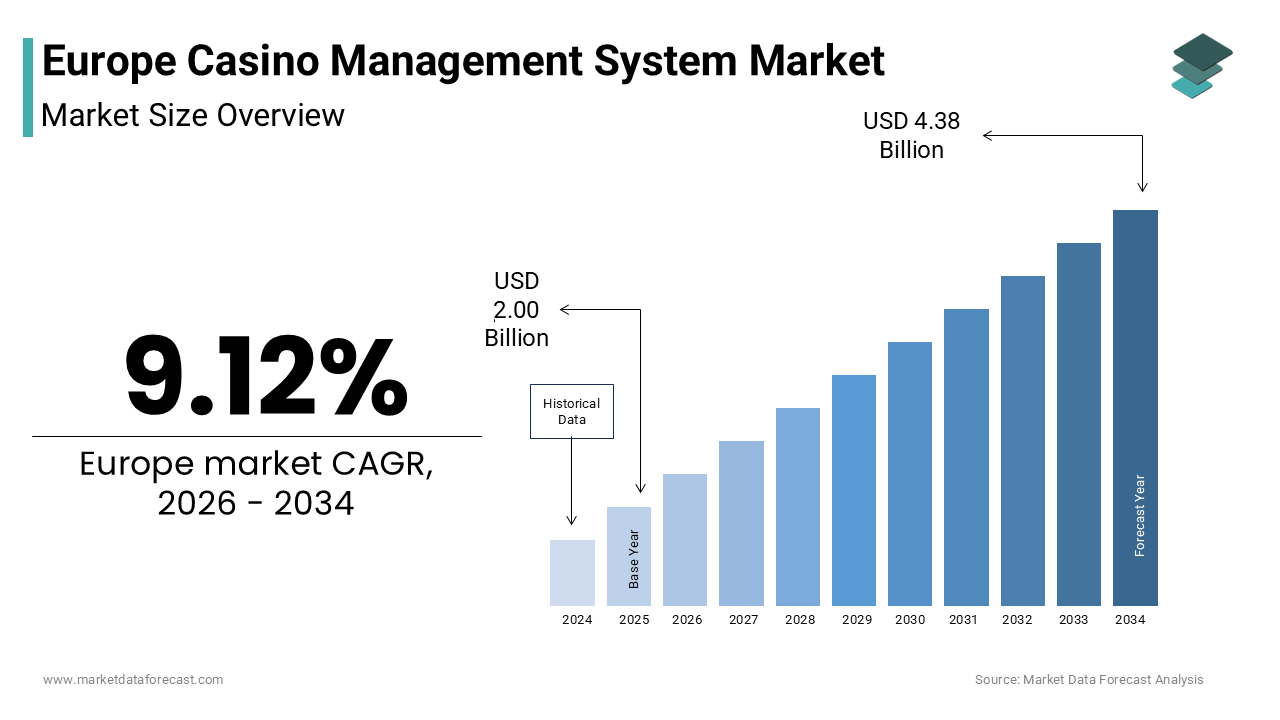
The Europe casino management system market was valued at USD 2.00 billion in 2025, is expected to reach USD 2.18 billion in 2026, and is projected to grow to USD 4.38 billion by 2034, registering a CAGR of 9.12% during the forecast period from 2026 to 2034. The growth of the Europe casino management system market is primarily driven by stringent regulatory compliance requirements, increasing adoption of omnichannel gaming experiences, and rising demand for cashless and AI-enabled gaming operations. Advanced technologies such as biometric authentication, real-time player analytics, and cloud-based platforms are transforming casino operations, while evolving EU gambling regulations and cybersecurity mandates continue to shape system innovation and deployment strategies across licensed European gaming environments.
Key Market Trends
-
Increasing adoption of AI-driven player behavior analytics to enhance personalization and responsible gaming compliance.
-
Rapid expansion of cashless wagering and digital wallet integration across regulated European casinos.
-
Shift toward cloud-based modular casino management platforms to reduce infrastructure costs.
-
Rising integration of biometric verification and mobile-based loyalty programs to deliver seamless omnichannel experiences.
-
Strong focus on cybersecurity frameworks and GDPR-compliant data architectures across gaming operations.
Segmental Insights
- Based on Purpose, the player tracking segment dominated the Europe casino management system market in 2025 due to its essential role in regulatory compliance and revenue optimization. European regulators increasingly require real-time monitoring and responsible gambling features, which ensures continued investment in advanced tracking technologies.
- The analytics segment is expected to grow at the fastest rate during the forecast period owing to the increasing use of predictive models for staffing optimization, gaming floor performance monitoring, and personalized promotions that enhance profitability in high-cost European casino environments.
- Based on end user, the large casinos segment held the major market share in 2025 as large-scale venues require fully integrated platforms to manage gaming operations, hotel services, entertainment, and regulatory reporting. Meanwhile, the small and medium casino segment is projected to witness steady growth supported by subscription-based cloud solutions that lower deployment costs and simplify compliance management.
Regional Insights
- The United Kingdom led the Europe casino management system market in 2025 supported by its mature casino ecosystem, strong regulatory enforcement, and early adoption of AI-powered player management platforms.
- France remains a key market driven by strict responsible gaming regulations and nationwide integration with self-exclusion databases, prompting widespread system upgrades.
- Spain continues to expand due to its tourism-driven casino industry, where integrated entertainment venues require advanced omnichannel management solutions.
- Italy is expected to grow steadily owing to centralized regulatory oversight and mandatory annual system certification requirements that drive continuous technology upgrades.
- Germany is emerging as a rapidly evolving market following the implementation of the Interstate Treaty on Gambling, which accelerated investments in real-time monitoring, analytics, and compliance-focused management platforms.
Competitive Landscape
The Europe casino management system market is characterized by high regulatory complexity, strong emphasis on cybersecurity, and continuous innovation in responsible gaming technologies. Leading companies operating in the Europe casino management system market include International Game Technology PLC, Novomatic AG, Apex Gaming Technology, Amatic Industries GmbH, Decart Ltd., Euro Games Technology Ltd., Ensico CMS d.o.o., Advansys d.o.o., Synectics plc, Dallmeier electronic GmbH & Co. KG, Konami Gaming, Inc., and SAS Institute Inc. These players focus on cloud-based deployment, AI-powered analytics, and jurisdiction-specific compliance modules to address Europe’s fragmented regulatory environment while enhancing operational efficiency and player engagement.
 Download Free Sample Report
Europe Casino Management System Market Size
The Europe casino management system market size was valued at USD 2.00 billion in 2025 and is anticipated to reach USD 2.18 billion in 2026 from USD 4.38 billion by 2034, growing at a CAGR of 9.12% during the forecast period from 2026 to 2034
Casino management system comprises integrated software and hardware solutions designed to streamline operations across gaming floors including player tracking, loyalty management table and slot monitoring cashless, wagering and regulatory compliance. These systems serve as the operational backbone of both land-based casinos and hybrid entertainment venues across jurisdictions where gambling is legally permitted. Unlike generic hospitality platforms casino management systems are highly specialized requiring real time data processing stringent security protocols and alignment with national gambling authorities. According to the European Gaming and Betting Association, only a limited number of EU member states fully legalize land-based casinos, with notable markets in France, Italy, Spain, the United Kingdom, and the Netherlands. As per Eurostat, there are over a thousand licensed land-based casinos operating across Europe as of 2023, which is reflecting a tightly regulated and geographically fragmented landscape. The European Commission’s Digital Services Act mandates robust player protection tools including self-exclusion mechanisms and deposit limits, which casino management systems must embed by design. This regulatory intensity combined with rising expectations for seamless digital experiences such as mobile check-in and biometric identification positions the European market as a high compliance, high sophistication segment within the global gaming technology ecosystem.
MARKET DRIVERS
Stringent Regulatory Compliance Mandates Driving System Adoption
European gambling regulators require casinos to implement advanced monitoring and player protection features, which directly fuels demand for modern casino management systems and is one of the major factors driving the European casino management systems market. According to the European Commission’s Gambling Policy Report, all EU jurisdictions with legal casinos enforce mandatory real time transaction logging, player identity verification, and integration with national self-exclusion databases such as France’s Système d’Interdiction de Jeu or the UK’s GAMSTOP. In Germany, the State Treaty on Gambling mandates that every gaming terminal must transmit session data to a centralized monitoring authority at regular intervals. As per a 2024 audit by the Malta Gaming Authority, a majority of casino operators upgraded their management systems between 2021 and 2023 to meet evolving anti money laundering and responsible gambling requirements. Furthermore, the General Data Protection Regulation imposes strict controls on biometric and behavioral data collection, compelling vendors to build privacy by design architectures. These overlapping legal obligations make compliance not optional but a core operational prerequisite, thereby accelerating technology refresh cycles across Europe’s licensed casino estate.
Rise of Integrated Omnichannel Player Experiences
Casinos across Europe are increasingly adopting unified management systems to deliver seamless experiences across physical and digital touchpoints in response to evolving consumer expectations, which is further boosting the European casino management systems market expansion. According to the European Casino Association, a majority of casino patrons in the UK, Spain, and the Netherlands now expect to access loyalty points, check table availability, or initiate cashless play via mobile apps before arriving on site. In France, the number of casinos offering integrated mobile wallets rose significantly between 2020 and 2023 as per the French Gambling Authority, reflecting a strategic shift toward frictionless engagement. Systems now incorporate AI driven personalization engines that analyze real time behavior to offer dynamic rewards. As per a study by the University of Nevada Las Vegas Center for Gaming Innovation, patrons using omnichannel platforms demonstrated higher visit frequency and longer session duration. This behavioral uplift transforms management systems from operational utilities into strategic revenue amplifiers, compelling continuous investment in platform modernization across Europe’s competitive casino sector.
MARKET RESTRAINTS
Fragmented Legal Landscape Across European Jurisdictions
The absence of a unified regulatory framework for gambling in Europe creates significant complexity for casino management system vendors and operators alike. According to the European Gaming and Betting Association, only 13 of 27 EU member states permit land-based casinos, each imposing distinct technical standards for data reporting, player verification, and game certification. For instance, Italy’s ADM requires all management systems to undergo annual penetration testing by accredited third parties, while Sweden’s Spelinspektionen mandates real time integration with its national deposit limit registry. According to a 2024 survey by the International Association of Gaming Regulators, most European casino operators cite regulatory fragmentation as the primary barrier to system standardization across multi country portfolios. Moreover, countries like Poland and Belgium prohibit certain player tracking functionalities citing privacy concerns, which is creating further customization demands. Unlike markets with federal oversight such as the United States, Europe’s regulatory heterogeneity undermines economies of scale and complicates cross border technology rollouts, making system integration slower, costlier, and less agile.
Persistent Cybersecurity Threats and Data Integrity Risks
Casino management systems are high value targets for cybercriminals due to their control over financial transactions, player identities, and real time gaming data, which is further hindering the growth of the European casino management systems market. According to Europol’s Threat Assessment on Cybercrime in the Gaming Sector, organized crime groups have increasingly deployed ransomware and API spoofing attacks to manipulate loyalty balances or extract sensitive customer databases. In 2022, a major casino operator in the Czech Republic suffered a breach that exposed hundreds of thousands of player records after attackers exploited an unpatched vulnerability in its legacy management software as confirmed by the Czech National Cyber and Information Security Agency. The financial and reputational fallout from such incidents is severe, with average breach costs exceeding several million euros according to the European Union Agency for Cybersecurity. Compounding the risk, many European casinos still operate on outdated on premise systems that lack automated patching or zero trust architectures. The EU’s NIS2 Directive now requires essential gaming entities to implement advanced threat detection and incident reporting protocols by October 2024. This regulatory pressure is forcing rapid but costly upgrades, yet legacy infrastructure inertia leaves many venues vulnerable during transition periods.
MARKET OPPPORTUNITIES
Expansion of Cashless and Contactless Wagering Solutions
The shift toward digital payment ecosystems presents a significant opportunity for the European casino management systems market. According to the European Central Bank, contactless transactions accounted for the majority of point-of-sale payments in the EU in 2023, with consumers increasingly expecting similar convenience in entertainment venues. In response, casinos in the Netherlands and Spain have rolled out closed loop digital wallets linked to player cards, allowing guests to fund accounts via mobile banking, instant transfers, or prepaid vouchers without handling physical chips. As per the reports from the Dutch Gaming Authority, casinos offering cashless play have reduced transaction processing times and improved operational efficiency. These systems also enable granular spend tracking, which enhances responsible gambling interventions such as automatic alerts when deposit thresholds are approached. As per the European Payment Council, SEPA Instant Credit Transfer adoption is now supported by most EU banks, which is creating a fertile infrastructure for frictionless casino fintech integration. This convergence of payment modernization and player experience innovation positions cashless management modules as a high growth frontier across Europe’s regulated gaming sector.
Integration of Artificial Intelligence for Player Behavior Analytics
Advanced casino management systems are increasingly embedding artificial intelligence to transform raw gaming data into actionable player insights, which is another promising opportunity in the European casino management systems market. According to the European Institute for Security Studies, machine learning models can predict churn risk, upsell potential, and problem gambling indicators by analysing patterns in session frequency, bet volatility, and response to promotions. In the United Kingdom, operators using AI enhanced systems reported improvements in loyalty program ROI in 2023 as per the UK Gambling Commission’s Technology Adoption Review. These systems dynamically adjust comp offers in real time. For example, granting expedited table access to high value players detected via facial recognition upon entry. Moreover, AI driven anomaly detection helps identify fraudulent collusion or chip dumping by monitoring unusual betting sequences across multiple terminals. The European Data Protection Board has issued guidelines permitting such analytics under strict anonymization and purpose limitation clauses, enabling compliant innovation. As computational power becomes more accessible, even mid-tier casinos in Italy and Portugal are piloting predictive modules. This shift from reactive to anticipatory management not only boosts revenue but also strengthens duty of care obligations, making AI a strategic differentiator in Europe’s increasingly competitive and ethically conscious gaming environment.
MARKET CHALLENGES
Legacy System Inertia and High Migration Costs
Many European casinos continue to operate on outdated management platforms installed decades ago, which is creating significant technical debt that impedes innovation and significantly challenging the growth of the European casino management systems market. According to a 2024 audit by the European Casino Association, a large share of land-based venues in Southern and Eastern Europe still relies on proprietary on-premise systems that lack API support, cloud connectivity, or modern cybersecurity protocols. Migrating to integrated platforms requires substantial capital investment as well as extensive staff retraining and operational downtime. In Italy, for example, a full system overhaul can take well over a year due to mandatory certification by the ADM for every software component. This inertia locks operators into vendor specific ecosystems with limited scalability. For instance, legacy compatibility issues have delayed the rollout of new loyalty programs in Belgium, which is resulting in significant revenue losses. Unlike new builds which can adopt modular cloud architectures, existing venues face painful trade-offs between continuity and modernization. Until regulatory bodies incentivize or mandate technology refreshes, this legacy burden will remain a structural brake on Europe’s casino management system evolution.
Talent Shortage in Specialized Gaming Technology Implementation
The deployment and maintenance of advanced casino management systems require a rare blend of skills in gaming regulation, real time data engineering, and cybersecurity as talent that is in critically short supply across Europe, which is another major challenge to the European casino management systems market growth. According to the European Commission’s Digital Skills Gap Report, the gaming technology sector faces a notable shortfall in qualified system integrators with expertise in both gambling compliance and enterprise software architecture. In countries like Portugal and Greece, local IT firms lack experience with certified casino protocols, forcing operators to rely on expensive international consultants, which increases project timelines and costs. As per a survey by the International Casino Technology Association, more than half of European casino CIOs identified workforce capability as the top barrier to adopting AI and cloud-based management systems. Furthermore, the niche nature of the field discourages academic programs, with only a handful of universities in the EU offering specialized courses in gaming systems engineering. This scarcity not only inflates labor costs but also heightens implementation risks due to knowledge gaps. Without targeted upskilling initiatives or cross border certification frameworks, Europe’s casino sector will struggle to fully leverage next generation management technologies despite regulatory and market readiness.
REPORT COVERAGE
| REPORT METRIC | DETAILS |
| Market Size Available | 2025 to 2034 |
| Base Year | 2025 |
| Forecast Period | 2026 to 2034 |
| CAGR | 9.12% |
| Segments Covered | By Purpose, End-use and Region |
| Various Analyses Covered | Regional & Country Level Analysis, Segment-Level Analysis, DROC, PESTLE Analysis, Porter’s Five Forces Analysis, Competitive Landscape, Analyst Overview on Investment Opportunities |
| Countries Covered | UK, France, Spain, Germany, Italy, Russia, Sweden, Denmark, Switzerland, the Netherlands, Turkey, the Czech Republic, and the Rest of Europe. |
| Market Leaders Profiled | International Game Technology PLC, Novomatic AG, Apex Gaming Technology, Amatic Industries GmbH, Decart Ltd., Euro Games Technology Ltd., Ensico CMS d.o.o., Advansys d.o.o., Synectics plc, Dallmeier electronic GmbH & Co. KG, Konami Gaming, Inc., and SAS Institute Inc. |
SEGMENTAL ANALYSIS
By Purpose Insights
The player tracking segment dominated the largest functional segment within the Europe casino management system market and accounted for 29.4% of the regional market share in 2025. The dominance of player tracking segment in the European market is attributed to its dual role in driving revenue optimization and fulfilling regulatory obligations across licensed jurisdictions. European gambling authorities increasingly mandate real time player monitoring to enforce responsible gambling measures, which has embedded player tracking as a non-optional system component. According to the UK Gambling Commission, all licensed casinos must implement systems capable of flagging excessive play patterns and triggering automated interventions such as cooling off periods or deposit caps. In Sweden, the Spelinspektionen requires player tracking data to be synchronized with the national self-exclusion registry within minutes of a new session start. As per a compliance audit by the French Gambling Authority, most casinos upgraded their tracking modules to meet the Responsible Gaming Directive, which mandates dynamic risk scoring based on session duration, loss velocity, and login frequency. Furthermore, the European Data Protection Board permits behavioral analytics under strict pseudonymization protocols, enabling operators to balance duty of care with personalization. This regulatory tailwind ensures sustained investment in advanced tracking capabilities across Europe’s legally operating casino estate.
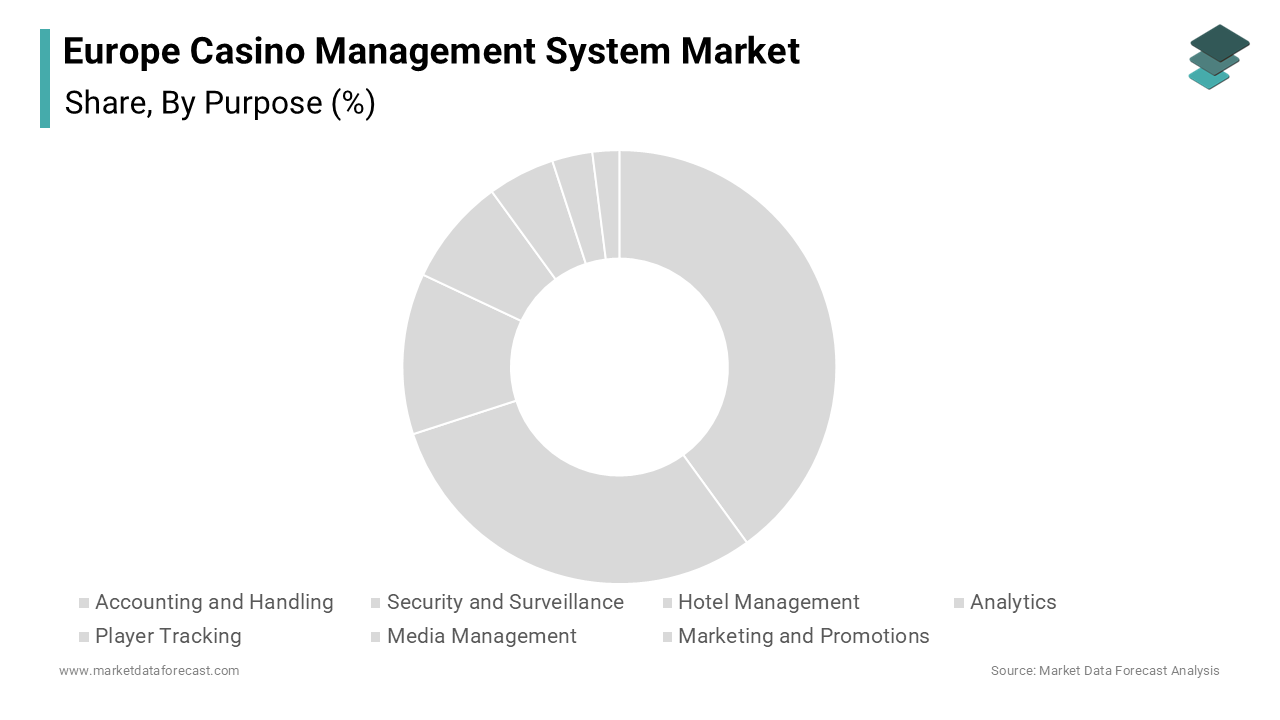
The analytics segment is expanding at the fastest rate in the Europe casino management system market and is estimated to record a CAGR of 13.1% over the forecast period. Advanced analytics platforms now use machine learning to forecast footfall, staff demand, and table utilization, which is enabling proactive resource allocation. According to the European Institute for Security Studies, predictive models analyzing historical visitation and local event calendars achieved high accuracy in daily patron volume forecasts across casinos in France and the Netherlands in 2023. This allows operators to optimize staffing—reducing labor costs during low traffic periods while ensuring service quality during peaks. Additionally, analytics engines monitor real time gaming floor performance, identifying underperforming slot zones or dealer inefficiencies. In Italy, casinos using such systems reduced slot downtime through predictive maintenance alerts as confirmed by the Italian Gaming Authority. These operational gains translate directly into margin improvement, making analytics indispensable for profitability in Europe’s high-cost labor environments.
By End User Insights
The large casinos segment dominated the Europe casino management system market by capturing 71.9% of the European market share in 2025. The leading position of large casinos segment in the European market is attributed to their scale, complex operations, and regulatory exposure, which necessitate comprehensive integrated platforms. Large casinos typically manage hundreds of gaming terminals, multiple table pits, hotel rooms, fine dining venues, and entertainment stages, which is requiring a unified system to synchronize data and workflows. According to the European Casino Association, venues with over 300 slot machines operate on average numerous subsystems from access control to payroll that must interoperate seamlessly. As per a case study from a major casino resort in Barcelona, legacy siloed systems caused delays in comp fulfillment and errors in player tier upgrades. Integrated management platforms resolve these inefficiencies by centralizing data into a single source of truth, enabling real time decision making. Furthermore, large operators often run multi property portfolios across jurisdictions, which is requiring standardized reporting for corporate governance. The European Commission’s Corporate Sustainability Reporting Directive now requires such entities to disclose gambling harm metrics, which further justifies investment in enterprise grade systems. This operational necessity ensures large casinos remain the primary adopters of high-end management solutions.
While smaller in share, the small and medium casino segment is growing at a promising CAGR of 10.4% over the forecast period owing to the modular cloud adoption and regulatory harmonization. The emergence of subscription-based cloud platforms has dramatically lowered entry barriers for smaller venues that previously could not afford million euro on premise deployments. Vendors now offer à la carte modules that scale with operational needs. According to a survey by the European Small Casino Operators Network, a majority of venues with fewer than 100 slot machines migrated to cloud management systems in 2022–2023, which is citing significant cost savings compared to traditional licenses. These platforms require minimal IT infrastructure and offer automatic updates, ensuring compliance without dedicated technical staff. In Portugal, for example, a network of regional casinos pooled resources to adopt a shared cloud instance, which is reducing per site costs as per the Portuguese Gaming Service. This democratization of enterprise functionality enables small operators to compete on experience rather than scale, which is accelerating technology penetration across Europe’s fragmented casino landscape.
REGIONAL ANALYSIS
United Kingdom Casino Management System Market Analysis
The United Kingdom led the casino management systems market in Europe in 2025 and accounted for 23.9% of the regional market share. The dominance of the UK in the European market is driven by its mature land-based casino sector, stringent regulatory regime, and early adoption of integrated digital platforms. With over a hundred licensed casinos operating nationwide, the UK enforces some of the world’s most rigorous player protection standards requiring real time behavioral monitoring and automated intervention protocols. Industry audits confirm that most UK casinos have implemented AI driven management systems capable of dynamic risk scoring and cross channel loyalty integration. The Gambling Commission’s Technology Guidance further mandates biometric verification for high value transactions, accelerating adoption of secure identity management modules. London’s status as a global financial and tourism hub also drives demand for premium experiences with integrated hotel, dining, and gaming suites. This combination of regulatory pressure, technological readiness, and commercial scale ensures the UK remains the benchmark for advanced casino system deployment in Europe.
France Casino Management System Market Analysis
France held 18.7% of the European market share in 2025 and emerged as the second major regional segment. The nation’s leadership is anchored in its licensed casinos concentrated in major cities and coastal resorts, all subject to a rapidly evolving compliance framework. The Responsible Gaming Reform mandated that every casino implement real time player tracking linked to the national Système d’Interdiction de Jeu database with shorter transmission intervals. Government audits confirm that most French casinos upgraded their core management platforms between 2021 and 2023 to meet these requirements. Additionally, France’s emphasis on cultural heritage has spurred innovation in media management systems that digitize historical gaming archives and enhance visitor engagement through augmented reality experiences. State owned Française des Jeux’s investment in secure cloud infrastructure has also set technical standards adopted by private operators. This blend of regulatory rigor, national coordination, and experiential innovation sustains France’s position as a high compliance, high sophistication market.
Spain Casino Management System Market Analysis
Spain is predicted to hold a promising share of the Europe casino management system market over the forecast period. The country’s strength lies in its tourism driven casino model, with major venues in Barcelona, Madrid, and the Costa del Sol operating as integrated entertainment destinations. These resorts manage complex ecosystems including hotels, spas, nightclubs, and convention centers, necessitating unified management platforms. According to the Spanish Ministry of Tourism, international visitors in 2023 included casino access as part of their stay, driving demand for seamless guest journey orchestration. In response, most Spanish casinos implemented full suite management systems by 2023 featuring cashless wagering, biometric entry, and AI powered personalization. The amendment to the Spanish Gambling Act further required real time anti money laundering checks on transactions above certain thresholds, accelerating adoption of integrated compliance modules. This convergence of tourism scale and regulatory modernization positions Spain as a dynamic and high-volume market where system sophistication directly correlates with guest retention and spends.
Italy Casino Management System Market Analysis
Italy is estimated to exhibit a prominent CAGR in the Europe casino management system market during the forecast period. The country’s licensed casinos operate under centralized federal oversight that mandates strict technical homogeneity. ADM’s Technical Specifications Directive requires all management systems to undergo annual penetration testing and real time data streaming to a national monitoring hub. Compliance reports confirm that Italian casinos now use certified platforms that auto generate audit trails for every gaming session, transaction, and player interaction. This regulatory uniformity simplifies vendor certification and accelerates deployment cycles. Moreover, Italy’s emphasis on cultural preservation has driven innovation in non-intrusive surveillance systems that use AI instead of visible cameras to monitor historic interiors. Recent investments in cashless infrastructure have also spurred upgrades. With per capita gambling expenditure rising in 2023 as per ISTAT, the demand for systems that balance heritage aesthetics with modern functionality ensures Italy remains a stable and high compliance market.
Germany Casino Management System Market Analysis.
Germany is anticipated to account for a notable share of the Europe casino management system market during the forecast period. The country’s recent emergence as a significant market stems from the full implementation of the Interstate Treaty, which legalized and standardized land-based casinos after decades of legal ambiguity. This regulatory clarity triggered a wave of technology investment as licensed venues rushed to meet compliance deadlines for player protection and financial monitoring. According to the German Gaming Association, most casinos undertook full or partial management system overhauls between 2021 and 2023 with substantial project budgets. The treaty mandates real time deposit limit enforcement, self-exclusion synchronization, and session duration tracking—all requiring robust backend infrastructure. Furthermore, Germany’s strong data privacy culture compelled vendors to develop GDPR native architectures with on premise data residency options. As the market stabilizes and operators shift from compliance to optimization, demand is now growing for analytics and personalization modules. This post liberalization technology surge positions Germany as Europe’s fastest maturing casino management system market with sustained upgrade cycles expected through 2030.
COMPETITIVE LANDSCAPE
The Europe casino management system market features intense yet specialized competition defined by regulatory sophistication rather than price. A handful of global technology leaders dominate due to their capacity to navigate complex and divergent national gambling laws while delivering integrated platforms that span player tracking security analytics and cashless operations. Competition is characterized by continuous innovation in responsible gaming tools cybersecurity resilience and data intelligence rather than feature parity alone. New entrants face formidable barriers including mandatory system certifications lengthy procurement cycles and the need for multilingual multijurisdictional support. At the same time large casino operators increasingly demand end to end solutions that unify gaming floor hotel and entertainment data creating a premium for vendors with full suite capabilities. Regional players remain limited to niche modules due to scale constraints while global firms leverage their international experience to anticipate regulatory shifts. Ultimately rivalry centers on trust reliability and the ability to balance player protection with revenue optimization within Europe’s ethically stringent and technically demanding gaming ecosystem.
KEY MARKET PLAYERS
Some of the companies that are playing a dominating role in the Europe Casino Management System Market include
- International Game Technology PLC
- Novomatic AG
- Apex Gaming Technology
- Amatic Industries GmbH
- Decart Ltd.
- Euro Games Technology Ltd.
- Ensico CMS d.o.o.
- Advansys d.o.o.
- Synectics plc
- Dallmeier electronic GmbH & Co. KG
- Konami Gaming, Inc.
- SAS Institute Inc.
Top Players in the Market
International Game Technology PLC
International Game Technology PLC plays a central role in the Europe casino management system market through its IGT Advantage platform which integrates player tracking cashless wagering and analytics across regulated jurisdictions. The company actively aligns its solutions with EU gambling directives by embedding real time self-exclusion checks and dynamic deposit limit enforcement. Recently IGT enhanced its cloud-based Advantage Suite with AI driven behavioral analytics certified by the UK Gambling Commission and the Swedish Spelinspektionen. It also launched a modular media management system allowing casinos to personalize digital signage based on player profiles. These innovations reinforce IGT’s commitment to responsible gaming while enabling operators to deliver tailored experiences that meet Europe’s exacting regulatory and consumer expectations.
Aristocrat Technologies Inc
Aristocrat Technologies Inc has significantly expanded its footprint in the Europe casino management system market via its Oasis 360 platform which unifies slot management table games analytics and hotel operations. The company has prioritized compliance with fragmented European regulations by developing jurisdiction specific modules for Germany France and the Netherlands that auto adapt to local reporting rules. Aristocrat recently introduced a biometric authentication layer compatible with GDPR that enables seamless player identification without compromising privacy. It also partnered with major European casino groups to pilot predictive analytics for churn reduction and staff optimization. Through these initiatives Aristocrat strengthens its position as a flexible and future ready technology partner in Europe’s complex and evolving gaming landscape.
KONAMI Gaming Inc.
KONAMI Gaming Inc contributes to the Europe casino management system market through its SYNKROS enterprise platform which offers real time player tracking cross property loyalty management and advanced surveillance integration. The company has intensified its focus on cybersecurity by achieving ISO 27001 certification for its European data centers and implementing zero trust architecture across all system interfaces. KONAMI recently rolled out a cashless ecosystem compatible with SEPA Instant Credit Transfer enabling frictionless top ups via mobile banking across EU jurisdictions. It also launched a responsible gaming dashboard that visualizes player risk scores and intervention history for regulatory audits. These actions underscore KONAMI’s strategy of combining operational intelligence with robust compliance to serve Europe’s sophisticated and security conscious casino operators.
Top Strategies Used by the Key Market Participants
Key players in the Europe casino management system market pursue strategies centred on regulatory compliance modular cloud deployment responsible gaming integration and cross channel personalization. They invest heavily in jurisdiction specific system certifications to navigate Europe’s fragmented legal landscape while offering scalable cloud-based architectures that reduce upfront costs for smaller operators. Companies embed AI driven analytics to enable real time player monitoring fraud detection and dynamic loyalty rewards aligned with EU data protection standards. Strategic partnerships with national gaming authorities and payment providers ensure seamless integration with self-exclusion registries and digital wallet ecosystems. Additionally, vendors emphasize cybersecurity through zero trust frameworks and third-party audits to protect sensitive transaction data. These approaches collectively address Europe’s dual imperatives of operational efficiency and stringent consumer protection solidifying long term vendor relevance in a high compliance environment.
MARKET SEGMENTATION
This research report on the Europe Casino Management System Market has been segmented and sub-segmented based on following categories.
By Purpose
- Accounting and Handling (slot machine and table management, cash handling)
- Security and Surveillance (Analog and IP Surveillance Systems, biometrics)
- Hotel Management (Hotel and other property)
- Analytics
- Player Tracking
- Media Management
- Marketing and Promotions
By End User
- Small and Medium Casinos
- Large Casinos
By Country
- UK
- France
- Spain
- Germany
- Italy
- Russia
- Sweden
- Denmark
- Switzerland
- Netherlands
- Turkey
- Czech Republic
- Rest of Europe