- Product Description Description
- Table of Contents TOC
- List of Table & Figure LOT
- Get Free Sample PDF Sample PDF
Market Size, 2025
$105.23 BnMarket Estimate, 2026
$111.19 BnMarket Forecast, 2034
$167.19 BnCAGR, 2026–2034
5.65%Europe Casinos Market Size, Growth, Trends & Forecast (2026–2034)
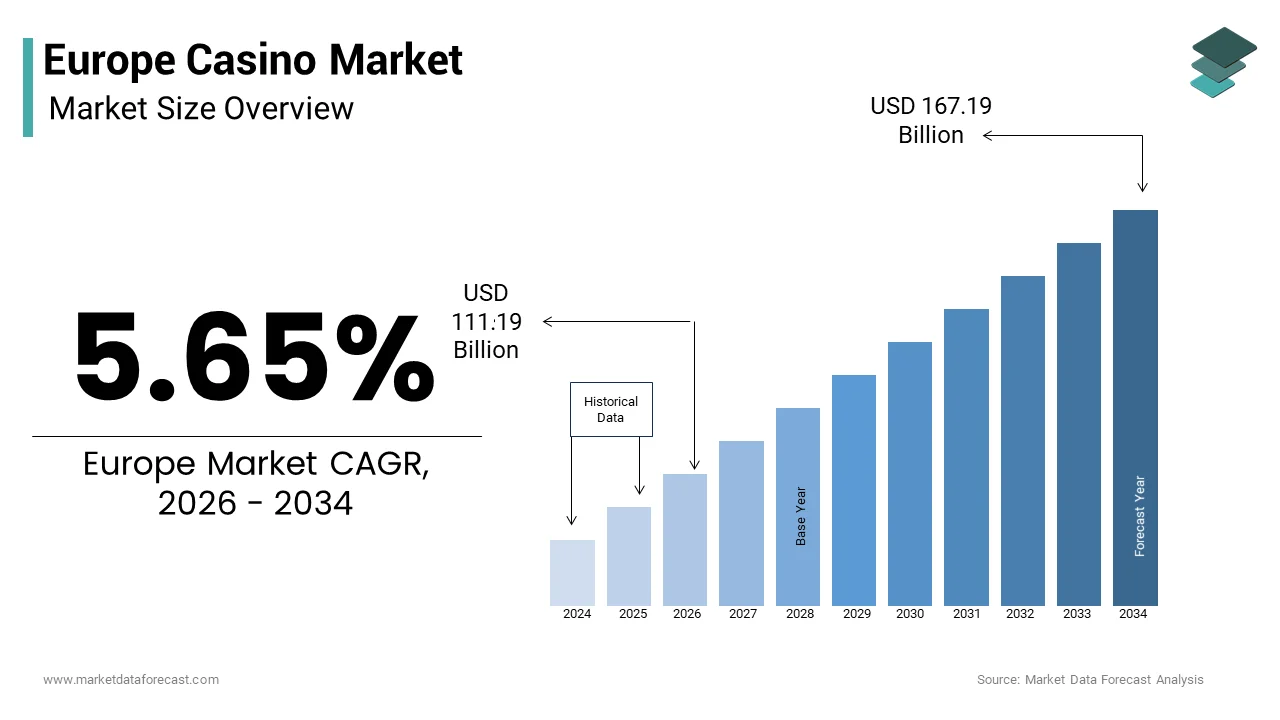
The Europe casinos market size was valued at USD 105.23 billion in 2025, is anticipated to reach USD 111.19 billion in 2026, and is expected to expand up to USD 167.19 billion by 2034, registering a compound annual growth rate (CAGR) of 5.65% during the forecast period from 2026 to 2034. Driven by the deep cultural integration of physical gambling venues, robust tourism-linked footfall, and rapid tech-enabled iGaming expansion across regulated jurisdictions, the regional market demonstrates steady long-term growth.
Key Executive Metrics (At-a-Glance)
- 2025 Base Valuation: USD 105.23 Billion
- 2026 Current Valuation: USD 111.19 Billion
- 2034 Forecast Valuation: USD 167.19 Billion
- Compound Annual Growth Rate (CAGR): 5.65% (2026–2034)
- Dominant Country Market: Italy (holding a 41.4% share in 2025 due to extensive physical and online network distribution managed via ADM)
- Leading Type Segment: Land-Based Casino Gaming (holding a 60.6% share in 2025 anchored by deep historic and tourism-led infrastructure)
Core Market Drivers
- Tourism & Leisure Integration: Europe’s global tourism dominance amplifying casino footfall through integrated resort destinations and cross-border travel.
- Digital & Hybrid Preferences: High smartphone penetration and 5G networks accelerating demand for mobile-first and live dealer online casino experiences.
Primary Market Restraints & Challenges
- Fragmented Regulations: Divergent national licensing laws, high compliance overheads, and rising public health measures addressing problem gambling.
- Unlicensed Black Markets: Unregulated offshore operators diverting significant gross gaming revenue and presenting persistent compliance threats.
Europe Casinos Market Segmentation Breakdown
| Category Dimension | Largest Segment / Leader | Fastest-Growing Segment |
|---|---|---|
| By Type | Land-Based Casino Gaming (60.6% Share in 2025) | Online Casino Gaming (Projected 12.2% CAGR driven by mobile adoption and liberalization) |
| By End User | Gambling Enthusiasts (51.5% Share in 2025) | Dabblers (Projected highest double-digit annual growth via gamified mobile interfaces) |
| By Country | Italy (41.4% Share in 2025) | United Kingdom (expanding via advanced digital penetration and online platforms) |
Major Industry Players Profiled
Key multinational corporations and operators leading the European market include Las Vegas Sands Corporation, MGM Resorts International, Entain plc, Betsson AB, Caesars Entertainment, Wynn Resorts, Galaxy Entertainment Group, Melco Resorts & Entertainment, SJM Holdings, Aristocrat Leisure Limited, Evolution Gaming, and Flutter Entertainment.
 Download Free Sample Report
Europe Casinos Market Size
The Europe Casinos Market size was valued at USD 105.23 billion in 2025 and is anticipated to reach USD 111.19 billion in 2026 to reach from USD 167.19 billion by 2034, growing at a CAGR of 5.65% during the forecast period from 2026 to 2034.
Casinos encompasses a sophisticated blend of land based and digital gaming ecosystems operating under rigorous national and supranational oversight. It includes physical venues offering table games, slot machines, and live entertainment, as well as online platforms delivering real time and on demand casino experiences. In 2025, the sector is defined by its dual structure and anchored in historic gambling hubs like Monte Carlo and evolving through tech enabled iGaming services across regulated jurisdictions. The continent hosts nearly 130,000 gambling premises, more than any other global region, reflecting deep institutional and cultural integration. As per the European Gaming and Betting Association, land-based operations generated significant revenue in 2024, while online casino gross gaming revenue among its members also showed notable growth compared to the previous year. According to the United Nations World Tourism Organization, Europe’s dominance in global tourism further embeds casinos within broader leisure and hospitality value chains, which is reinforcing their economic and social relevance beyond pure wagering activity.
MARKET DRIVERS
Integration of Tourism and Leisure Infrastructure Fuels Casino Patronage
Europe’s unparalleled position as the world’s leading tourist destination directly amplifies casino footfall and revenue potential, which is one of the major factors driving the growth of the European casinos market. As per the United Nations World Tourism Organization, the region offers a vast and continuous stream of potential patrons who view gaming as part of a holistic entertainment experience. According to Eurostat, tourism activity across the EU has sustained demand for integrated resort casinos in Spain, Italy, and France. As per Eurostat, a majority of EU residents took at least one personal tourism trip in 2023, with cross border travel facilitating regional casino visits, especially in areas like the Rhine Valley or the Adriatic coast where regulatory differences create destination appeal. Europe commands roughly 30% of the global casino tourism market share, demonstrating how heritage sites, luxury hotels, and gaming converge to attract high value visitors. This synergy ensures that casinos remain embedded in premium travel itineraries, reducing reliance on local clientele and insulating revenue from domestic economic fluctuations.
Evolving Consumer Preferences Toward Digital and Hybrid Gaming Experiences
A structural shift toward digital convenience and immersive interaction is reshaping demand patterns across age groups, which is further contributing to the casinos market expansion in Europe. As per the European Gaming and Betting Association, online channels have become a significant contributor to Europe’s gambling revenue, with member companies reporting notable growth in online casino gross gaming revenue compared to the previous year. According to industry reports, countries such as Sweden have demonstrated strong adoption of online gambling, a model now replicated in Germany, Denmark, and the Netherlands. High smartphone penetration and widespread 5G coverage enable seamless mobile play, while live dealer technology replicates the social dynamics of physical tables. Younger demographics increasingly favor skill based formats and interactive features, prompting operators to integrate gamified loyalty systems and real time analytics. As per industry assessments, the Europe online casino market generated USD 9.35 billion in 2024 and is projected to grow at an 11.8% compound annual rate through 2030. This digital migration not only expands market reach but also enables hyper personalized engagement, transforming passive players into active participants in a dynamic entertainment ecosystem.
MARKET RESTRAINTS
Stringent and Fragmented Regulatory Frameworks Across Jurisdictions
The absence of a harmonized regulatory regime across Europe imposes significant operational and financial burdens on casino operators, which is impeding the growth of the European casinos market. Each of the 27 EU member states, and additional non-EU nations like the UK and Switzerland, maintains independent gambling authorities with divergent licensing rules, tax rates, and technical mandates. As per the European Gaming and Betting Association, these inconsistencies have led to product fragmentation and reduced cross border scalability. Moreover, the rise of precautionary regulation, such as the UK’s proposed affordability checks, prioritizes harm reduction over commercial innovation, slowing product development cycles. This patchwork not only inflates compliance costs but also inadvertently fuels the unlicensed market, which captured an estimated 20% of online wagering in several jurisdictions in 2024, undermining both fiscal integrity and consumer protection.
Rising Public Health Concerns and Problem Gambling Incidence
Escalating awareness of gambling related harm is driving restrictive policy interventions that constrain market expansion. As per public health authorities, problem gambling prevalence across Europe has prompted governments to implement measures such as mandatory self-exclusion, stake caps, and daytime advertising bans. In 2025, multiple European parliaments launched inquiries into gambling addiction, resulting in legislative proposals targeting high intensity products like rapid spin slots. According to the UK National Health Service, specialist referrals for gambling disorder have increased significantly in recent years, which is signalling growing strain on public health systems. Operators now allocate over 5% of annual revenue to responsible gambling initiatives, including AI driven behavioral monitoring and real time intervention tools. While essential for ethical operations, these mandates increase operational complexity and reduce marketing agility, particularly in customer acquisition. The shifting narrative from entertainment to public health risk has dampened investor enthusiasm and limited product innovation, especially in markets with heightened political sensitivity to social harm.
MARKET OPPORTUNITIES
Technological Innovation in Secure and Immersive Gaming Platforms
Next generation technologies are unlocking new dimensions of engagement, security, and regulatory compliance, which is a notable opportunity in the European casinos market. Blockchain based provably fair systems enhance transparency, while biometric authentication strengthens identity verification against fraud and underage access. Most notably, extended reality (XR) environments, including virtual reality casinos and augmented reality table overlays, are redefining immersion. As per industry reports, pilot programs in Malta and Estonia in 2025 demonstrated that VR casino sessions delivered longer play times and higher conversion rates compared to standard mobile interfaces. Concurrently, 5G networks enable ultra-low latency streaming of live dealer interactions, replicating the sensory authenticity of physical venues. According to industry data, investments in immersive technology within the European iGaming sector have shown strong year on year growth. These innovations not only attract digitally native users but also generate rich behavioral datasets that support real time responsible gambling interventions. By embedding cutting edge infrastructure into core offerings, operators can differentiate themselves in a saturated market, reduce churn, and build trust through demonstrable fairness and safety, aligning commercial objectives with regulatory expectations.
Strategic Expansion into Emerging Central and Eastern European Markets
Central and Eastern Europe represents a high growth frontier for the European casinos market characterized by rising affluence, improving digital access, and progressive regulatory reforms. As per national regulatory authorities, Romania issued its first comprehensive online licenses in 2023, triggering significant growth in regulated market revenue. According to government sources, Poland’s 2024 amendment to its Gambling Act opened the door to private casino concessions for the first time in decades, unlocking a market of 38 million consumers with expanding middle class purchasing power. Internet penetration and smartphone adoption in the region have reached high levels, enabling mobile first casino strategies. As per national statistics, casino participation in the Czech Republic has shown notable expansion across licensed municipalities. These markets offer lower operational costs, less competitive saturation, and higher margins compared to mature Western economies. Early movers can establish brand loyalty through localized payment methods, culturally tailored game content, and partnerships with regional sports entities. By diversifying geographically into this corridor, operators mitigate concentration risk and tap into a demographic wave poised for sustained discretionary spending growth through 2030.
MARKET CHALLENGES
Persistent Threat of Unlicensed and Illicit Gambling Operators
The shadow market remains a systemic threat to the legitimacy and sustainability of Europe’s regulated casino sector, which is a major challenge to the European casinos market. As per the European Commission, a significant portion of online wagering in key jurisdictions occurs through unlicensed offshore platforms that evade taxation, bypass age verification, and operate without consumer safeguards. In 2024, the Commission identified numerous illicit domains actively targeting EU citizens, many hosted in non-cooperative territories with minimal enforcement. These sites lure players with unrestricted bonuses, higher payout rates, and no deposit limits, creating an uneven competitive landscape. According to industry assessments, unlicensed operators in Germany diverted billions in gross gaming revenue, depriving public coffers of substantial tax income. The absence of oversight on these platforms heightens risks of money laundering, match fixing, and underage gambling, eroding public confidence in the entire industry. Despite efforts like payment blocking and domain takedowns, rogue sites relaunch under new URLs within hours, rendering current enforcement reactive and inefficient. This persistent black market not only distorts market data but also impedes coordinated public health strategies, weakening the foundation of a transparent and accountable gambling ecosystem.
Workforce Shortages and Talent Retention in Specialized Operational Roles
A critical shortage of skilled professionals is constraining operational excellence and innovation across the European casino industry. The digitization of gaming and intensification of compliance demands have created acute need for hybrid talent, individuals proficient in cybersecurity, anti money laundering protocols, data science, and live entertainment management. As per industry surveys conducted in 2025, a majority of operators struggled to fill senior compliance roles, with vacancies lasting several months on average. Frontline positions face similar pressures, as croupiers and pit managers require extensive training in game integrity and fraud detection, yet attrition rates remain high in major markets like Spain and Italy due to demanding schedules and workplace stress. Compounding the issue, vocational certifications are rarely recognized across borders, limiting labor mobility. Operators consequently incur high costs in recruitment, onboarding, and continuous upskilling. Without pan European collaboration between regulators, educational institutions, and industry bodies to standardize training pathways and improve career incentives, this human capital gap will continue to impair service quality, regulatory adherence, and technological adoption, ultimately hindering the sector’s ability to evolve in a competitive global landscape.
REPORT COVERAGE
| REPORT METRIC | DETAILS |
| Market Size Available | 2025 to 2034 |
| Base Year | 2025 |
| Forecast Period | 2026 to 2034 |
| CAGR | 5.65% |
| Segments Covered | By Type, End-User, By Country |
| Various Analyses Covered | Global, Regional & Country Level Analysis, Segment-Level Analysis, DROC, PESTLE Analysis, Porter’s Five Forces Analysis, Competitive Landscape, Analyst Overview on Investment Opportunities |
| Regions Covered | UK, France, Spain, Germany, Italy, Russia, Sweden, Denmark, Switzerland, Netherlands, Turkey, the Czech Republic, and the Rest of Europe |
| Market Leaders Profiled | Las Vegas Sands Corporation, MGM Resorts International, Caesars Entertainment, Wynn Resorts, Galaxy Entertainment Group, Melco Resorts & Entertainment, SJM Holdings, Aristocrat Leisure Limited, Evolution Gaming, Flutter Entertainment, |
SEGMENTAL ANALYSIS
By Type Insights
The land-based casino segment held a dominant position in the European market by accounting for 60.6% of the regional market share in 2025. The leading position of land-based casino segment in the European market is driven by deep rooted cultural acceptance, extensive physical infrastructure, and integration with tourism and hospitality ecosystems across major cities and resort destinations. Standalone land-based properties alone held 51.05% of the Europe casino gambling market share in 2025 due to their established urban footprints and regulatory maturity. The segment benefits from high consumer trust in tangible environments where social interaction, live dealers, and sensory experiences cannot be replicated online. As per industry sources, land-based venues remain the primary channel in countries such as Italy, Spain, and Germany, with online gambling representing a smaller proportion of total gambling revenue. Furthermore, Europe hosts nearly 130,000 gambling premises, more than any other global region, providing unmatched accessibility. According to the European Gaming and Betting Association, land-based operations generated €75.5 billion in 2024, reflecting sustained patronage despite digital alternatives. This physical dominance is reinforced by stringent licensing frameworks that historically favoured brick and mortar operators, creating high barriers to entry for purely digital competitors in several jurisdictions.
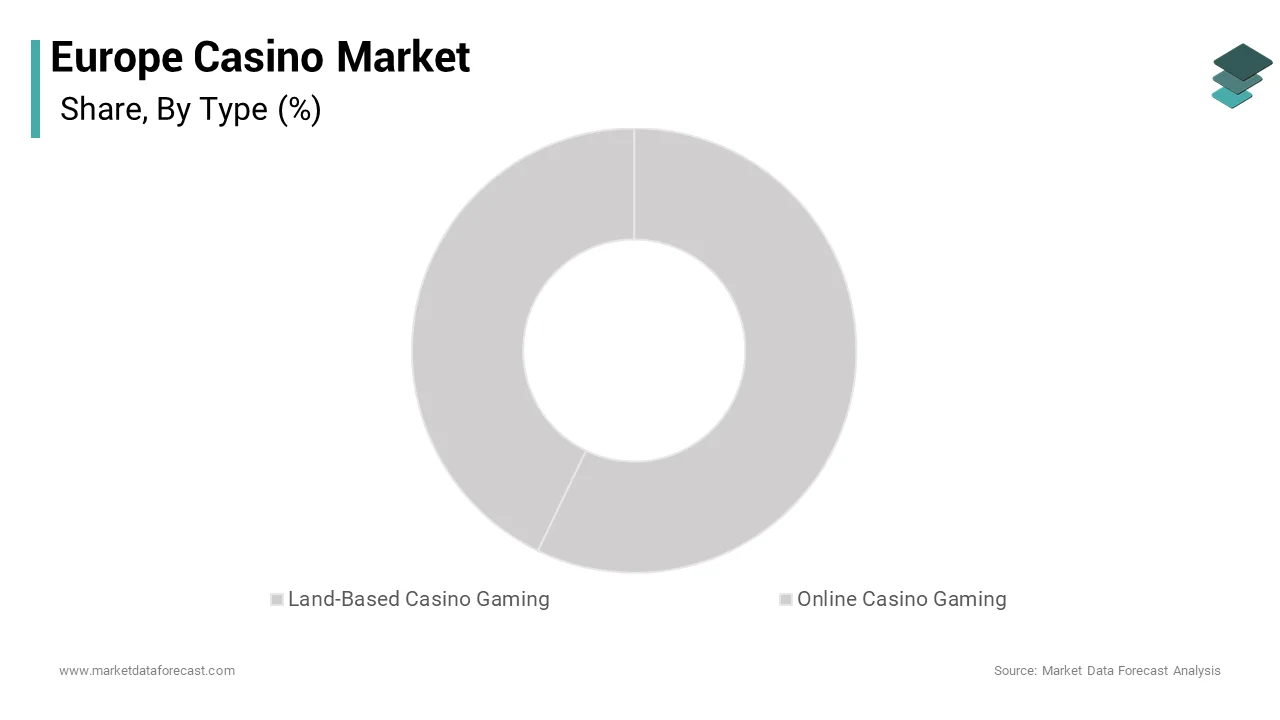
The online casino segment is estimated to witness the fastest CAGR of 12.2% over the forecast period owing to the rapid digital adoption, regulatory liberalization, and evolving consumer expectations for convenience and personalization. A key catalyst is the maturation of national licensing regimes in previously restrictive markets such as Germany and the Netherlands, enabling licensed operators to offer secure, localized platforms. Mobile penetration exceeding 85% across Western Europe facilitates on demand access, while innovations like live dealer streams and real time analytics enhance engagement. According to the European Gaming and Betting Association, online gambling accounted for 39% of Europe’s total gambling revenue in 2024, up from 37% in 2023, which is signaling a structural shift. As per industry reports, younger demographics exhibit strong preference for digital interfaces, with Sweden reporting that a majority of gambling activity occurred online, a trend now spreading regionally. This convergence of technology, regulation, and generational behavior ensures online casino gaming will continue to outpace its land-based counterpart in growth velocity.
By End User Insights
The gambling enthusiasts segment led the market by holding 51.5% of the regional market share in 2025. These individuals engage regularly, possess deep knowledge of game mechanics, and allocate significant discretionary income to both land based and online platforms. Their dominance is fueled by high lifetime value, brand loyalty, and responsiveness to premium offerings such as high roller tables, VIP programs, and skill-based tournaments. In mature markets like the UK and Italy, enthusiasts drive a significant share of table game revenue, particularly in poker and blackjack, where strategic play enhances retention. Regulatory frameworks that permit responsible marketing to verified adult players further enable targeted outreach to this group. Moreover, the integration of data analytics allows operators to tailor bonuses, game recommendations, and event invitations based on real time behavior, reinforcing engagement cycles. Unlike casual players, enthusiasts are less sensitive to short term economic fluctuations, providing stable revenue during macroeconomic uncertainty. Their centrality to the ecosystem makes them the focal point of product development, with new game launches and platform features often tested within this cohort before broader rollout.
The dabblers segment is predicted to witness the fastest CAGR in the European market during the forecast period. Dabblers, the segment comprising occasional or socially motivated players, are the fastest growing end user group in the European casino landscape. As per industry consensus, this segment is experiencing double digit annual growth driven by digital onboarding and gamified experiences. This cohort typically engages during holidays, major sporting events, or through peer influence, seeking low commitment entertainment rather than strategic wagering. Their expansion is directly linked to the rise of mobile first platforms that simplify registration, offer micro stakes, and integrate social sharing features. As per market analysts, a significant proportion of new online casino accounts in countries such as France and Spain were attributed to dabbler profiles, often converting from sports betting or lottery participation. The psychological appeal lies in low barrier entry, with many platforms offering free play modes or welcome bonuses requiring minimal deposits, reducing perceived risk. Furthermore, the normalization of online gaming through mainstream media and influencer partnerships has destigmatized casual play among younger adults. This segment’s growth is amplified by algorithmic personalization that surfaces engaging content, such as themed slots tied to pop culture, thereby extending session duration and encouraging repeat visits. Unlike lottery loyalists who prefer passive outcomes, dabblers are drawn to interactive elements, making them highly responsive to immersive technology like live chat and dynamic leaderboards.
COUNTRY LEVEL ANALYSIS
Italy Casino Market Analysis
Italy dominated the casinos market in Europe in 2025 with 41.4% of the European market share. The dominating position of Italy in the European market is driven by its economic scale and cultural embeddedness of gaming. Italy’s dominance is anchored in a vast network of authorized betting shops and licensed casinos, concentrated in tourist hubs like Venice, Milan, and Rome. The state-run monopoly model, managed by ADM, ensures tight control over both land based and online channels, fostering high compliance and tax collection efficiency. Slot machines remain immensely popular, contributing over 60% of total GGR, supported by widespread placement in bars, tobacconists, and entertainment venues. Recent regulatory updates have streamlined online licensing, which is attracting international operators while maintaining strict advertising and responsible gambling protocols. The integration of gaming with football culture, especially Serie A, further fuels betting activity during match days. This combination of dense physical distribution, regulatory stability, and socio-cultural affinity ensures Italy’s continued leadership in the regional market.
United Kingdom Casino Market Analysis
The United Kingdom held the second largest share of the European casinos market during the forecast period. It holds a unique position as the most digitally advanced jurisdiction, where online channels generated €11.1 billion in revenue in 2024, significantly higher than any other European nation. The UK’s market status is defined by a mature, competitive, and highly regulated environment overseen by the Gambling Commission, which licenses thousands of remote operators. London alone hosts numerous licensed casinos, serving both domestic high net worth individuals and international tourists. The country’s leadership in online penetration stems from early adoption of internet gambling legislation in 2005, fostering innovation in payment processing, identity verification, and customer analytics. Major operators such as Entain and Flutter are headquartered in the UK, driving R&D investment and global best practices. However, the market faces tightening scrutiny, with proposed affordability checks and stake limits reflecting heightened public health concerns. Despite these headwinds, the UK remains a bellwether for regulatory evolution and technological deployment, with its online segment expected to register the highest compound annual growth rate in Europe from 2025 onward.
Germany Casino Market Analysis
Germany is estimated to occupy a promising share of the European casinos market over the forecast period. The market is characterized by a cautious yet progressive regulatory transition following the Interstate Treaty on Gambling, which ended decades of legal ambiguity. Prior to this, Germany operated under a de facto ban on private online casinos, but the new framework now permits licensed operators to offer slots, poker, and table games under strict conditions. This controlled liberalization has spurred rapid growth, with online casino revenue increasing significantly as players migrated from unlicensed sites to regulated platforms. Land based casinos remain culturally significant, with state licensed venues operating in cities like Berlin, Hamburg, and Baden Baden, often integrated into historic spa resorts. Germany’s high disposable income, aging population, and affinity for structured leisure activities support steady demand. However, advertising restrictions during daytime hours and mandatory self-exclusion tools temper aggressive marketing. The market’s future hinges on balancing consumer protection with commercial viability, as policymakers monitor problem gambling rates.
France Casino Market Analysis
France is estimated to register a healthy CAGR in the European casinos market over the forecast period. The growth of France is likely to be driven by its tightly controlled yet profitable ecosystem. The country’s 2023 gross gaming revenue exceeded €15 billion, driven by a tripartite structure of state sanctioned operators, including Française des Jeux, PMU, and ARJEL licensed online casinos. France’s market status reflects a philosophy of controlled openness, where private competition is permitted only within predefined boundaries. There are numerous authorized land based casinos, mostly located in coastal resorts and border towns to attract foreign visitors while limiting domestic exposure. Online casino gaming, legalized in 2010, has grown steadily, propelled by mobile adoption and live dealer innovations. French players exhibit strong preference for roulette and blackjack, aligning with national gaming traditions. Regulatory oversight by ANJ emphasizes player protection, including real time loss tracking and mandatory breaks after prolonged sessions. Advertising is restricted to informational content, curbing promotional intensity. Nevertheless, the market remains resilient due to high consumer trust in state backed entities and consistent tourism inflows, with international visitors frequenting casino resorts in Cannes, Deauville, and Biarritz.
Spain Casino Market Analysis
Spain is anticipated to record a notable CAGR in the European casinos market during the forecast period. Spain is notable for its high growth trajectory. Spain’s market status is shaped by a dual focus on tourism driven land-based venues and a rapidly expanding online sector. There are 65 licensed casinos, strategically positioned in Madrid, Barcelona, and coastal regions like the Costa del Sol, catering to both locals and millions of annual tourists. The Dirección General de Ordenación del Juego has implemented a robust licensing system that attracts international operators while enforcing strict anti-money laundering and age verification protocols. Online casino participation has grown significantly since regulatory clarity improved in 2022, with mobile gaming now accounting for over 70% of digital wagers. Spaniards exhibit strong engagement with live casino formats, particularly during major football matches involving La Liga clubs. Cultural acceptance of gaming as social entertainment, combined with favorable climate and infrastructure, positions Spain as a high potential market. Its growth is further accelerated by rising disposable income among millennials and increased digital literacy across urban centers.
COMPETITIVE LANDSCAPE
The Europe casinos market features intense competition among established multinational operators and agile regional players vying for dominance in a fragmented regulatory landscape. Incumbents leverage brand recognition, technological infrastructure, and compliance expertise to maintain leadership, while newer entrants focus on niche segments and localized experiences. The rivalry is amplified by rapid digital transformation, where innovation in live gaming, AI driven personalization, and secure payment systems determines market relevance. Regulatory divergence across countries necessitates tailored strategies, increasing operational complexity and cost. Simultaneously, the persistent threat of unlicensed operators pressures legitimate businesses to differentiate through trust, transparency, and social responsibility. Mergers and strategic partnerships are increasingly common as companies seek economies of scale and cross border synergies. This dynamic environment rewards adaptability, ethical conduct, and deep consumer insight, making sustained competitive advantage contingent on balancing commercial ambition with public interest obligations in one of the world’s most scrutinized gaming regions.
KEY MARKET PLAYERS
A dominating player that are in the Europe casino market
- Las Vegas Sands Corporation
- MGM Resorts International
- Entain plc
- Betsson AB
- Caesars Entertainment
- Wynn Resorts
- Galaxy Entertainment Group
- Melco Resorts & Entertainment
- SJM Holdings
- Aristocrat Leisure Limited
- Evolution Gaming
- Flutter Entertainment
Top Players In The Market
- Entain plc is a leading global sports betting and gaming group with deep roots in the European casino market. Headquartered in the United Kingdom, the company operates iconic brands such as Ladbrokes Coral and bwin, offering both land based and online casino experiences across regulated European jurisdictions. Entain has intensified its focus on responsible gambling technologies and artificial intelligence driven player protection tools. In recent years, the company launched its proprietary Advanced Responsibility and Care system to monitor real time behavior and intervene when necessary. It also expanded its live dealer studios in Romania and Spain to enhance immersive gaming. These initiatives reinforce its commitment to sustainable growth while complying with evolving European regulatory standards.
- Flutter Entertainment plc is a dominant force in digital gaming with a strong footprint in Europe through its PokerStars and Sky Betting and Gaming brands. The company actively invests in localized content and secure payment ecosystems tailored to European consumer preferences. Flutter has prioritized regulatory compliance by obtaining licenses in key markets including Germany, France, and the Netherlands. Recently, it integrated advanced biometric authentication and real time fraud detection systems across its platforms to align with EU data protection norms. Additionally, Flutter has enhanced its mobile user experience through low latency streaming and personalized game recommendations, strengthening engagement among younger demographics and solidifying its leadership in the online casino segment.
- Betsson AB is a Sweden based operator with extensive presence across Central and Southern Europe, particularly in Spain, Italy, and the Baltics. The company specializes in online casino and sports betting, leveraging agile technology infrastructure to deliver localized gaming experiences. Betsson has reinforced its position by investing in live casino production facilities and expanding its portfolio of proprietary slot games. It recently upgraded its customer verification protocols to meet stricter KYC requirements in newly regulated markets like Poland. The company also launched multilingual responsible gambling hubs and partnered with local mental health organizations to promote safer play. These actions demonstrate Betsson’s strategic emphasis on regulatory alignment, technological innovation, and community trust building in diverse European contexts.
Top Strategies Used By The Key Market Participants
Key players in the Europe casinos market prioritize regulatory compliance through proactive licensing and localized operational frameworks. They invest heavily in responsible gambling technologies including real time behavioral monitoring and mandatory self-exclusion tools. Strategic expansion into emerging markets such as Poland and Romania is pursued via partnerships and tailored product offerings. Companies enhance user engagement through immersive technologies like live dealer streams and mobile optimized interfaces. Additionally, they strengthen cybersecurity and data privacy measures to align with GDPR and national directives. Continuous innovation in payment solutions and customer verification processes further supports market retention and acquisition in a highly scrutinized environment.
MARKET SEGMENTATION
This research report on the Europe casino market has been segmented and sub-segmented based on type, end-user, and region.
By Type
- Land-Based Casino Gaming
- Online Casino Gaming
By End-User
- Gambling Enthusiasts
- Dabblers
- Lottery Loyalists
- Unengaged Audience
By Country
- UK
- France
- Spain
- Germany
- Italy
- Russia
- Sweden
- Denmark
- Switzerland
- Netherlands
- Turkey
- Czech Republic