- Product Description Description
- Table of Contents TOC
- List of Table & Figure LOT
- Get Free Sample PDF Sample PDF
Market Size, 2025
$22.91 BnMarket Estimate, 2026
$24.16 BnMarket Forecast, 2034
$36.97 BnCAGR, 2026–2034
5.46%Europe Cat Food Market Report Summary
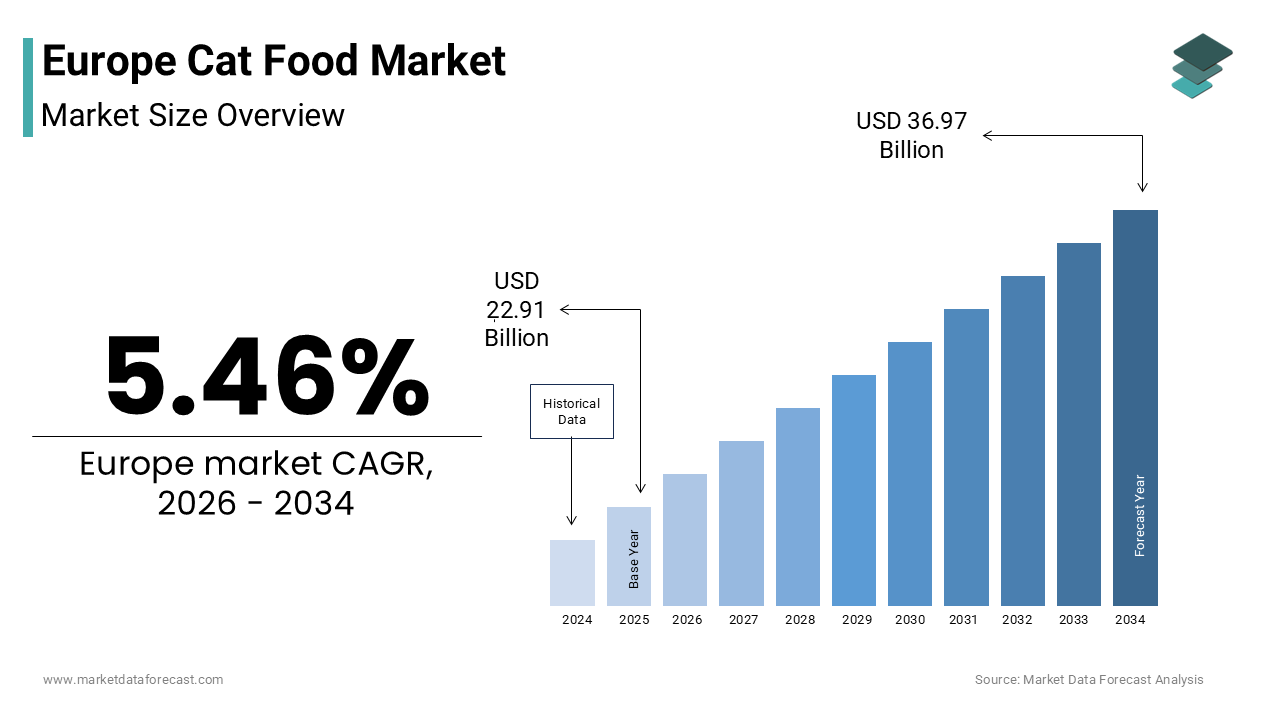
The Europe cat food market was valued at USD 22.91 billion in 2025, is estimated to reach USD 24.16 billion in 2026, and is projected to grow to USD 36.97 billion by 2034, registering a CAGR of 5.46% during the forecast period from 2026 to 2034. The growth of the Europe cat food market is driven by increasing pet humanization, premiumization of feline nutrition, and rising adoption of functional and veterinary diets across the region. Strong regulatory frameworks, high urban cat ownership, and growing consumer awareness regarding ingredient transparency and sustainability are further shaping market expansion. Additionally, the rapid rise of e-commerce, subscription-based feeding models, and sustainable ingredient sourcing is transforming purchasing behavior and product innovation across Europe’s cat food industry.
Key Market Trends
- Rising demand for premium, grain-free, and functional cat food with added health benefits such as urinary care and digestive support.
- Increasing adoption of subscription-based and personalized feeding services through digital platforms.
- Expansion of sustainable ingredient sourcing, including insect protein and circular food waste utilization.
- Growing popularity of fresh, freeze-dried, and minimally processed feline diets driven by pet humanization trends.
- Strong focus on recyclable packaging and eco-friendly formulations aligned with EU sustainability policies.
Segmental Insights
- Based on pet food product, the core cat food segment dominated the Europe cat food market by accounting for a major share in 2025, supported by its essential role as the primary daily nutrition source for cats and consistent repeat purchasing behavior among pet owners.
- Among product categories, the veterinary diets segment is projected to witness the fastest growth during the forecast period owing to the rising prevalence of chronic feline health conditions such as kidney disease, obesity, and urinary disorders. Veterinary-endorsed formulations provide targeted nutrition, enabling premium pricing and strong brand loyalty.
- Based on distribution channel, supermarkets and hypermarkets led the market in 2025 due to their widespread accessibility, high household penetration, and expansion of private-label cat food products. Meanwhile, the online channel is anticipated to grow rapidly, driven by personalized meal planning, subscription delivery services, and digital health integration.
Regional Insights
Germany dominated the Europe cat food market in 2025 owing to its high cat ownership rate, strong regulatory framework, and growing demand for premium and sustainably sourced nutrition.
- The United Kingdom holds a significant share supported by early adoption of personalized feeding services, strong e-commerce penetration, and innovation in fresh and natural cat food products.
- France continues to grow steadily due to strong veterinary influence, premium brand loyalty, and increasing investment in sustainable formulations.
- Italy is expected to showcase promising growth driven by urban pet ownership trends, expanding veterinary nutrition adoption, and rising demand for locally produced premium products.
- Spain is projected to record a notable CAGR during the forecast period owing to increasing pet adoption among younger consumers and growing online sales of functional and wet cat food products.
Competitive Landscape
The Europe cat food market is highly competitive and innovation-driven, characterized by strong emphasis on scientific nutrition, sustainability, and digital consumer engagement. Leading companies are focusing on expanding veterinary partnerships, launching personalized nutrition platforms, and investing in eco-friendly packaging solutions to strengthen market presence. Prominent players operating in the Europe cat food market include Mars Petcare, Nestlé Purina PetCare, Hill’s Pet Nutrition (Colgate-Palmolive), Royal Canin, Blue Buffalo (General Mills), Affinity Petcare S.A., Archer Daniels Midland (ADM), United Petfood, Butcher’s Pet Care, Spectrum Brands Holdings, Farmina Pet Foods, Monge & C. S.p.A., and WellPet LLC.
Europe Cat Food Market Size
The Europe cat food market size was valued at USD 22.91 billion in 2025 and is anticipated to reach USD 24.16 billion in 2026 from USD 36.97 billion by 2034, growing at a CAGR of 5.46% during the forecast period from 2026 to 2034
Cat food comprises formulated nutritional products designed specifically for feline dietary needs including dry, kibble, wet, canned meals, semi moist variants and specialized therapeutic diets. Unlike generic pet food, this segment is characterized by species, specific nutritional science, stringent regulatory oversight and evolving consumer expectations around ingredient transparency and sustainability. Europe’s approach to cat nutrition is shaped by a high density of urban pet ownership and strong animal welfare norms. According to Eurostat, cats are among the most common companion animals in Europe, with millions of households owning at least one feline in 2023. The European Pet Food Industry Federation mandates that all commercial cat food must meet essential amino acid requirements, particularly taurine, without which cats face irreversible health consequences. Additionally, the European Commission’s Farm to Fork Strategy has prompted reformulation efforts to reduce reliance on soy and increase use of insect or algae-based proteins. As per the European Environment Agency, pet food production contributes to the EU’s agricultural footprint, which is driving industry investment in circular ingredient sourcing. This confluence of scientific rigor, cultural attachment, and environmental accountability defines the Europe cat food market as a sophisticated and ethically conscious sector within the broader pet care landscape.
MARKET DRIVERS
Rising Humanization of Pets and Premiumization of Feline Nutrition
European consumers increasingly treat cats as family members, which is leading to increased demand for high quality, nutritionally balanced, and human grade cat food formulations, and is primarily propelling the cat food market growth in Europe. According to FEDIAF surveys, a majority of cat owners in Germany, France, and the Netherlands consider their pet’s diet as important as their own, with many willing to pay a premium for products labelled “natural” or “grain free.” This mindset has accelerated the shift from economy to super premium and functional segments. In 2023, most new cat food launches in Western Europe featured added benefits such as urinary health support, hairball control, or probiotics as per the European Pet Food Industry Federation. Retailers now dedicate expanded shelf space to refrigerated fresh cat food and freeze-dried raw options, with brands like Lily’s Kitchen and Katkin gaining traction through direct-to-consumer models. The emotional bond between owner and cat transforms feeding from a chore into an act of care, which is reinforcing willingness to invest in products that promise longevity and vitality.
Growth of E Commerce and Subscription Based Pet Nutrition Services
Digital retail has revolutionized cat food accessibility by offering convenience, personalized recommendations, and recurring delivery models tailored to individual feline needs, which is also boosting the cat food market expansion in Europe. According to the European E Commerce Association, online pet food sales grew significantly in 2023, with cat food accounting for a large share of the segment due to its lighter weight and longer shelf life compared to dog food. Platforms like Zooplus and Butternut Box use algorithms to customize meal plans based on breed, age, weight, and health conditions, then deliver pre portioned packs on a subscription basis. In the UK, surveys show that many cat owners now use auto replenishment services as per Kantar, reducing purchase friction and ensuring consistent supply. Additionally, virtual vet consultations integrated into e commerce apps allow real time dietary adjustments for cats with chronic conditions. This digitization not only enhances customer retention through behavioral data but also enables brands to bypass traditional retail markups, which is offering fresher formulations at competitive prices.
MARKET RESTRAINTS
Stringent EU Regulations on Novel Protein Sources and Labeling
The European Union enforces rigorous approval processes for novel ingredients in pet food, which significantly constrains innovation and increases time to market for alternative protein sources. According to the European Commission’s Novel Food Catalogue, any new ingredient such as insect meal, algae, or lab grown proteins must undergo a full safety assessment by the European Food Safety Authority before commercial use, a process that typically takes considerable time and investment. As of 2023, only a limited number of insect species have received approval for use in cat food despite strong sustainability potential. Furthermore, Regulation EC No 767 2009 mandates precise labeling of all ingredients by weight order and prohibits vague terms like “meat derivatives” without species specification. Audits by national consumer protection agencies have found instances of non-compliance among imported brands, leading to recalls and supply chain delays. These regulatory barriers, while protective of consumer safety, slow the adoption of eco-friendly proteins and increase costs, particularly for small innovators lacking regulatory expertise.
Volatile Prices of Key Raw Materials and Supply Chain Disruptions
The Europe cat food market faces persistent cost pressures due to fluctuating prices of essential raw materials such as poultry, fish meal, and grains, which are subject to global agricultural and geopolitical shocks. According to Eurostat, poultry and grain prices rose sharply between 2021 and 2023 due to avian influenza outbreaks and feed cost inflation. Similarly, fish meal prices increased following stricter quotas on anchovy catches as reported by the European Fishmeal and Fish Oil Producers Association. These increases directly impact formulation economics, forcing brands to either raise retail prices or reformulate with less optimal substitutes. For instance, some European cat food manufacturers reported temporary production halts due to raw material shortages. Moreover, the EU’s dependency on imported soy from South America exposes the supply chain to shipping delays and sustainability scrutiny. This raw material fragility undermines margin stability and complicates long term planning, particularly for mid-tier brands without hedging capabilities.
MARKET OPPORTUNITIES
Expansion of Functional and Breed Specific Cat Food Formulations
European consumers are increasingly seeking cat food tailored to specific health needs, breeds, or life stages, which is creating significant opportunity for the European cat food market. According to the European Society of Veterinary Nutrition, veterinarians across Europe increasingly recommend condition specific diets for issues like chronic kidney disease, dental health, or obesity, conditions that affect a large share of older cats. In response, brands have launched clinically backed lines such as Royal Canin’s Renal Support and Hill’s Science Diet Urinary Care, which are available through vet clinics and specialty retailers. Additionally, breed specific formulas for cats such as Maine Coon or Siamese have gained traction, with surveys in Sweden and Germany showing regular adoption among purebred owners. As per the European Pet Food Industry Federation, functional cat food launches grew significantly in 2023, reflecting this precision nutrition trend. By aligning with veterinary science and genetic understanding, brands can command premium pricing and foster professional endorsement, creating a trusted ecosystem beyond retail aisles.
Rise of Sustainable and Circular Ingredient Sourcing Models
Sustainability imperatives are driving innovation in alternative protein sources and closed loop packaging within Europe’s cat food sector, which is another notable opportunity for the regional market. According to the European Environment Agency, replacing a portion of traditional meat with approved insect protein could substantially reduce the carbon footprint of cat food. Companies like Yora in the UK and Tenetrio in the Netherlands now produce cat food using black soldier fly larvae fed on certified food waste, supporting the EU Circular Economy Action Plan. Additionally, brands are transitioning to mono material recyclable pouches and aluminum cans, with recyclability rates exceeding 90 percent in countries with established collection systems as per the European Aluminium Association. In France, the anti-waste law mandates that all pet food packaging must be reusable or recyclable by 2025, accelerating investment in eco design. Consumer response is positive, with studies by the European Consumer Organisation showing that a majority of cat owners would switch brands for demonstrably lower environmental impact. This convergence of regulatory pressure, consumer values, and technological feasibility positions sustainable sourcing as a core growth vector in the European cat food market.
MARKET CHALLENGES
Persistent Consumer Skepticism Toward Processed and Extruded Kibble
Despite its convenience, a growing segment of European cat owners views traditional dry kibble as nutritionally inadequate due to high carbohydrate content and ultra processing, which conflicts with feline biology as obligate carnivores and is challenging the European cat food market growth. According to the European Pet Nutrition Council, many cat owners in Denmark, Sweden, and Germany believe kibble contributes to long term health issues such as obesity and urinary tract problems. This perception is reinforced by veterinary influencers and online communities advocating raw or fresh diets. As a result, many consumers are shifting to wet food or hybrid feeding models, even though kibble remains dominant by volume. The challenge for manufacturers is balancing palatability, shelf stability, and cost while reducing starch fillers, which is a technical hurdle since carbohydrates are essential for kibble structure during extrusion. Reformulations using pea protein or lentils have faced scrutiny over potential links to dilated cardiomyopathy as flagged by the European Society of Veterinary Cardiology. This scientific uncertainty combined with consumer distrust creates a reputational risk that pressures brands to innovate beyond traditional formats or risk alienating health-conscious segments.
Fragmented Regulatory Landscape Across European Member States
While the EU provides overarching pet food regulations, individual member states impose additional requirements that complicate pan European product harmonization, which is also challenging the regional market growth. According to the European Pet Food Industry Federation, countries like Italy and Spain require national registration and local language labeling for all pet food imports, while Germany mandates separate notifications for each product variant. In Poland, pet food containing certain preservatives permitted at the EU level is banned under national food safety decrees, creating compliance contradictions. A 2024 audit revealed that many cat food brands faced market access delays due to divergent national interpretations of EU Regulation 767/2009, particularly around claims like “grain free” or “hypoallergenic.” Unlike centralized markets such as the United States, Europe’s regulatory fragmentation increases legal costs and slows new product rollouts. Small and medium brands often limit distribution to one or two countries to avoid complexity, while multinationals bear significant overhead in maintaining country specific SKUs. This administrative fragmentation stifles innovation and market fluidity, ultimately limiting consumer choice and competitive dynamics within the European cat food ecosystem.
REPORT COVERAGE
| REPORT METRIC | DETAILS |
| Market Size Available | 2025 to 2034 |
| Base Year | 2025 |
| Forecast Period | 2026 to 2034 |
| CAGR | 5.46% |
| Segments Covered | By Pet Food Product, Distribution Channel and Region |
| Various Analyses Covered | Regional & Country Level Analysis, Segment-Level Analysis, DROC, PESTLE Analysis, Porter’s Five Forces Analysis, Competitive Landscape, Analyst Overview on Investment Opportunities |
| Countries Covered | UK, France, Spain, Germany, Italy, Russia, Sweden, Denmark, Switzerland, the Netherlands, Turkey, the Czech Republic, and the Rest of Europe. |
| Market Leaders Profiled | Mars Petcare, Nestlé Purina PetCare, Hill’s Pet Nutrition (Colgate-Palmolive), Royal Canin, Blue Buffalo (General Mills), Affinity Petcare S.A., Archer Daniels Midland (ADM), United Petfood, Butcher’s Pet Care, Spectrum Brands Holdings, Farmina Pet Foods, Monge & C. S.p.A., and WellPet LLC. |
SEGMENTAL ANALYSIS
By Pet Food Product Insights
The core cat food segment accounted for the major share of 74.4% of the European cat food market in 2025. The dominance of core cat food segment in this regional market is driven by its essential role as the primary nutritional source for feline companions across the region. Cat food is not a discretionary purchase but a daily requirement integrated into household routines across urban and rural Europe. According to Eurostat, cats are among the most common companion animals in Europe, with millions of households owning at least one feline in 2023. On average, cats consume between 200 and 250 grams of food daily depending on age and activity level. Unlike treats or supplements which are occasional additives, complete cat food formulas must meet all nutritional needs as defined by FEDIAF guidelines, including minimum taurine levels to prevent blindness and heart disease. This biological imperative ensures consistent repeat purchases regardless of economic conditions. In countries like Germany and the Netherlands, surveys show that most cat owners feed commercial complete diets exclusively. Retailers reinforce this dependency through bulk packs, subscription models, and loyalty programs that lock in recurring consumption. The segment’s dominance stems from its irreplaceable function as the foundational element of feline care, making it the bedrock of the entire European cat food ecosystem.
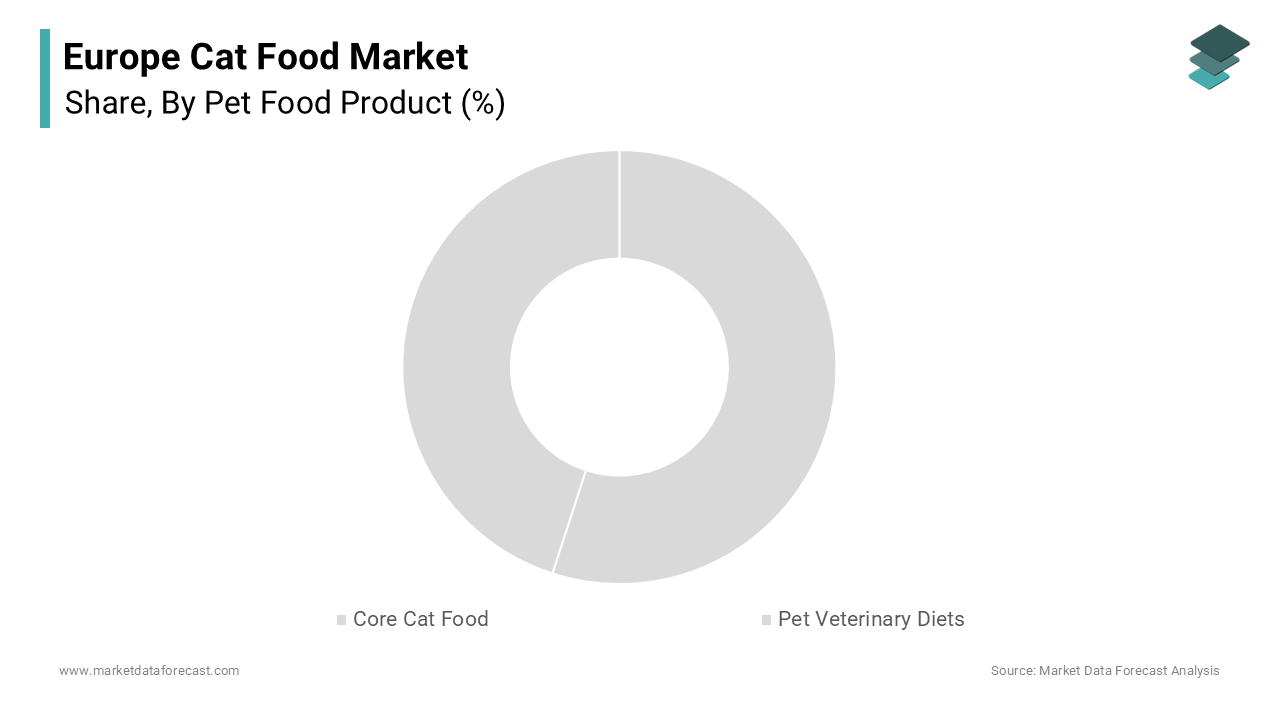
Among product types, the veterinary diets segment is expanding at the fastest pace and is estimated to grow at a CAGR of 12.4% over the forecast period due to the rising feline chronic conditions and veterinary channel control. Europe’s aging cat population is fuelling demand for therapeutic diets tailored to manage chronic diseases. According to the European Society of Veterinary Internal Medicine, a significant share of cats aged ten and older in Western Europe suffer from chronic conditions such as kidney disease, hyperthyroidism, or diabetes. These conditions require precise nutritional management that only prescription veterinary diets can provide. In Germany, veterinary clinics increasingly stock specialized renal or urinary formulas as per the German Veterinary Medical Association. Sales of Hill’s Prescription Diet and Royal Canin Veterinary Diets grew strongly in the UK in 2023 according to Kantar pet care data. Unlike over-the-counter food, veterinary diets are protected from price competition and benefit from professional recommendation, making them high margin and high loyalty products. As feline lifespans extend, the need for condition specific nutrition will continue to accelerate this segment’s growth.
By Distribution Channel Insights
The supermarkets and hypermarkets segment led the market by holding 41.4% of the European market share in 2025 due to their accessibility, household penetration, and strategic category placement. For most European families, cat food is a standard grocery item purchased alongside human food during weekly shopping trips. According to Eurostat, the vast majority of European households shop at supermarkets at least once a week, making these venues the default channel for pet food replenishment. Major retailers like Carrefour, Tesco, and Edeka dedicate prominent shelf space to cat food near pet care or household essentials, which is ensuring high visibility and impulse additions. In Spain, NielsenIQ retail audits confirm that most cat owners buy their primary food brand during regular grocery runs. Private label offerings further drive volume, with supermarket brands like Carrefour Bio and Tesco Own Label capturing budget conscious segments through value packs and eco claims. The convenience of one stop shopping combined with loyalty discounts and multi buy promotions solidifies supermarkets as the backbone of mass market cat food distribution across urban and suburban Europe.
The online channel is the fastest growing distribution segment and is expected to exhibit a CAGR of 14.04% over the forecast period owing to the personalization, convenience, and subscription models. Digital platforms now offer customized cat food based on breed, age, weight, and health metrics delivered via subscription, which is a model that resonates with tech savvy urban pet owners. According to the European Pet Tech Observatory, a majority of cat owners in the UK, Netherlands, and Sweden use online services that adjust formulations quarterly based on health updates or vet input. Brands like Katkin and Butternut Box use algorithms to create fresh or freeze-dried meals tailored to individual feline needs, then ship pre portioned packs on auto replenishment schedules. This eliminates guesswork and ensures optimal nutrition, key concerns for humanizing owners. Online cat food sales reached billions of euros in 2023, with most transactions occurring through brand owned sites rather than marketplaces as per the European E Commerce Association. The ability to bypass retail markups while offering higher quality ingredients creates a compelling value proposition that fuels rapid adoption.
REGIONAL ANALYSIS
Germany Cat Food Market Analysis
Germany dominated the cat food market in Europe in 2025 by holding 23.2% of the European market share. The dominance of Germany in the European cat food market is attributed to the high cat ownership rates, scientific consumerism, and a dense retail infrastructure. With over 15 million cats residing in German households as per FEDIAF, demand is structurally robust. German consumers prioritize ingredient transparency, with surveys showing that a majority read nutritional labels before purchase. This scrutiny has accelerated the shift toward natural, grain free, and sustainably sourced formulas, with brands like Animonda and Josera gaining strong regional loyalty. The country also enforces strict feed safety laws under the LFGB requiring batch traceability and allergen declarations, which elevates baseline quality. Additionally, Germany’s strong veterinary network ensures high adoption of premium and therapeutic diets. This combination of volume, rational consumption, and regulatory rigor makes Germany the most stable and influential market in the European cat food landscape.
United Kingdom Cat Food Market Analysis
The United Kingdom held 18.8% of the European market share in 2025. The growth of the UK in the European market can be credited to its early adoption of fresh and personalized cat food models and leadership in online pet retail. With over 11 million cats and around a quarter of households owning at least one feline, the UK exhibits strong humanization trends. According to Kantar, many British cat owners now subscribe to auto delivered food services, with fresh and raw formats showing rapid growth. Brands like Lily’s Kitchen and Scrumbles pioneered human grade recipes using British sourced meat and recyclable packaging, aligning with post Brexit “buy local” sentiment. The UK also maintains alignment with EU pet food safety standards through the Animal and Plant Health Agency, ensuring product integrity. London’s status as a pet tech hub further fuels innovation, with startups integrating AI and health tracking into feeding solutions. This dynamic blend of digital agility, premiumization, and regulatory continuity sustains the UK’s position as Europe’s most innovative cat food market.
France Cat Food Market Analysis
France is predicted to account for a prominent share of the Europe cat food market over the forecast period owing to the strong brand loyalty to premium and veterinary endorsed diets, rooted in a cultural reverence for animal welfare. With over 14 million cats and high per capita spending on pet food according to Eurostat, French consumers view nutrition as a pillar of feline health. Surveys show that a large majority of cat owners consult veterinarians before changing diets, driving high penetration of Royal Canin and Hill’s Prescription lines. France also leads in sustainable innovation, with brands using insect protein and circular packaging to meet anti waste law requirements. The country’s dense network of pet specialty stores and vet clinics ensures premium products remain accessible. This fusion of scientific trust, ethical consumption, and brand heritage makes France a high value and high loyalty market where quality consistently outweighs cost sensitivity.
Italy Cat Food Market Analysis
Italy is estimated to register a promising CAGR in the European cat food market during the forecast period. The country’s position is anchored in high urban cat density and a cultural tradition of cohabitation with felines, evident in Rome’s historic colony cats and Milan’s pet friendly apartments. With over 7 million cats and a significant share of urban households owning at least one, demand for convenient, nutritious food is consistent. Italian consumers favor locally made products, with surveys showing strong preference for brands that source meat from EU farms. Private label expansion in supermarkets like Conad and Esselunga has driven volume in the mass segment, while premium brands like Monge invest in grain free and hypoallergenic lines for discerning owners. Additionally, Italy’s strong veterinary sector promotes therapeutic diets for aging cats, with average feline lifespan exceeding 13 years as per the Italian Small Animal Veterinary Association. This blend of urban necessity, local pride, and professional care sustains steady growth across both value and premium tiers.
Spain Cat Food Market Analysis
Spain is anticipated to record a notable CAGR in the European cat food market over the forecast period. The country’s vibrancy stems from rising pet ownership among young urban professionals and increasing disposable income in post pandemic recovery. With nearly 5 million cats and ownership among adults under 35 growing steadily as per the Spanish Pet Owners Association, demand is shifting toward premium and functional foods. Online sales of grain free and urinary health formulas have risen sharply, driven by digital natives seeking convenience and health assurance. Spanish retailers like Mercadona have expanded private label cat food with recyclable packaging and natural claims, capturing cost conscious yet quality oriented buyers. Furthermore, Spain’s warm climate increases hydration awareness, driving wet food adoption, with surveys showing that a majority of owners now feed wet or mixed diets as per Kantar Iberia. This demographic and behavioral momentum positions Spain as a fast evolving and growth-oriented market within Southern Europe.
COMPETITIVE LANDSCAPE
The Europe cat food market features intense yet structured competition defined by scientific credibility ethical sourcing and channel specialization. Global leaders dominate through veterinary endorsed therapeutic lines and premium nutrition while regional players compete on local ingredient sourcing and private label innovation. Competition is rarely price based instead focusing on nutritional transparency sustainability credentials and digital engagement. Regulatory rigor creates high barriers that favor established players with compliance expertise. At the same time the rise of e commerce and direct to consumer models has enabled agile startups to challenge incumbents with personalized fresh food subscriptions. Supermarkets exert significant influence through private label expansion yet premium segments remain anchored in specialty stores and veterinary clinics. Ultimately success in Europe hinges on a brand’s ability to prove health outcomes demonstrate environmental responsibility and deliver seamless consumer experiences across both physical and digital touchpoints within a market where cats are unequivocally family.
KEY MARKET PLAYERS
Some of the companies that are playing a dominating role in the Europe cat food market include
- Mars Petcare
- Nestlé Purina PetCare
- Hill’s Pet Nutrition (Colgate-Palmolive)
- Royal Canin
- Blue Buffalo (General Mills)
- Affinity Petcare S.A.
- Archer Daniels Midland (ADM
- United Petfood
- Butcher’s Pet Care
- Spectrum Brands Holdings
- Farmina Pet Foods
- Monge & C. S.p.A.
- WellPet LLC
Top Players in the Market
Nestlé Purina PetCare
Nestlé Purina PetCare maintains a strong presence in the Europe cat food market through its scientifically formulated brands including Purina ONE Felix and Gourmet. The company actively advances feline nutrition by investing in digestive health research and launching specialized diets for urinary and hairball management. Recently Purina expanded its sustainable packaging initiative across Western Europe replacing plastic trays with recyclable mono material solutions. It also enhanced its direct-to-consumer platform with personalized meal plans based on breed and age. These actions reflect Purina’s dual commitment to veterinary science and environmental responsibility ensuring long term relevance in Europe’s discerning and regulation driven pet food landscape.
Mars Petcare
Mars Petcare plays a pivotal role in the Europe cat food market via premium and therapeutic brands such as Royal Canin Whiskas and Sheba. The company champions veterinary partnerships by training over 35000 European veterinarians annually on feline nutrition and condition specific diets. Mars recently launched a circular supply chain program in France and Germany using insect protein and food waste derived ingredients to reduce environmental impact. It also introduced AI powered feeding guides on its e commerce sites to improve dietary accuracy. Through this integration of clinical expertise sustainability and digital personalization Mars strengthens its leadership in both mass and veterinary segments across the continent.
Hill’s Pet Nutrition
Hill’s Pet Nutrition exerts significant influence in the Europe cat food market primarily through its science backed Prescription Diet and Science Diet lines. The company collaborates closely with veterinary schools and clinics to validate clinical outcomes and ensure professional trust. Recently Hill’s achieved carbon neutral certification for its manufacturing facilities in the Netherlands and launched recyclable aluminum packaging for wet cat food across the EU. It also integrated telemedicine support into its online platform allowing owners to consult vets before purchasing therapeutic foods. These initiatives underscore Hill’s strategy of combining rigorous science with environmental accountability and digital health to serve Europe’s evolving feline care ecosystem.
Top Strategies Used by the Key Market Participants
Key players in the Europe cat food market prioritize science led formulation sustainable packaging veterinary channel integration and digital personalization to maintain competitive advantage. They invest heavily in clinical research to develop condition specific diets for aging cats and partner with veterinary professionals to build trust and drive recommendations. Simultaneously, companies transition to mono material recyclable or compostable packaging to comply with the EU Packaging and Packaging Waste Directive and national anti-waste laws. Direct to consumer platforms leverage AI and health data to offer customized meal plans and auto replenishment enhancing convenience and loyalty. Strategic use of alternative proteins such as insect meal and food waste derivatives further aligns with the European Green Deal. These integrated approaches enable leading brands to balance nutritional excellence ethical sourcing and consumer convenience in a highly regulated and humanized market.
MARKET SEGMENTATION
This research report on the europe cat food market has been segmented and sub-segmented based on following categories.
By Pet Food Product
-
Core Cat Food
-
Dry Cat Food
-
Kibbles
-
Other Dry Cat Food
-
-
Wet Cat Food
-
-
Pet Veterinary Diets
-
Diabetes Diets
-
Digestive Sensitivity Diets
-
Oral Care Diets
-
Renal Diets
-
Urinary Tract Disease Diets
-
Obesity Diets
-
Derma Diets
-
Other Veterinary Diets
-
By Distribution Channel
- Convenience Stores
- Online Channel
- Specialty Stores
- Supermarkets/Hypermarkets
- Other Channels
By Country
- UK
- France
- Spain
- Germany
- Italy
- Russia
- Sweden
- Denmark
- Switzerland
- Netherlands
- Turkey
- Czech Republic
- Rest of Europe