- Product Description Description
- Table of Contents TOC
- List of Table & Figure LOT
- Get Free Sample PDF Sample PDF
Europe Cell Culture Media Market Size
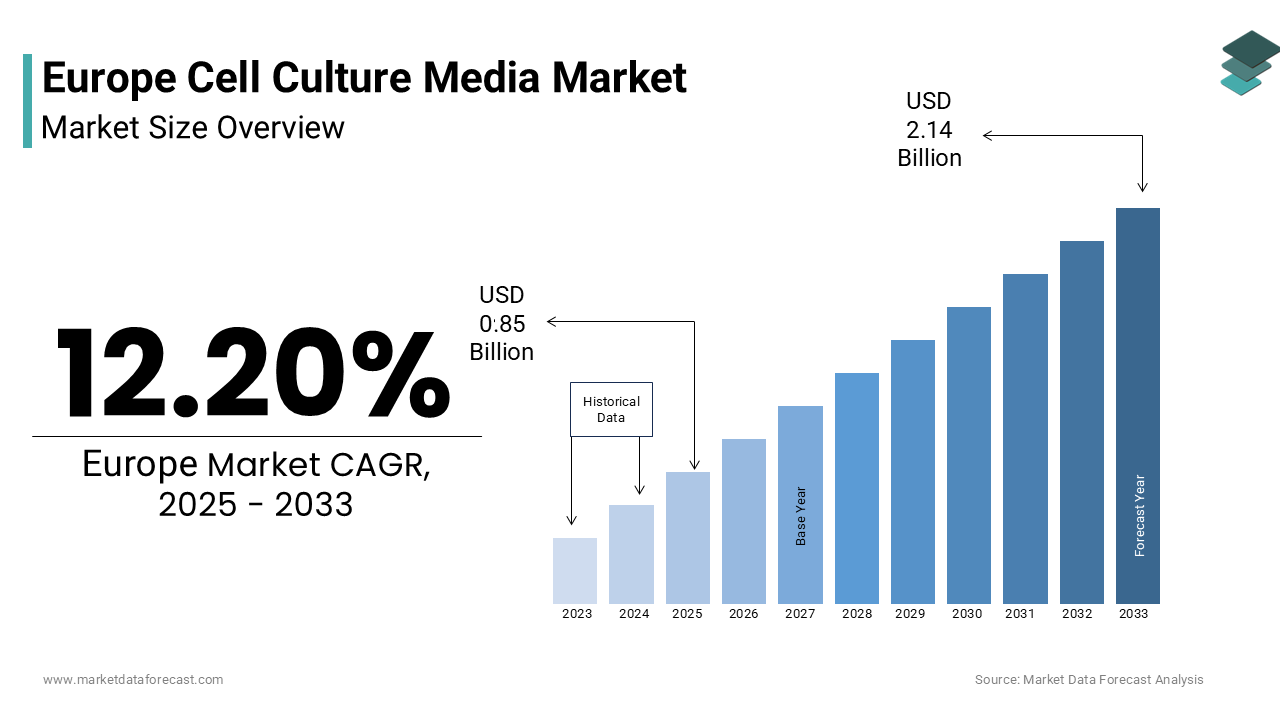
The europe cell culture media market size was valued at USD 0.76 billion in 2024 and is anticipated to reach USD 0.85 billion in 2025 from USD 2.14 billion by 2033, growing at a CAGR of 12.20% during the forecast period from 2025 to 2033.
Cell culture media refers to the specialized formulations, ranging from basal media to chemically defined and serum-free supplements, designed to support the in vitro growth, proliferation, and differentiation of mammalian, microbial, and insect cells. These media serve as foundational inputs for biopharmaceutical manufacturing regenerative medicine vaccine development and advanced research in academic and industrial laboratories. As of 2025, Europe’s position as a global leader in biologics production and life sciences innovation drives sustained demand for high performance media formulations. According to sources, a majority of advanced medicinal therapies being investigated in the European Union depend on sophisticated cell culture systems, which need specific media compositions.. The European Commission’s Pharmaceutical Strategy for Europe emphasizes self-reliance in biomanufacturing inputs prompting strategic investments in local media production. Furthermore, Europe is home to a substantial portion of the global facilities that adhere to Good Manufacturing Practice standards for cell therapy, establishing a significant center of demand. Unlike generic reagents cell culture media are increasingly customized to specific cell lines and process requirements making them critical determinants of yield purity and regulatory compliance in an era of precision biomanufacturing.
MARKET DRIVERS
Expansion of Advanced Therapy Medicinal Products and Biologics Manufacturing in the EU
The rapid growth of advanced therapy medicinal products and recombinant biologics accelerates the expansion of the Europe cell culture media market. According to industry reports and information from the EMA, over 350 advanced therapy medicinal products were in clinical development in the EU as of early 2025, including approximately 120 gene therapies and 95 cell-based immunotherapies such as CAR T cells. These therapies require highly specialized serum free and chemically defined media to ensure consistency safety and scalability under strict Good Manufacturing Practice regulations. As per sources, biologics accounted for a portion of new medicine approvals in 2024 reflecting a structural shift away from small molecules. In Germany alone, more than 45 commercial-scale biomanufacturing facilities produce monoclonal antibodies, vaccines, and viral vectors, relying on media volumes exceeding 2 million liters annually, as per information from the German Biotechnology Industry Association. Local demand for GMP grade customizable media is rising as Europe simultaneously seeks to reduce its dependency on imported bioprocessing reagents and maintain leadership in next-generation therapeutics.
Strengthening of Academic and Public Research Ecosystems in Life Sciences
The region’s dense network of publicly funded research institutions and collaborative life sciences initiatives sustains robust foundational demand for cell culture media beyond commercial applications, which further drives the growth of the Europe cell culture media market. Institutions routinely utilize customized media for disease modeling and drug screening. National research councils in Sweden the Netherlands and France have also mandated media transparency in grant reporting to enhance experimental rigor. This deep academic engagement not only drives volume but also serves as a testbed for next generation media innovations later adopted by industry.
MARKET RESTRAINTS
Stringent Regulatory Requirements for Raw Material Traceability and Quality Control
The European Union’s rigorous regulatory expectations regarding component sourcing purity and documentation remain a constraint to the Europe cell culture media market. According to the European Directorate for the Quality of Medicines any raw material used in the production of medicines for human use must comply with Ph Eur monographs requiring full traceability animal origin declarations and endotoxin testing. This places immense pressure on media suppliers to validate every ingredient including amino acids vitamins and growth factors often sourced from global supply chains. Furthermore, the EU’s Falsified Medicines Directive mandates serialization and batch level verification extending scrutiny to ancillary materials like media. These requirements increase lead times costs and administrative burden particularly for small and medium enterprises lacking dedicated regulatory affairs teams. Stringent oversight is necessary for patient safety, but it comes at the cost of slowing innovation cycles and complicating the adoption of novel or animal-free formulations.
High Cost and Supply Volatility of Critical Media Components
The reliability and affordability of cell culture media in the region are frequently affected by price fluctuations and supply chain fragility of key raw materials, particularly recombinant growth factors and specialty lipids, which impedes the expansion of the Europe cell culture media market. In addition, bovine serum albumin and transferrin face ethical and regulatory headwinds leading to scarcity and price surges for high purity alternatives. The war in Ukraine and Red Sea shipping disruptions further exposed logistical risks with media delivery delays averaging several days. Chemically defined media reduce biological variability but often depend on synthetic analogs that are just as scarce and expensive. The market will remain susceptible to external shocks and cost inflation until Europe develops resilient local production of critical media ingredients through initiatives like the European Critical Raw Materials Act for biologics.
MARKET OPPORTUNITIES
Rise of Personalized Medicine and Autologous Cell Therapy Platforms
The advent of personalized and autologous cell therapies is creating an opportunity for the Europe cell culture media market. Unlike allogeneic therapies that use standardized master cell banks autologous treatments such as patient specific CAR T cells require individualized manufacturing runs with media optimized for variable donor cell health and phenotype. These therapies necessitate closed automated bioprocessing systems like Miltenyi’s Prodigy or Cytiva’s FlexFactory which integrate proprietary media bags and reagent kits. Companies offer patient ready media kits with pre qualified components and digital batch records aligned with EU Annex 1 requirements. Europe's shift toward decentralized point-of-care biomanufacturing is dramatically expanding the demand for modular, flexible, and regulatory-ready media solutions.
Development of Animal Component Free and Chemically Defined Media Platforms
The region’s strong regulatory and ethical stance against animal derived components is accelerating the adoption of fully chemically defined and xeno free media formulations, which offers a major opportunity for the growth of the Europe cell culture media market. The policy has driven academic and industrial labs in Western Europe to transition to serum free systems. Companies have responded by launching platform media that support high titer production without animal proteins. These formulations not only meet ethical mandates but also enhance process consistency reduce viral contamination risk and simplify regulatory filings. The European Medicines Agency now encourages the use of chemically defined media in marketing authorization applications for biologics. This shift creates a durable market for advanced synthetic media platforms, complete with built-in scalability and compliance, as Europe solidifies its leadership in ethical biomanufacturing.
MARKET CHALLENGES
Limited Standardization Across Cell Line Specific Media Formulations
The lack of harmonized standards for media performance across diverse cell lines and applications leads to inefficiencies and reproducibility issues that have negatively impacted the Europe cell culture media market. Most media remain proprietary or customized with minor tweaks to basal recipes such as DMEM or RPMI making cross study comparisons difficult. This inconsistency complicates tech transfer between contract development organizations and sponsors and increases regulatory risk during process validation. Adoption of the reference media standards proposed by initiatives like the Innovative Health Initiative (IHI) (the successor to the IMI consortium) remains voluntary. The market will continue to operate in a fragmented and opaque manner, hindering scientific and industrial progress, until Europe establishes mandatory performance criteria or certification protocols for GMP media.
Geopolitical Disruptions Impacting Global Supply Chains for Media Ingredients
Reliance on extra EU suppliers for vital components exposes the region to geopolitical and logistical instability that threatens continuity of supply and thereby obstructs the expansion of the Europe cell culture market. According to the European Biopharmaceutical Supply Chain Observatory over 65 percent of amino acids vitamins and recombinant proteins used in media production are sourced from China India and the United States. Export controls trade restrictions and port congestion have repeatedly disrupted deliveries with several days delay for media shipments during the 2023 Suez Canal congestion event. Domestic production of high-purity biochemicals in Europe remains limited, even with the EU's push for local biomanufacturing through the Biotechnology and Biomanufacturing Initiative. Companies maintain dual sourcing but at significant cost premiums. The sector will remain exposed to external shocks, affecting both research continuity and therapeutic manufacturing security, until Europe builds regional capacity for essential media raw materials through public-private partnerships.
REPORT COVERAGE
| REPORT METRIC | DETAILS |
| Market Size Available | 2024 to 2033 |
| Base Year | 2024 |
| Forecast Period | 2025 to 2033 |
| Segments Analysed | By Type, Application, End-User and region |
| Various Analyses Covered | Global, Regional & Country Level Analysis; Segment-Level Analysis, Drivers, Restraints, Opportunities, Challenges; PESTLE Analysis; Porter's Five Forces Analysis, Competitive Landscape, Analyst Overview of Investment Opportunities |
| Regions Analysed | United Kingdom, France, Spain, Germany, Italy, Russia, Sweden, Denmark, Switzerland, the Netherlands, Turkey, and the Czech Republic. |
| Key Market Players | The key players in the Europe Cell Culture Media Market include Thermo Fisher Scientific Inc., Merck KGaA, Lonza Group AG, Sartorius AG, Miltenyi Biotec B.V. & Co. KG, GE Healthcare, Corning Incorporated, and Bio-Techne Corporation. |
SEGMENTAL ANALYSIS
By Type Insights
The serum free media segment was the top performer in the Europe cell culture media market by accounting for a 42.7% share in 2024. The dominance of the serum free media segment is because of stringent regulatory and ethical mandates that discourage the use of animal derived components in both research and therapeutic manufacturing. Leading suppliers have responded with platform media that support high viability and productivity across CHO HEK293 and stem cell lines. This regulatory ethical and operational alignment ensures serum free media remain the gold standard for compliant and reproducible bioprocessing.
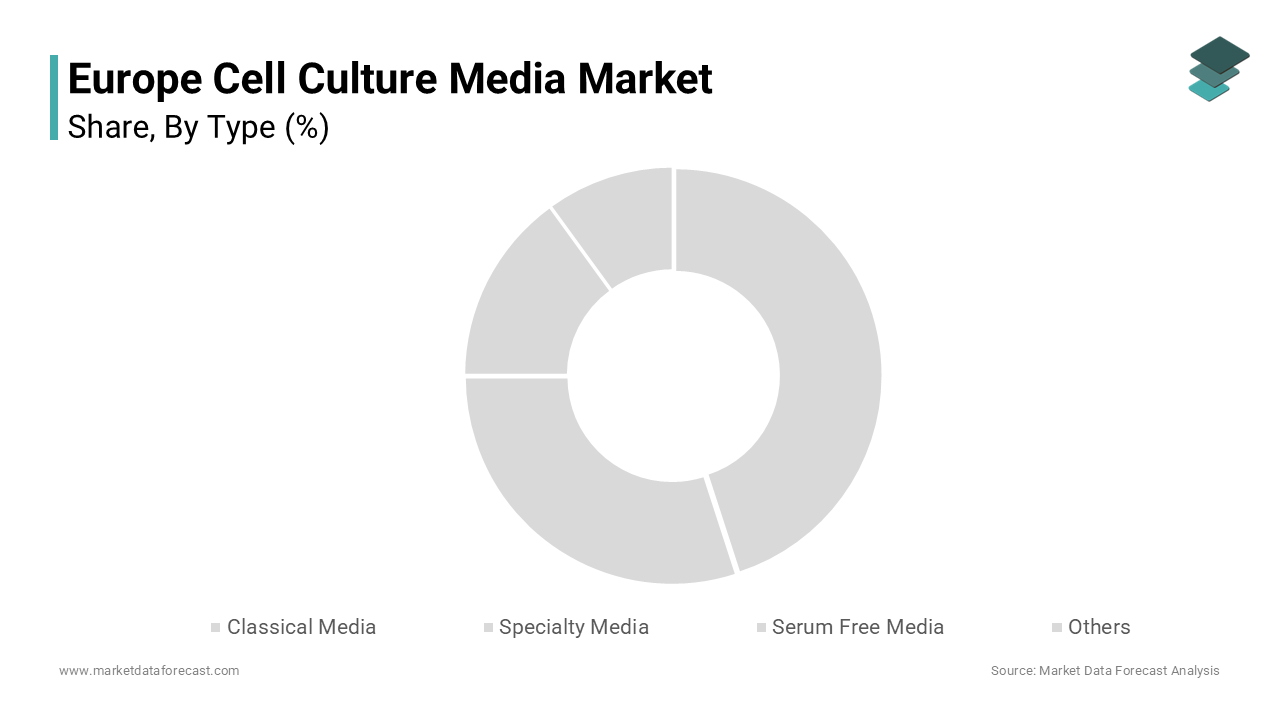
The specialty media segment is on the rise and is expected to be the fastest growing segment in the market by witnessing a CAGR of 14.8% between 2025 and 2033 due to the rise of complex cellular models including induced pluripotent stem cells organoids and primary immune cells which demand highly tailored nutrient compositions. Unlike classical or generic serum free formulations specialty media are engineered for specific applications such as T cell expansion neuronal differentiation or hepatocyte function. National research initiatives in some countries have also funded organoid biobanks requiring standardized specialty media for reproducibility. As Europe leads in advanced cellular models this segment bridges scientific innovation with industrial scalability.
By Application Insights
The drug screening and development segment led the Europe cell culture media market by capturing a 46.7% share in 2024. The supremacy of the drug screening and development segment is supported by Europe’s robust biopharmaceutical pipeline and reliance on in vitro models for target validation toxicity testing and lead optimization. High throughput screening platforms at companies routinely consume thousands of liters of media annually for 3D spheroid and co culture models that better mimic human physiology. The shift toward patient derived tumor organoids for oncology drug testing has further increased demand for specialized media that maintain genomic fidelity over multiple passages. This application remains the largest and most consistent driver of media consumption, aligning with Europe's strong emphasis on reducing animal testing through the REACH regulation and promoting human-relevant models.
The regenerative medicine and cell therapy development segment is expected to exhibit a noteworthy CAGR of 18.2% from 2025 to 2033 owing to the clinical and commercial maturation of autologous and allogeneic therapies for oncology rare diseases and tissue repair. These therapies require GMP grade media that are not only serum free but also xeno free chemically defined and functionally validated for specific cell expansion protocols. Academic medical centers in France and the UK have established hospital-based cell processing units that rely on closed system media bags from vendors. The European Commission allocated funds to scale domestic production of therapy specific media reinforcing this high growth trajectory.
By End User Insights
The biotechnology and pharmaceutical segment was the largest segment in the Europe cell culture media market by occupying a share of 58.3% in 2024. The prominence of the biotechnology and pharmaceutical segment is attributed to the massive scale of biologics production and the regulatory imperative for consistency and traceability in therapeutic manufacturing. Europe is home to commercial scale bioreactor facilities producing monoclonal antibodies vaccines and viral vectors with notable media consumption. Companies operate under strict Good Manufacturing Practice requiring media suppliers to provide full documentation of raw material provenance endotoxin levels and change control protocols. Apart from these, the EU’s push for biomanufacturing sovereignty under the Pharmaceutical Strategy has incentivized local sourcing of critical reagents. The industrial segment remains the primary engine of high-volume, high-specification media demand, as biologics represent over half of Europe's new drug approvals.
The academic and research laboratories segment is predicted to witness the highest CAGR of 12.6% between 2025 and 2033 due to factors such as unprecedented funding for life sciences under Horizon Europe and national initiatives focused on pandemic preparedness neurodegenerative diseases and cancer organoids. Institutions have adopted serum free and chemically defined media as standard to enhance reproducibility and comply with ethical review boards. Digital procurement platforms like UniProt and national reagent hubs have also streamlined media access across university networks. This segment provides both volume and early validation for next-generation media innovations as Europe doubles down on foundational science.
REGIONAL ANALYSIS
Germany Cell Culture Media Market Analysis
Germany dominated the Europe cell culture media market by accounting for a 25.2% share in 2024. Its dense biopharmaceutical cluster, world class research institutions, and strong regulatory infrastructure have mainly contributed to the domination of the German market. The country hosts commercial biologics manufacturing facilities including global sites consuming significant liters of GMP media annually. Academic powerhouses like the Max Delbrück Center and Helmholtz Zentrum München lead in organoid and immunotherapy research requiring specialty formulations. The Paul Ehrlich Institute enforces rigorous media documentation for advanced therapies ensuring high compliance standards. Germany sets the benchmark for scale, quality, and innovation in European cell culture media demand through its integrated approach across industry, academia, and policy.
United Kingdom Cell Culture Media Market Analysis
The United Kingdom followed closely in the Europe cell culture media market by capturing a 18.5% share in 2024 by leveraging its global leadership in academic research and advanced therapy development. Despite Brexit the UK remains a hub for cell and gene therapy. Institutions drive demand for organoid and stem cell media under Wellcome Trust and UK Research and Innovation funding. The UK also hosts major media distributors and contract development organizations serving pan European clients. The UK maintains an outsized influence on media innovation and adoption, despite its smaller population, due to strong science policy, agile regulation, and deep therapeutic expertise.
France Cell Culture Media Market Analysis
France is an attractive player in the Europe cell culture media market due to its national strategy for biomanufacturing and strong public research ecosystem. Sanofi’s vaccine and biologics sites in Lyon and Vitry consume significant volumes of serum free media under European Medicines Agency oversight. The National Agency for Medicines and Health Products Safety enforces strict ethical guidelines favoring xeno free formulations. Academic medical centers in Paris and Marseille lead in CAR T cell trials requiring custom expansion media. France has ensured a sustained and strategic media demand, aligned with its health sovereignty goals, through a combination of state investment, scientific excellence, and regulatory clarity.
Switzerland Cell Culture Media Market Analysis
Switzerland grew steadily in the Europe cell culture media market owing to its concentration of global pharmaceutical leaders and precision biomanufacturing standards. Companies operate large scale facilities in Basel and Visp producing monoclonal antibodies and cell therapies with significant media volumes. Switzerland’s regulatory framework though outside the EU aligns closely with European Medicines Agency requirements ensuring high media quality and documentation. The Swiss National Science Foundation funds cutting edge research in microphysiological systems requiring specialty media for organ chip applications. Switzerland serves as a high-value testbed for next-generation media formulations targeting global regulatory approval due to its culture of precision, quality, and neutrality.
Netherlands Cell Culture Media Market Analysis
The Netherlands is predicted to expand in the Europe cell culture media market between 2025 and 2033 due to its collaborative life sciences ecosystem and leadership in organoid technology. The Hubrecht Institute and Princess Máxima Center pioneered organoid models now used globally requiring proprietary media for long term culture. Companies operate biomanufacturing sites in Leiden and Haarlem consuming large volumes of GMP media. The Netherlands also hosts key media distributors and contract research organizations serving the Benelux and German markets. The Netherlands exemplifies how focused scientific excellence, driven by strong public-private partnerships, open science policies, and the early adoption of 3D culture models, can generate disproportionate media demand from a small geographic footprint.
COMPETITVE LANDSCAPE
Competition in the Europe cell culture media market is characterized by a mix of global life science giants regional specialists and niche innovators vying for trust in a highly regulated and science driven environment. Thermo Fisher Merck and Lonza dominate through scale portfolio breadth and deep regulatory expertise yet face growing competition from agile players like Sartorius and FUJIFILM Irvine Scientific that offer application specific media with faster customization. The market is less price sensitive and more focused on performance reproducibility and compliance with EU Good Manufacturing Practice and ethical standards. Differentiation hinges on technical support formulation IP and the ability to provide end to end solutions from R and D to commercial supply. While barriers to entry remain high due to quality requirements and validation timelines innovation in chemically defined specialty and therapy specific media continues to reshape the competitive landscape. Collaboration often coexists with competition as players co develop standards and participate in EU funded consortia reinforcing a dynamic yet highly professionalized ecosystem.
KEY MARKET PLAYERS
Some of the companies that are playing a dominating role in the Europe Cell Culture Media Market include
- Thermo Fisher Scientific, Inc.
- Merck KGaA
- Lonza Group AG
- Sartorius AG
- Miltenyi Biotec B.V. & Co. KG
- GE Healthcare
- Corning Incorporated
- Bio-Techne Corporation
Top Players in the Market
Thermo Fisher Scientific Inc
Thermo Fisher Scientific is a global leader in life sciences with a commanding presence in the Europe cell culture media market through its Gibco and Thermo Scientific portfolios. The company supplies a comprehensive range of classical serum free and specialty media formulations tailored for biopharmaceutical manufacturing stem cell research and cell therapy applications across the continent. Globally Thermo Fisher sets industry benchmarks for media quality consistency and regulatory documentation enabling seamless tech transfer. It also launched a digital media configurator tool allowing European researchers to customize formulations and access real time regulatory support strengthening its position as an integrated solutions provider.
Merck KGaA
Merck KGaA headquartered in Darmstadt Germany is a pivotal contributor to the Europe cell culture media market through its MilliporeSigma business unit. The company offers the SAFC and Advanced BioManufacturing portfolios featuring chemically defined and animal component free media designed for monoclonal antibodies vaccines and advanced therapies. Merck plays a strategic role in Europe’s biomanufacturing sovereignty agenda by localizing critical media production and supporting regulatory harmonization. By aligning its innovation with EU policy priorities and scientific excellence Merck reinforces its position as a trusted partner for both industry and academia.
Lonza Group Ltd
Lonza Group is a Swiss based global contract development and manufacturing organization with deep integration into the Europe cell culture media ecosystem. Beyond supplying its own EX CELL and PromoCell media lines Lonza embeds media selection and optimization into its end to end biologics and cell therapy services for European clients. The company contributes globally by standardizing media use across its multi site network ensuring consistency from process development to commercial supply. These initiatives position Lonza not just as a vendor but as a strategic enabler of Europe’s advanced therapy ecosystem.
Top Strategies Used by the Key Market Participants
Key players in the Europe cell culture media market employ several strategic approaches to maintain leadership and respond to evolving scientific and regulatory demands. Product customization is central with companies offering tailored media formulations for specific cell lines applications and regulatory pathways. Vertical integration ensures supply chain security through in house production of critical raw materials and GMP compliant manufacturing facilities within the EU. Strategic partnerships with biopharma firms academic centers and regulatory bodies accelerate media qualification and adoption. Digitalization enhances customer experience via online configurators batch traceability portals and AI driven media optimization tools. Finally compliance leadership is prioritized through proactive alignment with European Medicines Agency guidelines Annex 1 requirements and ethical mandates for animal free components ensuring trust and market access.
MARKET SEGMENTATION
The research report on the Europe Cell Culture Media Market has been segmented and sub-segmented based on categories.
By Type
- Classical Media
- Specialty Media
- Serum Free Media
- Others
By Application
- Drug Screening and Development
- Research
- Others
By End User
- Biotechnology and Pharmaceutical Industries
- Academic & Research Laboratories
- Others
By Country
- UK
- France
- Spain
- Germany
- Italy
- Russia
- Sweden
- Denmark
- Switzerland
- Netherlands
- Turkey
- Czech Republic
- Rest of Europe