- Product Description Description
- Table of Contents TOC
- List of Table & Figure LOT
- Get Free Sample PDF Sample PDF
Market Size, 2025
$1.13 BnMarket Estimate, 2026
$1.18 BnMarket Forecast, 2034
$1.70 BnCAGR, 2026–2034
4.69%Executive Summary: Europe Centrifugal Pump Market
- Market Scope: Comprehensive Europe centrifugal pump market analysis covering design stages, operation types, pump mechanisms, end-user verticals, country-level frameworks, and adoption barriers.
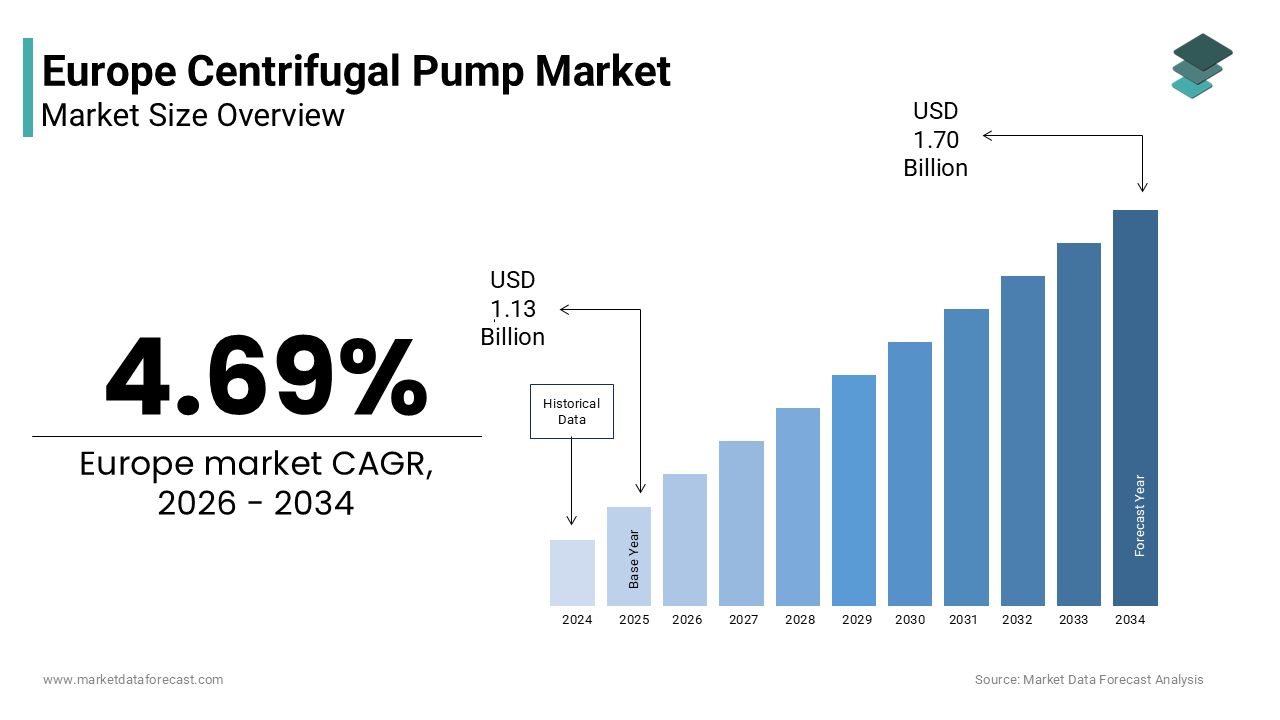
- Market Valuation: Valued at USD 1.13 billion (2025), estimated at USD 1.18 billion (2026), and projected to reach USD 1.70 billion by 2034, registering a steady CAGR of 4.69% (2026–2034).
- Primary Growth Drivers: Stringent energy-efficiency regulations, modernization of water and wastewater infrastructure, increasing industrial automation, and rising adoption of smart, IoT-enabled pumping systems. Key challenges include high initial capital costs and raw material price volatility.
Key Market Segment Metrics (2026–2034)
| Category | Leading Segment (2025 Position) | Fastest-Growing Segment |
|---|---|---|
| By Stage & Operation | Single Stage pumps and Electric-driven operation (dominated owing to high versatility and widespread standard industrial deployment) | Multistage pumps and smart VSD-integrated electric pumps |
| By Type & End User | Radial type pumps and Water/Waste Management, Chemicals, and Oil & Gas end-user sectors (led consumption volume) | IoT-enabled smart pumping systems and renewable energy applications |
| By Country | Germany (maintained the leading position due to a strong manufacturing base, chemical/automotive sectors, and advanced infrastructure) | United Kingdom and France (accelerating through wastewater treatment upgrades and sustainability initiatives) |
Major Market Players & Market Structure
Market Structure: Highly competitive fluid handling and industrial machinery landscape characterized by continuous investments in energy-efficient pump technologies, variable speed drive (VSD) integration, IoT-enabled monitoring systems, predictive maintenance solutions, and digital twin technologies.
Key Companies: Grundfos, KSB SE & Co. KGaA, Sulzer Ltd., Xylem Inc., Flowserve Corporation, Wilo SE, Ebara Corporation, ITT Inc., ANDRITZ AG, SPX FLOW, Inc., Pentair plc, and Ruhrpumpen Group.
Europe Centrifugal Pump Market Size
The Europe centrifugal pump market was worth USD 1.13 billion in 2025. The Europe market is estimated to be USD 1.18 billion in 2025 and is projected to reach USD 1.70 billion by 2034, at a CAGR of 4.69% from 2026 to 2034.
A centrifugal Pump is a mechanical device that transfers rotational energy through impellers in order to transfer liquids. Through the vane tips of the impeller, fluid is flung out by centrifugal force throughout the circle of the quickly rotating impeller. Due to the impeller's operation, the fluid traveling reaches the pump outlet at a higher speed and pressure. The impeller directs the fluid into the pump casing, which is constrained, slowed, and controlled before being discharged. Most low-pressure, high-capacity pumping applications involving low-viscosity fluids, such as water, solvents, chemicals, and light oils, can be solved affordably with centrifugal pump designs promoting the growth of the Europe Centrifugal Pump Market. The transfer of chemicals in petrochemical facilities, irrigation, water supply, and circulation are typical applications. However, for applications involving very viscous fluids like thick oils and slurries, especially at high pressures, for complicated feeds like emulsions, meals, or biological fluids, and when precision dosing is essential, positive displacement pumps are favored. These are used in industrial, agricultural, and home applications to pump water, solvents, organics, oils, acids, bases, and any "thin" liquids.
The European landscape is defined by a mature industrial base that prioritizes energy efficiency and operational reliability over initial acquisition cost. According to Eurostat, the water supply, sewerage, waste management, and remediation activities sector in the European Union employed approximately 1.2 million people and generated a turnover of 96 billion euros in recent years, underscoring the massive scale of fluid handling operations. As per the European Environment Agency, public water utilities in the EU distribute over 20 billion cubic meters of drinking water annually, requiring extensive pumping infrastructure for transmission and distribution. The region’s stringent regulatory framework, particularly the Ecodesign Directive, mandates minimum efficiency standards for rotodynamic pumps, driving technological innovation toward smart and variable speed drive integrated systems. The transition toward Industry 4.0 has further transformed this market, with manufacturers embedding Internet of Things sensors for predictive maintenance and real time performance monitoring. This shift reflects a broader industrial trend where mechanical components are becoming intelligent nodes in digital ecosystems. The market operates at the intersection of heavy engineering and digital transformation, requiring continuous adaptation to evolving environmental standards and the decarbonization goals outlined in the European Green Deal.
MARKET DRIVERS
Stringent Energy Efficiency Regulations and Decarbonization Mandates
The implementation of rigorous energy efficiency standards is majorly propelling the expansion of the European centrifugal pumps market. The European Commission’s Ecodesign Regulation sets mandatory minimum efficiency levels for water pumps, compelling end users to retire older, inefficient models in favor of high performance alternatives. According to the International Energy Agency, electric motor-driven systems account for approximately 45% of global industrial electricity consumption. In Europe, where electricity prices remain relatively high due to carbon pricing mechanisms, the operational cost savings from efficient pumps provide a compelling economic argument for adoption. The EuP Lot 11 regulations specifically target circulators and standard pumps, requiring manufacturers to meet specific efficiency indices. As per data from the European Association of Pump Manufacturers, the adoption of variable speed drives and high efficiency motors can reduce energy consumption by up to 30% in typical industrial applications. This regulatory pressure is amplified by the Corporate Sustainability Reporting Directive, which requires large companies to disclose their energy usage and carbon footprint. Consequently, facility managers are incentivized to invest in premium efficiency pumps that offer lower total cost of ownership. The push for decarbonization extends beyond compliance, as companies seek to align with net zero targets. This driver ensures a steady demand for advanced pumping solutions that minimize energy waste and contribute to broader sustainability goals.
Expansion of Water and Wastewater Infrastructure Projects
The modernization and expansion of water and wastewater treatment infrastructure is further fuelling the European centrifugal pumps market growth due to the urbanization and stricter environmental discharge standards. The European Union’s Urban Wastewater Treatment Directive mandates higher levels of purification for municipal effluent and this requires the installation of advanced pumping systems for sludge handling, aeration, and final discharge. According to the European Environment Agency, roughly 75% of the EU population is connected to public wastewater collection systems, creating a vast network that requires continuous maintenance and upgrades. Aging infrastructure in countries such as Germany, France, and the United Kingdom requires significant capital investment to replace corroded or obsolete pumping stations. The European Investment Bank has allocated billions of euros toward green infrastructure projects, including water resilience and sanitation improvements, which directly stimulate demand for durable and reliable centrifugal pumps. Furthermore, climate change induced flooding events have prompted investments in stormwater management systems, which rely heavily on high capacity drainage pumps. As per Eurostat, public expenditure on environmental protection in the EU reached 2% of GDP, with water management constituting a major share. This sustained public spending ensures a stable baseline demand for pumping equipment. The integration of smart water grids also drives the adoption of intelligent pumps capable of remote monitoring and automated flow control, enhancing operational efficiency in municipal utilities.
MARKET RESTRAINTS
High Initial Capital Expenditure and Economic Volatility
The substantial upfront cost associated with high efficiency and smart centrifugal pumps is a significant restraint for the regional market expansion, particularly for small and medium sized enterprises facing economic uncertainty. Advanced pumps equipped with variable frequency drives, stainless steel construction, and IoT connectivity command a premium price compared to standard cast iron models. According to Eurostat, the producer price index for machinery and equipment in the Euro area saw growth of about 5% in 2025 as the sector navigated ongoing inflationary pressures. This volatility makes capital budgeting difficult for industrial users who may delay replacement cycles to preserve cash flow. While the total cost of ownership favors efficient pumps, the initial investment barrier remains high for businesses operating on tight margins. The ongoing energy crisis in Europe has further strained industrial budgets, forcing companies to prioritize immediate operational survival over long term infrastructure upgrades. As per surveys by Eurochambres, nearly 40% of manufacturing firms reported that high costs and economic uncertainty remain top barriers to new investments. This hesitation slows the adoption rate of new technologies and extends the lifecycle of older, less efficient equipment. Additionally, the complexity of integrating smart pumps with existing legacy control systems requires additional engineering resources and software licensing fees, adding to the total project cost. These financial constraints limit market growth to only the most critical applications where failure is not an option.
Supply Chain Disruptions and Raw Material Price Instability
The supply chain fragility and the volatile pricing of key raw materials such as steel, copper, and rare earth elements are further impeding the centrifugal pumps market growth in Europe. Pumps require significant amounts of metal for casings, impellers, and motor windings, making them highly sensitive to commodity market fluctuations. According to the World Steel Association, global steel prices have remained elevated above pre-pandemic levels, directly impacting production costs for pump manufacturers. The reliance on global supply chains for specialized components such as seals, bearings, and electronic controllers exposes European manufacturers to geopolitical risks and logistical bottlenecks. The shortage of semiconductor chips, essential for smart pump controllers and variable speed drives, has led to extended lead times, sometimes exceeding six months for certain models. As per industry reports, these delays disrupt project timelines for end users in construction and industrial sectors, leading to contract penalties and lost revenue. The scarcity of skilled labor in the manufacturing sector further exacerbates production constraints, limiting the ability of factories to ramp up output quickly. These supply side issues create uncertainty in delivery schedules, prompting customers to hold larger inventories or seek alternative suppliers, which fragments the market. Until supply chains stabilize and raw material prices normalize, manufacturers will struggle to maintain consistent profit margins and reliable delivery performance.
MARKET OPPORTUNITIES
Integration of Digital Twins and Predictive Maintenance Solutions
The convergence of centrifugal pumps with digital twin technology and artificial intelligence presents a significant opportunity for manufacturers to transition from product sellers to service providers. Digital twins create virtual replicas of physical pumps, allowing operators to simulate performance, predict failures, and optimize maintenance schedules in real time. According to the European Commission’s Digital Economy and Society Index, over 60% of large enterprises in the EU have adopted advanced data analytics, creating a fertile ground for smart industrial solutions. By embedding sensors that monitor vibration, temperature, and pressure, manufacturers can offer predictive maintenance services that reduce unplanned downtime by up to 50%. This shift enables a subscription based business model where customers pay for uptime and performance rather than just hardware. As per industry analysis, the European industrial IoT market is expected to expand at a strong double digit CAGR through 2030, with Europe being a key adopter due to its strong manufacturing base. Companies that develop proprietary software platforms for pump monitoring can differentiate themselves in a commoditized hardware market. The ability to provide actionable insights on energy efficiency and wear patterns adds substantial value for industrial clients. Furthermore, regulatory support for digitalization under Industry 4.0 initiatives provides funding and incentives for such innovations. This opportunity allows manufacturers to capture recurring revenue streams and build deeper customer relationships through continuous service engagement.
Growth in Renewable Energy and Hydrogen Production Applications
The rapid expansion of renewable energy sectors, particularly green hydrogen production and concentrated solar power, which creates new application avenues for specialized centrifugal pumps. Green hydrogen production via electrolysis requires precise fluid handling for water purification, cooling, and chemical dosing, demanding pumps that are resistant to corrosion and capable of handling high purity fluids. According to the European Clean Hydrogen Alliance, the EU aims to install 40 gigawatts of renewable hydrogen electrolyzers by 2030, which will require thousands of specialized pumping units. Similarly, the geothermal energy sector, which is gaining traction in countries like Iceland and Italy, relies on heavy duty pumps to circulate hot brine from underground reservoirs. As per the European Geothermal Energy Council, geothermal heat production in Europe is projected to grow significantly as member states expand capacity toward 2030, driving demand for pumps that can withstand high temperatures and abrasive conditions. The wind energy sector also utilizes hydraulic systems and cooling pumps for turbine gearboxes and generators. Manufacturers that develop pumps tailored to these emerging energy technologies can capture early market share in high growth segments. The European Green Deal’s emphasis on energy independence accelerates investment in these sectors, providing a stable long term demand outlook. This opportunity allows pump makers to diversify away from traditional oil and gas markets toward sustainable energy infrastructure.
MARKET CHALLENGES
Shortage of Skilled Technical Workforce and Engineering Talent
The European centrifugal pumps market faces a critical challenge in the form of a shrinking skilled workforce capable of designing, manufacturing, and maintaining complex pumping systems. The aging demographic of experienced engineers and technicians is not being adequately replaced by younger entrants, leading to a knowledge gap in hydraulic design and precision manufacturing. According to Eurostat, the EU faces a persistent labor shortage in STEM fields, with over 3 million manufacturing-related roles currently at risk of vacancy due to a lack of qualified personnel. This labor shortage impacts the ability of manufacturers to innovate and respond to custom engineering requests promptly. The increasing complexity of smart pumps requires expertise in both mechanical engineering and software development, a combination that is rare in the traditional industrial workforce. As per industry surveys, over 60% of manufacturing companies report difficulty in finding staff with the necessary digital skills. This talent deficit slows down the deployment of advanced technologies and increases training costs for existing employees. Furthermore, the lack of skilled installers and maintenance technicians at the end user level leads to improper installation and premature pump failure, damaging the reputation of high quality products. Addressing this challenge requires significant investment in vocational training and partnerships with educational institutions, which is a long term strategy that does not yield immediate results.
Complexity of Compliance with Diverse Regional Standards
Navigating the fragmented regulatory landscape across European countries is further challenging the European centrifugal pumps market growth. While the EU provides overarching directives such as ATEX for explosive atmospheres and PED for pressure equipment, individual member states often impose additional national standards and certification requirements. According to the European Committee for Standardization, while harmonization is a priority, specific national implementations for noise emissions and chemical contact safety still vary. For example, Germany’s TA Luft regulations for air quality may impose stricter limits on seal leakage than other countries, requiring manufacturers to produce variant designs for different markets. This fragmentation increases the cost of compliance, testing, and certification, reducing economies of scale. As per legal analyses by industry bodies, the administrative burden of managing multiple certifications can delay product launches by several months. Small and medium sized manufacturers often lack the resources to navigate this complex regulatory web, limiting their market reach to domestic borders. The constant evolution of environmental laws, such as restrictions on per and polyfluoroalkyl substances in seals and coatings, requires continuous reformulation of products. This regulatory volatility creates uncertainty and increases the risk of non-compliance penalties, which is forcing companies to maintain large legal and compliance teams.
REPORT COVERAGE
| REPORT METRIC | DETAILS |
| Market Size Available | 2025 to 2034 |
| Base Year | 2025 |
| Forecast Period | 2026 to 2034 |
| CAGR | 4.69% |
| Segments Covered | By Stage, Operation Type, Type, End-User, and Country. |
| Various Analyses Covered | Global, Regional & Country Level Analysis, Segment-Level Analysis, DROC, PESTLE Analysis, Porter’s Five Forces Analysis, Competitive Landscape, Analyst Overview on Investment Opportunities |
| Regions Covered | North America, Europe, APAC, Latin America, Middle East & Africa |
| Market Leaders Profiled | EBARA CORPORATION, Grundfos Holding A/S, KIRLOSKAR BROTHERS LIMITED, KSB SE & Co. KGaA, PLEUGER INDUSTRIES; Sulzer Ltd, The Weir Group PLC, Tsurumi Manufacturing Co., Ltd., WILO SE, Xylem Inc., Franklin Electric, Andritz Group, and Others. |
SEGMENTAL ANALYSIS
By Stage Insights
The single stage segment dominated the market by capturing the leading share of the European market in 2025. The dominance of single stage segment in the European market is driven by their simplicity, lower initial cost, and suitability for a vast array of low to medium pressure applications. These pumps are the workhorses of industrial fluid handling, widely used in water circulation, HVAC systems, and general chemical transfer where high head pressure is not required. According to the European Association of Pump Manufacturers, single stage units account for over 60% of total pump installations in the region, reflecting their ubiquity in municipal and light industrial sectors. Their straightforward design involves only one impeller, which reduces manufacturing complexity and maintenance requirements. This mechanical simplicity translates to higher reliability and lower lifecycle costs, making them the preferred choice for facility managers and engineers. The widespread availability of standardized models allows for easy replacement and interoperability across different systems. In the building services sector, which consumes a significant portion of electricity in Europe, single stage pumps are essential for heating and cooling distribution. As per Eurostat, the construction and building services sector represents a major end user base, driving consistent demand for these reliable units. The ability to handle large volumes of fluid at moderate pressures efficiently ensures that single stage pumps remain the default solution for most general purpose applications, securing their dominant market share.
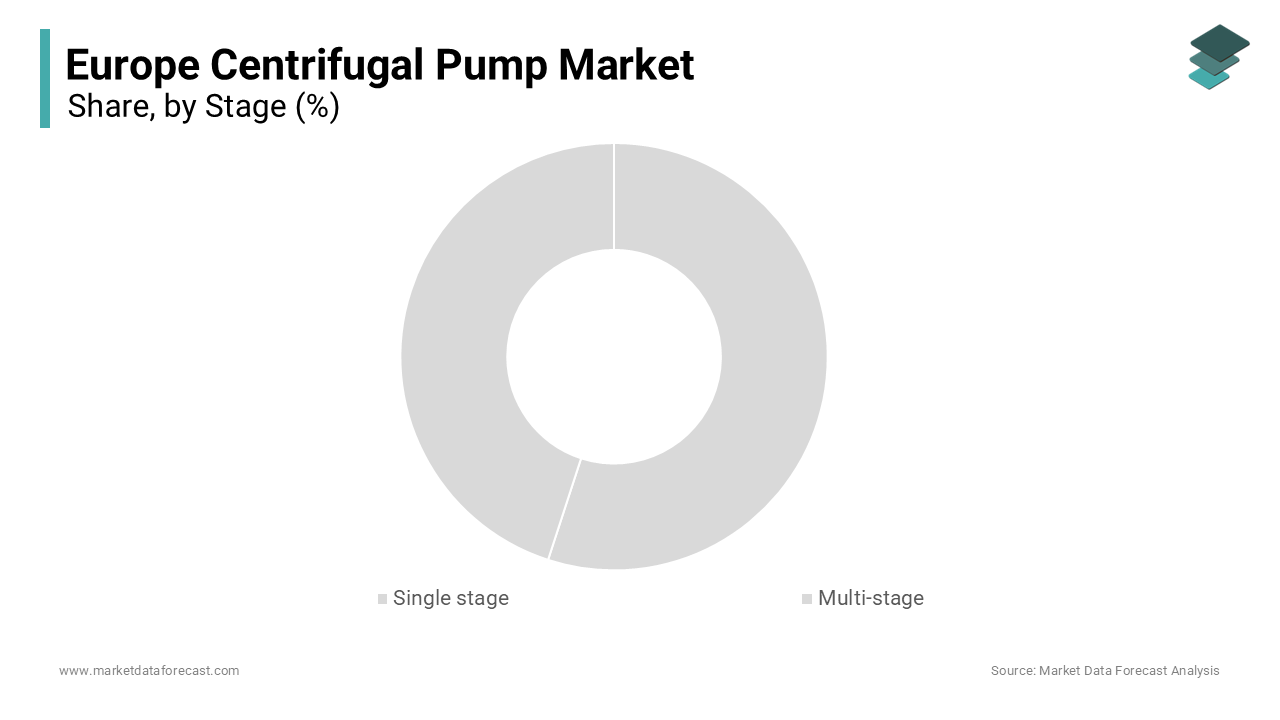
On the other side, the multistage segment is growing exponentially and is estimated to record a CAGR of 6.4% over the forecast period owing to the increasing demand for high pressure fluid delivery in specialized industrial applications such as boiler feed water, reverse osmosis, and high pressure cleaning. According to the International Desalination Association, the capacity of desalination plants in Europe is expanding, particularly in Southern countries like Spain and Italy, where water scarcity is a pressing issue. Reverse osmosis systems require pumps capable of generating pressures exceeding 60 bar, a task perfectly suited for multistage configurations. Additionally, the power generation sector, including nuclear and thermal plants, relies heavily on multistage pumps for boiler feed applications where precise pressure control is vital for safety and efficiency. As per the European Nuclear Society, modernization efforts in existing power plants are driving replacements with higher efficiency multistage units. The chemical industry also utilizes these pumps for high pressure reactor feeding and pipeline transport of viscous fluids. The ability to achieve high heads without excessive rotational speeds reduces wear and improves longevity. This technical advantage, combined with the industrial shift toward more complex and high intensity processes, propels the rapid adoption of multistage pumps across key European sectors.
By Operation Type Insights
The electric-driven segment led the market with the highest share of the global market in 2025. The growth of the electric-driven segment in the European market is attributed to the widespread availability of electrical infrastructure and their superior operational efficiency compared to other drive types. Electricity is the primary energy source for industrial and municipal facilities across Europe, making electric pumps the most convenient and cost effective choice for continuous operations. According to Eurostat, electricity accounts for approximately 22% of final energy consumption in the European Union industrial sector, highlighting its central role in powering machinery. Electric motors offer precise control over speed and torque, allowing for seamless integration with automated control systems and variable frequency drives. This controllability is essential for optimizing process parameters in industries such as chemicals and pharmaceuticals. The high efficiency of modern electric motors, often exceeding 90%, aligns with European energy conservation goals. As per the International Energy Agency, electric motor systems represent a significant portion of industrial electricity use, driving continuous improvements in motor technology. The lack of emissions at the point of use makes electric pumps compliant with strict indoor air quality and environmental regulations. Furthermore, the maturity of electric drive technology ensures reliable performance and easy access to maintenance services. This combination of infrastructure readiness, efficiency, and regulatory compliance secures the leading position of electric driven pumps in the European market.
However, the hydraulic driven segment is estimated to grow at the fastest CAGR of 5.4% over the forecast period in the European market owing to their intrinsic safety in hazardous environments. In industries such as oil and gas, chemical processing, and mining, the risk of explosion from electrical sparks necessitates the use of non electric drive systems. Hydraulic pumps utilize fluid power to drive the impeller, eliminating the need for electrical components in the pump vicinity. According to the European Agency for Safety and Health at Work, stringent ATEX directives mandate the use of explosion proof equipment in zones with flammable gases or dust, favoring hydraulic solutions. These pumps offer high torque density and precise control, making them suitable for heavy duty applications where reliability is critical. The ability to operate in submerged or wet environments without risk of short circuiting further enhances their appeal in offshore and marine applications. As per industry safety audits, hydraulic systems reduce the likelihood of ignition sources, thereby lowering insurance premiums and operational risks. The growing emphasis on workplace safety and regulatory compliance in high risk industries drives the adoption of hydraulic driven pumps. This specialized demand ensures steady growth in segments where electrical drives are prohibited or impractical.
By End-User Insights
The water and wastewater management segment led the market by holding the highest share of the European market in 2025. The dominance of water and wastewater management segment in the European market can be credited to the extensive municipal infrastructure required for drinking water distribution and sewage treatment. Every city and town in Europe relies on a network of pumping stations to move water from sources to treatment plants and then to consumers. According to Eurostat, public water utilities in the EU serve over 400 million citizens, requiring millions of pumps for transmission and distribution. The Urban Wastewater Treatment Directive mandates strict standards for effluent quality, necessitating advanced pumping systems for sludge handling, aeration, and discharge. Aging infrastructure in many European countries requires continuous replacement and upgrading of pumps to prevent leaks and ensure reliability. As per the European Investment Bank, billions of euros are invested annually in water infrastructure projects to improve resilience against climate change and population growth. Centrifugal pumps are the preferred technology due to their ability to handle large volumes of water and slurries efficiently. The critical nature of water supply ensures that this sector remains a stable and dominant consumer of pumping equipment. The ongoing focus on water conservation and leak detection further drives the adoption of smart pumps with monitoring capabilities. This foundational role in public health and sanitation secures the leading market share for this end user segment.
On the other end, the chemical segment is the fastest growing end user segment for centrifugal pumps in Europe and is predicted to register a CAGR of 6.4% over the forecast period owing to the process intensification and stringent safety standards. European chemical manufacturers are continuously upgrading their facilities to improve yield, reduce waste, and enhance safety. According to the European Chemical Industry Council, the sector is investing heavily in modernization to maintain global competitiveness and comply with REACH regulations. Centrifugal pumps are essential for transferring corrosive, toxic, and volatile chemicals, requiring specialized materials such as stainless steel, hastelloy and lined plastics. The shift toward continuous manufacturing processes increases the demand for reliable and precise pumping solutions. As per industry safety reports, the use of sealless magnetic drive pumps are growing to prevent leaks and ensure worker safety. The expansion of specialty chemical production, including pharmaceuticals and agrochemicals, requires high purity and sanitary pumping systems. The complexity of chemical processes necessitates pumps that can handle varying viscosities and temperatures. This technical demand drives innovation and adoption of advanced centrifugal pump technologies. The strategic importance of the chemical sector to the European economy ensures continued investment in infrastructure. This dynamic environment fosters rapid growth in pump procurement for new and upgraded plants.
COUNTRY ANALYSIS
Germany Centrifugal Pumps Market Analysis
Germany held the dominant share of the European market in 2025 and is poised to maintain its leadership in the centrifugal pumps market over the next few years, as its industrial base prioritizes energy-efficient and smart manufacturing technologies. The country is home to major pump manufacturers and a dense network of chemical, automotive, and machinery industries that require extensive fluid handling solutions. According to the German Federal Ministry for Economic Affairs and Climate Action, the industrial sector accounts for a significant portion of the nation’s GDP, sustaining high demand for reliable pumping equipment. Strict energy efficiency regulations under the Ecodesign Directive drive the replacement of old pumps with high efficiency models. The presence of leading research institutions fosters innovation in smart pump technologies and digital integration. Germany’s focus on Industry 4.0 encourages the adoption of IoT enabled pumps for predictive maintenance. The water and wastewater sector also contributes significantly, with ongoing infrastructure upgrades to meet environmental standards. The country’s strong export orientation supports domestic pump manufacturers who supply global markets. The combination of industrial depth, regulatory rigor, and technological innovation secures Germany’s position as the dominant market player in Europe.
France Centrifugal Pumps Market Analysis
France is likely to see steady growth in its centrifugal pump market for the next few years, underpinned by significant investments in nuclear plant modernization and water infrastructure upgrades. The country relies heavily on nuclear power, which requires specialized high pressure pumps for cooling and reactor systems. According to the French Ministry of Ecological Transition, the maintenance and modernization of nuclear plants drive consistent demand for high quality industrial pumps. The agricultural sector, being one of the largest in Europe, also contributes to pump sales for irrigation and processing. France has implemented strict regulations on water usage and pollution, prompting upgrades in municipal wastewater treatment facilities. The presence of major industrial conglomerates in chemicals and aerospace further sustains market activity. Government initiatives to improve energy efficiency in buildings and industries encourage the adoption of variable speed drive pumps. The country’s commitment to environmental protection drives investment in green technologies. France’s strategic focus on energy independence and water security ensures a stable and growing market for centrifugal pumps.
Italy Centrifugal Pumps Market Analysis
Italy is expected to experience moderate growth in the coming years as local industries prioritize the transition to high-efficiency pumping systems to combat water scarcity and reduce energy costs. Italy represents a vital market for centrifugal pumps in Southern Europe, characterized by a strong manufacturing sector and significant water scarcity challenges. The country has a dense network of small and medium sized enterprises in textiles, ceramics, and food processing, all of which rely on efficient pumping systems. According to ISTAT, the industrial sector is a key driver of the economy, sustaining demand for reliable fluid handling equipment. Water scarcity in regions like Sicily and Puglia drives investment in desalination and irrigation pumps. The tourism industry also contributes to demand for HVAC and water supply pumps in hotels and resorts. Italy is actively upgrading its aging water infrastructure to reduce leaks and improve efficiency. The government supports energy efficiency measures through tax incentives, encouraging the adoption of high efficiency pumps. The presence of local pump manufacturers fosters competition and innovation. Italy’s unique geographical and industrial landscape creates diverse demand patterns for centrifugal pumps.
United Kingdom Centrifugal Pumps Market Analysis
The United Kingdom is likely to witness sustained demand for centrifugal pumps over the next few years, largely driven by large-scale water utility investments and the transition toward green energy infrastructure. The United Kingdom maintains a mature market for centrifugal pumps, driven by its extensive water utility network and offshore energy sector. The country has a well established infrastructure for water distribution and wastewater treatment, requiring continuous maintenance and upgrades. According to the UK Office for National Statistics, the water industry is a major investor in infrastructure, driving demand for large scale pumping solutions. The offshore oil and gas sector, although transitioning, still requires robust pumps for extraction and processing. The renewable energy sector, particularly wind farms, uses hydraulic and cooling pumps for turbine operations. Strict environmental regulations enforce high standards for effluent discharge, prompting upgrades in treatment plants. The post Brexit regulatory environment has led to updates in safety and quality standards, influencing equipment specifications. The UK’s focus on net zero emissions drives the adoption of energy efficient pumps. The market is characterized by high technical standards and a focus on sustainability.
Spain Centrifugal Pumps Market Analysis
Spain is anticipated to maintain a positive growth trajectory for the next few years, supported by ongoing national efforts to enhance water security through desalination and the modernization of irrigation networks. Spain is a growing market for centrifugal pumps in Europe, driven by its agricultural intensity and renewable energy ambitions. The country is a leading producer of fruits and vegetables, requiring extensive irrigation systems that rely on efficient pumps. According to the Spanish Ministry for Ecological Transition, water scarcity is a critical issue, driving investment in desalination and water reuse projects. These projects require high pressure multistage pumps for reverse osmosis. The tourism sector also contributes to demand for HVAC and pool circulation pumps. Spain is investing heavily in solar and wind energy, which use pumps for cooling and hydraulic systems. The government supports modernization of water infrastructure to improve efficiency and reduce losses. Local manufacturers are competitive in the Mediterranean market. The combination of agricultural needs and energy transition drives steady market growth. Spain’s strategic location facilitates trade with North Africa and Latin America.
COMPETITIVE LANDSCAPE
The competition in the Europe centrifugal pumps market is characterized by a mix of established global manufacturers and specialized regional players who compete on technology, efficiency, and service quality. Leading companies leverage their extensive distribution networks and brand reputation to maintain strong positions in key industrial sectors such as water management and chemicals. The market is highly fragmented in lower end segments but consolidated in high performance applications where technical expertise is critical. Competition drives continuous innovation in hydraulic design and material science to improve energy efficiency and durability. Price pressure exists in standard product categories prompting manufacturers to differentiate through digital services and customized solutions. Regulatory compliance with European energy and environmental standards acts as a significant barrier to entry for smaller competitors. Strategic partnerships with engineering firms and system integrators are common to capture large infrastructure projects. The shift toward smart pumping solutions creates new competitive dynamics where software capabilities become as important as mechanical performance. Companies must balance cost efficiency with technological advancement to remain relevant in this mature yet evolving landscape.
KEY MARKET PLAYERS
The major players in the Europe centrifugal pump market include
- EBARA CORPORATION
- Grundfos Holding A/S
- Kirloskar Brothers Limited
- KSB SE & Co. KGaA
- Pleuger Industries
- Sulzer Ltd
- The Weir Group PLC
- Tsurumi Manufacturing Co., Ltd.
- WILO SE
- Xylem Inc.
- Franklin Electric
- Andritz Group
Top Players in the Europe Centrifugal Pumps Market
Grundfos
Grundfos operates as a global leader in pump solutions with a significant manufacturing and research presence across Europe. The company specializes in energy efficient centrifugal pumps for water supply, wastewater management, and industrial applications. Recently Grundfos has strengthened its market position by expanding its digital services portfolio including smart pumping solutions that integrate with building management systems. They have invested heavily in research and development to create pumps that meet the strictest European energy efficiency standards. The company actively promotes sustainability by offering retrofit kits that upgrade existing installations to high efficiency models. Their focus on circular economy principles ensures that products are designed for longevity and recyclability. This strategic emphasis on innovation and environmental responsibility solidifies their reputation as a preferred partner for utilities and industrial clients seeking reliable and sustainable fluid handling solutions.
KSB SE & Co. KGaA
KSB SE & Co. KGaA is a prominent German manufacturer known for its high quality centrifugal pumps and valves serving diverse industrial sectors. The company provides critical pumping solutions for power generation, chemical processing, and water infrastructure projects throughout Europe. Recently KSB has enhanced its market position by acquiring specialized engineering firms to expand its capabilities in custom built large scale pumps. They have launched new product lines featuring advanced hydraulic designs that reduce energy consumption and maintenance requirements. The company strengthens its customer relationships through comprehensive service contracts and predictive maintenance offerings. KSB actively participates in industry standardization committees to shape future regulatory frameworks. Their commitment to technical excellence and robust after sales support ensures they remain a trusted supplier for complex and demanding industrial applications where reliability is paramount.
Sulzer Ltd
Sulzer Ltd serves as a key player in the Europe centrifugal pumps market with strong expertise in flow control technologies for challenging environments. The company focuses on providing specialized pumps for the oil and gas, chemical, and pulp and paper industries. Recently Sulzer has strengthened its market position by investing in digital transformation initiatives that enable remote monitoring and diagnostics of pump performance. They have expanded their service network across Europe to provide faster response times and localized support for critical assets. The company develops innovative materials and coatings that enhance pump durability in corrosive and abrasive conditions. Sulzer collaborates closely with customers to optimize total cost of ownership through energy efficient designs. Their strategic focus on lifecycle management and technological innovation ensures they deliver value beyond initial equipment sales maintaining a competitive edge in specialized industrial segments.
Top Strategies Used by Key Market Participants
Key players in the Europe centrifugal pumps market prioritize product innovation by developing high efficiency models that comply with stringent Ecodesign regulations and reduce operational energy costs. Companies invest heavily in digitalization by integrating Internet of Things sensors and predictive maintenance software to offer value added services and enhance customer retention. Strategic acquisitions of niche technology firms allow participants to expand their product portfolios and enter specialized application segments such as desalination or hydrogen production. Manufacturers focus on sustainability by adopting circular economy principles in design and manufacturing processes to minimize environmental impact. Expanding service networks and offering comprehensive lifecycle management contracts help secure long term revenue streams. Collaboration with engineering consultants and end users ensures that solutions are tailored to specific industrial needs. These strategies collectively aim to differentiate offerings in a mature market while addressing evolving regulatory and environmental demands.
RECENT MARKET HAPPENINGS
- Several companies are actively participating in the betterment of the Europe Centrifugal Pump Market. Here are a few of the several examples.
- EBARA one of the giants of the Europe Centrifugal Pumps Market has recently introduced model 3E/3ES product which is an advancement to its previous additions. This model is a vertical single centrifugal pump that has several functional advantages and is in line with the latest technologies. It takes up less installation space and is easy to install.
- In order to better their services and for expansion of the market KSB SE & Co. KGaA and Leistritz Pumpen GmbH are joining hands to provide a joined service of better screw pump services. The alliance of these companies has proven to bring positive impact in the France Centrifugal Pump Market Previously and so the alliance is now spreading to other countries.
MARKET SEGMENTATION
This research report on the Europe centrifugal pump market is segmented and sub-segmented into the following categories.
By Stage
- Single stage
- Multi-stage
By Operation Type
- Electric
- Hydraulic
- Air Driven
By Type
- Axial
- Radial
- Mixed
By End-User
- Oil and Gas
- Chemicals
- Food and Beverages
- Mining
- Power Generation
- Automotive
- Agriculture
- HVAC
- Waste Management
- Others
By Region
- Germany
- UK
- France
- Italy
- Spain
- Others