- Product Description Description
- Table of Contents TOC
- List of Table & Figure LOT
- Get Free Sample PDF Sample PDF
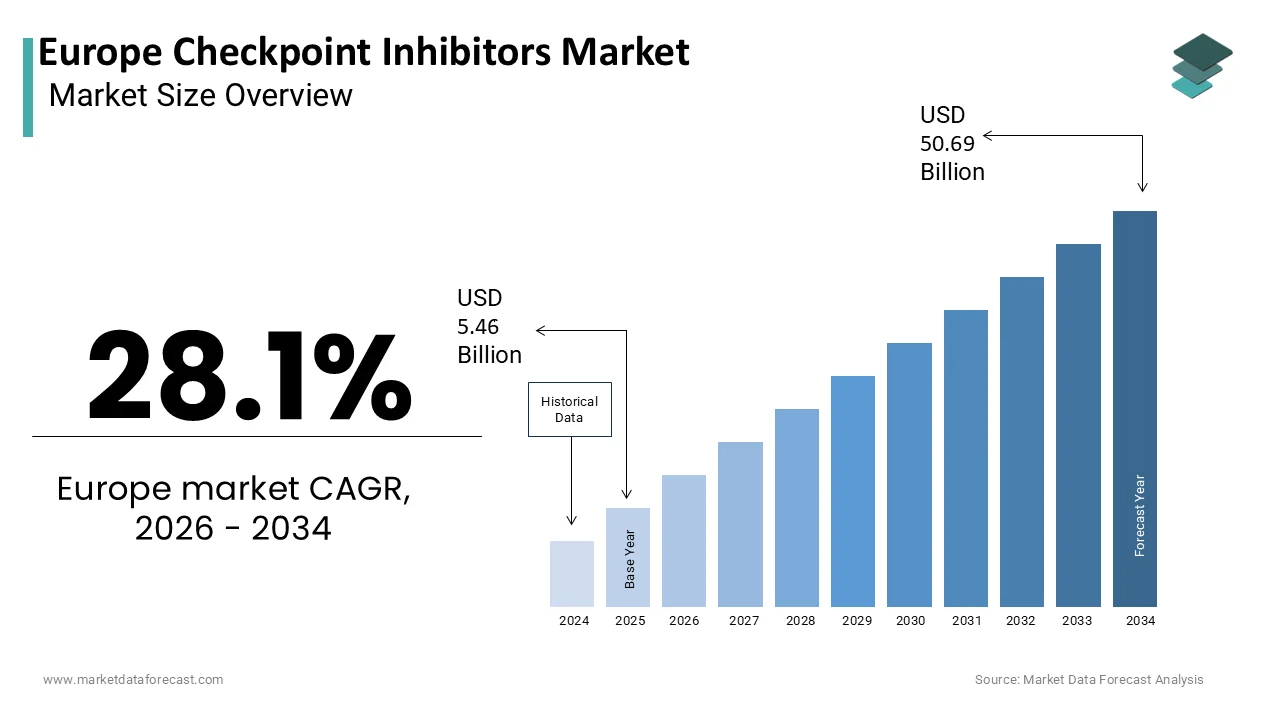
Market Size, 2025
$5.46 BnMarket Estimate, 2026
$6.99 BnMarket Forecast, 2034
$50.69 BnCAGR, 2026–2034
28.1%Executive Summary: Europe Checkpoint Inhibitors Market
- Market Scope: Comprehensive regional market evaluation of the European checkpoint inhibitors sector covering drug classifications, clinical applications, and country-level distribution frameworks.
- Market Valuation: Valued at USD 5.46 billion in 2025, estimated at USD 6.99 billion in 2026, and projected to reach USD 50.69 billion by 2034, registering a remarkable CAGR of 28.10% from 2026 to 2034.
- Primary Growth Drivers: Expanding indications in first-line and combination therapies, seamless integration into national cancer control programs, and robust academic oncology infrastructure across EU member states.
Key Market Segment Metrics (2026–2034)
| Category | Leading Segment (2025 Position) | Fastest-Growing / Preferred Segment |
|---|---|---|
| By Drug | PD-1 inhibitors (held 58.2% market share in 2025 due to extensive approvals across NSCLC, melanoma, and renal cell carcinoma) | PD-L1 inhibitors (projected to grow at a CAGR of 16.8% driven by complementary immune activation and consolidation regimens) |
| By Application | Lung cancer (accounted for 34.2% share in 2025 as the leading cause of cancer death with mature clinical real-world data) | Melanoma (estimated to grow at the fastest CAGR of 19.3% fueled by rising incidence, UV exposure, and adjuvant therapies) |
| By Country | Germany (captured 22.1% market share in 2025 backed by certified cancer centers, rapid reimbursement, and clinical trials) | France & United Kingdom (expanding rapidly through national cancer strategies, early authorization programs, and fast-track reviews) |
Major Market Players & Market Structure
Market Structure: Highly competitive European oncology landscape dominated by global pharmaceutical leaders competing through indication expansions, biomarker strategies, and real-world evidence generation.
Key Companies: Merck & Co., Inc., Bristol-Myers Squibb, Roche, AstraZeneca, Ono Pharmaceutical Co., Ltd., Juno Therapeutics, Novartis International AG, and Kite Pharma.
Europe Checkpoint Inhibitors Market Size
The Europe Checkpoint Inhibitors Market is projected to grow from USD 5.46 billion in 2025 to USD 6.99 billion in 2026 and reach USD 50.69 billion by 2034, registering a CAGR of 28.10% from 2026 to 2034.
The Checkpoint Inhibitors are a class of immunotherapeutic monoclonal antibodies that block inhibitory immune checkpoints, primarilyPD-1D 1 PD-L1 L1 and CTLA-4 4 to reactivate T cell mPD-1PD-1iatPD-L1PD-L1 anti tuCTLA-4CTLA-4responses in cancer patients. Unlike cytotoxic chemotherapy, these agents harness the body’s immune system to achieve durable remissions across a growing range of malignancies, including melanoma, non-small cell lung cancer, renal cell carcinoma, and Hodgkin lymphoma. Europe has been instrumental in both the clinical validation and real-world adoption of checkpoint inhibitors, supported by a robust academic oncology infrastructure and early regulatory recognition of their transformative potential. Furthermore, the European Society for Medical Oncology reported in 2024 that immune checkpoint inhibitors now feature in first-line treatment guidelines for at least eight major cancer types across EU member states.
MARKET DRIVERS
Expanding Indications in First Line and Combination Therapies Drive Clinical Adoption
Checkpoint inhibitors are increasingly deployed as initial therapy and in synergistic combinations, significantly broadening their eligible patient population is propelling the growth of the European checkpoint inhibitors market. According to the European Society for Medical Oncology’s 2024 treatment guidelines, pembrolizumab is now recommended as first-line monotherapy for metastatic non-small cell lung cancer with PD PD-L1 tumor proportion score of 50% or higher. PD-L1PD-L1a cohort represents approximately 28% of all NSCLC cases in Europe, as estimated by the European Lung Cancer Co, Congress. National cancer plans reflect this shift, where France’s 2023 National Cancer Strategy allocated specific funding for first-line immunotherapy in community oncology centers. Real-world data from the German Cancer Registry shows that first-line checkpoint inhibitor use rose by 62% between 2021 and 2023.
Integration into National Cancer Control Programs Ensures Systemic Access
European governments are embedding checkpoint inhibitors into publicly funded cancer care pathways, transforming them from premium innovations into standard therapeutic options. The integration into national cancer control programs ensures systemic access is also surging the growth of the European checkpoint inhibitors market. As per the European Observatory on Health Systems and Policies, all 27 EU member states now reimburse at least one PD1 or PD-L1 inhibitor for approved indications, with 19 countries providing universal access without restrictive prior authorization for first-line uses. Germany’s Federal Joint Commifirst-lineved nivolumab for classical Hodgkin lymphoma within three months of EMA authorization in 2016, setting a precedent for rapid uptake. The UK’s National Institute for Health and Care Excellence has issued 14 technology appraisals for checkpoint inhibitors since 2015, most with patient access schemes to manage budget impact. In 2023, Italy’s Agenzia Italiana del Farmaco implemented a centralized procurement model that reduced drug acquisition costs by 18% while maintaining supply stability.
MARKET RESTRAINTS
High Incidence of Immune-Related Adverse Events Complicates Clinical Management
The checkpoint inhibitors are associated with a distinct spectrum of immune-related adverse events that affect up to 60% of patients by creating significant clinical and logistical burdens across European healthcare systems is restraining the growth of the European checkpoint inhibitors market. The high incidence of immune-related adverse events is additionally hampering the growth of the European chemical inhibitors market. The European Society for Medical Oncology’s 2023 toxicity management guidelines mandate multidisciplinary coordination involving endocrinologists, pulmonologists, and gastroenterologists, resources that are scarce in rural or community settings. The patients in Southern Europe experienced treatment delays due to inadequate local management capacity for immunotoxicities. Furthermore, long-term sequelae like permanent hormone deficiencies necessitate lifelong monitoring, straining primary care systems.
Restrictive Biomarker Testing and Reimbursement Criteria Limit Patient Eligibility
Access to checkpoint inhibitors in Europe is often contingent on PD-L1 expression or tumor mutational burden testing, yet inconsistent diagnostic infrastructure and divergent national reimbursement rules exclude many potentially responsive patients. The restrictive biomarket testing and reimbursement criteria limit patient eligibility is additionally to hindering the growth of the European checkpoint inhibitors market. The restrictive biomarker testing and re According to the European Society of Pathology, EU countries have standardized, validated PD L1 immunohistochemistry protocols across all pathology laboratories as of 2023. In Eastern Europe, access to companion diagnostics remains limited to major academic centers.
MARKET OPPORTUNITIES
Expansion into Early Stage and Neoadjuvant Settings Unlocks Curative Potential
The checkpoint inhibitors are demonstrating unprecedented efficacy in early-stage cancers, where the goal shifts from palliation to cure, which has profound implications for European oncology. The expansion into early-stage and neoadjuvant settings to unlock curative potential is ascribed to bolstering the growth of the European checkpoint inhibitors market. Similarly, the CheckMate 816 regimen achieved a pathological complete response rate of 24% with nivolumab plus chemotherapy versus 2.2% with chemotherapy alone. These data led the European Medicines Agency to grant accelerated review for neoadjuvant indications in 2024.
Emergence of Novel Checkpoint Targets Beyond PD-1 and CTLA-4
Research into next-generation immune checkpoints such as LAG3 3 TIM3 3 and TIGIT is opening new therapeutic avenues for patients resistant to current inhibitors, positioning Europe at the forefront of target discovery. The emergence of novel checkpoint targets beyond PD1and CTLA-4 is additionally to leverage the growth of the European checkpoint inhibitors market. This European nation demonstrated a median progression-free survival of 10.1 months versus 4.6 months with nivolumab alone. European biotechs are also advancing first-in-class agents, where France’s ImCheck Therapeutics is testing an anti-BUTRITIN antibody in hematologic malignancies, and Germany’s BioNTech explores TIGIT inhibition in solid tumors. The European Medicines Agency’s 2024 guidance on novel immunomodulators provides a clear regulatory pathway for these agents.
MARKET CHALLENGES
Low Response Rates in Microsatellite Stable and Immunologically Cold Tumors
The limited efficacy of current agents in tumors with low mutational burden or non-inflamed microenvironments, categories that include the majority of colorectal, pancreatic, and prostate cancers. The low response rates I microsatellite-stable, and immunologically cold tumors are a challenge to the growth of Europe checkpoint ininhibitorsDespite the combination strategies with VEGF inhibitors or chemotherapy, durable responses remain elusive. This therapeutic gap not only limits clinical utility but also affects health technology assessment outcomes, as payers question cost-effectiveness in low-response populations.
Disparities in Access Across Socioeconomic and Geographic Regions Undermine Equity
Significant inequities persist in checkpoint inhibitor availability, which is driven by differences in national wealth, healthcare infrastructure, and regulatory timelines, is also limits t, he growth of the European checkpoint inhibitors market. In Romathe Europeand Bulgaria, inhibitor 30% of eligible melanoma patients accessed anti-PD1therapy in 2023 due to budget constraints. Even within countries, urban academic centers initiate checkpoint inhibitors twice as fast as rural clinics, per data from the German Oncology Care Network. These disparities are exacerbated by varying health technology assessment thresholds, where countries like Greece apply stringent cost per quality-adjusted life year limits that exclude high-priced regimens.
REPORT COVERAGE
| REPORT METRIC | DETAILS |
| Market Size Available | 2025 to 2034 |
| Base Year | 2025 |
| Forecast Period | 2026 to 2034 |
| Segments Covered | By Drug, Application, and Region. |
| Various Analyses Covered | Global, Regional, and Country-Level Analysis, Segment-Level Analysis, Drivers, Restraints, Opportunities, Challenges; PESTLE Analysis; Porter’s Five Forces Analysis, Competitive Landscape, Analyst Overview of Investment Opportunities |
| Countries Covered | UK, France, Spain, Germany, Italy, Russia, Sweden, Denmark, Switzerland, Netherlands, Turkey, Czech Republic, Rest of Europe |
| Market Leaders Profiled | Merck & Co., Inc., Bristol-Myers Squibb, Roche, AstraZeneca, Ono Pharmaceutical Co., Ltd., Juno Therapeutics, Novartis International AG, Kite Pharma |
SEGMENTAL ANALYSIS
By Drug Type Insights
The PD-1 inhibitors segment accounted in holding 58.2% of the Europe Checkpoint Inhibitors market share in 2025 European EuropeanD 1 inhibitors such as pembrolizumab and nivolumab are approved in Europe for at least ten cancer indications, including non-small cell lung cancer,, melanoma renal cell carcinoma and classical Hodgkin ly,,mphoma diseases tha,t collectively account for over 1.2 million new cases annually in Europe. Pembrolizumab alone holds EMA approval for first-line treatment in metastatic NSCLC with PD-L1 expression ≥50% a population representing 85,000 patients per year. The European Socie85,000 Medical Oncology included PD-1 inhibitors in 23 treatment guidelines in 2024, covering both monotherapy and combination regimens.
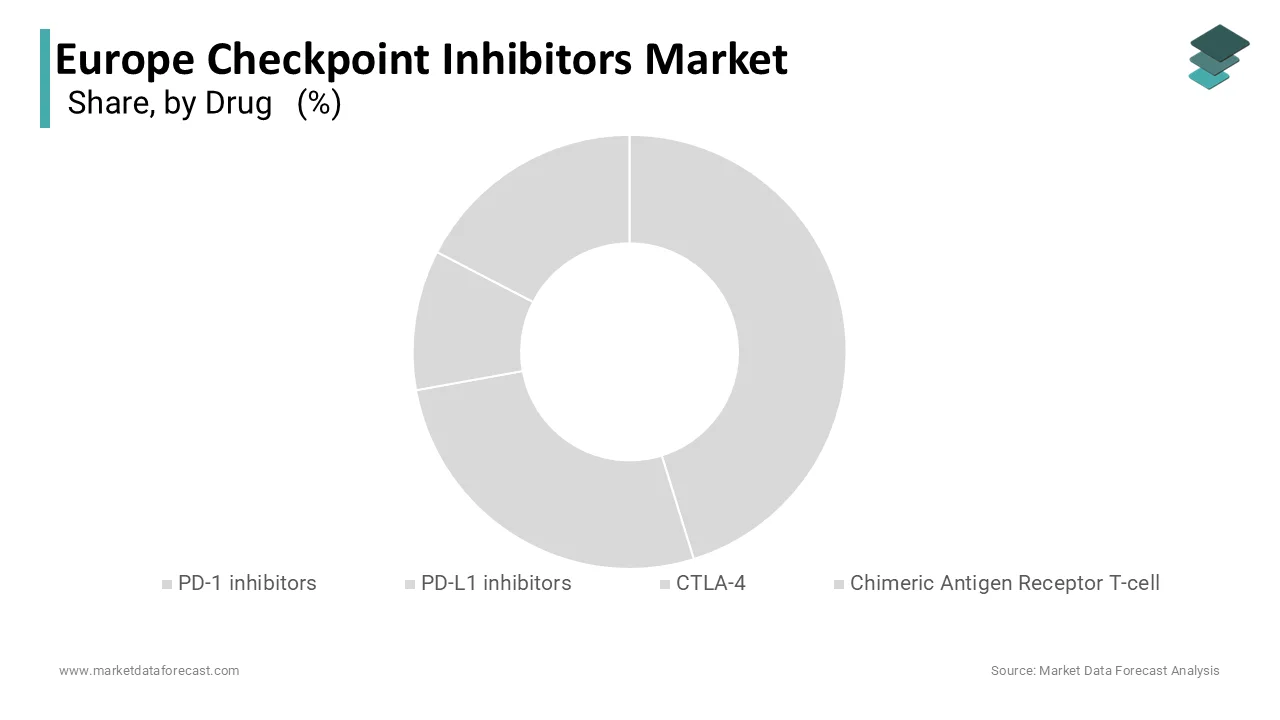
The PD-L11 inhibitors segment is projected to grow at a CAGR of 16.8% throughout the forecast period. PD L1 inhibitors, such as atezolizumab, durvalumab, and avelumab, are increasingly deployed in synergistic comb,,inations, where their distinct mechanism offers complementary immune activation. Similarly, durvalumab consolidation after chemoradiation in unresectable stage III NSCLC showed a five-year survival rate of 42.9% in the PACIFIC trial, leading to rapid EMA approval and national reimbursement. European cooperative groups actively test novel combinations. The UK’s National Cancer Research Institute launched a Phase III trial in 2024 evaluating avelumab with PARP inhibitors in ovarian cancer.
By Application Insights
The lung cancer segment was the largest by accounting for 34.2% of the Europe Checkpoint Inhibitors market share in 2025. Lung cancer remains the leading cause of cancer death in Europe, with over 400,000 new cases diagnosed in 2023. The pivotal shift to first-line checkpoint inhibitor use has dramatically expanded the treatable population. The European Society for Medical Oncology reported in 2024 that many newly diagnosed advanced NSCLC patients in Western Europe received a checkpoint inhibitor within three months of diagnosis. National screening programs further amplify detection, where the UK’s Lung Health Checks initiative identified 8,500 early-stage cases in 2023, many progressing to advanced disease requiring immunotherapy. European countries rely heavily on local real-world data to justify reimbursement, and lung cancer has the most mature evidence base for checkpoint inhibitors. Similarly, France’s National Cancer Institute tracked over 12,000 NSCLC patients in its 2023 immuno-oncology registry, confirming durable responses across community settings.
The melanoma segment is estimated to grow at the fastest CAGR of 19.3% throughout the forecast period. While melanoma accounts for only 4% of skin cancers, its high metastatic potential and immunogenicity make it ideal for checkpoint inhibition beyond advanced disease. The EMA approved nivolumab and pembrolizumab for adjuvant treatment of stage IIIB-IV melanoma after complete resection based on trials showing a 40 to 45% reduction in recurrence risk. National cancer plans are adapting; Germany’s S3 guideline now recommends adjuvant immunotherapy for all stage III patients, while Sweden’s National Board of Health covers treatment for stage IIB IIC as of 2024. Melanoma incidence continues to rise across Europe, driven by cumulative UV exposure and an aging demographic. Additionally, public awareness campaigns like the EU’s “SunSmart” initiative have improved early detection, increasing the proportion of patients diagnosed at stage II and III, precisely the group benefiting from adjuvant checkpoint inhibitors. This dual pressure of rising incidence and stage migration ensures sustained, accelerated growth in melanoma as a key application segment.
COUNTRY LEVEL ANALYSIS
Germany Checkpoint Inhibitors Market Analysis
Germany was the top performer of the Europe Checkpoint Inhibitors market by capturing 22.1% of the share in 2025 with its dense network of certified oncology centers, rapid reimbursement decisions, and strong clinical trial infrastructure. Germany hosts EMA-designated Comprehensive Cancer Centers, where most in Europe are all equipped for biomtesting and immu,ne toxicity management. The Federal Joint Committee approved all major checkpoint inhibitors within an average of 4.7 months post-EMA authorization in 2023, per its oncology access report. Furthermore, German sites enrolled over 1,50000 patients in global immuno-oncology trials in 202,3, making it the top European contributor as rec,, recorded by the German Cancer Consortium.
France Checkpoint Inhibitors Market Analysis
France's Checkpoint Inhibitors market growth is likely to grow with its national cancer plan, early temporary authorization programs, and leadership in academic oncology. The ANSM’s Temporary Authorization for Use mechanism enabled pembrolizumab access for over 5,000 patients before full EMA approval in 2015. Academic centers like Institut Gustave Roussy lead European trials enrolling 21% of the KEYNOTE 189 cohort.
United Kingdom Checkpoint Inhibitors Market Analysis
The United Kingdom Checkpoint Inhibitors market growth is likely to grow in next coming years. Despite Brexit, the UK remains deeply integrated into European oncology research and maintains rapid access through the NHS Cancer Drugs Fund. The UK also hosts Europe’s largest Phase III immuno-oncology trial network, where the Experimental Cancer Medicine Centres with 20 sites specialize in combination regimens. Companies like AstraZeneca leverage UK infrastructure to advance global programs, including durvalumab in lung cancer.
Italy Checkpoint Inhibitors Market Analysis
Italy Checkpoint Inhibitors market growth is likely to grow with the strong regional oncology network,,s high unmet need in solid tumors, and growing biomarker capacity. The Agenzia Italiana del Farmaco implemented a fast-track review for checkpoint inhibitors in 2023, reducing reimbursement decisions to under five months. Academic centers like Istituto Tumori Milano lead European trials in rare ca, including nivolumab in thymoma.
TOP LEADING PLAYERS IN THE MARKET
- Merck & Co plays a pivotal role in the European Checkpoint Inhibitors market through its anti-PD1 therapy pembrolizumab, which is approanti-PD1s numerous oncology indications, including lung cancer, melanoma, and head and neck cancer. The company has significantly advanced global immuno-oncology standards by generating robust long-term survival data and pioneering combination regimens. In 2024, Merck expanded access to biomarker testing in Central and Eastern Europe by collaborating with national pathology societies to standardize PD-L1 assessment protocols. It also launched a real-world evidence initiative in Germany and Spain, in tracking five-year outcomes in non-small cell lung cancer patients. These efforts reinforce Merck’s commitment to equitable access and data-driven clinical integration across diverse European healthcare systems.
- Bristol Myers Squibb is a foundational player in the Europe Checkpoint Inhibitors market with its dual portfolio of nivolumab, a PD-1 inhibitor, and ipilimumab,b CTLA-4 4 inhibiPD-1which est, which established the f,irstCTLA-4ssful immuno-oncology combination. The company conducts immuno-oncology clinical practice through innovative trial designs and expansion into early-stage disease settings. In 2024, Bristol Myers Squibb secured EMA approval for the neoadjuvant use of nivolumab plus chemotherapy in resectable non-small cell lung cancer based on the CheckMate 816 trial. It also initiated a pan-European education program for oncologists on managing immune-related adverse events in community settings.
- Roche contributes to the Europe Checkpoint Inhibitors market primarily through its PD-L1 inhibitor atezolizumab, used in lung cancer, triple-negative breast cancer, and urothelial carcinomtriple-negativeegativeompany differentiates itself by integrating diagnostics and therapeutics through its VENTANA PD-L1 assay, ensuring precise patient selection. Roche enhanced its European footprint by expanding companion diagnostic access to 120 pathology labs across Southern and Eastern Europe. It also partnered with national cancer registries in France and Italy to monitor real-world outcomes in rare tumor types treated with atezolizumab. These initiatives demonstrate Roche’s commitment to personalized immuno-oncology and sustainable healthcare integration throughout the continent.
TOP STRATEGIES USED BY THE KEY MARKET PARTICIPANTS
Key players in the European checkpoint inhibitors market pursue strategies centered on indication expansion into early-stage and adjuvant settings, robust biomarker-driven patient selection, and regeneration. Companies es conducting large-scale Phase III trials in curative intent settings to shift from palliative to preventive paradigms. Strategic collaborations with national pathology networks ensure standardized PD L1 testing and accurate patient identification. Simultaneously, firms invest in comprehensive toxicity management programs, including educational initiatives for community oncologists and nurse support services to improve treatment continuity. Regulatory engagement through PRIME and accelerated assessment pathways facilitates rapid market access while post-approval studies satisfy national health technology assessment requirements. Additionally, companies partner with cancer registries and academic institutions to generate localized real-world data that informs reimbursement decisions and clinical guidelines across diverse European healthcare systems.
COMPETITIVE LANDSCAPE
The Europe Checkpoint Inhibitors market is characterized by intense competition among global pharmaceutical leaders who vie for dominance across multiple tumor types and treatment lines. Merck, Bristol Myers Squibb, and Roche hold established positions through first-mover advantage and extensive label, while companies like AstraZeneca and Pfizer advance next-generation combinations. Competition is next-generation defined not only by clinical efficacy but also by diagnostic integration, biomarker strategy, and health system engagement. National reimbursement policies create a fragmented landscape where rapid access in Germany or Switzerland contrasts with delays in Southern and Eastern Europe. Academic medical centers serve as critical battlegrounds for clinical trial leadership and real-world data generation, influencing prescribing norms. The shift toward neoadjuvant and adjuvant use has intensified investment in early detection infrastructure and surgical oncology partnerships. With over fifteen checkpoint inhibitors approved and dozens in late-stage development, the market demands scientific excellence, commercial agility, and deep collaboration, the public health teams to achieve sustainable impact across Europe’s diverse oncology ecosystem.
KEY MARKET PLAYERS
A few prominent companies operating in the European checkpoint inhibitors market profiled in this report are
- Merck & Co., Inc.
- Bristol-Myers Squibb
- Roche
- AstraZeneca
- Ono Pharmaceutical Co., Ltd.
- Juno Therapeutics
- Novartis International AG
- Kite Pharma
MARKET SEGMENTATION
This research report on the European checkpoint inhibitors market has been segmented and sub-segmented into the following categories.
By Drug
- PD-1 inhibitors
- PD-L1 inhibitors
- CTLA-4
- Chimeric Antigen Receptor T-cell
- Others
By Application
- Lung cancer
- Renal cancer
- Blood cancer
- Bladder Cancer
- Hodgkin lymphoma
- Melanoma
- Others
By Country
- UK
- France
- Spain
- Germany
- Italy
- Russia
- Sweden
- Denmark
- Switzerland
- Netherlands
- Turkey
- Czech Republic
- Rest of Europe