Europe Chemical Distribution Market Size, Share, Trends & Growth Forecast Report By Product, End-User and Country (UK, France, Spain, Germany, Italy, Russia, Sweden, Denmark, Switzerland, Netherlands, Turkey, Czech Republic and Rest of Europe), Industry Analysis From 2026 to 2034
Market Size, 2025
$92.87 BnMarket Estimate, 2026
$97.65 BnMarket Forecast, 2034
$145.93 BnCAGR, 2026–2034
5.15%Europe Chemical Distribution Market Report Summary
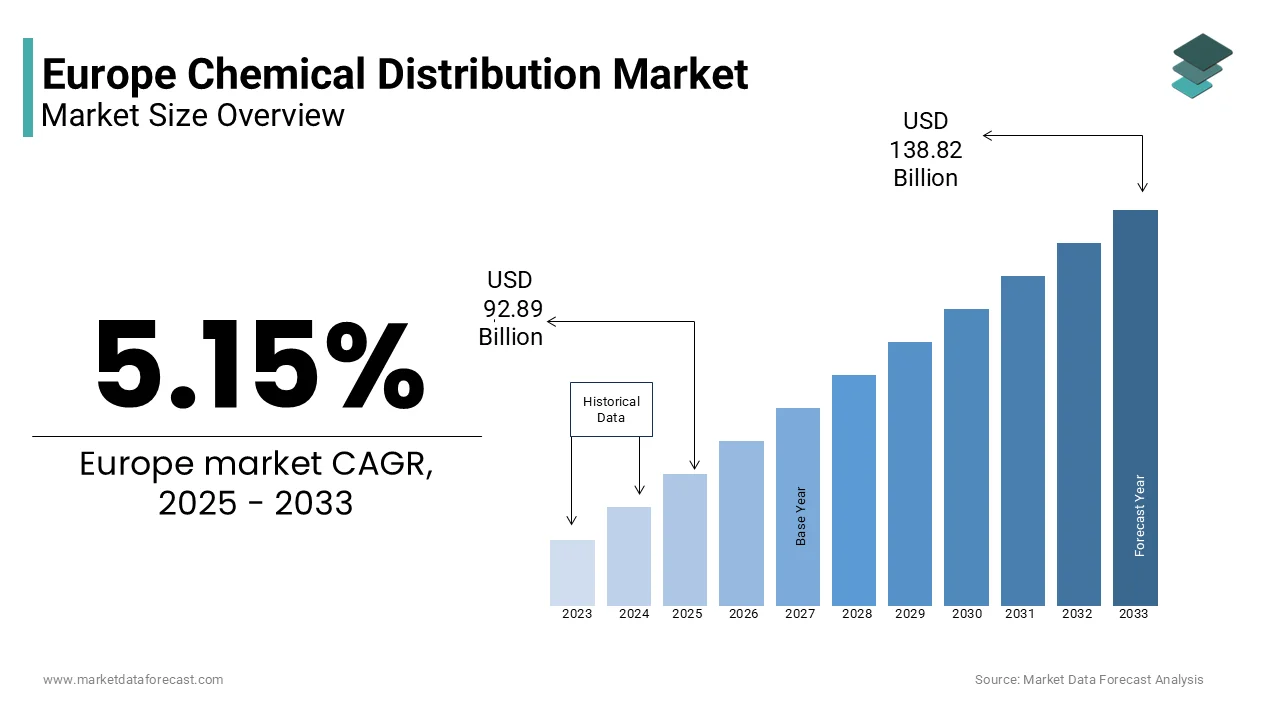
The Europe chemical distribution market was valued at USD 92.87 billion in 2025, is estimated to reach USD 97.65 billion in 2026, and is projected to reach USD 145.93 billion by 2034, growing at a CAGR of 5.15% during the forecast period. Market growth is driven by increasing demand for efficient supply chain solutions, rising industrial production, and growing complexity in chemical sourcing and logistics. Chemical distributors play a critical role in bridging manufacturers and end users by providing value added services such as storage, transportation, blending, and regulatory compliance. The expansion of specialty chemicals demand and digitalization of distribution networks is further supporting steady market growth across Europe.
Key Market Trends
- Rising demand for efficient chemical supply chain and logistics services is driving market growth.
- Increasing complexity in chemical sourcing and regulatory compliance is boosting demand for distributors.
- Growing demand for specialty and value added chemical services is supporting market expansion.
- Expansion of industrial manufacturing activities is enhancing distribution requirements.
- Digital transformation and automation in supply chain operations are improving efficiency.
Segmental Insights
- Based on product, the commodity chemicals segment was the largest and held a significant share of the Europe chemical distribution market in 2025. This dominance is attributed to high volume demand and widespread industrial applications.
- Based on end user, the industrial manufacturing sector accounted for 25.4% of the Europe chemical distribution market share in 2025. The segment’s growth is driven by strong demand for chemicals across manufacturing industries such as automotive, construction, and electronics.
Regional Insights
- The Europe chemical distribution market is experiencing steady growth across key countries, supported by industrial expansion and supply chain optimization.
- Germany was the largest contributor, accounting for 22.3% of the Europe chemical distribution market share in 2025, driven by strong industrial base, advanced manufacturing sector, and well established chemical industry.
Competitive Landscape
The Europe chemical distribution market is highly competitive, with key players focusing on service expansion, digital capabilities, and strategic partnerships to strengthen their market position. Companies are investing in logistics infrastructure, regulatory compliance solutions, and value added services. Prominent players in the Europe chemical distribution market include Univar AG, Helm AG, Brenntag AG, Azelis Holdings SA, IMCD Group, BASF SE, and Biesterfeld AG.
Europe Chemical Distribution Market Size
The chemical distribution market size in Europe was valued at USD 92.87 billion in 2025. The European market is anticipated to be worth USD 145.93 billion by 2034 from USD 97.65 billion in 2026, growing at a CAGR of 5.15% from 2026 to 2034.
The chemical distribution is the intermediary layer connecting chemical manufacturers with end users, across diverse industrial sectors, including pharmaceuticals agriculture automotive and construction. Distributors in this region provide essential value added services, such as bulk breaking technical support regulatory compliance management and just in time delivery which are vital for small and medium sized enterprises that lack the infrastructure for direct procurement. As per the European Chemicals Agency, over 24000 substances are registered under this regulation ensuring that distributed chemicals meet rigorous safety criteria before reaching the market. The shift toward sustainable chemistry and circular economy principles is reshaping distribution strategies with a focus on green logistics and waste reduction. As per the European Commission, the chemical strategy for sustainability aims to double the share of global chemical sales from the EU by 2030 driven by innovation and digitalization. Distributors are increasingly adopting digital platforms to enhance supply chain visibility and customer engagement. The integration of specialized logistics solutions ensures the safe handling of hazardous materials, while minimizing environmental impact.
MARKET DRIVERS
Stringent Regulatory Compliance Drives Demand for Specialized Distribution Services
The complex regulations in Europe necessitates specialized knowledge and infrastructure, which drives demand for professional chemical distribution services, which is propelling the growth of Europe chemical distribution market. The Registration Evaluation Authorisation and Restriction of Chemicals regulation imposes extensive obligations on companies handling chemical substances requiring detailed documentation safety assessments and risk management measures. As per the European Chemicals Agency small and medium sized enterprises often lack the internal resources to manage these compliance requirements effectively making them reliant on distributors who offer regulatory expertise. Distributors provide value added services such as classification labeling and packaging in accordance with the Classification Labelling and Packaging regulation which ensures that products meet legal standards before reaching end users. According to the European Commission, non-compliance with these regulations can result in significant fines and market exclusion which incentivizes companies to partner with certified distributors. The REACH regulation also restricts the use of certain hazardous substances prompting manufacturers to seek alternative materials and formulations. The ability of distributors to navigate the evolving regulatory framework provides a competitive advantage to their clients.
Growing Demand for Specialty Chemicals in High Value Industries
The increasing consumption of specialty chemicals in high value industries, such as pharmaceuticals electronics and automotive is accelerating the growth of Europe chemical distribution market. Specialty chemicals are characterized by their specific functional properties and low volumes, which require precise handling and technical support during distribution. As per study, the production of specialty chemicals in Europe grows at a faster rate than basic chemicals due to their application in innovative technologies and products. The pharmaceutical industry relies on high purity intermediates and active pharmaceutical ingredients, which distributors must store and transport under strict temperature and humidity controls. According to the European Pharmaceutical Manufacturers Association, the sector invests heavily in research and development leading to a constant influx of new chemical entities that require specialized distribution channels. The automotive industry’s shift toward electric vehicles also boosts demand for battery materials and lightweight composites which are often sourced through distributors. Distributors provide the necessary technical expertise to help manufacturers integrate these new materials into their production processes.
MARKET RESTRAINTS
Volatility in Raw Material Prices and Supply Chain Disruptions
The volatility in raw material prices and frequent supply chain disruptions is hindering the growth of Europe chemical distribution market. The region relies heavily on imported feedstocks, such as natural gas and crude oil, which are subject to geopolitical tensions and fluctuations. As per the International Energy Agency, the price of natural gas in Europe experienced extreme volatility in recent years affecting the production costs of energy intensive chemical products. These price fluctuations translate into unstable pricing for distributed chemicals making it difficult for distributors and customers to plan long term contracts. The reliance on global supply chains also exposes the market to disruptions caused by events such as pandemics trade disputes and logistical bottlenecks. According to the United Nations Conference on Trade and Development, shipping delays and port congestion have increased lead times and transportation costs for chemical imports. The shortage of key raw materials such as semiconductors for automotive production also impacts the demand for related chemical inputs. Distributors must maintain higher inventory levels to buffer against shortages which ties up capital and increases storage costs. The unpredictability of supply affects customer trust and loyalty as consistent availability is crucial for industrial operations.
High Operational Costs Associated with Safety and Environmental Standards
The stringent safety and environmental standards impose high operational costs on chemical distributors is additionally impeding the growth of Europe chemical distribution market. The transport and storage of hazardous chemicals require specialized infrastructure, including dedicated warehouses tank farms and fleet vehicles equipped with safety features. The maintenance of compliant facilities and vehicles requires significant capital investment and ongoing expenditure. According to the European Environment Agency, the cost of managing chemical waste and emissions has risen due to stricter environmental regulations such as the Industrial Emissions Directive. Distributors must implement advanced monitoring systems to track spills leaks and other incidents which adds to operational overheads. The insurance premiums for handling hazardous materials are also substantially higher than for general cargo reflecting the elevated risk profile. These high fixed costs limit the ability of smaller distributors to compete with larger players who benefit from economies of scale. The financial burden of compliance reduces profit margins and restricts investment in innovation and expansion.
MARKET OPPORTUNITIES
Digitalization of Supply Chains Enhances Efficiency and Transparency
The adoption of digital technologies for chemical distributors to enhance operational efficiency and supply chain transparency is certainly creating new opportunities for the growth of Europe chemical distribution market. Digital platforms enable real time tracking of shipments inventory management and automated ordering which improves customer service and reduces errors. For chemical distributors, this technology ensures compliance with safety regulations by providing auditable data on handling and transport conditions. The use of Internet of Things sensors allows for monitoring of temperature pressure and location throughout the journey, which is for sensitive chemical products. According to the World Economic Forum, digital twins of supply networks allow companies to simulate scenarios and optimize routes for safety and efficiency. This predictive capability minimizes the risk of accidents and delays which is crucial for hazardous materials. The integration of artificial intelligence helps in demand forecasting and resource allocation reducing idle time for specialized assets. Digital platforms facilitate seamless communication between suppliers distributors and customers streamlining documentation and customs clearance. The use of electronic waybills and automated reporting reduces administrative burdens and errors. Customers increasingly demand end to end visibility, which digital tools provide effectively.
Expansion of Circular Economy Models Creates New Service Opportunities
The shift toward a circular economy in the chemical industry generates for distributors to offer reverse logistics and waste management services, which is additionally to enhance the growth of Europe chemical distribution market. Regulations mandating higher recycling rates and extended producer responsibility require efficient systems for collecting and returning chemical waste and packaging. As per the European Commission, the circular economy action plan aims to double the circular material use rate in the EU by 2030 creating demand for specialized reverse logistics. Chemical distributors can expand their service portfolios by offering collection transportation and preprocessing of hazardous waste for recycling or disposal. The recovery of solvents catalysts and other valuable chemicals from industrial processes requires careful handling and segregated transport streams. Companies are developing closed loop systems where empty containers are cleaned and returned to producers for refilling reducing packaging waste. This model requires robust tracking and cleaning infrastructure which distributors can provide as a value-added service. The integration of reverse flows with forward logistics optimizes asset utilization and reduces empty runs. This approach shifts the focus from product sales to service delivery creating long term customer relationships. Distributors who specialize in circular supply chains position themselves as strategic partners.
MARKET CHALLENGES
Geopolitical Instability and Energy Security Concerns
The geopolitical tensions and energy security by disrupting supply chains and increasing costs is one of the challenges of the Europe chemical distribution market. The region’s dependence on imported energy and raw materials makes it vulnerable to external shocks and trade restrictions. As per the International Energy Agency, Europe reduced its reliance on Russian pipeline gas by 80% in 2023 but still faces volatility in energy prices. Chemical production is energy intensive and any disruption in supply affects production volumes and subsequently distribution demand. The rerouting of trade flows due to sanctions and conflicts increases transit times and costs for maritime and land transport. The security of transport corridors becomes a concern with increased risks of sabotage or interception in unstable regions. Distributors must constantly assess and mitigate these risks which adds complexity to planning and insurance costs. The fragmentation of global trade blocs leads to stricter border controls and customs inspections slowing down cross border movements. As per the European External Action Service the diversification of supply sources requires establishing new logistical connections which take time. The uncertainty discourages long term investment in infrastructure and fleet expansion. Companies must maintain higher inventory levels as a buffer against supply disruptions which ties up capital.
Cybersecurity Threats to Critical Infrastructure and Data
The increasing digitization of chemical distribution exposes the sector to heightened cybersecurity risks, which threaten operational continuity and data integrity. Distribution networks rely on interconnected systems for tracking scheduling and communication making them attractive targets for cyberattacks. A successful breach can disrupt entire supply chains by disabling tracking systems or corrupting shipment data. For chemical distribution, the consequences are severe as loss of control over hazardous material movements can lead to safety incidents. The integration of third party vendors and partners expands the attack surface requiring comprehensive security protocols, across the ecosystem. Legacy systems used in some warehouses and vehicles often lack adequate protection making them vulnerable to exploitation. As per the European Chemical Industry Council, cyber resilience is now a top priority for supply chain security alongside physical safety measures. The theft of sensitive customer data and proprietary formulation information poses additional reputational and financial risks. Regulatory requirements such as the NIS2 Directive mandate stricter cybersecurity measures for essential entities. Compliance requires significant investment in security infrastructure and staff training.
REPORT COVERAGE
| REPORT METRIC | DETAILS |
| Market Size Available | 2025 to 2034 |
| Base Year | 2025 |
| Forecast Period | 2026 to 2034 |
| CAGR | 5.15% |
| Segments Covered | By Product, End User, and Region |
| Various Analyses Covered | Global, Regional, & Country Level Analysis; Segment-Level Analysis; DROC; PESTLE Analysis; Porter’s Five Forces Analysis; Competitive Landscape; Analyst Overview of Investment Opportunities |
| Regions Covered | UK, France, Spain, Germany, Italy, Russia, Sweden, Denmark, Switzerland, Netherlands, Turkey, Czech Republic, Rest of Europe |
| Market Leaders Profiled | Univar AG, Helm AG, Brenntag AG, Azelis Holdings SA, IMCD Group, BASF SE, and Biesterfeld AG, and others. |
SEGMENTAL ANALYSIS
By Product Insights
The commodity chemicals segment was the largest by holding a significant share of the Europe Chemical Distribution Market in 2025 due to their extensive use in foundational industrial processes. The massive scale of demand from downstream industries, such as construction agriculture and manufacturing, which rely on bulk inputs like sulfuric acid, caustic soda, and ethylene. As per survey, the European chemical industry produces over 300 million tonnes of basic chemicals, annually creating a continuous need for efficient distribution networks to move these high volume low margin products. The established infrastructure for handling and storing bulk liquids and gases, which favors large scale distributors with specialized assets. According to Eurostat, the transport of dangerous goods by road in the European Union exceeds 1 billion tonnes annually with commodity chemicals representing a significant share. The stability of demand for these essential inputs ensures consistent revenue streams for distributors despite price volatility. The integration of supply chains across borders within the EU single market facilitates the seamless movement of commodity chemicals reducing logistical barriers. As per the European Commission the single market allows for the free movement of goods which supports the efficient distribution of bulk chemicals across member states. The economies of scale achieved by distributors in handling large volumes allow them to offer competitive pricing and reliable service.
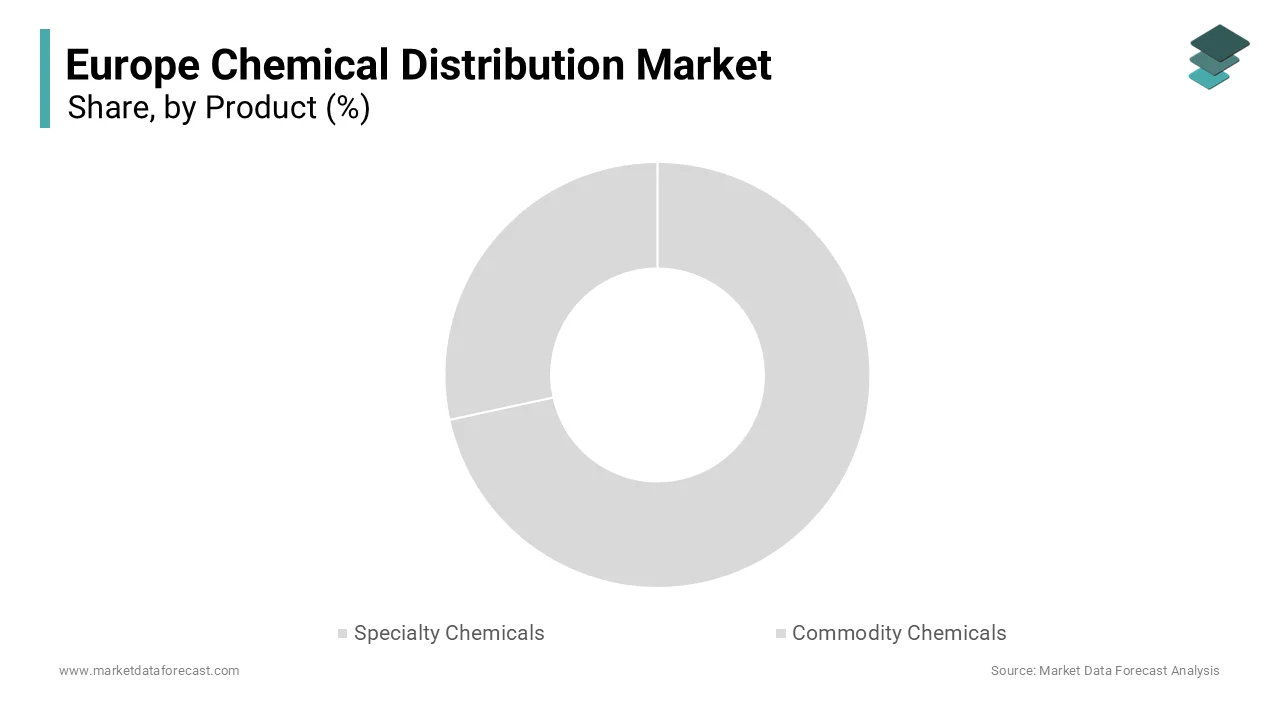
The specialty chemicals segment is projected to register a CAGR of 5.8% from 2026 to 2034 with the increasing complexity and value of chemical formulations. The rising demand for high performance materials in sectors, such as pharmaceuticals electronics and automotive, which require precise technical support and customized solutions. The specialty chemicals account for a growing proportion of chemical sales in Europe due to their application in innovative technologies. Distributors add significant value by providing technical expertise regulatory compliance assistance and just in time delivery for these sensitive products. According to the German Chemical Industry Association, small and medium sized enterprises produce a significant portion of specialty chemicals relying on distributors for market access. The higher profit margins associated with specialty chemicals allow distributors to invest in advanced logistics and customer service infrastructure. The shift toward sustainable and bio based specialties also creates new opportunities for distributors to introduce innovative products to the market. As per the European Commission, the chemical strategy for sustainability promotes the development of safe and sustainable chemicals driving demand for specialized distribution services.
By End User Insights
The industrial manufacturing sector was the largest by occupying 25.4% of the Europe Chemical Distribution Market share in 2025 with the diverse range of chemicals required for production processes. The widespread use of solvents adhesives coatings and cleaning agents in various manufacturing activities, including metalworking electronics assembly and machinery production. Distributors provide essential services, such as bulk breaking and timely delivery which are crucial for maintaining continuous production lines. The need for specialized handling and storage of hazardous materials used in manufacturing, which distributors are equipped to manage. According to the European Agency for Safety and Health at Work, strict regulations govern the handling of dangerous substances in workplaces prompting manufacturers to outsource logistics to certified distributors. The trend toward lean manufacturing and just in time inventory management further increases reliance on distributors for efficient supply chain operations. As per the Federation of European Producers of Lubricants, the demand for industrial lubricants and process chemicals remains stable due to ongoing industrial activity. The ability of distributors to offer technical support and safety training adds value for manufacturing clients. The consolidation of manufacturing facilities in industrial hubs creates dense demand clusters that distributors serve efficiently.
The pharmaceuticals segment is likely to witness a fastest CAGR of 7.2% from 2026 to 2034 with the increasing demand for active pharmaceutical ingredients and excipients. The robust research and development activities in the European pharmaceutical industry, which lead to the introduction of new drugs requiring specialized chemical inputs. Distributors, play a critical role in ensuring the purity and traceability of pharmaceutical chemicals through stringent quality control measures. According to the European Medicines Agency, the supply chain security for medicinal products is paramount to prevent falsified medicines from entering the market. Distributors who comply with these regulations gain a competitive advantage in serving pharmaceutical clients. The growth of biopharmaceuticals and personalized medicine also increases the demand for temperature controlled and sensitive chemical distribution. The ability of distributors to handle small batch sizes and high value products with precision supports the rapid growth of this segment.
REGIONAL ANALYSIS
Germany Chemical Distribution Market Analysis
Germany was the largest contributor in the Europe Chemical Distribution Market by accounting for 22.3% of the share in 2025 due to its status as the largest chemical producer in Europe. The country is home to major chemical clusters, such as Ludwigshafen and Leverkusen, which generate substantial demand for distribution services. The strong industrial base including automotive and manufacturing sectors, which consume large volumes of both commodity and specialty chemicals. According to BASF, the integration of production sites requires efficient logistics for raw material intake and product output. The central geographic location of Germany, which serves as a hub for cross border trade within Europe. As per study, the volume of chemical goods transported via inland waterways and rail in Germany is among the highest in the region. The presence of leading logistics companies and infrastructure facilitates efficient distribution. The focus on innovation and sustainability also drives demand for specialized chemical solutions.
France Chemical Distribution Market Analysis
France chemical distribution market was positioned next with 21.2% of share in 2025 with the diverse chemical industry and strong agricultural sector. The presence of global players, such as TotalEnergies and Arkema, which operate large production facilities requiring efficient supply chain management. According to Arkema the company relies on distributors for reaching smaller industrial customers across the country. The strategic location of French ports, such as Le Havre and Marseille which facilitate the import and export of chemical products. The agricultural sector’s demand for fertilizers and pesticides also sustains distribution volumes. The government’s support for industrial reindustrialization is boosting domestic chemical production.
Italy Chemical Distribution Market Analysis
Italy chemical distribution market growth is likely to have significant growth opportunities with its specialized chemical industry and strategic Mediterranean location. The country is a leading producer of pharmaceuticals and fine chemicals which require precise and reliable logistics services. The concentration of pharmaceutical manufacturing in regions, such as Lombardy, which generates high demand for active pharmaceutical ingredients. According to study, the pharmaceutical sector exports a significant portion of its production requiring efficient international logistics. The importance of port infrastructure in cities like Genoa and Trieste, which facilitate chemical imports and exports. As per the Italian Ports System, the volume of chemical goods handled in these ports is substantial. The growing focus on sustainable chemistry is influencing distribution practices. Italy’s strong export orientation drives the need for reliable cross border transport solutions.
United Kingdom Chemical Distribution Market Analysis
The United Kingdom chemical distribution market growth is driven by its strong pharmaceutical and specialty chemical sectors. The robust pharmaceutical sector, which requires high precision logistics for active ingredients is also escalating the growth of the market. The presence of major chemical ports such as Immingham, which handle significant volumes of bulk chemicals is also enhancing the growth of Europe chemical distribution market. As per the Department for Transport, UK ports handled 15 million tonnes of liquid bulk in 2023.
Netherlands Chemical Distribution Market Analysis
The Netherlands chemical distribution market growth is likely to grow with its world class port infrastructure. The extensive network of chemical storage terminals and processing facilities, which attract global chemical companies. The excellent connectivity via inland waterways and rail networks, which link Rotterdam to industrial centers in Germany and beyond. As per the Central Bureau of Statistics inland waterway transport in the Netherlands moved 150 million tonnes of goods in 2023. The focus on sustainability and digitalization is driving innovation in logistics services. The Netherlands’ role as a gateway ensures its continued importance. The integration of logistics and production creates a highly efficient ecosystem.
Spain Chemical Distribution Market Analysis
Spain chemical distribution market growth is likely to grow with its growing chemical industry and strategic access to trade routes. The significant producer of basic chemicals and refining products, which drive bulk distribution demand. The presence of large refining and petrochemical complexes in Tarragona and Huelva, which require massive inbound and outbound logistics is also boosting the growth of Europe chemical distribution market. According to study, the Tarragona complex handles over 10 million tonnes of products annually. The second driver is the strategic location of Spanish ports such as Algeciras which facilitate trade with Latin America and North Africa. The increasing investment in renewable energy is creating new distribution opportunities.
COMPETITIVE LANDSCAPE
The Europe Chemical Distribution Market features intense competition among global giants and specialized regional players who vie for dominance through service excellence and technological innovation. Large multinational corporations leverage their extensive networks and economies of scale to offer comprehensive solutions that appeal to large industrial clients. Regional specialists counter this by providing deep local expertise and flexible services tailored to specific customer needs in niche sectors. The barrier to entry remains high due to stringent regulatory requirements and the need for specialized infrastructure such as tank storage and hazardous material handling facilities. Consequently competition focuses heavily on value added services such as technical support regulatory compliance and supply chain optimization rather than price alone. Companies differentiate themselves through advanced digital platforms that provide real time tracking and predictive analytics. The push for sustainability has become a key competitive dimension with firms investing in low carbon logistics to meet environmental mandates. Mergers and acquisitions are frequent as companies seek to consolidate market position and expand service portfolios. The dynamic regulatory landscape further intensifies competition as providers must continuously adapt to new safety and environmental standards.
Key Market Players
Some of the notable companies in the Europe Chemical Distribution market are
- Univar AG
- Helm AG
- Brenntag AG
- Azelis Holdings SA
- IMCD Group
- BASF SE
- Biesterfeld AG
Top Players in the Market
- Brenntag SE stands as a global leader in chemical distribution with a significant footprint across Europe and North America. The company connects thousands of chemical producers with diverse industrial customers by offering tailored supply chain solutions and technical expertise. Recently Brenntag expanded its digital platform to enhance customer experience and streamline procurement processes for small and medium sized enterprises. The company also pursued strategic acquisitions in specialty chemicals to broaden its product portfolio and strengthen its position in high growth sectors such as life sciences and electronics. These actions enable Brenntag to provide value added services beyond simple logistics including regulatory support and formulation assistance. Its extensive network ensures reliable delivery and consistent quality which reinforces trust among global partners.
- Univar Solutions Inc is a prominent player in the global chemical distribution landscape known for its comprehensive service offerings and technical capabilities. The company serves a wide range of industries including water treatment food and beverage and personal care by providing both commodity and specialty chemicals. Recently Univar invested heavily in digital transformation initiatives to improve supply chain visibility and operational efficiency for its clients. The company also expanded its infrastructure in key European markets to enhance storage capacity and distribution speed. These efforts allow Univar to offer just in time delivery and customized blending services that meet specific customer requirements. Its commitment to environmental stewardship and safety compliance helps clients navigate complex regulatory landscapes.
- IMCD NV is a specialized distributor of specialty chemicals and ingredients with a strong presence in Europe and expanding global reach. The company focuses on niche markets such as home and personal care nutrition and coatings where it provides extensive technical support and innovation services. Recently IMCD acquired several regional distributors to expand its geographic footprint and enhance its product offerings in emerging markets. The company also launched new digital tools to facilitate easier access to product information and ordering for its customers. These strategic moves enable IMCD to deliver tailored solutions that help manufacturers develop innovative products efficiently. Its emphasis on sustainability and responsible sourcing aligns with growing consumer demand for eco friendly ingredients.
Top Strategies Used by Key Market Participants
Key players in the Europe Chemical Distribution Market primarily focus on strategic acquisitions to expand their geographic reach and product portfolios. Companies actively purchase smaller specialized distributors to gain access to niche markets and enhance technical capabilities. Digitalization is another major strategy with firms investing in online platforms and data analytics to improve supply chain transparency and customer engagement. Sustainability initiatives are increasingly central as distributors adopt green logistics practices and offer eco friendly product lines to meet regulatory demands. Partnerships with chemical manufacturers enable co development of customized solutions and secure long term supply agreements. Expansion into high growth sectors such as pharmaceuticals and electronics allows distributors to capture higher margins. Continuous investment in safety training and regulatory compliance ensures adherence to strict European standards.
MARKET SEGMENTATION
This research report on the Europe chemical distribution market is segmented and sub-segmented based on the following categories.
By Product
- Specialty Chemicals
- Commodity Chemicals
By End-User
- Automotive & Transportation
- Construction
- Agriculture
- Industrial Manufacturing
- Consumer Goods
- Textiles
- Pharmaceuticals
- Others
By Country
- UK
- France
- Spain
- Germany
- Italy
- Russia
- Sweden
- Denmark
- Switzerland
- Netherlands
- Turkey
- Czech Republic
- Rest of Europe
Frequently Asked Questions
1.What is the Europe chemical distribution market?
The Europe chemical distribution market involves the storage, transportation, marketing, and supply of specialty and commodity chemicals from manufacturers to end use industries across European countries.
2.What are the key growth drivers of the Europe chemical distribution market?
Growth is driven by expanding industrial production, increasing demand for specialty chemicals, regulatory compliance requirements, and supply chain optimization needs.
3.Which countries are major contributors to the market?
Germany, France, the United Kingdom, Italy, Spain, and the Netherlands are major contributors due to strong industrial and manufacturing bases.
4.What types of chemicals are distributed in the market?
The market includes commodity chemicals, specialty chemicals, agrochemicals, petrochemicals, and performance materials.
5.Which end use industries drive demand in the Europe chemical distribution market?
Key end use industries include automotive, construction, pharmaceuticals, food and beverages, agriculture, and personal care.
6.What role do specialty chemicals play in market growth?
Specialty chemicals contribute significantly to revenue due to higher margins, customized formulations, and increasing demand in advanced applications.
7.How do regulatory frameworks impact the market?
Regulations such as REACH influence product registration, handling standards, and compliance costs, shaping distribution strategies.
8.What services do chemical distributors provide beyond logistics?
Distributors offer value added services such as blending, repackaging, technical support, regulatory compliance assistance, and inventory management.
9.What challenges does the Europe chemical distribution market face?
Key challenges include stringent environmental regulations, supply chain disruptions, raw material price volatility, and margin pressure.
10.What is the future outlook for the Europe chemical distribution market?
The market is expected to grow steadily, supported by industrial recovery, innovation in specialty chemicals, and increasing demand for value added distribution services.
Access the study in MULTIPLE FORMATS
Purchase options starting from
$ 2000
Didn’t find what you’re looking for?
TALK TO OUR ANALYST TEAM
Need something within your budget?
NO WORRIES! WE GOT YOU COVERED!
Call us on: +1 888 702 9696 (U.S Toll Free)
Write to us: sales@marketdataforecast.com