Europe Chillers Market Size, Share, Trends & Growth Forecast Report – Segmented By Product (Water-Cooled, Air-Cooled), Application, Compressor, and Country (UK, France, Spain, Germany, Italy, Russia, Sweden, Denmark, Switzerland, Netherlands, Turkey, Czech Republic & Rest of Europe), Industry Analysis From 2026 to 2034
Market Size, 2025
$2.78 BnMarket Estimate, 2026
$2.86 BnMarket Forecast, 2034
$3.57 BnCAGR, 2026–2034
2.81%Executive Summary: Europe Chillers Market
- Market Scope: European market analysis covering product categories, application sectors, compressor types, and country-level landscapes.
- Market Valuation: Valued at USD 2.78 billion (2025), estimated at USD 2.86 billion (2026), and projected to reach USD 3.57 billion by 2034, growing at a CAGR of 2.81% (2026–2034).
- Primary Growth Drivers: Critical cooling infrastructure demand across pharmaceutical manufacturing, data centers, district cooling, and HVAC applications (>20 kW capacities), alongside strict regional environmental mandates (such as Germany's energy audit requirements for facilities >500 kW).
Key Market Segment Metrics (2026–2034)
| Category | Leading Segment (2025 Position) | Fastest-Growing Segment |
|---|---|---|
| By Product | Water-Cooled Chillers (58.5% share) | Air-Cooled Chillers (6.8% CAGR) |
| By Application | Industrial Applications (52.7% share) | Commercial Applications (7.3% CAGR) |
| By Compressor | Screw Chillers (63.3% share; 100–1,500 kW capacity range) | Centrifugal Chillers (8.1% CAGR) |
| By Country | Germany (24.5% share; France second at 18.8%) | — |
Major Market Players & Market Structure
Market Structure: Specialized competitive landscape focused heavily on energy efficiency, regulatory compliance, low-GWP refrigerants, and service integration. Competitors are heavily investing in IoT sensors, predictive analytics, digital twins, remote monitoring, and circular-economy initiatives like refrigerant recovery and design for disassembly.
Key Companies: Rite-Temp, General Air Products, Fluid Chillers, ClimaCool, Rite-Hite, Trane Technologies, Carrier Global, Daikin Industries, Honeywell International, Air Products & Chemicals, and Johnson Controls International.
Europe Chillers Market Size
The Europe chillers market size was valued at USD 2.78 billion in 2025 and is projected to reach USD 3.57 billion by 2034 from USD 2.86 billion in 2026, growing at a CAGR of 2.81%.
Chillers are refrigeration systems designed to remove heat from liquid coolants using vapor compression or absorption cycles for precise temperature control in processes and environments. These systems are integral to pharmaceutical manufacturing food and beverage processing data centers district cooling and HVAC applications across the continent. Unlike residential air conditioning units chillers operate at larger scales with capacities typically exceeding 20 kilowatts and are engineered for continuous operation under stringent efficiency and safety standards. As per sources, A vast majority of pharmaceutical production facilities, for instance, utilize these systems to uphold precise temperature conditions for the synthesis and storage of materials, aligning with rigorous manufacturing practice guidelines. These cooling systems are ubiquitous throughout EU industries, serving sectors where consistent thermal stability is paramount for ensuring product quality, adhering to energy compliance standards, and maintaining operational continuity. The prevalence of these units underscores their indispensable role in the region's industrial and commercial landscape. This technical and regulatory ecosystem positions chiller as critical infrastructure in Europe’s industrial decarbonization and climate resilience strategy.
MARKET DRIVERS
Stringent Energy Efficiency Mandates Under the Ecodesign Framework
The European Union’s Ecodesign Directive for chillers sets minimum seasonal energy performance requirements that have fundamentally reshaped procurement and technology adoption across the region, thereby boosting the expansion of the Europe chillers market. According to studies, all new chillers introduced to the European Union market must now satisfy stringent, climate-class specific energy efficiency minimums for seasonal space cooling performance. This has accelerated the replacement of legacy systems with inverter driven variable speed chillers that modulate compressor output based on real time thermal load. Furthermore, the European Union has established specific criteria under its sustainable finance framework, which classifies high-efficiency chillers as eligible for green financing provided they substantially surpass existing Ecodesign performance standards. Ultimately, as the European Union pursues ambitious, region-wide emissions reductions targets for the coming decades, energy-efficient chillers are positioned as critical technologies that will enable regulatory adherence across various sectors.
Expansion of Temperature Sensitive Industrial and Healthcare Infrastructure
The growth of biopharmaceutical manufacturing and cold chain logistics across the region has significantly increased demand for precision process chillers with tight temperature tolerances, which propels the growth of the Europe chillers market. Beyond healthcare the food processing sector is expanding chilled ready meal production. These applications require hygienic stainless-steel chillers compliant with EHEDG standards. Data centers also contribute with the cooling systems account for a portion of total facility energy use necessitating high efficiency chillers to meet Power Usage Effectiveness targets. This convergence of health safety and digital infrastructure cements chillers as indispensable industrial utilities.
MARKET RESTRAINTS
Phasedown of High Global Warming Potential Refrigerants Under F Gas Regulation
F-gas rules lead to a reduction in high-GWP refrigerants, which negatively impacts the Europe chillers market. The European Union has implemented rigorous regulations aimed at significantly phasing down the use of certain hydrofluorocarbon (HFC) refrigerants. These rules impose limitations on the availability of common HFCs and target their use in specific equipment. Consequently, a large proportion of existing cooling systems in Europe, many of which still rely on refrigerants now facing escalating restrictions and future servicing bans, are affected. This regulatory shift creates a pressing need for equipment owners to consider alternatives. Transitioning to low global warming potential alternatives like R 1234ze R 513A or natural refrigerants such as ammonia or carbon dioxide requires significant redesign of heat exchangers compressors and safety systems. Transitioning to more climate-friendly refrigerants often involves substantial capital expenditure increases, driven by higher costs for specialized components and necessary certifications. Furthermore, practical implementation challenges exist for certain alternative systems, such as ammonia-based units, which face specific installation restrictions in densely populated urban environments. These regulatory and technical barriers delay upgrades particularly among small and medium enterprises with constrained budgets creating a growing gap between compliance obligations and on ground implementation capacity.
High Initial Investment and Long Payback Periods for Advanced Systems
The upfront cost of high efficiency and low global warming potential chillers remains a significant barrier to adoption across the region. This hinders the expansion of the Europe chillers market. The payback period for such investments typically spans several years depending on energy prices and usage intensity. In Southern and Eastern Europe where access to green financing is limited and energy prices are volatile this timeline is often deemed unattractive. The implementation of upgrades is hindered by complex application processes and co-financing obligations, even though EU funds are available. The market may stagnate in cost-sensitive areas without specific subsidies or leasing programs, even with strong environmental and efficiency incentives.
MARKET OPPORTUNITIES
Integration of Chillers into District Cooling and Thermal Energy Storage Networks
The region’s push toward urban decarbonization is creating substantial opportunities for centralized chiller systems integrated into district cooling and thermal storage infrastructure, which accelerate the expansion of the Europe chillers market. According to research, district cooling initiatives are seeing widespread adoption throughout Europe, with numerous new schemes being launched across the European Union, featuring major projects in prominent cities. These networks often incorporate thermal energy storage using ice or chilled water allowing chillers to operate during off peak hours when electricity is cheaper and greener. Support for integrated urban cooling systems has been bolstered by significant financial allocations, encouraging the implementation of these solutions in large population centers. Furthermore, pioneering projects demonstrate innovative approaches to sustainable cooling. Apart from these, the EU’s Mission on Climate Neutral Cities encourages municipalities to adopt cooling master plans where chillers serve as backbone assets. This shift from decentralized to centralized cooling transforms chillers from standalone equipment into critical nodes in urban energy ecosystems offering scale efficiency and grid balancing benefits.
Adoption of Digital Twin and AI Driven Predictive Maintenance Platforms
The integration of digital technologies is unlocking new value from chiller operations through real-time monitoring, predictive analytics, and remote optimization, which in turn creates fresh prospects for the Europe chillers market. Leading manufacturers now embed IoT sensors and cloud connectivity into chillers enabling continuous tracking of parameters like approach temperature compressor vibration and refrigerant charge. These platforms reduce energy consumption through adaptive setpoint adjustments and cut maintenance costs by predicting failures before they occur. Furthermore, the EU Cybersecurity Act ensures these systems comply with ENISA standards for industrial control security. Chillers are becoming smart energy assets with dynamic grid interaction and optimized lifecycle costs, driven by the digital transformation of European buildings and industry.
MARKET CHALLENGES
Skilled Labor Shortage for Installation and Maintenance of Advanced Systems
The region faces a serious shortage of technicians qualified to install, service, and troubleshoot next generation chillers, particularly those using natural refrigerants or complex inverter drives, which constrains the expansion of the Europe chillers market. According to research, there is a deficit of certified refrigeration engineers across the EU with the gap widening due to retirements and insufficient vocational training. This shortage is especially acute in Eastern Europe where lesser technicians are certified to handle ammonia or carbon dioxide systems. The complexity of variable speed drives electronic expansion valves and digital control systems further exacerbates the skills gap. Consequently, even when capital is available projects face delays or suboptimal performance due to improper commissioning. The European Commission’s Pact for Skills has launched HVACR upskilling initiatives but uptake remains low among younger workers who perceive the field as less attractive than IT or renewable energy sectors. The market's ability to maximize advanced chiller technologies is at risk without a synchronized push for education and certification.
Regulatory Fragmentation and Divergent National Implementation of EU Directives
The implementation of chiller related regulations varies significantly across member states creating compliance complexity for manufacturers and end users, which inhibits the growth of the Europe chillers market. The Ecodesign Directive and F Gas Regulation are interpreted differently by national authorities leading to inconsistent testing protocols certification timelines and refrigerant handling rules. Moreover, Extended Producer Responsibility schemes for end-of-life chillers differ in fee structures and recycling obligations. This fragmentation increases time to market and administrative costs particularly for small and medium enterprises operating across borders. Market inefficiencies that impede innovation and cross-border trade in chiller technologies will persist until regulatory standards are better harmonized through bodies like the European Cooperation for Accreditation.
REPORT COVERAGE
| REPORT METRIC | DETAILS |
| Market Size Available | 2025 to 2034 |
| Base Year | 2025 |
| Forecast Period | 2026 to 2034 |
| CAGR | 2.81% |
| Segments Covered | By Product, Application, Compressor, and Region |
| Various Analyses Covered | Global, Regional, & Country Level Analysis; Segment-Level Analysis; DROC, PESTLE Analysis; Porter’s Five Forces Analysis; Competitive Landscape; Analyst Overview of Investment Opportunities |
| Regions Covered | UK, France, Spain, Germany, Italy, Russia, Sweden, Denmark, Switzerland, Netherlands, Turkey, and the Czech Republic |
| Market Leaders Profiled | Rite-Temp, General Air Products, Fluid Chillers, ClimaCool, Rite-Hite, Trane Technologies PLC Class A, Carrier Global Corp Ordinary Shares, Daikin Industries Ltd, Honeywell International Inc, Air Products & Chemicals Inc, and Johnson Controls International PLC |
SEGMENTAL ANALYSIS
By Product Insights
The water cooled chillers segment held the leading share of a 58.5% of the Europe chillers market in 2025. The supremacy of the water cooled chillers segment is attributed to its superior energy efficiency and suitability for large scale continuous operations in industrial and dense urban settings. Water cooled systems achieve seasonal energy efficiency ratios higher than air cooled counterparts due to lower condensing temperatures enabled by evaporative or cooling tower assisted heat rejection. The European Commission’s Ecodesign Directive formally acknowledges the inherent thermodynamic limitations of air-cooled systems by establishing less stringent efficiency requirements for air-cooled units. A strong preference for water-cooled chillers is evident across specific, highly regulated industries and district cooling networks. The requirement for water access and auxiliary infrastructure is a manageable trade-off in applications where operational cost and carbon footprint are the primary considerations, outweighing initial capital investment. The EU’s Industrial Emissions Directive also incentivizes water-based systems in zones with strict air quality limits by reducing localized heat discharge.
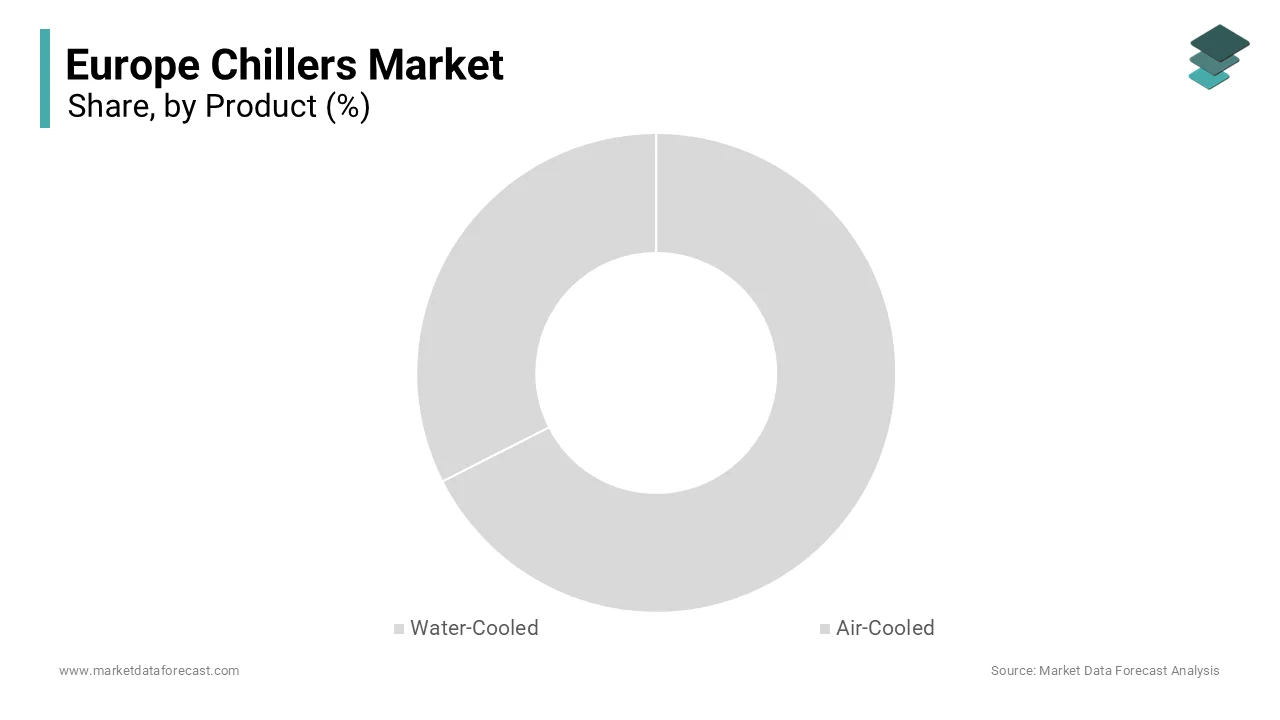
The air cooled chillers segment is likely to experience the fastest CAGR of 6.8% share in 2025. The swift expansion of the air cooled chillers segment is driven by their plug and play installation suitability for locations with water scarcity and expanding use in decentralized applications. In regions facing significant water stress, air-cooled systems are a major trend as they remove the reliance on cooling towers or municipal water supplies. The format is also ideal for medium scale food processors dairies and data closets that lack space for condenser water systems. Technological advances have narrowed the efficiency gap. Driven by technological innovation, the newest inverter-driven models are closing the performance gap, achieving energy performance ratios that rival their water-cooled counterparts. Furthermore, air-cooled chillers are proving highly advantageous for retrofitting existing structures, with case studies highlighting their ability to significantly reduce installation time in small industrial sites. Furthermore, Regulatory changes are also favoring this shift. These practical and regulatory advantages are driving rapid adoption beyond traditional niches.
By Application Insights
The industrial applications segment was the leading segment of the Europe chillers market by capturing a 52.7% share in 2025. The prominence of the industrial applications segment is driven by the non negotiable need for precise thermal control across manufacturing processes where temperature deviation directly impacts product quality safety or yield. Moreover, the food and beverage sector relies on industrial chillers for pasteurization crystallization and cold storage. Chemical and petrochemical plants use chillers for reactor temperature management and solvent recovery while data centers deploy them for server rack cooling under strict Power Usage Effectiveness mandates. Unlike commercial or residential uses industrial chillers operate 24 7 with redundancy built in creating high lifetime value and consistent demand for robust high-capacity units across the continent.
The commercial applications segment is on the rise and is expected to be the fastest growing segment in the market by witnessing a CAGR of 7.3% from 2026 to 2034 owing to the retrofitting of aging HVAC infrastructure in offices hospitals and retail spaces to comply with Energy Performance of Buildings Directive requirements. Supermarkets are a key driver. Hospitals also contribute significantly as modern imaging suites operating rooms and laboratories require stable cooling independent of ambient conditions. Apart from these, the rise of mixed use urban developments with centralized cooling plants further amplifies demand. This regulatory and functional convergence positions commercial chillers as a high growth segment beyond traditional comfort cooling.
By Compressor Insights
The screw chillers segment led the Europe chillers market and accounted for a 63.3% share in 2025. The domination of the screw chillers segment is fuelled by its versatility reliability and optimal performance across the 100 to 1 500 kilowatt capacity range that covers the majority of industrial and commercial needs. Unlike centrifugal chillers which suffer from surging at part load screw compressors maintain stable operation down to 10 percent capacity making them ideal for variable demand environments such as food processing plants or multi-tenant office buildings. The technology also accommodates a wider range of refrigerants including ammonia R 134a and R 1234ze without major redesign enabling compliance with F Gas mandates. Maintenance is simpler with fewer rotating parts and modular service access reducing downtime. The European Investment Bank notes that screw chillers dominate public sector procurement due to lower lifecycle risk and predictable performance across diverse climate zones from Scandinavia to the Mediterranean.
The centrifugal chillers segment is expected to exhibit a noteworthy CAGR of 8.1% during the forecast period due to its unmatched efficiency in large scale continuous applications exceeding 1 500 kilowatts such as district cooling plants data centers and heavy industry. Modern magnetic bearing centrifugal chillers achieve full load coefficients of performance and seasonal energy performance ratios exceeding. In data centers operators deploy centrifugal chillers with variable speed drives to maintain Power Usage Effectiveness below 1.3. Besides, advances in low global warming potential refrigerants like R 1233zd have enabled centrifugal systems to comply with F Gas rules without sacrificing performance. These factors position centrifugal chillers as the technology of choice for Europe’s decarbonizing large scale thermal infrastructure.
REGIONAL ANALYSIS
Germany Market Analysis
Germany dominated the Europe chillers market by occupying a 24.5% share in 2025. The domination of the German market is driven by its dense industrial base including automotive chemical and pharmaceutical manufacturing all requiring high reliability process cooling. The Energiewende policy framework further drives adoption of high efficiency systems. District cooling is expanding in cities like Munich and Frankfurt where new developments must connect to centralized plants under municipal climate action plans. Apart from these, Germany hosts major chiller manufacturers including GEA and Sabart who invest heavily in R&D for natural refrigerant and digital twin technologies. With stringent energy audits mandated for facilities over 500 kilowatts and rising carbon pricing Germany’s market remains deeply integrated with national decarbonization strategy.
France Market Analysis
France followed closely in the Europe chiller and accounted for a 18.8% share in 2025 because of its centralized urban planning and robust district cooling expansion particularly in Paris Lyon and Marseille. The Paris Climate Plan mandates that all new commercial buildings notable square meters integrate with the city’s cooling network which relies on large centrifugal chillers using seawater or river water sources. Industrial demand is also strong with the dairy and wine sectors requiring precise temperature control during processing and storage. France leads in F Gas compliance with a national registry requiring all chillers over 50 kilowatts to undergo annual leak checks and performance verification. The government’s MaPrimeRénov scheme provides subsidies covering up to a share of chiller replacement costs for small businesses. This blend of top down regulation bottom up incentives and urban infrastructure investment sustains France’s position as a core European market.
United Kingdom Market Analysis
The United Kingdom expanded steadily in the Europe chillers market. Despite Brexit the UK maintains alignment with EU Ecodesign and F Gas principles through the retained Environmental Protection Act. The market is driven by data center expansion and healthcare infrastructure modernization. Supermarkets are another key segment. The Streamlined Energy and Carbon Reporting framework compels large facilities to disclose chiller energy use accelerating replacements. Though residential adoption remains low the UK’s focus on industrial and institutional decarbonization ensures steady demand for advanced cooling systems.
Italy Market Analysis
Italy is moderately growing in the Europe chillers market, with its strong food and beverage processing sector and rising cooling demand due to climate change. Southern regions face extreme summer temperatures. Italy also leads in natural refrigerant adoption. However regulatory delays in local permitting and grid connection approvals sometimes slow deployment. Despite these hurdles Italy’s combination of industrial necessity climate vulnerability and financial incentives creates a resilient and growing chiller market.
Spain Market Analysis
Spain is anticipated to expand in the Europe chillers market from 2026 to 2034 owing to tourism infrastructure food processing and rising residential cooling demand due to intensifying heatwaves. The agri food sector is another pillar with Spain being Europe’s largest producer of olive oil and canned vegetables requiring consistent cooling during extraction and sterilization. Apart from these Spain is piloting solar assisted chillers in Andalusia using thermal energy to reduce grid dependence. These climate and policy forces position Spain as a dynamic and fast evolving market in Southern Europe.
COMPETITIVE LANDSCAPE
KEY MARKET PLAYERS
Some of the notable key players in the Europe chillers market are
- Rite-Temp
- General Air Products
- Fluid Chillers
- ClimaCool
- Rite-Hite
- Trane Technologies PLC Class A
- Carrier Global Corp Ordinary Shares
- Daikin Industries Ltd
- Honeywell International Inc
- Air Products & Chemicals Inc
- Johnson Controls International PLC
TOP STRATEGIES USED BY THE KEY MARKET PLAYERS
Key players in the Europe chillers market prioritize compliance with EU environmental regulations by accelerating the transition to low global warming potential refrigerants and designing systems that exceed Ecodesign efficiency thresholds. Companies invest heavily in digitalization embedding IoT sensors predictive analytics and remote monitoring capabilities to enhance lifecycle value and reduce operational carbon footprints. Strategic expansion of local manufacturing and testing facilities ensures faster delivery and adherence to national certification requirements. Collaboration with municipalities utilities and industrial clusters drives integration into district cooling and industrial decarbonization projects. Additionally, firms focus on circular economy principles by designing for disassembly refrigerant recovery and component reuse to align with upcoming Extended Producer Responsibility obligations under the revised Ecodesign framework.
COMPETITION OVERVIEW
The Europe chillers market is characterized by intense yet specialized competition among global engineering firms and regional specialists vying for dominance in a highly regulated and technically demanding environment. Competition is not primarily price based but revolves around energy efficiency regulatory compliance reliability and service integration. Leading companies differentiate through proprietary compressor technologies digital twin capabilities and expertise in natural or low global warming potential refrigerants. The market is bifurcated between industrial clients seeking process stability and commercial operators focused on lifecycle costs and carbon reporting. National implementation of EU directives creates fragmentation requiring tailored solutions for each member state. At the same time public funding for decarbonization and district energy projects has intensified bidding competition among top-tier suppliers. Smaller players survive through niche applications or regional service networks but face mounting pressure from tightening standards. Overall, the landscape favors incumbents with strong R&D capabilities regulatory agility and pan European service infrastructure driving consolidation and innovation in equal measure.
TOP PLAYERS IN THE MARKET
- Trane Technologies is a global leader in sustainable climate solutions with a strong footprint in the Europe chillers market through its Trane brand. The company supplies high efficiency water cooled and air cooled chillers for industrial commercial and district cooling applications across the continent. It has reinforced its European position by advancing its Solstice line of chillers using low global warming potential refrigerants like R 1234ze which comply with the EU F Gas Regulation. The company also collaborates with European utilities and municipalities to deploy chillers in decarbonizing district energy networks particularly in Scandinavia and Benelux regions.
- Daikin Europe is a pivotal player in the European chillers market offering a comprehensive portfolio of air cooled and water-cooled systems for HVAC and process cooling. The company leverages its Japanese engineering heritage to deliver inverter driven variable speed chillers that exceed Ecodesign Directive efficiency thresholds. To strengthen its position Daikin has expanded its production facility in Oostende Belgium to increase capacity for R 1234ze based chillers and opened a dedicated testing center in the Netherlands for EN 14825 seasonal performance validation. Daikin also partners with European engineering firms to integrate chillers into net zero building projects and participates in EU funded research on refrigerant safety and circularity in cooling systems.
- GEA Group is a Germany based global systems supplier with deep expertise in industrial process chillers for food pharmaceutical and chemical sectors across Europe. The company specializes in ammonia and CO2 based refrigeration systems that align with EU sustainability mandates. GEA has enhanced its market presence by launching the GEA Blu line of chillers featuring magnetic bearing compressors and IoT connectivity for real time energy optimization. GEA also contributes to European standardization efforts through its active role in Eurovent and the European Committee for Standardization ensuring its products meet evolving regulatory and safety requirements.
MARKET SEGMENTATION
This research report on the Europe chillers market has been segmented and sub-segmented based on categories.
By Product
- Water-Cooled
- Air-Cooled
By Application
- Industrial
- Commercial
- Residential
By Compressor
- Screw Chillers
- Centrifugal Chillers
By Country
- UK
- France
- Spain
- Germany
- Italy
- Russia
- Sweden
- Denmark
- Switzerland
- Netherlands
- Turkey
- Czech Republic
- Rest of Europe
Frequently Asked Questions
1. What is the Europe chillers market?
The Europe chillers market refers to systems used for cooling in commercial, industrial, and residential applications.
2. Which factors are driving the growth of the Europe chillers market?
Increasing industrial activities, rising demand for HVAC systems, and energy-efficient cooling solutions drive growth.
3. Which product types are commonly used in Europe?
Water-cooled and air-cooled chillers are the major product types used across European facilities.
4. Which applications dominate the Europe chillers market?
Industrial and commercial applications hold the largest share due to high cooling demand.
5. What are the main chiller technologies used in Europe?
Screw chillers and centrifugal chillers are widely used depending on capacity and efficiency needs.
6. Which countries lead the chillers market in Europe?
Germany, the UK, France, and Italy are among the leading markets for chillers in Europe.
7. What industries commonly use chillers in Europe?
Pharmaceuticals, food processing, chemicals, data centers, and commercial buildings use chillers extensively.
8. What trends are shaping the Europe chillers market?
Adoption of eco-friendly refrigerants, energy-efficient chillers, and smart HVAC systems are major trends.
9. What challenges does the Europe chillers market face?
High installation costs, refrigerant regulations, and maintenance requirements are key challenges.
10. What is the growth outlook for the Europe chillers market?
The market is expected to grow steadily due to rising infrastructure development and increasing cooling demand.
Related Reports
Access the study in MULTIPLE FORMATS
Purchase options starting from
$ 2000
Didn’t find what you’re looking for?
TALK TO OUR ANALYST TEAM
Need something within your budget?
NO WORRIES! WE GOT YOU COVERED!
Call us on: +1 888 702 9696 (U.S Toll Free)
Write to us: sales@marketdataforecast.com