- Product Description Description
- Table of Contents TOC
- List of Table & Figure LOT
- Get Free Sample PDF Sample PDF
Market Size, 2025
$1.95 BnMarket Estimate, 2026
$2.38 BnMarket Forecast, 2034
$11.73 BnCAGR, 2026–2034
22.06%Europe Cleaning Robot Market Report Summary
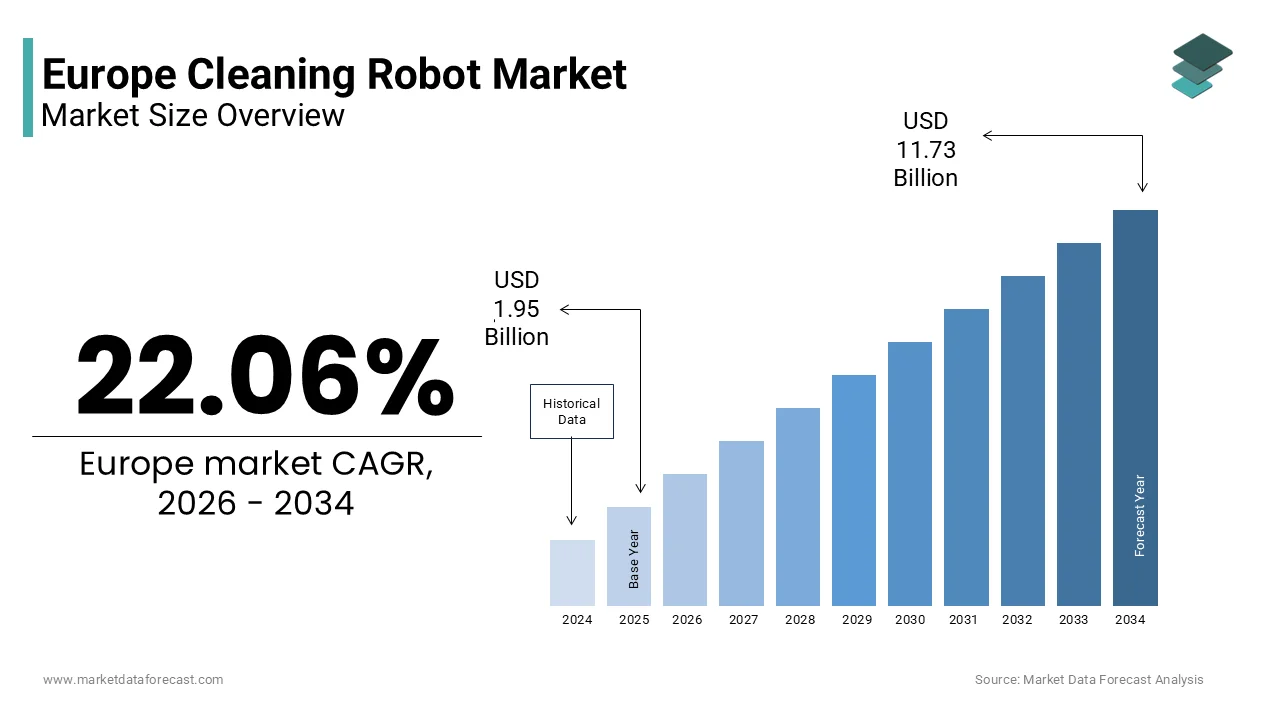
The Europe cleaning robot market was valued at USD 1.95 billion in 2025, is estimated to reach USD 2.38 billion in 2026, and is projected to reach USD 11.73 billion by 2034, growing at a CAGR of 22.06% during the forecast period. The market is experiencing rapid expansion due to rising adoption of smart home technologies, increasing labor costs, and growing demand for automated cleaning solutions across residential and commercial settings. Higher consumer awareness of convenience driven appliances, strong penetration of IoT enabled devices, and expanding online retail channels are further accelerating market growth across Europe.
Key Market Trends
-
Strong growth in floor cleaning robots driven by rising urban households and demand for time saving cleaning solutions.
-
Increasing preference for self driven cleaning robots supported by advancements in AI, sensors, and navigation technologies.
-
Rapid expansion of online sales channels as consumers favor product comparisons, discounts, and doorstep delivery.
-
Growing adoption of cleaning robots in commercial spaces such as offices, hospitals, hotels, and retail facilities.
-
Rising demand for energy efficient and low maintenance robotic cleaning solutions aligned with sustainability goals.
Segmental Insights
- Based on product, the floor cleaning robots segment accounted for a significant share of the Europe cleaning robot market in 2024. The segment’s dominance is driven by widespread household adoption, improved suction and mopping capabilities, and increasing affordability of robotic vacuum cleaners.
- Based on operation mode, the self driven robots segment held the largest share of the market in 2024. This leadership is attributed to autonomous navigation, minimal human intervention, and enhanced efficiency compared to remote controlled alternatives.
- By sales channel, the online segment dominated the market by capturing 58.3% of the Europe cleaning robot market share in 2024. The growth of this segment is supported by strong ecommerce penetration, digital marketing strategies, and growing consumer trust in online purchases.
Regional Insights
- Germany led the Europe cleaning robot market with an estimated share of around 25%. Market dominance is driven by high consumer awareness, strong purchasing power, advanced digital infrastructure, and a cultural emphasis on efficiency in household and commercial management.
- Western European countries are also witnessing fast adoption, supported by smart home trends and rising disposable incomes.
Competitive Landscape
The Europe cleaning robot market is highly competitive, characterized by rapid technological innovation and continuous product upgrades. Leading players focus on AI integration, smart connectivity, and expanding product portfolios across residential and professional applications. Strategic partnerships, new product launches, and strong online presence remain key competitive strategies. Prominent companies operating in the market include Maytronics, SoftBank Robotics America Inc., Gaussian Robotics, iRobot Corporation, Dyson, Pentair, LG Electronics, Zodiac Pool Systems LLC, Samsung, ILIFE, HOBOT, ECOVACS, Hayward Industries Inc., BISSELL Inc., Amano Corporation, Miele and Cie. KG, Neato Robotics Inc., Roborock, Xiaomi Inc., and Makita Corporation.
 Download Free Sample Report
Europe Cleaning Robot Market Size
The Europe cleaning robot market size was valued at USD 1.95 billion in 2025 and is projected to reach USD 11.73 billion by 2034 from USD 2.38 billion in 2026, growing at a CAGR of 22.06%.
Cleaning robots are autonomous or semi-autonomous devices designed to perform floor cleaning, vacuuming, mopping, or disinfection tasks in residential, commercial, and institutional settings using sensor-based navigation, artificial intelligence, and battery-powered mobility. Unlike manual or traditional cleaning equipment, these systems integrate LiDAR, visual simultaneous localisation and mapping, and edge computing to adapt to dynamic environments while minimising human intervention. The stringent product safety, electromagnetic compatibility, and data privacy regulations, including the EU Machinery Regulation, Radio Equipment Directive, and General Data Protection Regulation. As per Eurostat, over 74% of European households reported time poverty in daily chores in 2023, with dual-income and single-parent families expressing the highest demand for labour-saving home technologies. Additionally, the European Centre for Disease Prevention and Control notes that healthcare-associated infections affect over 8.9 million patients annually in EU hospitals, driving institutional interest in autonomous disinfection robots. These socio-demographic and regulatory conditions,s coupled with Europe’s ageing population and rising commercial real estate hygiene standards, position cleaning robots as a critical enabler of efficiency, health, and quality of life across the region.
MARKET DRIVERS
Rising Demand for Domestic Time Optimisation in Urban Households
The evolving household structures and labour market dynamics are accelerating the adoption of residential cleaning robots, as a solution to chronic time scarcity is driving the growth of the European cleaning robot market. As per Eurostat, 68% of European adults aged 25 to 54 live in dual-income or single-parent households where discretionary time for domestic chores is severely constrained. In Germany, the Federal Statistical Office reports that the average working week exceeds 41 hours for full-time employees, leaving less than 90 minutes per day for household maintenance. This pressure is amplified in dense urban centres like Paris, Amsterdam, and Stockholm, where apartment living increases cleaning frequency due to limited storage and higher foot traffic. The European Consumer Organisation found in 2023 that 52% of urban residents aged 30 to 45 view robotic vacuum cleaners as essential home appliances on par with dishwashers. Furthermore, declining domestic help availability,y household service employment has fallen by 18% in Western Europe, since 201,5 according to the International Labour Organization fuels reliance on automation. With over 215 million internet-connected homes in the EU, as per the European Commission, seamless integration with smart home ecosystems makes cleaning robots an accessible and socially accepted labour substitute in time-constrained European lifestyles.
Stricter Hygiene Protocols in Healthcare and Public Facilities
The post pandemic emphasis on infection control has institutionalised autonomous cleaning and disinfection robots in hospitals, airportss and public transport systems, which is additionally leveraging the growth of Europe cleaning robot market. As per the European Centre for Disease Prevention and Control, healthcare-associated infections incur annual costs of over 7 billion euros and affect 1 in 18 hospitalised patients, prompting mandatory surface hygiene upgrades. The EU’s Health Emergency Preparedness and Response Authority now recommends UV C or hydrogen peroxide-based disinfection after every patient discharge in high-risk wards. Companies like Xenex and UVD Robots have deployed autonomous units in over 120 European hospitals, including Charité Berlin and Karolinska University Hospital, which achieve 99.99% pathogen reduction on high-touch surfaces. Similarly, Amsterdam Schiphol and Frankfurt airports use robotic floor scrubbers with real-time soil detection to maintain terminal cleanliness during peak hours. The European Standard EN 17272 for automated disinfection equipment,t published in 2020, provides performance validation protocols that accelerate public sector procurement.
MARKET RESTRAINTS
Stringent Data Privacy and Surveillance Concerns
The integration of cameras, mapping sensors, and cloud connectivity in cleaning robots triggers significansignificant scrutinyrope’s rigorous data protection regime. This factor is solely limiting the growth of the European cleaning robot market. As per the European Data Protection Board, any device that captures spatial data or images within private or semi-private spaces is subject to General Data Protection Regulation requirements, including lawful basis, data minimisation, and user consent. In 2023, Germany’s Federal Commissioner for Data Protection issued a formal warning to three major robot vacuum brands for storing home floor plans on third-party servers without explicitopt-in,n a practice deemed disproportionate, under Article 5 of the GDPR. Similarly, France’s CNIL ruled that real-time video streaming from robot mops for remote monitoring constitutes biometric data processing if human presence is inferred, requiring enhanced safeguards. These interpretations deter consumers from enabling advanced features likeno-goo zones or object recognition, thereby limiting functionality and value perception. Manufacturers must now invest in on-device processing, anonymised mapping, and transparent data policies, increasing R&D costs and complicating user experience design.
High Initial Cost and Perceived Value Limitations
The upfront investment for advanced cleaning robots to achieve mass adoption in price is degrading the growth of Europe cleaning robot market. As per the European Commission’s Consumer Market Monitoring Report, the average European household spends 120 euros annually on cleaning supplies and equipment, yet premium robotic vacuums and mops cost between 400 and 1 200 euros. This disconnect creates a value perception gap in Southern and Eastern Europe, where disposable income is lower. Eurostat data shows that households in Spain, Italy, and Poland allocate less than 3% of discretionary spending to home automation, compared to 8% in Germany and Sweden. Moreover, a 2023 study by the German Consumer Organisation Stiftung Warentest found that 40% of users abandoned robotic cleaners within six months due to ineffective edge cleaning, poor carpet navigation, or frequent maintenance needs. Without compelling evidence of long term savings in time or cleaning efficacy, many consumers view robots as luxury gadgets rather than essential tools. This economic and experiential friction limits penetration beyond early adopters and affluent urban professionals.
MARKET OPPORTUNITIES
Integration into Smart Building Management Systems
The commercial real estate sector is increasingly embedding cleaning robots into integrated smart building platforms that optimise energy, security, and facility operations, which is majorly creating new opportunities for the growth of Europe cleaning robot market. As per the European Commission’s Level(s) framework for sustainable buildings, over 60% of new office constructions in the EU now include building management systems that coordinate HVAC, lighting, and lean workflows. In this ecosystem, robotic floor scrubbers and vacuum units receive real-time task assignments based on foot traffic data from IoT ssensorss occupancy schedules and air quality readings. Companies like Brain Corp and Avidbots have deployed fleets in retail chains such as Carrefour and IKEA across France and the Netherlands,s where robots clean only high traffic zones during off-hours, urs reducing energy and water use by up to 35% according to facility audits. The European Committee for Standardisation is finalising EN 50714 to govern interoperability between service robots and building automation protocols. With the EU’s Energy Performance of Buildings Directive mandating smart readiness indicators for all new constructions by 2025, cleaning robots are evolving from standalone devices to responsive nodes in data-driven facility ecosystems, unlocking recurring service contracts andenterprise-scalee deployments.
Expansion in Elderly Care and Assisted Living Environments
A rapidly ageing population is creating demand for cleaning robots in senior housing and assisted living facilities, where maintaining hygiene supports independent living and reduces caregiver burden. The expansionofn elderly care and assisted living environments is expected to escalate the growth of Europe cleaning robot market. As per Eurostat, 21.3% of the EU population was aged 65 or older in 2023, a figure projected to reach 29.1% by 2050. In Sweden and the Netherlands, public health agencies now subsidise robotic cleaners in home care packages for seniors with mobility limitations, recognising that clean floors reduce fall risks and infection exposure. Additionally, voice-controlled and simplified interface robots from brands like Ecovacs and Roborock are being adapted for elderly users with largebuttonss,s voice feedback and automatic recharging, features validated under the EU’s Active and Assisted Living Programme.
MARKET CHALLENGES
Limited Navigation Performance in Complex European Home Layouts
Cleaning robots often struggle with the architectural complexity of European residences, which feature narrow corridors, high thresholds, ds thick rugs and historic floor surfaces that challenge sensor accuracy and mobility. This is one of themajor factors challenging the European cleaning robot market players. As per a 2023 technical audit by the VDE Institute in Germany, over 35% of robotic vacuums failed to navigate traditional European thresholds exceeding 22 millimetres, a common feature in pre 1980s buildings. Similarly, Italian and Spanish homes with terracotta tiles or uneven stone flooring cause wheel slippage and mapping errors in optical flow-based navigation systems. The issue is compounded by small room sizes; the average European apartment is 85 square metres compared to 120 in North America, according to Eurostat, leading to frequent collisions and inefficient path planning. While LiDAR improves performance, it remainscost-prohibitivee for sub-300-euro models that dominate mass retail. Without adaptive AI trained on diverse European domestic environments, robots deliver inconsistent results, eroding consumer trust and increasing return rates. Manufacturers must invest in region-specific navigation datasets and mechanical designs to overcome Europe’s unique built environment challenges.
Fragmented Safety and Performance Certification Across Member States
The inconsistent testing and approval requirements, delaying time to and increasing compliance costs, are also inhibiting the growth of Europe cleaning robot market. While the Machinery Regulation and Radio Equipment Directive provide baseline safety rules, member states maintain divergent interpretations for robotic autonomy and human interaction. As per the European Robotics Forum, Germany’s TUV requires obstacle detection at 5 centimetres for floor robots, whereas France’s LCIE accepts 10 centimetres, forcing dual validation for the same product. Similarly, the UK’s post Brexit UKCA marking no longer aligns with CE standards, requiring separate electromagnetic compatibility and battery safety tests. In healthcare settings, national health agencies like Sweden’s Medical Products Agency impose additional biocompatibility and disinfection validation beyond EN 17272. A 2024 survey by euRobotics found that small European robotics firms spend up to 18 months and 250,000 euros on certification before pan-European launch, resources often unavailable to startups. This regulatory fragmentation stifles innovation and favours large global players with dedicated compliance teams, undermining the EU’s goal of a unified digital single market for service robots.
REPORT COVERAGE
| REPORT METRIC | DETAILS |
| Market Size Available | 2025 to 2034 |
| Base Year | 2025 |
| Forecast Period | 2026 to 2034 |
| CAGR | 22.06% |
| Segments Covered | By Product, Operation Mode, Sales Channel, Type, Sales Channel, Application, and Region |
| Various Analyses Covered | Global, Regional, & Country Level Analysis; Segment-Level Analysis; DROC, PESTLE Analysis; Porter’s Five Forces Analysis; Competitive Landscape; Analyst Overview of Investment Opportunities |
| Regions Covered | UK, France, Spain, Germany, Italy, Russia, Sweden, Denmark, Switzerland, Netherlands, Turkey, and the Czech Republic |
| Market Leaders Profiled | Maytronics, SoftBank Robotics America, Inc., Gaussian Robotics, iRobot Corporation, Dyson, Pentair, LG Electronics, Zodiac Pool Systems LLC, SAMSUNG, ILIFE, HOBOT, ECOVACS, Hayward Industries, Inc., BISSELL Inc., Amano Corporation, Miele & Cie. KG, NeatoRoboticss, Inc., Roborock, Xiaomi Inc. & Makita Corporation |
SEGMENTAL ANALYSIS
By Product Insights
The Floor cleaning robots segment accounted for a significant share of theEuropeane cleaning robot market in 2024, with their high utility in urban households, compatibility with smart home ecosystems, and continuous technological refinement. These devices address the most frequent and time-consuming domestic chore, floor maintenance,e across diverse European housing types. As per Eurostat, over 70% of Europeans live in apartments or multi-story homes where daily floor cleaning is essential due to limited outdoor access and high foot traffic. The European Consumer Organisation reports that 58% of urban residents aged 25 to 55 consider robotic vacuums a priority home appliance, surpassing dishwashers in perceived daily utility. Major retailers like MediaMarkt in Germany and Fnac in France allocate dedicated display zones for floor robots with live demonstrations, reinforcing consumer confidence. Furthermore, the EU Ecolabel certification now includes energy efficiency benchmarks for rorobocleaners pushing brands like Ecovacs and Roborock to develop models consuming under 30 watt hourper 100 square metres.
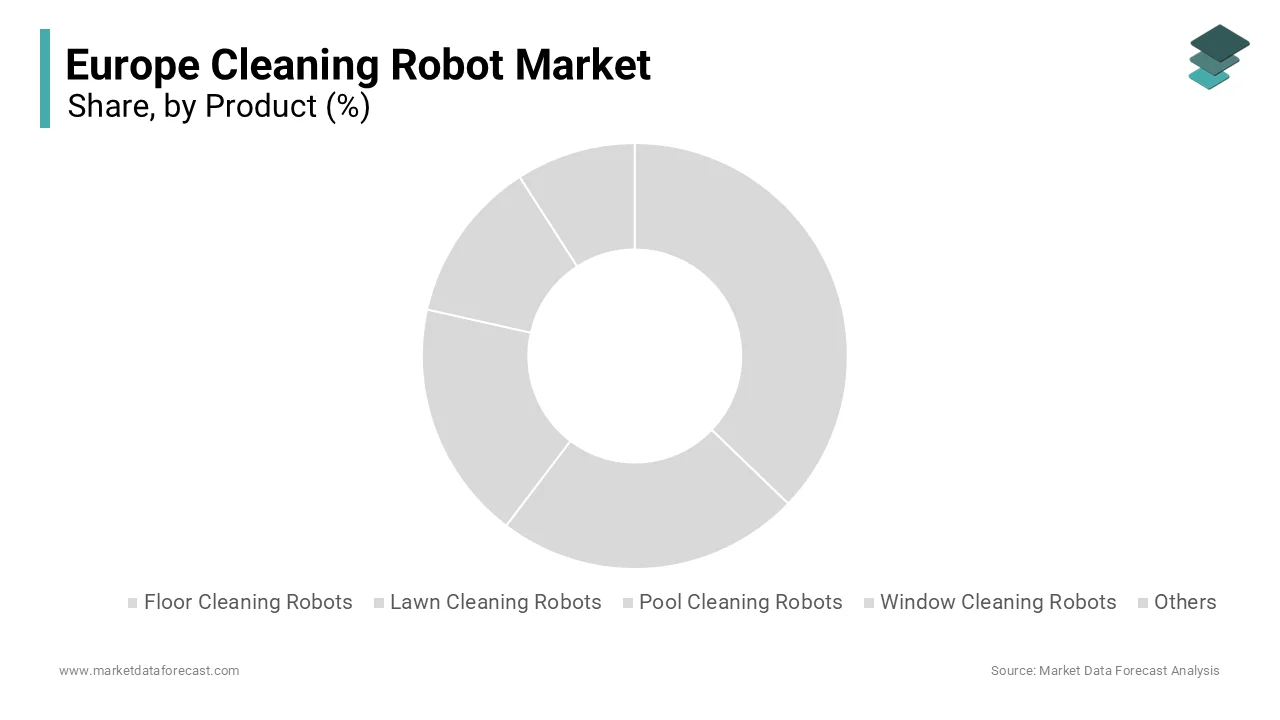
The window cleaning robots segment is projected to grow at a CAGR of 21.4% during the forecast period, owing to the rising demand in high-rise residential and commercial buildings, where manual window cleaning poses safety risks and labour shortages. As per the European Agency for Safety and Health at Work, falls from height account for 17% of fatal workplace accidents in the EU, prompting building managers to seek automated alternatives. In cities like London, Frankfurt, and Stockholm, over 40% of new residential towers exceed 15 stories according to Eurostat, creating strong demand for safe and efficient facade maintenance. Companies like Mamibot and Ecovacs have introduced vacuum adhesion robots with AI-powered edge detection that clean glass surfaces up to 30 square metres without human intervention. The European Committee for Standardisation is finalising EN 50715 for window cleaning robot safety, including fail-safe mechanisms and wind resistance,,e by enabling public procurement. Additionally, ageing homeowners in Switzerland and the Netherlands increasingly adopt these devices to avoid ladder use, supported by national home safety subsidies.
By Operation Mode Insights
The self-driven robots segment was the largest by accounting for a dominant share of Europe cleaning robot market in 2024. European users prioritise set-and-forget functionality that integrates seamlessly into daily routines without requiring constant oversight. As per the German Consumer Organisation Stiftung Warentest, 74% of robot vacuum owners value automatic scheduling and self-docking more than remote control features. This demand is enabled by advances in LiDAR and visual simultaneous localisation and mapping, which allow robots to navigate complex European apartments with narrow hallways and mixed flooring. The European Commission’s Radio Equipment Directive mandates robust obstacle detection and anti-collision systems standards that self-driving models meet through sensor fusion and AI path planning. Furthermore, smart home integration via Matter or Apple HomeKit allows self-driving robots to coordinate with lighting and security systems, thereby enhancing perceived intelligence. Retailers reinforce this preference by showcasing autonomous navigation in live demos, while remotely controlled models are increasingly relegated to budget segments. The cultural expectation of effortless automation in daily chores ensures self-driven dominance across residential and light commercial applications.
The self-driven robots segment is expected to witness the fastest CAGR of 16.8% from 2025 to 2033, with smart home adoption. As per the European Commission’s Digital Economy and Society Index, 68% of European households owned at least one smart home device in 2023, with robotic cleaners among the most integrated due to automatic scheduling and voice control compatibility. In Sweden and the Netherlands, national home care programmes for seniors include self-driven floor robots to reduce fall risks and support independent living,g recognising that consistent floor cleanliness lowers infection exposure. Additionally, commercial facilities like hospitals and airports deploy fleets of self-driven scrubbers that operate overnight usingpre-mappedd route,s maximising labour efficiency.
By Sales Channel Insights
The online sales segment was the largest by capturing 58.3% of theEuropeane cleaning robot market share in 2024, with the digital native consumer behaviour, extensive product comparison tools, adirect-to-consumermer brand strategies. European shoppers increasingly rely on e-commerce platforms to evaluate technical specifications, such as suction power, navigation type and battery life factors critical to robotic performance. As per the European Commission’s Digital Economy and Society Index, 84% of Europeans aged 16 to 74 shopped online in 2023, with electronics among the top three categories. Marketplaces like Amazon Germany, and Fnac Darty in France feature detailed comparison mamatricesuser reviews and video demonstrations that build confidence in high involvement purchases. Additionally, brands like Roborock and Ecovacs leverage their own websites to offer exclusive bundles, firmware updates, and extended warranties,s deepening direct relationships. The convenience of home delivery and flexible return policies further reduces purchase friction.
The Online sales segment is likely to grow with an expected CAGR of 18.2% from 2025 to 2033, owing to the rise of social commerce influencer reviews and immersive digital experiences that demystify robotic performance. As per the European Interactive Digital Advertising Alliance, 62% of European consumers discovered their last home appliance through social media or video platforms, where unboxing and long-term use videos showcase real-world robot capabilities. Brands now offer augmented reality apps that simulate robot navigation in users’ actual floor plan, which, whichs are available exclusively online. Furthermore, subscription-based models for filter replacements and software upgrades are seamlessly integrated intoe-commercee platform,,s creating recurring revenue streams. In Southern Europe, where physical retail penetration of premium robots is limited, the online channels bridge the accessibility. ga., Italy and Spain reported 27% and 31% year on year online growth in 2023, according to national e-commerce observatories.
REGIONAL ANALYSIS
Germany Cleaning Robot Market Analysis
Germany was the European cleaning robot market with an estimated 25% share driven by high consumer literacy, strong purchasing power and a culture of efficiency in household management. The country boasts Europe’s highest smart home penetration,n with over 28 million connected households according to the German Federal Ministry for Economic Affairs. As per the German Consumer Organisation Stiftung Warent, most robotic vacuums rank among the top three most tested home appliances annually, reflecting deep consumer engagement. Germany’s stringent product safety standards, enforced by TUV and VDE, ensure that only high-performance, reliable robots reach shelve,s building exceptional trust. The Federal Ministry of Family Affairs also promotes assistive technologies for ageing citizens with partial subsidies for autonomous cleaning devices in home care plans.
United Kingdom Cleaning Robot Market Analysis
The United Kingdom was ranked second by holding 16.3% of theEuropeane cleaning robot market share in 2024, with the early adoption of smart home ecosystems and strong demand in high-rise urban living. As per the Office for National Statistics, over 45% of new residential developments in London and Manchester exceed 10 storeys,s creating significant demand for window and floor cleaning robots that reduce manual labour and safety risks. The UK’s departure from the EU has not diminished technical alignment;t, products still comply with CE-derived UKCA standards for safety and electromagnetic compatibility. British consumers rank among Europe’s most digitally enengaged with 79% purchasing home appliances online,ne according to the UK’s Office of Communications. Brands like Dyson and SharkNinja leverage local R&D centres to adapt navigation algorithms forthe UK’s older housing stock with narrow corridors and thick carpets. Additionally, the National Health Service pilots robotic cleaners in elderly care homes to support independent living, a trend accelerated by post pandemic hygiene awareness.
France Cleaning Robot Market Analysis
The French cleaning robot market growth is likely to grow atthea fastest CAGR throughout the forecast period,d with thegovernment-backedd digital inclusion initiatives and a growing elderly population seeking home assistance. The French National Strategy for Home Automation allocates subsidies for smart devices that support ageing in place, covering up to 40% of the cost of certified robotic cleaners for seniors over 70. As per INSEE, over 23% of the French population is aged 65 or older,r with many living in multi-story Parisian apartments where floor and window maintenance is challenging. The country also hosts Europe’s largest robotic vacuum manufacturing facility, iRobot’s plant in Dunkirk, which supplies the entire EU and ensures local technical support. Retailers like Darty and Boulanger offer in-store navigation demos and multi-year service contracts, reinforcing purchase confidence. Furthermore, France’s data protection authority CNIL has issued clear guidelines for robot data hhandlingg enabling brands to implement GDPR compliant on device mappin,,g alleviating privacy concerns. These coordinated public-private efforts make France a stable and socially conscious market for residential cleaning automation.
Sweden Cleaning Robot Market Analysis
Sweden's cleaning robot market growth is likely tobe driven by the elderly care innovation and sustainability-focused consumption. The Swedish National Board of Health and Welfare includes robotic floor cleaners in municipal home care packages for seniors with mobility limitations, recognising their role in fall prevention and infection control. Swedish consumers also prioritise environmental iimpact which is why the Swedish Consumer Agency requires all electronic products to disclose energy and material footprint, which has pushed brands like Neato to develop robots with 100% recyclable housings and repairable modules. Stockholm’s dense urban design with compact apartments further drives demand for slim, efficient robots that navigate tight spaces.
Italy Cleaning Robot Market Analysis
Italy's cleaning robot market growth is likely to grow with its ageing demography,,c urban density and rising awareness of indoor air quality. As per ISTAT, over 24% of Italians are aged 65 or older, many residing in historic city centres like Rome and Florence, with small multi-level apartments where manual cleaning is physically demanding. The National Institute of Statistics reports that households with elderly members are 2.3 times more likely to purchase robotic vacuums than the national average. Additionally, Italy’s high asthma and allergy prevalence is sestimatedat 12% of the population by the Italian Society of Allergology, which fuels demand for HEPA-filtered robots that reduce airborne particulates. Retailers like Unieuro and Euronics offer financing plans and in-home setup services, lowering entry barriers. The Italian government’s National Recovery and Resilience Plan also includes smart home incentives forenergy-efficientt appliance,s which some regions have extended to robotic cleaners with low wattage consumption.
COMPETITIVE LANDSCAPE
Competition in the European cleaning robot market is defined by technological sophistication,n regulatory adherence,ce and user experience rather than price alone. The market features a mix of global leaders like iRobo,t Ecova, cs and Roborock alongside niche European brands such as Neato and Gausium that focus on specific functionalities like laser navigation or commercial disinfection. Unlike other regions where hardware specs dominate, the European consumers prioritise data privacyy energy efficiency andreal-worldd reliability in complex home environments. Success requires navigating a web of EU regulation, including the MachineryRegulationno the Radio Equipment Directive and GDPR-creating high barriers for non-compliant entrants. Retailers exert significant influence by featuring only certified models with strong customer reviews, while online channels reward brands with transparent performance data and responsive support. At the same time, rising demand in elderly care and commercial hygiene is attracting new players from the medical and facility management sectors.
KEY MARKET PLAYERS
Some of the notable key players in the European cleaning robot market are
- Maytronics
- SoftBank Robotics America, Inc.
- Gaussian Robotics
- iRobot Corporation
- Dyson
- Pentair
- LG Electronics
- Zodiac Pool Systems LLC
- Samsung
- ILIFE
- HOBOT
- ECOVACS
- Hayward Industries, Inc.
- BISSELL Inc.
- Amano Corporation
- Miele & Cie. KG
- Neato Robotics, Inc.
- Roborock
- Xiaomi Inc.
- Makita Corporation
Top Players in the Market
- Ecovacs Robotics Co Ltd has established a strong presence in the European cleaning robot market through its DEEBOT and WINBOT product lines, which offer advanced navigationn artificial intelligence amulti-surfaceace cleaning capabilities. The Chinese headquartered company operates regional offices in Germany and the Netherlands to support local compliance with EU safety data privacy and electromagnetic standards. Ecovacs products are widely distributed across major European retailers and e-commerce platforms,s featuring LiDAR mmapping,g self-emptying stations and voice control integration with Alexa and Google Assistant. Ecovacs launched its DEEBOT X8 Omni with dual rotating mops andAI-poweredd object recognition trained specifically on European household items like slippers and pet bowls. It also introduced enhanced on-device data processing to comply with GDPR requirements,s eliminating cloud storage of home maps. These initiatives reinforce Ecovacs’s role as a technology leader delivering regionally adapted autonomous cleaning solutions to European and global consumers.
- iRobot Corporation maintains a strategic foothold in theEuropeane cleaning robot market primarily through its Roomba and Braava brands,s which are recognised for reliabilityy smart home integration, ion and extensive service networks. The company leverages its manufacturing facility in Dunkirk, France,e to serve EU markets with locally assembled units that meet CE and UKCA safety certifications. iRobot’s robots feature proprietary iAdapt navigation and seamless compatibility with Amazon Alexa, Apple HomeKit,t and Google Assistant, thereby aligning with Europe’s smart home adoption trends. In early 20,24 iRobot enhanced its Roomba j7+ with improved carpet detection aallergen-focusedsed filtration certified by the European Centre for Allergy Research. It also partnered with German and Dutch home care agencies to pilot Roomba units in elderly assistance programmes that reduce manual cleaning burdens. These actions position iRobot as a trusted provider of health-oriented and user-friendly robotic solutions across Europe’s residential and care sectors.
- Roborock Technology Co Ltd has rapidly gained traction in the European cleaning robot market by combining precision LiDAR navigation, aa hisuction powerw er and aesthetically minimalist designs that appeal to urban European consumers. Headquartered in China, the company operates a European headquarters in the Netherlands with dedicated compliance and customer support teams ensuring adherence to GDP, R Machinery Regulation and Ecolabel energy standards. Roborock’s S and Q series robots are bestsellers on Amazon Germany and Fnac France due to their accurate room mapping and quiet operation suited for apartment living. Roborock launched the S8 Pro Ultra, featuring dual water tanks for precise mopping and an AI obstacle recognition system trained on European domestic environments. It also introduced a subscription-based filter replacement programme via itdirect-to-consumerer platfor,m enhancing customer retention. These strategies position Roborock as aninnovation-driven brandd that bridges performance design and digital engagement in Europe’s competitive robotic cleaning landscape.
MARKET SEGMENTATION
This research report on the European cleaning robot market has been segmented and sub-segmented based on categories.
By Product
- Floor Cleaning Robots
- Lawn Cleaning Robots
- Pool Cleaning Robots
- Window Cleaning Robots
- Others
By Operation Mode
- Self Driven
- Remote Controlled
By Type
- Personal Cleaning Robots
- Professional Cleaning Robots
By Sales Channel
- Online
- Offline
By Application
- Residential
- Commercial
- Industrial
- Others
By Country
- UK
- France
- Spain
- Germany
- Italy
- Russia
- Sweden
- Denmark
- Switzerland
- Netherlands
- Turkey
- Czech Republic
- Rest of Europe