- Product Description Description
- Table of Contents TOC
- List of Table & Figure LOT
- Get Free Sample PDF Sample PDF
Europe Clear Aligners Market Report Summary
The Europe clear aligners market was valued at USD 5.52 billion in 2024, is estimated to reach USD 6.88 billion in 2025, and is projected to reach USD 39.87 billion by 2033, growing at a CAGR of 24.56% during the forecast period from 2025 to 2033. The growth of the Europe clear aligners market is driven by rising adult demand for discreet aesthetic orthodontics, rapid integration of digital dentistry workflows, and advances in AI-enabled treatment planning that shorten time to outcome and improve predictability. Expansion of hybrid direct-to-consumer care models, sensor-enabled compliance monitoring, and increasing corporate and private insurance support for aesthetic dental services are further fueling market growth. Moreover, regulatory harmonization under the EU Medical Devices Regulation and investment in local manufacturing and biodegradable materials are broadening product availability and supporting faster market adoption across Europe.
Key Market Trends
- Rapid integration of artificial intelligence in treatment planning and staging to improve accuracy and reduce the number of aligner sets required.
- Growing adult demand for aesthetic orthodontics is driven by professional and social considerations, increasing willingness to pay for discreet solutions.
- Expansion of hybrid DTC-plus-clinic care models that combine centralized planning with local clinical supervision to improve access and reduce costs.
- Increasing adoption of compliance monitoring technologies (embedded sensors, mobile apps), enabling expansion into adolescent and teen segments.
- Heightened regulatory scrutiny under EU MD, raising clinical evidence and post-market surveillance standards, favouring established multinational players.
Segmental Insights
- Based on age group, the adult segment was the largest and held a significant share of the Europe clear aligners market in 2024. The segment’s dominance is attributed to strong aesthetic preferences among working-age populations, higher disposable income, and growing acceptance of orthodontics as part of wellness and professional grooming.
- Based on end user, the dentist & orthodontist-owned practices segment held the largest share in 2024, driven by clinical gatekeeping, in-clinic scanning, and integrated digital workflows that ensure diagnosis, oversight, and medico-legal compliance.
Regional Insights
The Europe clear aligners market is expanding across major economies, fueled by high digital dentistry adoption, private insurance penetration, and cultural demand for dental aesthetics.
- Germany was the largest contributor, accounting for 21.3% of the Europe clear aligners market share in 2024, supported by advanced digital dentistry infrastructure, high health literacy, and a strong private insurance ecosystem enabling access to premium treatments. The
- United Kingdom held ~17.3% in 2024, combining NHS functional care for youth with a robust private aesthetic market and strengthened regulatory oversight for remote models.
- France has strong private insurance penetration and a cultural emphasis on dental aesthetics support high adoption and hybrid model trials.
- Italy is notable for growth driven by aesthetic-conscious consumers, domestic material innovation (biodegradable aligners), and streamlined CE certification for local producers.
Competitive Landscape
The Europe clear aligners market is competitive and increasingly consolidated, with a mix of global incumbents, dental-technology groups, and agile direct-to-consumer brands. Market leaders differentiate through proprietary AI planning engines, clinical training programs, sensor-based compliance tools, and deep networks of clinic partners. Regulatory compliance (MDR), robust clinical evidence, and scalable digital manufacturing capacity are critical barriers to entry that advantage established players. Strategic moves include vertical integration with scanner/3D-printer suppliers, expansion of subscription-based treatment financing, and partnerships with insurers and corporate wellness programmes to broaden uptake. Prominent players in the Europe clear aligners market include Align Technology (Invisalign), Institut Straumann AG, Dentsply Sirona, 3M, Ormco (Envista), Argen, K Line Europe, Dentaurum, Prodways, ALS Dental, DMU Dental, Prismlab, SmileDirectClub, PlusDental, and Orthoclear.
Europe Clear Aligners Market Size
The europe clear aligners market size was valued at USD 6.88 billion in 2025 and is anticipated to reach USD 8.57 billion in 2026 from USD 49.66 billion by 2034, growing at a CAGR of 24.56% during the forecast period from 2026 to 2034.
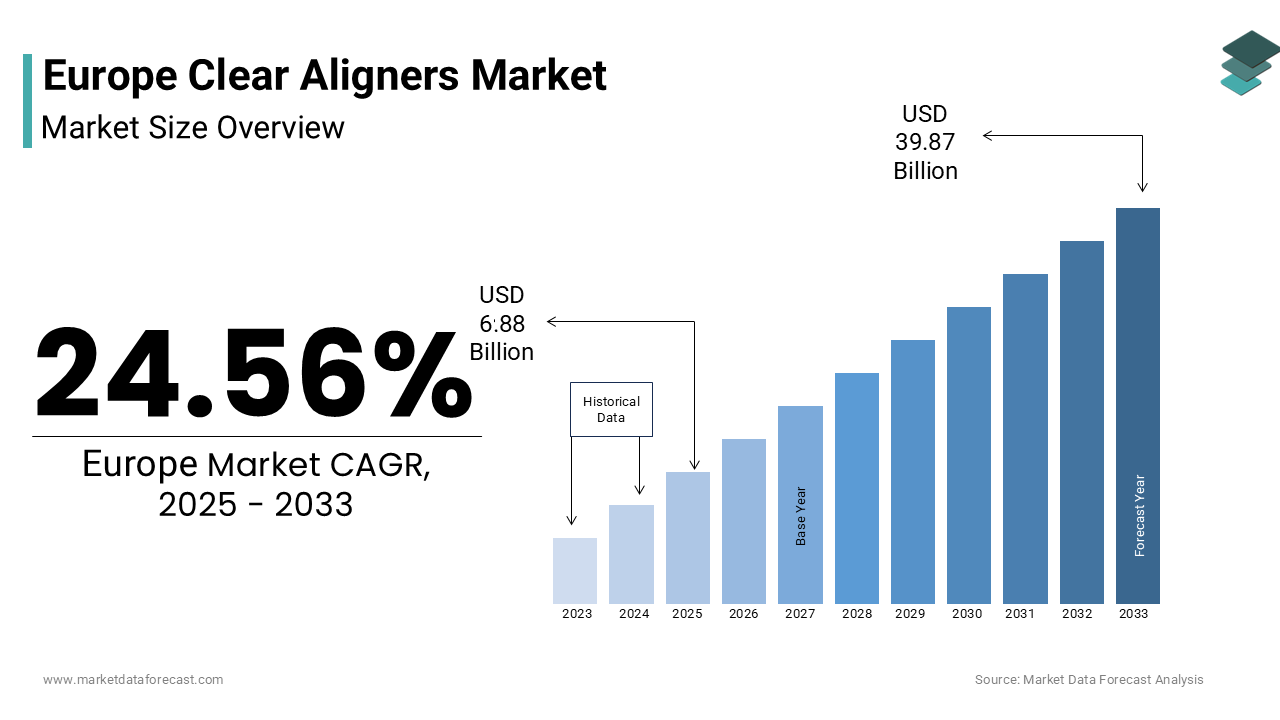
Clear aligners are digitally driven orthodontic modality comprising custom fabricated transparent polymeric trays designed to incrementally reposition teeth without fixed brackets or wires. The adoption of clear aligners is increasingly embedded within broader digital dentistry ecosystems, where artificial intelligence algorithms now predict tooth movement with sub-millimeter precision. As per the European Federation of Orthodontic Specialists Associations, approximately 38% of orthodontic practices across Western Europe integrated digital workflows by 2023 enabling end to end aligner treatment in under six weeks. The European Agency for Medical Devices classifies clear aligners as Class IIa medical devices requiring stringent conformity assessments under the Medical Devices Regulation which came into full application in May 2021. Furthermore, data from the Organisation for Economic Co-operation and Development indicates that over 65% of European adults aged 18 to 45 express dissatisfaction with dental aesthetics yet only 12% pursue orthodontic correction primarily due to visibility concerns with conventional braces.
MARKER DRIVERS
Rising Integration of Artificial Intelligence in Treatment Planning
Artificial intelligence is fundamentally reshaping treatment design accuracy and delivery speed is fuelling the growth of the Europe clear aligners market. Companies like SmileDirectClub and Dr Smile have deployed proprietary algorithms that auto generate staging sequences from intraoral scans with predictive accuracy exceeding 92% in controlled clinical validations conducted by Charité Universitätsmedizin Berlin. The European Commission’s Horizon Europe program allocated 28 million euros in 2023 to projects advancing AI in digital dentistry including real time monitoring of aligner compliance through embedded sensors. Additionally, the orthodontists using AI assisted planning achieved target occlusion in fewer aligner sets compared to conventional methods. This efficiency not only lowers material waste but also shortens treatment duration by an average of 3.2 months.
Growing Demand for Discreet Aesthetic Orthodontics Among Adults
Adults are seeking orthodontic correction without the social stigma associated with metal braces driving unprecedented demand for clear aligners. This factor is eventually to promote the growth of Europe clear aligners market. As per the data from a source, 74% of adults aged 25 to 45 consider visible dental appliances professionally disadvantageous particularly in client facing industries, such as finance and hospitality. In Sweden, where public dental subsidies cover orthodontics up to age 23 private pay adult treatments have grown at 14% annually since 2020, according to Sweden’s National Board of Health and Welfare. Furthermore, occupational health programs in the Netherlands and Switzerland now include aesthetic dental care as part of executive wellness packages accelerating corporate sector adoption.
MARKET RESTRAINTS
Stringent Medical Device Regulations Under EU MDR
The European Union’s Medical Devices Regulation imposes rigorous conformity requirements that significantly product iteration for clear aligner manufacturers is one of the major factors hampering the growth of Europe clear aligners market. Under Regulation EU 2017 745, which became fully enforceable in May 2021, all clear aligners must undergo clinical evaluation by notified bodies with demonstrable evidence of safety performance and biocompatibility. As per the European Commission, legacy aligner products failed initial certification audits in 2022 due to insufficient clinical data or inadequate post market surveillance plans. The regulation mandates Unique Device Identification implementation traceability, across the supply chain and periodic safety update reports increasing compliance costs, according to the European Association of Dental Manufacturers. Smaller European brands such as OrthoCaps and PlusDental have delayed product launches or exited certain markets due to the financial and administrative burden of MDR certification. Furthermore, the requirement for CE marking renewal every five years discourages long term investment in novel polymer formulations that may require revalidation. These regulatory hurdles not only limit innovation velocity but also favor large multinational players with established regulatory affairs infrastructure thereby reducing competitive diversity in the European clear aligners landscape.
Limited Reimbursement Coverage in Public Healthcare Systems
Public healthcare systems across most European countries exclude clear aligners from reimbursement due to their classification as cosmetic rather than medically necessary interventions. According to the European Observatory on Health Systems and Policies, only few countries offer partial public funding for clear aligners and solely under severe functional impairment criteria. In Germany, France, and Italy, national health insurers categorically deny coverage for aesthetic orthodontics leaving patients to bear full costs that typically range from 2500 to 5500 euros per treatment. Private dental insurance penetration is also low with only 29% of Europeans holding supplemental dental coverage, as per research. This reimbursement gap disproportionately affects middle income populations and stifles volume growth despite high unmet need. While some clinics offer installment plans the absence of systemic financial support constrains market democratization and reinforces clear aligners as a premium elective service rather than a mainstream therapeutic option.
MARKET OPPORTUNITIES
Expansion into Teen and Early Adolescent Segments with Compliance Monitoring
The adolescent demographic is driven by innovations in compliance tracking and parental engagement tools, which is creating new opportunities for the growth of Europe clear aligners market. Traditionally, clear aligners were deemed unsuitable for younger patients due to inconsistent wear but embedded sensors and mobile applications now verify usage in real time. Align Technology’s Teen Compliance Indicator which measures aligner wear through optical sensors has demonstrated 89% accuracy in clinical trials conducted at the University of Zurich. Germany’s statutory health insurer AOK launched a pilot program in Bavaria covering 50% of aligner costs for adolescents meeting specific occlusion criteria signaling a potential policy shift. Moreover, digital platforms now send automated alerts to parents if wear time drops below threshold enhancing accountability.
Rise of Direct to Consumer Hybrid Care Models
Hybrid care models combining telehealth consultations within person supervision by local dental professionals are unlocking new patient pools across underserved European regions. The rise of direct to consumer hybrid care models is significantly boosting the growth of Europe clear aligners market. These models leverage digital triage to reduce initial barriers of access cost and travel time particularly in Southern and Eastern Europe where orthodontist density remains low. A recent data shows that Greece Portugal and Romania have fewer than 3 orthodontists per 100000 inhabitants compared to the EU average of 8. Companies like Dr Smile and SmileDirectClub have established partner networks with over 1200 general dentists across these regions who perform scans and monitor progress while treatment planning is centralized. Regulatory acceptance is also growing with France’s National Health Authority issuing a favorable opinion on supervised remote orthodontics in early 2024.
MARKET CHALLENGES
High Incidence of Complex Malocclusions Requiring Fixed Appliances
A significant portion of European orthodontic cases involve complex malocclusions, such as severe crowding skeletal discrepancies or vertical maxillary excess that cannot be effectively addressed with clear aligners alone. The high incidences of complex malocclusions requiring fixed appliances is another factor declining the growth of Europe clear aligners market. According to the survey, approximately 42% of adolescent and adult patients present with Class II or Class III skeletal patterns necessitating skeletal anchorage or surgical intervention. A multicenter study published in the Journal of Orofacial Orthopedics in 2023 found that clear aligners achieved less planned tooth movement in cases involving molar distalization or intrusion compared to over 90% with fixed appliances. In countries like Poland and Hungary, where high prevalence of crossbites and open bites is documented by national dental health surveys aligner suitability is further limited. Orthodontists in Nordic countries report that their caseload qualifies for aligner therapy due to stringent biomechanical constraints. This clinical reality restricts market expansion to mild and moderate cases thereby capping the total addressable patient population and reinforcing reliance on traditional methods for comprehensive care.
Inconsistent Clinical Training and Treatment Outcome Variability
The rapid proliferation of clear aligner systems has outpaced standardized clinical education leading to significant variability in treatment outcomes isw another attribute degrading the growth of the Europe clear aligners market. Unlike fixed appliance therapy, which is comprehensively covered in orthodontic residency programs aligner specific training remains largely vendor driven and non-uniform. Consequently, complication rates including root resorption incomplete space closure and posterior open bites are rising with the increase in retreatment referrals linked to inadequate aligner planning between 2020 and 2023. In Spain, the General Council of Dentists issued a warning in 2023 about unqualified practitioners using direct to consumer aligner kits without proper diagnosis.
REPORT COVERAGE
| REPORT METRIC | DETAILS |
| Market Size Available | 2025 to 2034 |
| Base Year | 2025 |
| Forecast Period | 2026 to 2034 |
| Segments Covered | By Age Group, End-User & Region. |
| Various Analyses Covered | Global, Regional & Country Level Analysis, Segment-Level Analysis, DROC, PESTLE Analysis, Porter’s Five Forces Analysis, Competitive Landscape, Analyst Overview on Investment Opportunities |
| Regions Covered | United Kingdom, France, Spain, Germany, Italy, Russia, Sweden, Denmark, Switzerland, the Netherlands, Turkey, and the Czech Republic. |
| Key Market Players | Align Technology, Institut Straumann AG, Dentsply Sirona, 3M Company, Ormco Corporation (Envista Holdings), Argen Corporation, K Line Europe GmbH, Dentaurum GmbH & Co. KG, Prodways, ALS Dental, DMU Dental Manufacturing Unit GmbH, Prismlab China Ltd., SmileDirectClub, PlusDental, and Orthoclear. |
SEGMENTAL ANALYSIS
By Age Group Insights
The adults segment held a significant share of the Europe clear aligners market in 2025 with the strong aesthetic preferences professional image considerations and greater disposable income among working age populations. Adults aged 25 to 45 represent the core consumer base, as they seek discreet orthodontic solutions without compromising career or social interactions. The psychological dimension is equally influential with a University of Milan longitudinal study finding that 72% of adult users reported measurable improvements in self-esteem and social confidence within the first three months of treatment. Additionally, rising awareness through digital marketing and social media has normalized adult orthodontics shifting it from a niche pursuit to a mainstream wellness investment. Employer sponsored dental benefits in countries like Switzerland and the Netherlands increasingly include aesthetic treatments further supporting adult adoption.
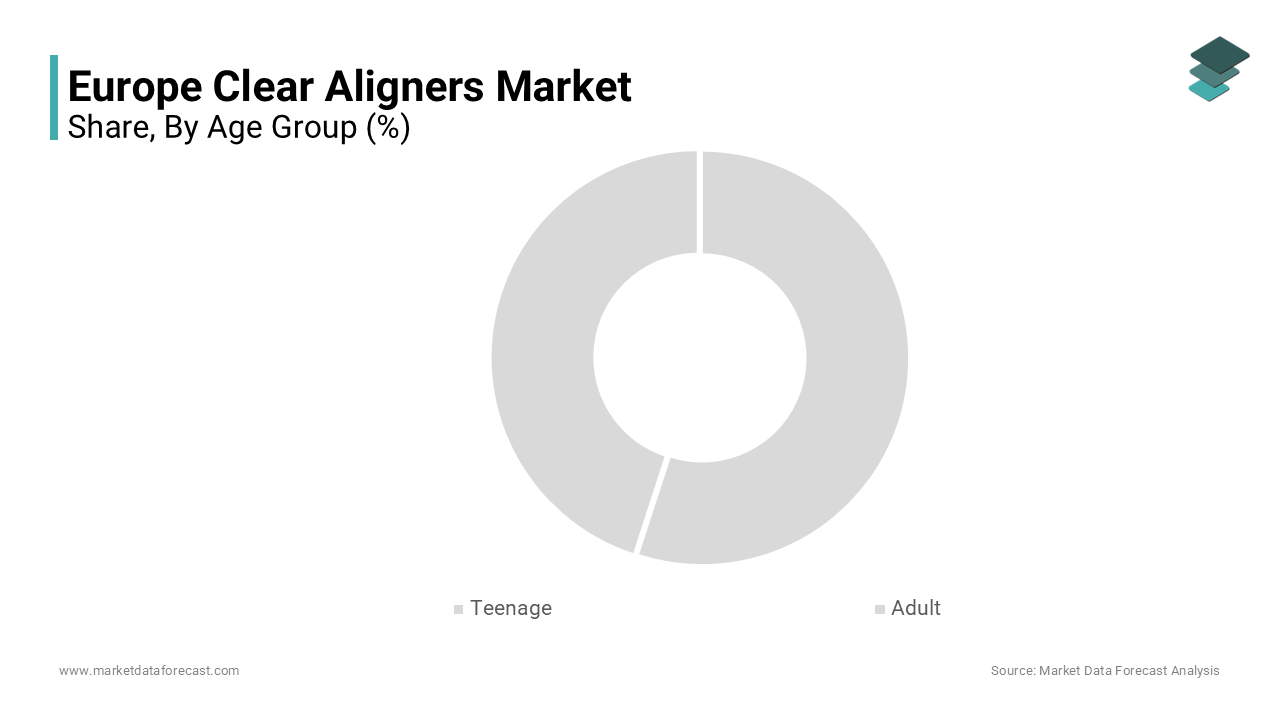
The teenager segment is projected to witness a fastest CAGR of 12.4% from 2026 to 2034 from advancements in compliance monitoring technologies and evolving clinical guidelines that now endorse aligners for adolescents with mild to moderate malocclusions. The British Orthodontic Society updated its 2023 treatment protocols to recognize clear aligners as a valid first line option for Class I cases in patients aged 12 to 17 provided wear time exceeds 20 hours per day. Embedded sensor technology, such as Align Technology’s Teen Compliance Indicator has demonstrated 88% accuracy in verifying actual usage, according to some studies. Furthermore, public awareness campaigns in Scandinavia have reframed orthodontics as part of adolescent health rather than purely cosmetic care.
By End User Insights
The dentist and orthodontist segment was accounted in holding a prominent share of the Europe clear aligners market in 2025. This overwhelming share reflects the regulatory and clinical gatekeeping role of licensed professionals in treatment planning diagnosis and oversight. Unlike direct-to-consumer models, which require in person verification under the EU Medical Devices Regulation most patients still initiate care through established dental clinics where trust clinical history and comprehensive oral health assessment are prioritized. In France, Germany, and Italy, over 85% of aligner treatments originate from private orthodontic practices. These clinics benefit from integrated digital workflows including intraoral scanners chairside design software and 3D printers enabling end to end treatment customization. Moreover, continuing education programs offered by national dental associations have significantly enhanced practitioner competency in aligner biomechanics.
The “Others” segment is likely to grow at fastest CAGR of 14.7% from 2026 to 2034, which is stated business models that combine centralized treatment planning with localized clinical supervision to serve price sensitive and geographically dispersed populations. Companies like Dr Smile and Mylène have established networks of over 900 affiliated general dentists, across Southern and Eastern Europe, where orthodontist density remains critically low. These hybrid models reduce initial consultation costs by 35 to 40% and cut treatment initiation time by nearly two thirds compared to traditional pathways, as documented in a 2024 University of Barcelona health economics study. Regulatory acceptance is also increasing with France’s National Health Authority issuing a favorable opinion on supervised remote orthodontics in early 2024.
REGIONAL ANALYSIS
Germany Clear Aligners Market Analysis
Germany was the top performer of the Europe clear aligners market at an estimated share of 21.3% of share in 2025 from high health literacy advanced digital dentistry infrastructure and strong patient willingness to invest in aesthetic oral care. German orthodontic practices utilize intraoral scanners and AI powered treatment planning, as confirmed by the 2023 Digital Dentistry Barometer published by the University of Heidelberg. Although public health insurance does not cover clear aligners for adults a robust private insurance ecosystem with supplementary policyholders enables broad access. The German Society of Orthodontics has also established rigorous certification standards for aligner providers ensuring clinical quality and reducing complication rates. Furthermore, Germany hosts Europe’s largest dental technology trade fair IDS in Cologne, which serves as a launchpad for aligner innovation and professional education.
United Kingdom Clear Aligners Market Analysis
The United Kingdom was positioned second by holding 17.3% of Europe clear aligners market share in 2025 with a dual system where NHS orthodontics prioritize functional cases for patients under 18, while private providers cater to aesthetic demand across all age groups. London and the South East account for nearly 40% of national aligner volume driven by high disposable income and cosmopolitan attitudes toward dental aesthetics. The Care Quality Commission’s 2023 regulatory update mandated stricter oversight of direct to consumer aligner companies requiring in person clinical assessments before treatment commencement thereby reinforcing the role of licensed practitioners. Additionally, UK dental schools have integrated aligner therapy into postgraduate curricula with King’s College London launching a dedicated digital orthodontics fellowship in 2024.
France Clear Aligners Market Analysis
France clear aligners market growth is likely to grow at prominent CAGR from 2026 to 2034 owing to the strong cultural emphasis on dental aesthetics with 68% of adults rating smile appearance. Although, public reimbursement is limited private dental insurance penetration exceeds 95% enabling widespread adoption of premium orthodontic services. Paris Lyon and Marseille host over 1200 certified aligner providers many of whom collaborate with tech firms to offer real time treatment monitoring via mobile applications. In 2024, the French National Health Authority issued formal guidance endorsing hybrid care models that combine teleconsultations with in clinic checkups for low-risk cases. Additionally, the country is home to several European headquarters of global aligner brands, which drive localized product innovation such as thinner polymer formulations suited to French facial morphology.
Italy Clear Aligners Market Analysis
Italy clear aligners market growth is propelled by a deeply ingrained aesthetic consciousness particularly in urban centers, such as Milan Rome and Turin where smile enhancement is closely tied to social and professional identity. Italian manufacturers have also pioneered biodegradable aligner materials derived from castor oil which appeal to environmentally conscious consumers. Furthermore, the Italian Medicines Agency has streamlined CE certification for domestically produced aligners accelerating time to market for local innovators. This fusion of cultural demand environmental innovation and agile regulation positions Italy as a distinctive and expanding market node.
KEY MARKET PLAYERS
Some of the companies that are playing a dominating role in the Europe Clear Aligners Market include
- Align Technology, Inc.
- Institut Straumann AG
- Dentsply Sirona
- 3M Company
- Ormco Corporation (Envista Holdings)
- Argen Corporatio
- K Line Europe GmbH
- Dentaurum GmbH & Co. KG
- Prodways
- ALS Dental
- DMU Dental Manufacturing Unit GmbH
- Prismlab China Ltd.
- SmileDirectClub, Inc.
- PlusDental
- Orthoclear
MARKET SEGMENTATION
This research report on the europe clear aligners market has been segmented and sub–segmented into the following categories.
By Age Group
- Teenage
- Adult
By End User
- Dentist & Orthodontist Owned Practices
- Others
By Country
- UK
- France
- Spain
- Germany
- Italy
- Russia
- Sweden
- Denmark
- Switzerland
- Netherlands
- Turkey
- Czech Republic
- Rest of Europe