- Product Description Description
- Table of Contents TOC
- List of Table & Figure LOT
- Get Free Sample PDF Sample PDF
Market Size, 2025
$4506.2 MnMarket Estimate, 2026
$5109.13 MnMarket Forecast, 2034
$13.952.6 MnCAGR, 2026–2034
13.38%Executive Summary: Europe Cloud Security Market
- Market Scope: Comprehensive European cloud security industry analysis covering component types (solutions, services), deployment models (hybrid cloud), vertical end-use sectors (BFSI), regional leadership frameworks, strategic corporate developments, and competitive landscapes.
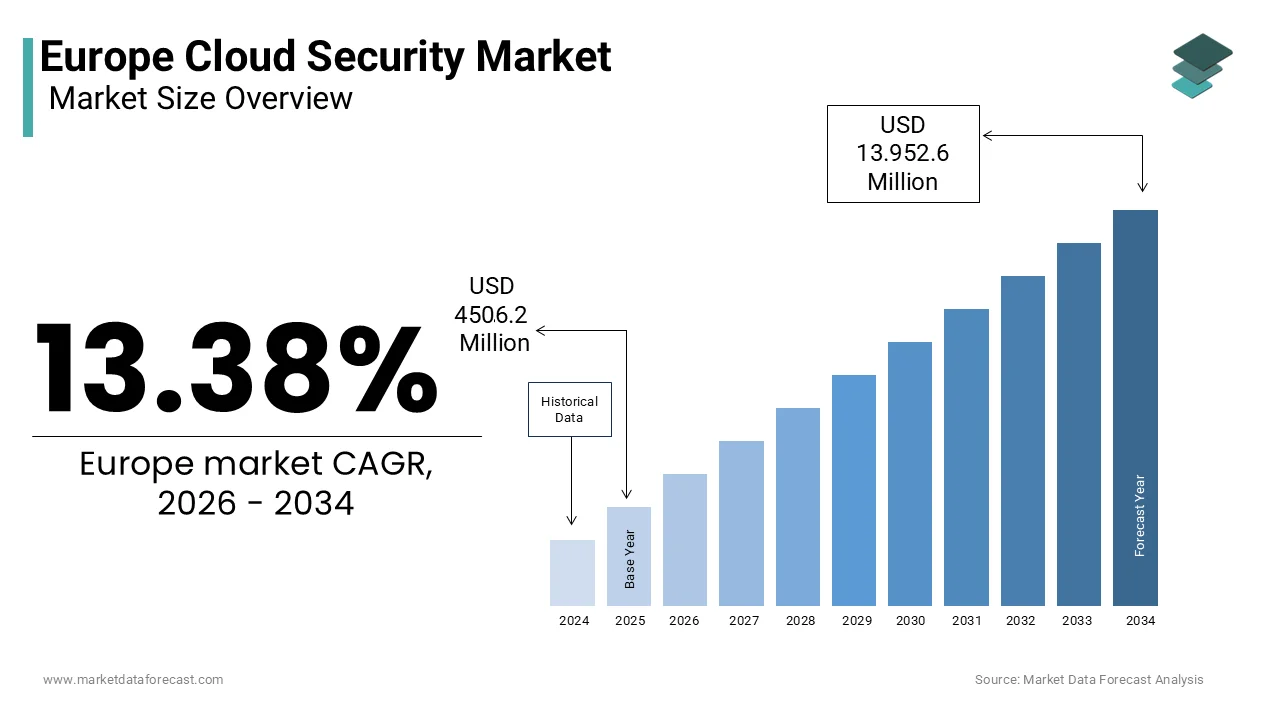
- Market Valuation: Valued at USD 4506.2 million (2025), estimated at USD 5109.13 million (2026), and projected to reach USD 13,952.6 million by 2034, registering a robust CAGR of 13.38% (2026–2034).
- Primary Growth Drivers: NIS2 Directive and Cyber Resilience Act compliance, identity-centric threats, cloud workload protection, Gaia-X aligned federated infrastructures, and AI-driven security operations centers. Restraints include multi-cloud misconfigurations and cross-border data transfer geopolitics.
Key Market Segment Metrics (2026–2034)
| Category | Leading Segment / Region (Position) | Fastest-Growing Segment |
|---|---|---|
| By Component & Deployment | Solutions segment (dominated with 62.3% share in 2024) & Hybrid cloud (captured 48.6% deployment share via digital sovereignty priorities) | Services segment (projected to witness the highest CAGR of 21.8% from 2025 to 2033) |
| By End-Use Industry | Banking, financial services, and insurance (BFSI occupied 29.4% of end-use share in 2024) | Sectors scaling digital sovereignty, AI-driven security operations, and multi-cloud workload protection |
| By Region / Country | Germany (led regionally with 23.1% share in 2024) & United Kingdom (18.9% share) | France (identified as the most lucrative region driven by state-led digital sovereignty policies) |
Major Market Players & Market Structure
Market Structure: Highly strategic European cybersecurity ecosystem driven by regulatory compliance mandates (GDPR, NIS2, Cyber Resilience Act), sovereign cloud region establishments by hyperscalers, and integrated security platforms (Azure Defender, AWS sovereign infrastructure, Google Cloud EU Data Residency).
Key Companies: Cisco Systems Inc., IBM Corporation, Palo Alto Networks Inc., Check Point Software Technologies Ltd., Fortinet Inc., Broadcom Inc. (Symantec Enterprise Division), McAfee Corp., Trend Micro Incorporated, Microsoft Corporation, Amazon Web Services Inc., Oracle Corporation, Google LLC, Zscaler Inc., CrowdStrike Holdings Inc., Sophos Group plc, Proofpoint Inc., Okta Inc., F5 Networks Inc., Imperva Inc., and Forcepoint LLC.
Europe Cloud Security Market Size
The europe cloud security market was valued at USD 4506.2 million in 2025 and is projected to reach USD 13.952.6 million by 2034, increasing from USD 5109.13 million in 2026, growing at a CAGR of 13.38% during the forecast period from 2026 to 2034.
Cloud security refers to the technologies, processes, and policy frameworks designed to protect data, applications, and infrastructure hosted in cloud environments across the Economic Area. Unlike other regions where cloud adoption follows a linear scalability model, Europe’s cloud security landscape is uniquely shaped by a triad of digital sovereignty mandates, strict data protection laws, and fragmented national cyber strategies. According to a 2023 Eurostat report, 45% of EU businesses use cloud services, with 78% of large enterprises adopting them. EU businesses broadly use cloud services but often grapple with subpar security, making them prime targets for increasingly sophisticated cybercriminals who exploit vulnerabilities like misconfigured cloud storage and identity access management (IAM) layers. In response, the European Commission’s Cyber Resilience Act (CRA) is a key legislative measure that compels manufacturers and vendors of products with digital elements (including certain software and potentially cloud-related components) to embed security by design throughout the product lifecycle to enhance overall digital resilience across the single market This confluence of technological dependency legal accountability and geopolitical risk defines cloud security in Europe not as an IT function but as a foundational pillar of economic resilience and democratic integrity.
MARKET DRIVERS
Mandatory Compliance with the NIS2 Directive and Cyber Resilience Act
The enforcement of the NIS2 Directive and the Cyber Resilience Act has encouraged the growth of the European cloud security market. The surge in investment for cloud security adoption is a result of legally obligating essential entities to implement robust protective measures. According to the European Commission, the NIS2 Directive significantly expands cyber risk management obligations to over 100,000 additional organizations across critical sectors like energy, transport, health, and digital infrastructure, among others. Entities must implement a range of technical and organizational measures, including multi-factor authentication (MFA) and data encryption in transit and at rest, and follow a strict multi-stage incident reporting process that begins with an early warning within 24 hours of becoming aware of a significant incident. Concurrently, the Cyber Resilience Act requires all digital products with cloud connectivity sold in the EU to undergo security assessments throughout their lifecycle, le with manufacturers liable for vulnerabilities arising from poor design. This regulatory compulsion has transformed cloud security from an optional enhancement into a legal necessity, thereby structurally expanding demand across public and private sectors.
Surge in Identity-Based Cloud Attacks Targeting Hybrid Workforces
The dramatic shift to hybrid and remote work models has intensified reliance on identity and access management as the primary security perimeter in cloud environments, and this, in turn, is triggering widespread investment in advanced cloud security controls and is another factor bolstering the expansion of the European cloud security market. Phishing and credential theft are increasingly the primary methods for initial breaches in cloud incidents across the EU. A significant portion of attempted financial fraud stems from compromised employee identities used to access cloud-based systems. A majority of European employees are using unauthorized cloud applications to bypass perceived inefficiencies in official corporate tools. In response, organizations are deploying cloud workload protection platforms with behavioral analytics and just-in-time access provisioning to detect anomalous logins and privilege escalations. European enterprises are dramatically increasing the enforcement of conditional access policies. This identity-centric threat landscape has made cloud security indispensable not as a backend safeguard but as a frontline defense against workforce-enabled breaches.
MARKET RESTRAINTS
Limited Availability of Sovereign Cloud Security Skills
A severe shortage of professionals skilled in both cloud architecture and specific regulatory compliance creates implementation delays and configuration vulnerabilities, hindering the growth of the European cloud security market. This scarcity is compounded by the fact that global cloud certifications, such as those from AWS or A, do not cover Europe’s unique legal requirements, including data localization under Article 44 of the General Data Protection Regulation or the Cyber Resilience Act’s conformity assessments. As per sources, only a portion of cloud security practitioners in Europe possess formal training in both technical cloud controls and EU cyber law. Consequently, organizations frequently misconfigure sovereign cloud environments or delay deployments due to internal capability gaps. Startups and public sector bodies are disproportionately affected. The skills disparity will continue to diminish the effectiveness of the most advanced cloud security technologies unless there is coordinated upskilling through national cyber academies or vendor compliance programs.
Fragmented National Implementation of EU Cyber Directives
Friction from inconsistent national transposition and enforcement of directives such as NIS2 leads to compliance uncertainty and operational inefficiency, despite harmonized EU legislation, which holds back the expansion of the European cloud security market. The legislative dissonance forces multinational enterprises to maintain multiple cloud security postures within a single regulatory bloc. For instance, a logistics company operating in both Germany and Poland may face mandatory encryption of cloud backups in one country but only recommended guidelines in another. Moreover, national cyber agencies such as France’s ANSSI and Germany’s BSI issue conflicting technical standards for cloud incident reporting formats and vulnerability disclosure timelines. This fragmentation not only increases legal risk but also discourages smaller cloud providers from offering pan-European services due to unpredictable compliance overhead, thereby stifling competition and innovation in the market.
MARKET OPPORTUNITIES
Deployment of Gaia X Aligned Federated Cloud Infrastructures
The emergence of Gaia X-inspired federated cloud ecosystems creates an opportunity for the growth of the European cloud security market. This provides a strategic opportunity for cloud security innovation by embedding trust, interoperability, and data control into infrastructure design. Unlike traditional public clouds, Gaia X compliant platforms enable European organizations to share computing resources while retaining sovereignty over data location, access policies, and audit rights. Gaia-X's move from perimeter-based security to a data-centric governance model is driving the need for next-generation cloud security tools that emphasize verifiable compliance over reactive threat detection. This infrastructure-level engineering positions Europe to lead in trustworthy cloud services aligned with its digital sovereignty ambitions.
Integration ofAI-Drivenn Security Operations Centers
The adoption of artificial intelligence in European security operations centers is opening new efficiencies in cloud threat detection and response, which is generating a potential growth prospect for the European cloud security market. Unlike rule-based legacy systems AI AI-powered platforms can analyze petabytes of cloud telemetry across identity workloads and network flows to identify subtle anomalies indicative of zero-day exploits or insider threats. Importantly, these systems are being designed with EU-specific constraints such as algorithmic transparency under the AI Act and GDPR compliant data handling, ensuring that automation does not compromise fundamental rights. This convergence of automation, accountability, and speed is transforming security operations from cost centers into strategic assets capable of enabling secure digital transformation at scale.
MARKET CHALLENGES
Proliferation Multi-Cloud Misconfigurations
The rapid adoption of multi-cloud and hybrid environments in the continent has led to an alarming rise in security misconfigurations that expose sensitive data and vital workloads to unauthorized access and thereby constrain the growth of the European cloud security market. According to a 2024 Gartner report, over 99 percent of cloud breaches through 2025 are predicted to be due to preventable misconfigurations, not flaws in the underlying cloud platform. The complexity is exacerbated by inconsistent security controls across AWS, Azure, and Google Cloud, which require specialized expertise to harmonize. As per sources, the use of multi-cloud environments is a growing trend among European enterprises. The complexity of these environments often leads to visibility gaps and an increased risk during configuration and management. This fragmentation results in visibility gaps where security teams cannot enforce consistent policies across environments. The healthcare sector is particularly vulnerable. Enterprises cannot rely solely on perimeter defenses. They remain exposed to significant risks without standardized configuration baselines and automated drift detection. The dynamic nature of cloud infrastructure ensures this challenge will persist unless addressed through architecture-level governance and continuous compliance validation.
Geopolitical Pressures on Cross-Border Data Flows
Geopolitical tensions are intensifying regulatory scrutiny over transatlantic and global data transfers, which is creating a persistent challenge for the European cloud security market. Following the invalidation of the Privacy Shield framework and ongoing concerns about US surveillance laws, European data protection authorities have restricted transfers of personal data to non-EU jurisdictions unless stringent supplementary measures are implemented. This forces European organizations to either localize data in EU-based cloud regions, which are still limited in availability for certain services, or implement complex encryption and key management schemes that degrade performance. Moreover, emerging export controls on cryptographic technologies could restrict the use of advanced cloud security tools developed outside the EU. These geopolitical constraints transform cloud security from a technical discipline into a geopolitical negotiation where architecture decisions carry legal and strategic consequences beyond cybersecurity.
REPORT COVERAGE
| REPORT METRIC | DETAILS |
| Market Size Available | 2024 to 2033 |
| Base Year | 2024 |
| Forecast Period | 2025 to 2033 |
| Segments Covered | By Component, Deployment, End Use, and Region. |
| Various Analyses Covered | Global, Regional, and Country-Level Analysis, Segment-Level Analysis, Drivers, Restraints, Opportunities, Challenges; PESTLE Analysis; Porter’s Five Forces Analysis, Competitive Landscape, Analyst Overview of Investment Opportunities |
| Countries Covered | UK, France, Spain, Germany, Italy, Russia, Sweden, Denmark, Switzerland, Netherlands, Turkey, Czech Republic, Rest of Europe |
| Market Leaders Profiled | Cisco Systems, Inc., IBM Corporation, Palo Alto Networks, Inc., Check Point Software Technologies Ltd., Fortinet, Inc., Broadcom Inc. (Symantec Enterprise Division), McAfee Corp., Trend Micro Incorporated, Microsoft Corporation, Amazon Web Services, Inc. (AWS), Oracle Corporation, Google LLC, Zscaler, Inc., CrowdStrike Holdings, Inc., Sophos Group plc, Proofpoint, Inc., Okta, Inc., F5 Networks, Inc., Imperva, Inc., Forcepoint LLC. |
SEGMENTAL ANALYSIS
By Component Insights
The solutions segment held the majority share of 62.3% of the European cloud security market in 2024. Their foundational role in enforcing data protection, accecontrollr,,l and threat prevention across cloud environments is boosting the expansion of the solutions segment. In addition, a further growth factor of this segment is the regulatory mandate for technical safeguards under the General Data Protection Regulation and the NIS2 Directive, which requires encryption, identity governance, and logging capabilities that only specialized security software can deliver. According to research, a significant share of data protection violations in settings stems from absent or misconfigured security controls, which prompts enterprises to prioritize solution deployment over advisory services. The second factor is the rise of automated threat landscapes. Unlike services that provide episodic solutions, it provides continuous real-time defense that scales with cloud adoption. This operational imperative, combined with vendor bundlicompliance-readydyy features, has cemented solutions as the structural backbone of Europe’s cloud security posture.
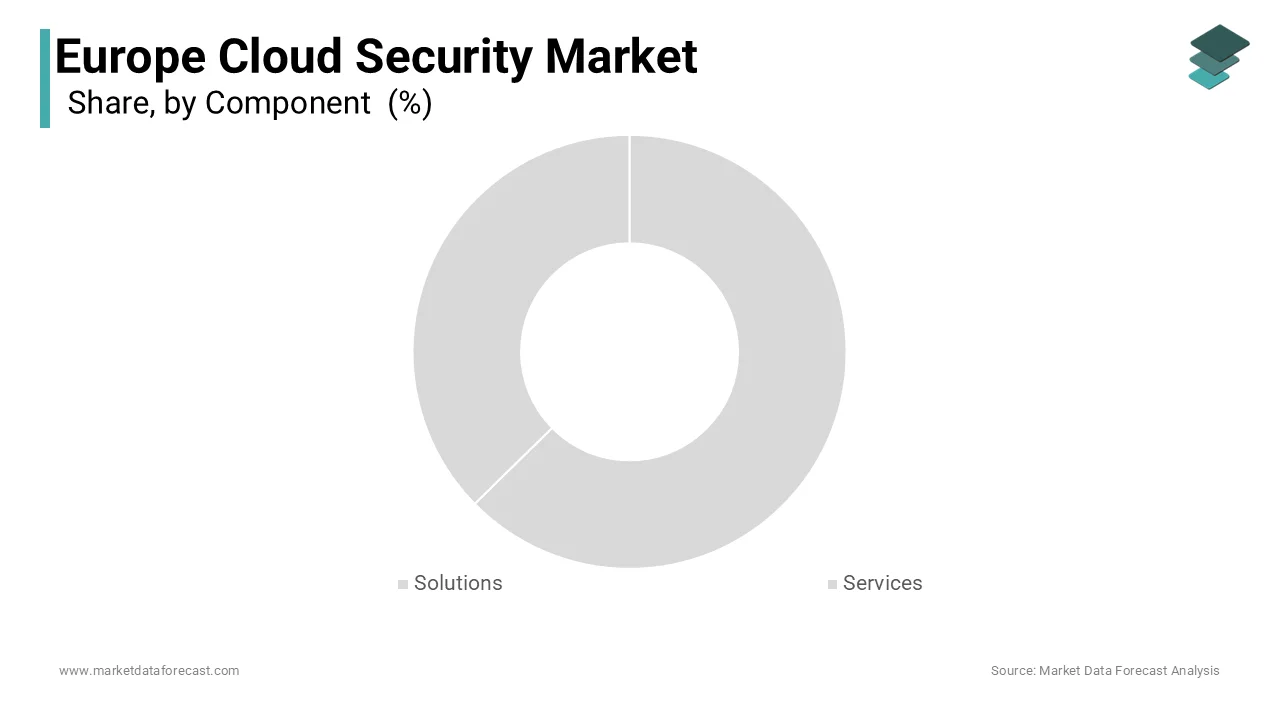
The services segment is predicted to witness the highest CAGR of 21.8% from 2025 to 2033. The rapid growth of the services segment is driven by acute skills shortages and the complexity of sovereign cloud compliance. European organizations increasingly rely on managed detection and response consultants and implementation partners to navigate the technical nuances of EU-specific requirements as data localization under the Cyber Resilience Act or audit trails mandated by national cyber agencies. According to sources, a portion of enterprises lack internal teams capable of configuring GaiaX-aligned security policies or validating cross-border data transfer mechanisms. This capability gap has fuelled demand for specialized cloud security advisory and managed services. A different driver is the operational burden of multi-cloud environments. Significant European Commission allocations for upskilling and public body service procurement are transforming cybersecurity from a mere support role into a strategic driver for compliant cloud adoption.
By Deployment Insights
The hybrid cloud segment t the European cloud security market by capture a 48.6% share in 2024. The dominance of the hybrid cloud segment is because of its alignment with Europe’s dual priorities of digital transformation and data sovereignty. According to studies, a share of critical infrastructure operators, including energy grids and healthcare systems, retain sensitive workloads on private infrastructure while using public clouds for analytics and collaboration, necessitating layered security across both environments. A different driver of this segment is regulatory pragmatism. Unlike pure public cloud adp t, which faces scrutiny under GDPR Article44,, hybrid deployment allows enterprises to satisfy legal obligations without sacrificing scalability. This architectural preference has made hybrid cloud not merely a technical choice but a compliance strategy by securing iits marketleadership.
The private cloud segment is estimated to register the fastest CAGR of 23.1% over the forecast period, owing to national digital sovereignty initiatives and sector-specific data sensitivity. Governments and defense entities are leading this shift. A further accelerator of this segment is the healthcare sector’s response to the European Health Data Space Regulation, which requires strict control over patient data provenance and processing location. Thesplatforms incorporate hardware-based execution environmentsts and logging to meet high assurance security standards. Apart from these, the Gaia X framework incentivizes private cloud federation among industrial cons or, tia enabling secure data sharing without third-party exposure. The emphasis on vendor accountability within the Cyber Resilience Act, combined with rising global tensions, is making the private cloud a strategic necessity, rather than just a niche choice, for risk-conscious industries.
By End-use Insights
The banking, financial services, and insurance segment of the European cloud security market occupied a 29.4% share in 2024. The dominance of the banking, financial services, and insurance segment is attributed to its combination of stringent regulations, high digital transaction volumes, and sensitive data assets. A different driver of this segment is the European Central Bank’s operational resilience framework, which mandates that all significant institutions implement real-time cloud security monitoring for customer data and payment systems. The sector’s early adoption of open banking under the Revised Payment Services Directive, which exposes customer data to third-party providers vAPIsAIs therebyeby expanding the threat surface, also propels the expansion of this segment. This regulatory density, combined with reputational risk from breaches, ensures BFSI remains a security-intensive investment-ready vertical in the European cloud landscape.
The healthcare segment is anticipated to witness the fastest CAGR of 25.3% from 2025 to 2033 due to factors such as the digitalization of patient records and the rollout of the European Health Data Space. The European Health Data Space (EHDS) Regulation, which entered into force on March 26, 2025, mandates the phased implementation of cross-border access to health data. Key data categories like patient summaries and e-prescriptions must be exchangeable across all EU member states by March 2029, with other data (medical images, lab results) following by March 2031. The rise of connected medical devices is also among the key drivers of this segment. Cloud security is an existential requirement for healthcare organizations, primarily because patient information is classified as highly sensitive by the General Data Protection Regulation, which carries severe penalties of up to 4% of annual worldwide revenue for non-compliance.
COUNTRY LEVEL ANALYSIS
Germany Cloud Security Market Analysis
Germany outperformed other countries in the European cloud security market and accounted for a 23.1% share in 2024. The supremacy of the German market is mainly driven by its industrial strength, data protection, and leadership in digital sovereignty. The country’s implementation of the Federal Data Protection Act sets stricter cloud data handling standards than the EU baseline, compelling local and multinational firms to adopt advanced encryption and access controls. The GAIA X Initiative, headquartered in Berlin, has catalyzed collaboration among Sieme, Boc,h, and Deutsche Telekom to build federated cloud environments with embedded security by design. This blend of industrial demand and global growth and hanadvancednovation, solisolidifiesmany’s leadership in shaping Europe’s cloud security trajectory.
United Kingdom Cloud Security Market Analysis
The United Kingdom maintained a strong presence in Europe’s cloud security market by capturing 18.9% share in 2024. Its mature fintech ecosystem, advanced cyber defense institutions, and agile regulatory approach have contributed to the growth of the UK market. The UK’s National Cyber Security Centre operates one of Europe’s most active threat intelligence units, publishing weekly advisories on cloud misconfigurations affecting British enterprises. The country’s Data Protection and Digital Information introduces enhanced accountability for cloud data processors while preserving alignment with EU standards through adequacy decisions. Moreover, London’s concentration of global cloud hyperscalers and cybersecurity startups creates a dense innovation cluster for zero-trust and confidential computing solutions. A Tcocombinationblic-privateateate vigvigilancecenceconnectivityonnectiv,ity and legal clarity ensures the UK remains a pivotal node in Europe’s cloud security architecture.
France Cloud Security Market Analysis
France is expected to be the most lucrative region in the European cloud security market because of state-led digital sovereignty and defense-oriented cloud policies. The French National Cybersecurity Agency mandates that all ministries and state-owned enterprises use ANSSI-certified cloud providers such as OVHcloud or Scale, which implement sovereign encryption key management and air-gapped logging. A further aspect contributing to the country’s growth is its leadership in secure health data exchange. France’s investment in AI sovereignty through the supercomputer also includes secure cloud sandboxes for training sensitive models. These initiatives reflect a national doctrine where cloud security is inseparable from technological independence and public trust.
Netherlands Cloud Security Market Analysis
The Netherlands grew steadily in the European cloud security market due to its advanced digital government infrastructure as a data transit hub and progressive cyber governance. As per sources, the Dutch public sector is extensively adopting the Secure Cloud for Government platform, which enforces mandatory security labeling and third-party audits to ensure robust security. The country hosts major European datacenters for Google and Microsoft, et maintains strict oversight through the Dutch Data Protection Authority w which actively enforces the General Data Protection Regulation (GDPR), imposing fines on cloud providers for inadequate breach notifications. An additional key growth factor is that key industries, such as the Port of Rotterdam, utilize secure multi-cloud logistics platforms to protect sensitive data across extensive networks of trading partners. According to research, the Netherlands is a primary European hub for numerous US cloud security vendors, indicating a strong international presence in the cybersecurity market. This strategic positioning as a trusted digital gateway amplifies its market influence beyond its size.
Sweden Cloud Security Market Analysis
Sweden is anticipated to grow in the European cloud security market during the forecast period, owing to an innovation-driven public sector and early adoption of ethical AI, climate-conscious digital policies. The Swedish Civil Contingencies Agency (MSB) strongly recommends cyber resilience testing for critical infrastructure operators, and has pointed out that many public organizations still need to improve their foundational cybersecurity. The European Union Agency for Cybersecurity (ENISA) promotes cyber stress testing as a key regulatory tool to improve resilience across critical sectors. A distinctive feature is the integration of sustainability into cloud security design. Sweden’s leadership in green tech extends to confidential computing, which reduces data replication and energy waste. Apart from these, the country’s robust whistleblower protections and transparent procurement laws that foster trust in public cloud deployments.
COMPETITIVE OVERVIEW
Competition in the European cloud security market is defined by a convergence of global technology leadership and regional regulatory specificity. Unlike other markets where performance and scalability dominate competitive dynamics, Europprioritizcompliancece iadatasovereigntyey and ethical design as core differentiators. The presence of US based hyperscalers such as Microsoft Amazon Web Ser, vices and Google Cloud is balanced by the emergence of European sovereign providers like OVHcloud,ud Deutsche Telekom,o,m, and others, which leverage local trust and legal alignment. This duality fosters a hybrid competitive landscape where innovation must satisfy both technical excellence and stringent legal mandates under the Cyber Resilience Act and NIS2 Directive. Startups further disrupt the space with niche solutions in confidential computingutilizinggg identity threat detection and automated policy enforcement. The result is a fragmented, high-integrity market where competitive advantage stems not from market size but from demonstrable adherence to Europe’s digital sovereignty ethos and ability to operationalize complex regulatory requirements into secure, scalable cloud architectures.
KEY MARKET PLAYERS
Some of the companies that are playing a dominating role in the global European cloud security market include
- Cisco Systems, Inc.
- IBM Corporation
- Palo Alto Networks, Inc.
- Check Point Software Technologies Ltd.
- Fortinet, Inc.
- Broadcom Inc. (Symantec Enterprise Division)
- McAfee Corp.
- Trend Micro Incorporated
- Microsoft Corporation
- Amazon Web Services, Inc. (AWS)
- Oracle Corporation
- Google LLC
- Zscaler, Inc.
- CrowdStrike Holdings, Inc.
- Sophos Group plc
- Proofpoint, Inc.
- Okta, Inc.
- F5 Networks, Inc.
- Imperva, Inc.
- Forcepoint LLC
TOP LEADING PLAYERS IN THE MARKET
- Microsoft plays a central role European cloud security market through its Azure cloud platform, which integrates comprehensive security services such as Azure Defender for Cloud, Azure Ke,y Vault, and confidential computing capabilities. The company actively aligns its offerings with EU regulations, including the General Data Protection Regulation and the Cyber Resilience Act, by implementing data residency controls and sovereign cloud regions in Germany, France, and Sweden. It also collaborates with national cyber agencies to support incident response and threat intelligence sharing. These actions reinforce Microsoft’s commitment to building trust and resilient cloud security infrastructure tailored to Europe’s legal and geopolitical context while contributing to global standards in secure cloud architecture.
- Amazon Web Services significantly influences the European cloud security market by offering a broad suite of security services, including AWS Identity MManagManagementred to multi-cloud and hybrid environments. AWS has strengthened its European presence by expanding sovereign cloud infrastructure with regions in Spain, Italy, and the upcoming Zurich, Switzerland, ensuring data localization and compliance with national cyber laws. The company recently introduced the European Sovereign Cloud Blueprint to help public sector and regulated industries meet NIS2 and GDPR requirements. AWS also partners with cybersecurity firms and participates in U-funded initiatives like GAIA X to promote interoperable and secure data spaces. These strategic moves demonstrate AWS’s dedication to embedding regulatory adherence and data sovereignty into its global cloud security framework while addressing Europe’s unique risk landscape.
- Google Cloud contributes European cloud security market through its focus on zero trust architecture, confidential computiAI-driven driven threat detection via services like BeyondCorp Enterprise and Chronicle Security. The company has reinforced its European operations by opening data centers in Berlin and Turin and launching the EU Data Residency and SovereigntyPogram which guarantees customer data remains within EU borders. Collaborations with European research institutions and participation in the EU’s Cybersecurity Competence Network further underscore its investment in regionally attuned security innovation. These efforts position Google Cloud as a key enabler of secure digital transformation aligned with Europe’s values of privacy,acy transpar, and technological autonomy.
TOP STRATEGIES USED BY THE KEY MARKET PARTICIPANTS
Key players in the European cloud security market employ strategies centered on regulatory alignment, ent data sovereignty, a nd public-private collaboration. They establish sovereign cloud regions within the European Union to ensure data residency and compliance with the General Data Protection Regulation and NIS2 Directive. Companies embed regulatory requirements directly into product architecture through features like EU data boundaries, confidential computing, and automated compliance reporting. Strategic partnerships with national telecom providers, research institutions, and cyber agencies enabco-developmentent of secure data spaces and threat intelligence sharing. Additionally, vendors invest in local talent and open-source initiatives to build trust and foster ecosystem resilience. These approaches reflect a shift from globone-size-fits-allilregion-specificion specific security frameworks that prioritize legal accountability and digital autonomy.
MARKET SEGMENTATION
This research report on the europe cloud security market is segmented and sub-segmented into the following categories.
By Component
- Solutions
- Services
By Deployment
- Public Cloud
- Private Cloud
- Hybrid Cloud
By End Use
- Banking, Financial Services, and Insurance (BFSI)
- Healthcare
- IT & Telecommunications
- Government & Defense
- Others
By Country
- Germany
- United Kingdom
- France
- Netherlands
- Sweden
- Rest of Europe