- Product Description Description
- Table of Contents TOC
- List of Table & Figure LOT
- Get Free Sample PDF Sample PDF
Market Size, 2025
$53.03 BnMarket Estimate, 2026
$56.04 BnMarket Forecast, 2034
$87.19 BnCAGR, 2026–2034
5.68%Europe Coffee Shop Market Size, Growth, Trends & Forecast (2026–2034)
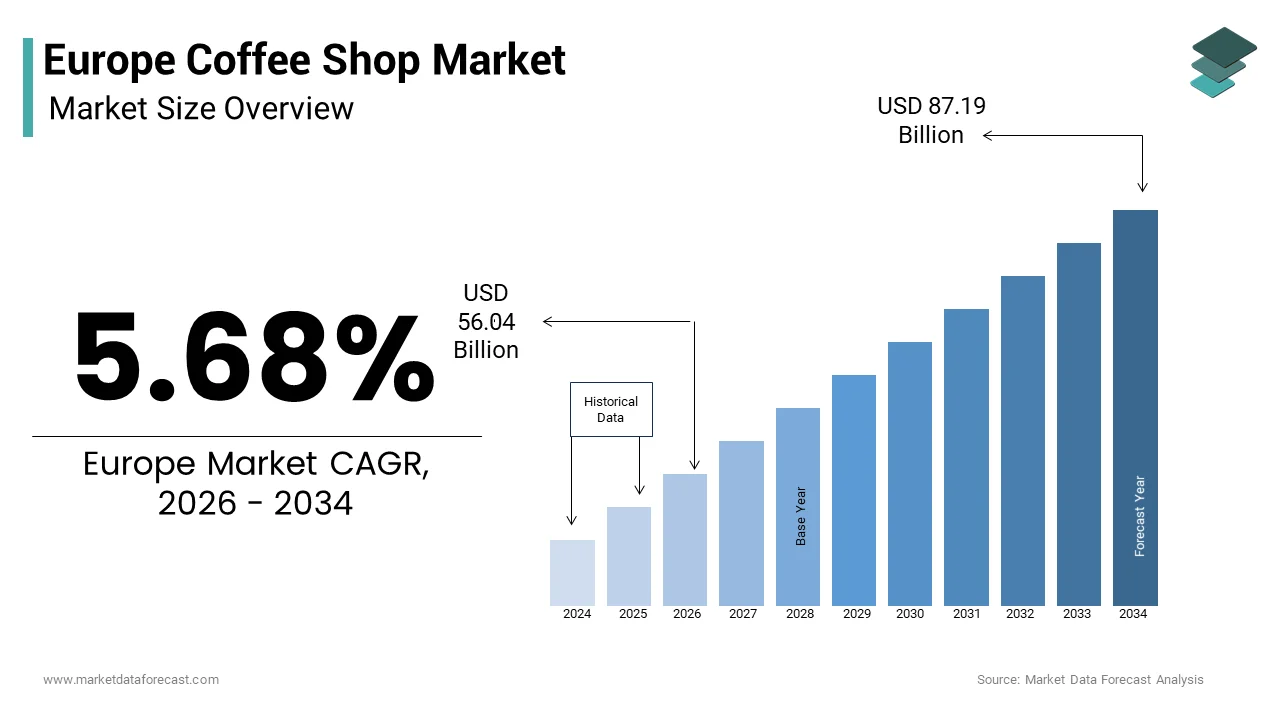
The Europe coffee shop market size was valued at USD 53.03 billion in 2025, is anticipated to reach USD 56.04 billion in 2026, and is projected to scale up to USD 87.19 billion by 2034, registering a compound annual growth rate (CAGR) of 5.68% during the forecast period from 2026 to 2034. Driven by a deeply entrenched coffee culture, high per capita consumption, the rise of remote work and "third place" environments, and rapid digitalization, the European café sector continues to demonstrate steady and resilient growth.
Key Executive Metrics (At-a-Glance)
- 2025 Base Valuation: USD 53.03 Billion
- 2026 Current Valuation: USD 56.04 Billion
- 2034 Forecast Valuation: USD 87.19 Billion
- Compound Annual Growth Rate (CAGR): 5.68% (2026–2034)
- Dominant Type Segment: Independent Coffee Shops (captured 62.7% share in 2025)
- Fastest-Growing Type Segment: Chain Coffee Shops (projected at 8.4% CAGR)
- Dominant Distribution Channel: Offline Distribution Channel (physical store experience)
- Fastest-Growing Distribution Channel: Online Distribution Channel (12.5% CAGR; delivery & mobile pre-ordering)
- Dominant Age Group Segment: 25–39 Years (held 38.8% share in 2025)
Core Market Drivers
- Deeply Entrenched Coffee Culture: High per capita consumption and daily ritualistic coffee breaks across Nordic nations, the UK, and continental Europe.
- Rise of Remote Work: Expansion of flexible hybrid work models driving demand for "third place" café environments equipped with high-speed internet and workspaces.
- Premiumization & Specialty Coffee: Consumer preference for traceable single-origin beans, artisan preparation, and ethical/sustainable sourcing.
Primary Market Restraints & Challenges
- Supply Chain Volatility: Climate change and geopolitical instability leading to unpredictable spikes in raw coffee bean and commodity costs.
- Regulatory & Labor Pressures: Stringent food safety standards, strict labor laws, and minimum wage increases raising operational overhead.
- Market Saturation & Health Trends: Intense urban competition and shifting consumer preferences toward health-optimized or non-caffeinated alternative beverages.
Europe Coffee Shop Market Segmentation Highlights
| Segment Category | Largest Market Segment | Fastest-Growing Market Segment |
|---|---|---|
| By Type | Independent Coffee Shops (62.7% share in 2025) | Chain Coffee Shops (8.4% CAGR) |
| By Distribution Channel | Offline Distribution Channel | Online Distribution Channel (12.5% CAGR) |
| By Age Group | 25–39 Years (38.8% share in 2025) | Millennial & Gen-Z demographic cohorts |
| By Region | Western Europe & Nordic Countries (High per capita) | Southern and Eastern European urban hubs |
Major Industry Players Profiled
Key market leaders dominating the European coffee shop landscape include Starbucks Corporation, Costa Coffee (The Coca-Cola Company), Inspire Brands, Inc., Blue Bottle Coffee, Inc. (Nestle S.A.), Keurig Dr Pepper, Inc., Barista Coffee, Coffee Day Enterprises Ltd., and The J.M. Smucker Company.
Europe Coffee Shop Market Size
The Europe coffee shop market size was valued at USD 53.03 billion in 2025 and is anticipated to reach USD 56.04 billion in 2026 to reach from USD 87.19 billion by 2034, growing at a CAGR of 5.68% during the forecast period from 2026 to 2034.
A coffee shop (also known as a café) is an establishment that primarily serves hot and cold coffee, tea, and other beverages. This sector has evolved from simple transactional outlets to complex third places that facilitate community interaction, remote work, and leisure across the continent. The landscape is deeply intertwined with European lifestyle patterns, where coffee consumption is a daily ritual rather than an occasional indulgence. As per Eurostat, the accommodation and food service activities sector employs 10.9 million people across the European Union, representing 6.8% of total employment in the EU business economy. Furthermore, the European Commission points out that while the core hospitality sector contributes roughly 3% of the EU's total value added, the broader travel and tourism economy accounts for more than 10% of the EU's GDP, making it a vital pillar for regional growth. Urbanization rates play a pivotal role. The United Nations estimates that 75% of Europeans now reside in urban areas, a trend that continues to drive the concentration of consumer demand in city-center cafes and high-density residential hubs. The market is also influenced by shifting consumer behaviors regarding health and sustainability, as highlighted by the European Food Safety Authority which monitors caffeine intake and ingredient safety standards. The proliferation of high-speed internet has transformed these venues into informal offices. According to the ITU and latest Eurostat data, 94.5% of EU residents were active internet users by the end of 2025, cementing the expectation for reliable, high-speed connectivity in all public social spaces. This convergence of social habits, urban density, and digital connectivity defines the modern operational framework for coffee shops throughout the region.
MARKET DRIVERS
Deeply Entrenched Coffee Culture and High Per Capita Consumption
The profound cultural embedding of coffee consumption as an essential daily ritual across diverse European nations is the primary engine propelling the Europe coffee shop market. Unlike regions where coffee is merely a functional caffeine source, in Europe it serves as a cornerstone of social interaction, business meetings, and personal relaxation. Nordic countries are the world's largest coffee consumers per capita, with Finland being the only nation to consistently exceed the 10 kg benchmark, while neighbors like Norway and Iceland follow closely in the high single digits. This ingrained habit ensures a steady and resilient stream of foot traffic for coffee shops regardless of broader economic fluctuations. The culture of the "coffee break" is legally and socially protected in many jurisdictions, encouraging workers to leave their desks and visit local cafes. Coffee shop culture is expanding in Europe, but regular weekly visitation remains concentrated in specific markets like the UK and Scandinavia, rather than being a uniform continental habit. This habitual behavior creates a loyal customer base that prioritizes quality and atmosphere over price sensitivity. The diversity of regional preferences, from the strong espresso culture in Italy to the filter coffee traditions in Scandinavia, allows operators to tailor offerings to specific local tastes while maintaining a core value proposition. The social function of these establishments as meeting points for friends and colleagues further cements their role in daily life. Consequently, the market benefits from a structural demand driver that is resistant to short-term trends, ensuring long-term viability for businesses that can authentically connect with local coffee traditions while offering premium experiences.
Rise of Remote Work and Demand for Third Place Environments
The structural shift toward remote and hybrid work models is a significant catalyst shaping the growth trajectory of the Europe coffee shop market. This shift has increased the demand for versatile third-place environments. The traditional office is no longer the sole location for productivity, leading professionals to seek alternative spaces that offer comfort, connectivity, and a change of scenery. As per a report by Eurofound, the European Foundation for the Improvement of Living and Working Conditions, approximately 20% of employees in the EU worked remotely on a regular basis in 2023, a figure that remains substantially higher than pre-pandemic levels. This demographic actively utilizes coffee shops as informal co-working spaces, driving sales during mid-morning and afternoon periods that were previously slower. Coffee shop operators have responded by upgrading their infrastructure to include high-speed Wi-Fi, ample power outlets, and comfortable seating arrangements designed for laptop usage. Flexible working arrangements are creating a "third place" economy where remote workers utilize cafes and co-working spaces, but labor organizations warn this flexibility often comes at the cost of extended availability and work-life boundary erosion. This trend is particularly pronounced in major metropolitan areas where living spaces are often small and cramped, making public venues attractive for focused work. The ability of coffee shops to provide a professional yet relaxed atmosphere appeals to freelancers, entrepreneurs, and corporate employees alike. By catering to this new workflow, establishments increase their average transaction value and dwell time, transforming from quick-stop cafes into essential hubs for the modern mobile workforce. This adaptation to changing work paradigms opens new revenue streams and stabilizes income throughout the day.
MARKET RESTRAINTS
Volatile Global Supply Chains and Rising Raw Material Costs
Extreme volatility in global supply chains is a major restraint impeding the profitability and expansion of the Europe coffee shop market. This volatility leads to unpredictable spikes in raw material costs. Coffee beans are an agricultural commodity highly susceptible to climate change, geopolitical instability, and logistical disruptions, all of which directly impact the cost of goods sold for operators. Global coffee markets are entering a period of high volatility and sustained elevated prices as climate change increasingly disrupts output in the world's most critical growing regions. European importers face additional pressures from currency exchange rate variations and increased freight costs, which squeeze margins for businesses that cannot immediately pass these costs to consumers. The European Central Bank has emphasized that food inflation in the euro area reached double-digit percentages in recent periods, forcing operators to make difficult pricing decisions. Small and independent coffee shops lack the purchasing power of large chains to hedge against these price swings, making them vulnerable to sudden cost surges. Furthermore, the reliance on imported inputs such as milk, sugar, and packaging materials exacerbates the financial strain. Coffee processors are navigating a "perfect storm" of record-high raw material costs and increased operational overhead, leading to multiple rounds of price hikes for retail consumers. These cumulative cost pressures force many establishments to reduce portion sizes, lower quality, or close entirely if they cannot maintain profitability. The inability to predict future input costs complicates long-term planning and investment, acting as a severe brake on market growth and stability.
Stringent Regulatory Frameworks and Labor Cost Pressures
A rigorous regulatory environment is a critical constraint for the European coffee shop market. Combined with high labor costs, this characterizes the European employment landscape. Operators must navigate a complex web of regulations concerning food safety, hygiene standards, licensing, and increasingly strict labor laws that mandate high wages and comprehensive benefits. The European hospitality sector remains one of the most expensive labor markets globally, as statutory wage increases and a competitive hiring environment drive up the cost of service. The implementation of minimum wage increases across countries like Germany and Spain further elevates operational expenses for labor-intensive coffee shop models. Additionally, the General Data Protection Regulation imposes strict rules on customer data collection, affecting loyalty programs and digital marketing strategies that are crucial for customer retention. The European Commission enforces rigorous food labeling and allergen disclosure requirements, necessitating constant staff training and administrative oversight. Small and medium hospitality enterprises are increasingly squeezed between a shrinking labor pool and a growing list of administrative and environmental mandates. The scarcity of skilled baristas and service staff drives up recruitment costs and turnover rates, disrupting service quality. These structural cost drivers limit the ability of operators to expand rapidly or invest in innovation. The high fixed cost base means that even minor dips in revenue can lead to losses, making the market particularly sensitive to economic downturns and reducing the attractiveness for new entrants who may be deterred by the bureaucratic and financial hurdles.
MARKET OPPORTUNITIES
Expansion of Premiumization and Specialty Coffee Segments
The growing consumer preference for premiumization and specialty coffee experiences is a great opportunity for the Europe coffee shop market. These experiences emphasize quality, origin, and ethical sourcing. Modern European consumers are becoming increasingly discerning, seeking unique flavor profiles and transparent supply chains rather than standardized mass-market blends. European coffee culture is undergoing a "premiumisation" shift, where consumers are increasingly willing to pay a higher price for traceable, high-quality beans and artisan preparation methods. This trend allows operators to command higher price points and build loyal communities around their brand ethos. Coffee shops that offer single-origin beans, precise brewing methods, and educated baristas can differentiate themselves in a crowded market. The rise of the "third wave" coffee movement has educated consumers to appreciate nuances in taste, creating demand for artisanal offerings. Furthermore, the integration of sustainability into the value proposition resonates strongly with European values. Sustainability has moved from a niche concern to a majority priority for European shoppers, who are increasingly scrutinizing the carbon footprint and ethical sourcing of their food and beverages. Operators who adopt fair trade practices, use biodegradable packaging, and support local farmers can attract this conscious demographic. The opportunity extends to limited edition releases and collaborative blends with local roasters, fostering a sense of exclusivity. By focusing on the experiential aspect of coffee consumption, shops can transform a commodity purchase into a luxury experience. This shift towards high-margin specialty products provides a pathway for growth even in saturated markets, appealing to affluent urbanites willing to pay for superior quality and ethical alignment.
Integration of Digital Technology and Personalized Customer Engagement
The burgeoning adoption of digital technology offers a potential prospect for the Europe coffee shop market. This trend can enhance operational efficiency and deepen customer relationships through personalized engagement. The integration of mobile ordering apps, loyalty programs, and data analytics enables operators to streamline service and tailor offerings to individual preferences. Consumers now view tailored service not as a luxury but as a standard requirement, reacting negatively to generic experiences that do not acknowledge their individual preferences or past behaviors. Coffee shops leveraging app-based ecosystems can reduce wait times, manage peak hour crowds, and gather valuable data on purchasing habits. This data allows for targeted marketing campaigns and dynamic pricing strategies that drive repeat visits. Digital "click-and-collect" services are becoming an essential component of urban cafe operations, as time-sensitive commuters increasingly use mobile apps to bypass physical queues. Implementing contactless payment systems and self-service kiosks further enhances the customer experience while reducing labor pressure. Additionally, digital platforms facilitate the creation of virtual communities where brands can engage directly with customers through social media and push notifications. The ability to offer subscription models or digital rewards fosters long-term loyalty and predictable revenue streams. Technology also aids in inventory management and waste reduction, improving overall profitability. By embracing digital transformation, coffee shops can compete effectively with larger chains and adapt to the fast-paced expectations of modern consumers. This technological evolution opens new avenues for revenue and operational optimization, positioning early adopters for sustained success in a competitive landscape.
MARKET CHALLENGES
Intensifying Market Saturation and Competitive Density
The intense saturation in key urban areas is a serious challenge confronting the European coffee shop market. This situation leads to fierce competition and diminished returns for individual outlets.Major cities across Europe are densely populated with coffee shops ranging from global chains to independent cafes, creating a hyper-competitive environment where capturing market share becomes increasingly difficult. Major European cities are seeing a high turnover of hospitality businesses, where new artisan and chain concepts are rapidly replacing traditional outlets, leading to intense competition for a fixed number of prime high-street locations. This oversupply forces operators to engage in price wars or excessive discounting to attract customers, eroding profit margins. The proximity of competitors means that customer loyalty is fragile, with patrons easily switching to a nearby alternative for minor conveniences or better promotions. High rental costs in prime locations exacerbate the pressure, as landlords demand premium rates for spaces in high-footfall areas. The cost of occupying prime urban real estate is rising significantly, forcing cafe and restaurant owners to achieve higher turnover per square meter to remain profitable. The struggle to differentiate in a crowded marketplace requires significant investment in branding and interior design, which may not yield immediate returns. Furthermore, the rapid entry of non-traditional competitors such as bakeries, convenience stores, and gas stations offering decent coffee options fragments the customer base further. This density makes it challenging for new entrants to survive and forces established players to constantly innovate just to maintain their position, threatening the overall stability and growth potential of the sector.
Shifting Consumer Preferences Toward Health and Alternative Beverages
The relentless evolution of consumer health consciousness poses a significant obstacle to the European coffee shop market. This is because patrons are increasingly opting for alternative beverages perceived as healthier or more functional. There is a growing trend away from sugary, calorie-laden coffee drinks toward options like herbal teas, fresh juices, plant-based milks, and functional wellness shots. Alternative dairy products have successfully integrated into the mainstream European diet, becoming a mandatory menu requirement for coffee shops rather than a high-growth novelty. Consumers are scrutinizing sugar content and caloric intake more closely, leading to a decline in demand for classic flavored lattes and frappes. This shift requires operators to reformulate recipes and source new ingredients, increasing complexity and costs. The rise of the "sober curious" movement also drives demand for non-caffeinated and alcohol-free options, diversifying the competitive landscape beyond traditional coffee providers. A significant portion of the European population is seeking "lower-energy" or health-optimized alternatives to traditional espresso, driving a diversification of cafe menus beyond standard caffeinated drinks. Coffee shops that fail to adapt their menus risk alienating this health-conscious demographic. Additionally, the perception of coffee as potentially acidic or disruptive to sleep drives some consumers toward gentler alternatives. Meeting these diverse and changing demands requires continuous menu innovation and staff training, straining resources. The need to balance core coffee offerings with a broad range of healthy alternatives complicates operations and inventory management, presenting a persistent challenge for operators striving to remain relevant in a health-focused era.
REPORT COVERAGE
| REPORT METRIC | DETAILS |
| Market Size Available | 2025 to 2034 |
| Base Year | 2025 |
| Forecast Period | 2026 to 2034 |
| CAGR | 5.68% |
| Segments Covered | By Type, Age Group, Distribution Channel, and Region |
| Various Analyses Covered | Global, Regional, & Country Level Analysis; Segment-Level Analysis; DROC, PESTLE Analysis; Porter’s Five Forces Analysis; Competitive Landscape; Analyst Overview of Investment Opportunities |
| Regions Covered | UK, France, Spain, Germany, Italy, Russia, Sweden, Denmark, Switzerland, Netherlands, Turkey, and the Czech Republic |
| Market Leaders Profiled | Starbucks Corporation, Inspire Brands, Inc., F. Gavina and Sons, Inc., Barista Coffee, Coffee Day Enterprises Ltd., Blue Bottle Coffee, Inc. (Nestle S.A.), Eight O'Clock Coffee Company (Tata Consumer Products Limited), Keurig Dr Pepper, Inc., Costa Coffee (The Coca-Cola Company), and The J.M. Smucker Company |
SEGMENTAL ANALYSIS
By Type Insights
In 2025, the independent coffee shops segment led the Europe coffee shop market and captured a 62.7% share. This supremacy of the segment is attributed to the European consumer's deep appreciation for artisanal quality, unique atmospheres, and locally owned businesses that reflect regional character. Unlike standardized chains, independent venues offer personalized experiences that resonate strongly with the cultural fabric of European cities and towns. Among these, the primary driver sustaining the dominance of independent coffee shops is the strong European consumer inclination toward authenticity and locally crafted products over mass-produced alternatives. Shoppers increasingly view coffee consumption as a cultural experience rather than a mere transaction, seeking venues that tell a story through their decor, bean sourcing, and brewing methods. As per sources, a portion of European coffee consumers prefer purchasing from local independent roasters who can verify the origin and ethical standards of their beans. This demand for transparency and quality allows independent operators to charge premium prices that justify their smaller scale. The "third wave" coffee movement has educated patrons to distinguish between flavor profiles, creating a loyal customer base that values the expertise of independent baristas. Independent shops often serve as community hubs, hosting events and fostering social connections that large chains cannot replicate. This emotional connection drives repeat visits and word-of-mouth marketing, which are crucial for survival in a competitive landscape. The ability to adapt quickly to local tastes and trends without corporate bureaucracy further enhances their appeal, ensuring they remain the preferred choice for discerning coffee lovers across the continent. A further reason for this growth is their unparalleled agility in menu innovation and ability to target niche demographic segments effectively. Free from the rigid standardization protocols of large franchises, independent owners can rapidly experiment with new flavors, seasonal offerings, and alternative milk options to meet evolving consumer demands. As per research, a notable share of European consumers actively seek novel food and beverage experiences, driving independents to introduce unique items like nitro cold brew, turmeric lattes, or locally sourced pastries. This flexibility allows them to cater to specific dietary needs such as vegan, gluten-free, or keto-friendly options, which are increasingly important to health-conscious Europeans. Independent shops can also tailor their ambiance and music to specific local subcultures, creating distinct identities that attract dedicated followings. This adaptability extends to pricing strategies and loyalty programs, enabling them to compete effectively despite limited marketing budgets. Independent coffee shops focus on hyper-local relevance and rapid iteration to maintain a dynamic, engaging, and curious presence for customers. This approach secures their majority share in a diverse and fragmented market.
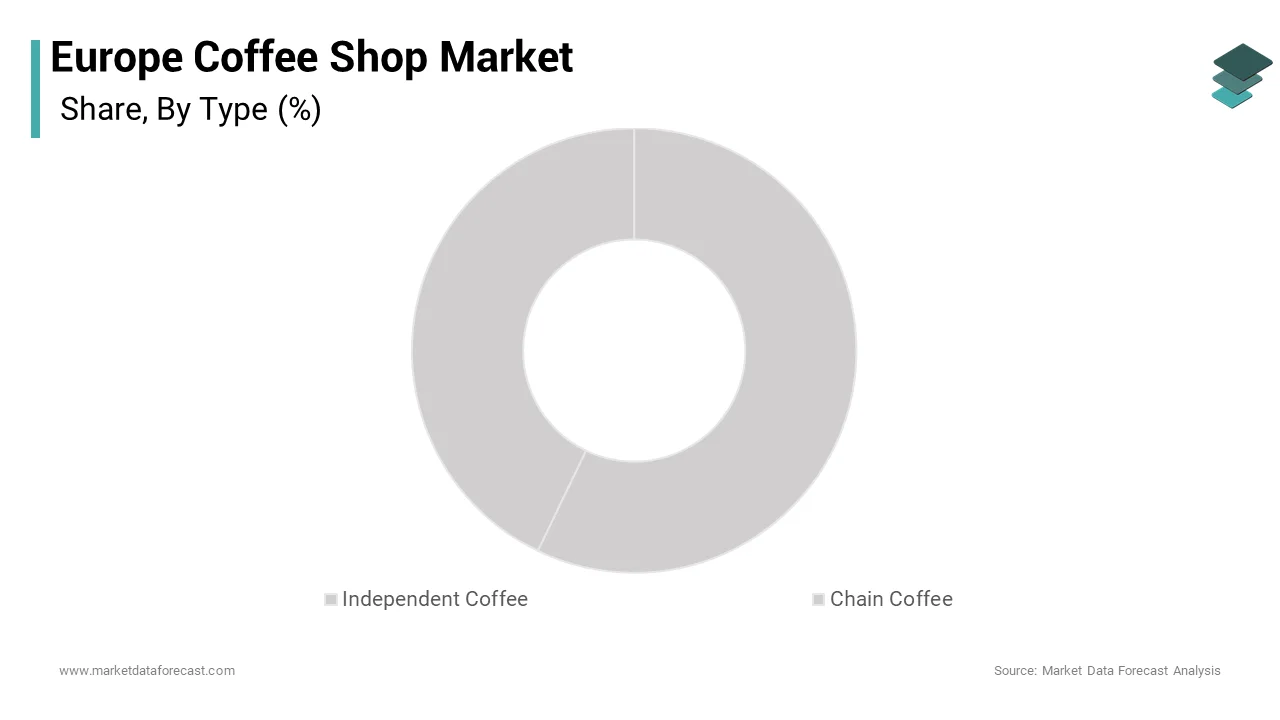
The chain coffee shops segment is likely to experience the fastest CAGR of 8.4% during the forecast period due to aggressive expansion strategies, significant capital investment, and the increasing demand for consistency and convenience among busy urban professionals who rely on recognizable brands for reliable service. The rapid proliferation of chain coffee shops is also driven by their substantial financial resources which enable aggressive expansion into high-traffic prime locations that are often inaccessible to independent operators. Large chains leverage economies of scale to secure long-term leases in key transportation hubs, shopping malls, and business districts across major European cities. Their ability to invest heavily in fit-outs and technology ensures a consistent brand experience that appeals to travelers and commuters seeking familiarity. The strategy of clustering stores in dense urban areas creates a network effect that maximizes brand visibility and operational efficiency. Research shows that chain operators often pay premium rents to secure corner plots in city centers, betting on high volume to offset costs. Furthermore, their standardized operating models allow for rapid rollout of new stores, with some chains opening hundreds of locations annually across the continent. This speed of expansion is supported by sophisticated supply chain logistics that ensure uniform quality and availability of ingredients regardless of location. The promise of reliability and speed makes chains the go-to option for time-poor consumers, driving their double-digit growth rates as they continue to saturate key markets and expand into secondary cities where disposable incomes are rising. In addition, this segemnt is supported by their superior integration of advanced digital ecosystems including mobile ordering apps and sophisticated loyalty programs that drive customer retention and frequency. Chains invest millions in developing proprietary technology platforms that streamline the purchasing process and gather valuable consumer data for targeted marketing. These systems allow customers to order ahead, skip lines, and customize drinks with ease, addressing the growing demand for convenience in fast-paced European urban environments. The accumulation of data enables chains to personalize offers and rewards, significantly boosting customer lifetime value. Additionally, gamified loyalty programs encourage repeat purchases by offering free drinks and exclusive perks, creating a sticky user base. The ability to push notifications about new products or limited-time offers directly to smartphones keeps the brand top-of-mind. This technological edge not only enhances operational efficiency by predicting demand but also creates a seamless omnichannel experience that independent shops struggle to match due to cost constraints, thereby accelerating the market share gains of chain operators.
By Distribution Channel Insights
The offline distribution channel segment held the majority share of the Europe coffee shop market in 2025. This dominance of the segment is credited to the nature of the coffee shop business model, which relies heavily on the physical experience of the venue, the immediacy of consumption, and the social atmosphere that cannot be replicated through delivery or take-away alone. The foremost reason behind the supremacy of the offline channel is the enduring concept of the coffee shop as a "third place" distinct from home and work, where social interaction and relaxation occur. European culture places a high premium on sitting down to enjoy coffee in a curated environment, making the physical store essential for the core value proposition. The sensory experience of aroma, ambiance, and face-to-face service creates an emotional connection that drives foot traffic and dwell time. The design of interiors, seating arrangements, and lighting plays a crucial role in attracting customers who seek a respite from their daily routines. Furthermore, the immediate gratification of receiving a freshly brewed beverage at the optimal temperature is best achieved in-store. The social ritual of meeting friends or conducting informal business meetings in a cafe remains deeply embedded in European lifestyle, ensuring that physical locations remain the primary revenue generator. This reliance on the physical environment safeguards the offline channel against digital disruption, maintaining its dominant share. Also, this segment is boosted by the operational necessity of on-site brewing to ensure the highest quality and freshness of the product, which is a key differentiator for European consumers. Coffee is a perishable commodity where flavor degrades rapidly after brewing, making immediate consumption in the store the ideal method for enjoying premium varieties. Customers visiting physical stores expect baristas to demonstrate skill and artistry in real-time, adjusting grind settings and extraction times to perfect each cup. This level of quality control builds trust and justifies premium pricing. The presence of specialized equipment like espresso machines and pour-over stations requires a fixed location, anchoring the business model to physical premises. Additionally, the visual appeal of the brewing process serves as a marketing tool that attracts passersby. The inability to fully replicate this fresh, artisanal experience through off-premise channels ensures that the majority of revenue continues to be generated within the four walls of the coffee shop, reinforcing the offline segment's dominance.
The online distribution channel segment is on the rise and is expected to be the fastest growing segment in the market by witnessing a CAGR of 12.5% over the forecast period owing to the changing lifestyles of urban consumers who prioritize convenience and the widespread adoption of food delivery platforms that have normalized ordering coffee digitally. The explosive growth of the online channel is primarily fueled by the ubiquitous presence of third-party delivery platforms that have fundamentally altered consumer behavior towards convenience and instant gratification. Apps like Deliveroo, Uber Eats, and Glovo have made ordering coffee as easy as a few taps on a smartphone, integrating coffee shops into the broader on-demand economy. These platforms provide coffee shops with access to a vast customer base without the need for their own delivery infrastructure, lowering the barrier to entry for online sales. The convenience of having coffee delivered to homes or offices appeals particularly to busy professionals and remote workers who may not have time to visit a physical store. The integration of real-time tracking and estimated arrival times reduces uncertainty and enhances the user experience. Furthermore, promotional offers and subscription models offered by these platforms incentivize frequent ordering. The ability to reach customers beyond the immediate vicinity of the store expands the potential market radius significantly. This ecosystem of convenience and accessibility is driving the rapid adoption of online channels, making it the fastest growing avenue for coffee sales in Europe. Additionally, the segment is helped by the widespread adoption of click-and-collect and mobile pre-ordering technologies that streamline the pickup process and reduce wait times for customers. Coffee shops are increasingly investing in proprietary apps or partnering with solutions that allow patrons to order and pay in advance, picking up their beverages at a designated counter without queuing. As per a study, a notable share of consumers prefer using mobile ordering to save time during their morning commute, highlighting the efficiency gain. This model optimizes store operations by smoothing out peak hour rushes and allowing staff to prepare orders in a controlled sequence. The technology also facilitates personalized marketing and loyalty integration, encouraging repeat usage. The hybrid nature of this channel combines the convenience of digital ordering with the immediacy of self-pickup, appealing to those who want speed without delivery fees. It also allows shops to capture data on customer preferences and peak times, enabling better inventory management and staffing decisions. The reliance on click-and-collect services will continue to surge as consumers become more accustomed to frictionless digital interactions. Consequently, the online segment's growth rate is accelerating well above traditional offline metrics.
By Age Group Insights
The 25-39 Years age group segment was the largest segment in the Europe coffee shop market and occupied a share of 38.8% share in 2025 because of its status as the core workforce population, their high disposable income relative to younger groups, and their established habit of using coffee shops for both professional and social purposes. In addition, the main reason supporting the leadership of the 25-39 years demographic is their combination of relatively high disposable income and firmly established daily coffee consumption habits formed during early adulthood. Individuals in this age bracket are typically established in their careers, granting them the financial flexibility to purchase premium coffee products regularly without significant budget constraints. As per sources, individuals aged 25 to 39 spend more on dining out and beverages compared to the 18-24 age group. This financial capacity allows them to frequent coffee shops daily, often opting for higher-margin specialty drinks and food pairings. The habit of the morning coffee run or the afternoon break is deeply ingrained in their routine, serving as a non-negotiable part of their day. They are less price-sensitive than students and more quality-conscious than older generations, driving demand for premium offerings. Furthermore, this demographic is in a life stage characterized by active social lives and professional networking, both of which frequently occur in coffee shop settings. Their willingness to spend on experiences rather than just products aligns perfectly with the value proposition of modern coffee shops, ensuring they remain the most lucrative and frequent customer base for the industry. A major factor that aids this segment is its extensive utilization of coffee shops as hybrid workspaces and social hubs, blending productivity with leisure. This generation has embraced flexible working arrangements, often choosing coffee shops over traditional offices or cramped home environments for focused work and virtual meetings. The need for reliable Wi-Fi, power outlets, and a stimulating atmosphere makes coffee shops ideal for this demographic. They tend to stay longer and purchase multiple items during these sessions, increasing the average ticket size. Socially, this age group prefers casual meeting spots for dates, friend gatherings, and informal business discussions, favoring the relaxed vibe of cafes over formal restaurants. The dual utility of coffee shops as both productive workspaces and social arenas creates multiple touchpoints for engagement throughout the day. This versatility ensures consistent foot traffic from the 25-39 demographic, cementing their position as the primary revenue drivers for the market. Their lifestyle demands align perfectly with the evolving offerings of coffee shops, securing their leading share.
The 18-24 years age group segment is expected to exhibit a noteworthy CAGR of 9.2% between 2026 and 2034. This rapid expansion is fueled by the rising influence of student culture, the viral impact of social media trends on beverage choices, and the increasing acceptance of coffee shops as primary study and socialization venues for young adults. Moreover, the accelerated growth of the 18-24 years segment is largely propelled by the powerful influence of social media platforms where visually appealing and unique coffee beverages frequently go viral, driving immediate demand. Young adults in this age group are heavy users of Instagram, TikTok, and Snapchat, where aesthetically pleasing drinks and cafe interiors are widely shared, creating a "fear of missing out" and compelling peers to visit trending spots. Coffee shops that introduce colorful, layered, or novelty drinks often see surges in foot traffic from this demographic eager to capture content. The desire for "instagrammable" moments transforms coffee consumption into a shareable social experience, amplifying brand reach organically. This digital nativity means that trends spread rapidly across borders, influencing preferences in cities from London to Berlin overnight. The alignment of coffee shop aesthetics with social media trends creates a feedback loop where popularity breeds more popularity. Coffee shops are successfully catering to this visual and digital-centric culture, which captures the attention and spending power of the youngest adult consumers. Consequently, they are driving their segment growth at an impressive pace. One more point that adds strength is the expanding role of coffee shops as essential extensions of university campuses and primary venues for academic study and group collaboration. With European universities increasingly encouraging collaborative learning and project-based work, students require accessible spaces outside of crowded libraries to meet and study. Coffee shops respond by offering student discounts, extended seating, and quiet zones tailored to academic needs. The affordability of entry-level coffee items combined with the ability to occupy a table for hours makes these venues attractive for students managing tight budgets. The social aspect of campus life also revolves around cafes, where students gather between classes or after lectures. This institutional integration ensures a steady stream of daily visitors. Furthermore, the habit formation during these formative years creates lifelong customers who continue to frequent coffee shops as they enter the workforce. The strategic positioning of outlets near university districts and the tailoring of services to student needs are key drivers fueling the high growth rate of this youthful demographic.
COUNTRY ANALYSIS
United Kingdom Coffee Shop Market Analysis
The United Kingdom dominated the market for coffee shops in Europe and accounted for a 24.9% share in 2025. The dominance of the UK market is driven by the sheer concentration of coffee shops in major urban centers and the widespread acceptance of coffee as a daily staple across all demographics. The country's market is known for an incredibly high density of outlets, particularly in London, and a deeply ingrained coffee culture that has evolved rapidly from tea-dominance to a thriving specialty scene over the last two decades. London alone hosts thousands of coffee outlets, creating a hyper-competitive yet vibrant ecosystem that sets trends for the rest of Europe. The proliferation of the "commuter coffee" culture, where grabbing a coffee on the way to work is a ritual for millions, fuels high morning peak trading. Furthermore, the UK has been a pioneer in the specialty coffee movement, with cities like Manchester and Bristol becoming hubs for third-wave roasters who prioritize quality and ethics. The presence of major global chains alongside a robust independent sector creates a diverse landscape that caters to every price point and preference. The resilience of the sector post-pandemic, with rapid recovery in footfall, demonstrates the strength of consumer attachment. Government support for high street regeneration and the cultural shift towards remote work have further boosted the role of cafes as community anchors. This combination of volume, variety, and cultural integration secures the UK's position as the undisputed leader in the European coffee shop market.
Italy Coffee Shop Market Analysis
Italy followed closely behind in the Europe coffee shop market and captured an 18.1% share in 2025. The growth of the Italian market is attributed to the ubiquitous presence of bars and cafes in every neighborhood, serving as essential social nodes where locals gather multiple times a day for quick espressos. It is distinguished by its unique historical legacy as the birthplace of espresso and a coffee culture that is deeply woven into the national identity. The market growth in Italy reveals a high frequency of consumption but lower average transaction values compared to Northern Europe, driven by traditional standing-bar habits. The cultural norm of drinking coffee while standing at the counter keeps prices low and turnover high, creating a volume-driven business model that differs significantly from the sit-down culture elsewhere. The protection of traditional methods, such as the strict definition of espresso, maintains high quality standards that consumers expect. This habitual consumption provides a stable revenue base resistant to economic downturns. While the chain segment is growing, the market remains dominated by independent family-run establishments that have operated for generations, fostering deep community loyalty. The recent trend of modernizing interiors and introducing specialty filters is attracting younger demographics without alienating traditionalists. The integration of coffee into the rhythm of daily life, from breakfast to post-dinner digestifs, ensures consistent demand. This deep-rooted cultural significance and high frequency of visits make Italy a cornerstone of the European coffee landscape.
Germany Coffee Shop Market Analysis
Germany holds a noteworthy share of the Europe coffee shops market. The stability of the German market is mainly driven by the rising popularity of specialty coffee and the willingness of consumers to pay a premium for ethically sourced and organically produced beans. Germany has a strong preference for high-quality specialty coffee, a growing cafe culture in major cities like Berlin and Hamburg, and a consumer base that values sustainability and ethical sourcing above all else. Also, Germans are among the most conscious consumers in Europe, prioritizing fair trade and environmental credentials in their purchasing decisions. The urban renaissance in cities like Berlin has spawned a vibrant indie cafe scene that rivals London, attracting tourists and locals alike. The "Kaffee und Kuchen" tradition is evolving, with modern cafes offering innovative twists on classic pairings to attract younger crowds. Furthermore, the integration of coffee shops into co-working spaces and retail environments is expanding their reach. The high disposable income of the German population supports the premiumization trend, allowing operators to invest in high-end equipment and training. The focus on quality and ethics creates a differentiated market that fosters loyalty and justifies higher price points, securing Germany's position as a key growth engine in the region.
France Coffee Shop Market Analysis
France experienced growth in the Europe coffee shop market. The revitalization of the French coffee market is propelled by the emergence of a dynamic specialty coffee scene that challenges the dominance of traditional low-quality commercial blends historically found in brasseries. It is known a historic cafe culture that is currently undergoing a modernization wave led by the explosion of specialty coffee concepts in Paris and other major cities. The market position reflects a blend of traditional brasseries and a rapidly growing network of modern artisanal coffee shops. Younger French consumers are increasingly rejecting the old model in favor of high-quality, single-origin espressos and filter coffees served in trendy, minimalist settings. The French appreciation for gastronomy extends to coffee, with patrons demanding barista skills and precise brewing methods comparable to wine sommeliers. The government's support for small businesses and the "Artisan" label helps independent coffee shops thrive against larger chains. The cultural habit of lingering in cafes for socializing remains strong, providing a steady stream of customers throughout the day. The integration of coffee culture with the fashion and design sectors in cities like Lyon and Marseille further boosts appeal. This fusion of tradition and modernity, coupled with a growing palate for quality, is transforming France into a high-potential market that balances heritage with innovation.
Spain Coffee Shop Market Analysis
Spain is predicted to expand notably in the Europe coffee shop market over the forecast period due to the country's intense social culture where cafes serve as the primary venue for socialization, business, and leisure from morning until late night. It is distinguished by its vibrant social cafe culture, late-night dining habits, and a strong preference for milk-based coffee varieties like cortado and latte macchiato. The market status is defined by high foot traffic in city centers and a resilient hospitality sector that integrates coffee into every meal occasion. Unlike other markets that peak in the morning, Spanish cafes enjoy sustained traffic throughout the day due to the custom of mid-morning breaks, long lunches, and evening tapas accompanied by coffee. The preference for milk-based drinks drives higher average ticket values compared to markets dominated by black coffee. The rise of international tourism, particularly in cities like Barcelona and Madrid, brings a diverse clientele eager to experience local cafe culture, boosting revenues. The adaptation of cafes to offer all-day dining and coworking spaces has further diversified revenue streams. The warm climate encourages terrace seating, increasing capacity and appeal. The combination of strong local habits, tourism inflows, and versatile operating models ensures Spain remains a critical and dynamic component of the European coffee shop landscape.
COMPETITIVE LANDSCAPE
The competition within the Europe coffee shop market is intensely fragmented and characterized by a fierce rivalry between global multinational chains and a vast array of independent local operators. Global brands leverage their immense financial resources to secure premium real estate and deploy advanced technology for seamless customer experiences. Conversely, independent shops compete by offering unique atmospheres, artisanal quality, and deep community connections that large corporations often struggle to replicate. The market sees constant innovation as players introduce novel beverage flavors and sustainable practices to differentiate themselves. Price competition remains moderate as consumers prioritize quality and experience over cost in this sector. The entry of non traditional competitors like bakeries and convenience stores offering premium coffee further intensifies the battle for market share. Regional differences in taste preferences require operators to adapt their offerings locally while maintaining brand consistency. The war for talent is also significant as skilled baristas become essential assets for delivering superior service. This dynamic environment forces all participants to continuously evolve their strategies and operational models to survive and thrive in a saturated landscape.
KEY MARKET PLAYERS
Some of the notable key players in the European coffee shop market are
- Starbucks Corporation
- Inspire Brands, Inc.
- Luigi Lavazza S.p.A.
- F.Gavina and Sons, Inc.
- Barista Coffee
- Coffee Day Enterprises Ltd.
- Blue Bottle Coffee, Inc. (Nestlé S.A.)
- Eight O'Clock Coffee Company (Tata Consumer Products Limited)
- Keurig Dr Pepper, Inc.
- Costa Coffee (The Coca-Cola Company)
Top Players In The Market
- Starbucks Corporation operates as the most recognizable global coffeehouse chain with a massive and expanding footprint across major European cities. The company contributes significantly to the global market by setting standards for consistent quality, customer service, and ethical sourcing practices known as Coffee and Farmer Equity. In Europe, Starbucks has recently intensified its focus on digital innovation by expanding its mobile order and pay capabilities to reduce wait times in busy urban locations. The firm is also strengthening its position by opening larger reserve roasteries in key capitals like Milan and Paris to offer premium experiential retail. Their commitment to sustainability includes plans to make all stores resource positive by reducing water usage and waste. Starbucks continues to adapt its menu to local tastes while maintaining its core brand identity, ensuring relevance in diverse European markets. These strategic moves allow the company to deepen customer loyalty and drive growth despite intense local competition.
- Costa Coffee Limited stands as a dominant force in the European sector with its British heritage and extensive network of stores spanning multiple continents. As a subsidiary of The Coca Cola Company, Costa leverages global distribution strengths to expand its ready to drink portfolio alongside its physical cafe presence. The brand is deeply involved in the European market by focusing on community engagement and sourcing beans through its direct trade programs. Recent actions to strengthen its position include the rollout of automated express kiosks in transportation hubs and hospitals to increase accessibility without full store overheads. Costa is also investing heavily in plant based menu options to align with shifting European dietary preferences. The company emphasizes training for its baristas to ensure high quality espresso preparation which remains central to its value proposition. By integrating digital loyalty schemes and enhancing its delivery partnerships, Costa Coffee aims to capture more occasions and maintain its status as a leading choice for consumers seeking reliable quality.
- Luigi Lavazza S.p.A. represents a unique player in the market as an Italian family owned enterprise that bridges traditional roasting excellence with modern cafe concepts globally. The company contributes to the international landscape by exporting its distinct Italian coffee culture through its Lavazza Espresso Point and Cremonini partnership cafes. In Europe, Lavazza has aggressively expanded its flagship stores in cities like Turin, London, and Paris to showcase its heritage and premium blends. Recent strategic actions include the acquisition of specialty coffee brands to diversify its portfolio and appeal to third wave coffee enthusiasts. The firm is strengthening its market position by investing in sustainable packaging and carbon neutral production facilities to meet strict European environmental regulations. Lavazza also focuses on digital transformation by launching apps that connect customers with its history and products. Their ability to blend centuries of tradition with contemporary retail experiences allows them to compete effectively against larger multinational chains while preserving their authentic brand essence.
Top Strategies Used By Key Market Participants
Key players in the Europe coffee shop market primarily employ aggressive expansion strategies that focus on securing prime locations in high footfall urban centers and transportation hubs. Companies frequently invest in digital transformation by developing robust mobile applications for ordering and loyalty programs to enhance customer convenience and data collection. Another major strategy involves menu diversification to include extensive plant based food options and non coffee beverages that cater to evolving health conscious consumer preferences. Operators are increasingly forming strategic partnerships with third party delivery platforms to extend their reach beyond physical store limits. Sustainability initiatives such as eliminating single use plastics and sourcing ethically certified beans serve as critical differentiators to attract environmentally aware patrons. Franchising models are utilized to accelerate growth while minimizing capital expenditure for the parent companies. Continuous staff training programs ensure consistent service quality and product knowledge which builds brand loyalty. These combined approaches help market leaders navigate competitive pressures and adapt to changing regional demands effectively.
MARKET SEGMENTATION
This research report on the European coffee shop market has been segmented and sub-segmented based on categories.
By Type
- Independent Coffee
- Chain Coffee
By Age Group
- 18–24 Years
- 25–39 Years
- 40–59 Years
- Above 60
By Distribution Channel
- Retail
- Away From Home
By Country
- UK
- France
- Spain
- Germany
- Italy
- Russia
- Sweden
- Denmark
- Switzerland
- Netherlands
- Turkey
- Czech Republic
- Rest of Europe