- Product Description Description
- Table of Contents TOC
- List of Table & Figure LOT
- Get Free Sample PDF Sample PDF
Market Size, 2025
$33.07 BnMarket Estimate, 2026
$37.15 BnMarket Forecast, 2034
$94.24 BnCAGR, 2026–2034
12.34%Europe Cold Chain Packaging Market Size, Growth, Trends & Forecast (2026–2034)
The Europe cold chain packaging market size was calculated to be USD 33.07 billion in 2025, is anticipated to reach a valuation of USD 37.15 billion in 2026, and is projected to scale up to USD 94.24 billion by 2034, registering a compound annual growth rate (CAGR) of 12.34% during the forecast period from 2026 to 2034. Driven by surging pharmaceutical requirements for temperature-controlled vaccine and biologic deliveries, expanding food and e-commerce online retail sectors, and stringent regulatory frameworks like Good Distribution Practices (GDP), the European market continues to experience extensive growth.
Key Executive Metrics (At-a-Glance)
- 2025 Base Valuation: USD 33.07 Billion
- 2026 Current Valuation: USD 37.15 Billion
- 2034 Forecast Valuation: USD 94.24 Billion
- Compound Annual Growth Rate (CAGR): 12.34% (2026–2034)
- Dominant Product Type Segment: Expanded Polystyrene (EPS) Containers (held 35.4% of the European market share in 2025 backed by excellent thermal insulation, lightweight design, and cost-effectiveness)
- Fastest-Growing Product Type Segment: Vacuum Insulated Panels - VIPs (predicted to witness a CAGR of 12.5% over the forecast period driven by ultra-low temperature requirements for vaccines and biologics)
- Dominant Application Segment: Pharmaceuticals (led the market by holding 40.1% of the European share in 2025 due to strict regulatory compliance and the need to preserve medical efficacy)
- Fastest-Growing Application Segment: Food (identified as the fastest-growing application, predicted to showcase a CAGR of 9.8% over the forecast period owing to perishable logistics and online grocery expansion)
- Dominant Region: Germany (top performer capturing 25.6% of the European market share in 2025 supported by robust pharmaceutical exports and advanced food processing standards)
Core Market Drivers
- Rising Demand in the Pharmaceuticals Sector: Strict temperature control needs for vaccines, biologics, and personalized cell therapies to prevent excursion failures.
- Expansion of the Food and Beverage Industry: Surging online grocery shopping and consumer demand for fresh convenience foods requiring resilient last-mile cooling packaging.
Primary Market Restraints & Challenges
- High Costs of Advanced Packaging Solutions: Prohibitive upfront expenses for vacuum-insulated panels and phase-change materials creating financial barriers for SMEs.
- Infrastructure Limitations & Supply Chain Complexities: Lacking cold-storage networks in rural Eastern Europe and price volatility for core materials like polyurethane foam.
Europe Cold Chain Packaging Market Segmentation Breakdown
| Segment Category | Largest Segment | Fastest-Growing Segment |
|---|---|---|
| By Product Type | Expanded Polystyrene (EPS) Containers (35.4% Share in 2025) | Vacuum Insulated Panels - VIPs (12.5% CAGR) |
| By Application | Pharmaceuticals (40.1% Share in 2025) | Food (9.8% CAGR) |
Major Industry Players Profiled
Key packaging manufacturers and thermal logistics leaders shaping the European market include Sonoco ThermoSafe, Pelican BioThermal, Cold Chain Technologies, Cryopak, Sofrigam, Intelsius, Softbox Systems, va-Q-tec AG, Orora Group, and Cascades Inc..
Europe Cold Chain Packaging Market Size
The Europe cold chain packaging market size was calculated to be USD 33.07 billion in 2025 and is anticipated to be worth USD 94.24 billion by 2034 from USD 37.15 billion in 2026, growing at a CAGR of 12.34% during the forecast period.
The European cold chain packaging is a component of the broader logistics and supply chain ecosystem, which ensures the safe transportation and storage of temperature-sensitive products. Cold chain packaging solutions are designed to maintain specific temperature ranges during transit, safeguarding the integrity of perishable goods such as pharmaceuticals, vaccines, and food products. According to Eurostat, the demand for cold chain packaging in Europe has surged due to the increasing emphasis on preserving product quality and compliance with stringent regulatory standards.
MARKET DRIVERS
Rising Demand in the Pharmaceuticals Sector
The escalating demand in the pharmaceuticals sector is driving the growth of the European cold chain packaging market. These products require precise temperature control during transportation to maintain efficacy, which makes cold chain packaging indispensable. The rollout of COVID-19 vaccines further amplified this demand, with over 13 billion doses distributed across the globe since 2021. The European Medicines Agency emphasizes that temperature excursions during transit can render vaccines ineffective, which is playing the prominent role of advanced packaging solutions play a prominent role. The rise in personalized medicine and cell therapies, which require ultra-low temperature storage, is driving innovation in specialized packaging designs that ensure sustained market growth.
Expansion of the Food and Beverage Industry
The expansion of the food and beverage industry is another factor propelling the growth of the European cold chain packaging market. According to the European Food Safety Authority, the EU food and beverage sector generated over €1.1 trillion in 2020, with fresh produce, dairy, and frozen foods being major contributors. Cold chain packaging plays a significant role in extending the shelf life of perishable items by reducing food waste and ensuring compliance with hygiene standards. The increasing consumer preference for convenience foods and online grocery shopping has further accelerated the demand for efficient cold chain solutions, leading to market expansion. For instance, the European Grocery Retail Report mentions that online grocery sales grew in 2022, necessitating robust packaging systems to maintain product quality during last-mile delivery.
MARKET RESTRAINTS
High Costs of Advanced Packaging Solutions
The high costs associated with advanced packaging solutions are limiting the growth of the European cold chain packaging market. According to the European Investment Bank, the initial investment required for cutting-edge technologies such as vacuum-insulated panels and phase-change materials can be prohibitive for small and medium-sized enterprises (SMEs). The average cost of implementing advanced cold chain packaging systems is increasing primarily due to the rising prices of raw materials and energy-intensive manufacturing processes. The European Packaging Federation notes that these costs are often passed on to end-users, which is leading to higher operational expenses for industries like pharmaceuticals and food. This financial burden is particularly challenging for emerging markets within Europe, where the budget constraints limit the adoption of premium packaging solutions.
Stringent Regulatory Compliance Requirements
Stringent regulatory compliance requirements are additionally hindering the growth of the European cold chain packaging market. According to the European Medicines Agency, regulations governing the transportation of temperature-sensitive products, such as Good Distribution Practices (GDP), impose rigorous standards on manufacturers. Non-compliance can result in hefty fines and reputational damage by creating additional pressure for companies. The European Commission projects that the complexity of maintaining compliance across diverse regions within Europe often requires significant investments in monitoring systems and staff training.
MARKET OPPORTUNITIES
Growing E-Commerce and Last-Mile Delivery Solutions
The rapid growth of e-commerce is accelerating the growth of the European cold chain packaging market. According to the European E-Commerce Report, online retail sales in the EU reached €899 billion in 2022, with grocery and pharmaceutical products witnessing exponential growth. This surge in demand necessitates innovative packaging solutions capable of maintaining product integrity during last-mile delivery, where temperature control is necessary. According to the European Commission, over 60% of consumers now prioritize freshness and quality when purchasing perishable goods online, which is driving the adoption of advanced cold chain packaging technologies. For instance, insulated pouches and reusable cooling systems are gaining traction due to their ability to ensure consistent temperature regulation. The integration of IoT-enabled sensors in packaging allows real-time monitoring by enhancing supply chain transparency and customer satisfaction, creating opportunities for market growth.
Advancements in Sustainable Packaging Technologies
Advancements in sustainable packaging technologies are providing another promising opportunity for the European cold chain packaging market. According to the European Environment Agency, the push for circular economy practices has led to increased investments in eco-friendly materials such as biodegradable polymers and recyclable insulating foams. For example, the Single-Use Plastics Directive encourages the development of alternatives to traditional polystyrene containers, which are widely used in cold chain logistics. Furthermore, innovations such as plant-based phase-change materials and reusable containers are reducing the environmental footprint of cold chain packaging.
MARKET CHALLENGES
Limited Infrastructure in Rural Areas
Limited infrastructure in rural areas is likely to disrupt the growth of the European cold chain packaging market. The rural regions in the EU lack adequate cold storage facilities and transportation networks, which are hindering the effective distribution of temperature-sensitive products. The issue is particularly pronounced in Eastern Europe, where logistical issues result in significant product losses. The absence of reliable power supply and refrigerated transport options escalates the problem by making it difficult for manufacturers to ensure consistent quality. This challenge not only impacts food security but also limits market penetration in underserved regions. Addressing these gaps requires substantial investment in infrastructure development, which remains a significant task for both public and private stakeholders.
Increasing Complexity of Global Supply Chains
The increasing complexity of global supply chains is another significant challenge impacting the European cold chain packaging market. According to the European Trade Union Confederation, geopolitical tensions and trade restrictions have disrupted the supply chain, which is leading to delays and shortages of essential packaging materials. For example, in 2022, the price of polyurethane foam, which is a key material used in insulated containers, has surged due to supply chain disruptions. These fluctuations create uncertainty for manufacturers who are facing difficulties in maintaining production schedules and meeting customer demands. The need for seamless coordination across multiple stakeholders adds layers of complexity and increases operational risks.
REPORT COVERAGE
| REPORT METRIC | DETAILS |
| Market Size Available | 2025 to 2034 |
| Base Year | 2025 |
| Forecast Period | 2026 to 2034 |
| CAGR | 12.34% |
| Segments Covered | By Product, Application, And Region |
|
Various Analyses Covered | Global, Regional & Country Level Analysis; Segment-Level Analysis; DROC, PESTLE Analysis; Porter’s Five Forces Analysis; Competitive Landscape; Analyst Overview of Investment Opportunities |
| Regions Covered | UK, France, Spain, Germany, Italy, Russia, Sweden, Denmark, Switzerland, Netherlands, Turkey, and the Czech Republic |
|
Market Leaders Profiled | Sonoco ThermoSafe, Pelican BioThermal, Cold Chain Technologies, Cryopak, Sofrigam, Intelsius, Softbox Systems, va-Q-tec AG, Orora Group, and Cascades Inc. |
SEGMENTAL ANALYSIS
By Product Type Insights
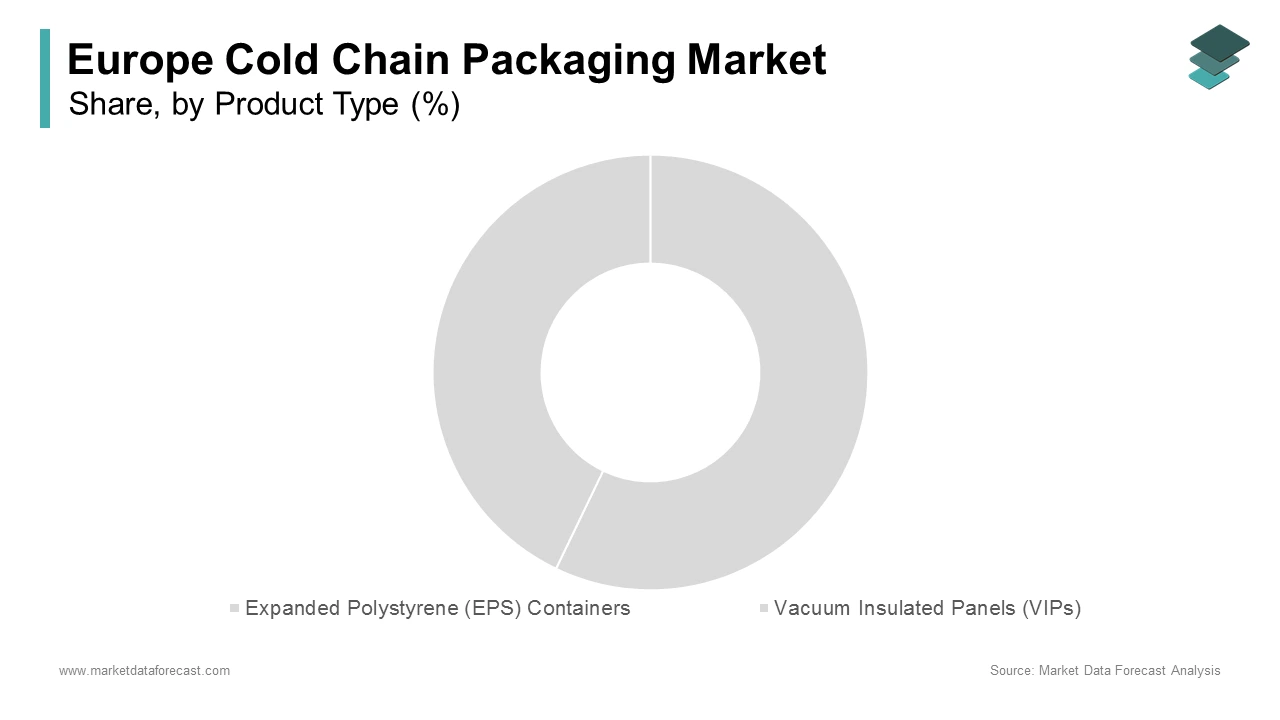
The expanded polystyrene (EPS) containers segment held 35.4% of the European market share in 2025 due to their excellent thermal insulation properties, lightweight design, and cost-effectiveness, which make them ideal for transporting perishable goods such as food and pharmaceuticals. According to Eurostat, the demand for EPS containers increased by 8% in 2022, driven by their widespread use in the food sector, particularly for fresh produce and frozen goods. Their versatility allows them to cater to diverse applications, from retail distribution to long-haul logistics. The dominance of EPS containers is further reinforced by their ease of customization, enabling manufacturers to tailor solutions to specific end-user requirements.
The vacuum insulated panels (VIPs) are predicted to witness a CAGR of 12.5% over the forecast period. The superior thermal efficiency of vacuum-insulated panels compared to traditional insulation materials is making them ideal for applications requiring ultra-low temperature control, such as vaccines and biologics, which is primarily propelling the growth of the VIPs segment in the European market. According to the European Medicines Agency, the demand for VIPs surged by 20% in 2022 due to the increasing focus on precision and reliability in pharmaceutical logistics. Additionally, advancements in panel technology, such as improved durability and reduced thickness, have expanded their applicability across diverse industries.
By Application Insights
The pharmaceuticals segment led the market by holding 40.1% of the European market share in 2025. Cold chain packaging is indispensable in this sector for transporting vaccines, biologics, and other temperature-sensitive medications to ensure their efficacy and safety. According to Eurostat, the pharmaceutical industry’s output grew by 7% in 2022 owing to the advancements in biotechnology and personalized medicine. The dominance of the pharmaceuticals segment in the European market is further supported by stringent regulatory requirements that mandate the use of specialized packaging solutions to comply with Good Distribution Practices (GDP). These solutions not only safeguard product integrity but also enhance supply chain transparency, making them critical for maintaining trust and compliance.
The food segment is the fastest-growing application segment and is predicted to showcase a CAGR of 9.8% over the forecast period. Cold chain packaging is increasingly adopted in this sector for transporting perishable items such as fresh produce, dairy, and frozen foods, where maintaining freshness and quality is paramount. According to the European Commission, the food industry’s revenue grew by 6% in 2022 owing to the rising consumer demand for convenience foods and online grocery shopping. The demand for insulated containers and reusable cooling systems has surged by 15% in this sector, ensuring compliance with hygiene standards and reducing food waste.
REGIONAL ANALYSIS
Germany Cold Chain Packaging Market Insights
Germany was the top performer of the European cold chain packaging market by capturing 25.6% of the market share in 2025. The country’s robust pharmaceutical and food processing industries drive the demand for advanced packaging solutions by ensuring compliance with stringent regulatory standards. According to Eurostat, Germany’s pharmaceutical exports totalled €68 billion in 2022, which shows the sector’s reliance on reliable cold chain logistics. The emphasis on sustainability has further propelled the adoption of eco-friendly packaging materials by aligning with national green initiatives.
France Cold Chain Packaging Market Insights
France holds second position in the Europe Cold Chain Packaging Market by capturing 20.3% of the market share. The country’s strong presence in the food and beverage sector drives the demand for cold chain packaging, particularly for transporting fresh produce and dairy products.
UK Cold Chain Packaging Market Insights
The UK holds prominence in the market revenue of the Europe Cold Chain Packaging Market. The country’s thriving pharmaceutical and e-commerce sectors boost the demand for cold chain packaging, which ensures product integrity during last-mile delivery.
Italy Cold Chain Packaging Market Insights
Italy is estimated to be the fastest-growing market in the Europe Cold Chain Packaging Market. The country’s food processing industry, particularly in pasta and cheese productio,n is relying heavily on cold chain packaging to maintain product quality.
Spain Cold Chain Packaging Market Insights
Spain captures a significant portion of the market share of the Europe Cold Chain Packaging Market. The country’s agricultural sector, particularly in fresh produce and seafood, is driving the demand for efficient cold chain solutions by ensuring timely delivery and minimal wastage.
KEY MARKET PLAYERS
Major Players of the Europe cold Chain Packaging Market include Sonoco ThermoSafe, Pelican BioThermal, Cold Chain Technologies, Cryopak, Sofrigam, Intelsius, Softbox Systems, va-Q-tec AG, Orora Group, and Cascades Inc.
DETAILED SEGMENTATION OF THE EUROPE COLD CHAIN PACKAGING MARKET IS INCLUDED IN THIS REPORT
This research report on the Europe cold chain packaging market has been segmented and sub-segmented based on product type, application & region.
By Product Type
- Expanded Polystyrene (EPS) Containers
- Vacuum Insulated Panels (VIPs)
By Application
- Pharmaceuticals
- Food
By Region
- UK
- France
- Spain
- Germany
- Italy
- Russia
- Sweden
- Denmark
- Switzerland
- Netherlands
- Turkey
- Czech Republic
- Rest of Europe