- Product Description Description
- Table of Contents TOC
- List of Table & Figure LOT
- Get Free Sample PDF Sample PDF
Europe Collagen Supplement Market Report Summary
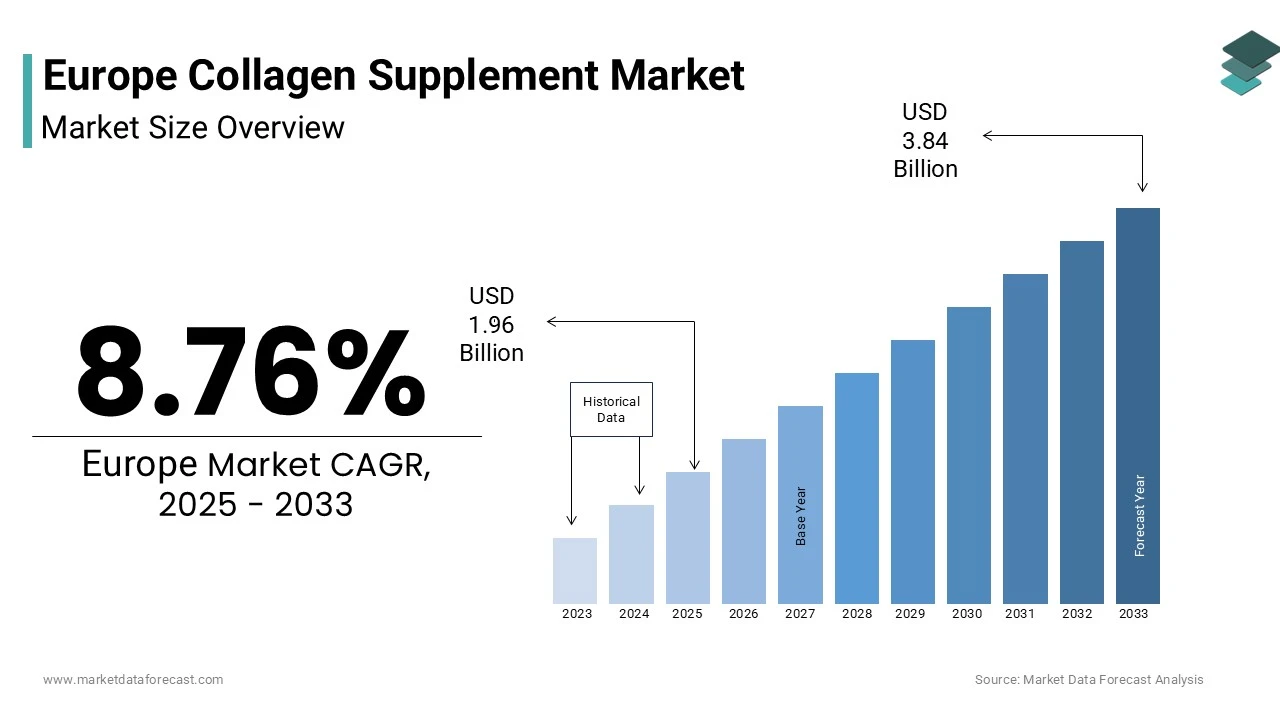
The Europe collagen supplement market was valued at USD 1.80 billion in 2024, is estimated to reach USD 1.96 billion in 2025, and is projected to reach USD 3.84 billion by 2033, growing at a CAGR of 8.76% during the forecast period from 2025 to 2033. The growth of the Europe collagen supplement market is driven by the rapidly aging population, rising prevalence of joint and skin-related conditions, and increasing consumer preference for preventive health and beauty-from-within solutions. Growing awareness of nutraceutical benefits, expanding clinical validation of collagen peptides, and the strong presence of pharmacy-based distribution channels are further supporting market expansion. Moreover, rising demand for sustainably sourced marine collagen and increasing adoption of collagen supplements within dermatological and medical care pathways are strengthening long-term market growth across Europe.
Key Market Trends
- Rising demand for beauty-from-within and preventive wellness supplements, particularly among women aged 25–55.
- Increasing adoption of clinically validated collagen peptides recommended by dermatologists and healthcare professionals.
- The growing popularity of marine-based collagen is due to its sustainability, halal, and kosher compliance.
- Expanding use of powdered collagen formats for customizable dosing and clean-label preferences.
- Strong growth of online and direct-to-consumer channels, supported by influencer marketing and subscription models.
Segmental Insights
- Based on form, the powder segment was the largest and held a significant share of the Europe collagen supplement market in 2024. The dominance of this segment is attributed to its cost efficiency, higher dosage flexibility, clean-label appeal, and ease of integration into daily diets such as beverages and meals.
- Based on the source, the animal-based collagen segment accounted for the largest share of the Europe collagen supplement market in 2024. This leadership is driven by established clinical evidence, scalable raw material availability, and lower production costs compared to marine alternatives.
- However, the marine-based collagen segment is expected to register the fastest growth due to its sustainable sourcing, ethical acceptance, and rising demand from environmentally conscious and religiously compliant consumers.
- Based on distribution channel, the pharmacies and drug stores segment dominated the market, supported by high consumer trust, pharmacist recommendations, and strict product vetting standards across European healthcare systems.
Regional Insights
The Europe collagen supplement market is witnessing robust growth across major economies, supported by strong healthcare infrastructure and evidence-driven consumer behavior.
- Germany was the largest contributor, accounting for 24.3% of the Europe collagen supplement market share in 2024, driven by its strong pharmacy network, clinical orientation, and presence of leading collagen manufacturers.
- France followed closely, supported by its deep integration of dermatological science with beauty culture and high adoption of collagen as part of daily beauty routines.
- The United Kingdom is emerging as a fast-growing market due to influencer-driven awareness, online retail expansion, and flexible post-Brexit supplement regulations.
- Italy continues to show steady growth, fueled by its aging population and strong cultural emphasis on preventive wellness and nutraceutical consumption.
Competitive Landscape
The Europe collagen supplement market is characterized by the presence of science-driven incumbents, specialized marine collagen producers, and agile digital-native brands operating within a highly regulated environment. Competition is shaped by clinical validation, sourcing transparency, regulatory compliance, and strong pharmacy relationships rather than price alone. Leading companies are investing heavily in human clinical trials, sustainable raw material sourcing, novel food authorization, and clean-label innovations to strengthen brand credibility. Strategic collaborations with dermatologists, pharmacists, and research institutions are reinforcing market leadership. Prominent players in the Europe collagen supplement market include Nestlé S.A., Shiseido Co., Ltd., Bayer AG, GELITA AG, PB Leiner, Rousselot, Weishardt, DSM-Firmenich AG, Symrise AG, and Lapi Gelatin S.p.A., among others.
Europe Collagen Supplement Market Size
The europe collagen supplement market size was valued at USD 1.80 billion in 2024 and is anticipated to reach USD 1.96 billion in 2025 from USD 3.84 billion by 2033, growing at a CAGR of 8.76% during the forecast period from 2025 to 2033.
The collagen supplement of oral products, primarily in powder, capsule, and liquid forms containing hydrolyzed collagen peptides derived from bovine, porcine, marine, or poultry sources, for skin health, joint mobility, and hair and nail strength. According to the European Commission, over 120 collagen peptide products received novel food authorization between 2019 and 2024, establishing a regulatory pathway for market entry. As per Eurostat, more than 68 million Europeans aged 50 and above representing 15% of the population actively seek solutions for age related joint and skin concerns by creating structural demand for evidence based nutraceuticals.
MARKET DRIVERS
Aging Population and Rising Prevalence of Age Related Joint and Skin Conditions
Europe’s rapidly aging demographic is a structural driver of collagen supplement demand as consumers seek non-invasive solutions for connective tissue decline. The aging population and rising prevalence of age related joint and skin conditions is a major factor propelling the growth of Europe collagen supplement market. As per the European League Against Rheumatism, over 40 million Europeans suffer from osteoarthritis with prevalence exceeding 50% in those over 70. Similarly, the European Academy of Dermatology and Venereology reports that 78% of women over 50 express concern about skin elasticity and wrinkle formation. This scientific validation combined with demographic inevitability creates sustained demand insulated from wellness fads and anchored in measurable physiological needs.
Consumer Shift Toward Preventive and Holistic Beauty from Within Approaches
The consumers are increasingly rejecting topical cosmetics in favor of ingestible beauty solutions that address root causes of aging through nutrition. The consumer shift toward preventive holistic beauty from within approaches is additionally prompting the growth of Europe collagen supplement market. According to the European Consumer Organisation, 64% of women aged 25 to 45 purchased at least one beauty supplement in 2024 citing “internal nourishment” as a key motivator. As per the European Food Information Council, the concept of “beauty from within” is now mainstream in Germany, France, and the Nordics, where 58% of collagen buyers view it as part of a holistic self-care routine alongside diet and exercise. Social media and dermatologist endorsements amplify this trend with collagen receiving over 2.1 million mentions on European Instagram accounts in 2024. Unlike fleeting wellness trends this shift is reinforced by long term changes in beauty ideology prioritizing health over cover up and supported by clinical evidence that positions collagen as a functional nutrient rather than a cosmetic additive.
MARKET RESTRAINTS
Strict European Union Restrictions on Health Claims and Marketing Language
The European Food Safety Authority’s prohibition of most collagen specific health claims severely limits how brands can communicate product benefits is one of the primary factors hindering the growth of Europe collagen supplement market. According to the European Commission, only two generic claims are permitted for collagen peptides “contributes to the maintenance of normal skin” and “contributes to the maintenance of normal bones” both requiring specific wording and dosage thresholds. As per the European Food Safety Authority, over 95% of collagen health claim applications submitted between 2015 and 2024 were rejected for insufficient evidence including claims related to joint health hair strength and anti-aging. This regulatory constraint forces brands to rely on indirect messaging, such as “dermatologist tested” or “clinically studied” without specifying outcomes. The resulting communication gap reduces consumer understanding of efficacy and increases awareness, among evidence conscious Northern European shoppers.
Religious and Ethical Sourcing Constraints Limiting Ingredient Availability
Europe’s diverse cultural and religious landscape imposes significant constraints on collagen sourcing, particularly regarding bovine and porcine materials. The religious and ethical sourcing constraints limiting ingredient availability is also declining the growth of Europe collgen supplement market. According to the European Commission, collagen derived from non halal or non-kosher slaughtered animals cannot be marketed to Muslim and Jewish consumers, who collectively represent many people in the European Union. As per the research, 42% of German and Dutch consumers avoid porcine collagen due to ethical or religious reasons even if not observant. This sourcing restricts product formulation flexibility and inflates prices for compliant alternatives, excluding segments of the population and reducing market inclusivity despite strong underlying demand.
MARKET OPPORTUNITIES
Integration of Clinically Validated Collagen into Medical and Dermatological Pathways
The formal adoption of collagen supplements within clinical and aesthetic practice as adjunctive nutraceuticals is certainly to create new opportunities for the growth of Europe collagen supplement market. According to the European Academy of Dermatology and Venereology, dermatologists in Germany, France, and Italy, now recommend specific collagen peptide products to patients with photoaged skin or early osteoarthritis as part of integrative care plans. As per the German Federal Institute for Drugs and Medical Devices, the number of medical grade collagen supplements with documented bioavailability and safety data increased in 2024. Hospitals in Sweden, and the Netherlands, have begun including collagen in post-surgical recovery protocols to support tissue repair. The European Commission’s Horizon Europe program has funded the COLLAGENMED project to establish dosage guidelines and outcome measures for clinical use. This medical endorsement transforms collagen from a discretionary wellness item into a prescribed therapeutic support, enhancing credibility and expanding reimbursement potential through private health schemes.
Expansion of Sustainable and Traceable Marine Collagen Sourcing in Coastal Regions
The extensive coastline and advanced fisheries infrastructure to scale certified sustainable marine collagen production is additionally to leverage new opportunities for the growth of Europe collagen supplement market. According to the European Marine Ingredients Association, over 1.2 million metric tons of fish processing byproducts primarily skins and scales are generated annually in EU ports are currently valorized into collagen peptides. As per the European Commission’s Farm to Fork Strategy, funding has been allocated to pilot projects in Norway, Spain, and Greece that extract high purity collagen from cod hake and sardine waste using enzymatic hydrolysis with zero chemical solvents. Companies like Naticol and Peptan, have achieved Marine Stewardship Council certification for traceable supply chains from certified fisheries.
MARKET CHALLENGES
Lack of Standardization in Collagen Peptide Molecular Weight and Bioavailability
The inconsistent product quality due to the absence of harmonized standards for peptide size, purity, and bioavailability is one of the challenges for the growth of Europe collagen supplement market. According to the European Food Safety Authority, collagen products contained peptides ranging from 500 to 5 000 Daltons, only fragments below 2 000 Daltons demonstrate proven skin and joint absorption in human trials. This opacity erodes consumer trust and complicates clinical validation as study outcomes cannot be replicated across different products.
Intensifying Competition from Plant Based and Lab Fermented Alternatives
The rise of animal free collagen alternatives produced via microbial fermentation of genetically modified yeast or bacteria is challenging traditional hydrolyzed collagen on ethical and sustainability grounds. According to the European Alternative Proteins Association, over 12 plant derived “collagen boosters” and 5 bioengineered true collagen products in 2024, marketed as vegan and eco-friendly. As per the European Consumer Organisation, many consumers under 35 expressed preference for fermentation derived collagen, despite its 2.8 times higher price due to concerns about animal welfare and carbon footprint. Traditional collagen producers face pressure to justify animal sourcing in a regulatory environment increasingly supportive of cellular agriculture by creating strategic uncertainty even as demand for connective tissue support grows.
REPORT COVERAGE
| REPORT METRIC | DETAILS |
| Market Size Available | 2024 to 2033 |
| Base Year | 2024 |
| Forecast Period | 2025 to 2033 |
| CAGR | 8.76% |
| Segments Covered | By Form , Source, Distribution Channel and Region. |
| Various Analyses Covered | Global, Regional and Country Level Analysis, Segment-Level Analysis, DROC, PESTLE Analysis, Porter’s Five Forces Analysis, Competitive Landscape, Analyst Overview of Investment Opportunities |
| Regions Covered | United Kingdom, France, Spain, Germany, Italy, Russia, Sweden, Denmark, Switzerland, the Netherlands, Turkey, and the Czech Republic. |
| Market Leaders Profiled | Nestlé S.A., Shiseido Co., Ltd., Bayer AG, Hunter & Gather Foods Ltd, Everest NeoCell LLC, Revive Collagen (Revive Naturals), Codeage LLC, Rousselot (Darling Ingredients), PB Leiner (Tessenderlo Group), GELITA AG, Weishardt (Weishardt Holding SA), DSM-Firmenich AG, Symrise AG, Sirio Europe, and Lapi Gelatin S.p.A. |
SEGMENTAL ANALYSIS
By Form Insights
The powder segment was accounted in holding 48.2% of the Europe collagen supplement market share in 2024. European consumers increasingly favor unflavored or subtly flavored powders that can be seamlessly incorporated into coffee smoothies or oatmeal without altering taste or texture. According to the European Food Information Council, many collagen users in Germany, France, and the Nordics prefer powder because it contains no added sugars binders or gelatin capsules by aligning with clean eating trends. As per the European Consumer Organisation, powder formats typically list only “hydrolyzed collagen peptides” as the sole ingredient, whereas capsules and gummies often include fillers preservatives or artificial colors. The absence of processing additives not only enhances perceived safety but also supports compliance with EU clean label initiatives that discourage unnecessary additives. Powder enables delivery of clinically relevant collagen doses, typically 10 grams per serving at a lower cost per gram compared to encapsulated alternatives. According to the European Commission’s Joint Research Centre, achieving a 10 gram daily dose would require consuming 10 to 15 standard capsules, which many consumers find impractical. This economic efficiency is price sensitive Southern European countries like Spain and Italy, buyers prioritize value for money. Additionally, powder allows for customizable dosing by enabling users to adjust intake based on need, which supports long term adherence and therapeutic efficacy in joint and skin health protocols.
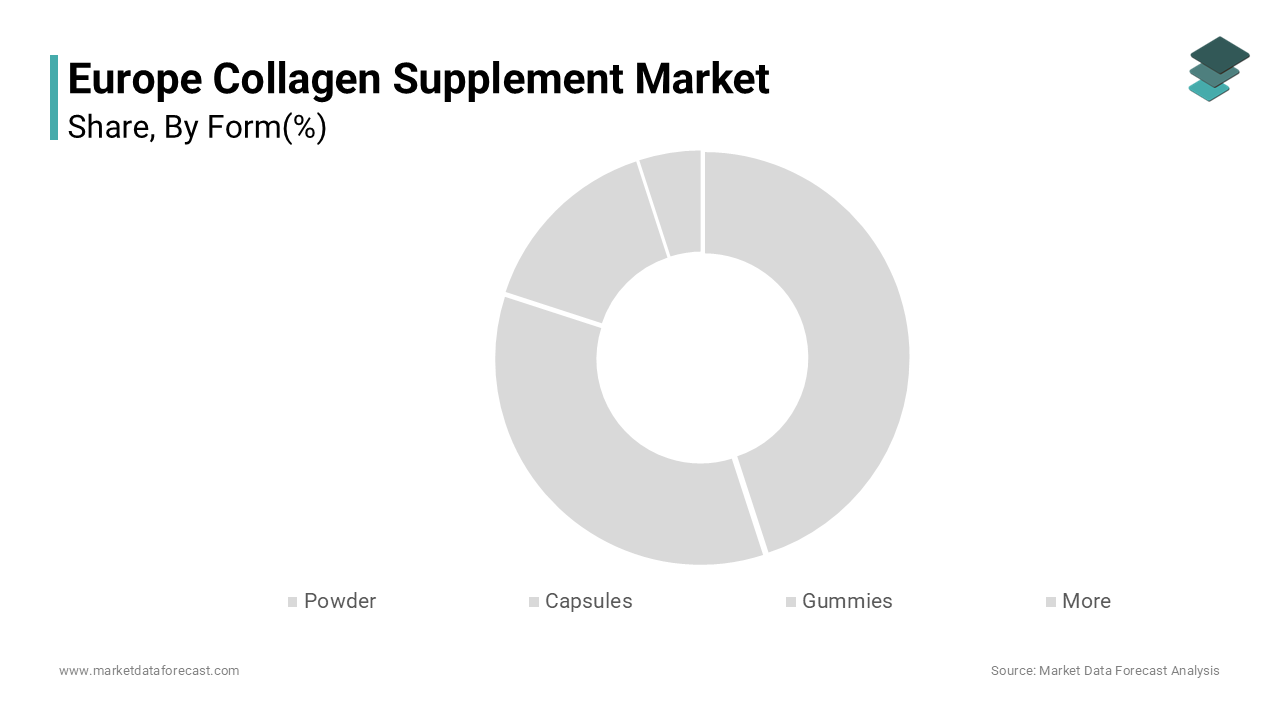
The gummies segment is projected to grow at a fastest CAGR of 21.4% from 2025 to 2033. Gummies are successfully capturing consumers under 35, who associate traditional supplements with aging and prefer palatable enjoyable formats. According to the European Consumer Organisation, 74% of women aged 18 to 30, who purchased collagen in 2024 chose gummies citing taste convenience and resemblance to candy as key motivators. As per the UK’s Food Standards Agency, gummy supplements saw a 38% increase in repeat purchases, among millennials due to their integration into daily routines that often consumed alongside breakfast or as an afternoon treat. Brands like Vitabiotics and Nivea have launched collagen gummies with fruit flavors and no artificial colors targeting this demographic with Instagram friendly packaging and influencer marketing. This shift transforms collagen from a clinical intervention into a lifestyle habit driving consistent usage and category expansion beyond traditional wellness users.
By Source Insights
The animal-based collagen segment was accounted in holding a dominant share of the Europe collagen supplement market. Bovine and porcine collagen peptides are significantly more affordable and scalable than marine alternatives due to integration with Europe’s large meat processing industry. According to the European Meat Federation, animal byproducts are generated annually in EU slaughterhouses providing a consistent low-cost raw material stream for collagen extraction. As per the European Commission, the average price of bovine collagen peptides in 2024 was 32 Euros per kilogram compared to 85 Euros for marine collagen by making it accessible for mass market products. Major producers like GELITA and Tessenderlo operate integrated facilities in Germany, Belgium, and the Netherlands that process hides and bones directly from meat plants reducing transport emissions and ensuring traceability. Decades of research have established the bioavailability and effectiveness of bovine and porcine collagen peptides for skin and joint health. According to the European Food Safety Authority, human clinical trials on collagen supplementation published between 2010 and 2024 used bovine or porcine sources due to their consistent amino acid composition and high hydroxyproline content. As per the German Federal Institute for Drugs and Medical Devices, standardized bovine peptides like Verisol and Fortibone have documented effects on skin elasticity and cartilage integrity by enabling medical and dermatological endorsement. This scientific legacy creates consumer trust and facilitates regulatory approval under the novel food framework.
The marine based collagen segment is likely to witness a fastest CAGR of 18.7% from 2025 to 2033. Marine collagen is increasingly positioned as an eco-friendly solution that valorizes fish processing waste by aligning with the European Green Deal’s circular economy objectives. According to the European Commission, million of tons fish skins and scales are discarded annually by EU fisheries with less currently utilized. As per the European Maritime and Fisheries Fund, pilot projects in Norway, Spain, and Greece, now extract high purity collagen from cod hake and sardine byproducts using enzymatic processes that generate zero chemical waste. Companies like Naticol and Peptan have achieved Marine Stewardship Council certification ensuring traceability from certified sustainable fisheries. Marine collagen provides a halal and kosher compliant alternative that addresses ethical concerns about mammalian sourcing. According to the European Commission, over 25 million Muslims and Jews reside in the European Union many of whom avoid bovine and porcine products for religious or cultural reasons. Marine collagen derived from fish is widely accepted across these groups and certified by bodies like the European Halal Development Agency. This inclusivity expands market reach beyond traditional supplement users into underserved communities. Retailers like Monoprix and Edeka now feature marine collagen prominently in “ethical beauty” sections driving trial and loyalty, among values driven shoppers.
By Distribution Channel Insights
The pharmacies and drug stores segment was accounted in holding 42.3% of the Europe collagen supplement market share in 2024. European consumers place high trust in pharmacists as health advisors particularly for nutraceuticals with therapeutic claims. According to the European Association of Pharmacy Students, collagen buyers in Germany, France, and Italy consult pharmacists before purchasing supplements. As per the German Federal Institute for Drugs and Medical Devices, pharmacies are legally permitted to recommend specific collagen brands with documented clinical studies, such as Gelita’s Verisol enhancing consumer confidence. This professional endorsement differentiates pharmacy offerings from mass retail where products may lack scientific backing. In countries like Spain and Portugal, where pharmacists hold advanced clinical training collagen is often positioned alongside osteoarthritis or dermatological treatments creating a quasi medical context that validates efficacy and safety. Pharmacies in Europe are subject to stricter product vetting compared to supermarkets or online platforms ensuring only compliant and high-quality collagen supplements are stocked. According to the European Medicines Agency, national pharmacy associations require proof of novel food authorization good manufacturing practice certification and accurate labeling before listing any supplement.
The online retail stores segment is likely to witness a fastest CAGR of 24.3% from 2025 to 2033. Digital native collagen brands are leveraging e-commerce to build direct relationships through personalized content subscription boxes and data driven recommendations. According to the European Consumer Organisation, many online collagen buyers in 2024 were first time users attracted by targeted social media ads and influencer testimonials. As per the UK’s Office for National Statistics, subscription models offering monthly deliveries with customized dosing saw higher retention than one time purchases enabling brands like HUM Nutrition and BeautyScoop to achieve predictable revenue. Online platforms also allow for detailed product storytelling by sourcing certifications clinical studies and sustainability credentials impossible in crowded retail shelves.
REGIONAL ANALYSIS
Germany Collagen Supplement Market Analysis
Germany was the top performer of the Europe collagen supplement market by holding 24.3% of share in 2024 with its evidence-oriented consumer culture and robust pharmacy network. According to the German Federal Institute for Risk Assessment, many collagen products sold in Germany, carry clinical study references and novel food authorization numbers reflecting stringent consumer expectations. The country’s 20,000 pharmacies serve as primary distribution channels with pharmacists recommending specific peptide profiles for joint or skin indications. As per the German Nutrition Society, daily collagen intake is increasingly integrated into preventive health guidelines for adults over 40. Germany also hosts leading producers like GELITA whose Verisol peptide is used in over 30 global clinical trials.
France Collagen Supplement Market Analysis
France collagen supplement market was ranked second by holding 19.2% of share in 2024 with its seamless fusion of dermatological science and beauty culture. According to the French Agency for Food Environmental and Occupational Health and Safety, collagen supplements are commonly recommended by dermatologists alongside topical retinoids for photoaged skin. The country’s 22,000 pharmacies dominate distribution with brands like Arkopharma and Juvamine, offering clinically backed formulations in premium packaging. As per the French Beauty Federation, many women aged 30 to 55 view collagen, as an essential part of their beauty ritual on par with serums and moisturizers. France’s strong regulatory stance against unproven claims ensures that only products with documented efficacy reach shelves reinforcing consumer trust.
UK Collagen Supplement Market Analysis
The UK collagen supplement market growth is likely to grow with the online collagen retail and influencer driven brand building. The country’s flexible post Brexit supplement regulations allow faster market entry for novel formats like collagen gummies and coffee blends. As per the British Beauty Council, collagen buyers under 35 discovered products through social media rather than traditional advertising. This digital first ecosystem encourages rapid innovation and consumer engagement making the UK a testing ground for new product concepts that later spread across Europe.
Italy Collagen Supplement Market Analysis
Italy collagen supplement market growth is likely to grow with its large aging population and cultural emphasis on preventive wellness. According to the Italian National Institute of Statistics, 24% of the population is over 65 the highest in Europe by creating strong demand for joint and skin health solutions. As per the Italian Pharmacists Union, collagen supplements are among the top five-best selling nutraceuticals in pharmacies with brands like Aboca and Solgar offering high dose formulations tailored for osteoarthritis support. Italy’s “food as medicine” tradition further normalizes daily collagen intake through functional foods like collagen enriched pasta and beverages. This deep integration into both healthcare and culinary culture ensures consistent consumption across age groups and channels making Italy a structurally resilient market grounded in demographic reality.
Sweden Collagen Supplement Market Analysis
Sweden collagen supplement market growth is likely to grow with its uncompromising focus on sustainability ethical sourcing and scientific transparency. According to the Swedish Consumer Agency, collagen buyers prioritize marine or traceable bovine sources with full supply chain disclosure. The country’s pharmacies and health stores feature prominently certified products like Naticol marine collagen, which carries Nordic Ecolabel and MSC certification. As per the Swedish Nutrition Foundation, collagen is promoted within national dietary guidelines as a protein source for active aging. This values driven approach combining environmental responsibility clinical validation and public health alignment makes Sweden a high trust benchmark for premium collagen in Northern Europe.
COMPETITIVE LANDSCAPE
Competition in the Europe collagen supplement market is defined by a triad of science driven incumbents agile digital native brands and specialized marine producers operating within a uniquely regulated and discerning consumer environment. The landscape is not dominated by price but by clinical credibility sourcing transparency and channel strategy. Established players leverage decades of research pharmacy relationships and integrated production to maintain leadership while direct to consumer startups gain ground through social media storytelling and personalized e commerce. Marine collagen specialists carve out premium niches by aligning with circular economy values. The market faces pressure from unverified online sellers yet benefits from strong regulatory gatekeeping in pharmacies and novel food oversight by the European Food Safety Authority.
KEY MARKET PLAYERS
Some of the companies that are playing a dominating role in the Europe Collagen Supplement Market include
- Nestlé S.A.
- Shiseido Co., Ltd.
- Bayer AG
- Hunter & Gather Foods Ltd
- Everest NeoCell LLC
- Revive Collagen (Revive Naturals)
- Codeage LLC
- Rousselot (Darling Ingredients)
- PB Leiner (Tessenderlo Group)
- GELITA AG
- Weishardt (Weishardt Holding SA)
- DSM-Firmenich AG
- Symrise AG
- Sirio Europe
- Lapi Gelatin S.p.A.
Top Players in the Europe Collagen Supplement Market
GELITA AG
GELITA AG is a global leader in collagen peptide production with a foundational presence in the Europe collagen supplement market through its scientifically validated Verisol and Fortibone branded peptides. Headquartered in Germany the company supplies high purity bovine and porcine collagen to major pharmaceutical cosmetic and nutraceutical brands across the continent. GELITA actively contributes to global standards by funding over 30 human clinical trials demonstrating collagen’s efficacy in skin elasticity joint mobility and bone health. In recent years the company has expanded its sustainable sourcing initiatives achieving ISO 14064 certification for carbon neutral production at its Eberbach facility. GELITA’s Europe developed peptides are exported worldwide setting benchmarks for bioavailability and purity while reinforcing Europe’s reputation for science backed nutraceutical innovation.
Naticol (by Weishardt Group)
Naticol by Weishardt Group holds a strategic position in the Europe collagen market as a pioneer of certified sustainable marine collagen derived from fish processing byproducts. Based in France the brand leverages Europe’s stringent traceability and eco labeling frameworks to supply premium peptides to beauty and health brands in the Nordics Benelux and DACH regions. Naticol has achieved Marine Stewardship Council and Friend of the Sea certifications ensuring full supply chain transparency from certified fisheries. The company actively participates in EU funded circular economy projects valorizing fish waste into high value collagen. Globally Naticol exports its Europe verified marine peptides to North America and Asia where clean label and ocean sustainability claims command premium positioning exporting European regulatory rigor as a competitive differentiator.
Helsinn Healthcare
Helsinn Healthcare maintains a distinctive role in the Europe collagen supplement market through its medical grade nutraceutical approach under the brand Collactive. Headquartered in Switzerland the company integrates collagen peptides with synergistic ingredients like hyaluronic acid and vitamin C in clinically dosed formulations distributed primarily through pharmacies and dermatology clinics. Helsinn emphasizes regulatory compliance with full novel food authorization and Good Manufacturing Practice certification across all products. The company collaborates with European research institutions to validate combination efficacy for skin aging and post procedural recovery. Globally Helsinn leverages its Swiss precision and pharmaceutical heritage to position Collactive as a premium dermo nutritional solution in regulated markets requiring robust safety and efficacy documentation.
Top Strategies Used by the Key Market Participants
Key players in the Europe collagen supplement market pursue science led differentiation through clinical validation regulatory compliance and sustainable sourcing. Companies invest in human trials to substantiate specific health benefits enabling pharmacist and dermatologist endorsement. They secure novel food authorization and adhere to strict labeling guidelines to ensure legal market access across all member states. Strategic focus on traceable and certified raw materials, such as MSC marine collagen or carbon neutral bovine peptides aligns with European consumer demand for transparency and environmental responsibility. Brands also prioritize pharmacy and professional channel distribution to build trust and credibility over mass retail. Additionally, firms innovate in delivery formats like clean label powders and gelatin free gummies to address ethical and demographic preferences. These strategies collectively position collagen not as a generic supplement but as a scientifically grounded and ethically produced component of preventive health and beauty.
MARKET SEGMENTATION
This research report on the europe collagen supplement market has been segmented and sub–segmented into the following categories.
By Form
- Powder
- Capsules
- Gummies
- More
By Source
- Animal Based
- Marine Based
By Distribution Channel
- Supermarkets/Hypermarkets
- Pharmacies/Drug Stores
- Online Retail Stores
- More
By Country
- UK
- France
- Spain
- Germany
- Italy
- Russia
- Sweden
- Denmark
- Switzerland
- Netherlands
- Turkey
- Czech Republic
- Rest of Europe