- Product Description Description
- Table of Contents TOC
- List of Table & Figure LOT
- Get Free Sample PDF Sample PDF
Market Size, 2025
$26.08 BnMarket Estimate, 2026
$29.13 BnMarket Forecast, 2034
$64.57 BnCAGR, 2026–2034
11.68%Europe Colocation Data Center Market Size, Growth, Trends & Forecast (2026–2034)
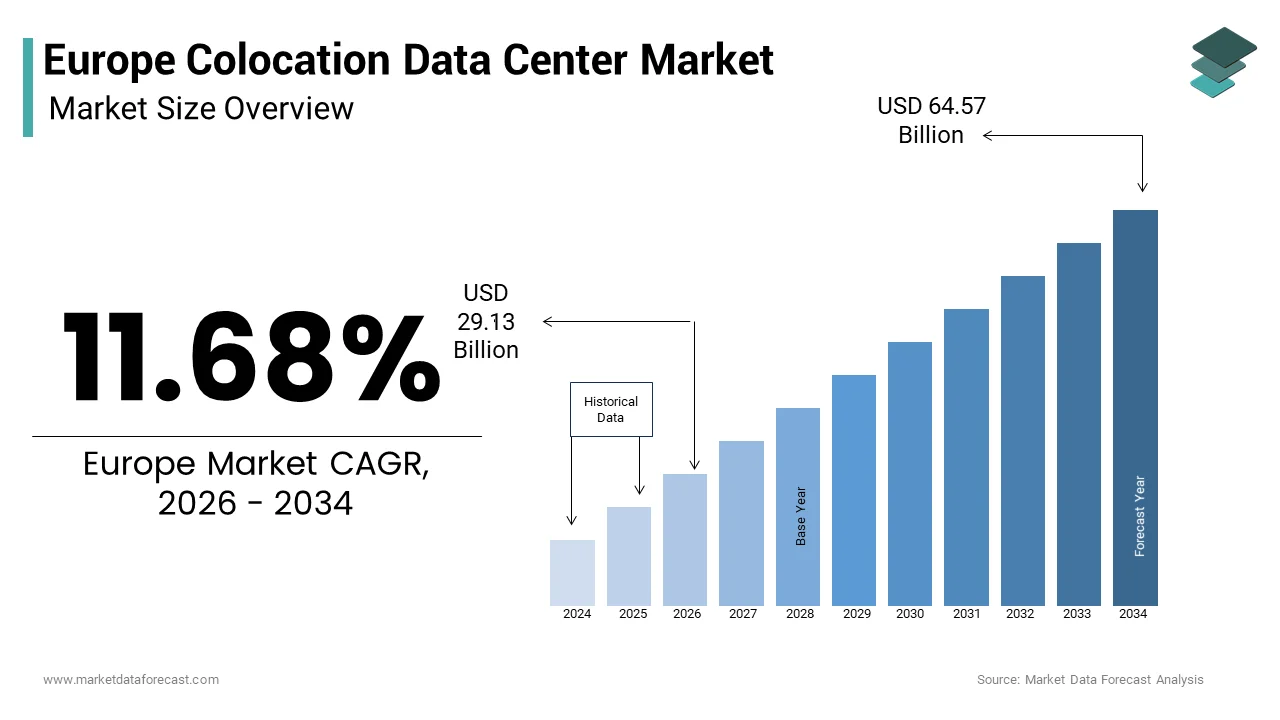
The Europe colocation data center market size was valued at USD 26.08 billion in 2025, is anticipated to reach USD 29.13 billion in 2026, and is projected to scale up to USD 64.57 billion by 2034, registering a compound annual growth rate (CAGR) of 11.68% during the forecast period from 2026 to 2034. Driven by stringent data sovereignty laws, rapid artificial intelligence adoption, high-performance computing workloads, and digital transformation initiatives, the European colocation sector continues to expand robustly.
Key Executive Metrics (At-a-Glance)
- 2025 Base Valuation: USD 26.08 Billion
- 2026 Current Valuation: USD 29.13 Billion
- 2034 Forecast Valuation: USD 64.57 Billion
- Compound Annual Growth Rate (CAGR): 11.68% (2026–2034)
- Dominant Type Segment: Retail Colocation (captured 56.5% share in 2025)
- Fastest-Growing Type Segment: Wholesale Colocation (projected at 15.5% CAGR)
- Dominant End-User Segment: BFSI (held 33.6% share in 2025)
- Fastest-Growing End-User Segment: Healthcare (anticipated at 16.6% CAGR)
- Dominant Country Markets: Germany (21.2% market share) and the United Kingdom
Core Market Drivers
- Data Sovereignty & GDPR Compliance: Strict legal frameworks forcing enterprises and multinational corporations to host European citizen data locally.
- AI & HPC Workloads: Surging demand for advanced, high-density infrastructure equipped with liquid cooling and massive parallel processing power.
- Cloud Adoption: Exponential growth in data generation driving the migration from on-premise server rooms to third-party secure facilities.
Primary Market Restraints & Challenges
- Power & Grid Constraints: Acute electrical shortages and grid congestion causing connection delays and moratoriums in major hubs like Frankfurt and Amsterdam.
- Permitting & Environmental Zoning: Complex planning laws, environmental impact assessments, and prolonged zoning approvals across member states.
- Operational Cost Pressures: Volatile energy pricing, rising operational expenditures, and a persistent technical talent gap.
Europe Colocation Data Center Market Segmentation Highlights
| Segment Category | Largest Market Segment | Fastest-Growing Market Segment |
|---|---|---|
| By Type | Retail Colocation (56.5% share in 2025) | Wholesale Colocation (15.5% CAGR) |
| By End-User | BFSI (33.6% share in 2025) | Healthcare (16.6% CAGR) |
| By Country | Germany (21.2% market share) | France and secondary European markets |
Major Industry Players Profiled
Key enterprises dominating the Europe colocation data center market include Equinix (US), Digital Realty (US), NTT Communications (JP), Interxion (NL), CyrusOne (US), Telehouse (GB), CoreSite (US), KDDI (JP), and China Telecom (CN).
Europe Colocation Data Center Market Size
The Europe colocation data center market size was valued at USD 26.08 billion in 2025 and is anticipated to reach USD 29.13 billion in 2026 to reach USD 64.57 billion by 2034, growing at a CAGR of 11.68% during the forecast period from 2026 to 2034.
Current Introduction of the Europe Colocation Data Center Market
Colocation data center constitutes a critical infrastructure sector where enterprises lease physical space, power, and cooling for their servers within third-party facilities rather than maintaining on-premise data halls. This model offers scalability, enhanced security, and connectivity to diverse network carriers, serving as the backbone for the continent's digital economy. The definition has evolved to include edge computing nodes that bring processing power closer to end users in dense urban environments. According to Eurostat, European enterprises have increasingly adopted cloud computing services, which is driving a strong need for robust hosting environments. According to the European Commission, the total volume of data created and consumed in the EU is expected to grow substantially, which is requiring expansion of physical storage capacity. As per the International Energy Agency, data centers in Europe account for a notable share of the region's electricity demand, highlighting the energy intensity of this sector. Regulatory frameworks like the General Data Protection Regulation mandate strict data sovereignty, compelling multinational corporations to store European citizen data within local borders. This legal landscape fosters a thriving ecosystem of hyperscale and enterprise colocation providers who ensure compliance while delivering high availability and low latency services across the continent.
MARKET DRIVERS
Stringent Data Sovereignty Regulations and Localization Mandates
The rigorous enforcement of data sovereignty laws that require sensitive information to remain within specific geographic boundaries is one of the major factors driving the growth of the Europe colocation data center market. The General Data Protection Regulation imposes severe penalties for data breaches and unauthorized cross-border transfers, which is forcing organizations to seek local hosting solutions that guarantee compliance. According to the European Data Protection Board, fines related to data residency violations have been significant, prompting a mass migration of workloads from public clouds with ambiguous data locations to certified colocation facilities. Enterprises in highly regulated sectors such as finance and healthcare are particularly driven to adopt colocation to maintain full control over their physical infrastructure while leveraging shared resources. The European Cloud Sovereignty Initiative further encourages the development of indigenous data infrastructure to reduce reliance on non-European hyperscalers. Companies view colocation not merely as a cost-saving measure but as a strategic necessity to mitigate legal risks and maintain consumer trust. The inability of some global public cloud providers to offer granular data residency guarantees in all European jurisdictions strengthens the value proposition of regional colocation operators who can promise strict adherence to local laws.
Exponential Growth of Artificial Intelligence and High-Performance Computing Workloads
The growth of the Europe colocation data center market is further attributed to the surging adoption of artificial intelligence and high-performance computing applications which demand specialized infrastructure that traditional on-premise setups cannot efficiently support. AI models require massive parallel processing power and ultra-low latency interconnects that are only feasible in advanced colocation facilities equipped with high-density power racks and liquid cooling systems. According to the European High Performance Computing Joint Undertaking, investment in AI infrastructure across the EU has grown substantially, with a significant portion deployed in colocation environments. These facilities provide the necessary power density which is unattainable in standard enterprise server rooms. The need for rapid scalability allows businesses to expand their compute capacity instantly without the long lead times associated with building private data centers. Colocation providers are increasingly offering AI-as-a-Service bundles that include access to GPU clusters and high-speed networking fabrics. The complexity of managing heat dissipation from AI chips makes the advanced cooling technologies inherent in modern colocation centers indispensable.
MARKET RESTRAINTS
Severe Constraints on Power Availability and Grid Capacity
A significant impediment facing the Europe colocation data center market is the acute shortage of available electrical power and the limited capacity of national grids to support new high-density facilities. Data centers are energy-intensive operations, and many European regions are experiencing grid congestion that delays or prevents the connection of new large-scale sites. According to the European Network of Transmission System Operators for Electricity, a large share of new data center connection requests in major hubs like Frankfurt and Amsterdam have faced delays due to grid saturation. Local municipalities in countries such as Ireland and the Netherlands have occasionally imposed moratoriums on new data center constructions to prioritize power for residential and industrial needs. The transition to renewable energy sources, while essential, introduces intermittency issues that complicate the provision of uninterrupted power supply required for mission-critical operations. Obtaining sufficient power allocations has become a primary bottleneck, forcing operators to look toward less connected peripheral regions which may lack the necessary fiber connectivity.
Complex Permitting Processes and Environmental Zoning Restrictions
The intricate and often prolonged permitting processes coupled with stringent environmental zoning regulations are further hindering the expansion of the Europe colocation data center market. European planning laws vary significantly across member states, which is requiring developers to navigate a labyrinth of local, regional, and national approvals before construction can commence. According to the European Environment Agency, the average time to secure all necessary permits for a hyperscale data center in Western Europe has increased in recent years. Public opposition based on concerns regarding noise pollution, visual impact, and water usage frequently leads to legal challenges that further delay projects. Strict environmental impact assessments mandate detailed plans for water conservation and carbon neutrality, which is adding layers of complexity and cost to project proposals. In some historic cities, zoning laws strictly prohibit industrial-scale infrastructure, which is pushing developments to remote locations that may not meet latency requirements for certain applications. The lack of harmonized regulations across the EU creates uncertainty for international investors who face unpredictable timelines and varying compliance standards in each country. These administrative hurdles increase capital expenditure and risk, which is causing some providers to postpone or cancel expansion plans despite strong market demand.
MARKET OPPORTUNITIES
Expansion of Edge Computing Networks in Secondary Cities
The widespread deployment of edge computing offers a potential opportunity for the Europe colocation data center market by shifting infrastructure from centralized hyperscale hubs to distributed nodes in secondary and tertiary cities. As applications like autonomous vehicles, smart manufacturing, and augmented reality require single-digit millisecond latency, data processing must occur closer to the source of data generation. According to the 5G Infrastructure Association, the rollout of 5G networks across Europe will require a significant number of new edge data center locations to support low-latency use cases. Colocation providers can capitalize on this by establishing smaller, modular facilities in urban centers that currently lack substantial digital infrastructure. This decentralization reduces the strain on major interconnection hubs and opens up new revenue streams in underserved markets. The opportunity extends to partnering with telecommunications operators to co-locate equipment at cell tower sites and central offices. By offering edge-specific services, providers can cater to industries that require real-time data processing without the cost of building private infrastructure.
Adoption of Advanced Liquid Cooling and Sustainable Energy Solutions
The urgent drive toward sustainability offers a significant opportunity for the Europe colocation data center market. With the European Union targeting climate neutrality by 2050, data centers face increasing pressure to reduce their carbon footprints and water usage. As per the Climate Neutral Data Centre Pact, signatories are committed to achieving carbon neutrality, driving investment in innovative cooling methods such as direct-to-chip and immersion cooling. These technologies allow for higher power densities while significantly lowering energy consumption compared to traditional air cooling. Providers who successfully implement these solutions can attract environmentally conscious clients and qualify for green financing options. The integration of on-site renewable generation, such as solar panels and fuel cells, further enhances sustainability credentials. There is also a growing market for waste heat recovery systems where excess thermal energy is supplied to district heating networks, turning a liability into a community asset.
MARKET CHALLENGES
Escalating Costs of Energy and Operational Expenditures
The volatility and sustained elevation of energy prices that directly impacts operational profitability and pricing strategies is majorly challenging the expansion of the Europe colocation data center market. The geopolitical instability in recent years has led to fluctuating electricity costs across the continent, which is making long-term financial planning difficult for facility operators. According to Eurostat, industrial electricity prices in the European Union have varied widely between member states, creating an uneven playing field for competitors. High energy costs force providers to either absorb the expense, eroding margins, or pass them on to customers, which is potentially reducing demand. The need to hedge against price spikes requires sophisticated financial instruments and long-term power purchase agreements that are not always accessible to smaller players. Additionally, the cost of backup power systems, such as diesel generators and battery storage and has risen due to inflation and supply chain constraints.
Acute Shortage of Specialized Technical Talent and Skills Gap
The severe shortage of skilled professionals capable of designing, operating and maintaining complex data center infrastructure represents a persistent challenge for the Europe colocation data center market. The rapid evolution of technology, including high-density computing and advanced cooling systems, requires a workforce with specialized expertise that is currently in short supply. According to the European Centre for the Development of Vocational Training, the digital sector in Europe faces a significant deficit of ICT specialists, with data center engineering being one of the hardest roles to fill. This talent gap leads to increased labor costs as companies compete for a limited pool of qualified engineers and technicians. The lack of experienced staff can result in operational inefficiencies, increased downtime risks, and delays in deploying new technologies. Educational institutions have struggled to update curricula quickly enough to match the industry's evolving needs, exacerbating the skills mismatch. Without a strategic approach to training and recruitment, operators may find themselves unable to scale operations or maintain the high service levels expected by enterprise clients.
REPORT COVERAGE
| REPORT METRIC | DETAILS |
| Market Size Available | 2025 to 2034 |
| Base Year | 2025 |
| Forecast Period | 2026 to 2034 |
| CAGR | 11.68% |
| Segments Covered | By Type, End-User, and Region |
| Various Analyses Covered | Global, Regional, & Country Level Analysis; Segment-Level Analysis; DROC, PESTLE Analysis; Porter’s Five Forces Analysis; Competitive Landscape; Analyst Overview of Investment Opportunities |
| Regions Covered | UK, France, Spain, Germany, Italy, Russia, Sweden, Denmark, Switzerland, Netherlands, Turkey, and the Czech Republic |
| Market Leaders Profiled | Equinix (US), Digital Realty (US), NTT Communications (JP), CyrusOne (US), Interxion (NL), CoreSite (US), KDDI (JP), Telehouse (GB), China Telecom (CN) |
SEGMENTAL ANALYSIS
By Type Insights
The retail colocation segment dominated the market by capturing 56.5% of the European market share in 2025. The dominance of retail colocation segment in the European market is attributed to the widespread adoption of this model among small and medium-sized enterprises and large corporations that require flexible, scalable space without the capital expenditure of building private facilities. The ability to lease single racks or small cages allows businesses to align costs directly with usage, which is making it the preferred choice for diverse IT workloads. The unparalleled flexibility it offers organizations to scale their infrastructure incrementally in response to fluctuating business demands is also aiding the expansion of the retail colocation segment in the European market. Unlike wholesale models that require long-term commitments and large minimum power allocations, retail colocation allows companies to start with a single rack and expand cabinet by cabinet as needed. According to Eurostat, small and medium-sized enterprises make up the overwhelming majority of businesses in the European Union, and most lack the capital resources to construct proprietary data centers. This demographic relies heavily on retail providers to access enterprise-grade security, connectivity, and redundancy at a manageable operational expense. The pay-as-you-grow model significantly reduces upfront capital expenditure, freeing up funds for core business innovation. Furthermore, the ability to terminate or adjust contracts with shorter notice periods provides a strategic advantage in an uncertain economic climate. Retail providers cater to this need by offering modular solutions that can be deployed rapidly that often within weeks.
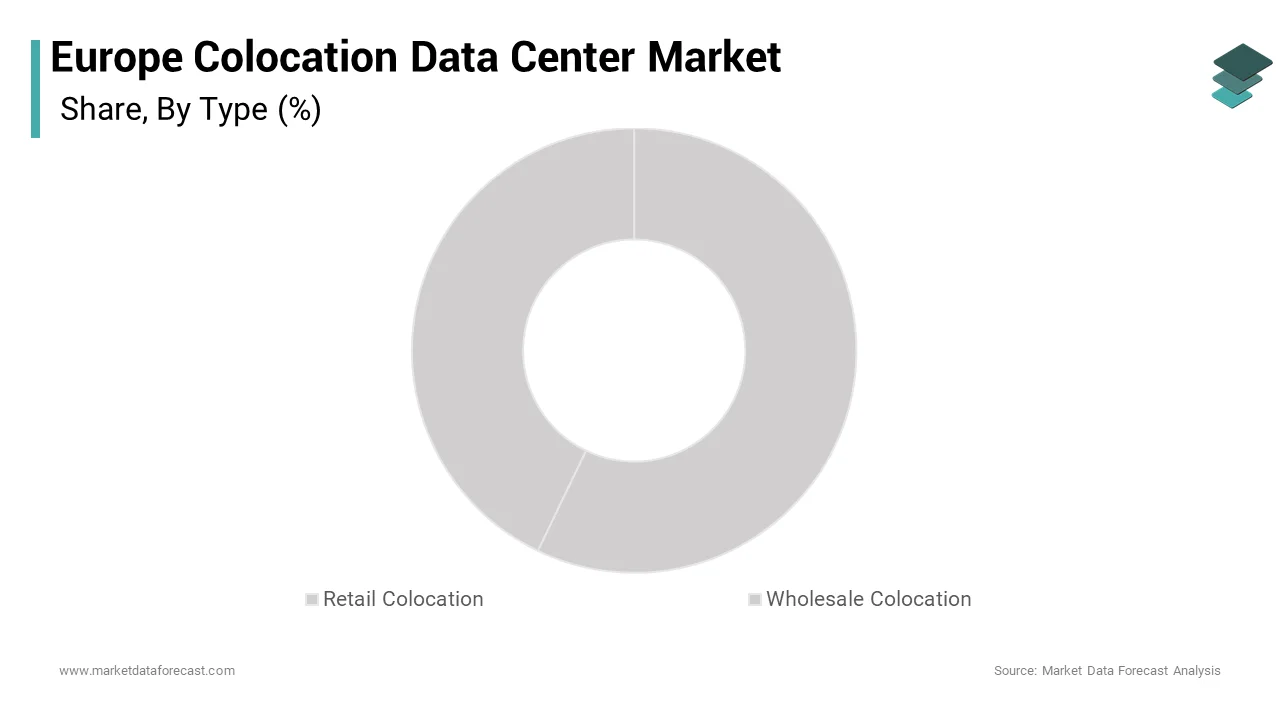
The wholesale colocation segment is poised to expand at a CAGR of 15.5% over the forecast period in the European market. Factors such as the insatiable demand from hyperscale cloud providers and large technology firms for massive, customized facilities capable of supporting high-density computing workloads are propelling the wholesale segment in the European market. The aggressive expansion plans of hyperscale cloud providers that require vast amounts of power and space to build region-specific availability zones is also contributing to the expansion of wholesale colocation segment in the European market. These giants prefer wholesale arrangements that allow them to design and operate entire data halls or buildings tailored to their specific technical requirements. According to the Synergy Research Group, hyperscale data center additions in Europe have increased significantly, with the majority secured through long-term wholesale leases. These deals often involve power capacities far exceeding the capabilities of retail offerings. The customizability of wholesale spaces enables providers to implement specialized cooling systems and power architectures optimized for their unique server designs. Long-term contracts associated with wholesale deals provide the financial stability necessary for developers to secure funding and construct these massive projects.
By End-User Insights
The BFSI segment held the dominant share of the Europe colocation data center market by capturing 33.6% of the regional market share in 2025. The leading position of the BFSI segment in the European market is attributed to the sector's critical need for data sovereignty, rigorous regulatory compliance, and ultra-high availability to maintain customer trust and operational continuity in a highly regulated environment. The uncompromising requirement to adhere to strict data protection regulations such as the General Data Protection Regulation and specific financial directives like PSD2 is also favouring the growth of the BFSI segment in the European market. These laws mandate that sensitive customer financial data must remain within specific geographic boundaries and be protected by robust security measures. According to the European Banking Authority, fines for non-compliance with data residency and security protocols have been substantial, which is compelling banks and insurers to migrate critical workloads to certified colocation facilities. Colocation providers offer the physical control and audit trails necessary to demonstrate compliance to regulators, providing a level of assurance that shared public cloud environments may not match for certain legacy systems. The ability to isolate sensitive data in private cages while maintaining connectivity to external partners makes colocation the ideal hybrid solution.
The healthcare segment is anticipated to register the fastest CAGR of 16.6% over the forecast period in the European market. The digital transformation of medical records, the rise of telemedicine, and the increasing use of data-intensive technologies like genomic sequencing and AI-driven diagnostics are propelling the expansion of the healthcare segment in the European market. The massive shift toward digitizing patient records and the exponential expansion of telemedicine services across Europe are contributing to the growth of the healthcare segment in the European market. The European Commission’s push for a European Health Data Space has accelerated the adoption of electronic health records, generating vast amounts of data that require secure and scalable storage solutions. According to the World Health Organization Regional Office for Europe, telemedicine consultations have risen significantly compared to pre-pandemic levels, creating a continuous stream of video and diagnostic data that must be stored and processed reliably. Colocation facilities offer the necessary capacity and security to handle this sensitive personal health information in compliance with strict privacy laws. Hospitals and clinics are increasingly outsourcing their IT infrastructure to colocation providers to focus on patient care while ensuring their data is housed in state-of-the-art environments. The need for real-time access to patient data across different healthcare providers necessitates the high-speed interconnectivity found in colocation hubs.
COUNTRY LEVEL ANALYSIS
Germany Colocation Data Center Market
Germany led the market and held 21.2% of the European market share in 2025. Frankfurt is the country’s primary hub and is hosting major operators such as Equinix, Digital Realty, and Telehouse, supported by DE‑CIX, the world’s largest internet exchange. Germany’s strong enterprise base in automotive, finance, and manufacturing drives demand for secure, low‑latency colocation services. The government’s Cloud Computing Strategy and strict data protection laws (BDSG, GDPR) reinforce trust in domestic facilities. Sustainability is a priority, with operators investing in renewable energy sourcing and advanced cooling systems to meet EU Green Deal targets. With its combination of enterprise demand, regulatory rigor, and connectivity, Germany remains the anchor of Europe’s colocation market and is expected to lead in hyperscalers expansion and green data center innovation.
UK Colocation Data Center Market
The UK had the second largest share of the Europe colocation data center market in 2025. London is the dominant hub, with Docklands hosting dense clusters of Tier III and Tier IV facilities operated by Equinix, Telehouse, and Global Switch. The UK’s financial services sector and strong cloud adoption rates drive colocation demand, while post‑Brexit regulatory autonomy has allowed flexible energy and sustainability policies. For instance, vacancy rates in London fell sharply between 2021 and 2023, reflecting strong absorption by hyperscalers and enterprises. The UK also benefits from subsea cable connectivity, making it a gateway for transatlantic traffic. With its blend of global finance, cloud adoption, and connectivity, the UK is expected to remain a high‑value colocation hub, particularly for hybrid cloud and edge deployments.
France Colocation Data Center Market
France is estimated to showcase a promising CAGR in the Europe colocation data center market during the forecast period. Paris hosts major enterprise and government workloads, while Marseille has emerged as a strategic Mediterranean hub for subsea cable landings, connecting Europe to Africa, the Middle East, and Asia. Operators such as Interxion (Digital Realty) and Equinix have expanded capacity to meet rising demand from telecom and content providers. France’s Plan France Très Haut Débit and national AI strategy have accelerated digital transformation, boosting colocation adoption. Energy efficiency is a priority, with French operators investing in liquid cooling and waste‑heat recovery systems. With its dual strength in enterprise workloads and international connectivity, France is expected to remain a stable and strategically important colocation market.
Netherlands Colocation Data Center Market
The Netherlands is projected to account for a notable share of the Europe colocation data center market over the forecast period. Amsterdam is one of Europe’s most connected hubs, hosting AMS‑IX, one of the largest internet exchanges globally. Major operators such as Equinix, Digital Realty, and NorthC Data Centers provide dense interconnection ecosystems for enterprises, cloud providers, and telecoms. The Dutch government has introduced strict sustainability and spatial planning rules, temporarily pausing hyperscaler permits in 2022 before resuming under new efficiency guidelines. Despite regulatory scrutiny, demand remains strong due to the Netherlands’ role as a logistics and connectivity hub. With its combination of interconnection density, strategic location, and sustainability focus, the Netherlands is expected to remain a high‑influence colocation market, serving as a gateway for pan‑European and global traffic.
COMPETITIVE LANDSCAPE
The competition within the Europe colocation data center market is characterized by intense rivalry among global hyperscalers, regional specialists, and telecommunications giants vying for limited power resources and prime real estate. Major players compete fiercely to secure long term power purchase agreements and grid connections in saturated hubs like Frankfurt and London where availability is critically low. The landscape features a battle for innovation where firms strive to deploy cutting edge cooling technologies and modular designs that reduce construction timelines significantly. Differentiation is often achieved through the richness of the interconnection ecosystem allowing customers to connect directly with multiple cloud providers and networks. Strategic alliances with local utilities and governments serve as a critical battleground to navigate complex permitting processes and environmental regulations. The entry of sovereign wealth funds and infrastructure investors adds financial pressure prompting operators to optimize asset yields and operational margins. Talent acquisition remains a key competitive factor as organizations scramble to hire skilled engineers capable of managing increasingly complex facilities. Regulatory compliance regarding data sovereignty and carbon emissions acts as a significant moat where only those with deep local expertise can execute successfully.
KEY MARKET PLAYERS
A domainant players that are in the Europe colocation data center market are
- Equinix (US)
- Digital Realty (US)
- NTT Communications (JP)
- CyrusOne (US)
- Interxion (NL)
- CoreSite (US)
- KDDI (JP)
- Telehouse (GB)
- China Telecom (CN)
Top Players In The Market
- Equinix stands as a preeminent force in the Europe colocation data center market by operating the largest global interconnection platform that enables digital ecosystems to thrive. The company contributes globally by setting standards for carrier neutrality and facilitating direct connections between networks, clouds, and enterprises across continents. Recent actions to strengthen their market position include the strategic acquisition of additional facilities in key metropolitan areas like Paris and Amsterdam to alleviate capacity constraints. They have heavily invested in sustainable infrastructure by committing to one hundred percent renewable energy coverage across all European sites. Equinix continues to expand its Edge Metro solutions to bring connectivity closer to end users in secondary cities. Their focus on hybrid multicloud environments allows customers to seamlessly integrate private infrastructure with public cloud providers. This relentless expansion of interconnection density solidifies their reputation as the critical backbone for global digital trade and enterprise IT strategies.
- Digital Realty operates as a critical enabler of data gravity in the Europe colocation data center market by providing scalable solutions that support massive data growth and artificial intelligence workloads. The group plays a pivotal role globally through its PlatformDIGITAL ecosystem which connects organizations to the right data places with the right partners. Recent efforts to bolster their standing involve the development of hyperscale campuses in Frankfurt and London designed specifically for high density computing needs. They have launched innovative liquid cooling technologies to support the thermal demands of next generation graphics processing units used in AI training. Digital Realty actively pursues partnerships with major cloud service providers to offer integrated hybrid cloud services within their facilities. Their commitment to sustainability includes ambitious targets for water positivity and carbon reduction across their European portfolio. By focusing on flexible power solutions and global interconnectivity they ensure clients can scale efficiently while meeting strict environmental regulations.
- NTT Ltd distinguishes itself in the Europe colocation data center market through its extensive global network and ability to deliver integrated intelligent infrastructure solutions. The company contributes to the global market by leveraging its Japanese heritage of operational excellence to provide highly reliable and secure data center services worldwide. Recent strategic moves include the expansion of their modular data center offerings in Germany and the Netherlands to accelerate deployment times for enterprise clients. They have enhanced their smart hand services to allow remote management of physical infrastructure reducing the need for onsite visits. NTT Ltd is investing significantly in edge computing nodes to support low latency applications for automotive and manufacturing sectors. Their holistic approach combines colocation with managed network services creating a seamless experience for multinational corporations. By prioritizing security compliance and energy efficiency they attract regulated industries such as finance and healthcare seeking robust European data residency solutions.
Top Strategies Used By Key Market Participants
Key players in the Europe colocation data center market primarily employ strategies focused on aggressive geographic expansion into secondary cities to capture emerging demand from edge computing applications. Companies frequently engage in mergers and acquisitions to consolidate market presence and acquire ready built facilities in power constrained regions. Another prevalent strategy involves the development of specialized high density suites equipped with advanced liquid cooling systems to support artificial intelligence and high performance computing workloads. Firms are increasingly investing in renewable energy projects and power purchase agreements to meet stringent European sustainability mandates and attract eco conscious clients. Strategic partnerships with hyperscale cloud providers enable operators to offer seamless hybrid cloud solutions that integrate physical infrastructure with virtual services. Participants also focus on enhancing interconnection ecosystems by attracting diverse network carriers and internet exchange points to their facilities. Automation of facility management through artificial intelligence drives operational efficiency and reduces human error in critical environments. These approaches collectively enhance competitiveness and resilience in a rapidly evolving landscape.
MARKET SEGMENTATION
This research report on the Europe colocation data center market is segmented and sub-segmented into the following categories.
By Type
- Retail Colocation
- Wholesale Colocation
By End-User
- BFSI
- IT and telecom
- Government and defense
- Healthcare
By Deployment
- Cloud
- On-Premises
By Country
- UK
- France
- Spain
- Germany
- Italy
- Russia
- Sweden
- Denmark
- Switzerland
- Netherlands
- Turkey
- Czech Republic
- Rest of Europe