- Product Description Description
- Table of Contents TOC
- List of Table & Figure LOT
- Get Free Sample PDF Sample PDF
Europe Compressor Oil Market Report Summary
The Europe compressor oil market was valued at USD 3.04 billion in 2024, is estimated to reach USD 3.18 billion in 2025, and is projected to reach USD 4.66 billion by 2033, growing at a CAGR of 4.88% during the forecast period from 2025 to 2033. The growth of the Europe compressor oil market is driven by stringent EU energy-efficiency and Ecodesign regulations, expanding industrial refrigeration and cold-chain infrastructure, and rising demand for high-performance synthetic lubricants that enhance equipment longevity and reduce energy consumption. Increasing adoption of condition-based maintenance, oil-life extension technologies, and circular-economy initiatives for re-refined and bio-based base oils are further fueling market expansion. Moreover, OEM specifications, stricter chemical safety rules (REACH/CLP), and the need for compatible lubricants for new refrigerants (CO₂, HFO alternatives) are positioning compressor oil as a critical compliance and performance input across European industry.
Key Market Trends
- Regulatory push (Ecodesign, EN standards) driving adoption of premium synthetic oils to meet efficiency and emission targets.
- Expansion of temperature-controlled logistics and industrial refrigeration elevating demand for specialized compressor lubricants.
- Digitalization of maintenance with oil condition monitoring enabling extended drain intervals and performance-based lubrication strategies.
- Rising interest in re-refined and bio-based base stocks as circular-economy and lifecycle-emissions disclosure requirements intensify.
- OEM-led specification and factory-fill approvals shaping buyer preference and limiting generic substitution.
Segmental Insights
- Based on base oil, the synthetic compressor oils segment dominated the market, holding 53.5% of the Europe compressor oil market share in 2024. The segment’s dominance is attributed to superior thermal stability, oxidation resistance and viscosity retention required by high-speed and high-pressure compressors and by refrigeration systems using CO₂ and natural refrigerants.
- Based on end-use industry, the manufacturing segment occupied 45.5% of the Europe compressor oil market share in 2024, driven by ubiquitous compressed-air usage across automotive parts, food processing, textiles and machinery fabrication.
Regional Insights
The Europe compressor oil market is supported by advanced industrial bases, strict regulatory frameworks and strong OEM ecosystems across major economies.
- Germany was the largest contributor, accounting for 22.8% of the Europe compressor oil market share in 2024, driven by a dense manufacturing sector, strict energy-efficiency mandates, and leading compressor OEMs (Kaeser, BOGE) that specify synthetic oils as standard.
- Italy holds a strong position due to its SME-led industrial clusters in food machinery, textiles and automotive components and government modernization funding.
- France benefits from nuclear-backed low-carbon electricity, hydrogen infrastructure projects and significant cold-chain logistics needs supporting specialized refrigeration lubricants.
- United Kingdom shows steady demand supported by pharmaceuticals, high-value manufacturing and energy-efficiency funding programs.
- Netherlands (Port of Rotterdam) supports demand via energy/logistics infrastructure, gas-processing and cold-chain hubs requiring high-performance compressor oils.
Competitive Landscape
The Europe compressor oil market is characterized by a mix of global integrated oil majors and specialized lubricant specialists competing on technical performance, OEM approvals, and service ecosystems. Key competitive levers include proprietary additive technologies, base-oil security, OEM factory-fill listings, digital oil-condition services, and sustainable product portfolios (re-refined and bio-based oils). Barriers to entry are high due to extensive field testing, compliance requirements, and the need for localized technical service. Market players are increasingly differentiating through circular-economy offerings and condition-monitoring platforms to extend drain intervals and reduce total cost of ownership. Prominent players in the Europe compressor oil market include Shell, ExxonMobil (Mobil), TotalEnergies, BP/Castrol, FUCHS PETROLUB, Klüber Lubrication, Quaker Houghton, Petronas Lubricants, Idemitsu Kosan, Chevron (Caltex), MOL Group, and Eni.
Europe Compressor Oil Market Size
The europe compressor oil market size was valued at USD 3.04 billion in 2024 and is anticipated to reach USD 3.18 billion in 2025 from 4.66 billion by 2033, growing at a CAGR of 4.88% during the forecast period from 2025 to 2033.
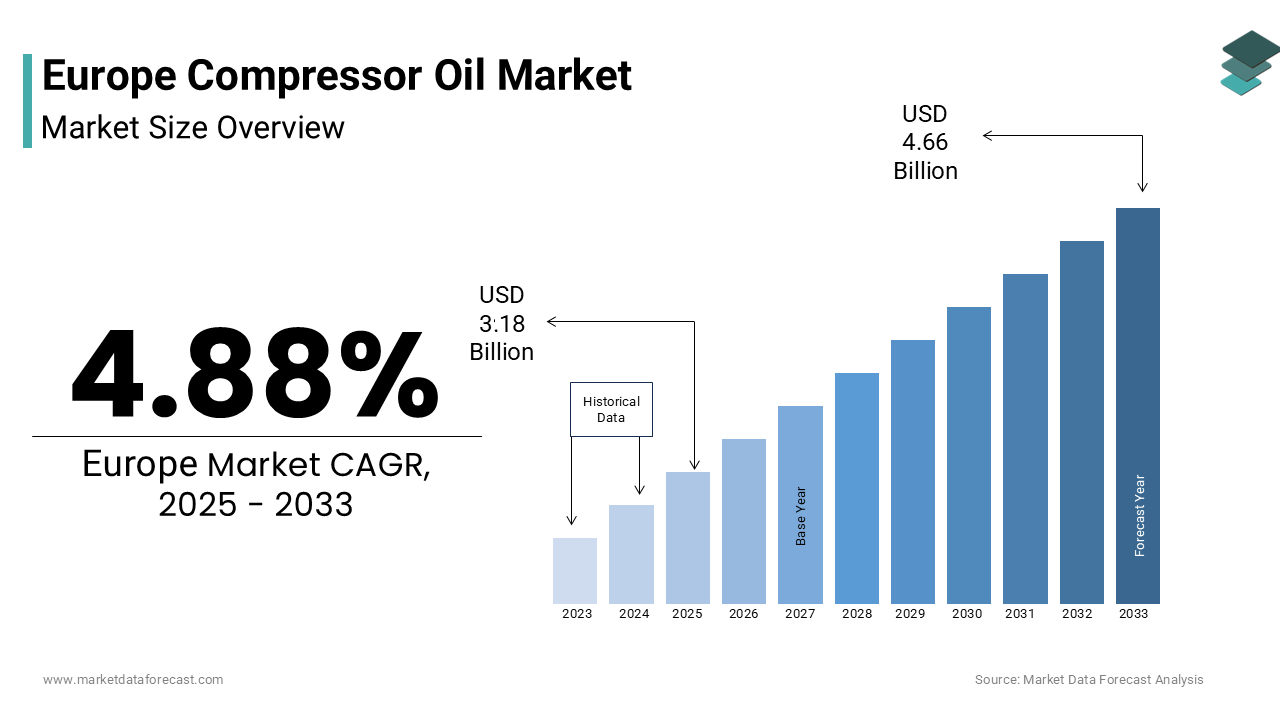
Compressor oil is a lubricant formulated to ensure optimal performance cooling and protection in air gas and refrigeration compressors across industrial commercial and automotive applications. These oils are engineered to resist thermal degradation minimize deposit formation and maintain viscosity stability under high pressure and temperature conditions. Europe’s demand is shaped not by volume alone but by stringent regulatory standards for energy efficiency equipment longevity and environmental safety. According to the European Environment Agency, industrial and commercial compressors operate widely across the EU requiring regular oil replenishment and maintenance to ensure long‑term performance. The European Commission’s Ecodesign Directive mandates minimum efficiency levels for compressors used in refrigeration and industrial processes, which directly influences oil performance specifications. Additionally, REACH and CLP regulations govern chemical composition, which is restricting substances of very high concern. This regulatory and operational context positions compressor oil not as a commodity but as a critical enabler of reliability sustainability and compliance in Europe’s energy‑intensive infrastructure.
MARKET DRIVERS
Stringent EU Energy Efficiency and Ecodesign Regulations
European regulatory frameworks are driving demand for high performance synthetic compressor oils by mandating improved energy efficiency in compressed air and refrigeration systems, which is further driving the European compressor oil market growth. According to the European Commission’s updated Ecodesign Directive for motors and compressors effective from 2023, all industrial air compressors placed on the EU market must achieve a specific energy performance class that often requires low‑traction synthetic lubricants to minimize internal friction. The European Committee for Standardization’s EN 12285 standard now references ISO 6743‑3 viscosity and thermal stability benchmarks that only premium synthetic oils can consistently meet. According to the studies on compressor efficiency in Europe, upgrading lubrication systems and using high‑performance synthetic oils can contribute measurable energy savings in industrial operations. As industrial compressors remain widely deployed across major EU economies, these incremental efficiency gains create substantial aggregate demand for advanced lubricants. Compliance is no longer optional but a prerequisite for market access.
Expansion of Industrial Refrigeration and Cold Chain Infrastructure
The growth of temperature-controlled logistics and food processing is significantly elevating demand for specialized refrigeration compressor oils across Europe, which is further contributing to the regional market expansion. According to the European Food Safety Authority, the EU processes large volumes of perishable food each year, which is requiring uninterrupted cold chain integrity from farm to retail. Cold storage capacity across Europe has continued to expand in response to rising e‑grocery demand and increased public‑health‑driven refrigeration needs. These systems predominantly use ammonia or hydrofluoroolefin refrigerants which demand chemically stable polyalkylene glycol or ester‑based oils to prevent sludge formation and acid buildup. Germany has also continued to increase its refrigerated warehouse footprint, which is requiring new compressor installations with compatible lubricants. Furthermore, the F‑Gas Regulation phase‑down of high‑GWP refrigerants is accelerating adoption of natural refrigerants like CO₂, which operate at extreme pressures requiring high film‑strength oils. This confluence of food safety public health and environmental policy ensures sustained demand for technically advanced compressor lubricants.
MARKET RESTRAINTS
High Cost and Limited Availability of Synthetic Base Stocks
The Europe compressor oil market faces significant supply constraints due to dependence on imported synthetic base stocks whose production is capital intensive and geographically concentrated. According to the European Lubricating Grease Institute, a significant share of Group IV polyalphaolefin base stocks used in premium compressor oils is sourced from outside the EU, which is reflecting the region’s longstanding dependence on imported synthetic hydrocarbons. The 2022 energy crisis exacerbated this vulnerability as European chemical plants curtailed output of specialty hydrocarbons due to natural‑gas shortages. For instance, PAO prices experienced substantial volatility during this period, which is disrupting blending operations for independent lubricant formulators. Although companies like INEOS and Nynas produce select synthetic base fluids, domestic capacity still meets only a limited portion of EU demand. This import reliance not only inflates costs but also introduces lead‑time volatility that impedes just‑in‑time maintenance strategies, particularly for SMEs. Until Europe develops secure and scalable synthetic base‑stock production, the market will remain exposed to global petrochemical fluctuations.
Fragmented Equipment Standards and OEM-Specific Approvals
The lack of universal performance specifications across compressor manufacturers creates significant complexity in oil selection and procurement across Europe, which is further hindering the compressor oil market growth in Europe. According to the European Committee of Manufacturers of Compressors Vacuum Pumps and Allied Equipment, each major OEM maintains proprietary oil approval lists with unique test protocols for oxidation resistance demulsibility and foaming control. A single industrial facility operating mixed compressor brands may require multiple different oil types increasing inventory costs and risk of misapplication. For instance, a notable share of compressor failures is linked to incorrect oil substitution often due to unclear compatibility guidance. While ISO 6743‑3 provides a general classification framework it does not replace OEM approvals which can take significant time and investment to obtain. This approval bottleneck stifles competition from independent blenders and slows adoption of innovative bio‑based or circular‑economy lubricants.
MARKET OPPORTUNITIES
Adoption of Condition Monitoring and Oil Life Extension Technologies
Digitalization of maintenance practices is creating new opportunities for the European compressor oil market. According to the European Maintenance Society, many large industrial facilities in Germany France and the Netherlands now use oil analysis sensors that monitor viscosity acidity and particle count in real time. These systems enable condition‑based oil changes rather than fixed schedules reducing consumption while preventing unplanned downtime. Lubricant manufacturers are responding with oils formulated for longevity. Shell and TotalEnergies have launched digital oil tracking services that integrate sensor data with cloud analytics to recommend optimal change points. The European Investment Bank allocated funding in 2024 to support predictive‑maintenance adoption in SMEs under its Digital Europe Programme. This shift transforms compressor oil from a consumable into a performance enabler within data‑driven asset‑management strategies.
Growth of Circular Economy and Re-refined Lubricant Adoption
The EU’s Circular Economy Action Plan is catalyzing demand for re-refined and bio-based compressor oils as part of industrial decarbonization efforts, which is further offering growth opportunities for the European compressor oil market. According to the European Environment Agency, re‑refined base oils can reduce lifecycle CO₂ emissions by over 80% compared to virgin mineral oils while meeting ISO performance standards. The revised End‑of‑Life Vehicles Directive and Waste Framework Directive now encourage or mandate use of recycled content in industrial lubricants where technically feasible. Several European regulators have begun approving re‑refined synthetic blends for use in industrial equipment, setting important precedents for wider adoption. Companies like FUCHS and Avista Oil have launched certified re‑refined compressor oils compliant with DIN 51524 and OEM specifications. The European Commission’s upcoming Product Environmental Footprint rules will further incentivize low‑carbon lubricants by requiring disclosure of embodied emissions. This policy‑driven shift opens a sustainable premium segment aligned with corporate net‑zero commitments.
MARKET CHALLENGES
Volatility in Crude Oil and Feedstock Pricing
Persistent fluctuations in global crude oil and natural gas markets directly impact the cost stability of compressor oil production in Europe, which is one of the major challenges to the European compressor oil market. According to the European Central Bank, energy price volatility has continued to elevate industrial input costs across the EU with Group I and II base‑oil prices closely tracking Brent crude benchmarks. Although synthetics are less correlated, their production relies on ethylene and propylene derivatives whose pricing is tied to naphtha‑cracking margins affected by refinery‑utilization rates. For instance, unplanned maintenance at key European refineries in 2023 reduced base‑oil output, which is triggering spot shortages and price spikes. These cost pressures cannot be fully passed to customers due to long‑term service contracts in sectors like food processing and pharmaceuticals where compressor downtime is unacceptable. As a result, lubricant blenders face margin compression, particularly in the mid‑tier segment where price sensitivity is high. This economic fragility undermines investment in R&D for next‑generation sustainable formulations.
Shortage of Technical Expertise in Lubrication Management
A critical deficit of trained personnel in lubrication engineering and oil analysis is impeding optimal compressor oil selection and maintenance across European industry, which is further challenging the regional market growth. According to Cedefop, the European Centre for the Development of Vocational Training there is a limited pool of certified lubrication specialists serving the EU industrial sector despite millions of compressors requiring regular care. For instance, many maintenance teams in Southern and Eastern Europe rely on generic product datasheets rather than oil analysis or OEM guidance leading to premature wear and inefficiency. Although ISO 18436 sets standards for machinery‑lubrication technician certification uptake remains low outside Germany and the Nordics. This knowledge gap results in over‑lubrication unnecessary oil changes and misapplication of synthetic grades, which is costing European industry significant annual losses in avoidable energy and repair expenses. Without systemic investment in technical training the full performance and sustainability potential of advanced compressor oils will remain unrealized.
REPORT COVERAGE
| REPORT METRIC | DETAILS |
| Market Size Available | 2024 to 2033 |
| Base Year | 2024 |
| Forecast Period | 2025 to 2033 |
| Segments Covered | By Base Oil, End-Use Industry & Region |
| Various Analyses Covered | Global, Regional & Country Level Analysis; Segment-Level Analysis, DROC, PESTLE Analysis, Porter’s Five Forces Analysis, Competitive Landscape, Analyst Overview of Investment Opportunities |
| Regions Covered | United Kingdom, France, Spain, Germany, Italy, Russia, Sweden, Denmark, Switzerland, the Netherlands, Turkey, and the Czech Republic. |
| Market Leaders Profiled | GE Healthcare, Phillips Respironics, ImThera Medical Inc., BMC Medical Co. Ltd, Cadwell Laboratories, ResMed, Curative Medical Inc., Nihon Kohden, Curative Medical Inc., Compumedics Limited, Invacare Corporation, and Braebon Medical Corporation. |
SEGMENTAL ANALYSIS
By Base Oil Insights
The synthetic compressor oils segment dominated the market by holding 53.5% of the regional market share in 2024. The dominance of synthetic segment in the European market is driven by regulatory mandates for energy efficiency and the operational demands of modern high-speed compressors. The European Commission’s Ecodesign Directive requires industrial compressors to meet minimum efficiency standards that are unattainable with conventional mineral oils due to higher internal friction. Synthetic polyalphaolefins and polyalkylene glycols offer superior thermal stability oxidation resistance and viscosity retention at extreme temperatures enabling measurable energy‑efficiency improvements in compressor operation. In refrigeration applications where CO₂ and ammonia systems operate at high pressures only synthetic esters provide adequate lubricity and chemical inertness. Additionally, OEMs like Atlas Copco and Kaeser now specify synthetic oils as standard for all new rotary screw and centrifugal compressors sold in the EU. This regulatory and technical alignment ensures synthetics remain the benchmark for performance and compliance.
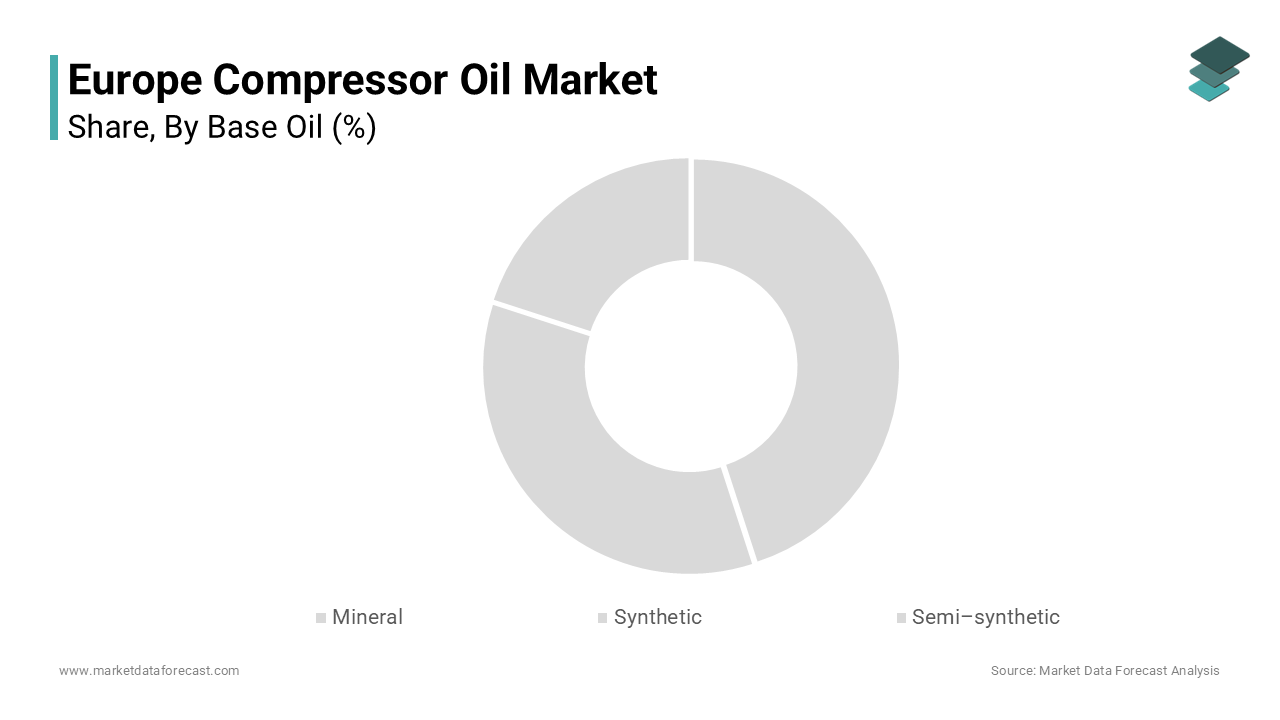
The semi-synthetic segment is a promising segment and is likely to expand at a CAGR of 7.04% over the forecast period. The growth of the semi-synthetic segment in the European market is expected to be driven by its role as a cost-effective performance bridge for small and medium enterprises transitioning from mineral to full synthetic oils. Semi synthetics blend Group II mineral base stocks with synthetic components to deliver enhanced thermal stability and oxidation control at a lower cost than full synthetics. Many European manufacturing SMEs operate on tight maintenance budgets yet face pressure to comply with ISO 50001 energy‑management standards, which is making semi synthetics an attractive compromise. In Italy and Spain where industrial energy costs have remained elevated in recent years, small food processors and textile mills are adopting semi synthetic oils to extend drain intervals without major equipment retrofits. Lubricant blenders like FUCHS and Avista Oil have launched OEM‑approved semi synthetic lines certified for use in Ingersoll Rand and BOGE compressors, further accelerating adoption across cost‑sensitive sectors.
By End-Use Industry Insights
The manufacturing segment occupied 45.5% of the European compressor oil market share in 2024. The dominance of the manufacturing segment in the regional market is attributed to the pervasive reliance on compressed air systems across diverse subsectors including automotive parts food processing textiles and machinery fabrication. According to the European Commission, compressed air is widely used across European manufacturing for automation tooling and material handling, which is making it one of the most ubiquitous utilities in industrial operations. In Germany, manufacturing facilities collectively consume substantial electricity for air compression each year, which is reflecting the high energy intensity of these systems. Stringent hygiene standards in food and pharmaceutical manufacturing further necessitate high‑purity synthetic oils compliant with NSF H1 registration, which are now widely adopted across EU food‑processing plants. This combination of ubiquity, regulatory stringency and energy intensity cements manufacturing as the core demand driver.
The power generation segment is predicted to register the fastest CAGR of 8.04% over the forecast period owing to the expansion of gas fired peaking plants and renewable energy integration infrastructure. As Europe phases out coal, the EU has continued to expand gas turbine capacity to support grid stability, requiring high‑pressure instrument‑air systems lubricated with thermally stable synthetic oils. Additionally grid‑scale battery‑storage facilities use compressors for thermal management and nitrogen blanketing, demanding oils with low volatility and non‑conductive properties. Hydrogen production via electrolysis relies on diaphragm compressors that require ester‑based lubricants resistant to hydrogen embrittlement. The European Investment Bank has allocated substantial funding in 2024 to support clean‑energy infrastructure where compressor reliability is critical. This energy‑transition dynamic transforms power generation from a marginal to a strategic growth segment for advanced compressor oils.
REGIONAL ANALYSIS
Germany Compressor Oil Market Analysis
Germany led the compressor oil market in Europe in 2024 by occupying a share of 22.8% of the regional market share. The dominance of Germany in the European market is attributed to its dense manufacturing base stringent energy efficiency policies and world class compressor OEMs like Kaeser and BOGE. Over 210,000 industrial facilities rely on compressed air and compressor systems represent a significant share of industrial electricity use in Germany. The Energiewende policy mandates ISO 50001 certification for all large energy users, driving adoption of high‑performance synthetic oils. Germany also hosts Europe’s most advanced oil‑analysis laboratories with many industrial plants using condition monitoring to extend drain intervals. The Federal Ministry for Economic Affairs allocated funding in 2023 to support lubrication optimization in SMEs under its Industrial Efficiency Initiative. This fusion of industrial scale, regulatory rigor and technical infrastructure ensures Germany remains the market’s technological and commercial nucleus.
Italy Compressor Oil Market Analysis
Italy captured the second largest share of the Europe compressor oil market in 2024. The growth of Italy in the European market is fuelled by its vast network of small and medium enterprises in food machinery textiles and automotive components. Italian food processors alone account for a significant share of EU olive‑oil and dairy output, requiring NSF H1 certified oils for hygiene compliance. Rising energy costs in 2023 have accelerated the shift from mineral to semi‑synthetic oils among cost‑conscious firms. The National Recovery and Resilience Plan committed funding in 2024 to modernize industrial energy systems including compressor upgrades. With strong regional clusters in Emilia‑Romagna and Lombardy, Italy’s fragmented yet high‑volume demand creates a resilient and adaptive compressor‑oil market.
France Compressor Oil Market Analysis
France is a notable regional segment in the European compressor oil market. The nuclear-powered grid expansion of hydrogen infrastructure in France and cold chain logistics is supporting the compressor oil market in France. France operates 56 nuclear reactors whose safety systems rely on instrument‑air compressors requiring ultra‑stable synthetic oils to ensure long‑term reliability. The France 2030 investment plan allocated funding to green‑hydrogen projects including electrolysis and compression facilities that demand specialized ester‑based lubricants. Additionally, France’s agricultural sector generates substantial refrigerated‑transport needs with a large national fleet of refrigerated trucks requiring regular compressor‑oil changes. This blend of energy strategy, food logistics and regulatory oversight sustains steady and diversified demand.
United Kingdom Compressor Oil Market Analysis
The United Kingdom is expected to exhibit a healthy CAGR in the European compressor oil market over the forecast period. Despite Brexit, the UK maintains a robust industrial base in pharmaceuticals automotive and food processing with a large population of compressors in active use. The UK’s Industrial Energy Transformation Fund allocated substantial funding in 2023 to support energy‑efficiency upgrades including high‑efficiency compressors requiring synthetic lubricants. Pharmaceutical manufacturers in the “Golden Triangle” of Oxford Cambridge and London adhere to strict ISO 8573‑1 Class 0 air‑purity standards necessitating oil‑free or highly refined lubricants. Additionally, the UK’s offshore‑wind expansion relies on onshore compression for hydrogen blending and grid balancing. While import complexities persist domestic demand remains strong driven by decarbonization mandates and high‑value manufacturing.
Netherlands Compressor Oil Market Analysis
The Netherlands is estimated to hold a noteworthy share of the European compressor oil market over the forecast period. The role of Netherlands as Europe’s energy and logistics gateway is hosting the Port of Rotterdam Europe’s largest oil and gas terminal and a major LNG import hub, which is primarily driving the market growth in Netherlands. Gas processing facilities at Slochteren and Maasvlakte operate high‑pressure compressors requiring synthetic oils resistant to sour‑gas and glycol contamination. The Netherlands also leads in cold‑chain innovation with significant additions to temperature‑controlled warehousing in recent years, which is requiring refrigeration‑compressor lubricants. Furthermore, the North Sea hydrogen‑backbone project is expected to deploy new hydrogen‑compression stations by 2027 using specialized ester formulations. This strategic position at the intersection of energy transit and climate infrastructure ensures sustained high‑value demand.
COMPETITIVE LANDSCAPE
The Europe compressor oil market features an oligopolistic structure dominated by global integrated players like Shell TotalEnergies and FUCHS alongside specialized independent blenders. Competition is defined by technical expertise OEM approvals and regulatory compliance rather than price alone. Leading firms leverage in house base oil production R&D capabilities and digital service ecosystems to differentiate their offerings. Barriers to entry are high due to the need for extensive field testing proprietary additive packages and compliance with diverse OEM specifications. The market is increasingly segmented between premium synthetic oils for high efficiency compressors and cost optimized semi synthetics for SMEs. Sustainability is emerging as a key battleground with re-refined and bio based formulations gaining traction under EU policy pressure. While price sensitivity exists in mid tier segments the top tier remains innovation driven with strong customer loyalty based on reliability and performance assurance.
KEY MARKET PLAYERS
Some of the companies that are playing a dominating role in the Europe Compressor Oil Market include
- Shell
- ExxonMobil / Mobil
- TotalEnergies (Elf)
- BP / Castrol
- Fuchs Petrolub
- Klüber Lubrication
- Quaker Houghton
- Petronas Lubricants
- Idemitsu Kosan
- Chevron (Caltex)
- MOL Group
- Eni
Top Players in the Europe Compressor Oil Market
Shell plc
Shell is a global leader in industrial lubricants with a robust presence in the Europe compressor oil market through its Shell Corena and Shell Cassida product lines. The company supplies synthetic and semi synthetic oils tailored for rotary screw refrigeration and reciprocating compressors across food processing power generation and manufacturing sectors. In 2024 Shell launched its Shell LubeAnalyst digital platform in Germany and France offering real time oil condition monitoring to optimize drain intervals and prevent unplanned downtime. It also expanded partnerships with major OEMs like Atlas Copco and Ingersoll Rand to ensure its formulations meet stringent factory fill specifications. Shell’s global R&D network and commitment to lower carbon lubricants reinforce its role as a trusted supplier for multinational industrial clients across Europe and beyond.
TotalEnergies SE
TotalEnergies is a key European player in the compressor oil segment offering high performance synthetic and mineral-based lubricants under its Total Carter and Total Lubrizit brands. The company leverages its integrated refining and chemical operations to ensure consistent base oil quality and supply security across the continent. In 2023 TotalEnergies introduced its EVOLUTION 9000 series of polyalphaolefin based compressor oils certified for extended drain intervals up to 12,000 hours in demanding industrial applications. It also strengthened its circular economy initiatives by launching a re-refined compressor oil line compliant with DIN 51524 standards. Through technical service centers in Lyon Madrid and Warsaw TotalEnergies provides localized oil analysis and lubrication engineering support enhancing customer retention and operational reliability for European industrial users.
FUCHS PETROLUB SE
FUCHS PETROLUB is a Germany based global lubricant specialist with deep expertise in compressor oils for industrial and refrigeration applications. Its RENISO and FUCHS CARNOT brands are widely specified in food grade and high pressure gas compression systems across Europe. In 2024 FUCHS enhanced its sustainability portfolio with RENISO TRITON ORBIT series featuring bio based base stocks and full NSF H1 approval for food processing. The company also integrated its LUBExpert digital advisory tool into compressor maintenance workflows enabling predictive oil recommendations based on equipment type and operating conditions. FUCHS’s strong OEM approvals extensive application knowledge and commitment to innovation solidify its position as a premium technical partner in both European and global compressor oil markets.
Top Strategies Used by the Key Market Participants
Key players in the Europe compressor oil market are developing high performance synthetic and semi synthetic formulations that comply with EU Ecodesign and F Gas regulations to support energy efficiency and refrigerant compatibility. They are integrating digital oil monitoring platforms that provide real time viscosity acidity and contamination data to enable predictive maintenance and extended drain intervals. Companies are expanding re-refined and bio based lubricant portfolios to align with the EU Circular Economy Action Plan and corporate net zero commitments. Strategic OEM partnerships ensure factory fill approvals and technical validation for new compressor models. Additionally firms are establishing regional application centers to offer oil analysis training and lubrication audits strengthening customer trust and service differentiation in a technically complex market.
MARKET SEGMENTATION
This research report on the europe compressor oil market has been segmented and sub–segmented into the following categories.
By Base Oil
- Mineral
- Synthetic
- Semi–synthetic
By End-Use Industry
- Manufacturing
- Oil & Gas
- Power Generation
- Automotive
- Others
By Country
- UK
- France
- Spain
- Germany
- Italy
- Russia
- Sweden
- Denmark
- Switzerland
- Netherlands
- Turkey
- Czech Republic
- Rest of Europe