- Product Description Description
- Table of Contents TOC
- List of Table & Figure LOT
- Get Free Sample PDF Sample PDF
Market Size, 2025
$117.88 MnMarket Estimate, 2026
$124.55 MnMarket Forecast, 2034
$187.14 MnCAGR, 2026–2034
5.64%Europe Construction Material Market Size, Growth, Trends & Forecast (2026–2034)
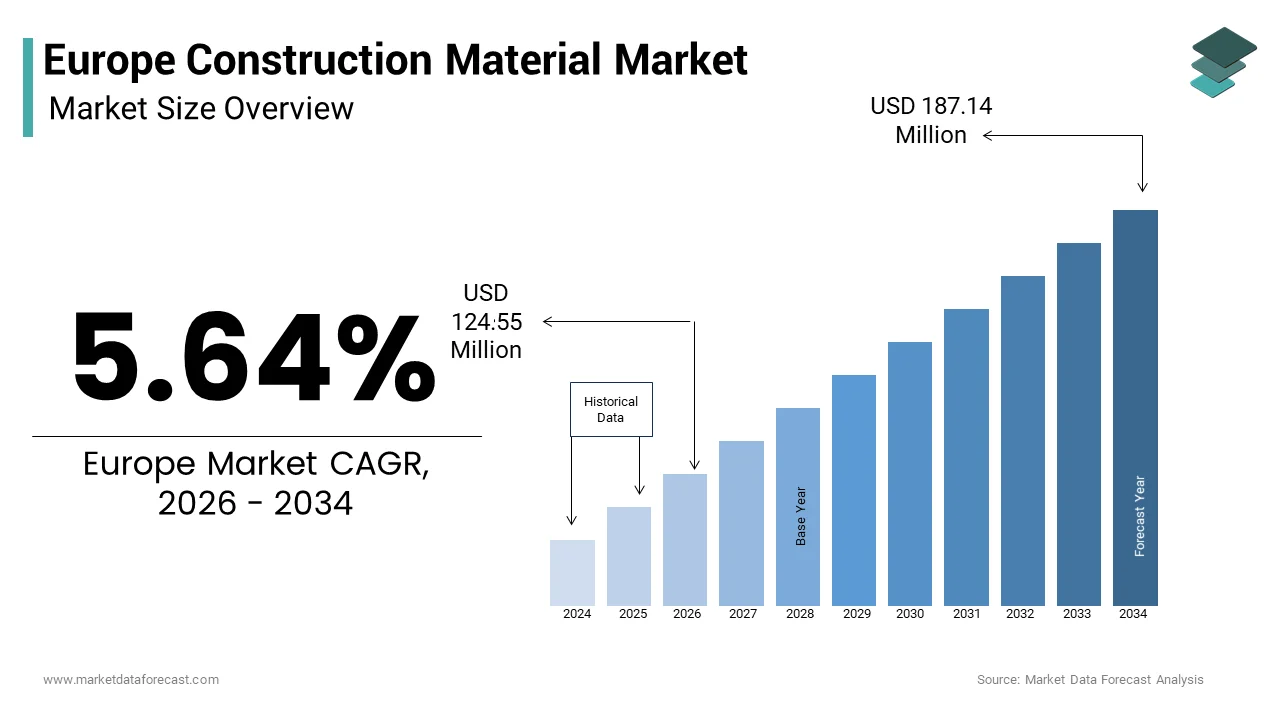
The Europe construction material market size was valued at USD 117.88 million in 2025, is anticipated to reach USD 124.55 million in 2026, and is projected to scale up to USD 187.14 million by 2034, registering a compound annual growth rate (CAGR) of 5.64% during the forecast period from 2026 to 2034. Driven by EU legislative mandates for energy efficiency, aggressive building renovation waves, urbanization trends, and the transition toward circular economy principles, the regional construction materials sector continues to expand steadily.
Key Executive Metrics (At-a-Glance)
- 2025 Base Valuation: USD 117.88 Million
- 2026 Current Valuation: USD 124.55 Million
- 2034 Forecast Valuation: USD 187.14 Million
- Compound Annual Growth Rate (CAGR): 5.64% (2026–2034)
- Dominant Material Segment: Aggregates Segment (45.3% share in 2025)
- Fastest-Growing Material Segment: Metals Segment (projected at 6.8% CAGR)
- Dominant Application Segment: Residential Application Segment (58.4% share in 2025)
- Fastest-Growing Application Segment: Infrastructure Application Segment (projected at 7.4% CAGR)
- Dominant Country Market: Germany (22.6% share in 2025) followed by France and the United Kingdom
Core Market Drivers
- Energy Efficiency Mandates: Stricter European directives like the Energy Performance of Buildings Directive boosting demand for advanced insulation and retrofitting materials.
- Urbanization & Infrastructure: Ongoing concentration of populations in cities and massive public investments in trans-European transport and energy networks.
- Circular Economy Adoption: Increasing regulatory pressure and commercial preference for recycled aggregates, reclaimed steel, and secondary raw materials.
Primary Market Restraints & Challenges
- Cost Volatility: Persistent fluctuations in energy and raw material prices compressing manufacturer margins and risking fixed-price project budgets.
- Permitting Delays: Prolonged environmental reviews and administrative hurdles for new quarries and manufacturing facilities constraining supply.
- Skilled Labor Shortages: An aging construction workforce and technical gaps complicating the proper installation of specialized high-performance materials.
Europe Construction Material Market Segmentation Highlights
| Segment Category | Largest Market Segment | Fastest-Growing Market Segment |
|---|---|---|
| By Material Type | Aggregates Segment (45.3% share in 2025) | Metals Segment (6.8% CAGR) |
| By Application | Residential Segment (58.4% share in 2025) | Infrastructure Segment (7.4% CAGR) |
| By Country | Germany (22.6% share in 2025) | Italy, France, and Spain |
Major Industry Players Profiled
Key enterprises dominating the European construction material market include Saint-Gobain (FR), HeidelbergCement / Heidelberg Materials (DE), CRH plc (IE), LafargeHolcim (CH), Cemex (MX), Martin Marietta Materials (US), Boral (AU), and China National Building Material (CN).
Europe Construction Material Market Size
The Europe construction material market size was valued at USD 117.88 million in 2025 and is anticipated to reach USD 124.55 million in 2026 to reach USD 187.14 million by 2034, growing at a CAGR of 5.64% during the forecast period from 2026 to 2034.
Current Introduction of the Europe Construction Material Market
The construction materials are essential substances utilized in the erection, renovation, and maintenance of infrastructure, residential dwellings, and commercial edifices across the continent. The region operates under a rigorous regulatory framework aimed at decarbonization, with the European Union mandating that all new buildings achieve nearly zero energy consumption standards by 2030. In 2024, the construction sector accounted for approximately 9% of the total Gross Domestic Product in the European Union, employing over 18 million people directly according to Eurostat data. The navigating a complex transition from linear consumption models to circular economy principles, where material reuse and recycling rates are becoming critical performance indicators. Furthermore, the region hosts some of the world's most stringent safety and environmental standards, compelling manufacturers to innovate continuously.
MARKET DRIVERS
Legislative Mandates for Energy Efficiency and Building Renovation
The comprehensive legislative framework established by the European Union to enhance energy efficiency and accelerate the renovation of existing building stock is fuelling the growth of Europe construction material market. The Energy Performance of Buildings Directive mandates significant upgrades to insulation, glazing, and heating systems, creating an insatiable demand for high-performance materials such as aerogels, vacuum insulation panels, and triple-glazed units. In 2025, the European Commission launched the Renovation Wave strategy with the explicit goal of doubling the annual energy renovation rate of residential and non-residential buildings, which requires the deployment of over 300 million square meters of advanced insulation materials annually according to official EU publications. This regulatory pressure compels property owners and developers to replace outdated components with modern alternatives that offer superior thermal resistance and air tightness. The directive also introduces minimum energy performance standards for non-residential buildings, forcing a wave of retrofits across the commercial sector. Furthermore, national implementation plans in countries like Germany and France have allocated billions of euros in subsidies specifically tied to the use of certified low-emission and high-efficiency materials. As per the Buildings Performance Institute Europe, achieving the 2030 climate targets will require an investment of 275 billion euros annually in building renovations, the majority of which will flow directly into the procurement of specialized construction materials. This policy-driven demand ensures a sustained and growing market for products that enable energy compliance.
Urbanization and Infrastructure Modernization Initiatives
The ongoing trend of urbanization coupled with massive public and private investments aimed at modernizing Europe's aging infrastructure network is also elevating the growth of Europe construction material market. Despite a slowing population growth rate, the concentration of people in urban centers continues to rise, with over 75% of the European population expected to live in cities by 2030, necessitating the construction of high-density housing and associated utilities according to United Nations data. This shift drives the demand for durable, high-strength materials such as high-performance concrete, reinforced steel, and modular prefabricated components that facilitate rapid vertical construction. Simultaneously, the Trans-European Transport Network policy outlines a strategic plan to upgrade railways, roads, and bridges across the continent, injecting substantial volume requirements for civil engineering materials. The modernization of water and sewage systems in Eastern European member states further amplifies this demand, as these regions undertake catch-up investments to meet EU environmental standards.
MARKET RESTRAINTS
Volatility in Raw Material and Energy Costs
The extreme volatility in the costs of essential raw materials and energy inputs, which severely compresses manufacturer margins and disrupts project planning is limiting the growth of Europe construction material market. The production of key materials such as cement, glass, and steel is highly energy-intensive by making these sectors disproportionately vulnerable to fluctuations in natural gas and electricity prices. In 2024, industrial electricity prices in parts of Europe remained 40% higher than pre-crisis levels, forcing several energy-intensive plants to reduce output or temporarily cease operations according to data from the European Chemical Industry Council. Furthermore, the prices of critical inputs like iron ore, bauxite, and silica sand are subject to global supply chain disruptions and geopolitical tensions, leading to unpredictable cost spikes that are difficult to pass on to price-sensitive contractors. The construction industry operates on thin margins and long-term fixed-price contracts, meaning sudden material cost increases can render projects unviable or lead to widespread disputes and delays. As per the European Builders Confederation, 65% of construction firms reported that rising material costs were the single biggest obstacle to new project initiation in the past year. This financial instability discourages investment in new production capacity and forces many smaller manufacturers out of the market, leading to supply bottlenecks.
Stringent Environmental Regulations and Permitting Delays
The increasing complex web of environmental regulations and prolonged permitting processes that delay project execution and increase compliance costs is fuelling the growth of Europe construction material market. The European Green Deal and associated legislation impose rigorous limits on carbon emissions, waste generation, and resource extraction, requiring manufacturers to invest heavily in cleaner technologies and extensive reporting mechanisms. While environmentally necessary, these requirements often result in lengthy approval times for new quarries, mining operations, or manufacturing facilities, constraining supply expansion. In 2025, the average time to obtain an environmental permit for a new cement plant or aggregate quarry in the EU exceeded 4 years, significantly lagging behind global competitors according to the World Bank's Ease of Doing Business indicators. The requirement for Environmental Product Declarations and lifecycle assessments adds administrative burdens and costs, particularly for small and medium-sized enterprises that lack dedicated compliance teams. Additionally, local opposition to new extraction sites based on biodiversity concerns frequently leads to legal challenges that can stall projects indefinitely. As per the European Aggregates Association, the industry faces a potential shortage of critical raw materials due to the inability to open new sites fast enough to replace depleted reserves. This regulatory friction not only limits the availability of essential inputs but also stifles innovation by diverting capital from research and development toward compliance administration, ultimately slowing the market's ability to respond to growing demand.
MARKET OPPORTUNITIES
Adoption of Circular Economy and Recycled Material Solutions
The accelerated adoption of circular economy principles, which prioritize the use of recycled and reclaimed materials in new construction projects is creating new opportunities for the growth of Europe construction material market. The European Union's Circular Economy Action Plan sets ambitious targets for increasing the recycling rate of construction and demolition waste to 70% by 2030, creating a massive market for processed secondary raw materials. Innovations in crushing and sorting technologies now allow for the production of high-quality recycled aggregates, reclaimed steel, and crushed concrete that meet strict performance standards, offering a sustainable alternative to virgin resources. Startups and established players alike are developing novel materials such as bio-based insulation made from agricultural waste and bricks manufactured from demolished masonry, tapping into a growing consumer preference for eco-friendly building solutions. The potential to monetize waste streams turns a liability into a revenue source, improving the economics of demolition and renovation projects. Furthermore, the development of digital material passports facilitates the tracking and reuse of building components, fostering a marketplace for second-life materials. As per the Circle Economy Foundation, closing the loop in the construction sector could save the European economy 1.8 billion tons of CO2 emissions annually, presenting a lucrative opportunity for companies that can successfully commercialize these circular solutions.
Integration of Smart and Responsive Building Materials
The integration of smart and responsive building materials with the demand for intelligent infrastructure that can monitor, adapt, and optimize building performance in real time is additionally to escalate new opportunities for the growth of Europe construction material market. Advances in nanotechnology and material science have enabled the creation of self-healing concrete, phase-change materials for thermal regulation, and photovoltaic glass that generates electricity while serving as a building envelope. These innovative products address the dual challenges of maintenance costs and energy efficiency, offering long-term value propositions that appeal to developers and facility managers. Self-healing concrete, which utilizes embedded bacteria to seal cracks automatically, extends the lifespan of infrastructure and reduces repair costs by up to 50%, making it highly attractive for bridge and tunnel projects. Similarly, electrochromic glass that adjusts its tint based on sunlight intensity helps buildings achieve net-zero energy status by dynamically managing heat gain. The European Union's Horizon Europe funding program has allocated significant grants to research consortia focused on developing these next-generation materials, accelerating their path to commercialization.
MARKET CHALLENGES
Severe Shortage of Skilled Labor and Technical Expertise
The severe and persistent shortage of skilled labor and technical expertise required to install and utilize advanced building materials effectively is one of the challenges for the growth of Europe construction material market. The industry faces an aging workforce, with a significant proportion of skilled craftsmen approaching retirement age, while insufficient numbers of young entrants are joining the trade to replace them. This labor gap leads to project delays, increased labor costs, and in some cases, the improper installation of high-performance materials, which compromises their efficacy and longevity. The rapid evolution of material technology exacerbates this issue, as existing workers often lack the training to handle new products such as carbon-fiber reinforcements or phase-change materials. Vocational training systems in many member states have struggled to keep pace with industry needs by resulting in a mismatch between available skills and market demands. As per the European Centre for the Development of Vocational Training, the deficit of skilled construction workers could cost the European economy up to 100 billion euros annually in lost productivity by 2030.
Supply Chain Fragmentation and Logistics Bottlenecks
The persistent challenge of supply chain fragmentation and logistics that disrupt the timely delivery of heavy and bulky construction materials to job sites is also to degrade the growth of Europe construction material market. The construction supply chain involves numerous stakeholders ranging from raw material extractors and processors to distributors and contractors, creating multiple points of vulnerability where delays can occur. Geopolitical tensions, port congestions, and driver shortages have frequently paralyzed the movement of essential goods like steel beams, cement bags, and glass panels across European borders. In 2025, logistics costs for construction materials in Europe increased by 18% compared to the previous year, driven by fuel price volatility and regulatory constraints on heavy goods vehicle movements according to the International Road Transport Union. The reliance on just-in-time delivery models leaves little buffer for disruptions, meaning even minor delays can halt entire construction projects, incurring significant penalty costs. Furthermore, the fragmented nature of the industry, dominated by small and medium-sized enterprises, limits the ability to negotiate favorable shipping rates or invest in resilient logistics infrastructure. As per the European Logistics Association, the lack of digital integration and visibility across the supply chain prevents proactive management of risks, leading to inefficiencies and wasted resources. Addressing these logistical hurdles requires substantial investment in digital platforms, warehousing, and alternative transport modes, posing a significant operational challenge for market participants striving to maintain reliability in an increasingly volatile environment.
REPORT COVERAGE
| REPORT METRIC | DETAILS |
| Market Size Available | 2025 to 2034 |
| Base Year | 2025 |
| Forecast Period | 2026 to 2034 |
| CAGR | 5.64% |
| Segments Covered | By Country |
| Various Analyses Covered | Global, Regional & Country Level Analysis, Segment-Level Analysis, DROC, PESTLE Analysis, Porter’s Five Forces Analysis, Competitive Landscape, Analyst Overview on Investment Opportunities |
| Regions Covered | UK, France, Spain, Germany, Italy, Russia, Sweden, Denmark, Switzerland, Netherlands, Turkey, the Czech Republic, and the Rest of Europe |
| Market Leaders Profiled | LafargeHolcim (CH), CRH (IE), HeidelbergCement (DE), Cemex (MX), Martin Marietta Materials (US), Boral (AU), Saint-Gobain (FR), China National Building Material (CN), Eagle Materials (US) |
SEGMENTAL ANALYSIS
By Material Insights
The aggregates segment was the largest by holding 45.3% of the Europe construction material market share in 2025 with the fundamental necessity of sand, gravel, and crushed stone as the primary bulk ingredients in concrete, asphalt, and road base layers, making them indispensable for all forms of infrastructure development. The sheer scale of civil engineering projects across the continent, where aggregates account for over 80% of the mass in typical concrete mixes used for bridges, highways, and foundations. The localized nature of aggregate supply chains, which necessitates a vast network of quarries near consumption centers due to high transport costs relative to product value is also boosting the growth of the segment. This geographic constraint ensures that domestic production remains robust despite import pressures, as seen in Germany and France, where local quarrying supports 90% of regional demand. As per Eurostat data, the construction of new transport corridors under the Trans-European Network policy has sustained a steady annual demand growth of 2.1% for high-quality crushed aggregates. The irreplaceable physical properties of aggregates in providing structural strength and volume stability cement their position as the backbone of the European construction industry.
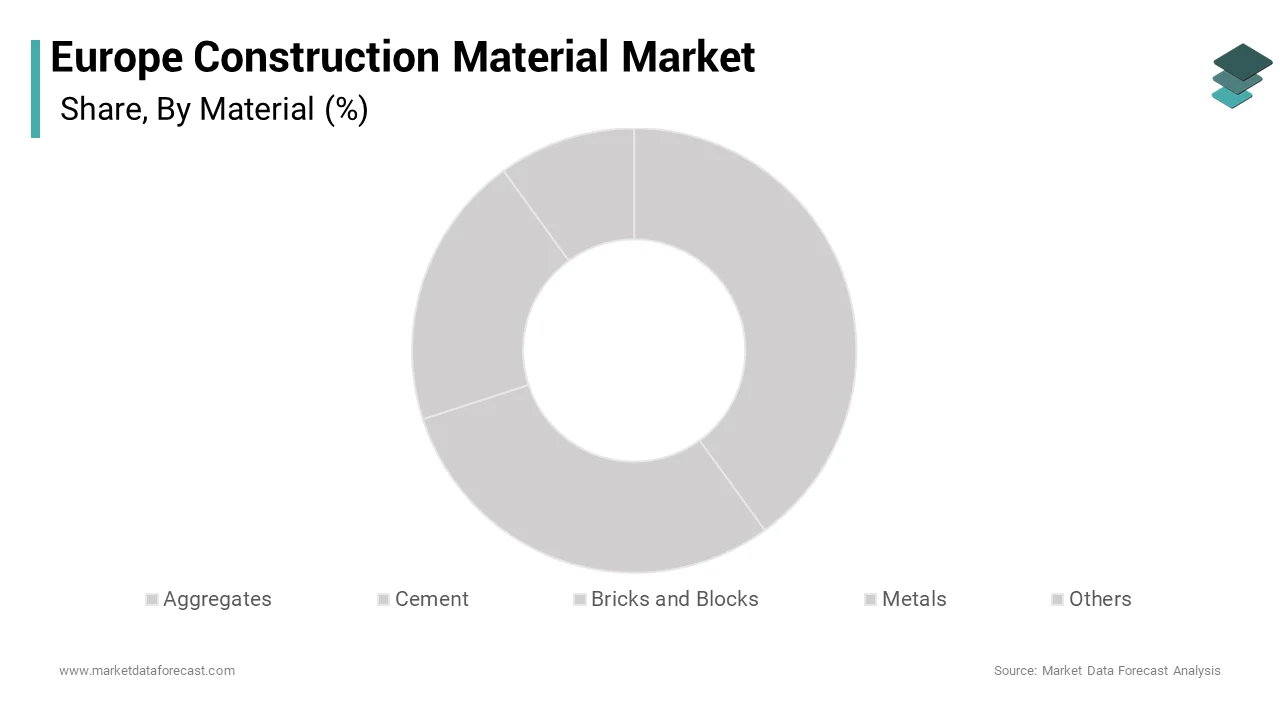
The metals segment is significantly to witness a fastest CAGR of 6.8% from 2026 to 2034 with the dual imperatives of structural lightweighting for energy efficiency and the electrification of building systems. The surging demand for high-strength steel and aluminum alloys in modern skyscraper construction and industrial facilities, where reducing dead load allows for taller structures and larger spans while minimizing foundation costs. The rapid integration of renewable energy systems and electric vehicle charging infrastructure into new builds, which drastically escalates the requirement for copper wiring and aluminum conductors is elevating the growth of the segment. The European Union mandate requiring all new residential buildings to be solar-ready by 2028 has triggered a spike in metal consumption for photovoltaic mounting structures and electrical grids. Furthermore, the shift toward prefabricated modular construction relies heavily on precise metal components for rapid assembly by enhancing the segment's growth momentum compared to traditional bulk materials.
By Application Insights
The residential application segment was the largest by holding 58.4% of the Europe construction material market share in 2025 with the persistent housing deficit across major European economies and the continuous cycle of home renovation and maintenance. The primary driver is the chronic shortage of affordable housing units, which has prompted governments to launch massive social housing programs and incentivize private development. The extensive renovation wave targeting the existing residential stock, which comprises over 75% of the total building inventory in Europe. Policies mandating energy efficiency upgrades compel homeowners to replace windows, insulation, and heating systems, driving substantial volumes of materials such as cement, bricks, and metals. As per the Buildings Performance Institute Europe, residential renovations account for nearly 60% of all insulation material sales in the region. The emotional and financial priority placed on home ownership and improvement by European households ensures a resilient and consistent demand stream that outweighs fluctuations in commercial or public sector spending. This dual engine of new builds and deep retrofits secures the residential sector's position as the primary consumer of construction materials.
The infrastructure application segment is anticipated to register a CAGR of 7.4% throughout the forecast period with the unprecedented public investment aimed at modernizing transcontinental transport networks and upgrading utility grids to support decarbonization goals. The first major driver is the implementation of the Trans-European Transport Network (TEN-T) policy, which mandates the upgrading of railways, roads, and inland waterways to create a seamless multimodal corridor across the continent. In 2025, the European Investment Bank allocated 30 billion euros specifically for TEN-T projects, triggering a surge in demand for asphalt, concrete, and steel rails according to the European Commission. The second critical factor is the massive rollout of renewable energy infrastructure, including wind farms, solar parks, and hydrogen pipelines, which requires extensive civil engineering works and specialized materials. The REPowerEU plan aims to install 1,200 gigawatts of renewable capacity by 2030, necessitating the construction of thousands of new substations and transmission lines that consume vast quantities of metals and composites. The modernization of water and wastewater treatment facilities to meet stricter environmental standards drives demand for pipes and tanks.
COUNTRY-LEVEL ANALYSIS
Germany Construction Material Market Analysis
Germany was the largest contributor in the Europe construction material market by holding 22.6% of the share in 2025, which drives continuous demand for factory construction, logistics warehouses, and specialized infrastructure. In 2025, the German government launched the "Climate Neutral Industry" initiative, allocating 10 billion euros to retrofit manufacturing plants, thereby stimulating significant consumption of high-performance insulation and steel according to the German Federal Ministry for Economic Affairs. The country's strong export-oriented economy necessitates world-class transport links, sustaining heavy usage of aggregates and asphalt for highway and railway maintenance. Furthermore, Germany leads in the adoption of sustainable building standards, with over 40% of new constructions certified under the DGNB green building system, driving demand for eco-friendly materials like recycled concrete and timber hybrids as reported by the German Sustainable Building Council. The residential sector also contributes significantly, with a target of building 400,000 new homes annually to address housing shortages. The presence of major material producers within the country ensures a stable supply chain, while strict regulatory frameworks push for innovation in low-carbon cement and energy-efficient glazing.
France Construction Material Market Analysis
France construction material market was positioned second by holding 16.4% of share in 2025 with the aggressive national renovation strategy and sustained investment in energy infrastructure. The "France Rénov" program aims to renovate 700,000 homes annually by creating a massive and steady demand for insulation materials, windows, and heating systems across the residential sector. In 2024, the French government disbursed 2.5 billion euros in grants for energy efficiency upgrades, directly boosting sales of construction products compliant with thermal regulations according to the French Ministry of Ecological Transition. Beyond housing, France's commitment to maintaining its nuclear energy dominance drives specialized construction activities, including the refurbishment of existing reactors and the development of new EPR2 units, which require vast quantities of reinforced concrete and specialty steel. The Grand Paris Express project, a major metro expansion, further stimulates the consumption of aggregates and tunneling materials in the capital region.
United Kingdom Construction Material Market Analysis
The United Kingdom construction material market growth is likely to grow with its ambitious infrastructure pipeline and persistent efforts to resolve its housing crisis. The residential sector remains a pillar, with planning permissions for new homes increasing by 8% as local authorities strive to meet the target of 300,000 new dwellings per year. The UK's focus on net-zero targets has also accelerated the retrofitting of older Victorian and Edwardian housing stock, driving demand for breathable insulation materials and double-glazed units. Furthermore, the offshore wind sector, where the UK is a global leader, requires extensive marine construction works for turbine foundations and grid connections, utilizing specialized corrosion-resistant materials.
Italy Construction Material Market Analysis
Italy construction material market growth is to witness a fastest growth opportunities in coming years with a unique blend of heritage restoration, tourism infrastructure development, and seismic retrofitting. The country's rich historical fabric necessitates the continuous use of traditional materials like lime mortar, terracotta bricks, and natural stone for the conservation of monuments and historic city centers. In 2024, the Italian government allocated 4 billion euros under the National Recovery and Resilience Plan specifically for cultural heritage preservation, driving specialized demand for authentic construction products, according to the Italian Ministry of Culture. Simultaneously, the tourism sector's recovery has spurred investments in hotel renovations and airport expansions, particularly in regions like the Veneto and Lazio. The imperative for seismic safety in earthquake-prone zones also mandates the retrofitting of existing structures with advanced composite materials and steel bracing, creating a steady market for high-tech reinforcement solutions. As per the Italian National Institute of Statistics, the renovation sector accounts for over 50% of total construction activity, outpacing new builds. Additionally, the "Superbonus" tax incentive scheme, though modified, continues to influence the market by encouraging energy efficiency upgrades in condominiums.
Spain Construction Material Market Analysis
Spain construction material market growth is driven with its booming renewable energy sector, coastal tourism development, and urban regeneration projects. The nation has emerged as a solar power superpower, with massive investments in photovoltaic parks requiring extensive civil works, mounting structures, and grid infrastructure. In 2025, Spain installed 7 gigawatts of new solar capacity, making it the largest consumer of construction materials for renewable energy projects in Southern Europe, according to the Spanish Photovoltaic Union. The tourism industry, a cornerstone of the economy, fuels continuous demand for the construction and renovation of hotels, resorts, and leisure facilities along the Mediterranean coast. Furthermore, the high-speed rail network expansion connects major cities, driving demand for aggregates and concrete for track beds and stations. The synergy between green energy leadership, tourism resilience, and social housing initiatives positions Spain as a dynamic and rapidly growing market for construction materials in the region.
COMPETITIVE LANDSCAPE
The competition in the Europe construction material market is characterized by intense rivalry among established multinational conglomerates and agile regional specialists who vie for dominance through technological innovation and supply chain efficiency. Major players leverage their extensive production networks and financial resources to offer comprehensive product portfolios that cater to diverse construction needs ranging from residential housing to complex infrastructure. The market landscape features a mix of broad-line suppliers providing everything from cement to finishing materials and niche operators focusing on specialized high-performance composites or sustainable solutions. Competitive pressure drives continuous investment in green technologies as companies strive to meet stringent carbon reduction targets and evolving regulatory frameworks. Pricing strategies remain critical due to the volatility of energy and raw material costs, forcing firms to balance profitability with market share retention. Strategic alliances and joint ventures are common tactics used to share risks in large-scale projects and expand geographic reach. The threat of new entrants is moderated by high capital requirements and regulatory barriers, yet local players often compete effectively on service speed and regional knowledge.
KEY MARKET PLAYERS
A few of the market players that are dominating the Europe construction material market.
- LafargeHolcim (CH)
- CRH (IE)
- HeidelbergCement (DE)
- Cemex (MX)
- Martin Marietta Materials (US)
- Boral (AU)
- Saint-Gobain (FR)
- China National Building Material (CN)
- Eagle Materials (US)
Top Players In The Market
- Saint-Gobain stands as a global titan in the design and distribution of construction materials, offering an extensive portfolio that spans glass, gypsum, insulation, and exterior products. The company plays a pivotal role in the European market by driving the transition toward sustainable and energy-efficient building solutions. Globally, Saint-Gobain contributes to reducing the carbon footprint of the built environment through its innovative low-emission technologies. Recent actions to strengthen its position include the strategic acquisition of certain distribution networks in Eastern Europe to enhance local supply chain resilience. The firm has also launched new ranges of recycled gypsum boards and bio-based insulation materials to meet stringent EU environmental standards. These initiatives reinforce its commitment to lightweight and sustainable construction, solidifying its reputation as a leader in transforming the industry toward a greener future while expanding its reach across diverse European markets.
- Heidelberg Materials operates as one of the world's largest producers of aggregates, cement, and ready-mixed concrete, serving as a foundational pillar for the European construction sector. The company is deeply involved in supplying essential materials for major infrastructure projects, residential developments, and industrial facilities across the continent. On the global stage, Heidelberg Materials is recognized for its pioneering efforts in carbon capture and storage technologies aimed at decarbonizing heavy industry. Recent strategic moves include the commissioning of several large-scale carbon capture facilities in Norway and Germany to significantly reduce process emissions. The corporation has also expanded its portfolio of low-carbon concrete mixes, catering to the growing demand for green building certifications. Furthermore, Heidelberg Materials actively engages in vertical integration by securing long-term rights to quarry reserves, ensuring stable raw material supplies.
- CRH plc functions as a leading integrated building materials group with a vast presence across Europe, providing essential products such as aggregates, asphalt, cement, and lime. The company is integral to the regional market by supporting both small-scale residential projects and massive civil engineering endeavors through its extensive distribution network. Globally, CRH contributes to the construction industry by delivering high-quality materials that meet diverse climatic and structural requirements. The firm has also invested in advanced recycling facilities to produce circular construction materials, aligning with European waste reduction targets. CRH continues to optimize its logistics operations through digital tracking systems, ensuring timely delivery to remote and urban job sites alike.
Top Strategies Used by Key Market Participants
Key players in the Europe construction material market predominantly employ mergers and acquisitions to consolidate their market positions and gain access to new geographic regions or specialized product lines. Companies frequently invest in research and development to create low-carbon and energy-efficient materials that comply with strict European environmental regulations. Vertical integration strategies are common, where firms secure ownership of raw material sources like quarries and mines to control costs and ensure supply stability. Strategic partnerships with governments and large contractors enable participants to secure long-term contracts for major infrastructure projects. Sustainability leadership acts as a core differentiator, with corporations committing to net-zero targets and circular economy principles to appeal to eco-conscious clients. Digital transformation initiatives are increasingly adopted to optimize supply chain logistics and enhance customer engagement through data-driven insights. Expansion into emerging markets within Eastern Europe allows established entities to capture growth opportunities in developing industrial sectors. These multifaceted strategies collectively ensure long-term competitiveness and resilience in a dynamic and highly regulated regional environment.
MARKET SEGMENTATION
This research report on the Europe construction material market is segmented and sub-segmented into the following categories.
By Application
- Residential
- Infrastructure
- Commercial
- Industrial
By Material Type
- Aggregates
- Cement
- Bricks and Blocks
- Metals
- Others
By Country
- UK
- France
- Spain
- Germany
- Italy
- Russia
- Sweden
- Denmark
- Switzerland
- Netherlands
- Turkey
- Czech Republic