- Product Description Description
- Table of Contents TOC
- List of Table & Figure LOT
- Get Free Sample PDF Sample PDF
Market Size, 2025
$358.85 MnMarket Estimate, 2026
$421.64 MnMarket Forecast, 2034
$1,531.96 MnCAGR, 2026–2034
17.5%Executive Summary: Europe Construction Robots Market
- Market Scope: Comprehensive European construction robotics industry analysis covering robot types, automation levels, end-use applications, country leadership frameworks, strategic developments, and competitive landscapes.
- Market Valuation: Valued at USD 358.85 million (2025), estimated at USD 421.64 million (2026), and projected to reach USD 1,531.96 million by 2034, registering a robust CAGR of 17.5% (2026–2034).
- Primary Growth Drivers: Persistent labor shortages (affecting over 42% of EU firms), European Green Deal sustainability mandates, NextGenerationEU public infrastructure funding, shift toward modular off-site construction, and autonomous perception system advances. Restraints include high initial unit costs and fragmented regulatory approvals.
Key Market Segment Metrics (2026–2034)
| Category | Leading Segment (2025 Position) | Fastest-Growing Segment |
|---|---|---|
| By Robot Type | Demolition robots (dominated with a 40.9% share due to safety mandates) | 3D printing robots (projected to grow at the fastest CAGR of 23.5%) |
| By Automation Level | Semi-autonomous systems (led with a 66.5% market share) | Fully autonomous robots (expected to witness an 18.8% CAGR) |
| By End-Use Sector | Public infrastructure (commanded the largest segment at 35.5%) | Residential buildings (anticipated to exhibit the highest CAGR of 20.9%) |
| By Region / Country | Germany (held largest regional share at 20.9% in 2025 with skilled trade vacancies) | United Kingdom (second-largest market supported by digital construction frameworks) |
Major Market Players & Market Structure
Market Structure: Highly dynamic European construction tech landscape driven by specialized robotics developers, heavy equipment manufacturers, masonry automation providers, and additive construction companies addressing labor shortages.
Key Companies: Boston Dynamics (Hyundai Motor Group), High-Growth Robotics Inc., Fastbrick Robotics (FBR Ltd.), Brokk AB, Komatsu Ltd., Honda Motor Co., Ltd., Takeuchi Mfg. Co., Ltd., Caterpillar Inc., Hilti AG, Trimble Inc., Topcon Positioning Systems, Inc., Emanuel Löffler GmbH, SAM (Semi-Automated Mason) by Construction Robotics, Dusty Robotics Inc., Canvas, Exyn Technologies, Sarcos Robotics, Additive Industries, and Scalers.
 Download Free Sample Report
Europe Construction Robots Market Size
The Europe Construction Robots Market is projected to grow from USD 358.85 million in 2025 to USD 421.64 million in 2026 and reach USD 1,531.96 million by 2034, registering a CAGR of 17.50% from 2026 to 2034.
Construction robots are a growing array of automated and semi-automated machines engineered to perform specialized tasks across building and infrastructure projects, including bricklaying, site surveying, concrete finishing, rebar tying,g and autonomous material transport. These systems integrate advanced sensors, artificial intelligence,e and precise actuation mechanisms to enhance productivity, ty reduce human error, and to address acute labor constraints on job si,tes. Unlike manufa,cturing roboti, cs which operate in controlled environments construction robots function in, dynamic unstructured set, tings requiring robust adaptability and real time decisio,n making. According to Eurostat, the EU construction sector employed around 16 million people in 2024, yet faced one of the highest vacancy rates among industrial sectors, as docum, ented by the European Commission’s Labour Force Survey. Creal-time this challenge is Europe’s ageing workforce, with over one-third of construction workers aged 50 or older, according to EU-OSHA. Simultaneously, the European Green Deal mandates a 55% reduction in emissions by 2030 and climate neutrality by 2050, which is accelerating demand for precision construction that minimizes material waste. Within this context, robotics emerges not as a futuristic novelty but as a strategic response to converging demographic, environmental, and efficiency imperatives reshaping Europe’s built environment.
MARKET DRIVERS
Persistent Labor Shortages and Aging Workforce
Europe’s construction industry confronts a deepening human capital crisis that directly fuels demand for robotic automation, which is one of the key factors propelling the growth of the European construction robots market. According to the European Commission’s 2024 Labour Shortage Monitor, more than 42% of construction firms across the EU reported significant difficulty in hiring skilled tradespeople such as masons, electricians, and steel fixers. This gap is exacerbated by demographic trends: EU‑OSHA data confirm that workers aged 50+ constitute ~39% of the sector’s labor force, while new entrants under 30 represent less than 14%. In Germany alone, the German Construction Industry Association estimates a shortfall of more than 150,000 workers. These shortages delay project timelines, increase wage pressures, and compromise quality control. Robotics offers a viable countermeasure by executing repetitive, precise, or physically demanding tasks with consistent output. Autonomous rebar‑tying robots deployed on Dutch infrastructure projects reduced manual labor requirements by up to 60% (Dutch Ministry of Infrastructure and Water Management). Similarly, bricklaying robots tested in Sweden achieved laying speeds of more than 300 bricks per hour, over double the human average (Swedish Construction Federation). This operational relief positions robotics as an essential productivity enabler rather than a luxury.
Regulatory Push for Sustainable and High‑Precision Construction
The EU’s stringent environmental and energy performance mandates are accelerating the adoption of construction robots capable of delivering material efficiency and build accuracy unattainable through conventional methods, which is further boosting the expansion of the European construction robots market. The revised Energy Performance of Buildings Directive requires all new structures to meet near‑zero energy standards by 2030, driving demand for airtight, precise assemblies that minimize thermal bridging. According to the European Environment Agency, construction and demolition waste accounts for more than 36% of total EU waste generation, with material overuse and rework as primary contributors. Robotic systems address this by enabling millimeter‑level precision in tasks such as concrete spraying, 3D printing, and panel installation. In France, the E‑Galatea project (France 2030 plan) demonstrated that robotic interior finishing reduced drywall material waste by 22% compared to manual methods (French Building Research Centre). Similarly, autonomous site‑surveying drones integrated with BIM models cut measurement errors by up to 40% on German infrastructure projects (German Aerospace Center). These performance gains directly support compliance with the EU Taxonomy for Sustainable Activities, which now links financing eligibility to verifiable resource‑efficiency metrics. Robots are increasingly viewed as compliance tools that align construction execution with Europe’s decarbonization and circular economy objectives.
MARKET RESTRAINTS
High Initial Investment and Uncertain Return on Integration
A significant restraint on the European construction robots market stems from the substantial capital outlay and integration complexity associated with deploying robotic systems on fragmented, project‑based job sites. Unlike manufacturing, where robots operate continuously in fixed facilities, construction robots must be transported, assembled, calibrated, and operated across short‑term projects with unique layouts and subcontractor ecosystems. According to a 2024 cost analysis by the Fraunhofer Institute for Building Physics, the average upfront cost for a mid‑size autonomous bricklaying or concrete‑finishing robot ranges from €250,000 to €400,000, excluding training, integration, and maintenance. For Europe’s predominantly small and medium‑sized construction enterprises, this investment is often prohibitive without external financing. Moreover, ROI remains uncertain due to limited historical performance data and variability in site conditions. A survey by the European Construction Institute found that 67% of contractors cited unpredictable payback periods as the primary barrier to adoption. Insurance frameworks for robotic operations are still underdeveloped: EIOPA reports that fewer than 15% of construction policies explicitly cover robotic malfunction or human‑robot interaction incidents. These financial and risk‑management gaps constrain widespread deployment despite proven technical capabilities.
Lack of Standardized Skills and Interoperability Protocols
The absence of harmonized technical standards and skilled personnel severely limits the scalability of construction robotics across Europe’s diverse building ecosystems, which is further hampering the growth of the European construction robots market. Unlike industrial automation governed by ISO and IEC frameworks, specific standards for cothe the construction robot communication, safety, and data exchange remain nascent. According to the European Committee for Standardization (CEN), only three preliminary technical specifications for construction robotics had been published as of 2024, leaving interoperability largely vendor‑dependent. This fragmentation increases integration costs and locks contractors into proprietary ecosystems. Concurrently, there is a critical shortage of workers trained to operate and maintain these systems. CEDEFOP estimates that fewer than 5,000 technicians across the EU possess certified competencies in construction robotics programming and troubleshooting. National training curricula have been slow to adapt; in Italy and Spain, vocational schools only began piloting robotics modules in 2023. Without a standardized workforce and open technical architecture, even the most advanced robots risk underutilization or operational failure on complex multi‑contractor sites. This dual deficit in human capital and system compatibility acts as a structural brake on market maturation.
MARKET OPPORTUNITIES
Expansion of Public Infrastructure Investment Under the NextGeneration EU Framework
A major opportunity for the European construction robots market lies in the unprecedented scale of public infrastructure funding allocated through the European Union’s NextGeneration EU recovery instrument. Of the eight hundred and six billion euro package, over two hundred and fifty billion euros are dedicated to transport, energy, and social infrastructure projects that prioritize innovation and sustainability. According to the European Investment Bank,k over sixty percent of these funded projects include explicit requirements for digital construction methods, including robotics and automation, autom,ation to ensure quality control and schedule adherence. In Spain, the Sustainable Infrastructure Plan has earmarked four points, two sixty percent euros for robotic tunnel boring and autonomous material handling on high-speed rail extensions as per the Ministry of Transport. Similarly, Poland’s Central Communication Port proj,ect has mandated the use of robotic surveying and rebar placement systems to meet accelerated completion timelines. These public mandates create de facto test beds for robotic adoption while reducing perceived risk for private contractors. As public authorities increasingly tie disbursement to performance metrics such as waste reduction and labor productivity,y robotics transitions from optional innovation to contractual necessity, ty thereby unlocking sustained demand across the EU infrastructure pipeline.
Rise of Modular and Off-Site Construction Ecosystems
The accelerating shift to off-site and modular con,,struction in Europe presents a fertile ground for robotic integration due to the controlled factory-like environments that favor automation, which is another promising opportunity in the European construction robots market. According to the European Modular Construction Council, prefabricated building components now account for over 28% of new factory-like units in Germany, the Netherlands,s and Sweden, which is a figure projected to reach 40% by 2030. These facilities operate with repetitive workflows ideal for robotic arms performing tasks such as wall panel assembly, window insertion, and quality inspection. In Finland, the modular housing company Blokwise operates a fully automated factory where robots handle over 80% of structural assembly, thereby achieving a production cycle of one modular unit every 22 minutes as per the Finnish Ministry of the Environment. Similarly, in the UK, the Construction Playbook updated in 2023 prioritizes off-site manufacturing for all central government projects crea, creating stable demand for robotic systems. The European Commission’s New European Bauhaus initiative further incentivizes such approaches by linking aesthetic and sustainability criteria to product decision as these capabilities are inherently enhanced by robotics. This convergence of policy, industrial logic,c and environmental performance positions off-site construction as the most viable near-term corridor for scalable robotic deployment in Europe.
MARKET CHALLENGES
Fragmented Regulatory Approval Processes Across Member States
A persistent challenge confronting the European construction robots markeoff-site absence of a unified regulatory framework governing the deployment of autonomous machines on construction sites. While the European Union has established general machinery safety directives under Regulation EU two zero two three eleven hundred and eleven, the interpretation and enforcement of these rules vary significantly among member states. According to the European Agency for Safety and Health at Work, national occupational safety authorities in countries like Italy,y Greece, and Romania require case-by-case risk assessments for each robotic system, often delaying project approvals by three to six months. In contrast, Germany and the Netherlands have developed streamlined certification pathways through their national technical inspection associaticase-by-casee are not mutually recognized. This regulatory fragmentation increases compliance costs for manufacturers who must adapt safety documentation, sensor redundancy, and emergency stop mechanisms to align with local interpretations. A study by the VDMA Robotics Association found that companies spend an average of seventy thousand euros per country to meet divergent national safety validation requirements. Until a ha,rmonized EU wide certification protocol for construction robotics is implemented, operators face unpredictable legal exposure and deployment delay,s undermining the economic case focross-borderer scalability.
Technical Limitations in Unstructured and Dynamic Environments
Despite advances, construction robots continue to struggle with the inherent unpredictability of real-world building sites, where lighting, harsh weather, human movement, and cross-border digital models challenge sensor reliability and decision algorithms, which further challenge the expansion of the European construction robots market. According to field tests conducted by the S,wiss Federal Ins,titute, of Technology, autonomous bricklaying robots exhibited a 32% drop in task accuracy when operating under variable daylight or light rain conditions due to limitations in visual recognition systems. Similarly, collaborative robots designed to work alongside humans often halt operations when unexpected personnel enter predefined zones, which is a frequent occurrence on multi-trade sites. The European Construction Technology Platform reports that over 55% of early robotic deployments in Southern Europe required manual intervention due to dust debris or uneven terrain interfering with navigation sensors. Unlike warehousemulti-ademulti-tradeies construction environments lack standardized layouts and continuous infrastructure such as Wi Fi or power rails necessary for sustained robotic operation. These environmental constraints limit current robots to highly controlled or repetitive tasks, reducing their versatility and return on investment. Until perception algorithms and mechanical robustness improve to match the chaos of active construction zones, robotics will remain a supplemental rather than central component of Europe’s building future.
REPORT COVERAGE
| REPORT METRIC | DETAILS |
| Market Size Available | 2025 to 2034 |
| Base Year | 2025 |
| Forecast Period | 2026 to 2034 |
| Segments Covered | By Robot Type, Automation Level, End Use, and Region. |
| Various Analyses Covered | Global, Regional, and Country-Level Analysis, Segment-Level Analysis, Drivers, Restraints, Opportunities, Challenges; PESTLE Analysis; Porter’s Five Forces Analysis, Competitive Landscape, Analyst Overview of Investment Opportunities |
| Countries Covered | UK, France, Spain, Germany, Italy, Russia, Sweden, Denmark, Switzerland, Netherlands, Turkey, Czech Republic, Rest of Europe |
| Market Leaders Profiled | Boston Dynamics (Hyundai Motor Group), High-Growth Robotics Inc., Fastbrick Robotics (FBR Ltd.), Brokk AB, Komatsu Ltd., Honda Motor Co., Ltd. (construction robotics initiatives), Takeuchi Mfg. Co., Ltd., Caterpillar Inc., Hilti AG, Trimble Inc., Topcon Positioning Systems, Inc., Emanuel Löffler GmbH (robotic masonry systems), SAM (Semi-Automated Mason) by Construction Robotics, Dusty Robotics Inc., Canvas (robotics for layout), Exyn Technologies (autonomous drones for construction), Sarcos Robotics (industrial & construction exoskeletons), Additive Industries (metal 3D printing for construction tooling), Scalers (UK robotics integrator) |
SEGMENTAL ANALYSIS
By Robot Type Insights
The demolition robots segment held 40.9% of theEuropeane construction robots market share by robot type in 2025. The growth of the demolition robots segment in this regional market is primarily driven by their safety mandates and urban redevelopment pressures. European workplace safety legislation increasingly restricts human exposure to high‑risk demolition environments, particularly in confined or structurally compromised spaces. According to the European Agency for Safety and Health at Work, more than 600 severe injuries occurred annually in manual demolition operations between 2020 and 2023, prompting regulatory action. In response, countries such as Sweden and Germany enacted national guidelines requiring robotic systems for interior demolition in buildings over three stories or containing hazardous materials. According to the Swedish Work Environment Authority, a 58% reduction in demolition‑related incidents after mandating remote‑controlled robots on public projects in 2022. Similarly, the German Social Accident Insurance introduced premium discounts for contractors using certified demolition robots, which over 1200 firms claimed in 2024. These policy levers transform robotic demolition from a cost center into a compliance and insurance advantage, which is accelerating adoption across both public and private sectors.
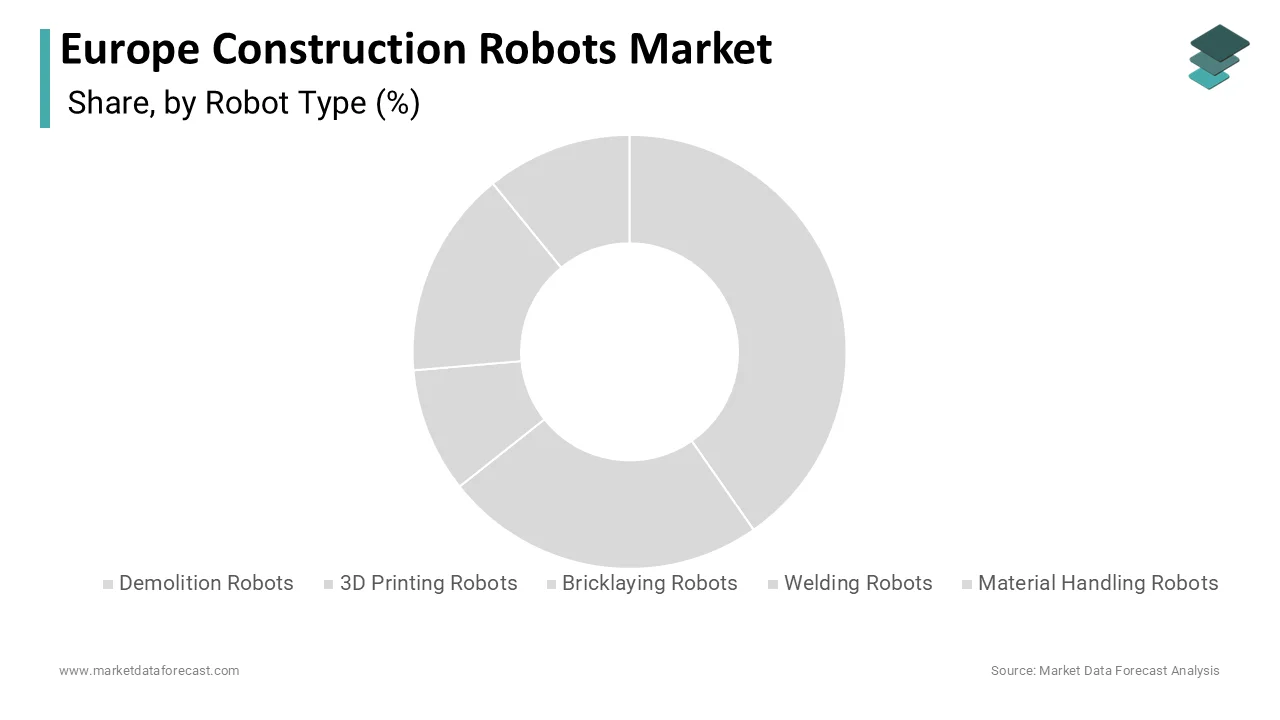
By contrast, the 3D printing robots segment is emerging as the fastest-growing segment and is projected to expand at a CAGR of 23.5% over the forecast period in this regional market. This explosive growth is propelled by housing affordability crises and industrialized construction mandates. Europe faces a deficit offastest-growingty million affordable housing units as estimated by the European Investment Bank, with countries such as Germany, France, and the Netherlands experiencing acute supply gaps. In response, governments are turning to 3D concrete printing as a means to accelerate delivery while reducing labor and dependency. The French Ministry of Housing launched the BIM4Housing initiative in 2023, which fast‑tracks permits for projects using certified robotic printing systems, resulting in over forty such developments by mid‑2024. In the Netherlands, the city of Eindhoven completed Europe’s first habitable 3D‑printed social housing complex, with units constructed in under one week per home as verified by the Dutch Building Authority. These projects demonstrate up to thirty percent lower labor costs and forty percent less material waste compared to traditional methods, according to the Eindhoven University of Technology. As housing waitlists grow over 1.2 million households in Germany alone, as per the German Tenants Association, thirty percent transitions from forty percent to essential in public policy toolkits.
By Automation Level Insights
The semi‑autonomous systems segment occupied 66.5% of the European market share in 2025. The dominance o,f semi-autonomous systems segment in this regional market can be attributed to the practical adaptability and workforce integration realities on dynamic job sites. Construction environments remain too variable for full automation, with shifting layouts, incomplete digital models, and multi‑trade coordination requiring human judgment. Semi‑autonomous systems leverage operator oversight for navigation and decision‑making while automating precise repetitive actions such as welding, rebar tying, or concrete smoothing. According to field studies by the Technical University of Munich, operator‑supervised robots achieved ninety‑four% task completion reliability in real‑world conditions compared to 68% for fully autonomous units. In Sweden, the Construction Federation mandates that all robotic systems on unionized sites include manual override and collaborative control interfaces, ensuring worker involvement. This hybrid model reduces resistance from labor groups while delivering productivity gains. For instance, Swedish contractors reported a 35% increase in rebar installation speed using semi‑autonomous tying robots with human guidance, as per national productivity audits. The balance of control and automation makes semi‑autonomy the pragmatic choice for Europe’s complex project ecosystems.
The fully autonomous robots segment is the fastest-growing segment and is estimated to witness a CAGR of 18.8% over the forecast period in this regional market, owing to advances in perception systems and the rise of controlled construction environments. Recent breakthroughs in LiDAR, visual, and real‑time BIM integration have significantly improved robot navigation in semi‑structured settings. According to the German Aerospace Center, autonomous surveying robots now achieve sub‑centimeter positional accuracy even in GPS‑denied environments such as tunnels or high‑rise interiors. In Denmark, the company Dansk Ampel integrated fully autonomous road‑marking robots that operate overnight on highways without human intervention, achieving a ninety‑nine point three percent compliance rate with lane geometry standards as verified by the Danish Road Directorate. These performance milestones build confidence among infrastructure owners who increasingly include autonomy requirements in tenders. The European GNSS Agency estimates that over thirty public works contracts in 2024 specified autonomous material transport or inspection systems, reflecting growing institutional trust in unsupervised operation.
By End Use Insights
The public infrastructure segment led the market by commanding for 35.5% of the regional market share in 2025. The growth of the public infrastructure segment in this regional market is driven by the large‑scale funding mandates and performance accountability. The NextGeneration EU recovery fund allocates over two hundred billion euros to transport, energy, and civic infrastructure, with explicit requirements for digital construction methods. According to the European Commission, more than seventy% of approved projects under the Recovery and Resilience Facility include robotics or automation in their technical specifications to ensure schedule adherence and cost control. In Spain, the Ministry of Transport mandated robotic tunnel boring and autonomous surveying for all high‑speed rail extensions funded under the National Infrastructure Plan, leading to the deployment of over one hundred twenty construction robots by mid‑2024. Similarly, Poland’s Central Communication Port uses demolition and material handling robots to meet its accelerated timeline, endorsed by the European Court of Auditors. These public mandates create adoption corridors that de‑risk technology investment for contractors and suppliers alike.
Meanwhile, the residential buildings segment is tthe fastest-growingend‑use segment and is expected to exhibit a CAGR of 20.9% over the forecast period, owing to the affordable housing crisis and the adoption of industrialized building methods. Europe’s severe shortage of accessible housing has pushed govfastest-growingentivize rapid build solutions. In Germany, the federal housing ministry allocated 1.,5 billion euros in 2024 to suppocrisisotic 3D printing and modular construction for social housing, with over eighty pilot projects approved. Similarly, the French government’s “Logement à Bâtir” plan fast‑tracks permits for developments using certified robotic systems, reducing approval timelines from eighteen to six months as per the Ministry of Housing. These policy accelerants directly translate to hardware deployment; the Swedish construction firm Skanska reported a threefold increase in residential robot usage between 2022 and 2024, driven by municipal housing contracts. As waiting lists lengthen, robotics becomes a strategic tool for closing the supply gap.
COUNTRY LEVEL ANALYSIS
Germany Construction Robots Market Analysis
Germany dominated the construction robots market in Europe in 2025 by holding 20.9% of the regional market share. The dominance of Germany in the European market is driven by its advanced industrial base, stringent safety culture, and acute labor shortages in construction. As per the Federal Employment Agency, over 160,000 skilled trade vacancies existed in the German construction sector in 2024, prompting widespread automation adoption. Public infrastructure projects such as the Stuttgart 21 rail redevelopment extensively deploy demolition and surveying robots, with over 200 units in operation, according to Deutsche Bahn. Germany also hosts leading robotics developers such as Built Robotics Europe and Hilti’s automated drilling systems, which benefit from close collaboration with Fraunhofer research institutes. The federal government’s Construction 4.0 initiative allocated €400 million in 2023 to support field testing of autonomous systems on public works.
United Kingdom Construction Robots Market Analysis
The United Kingdom hadthe second-largestt share of the European construction robots market in 2025. Despite Brexit, the UK maintains strong momentum driven by its housing crisis and advanced off‑site construction sector. The government’s Construction Playbook (updated 2023) mandatsecond-largest robotic methods for all central procurement projects, accelerating adoption in public housing and health infrastructure. Over 45 modular housing factories across England and Scotland now use robotic arms for wall and floor assembly, with the Ministry of Housing reporting a 50% reduction in build time for robotic units. The UK’s Health and Safety Executive has certified over 30 robotic demolition models for use in confined spaces, reducing high‑risk manual interventions. Universities such as Loughborough and Cambridge lead in construction robotics research, with over £25 million in UKRI funding awarded in 2014.
France Construction Robots Market Analysis
France held a prominent share of the European construction robots market in 2025. The country’s market is propelled by bold housing policy and leadership in 3D printed construction. The Ministry of Housing’s BIM4Housing program has fast‑tracked over 50 robotic construction projects since 2023, with a target of 10,000 3D printed homes by 2030. Iconic deployments include the Yhnova social housing project in Nanes, now replicated in over 15 municipalities. France enforces strict asbestos and lead abatement rules in renovation, driving adoption of remote‑controlled demolition robots; the French Labour Inspectorate reports a 40% decline in hazardous material exposur,e incidents since 2022. Furthermore, the France 2030 investment plan allocated €600 million to construction tech innovation, including robotics startups such as XtreeE.
Sweden Construction Robots Market Analysis
Sweden is estimated to witness a promising CAGR in the European construction robots market over the forecast period. The country’s leadership is rooted in proactive safety regulations, advanced digital infrastructure, anda commitment to sustainable building. Swedish law requires robotic systems for all interior demolition in buildings over three stories, a policy that has led to over 800 demolition robots in active use, according to the Swedish Work Environment Authority. Sweden’s modular housing sector relies heavily on robotic assembly lines, with companies such as BoKlok achieving one finished unit every two hours using automated production. The Swedish Innovation Agency Vinnova has invested over SEK 200 million since 2022 in construction robotics consortia involving academia and industry. Sweden’s cold climate also drives innovation in autonomous snow‑clearing and site‑preparation robots tested on infrastructure projects in the Arctic Circle.
Netherlands Construction Robots Market Analysis
The Netherlands is predicted to account for a notable share of the regional market over the forecast period. The country’s market is distinguished by its integration of robotics into water management, urban resilience, and circular construction. Dutch infrastructure projects such as the Delta Works dike reinforcements utilize autonomous underwater inspection and repair robots to maintain flood defenses without ecological disruption, as verified by the Delta Programme. In urban settings, Amsterdam and Rotterdam mandate low‑noise, zero‑emission demolition in historic districts, leading to over 600 electric remote‑controlled robots deployed in 2024, according to the Dutch Ministry of Infrastructure. The Netherlands is also Europe’s leader in 3D printed concrete housing, with Eindhoven University of Technology and contractor Van Wijnen completing multiple habitable projects that use up to 50% recycled construction waste in printed mixes. Additionally, the Dutch government’s Robot Valley initiative provides tax incentives for construction tech startups, accelerating commercialization.
COMPETITIVE LANDSCAPE
The European construction robots market features a dynamic competitive landscape blending specialized robotics startups with divisions of traditional construction equipment manufacturers. Innovation is concentrated in niche applications such as demolition, 3D printing,g and bricklaying, where agility and domain expertise outweigh scale. Global players adapt their platforms to meet stringent European safety environmentala,,l and data privacy regulations, which act as both barriers and differentiators. Competition, increasingly,y centers ototal,l cost of ownership reliability in unstructured environments and integration with building information modeling ecosystems, rather than hardware specifications alone. Public sector mandates and sustainability criteria further influence procurement, favoring vendors with certified performance data and circular service models. While no single firm dominates the market, leaders distinguish themselves through regulatory compliance,e localized support, and strategic alliances with material suppliers and contractors c, creating defensible positionsin high-growthh segments aligned with Europe’s green and digital c,onstruction ambitions.
KEY MARKET PLAYERS
Some of the companies that are pplayinga dodominantrole in the European construction robots market include
- Boston Dynamics (Hyundai Motor Group)high-growthtics Inc.
- Fastbrick Robotics (FBR Ltd.)
- Brokk AB
- Komatsu Ltd.
- Honda Motor Co., Ltd. (construction robotics initiatives)
- Takeuchi Mfg. Co., Ltd.
- Caterpillar Inc.
- Hilti AG
- Trimble Inc.
- Topcon Positioning Systems, Inc.
- Emanuel Löffler GmbH (robotic masonry systems)
- SAM (Semi-Automated Mason) by Construction Robotics
- Dusty Robotics Inc.
- Canvas (robotics for layout)
- Exyn Technologies (autonomous drones for construction)
- Sarcos Robotics (industrial & construction exoskeletons)
- Additive Industries (metal 3D printing for construction tooling)
- Scalers (UK robotics integrator)
TOP LEADING PLAYERS IN THE MARKET
- Built Robotics has established a strong foothold in the European construction robots market by adapting its autonomous dozer and excavator platforms for infrastructure and site preparation projects across Germany and the Nordics. The company integrates GPS LiDAR and real-time kinematic navigation to enablpre-existing movingng without manual input. In recent years, Built Robotics has partnered with European rental firms such as Boels and Ramirent to deploy its retrofitted autonomous systems on public works contracts creal-timewith EU machinery safety directives. It also opened a technical support center in Munich i n 2024 to provide localized training and maintenance, enhancing fleet uptime. Its technology contributes globally by demonstrating scalable autonomy in regulated environments,s setting benchmarks for safety and interoperability adopted in North American and Asian markets.
- Husqvarna Group is a European ppioneerin demolition and rebar cutting robots with its DX series widely deployed across urban renovation sites in Sweden Fran,ce and the Netherlands. The company leverages its deep roots in construction equipment to design compact electric robots that operate safely in confined indoor spaces while m,eeting EU noise and emission standards. Husqvarna has strengthened its position b,byntegrating cloud-based fleet management software that enables remote monitoring, diagnostics,s and usage analytics for contractors. In 20,24, it launched AI-poweredred obstacle recognition upgrade for its DX robots, improving navigation reliability in cluttered environments. Its global influence extends through safety protocols now rreferencedin, i nternational robotic demolition guidelines, nd itsAI-powered modell offering robot-as-a-service subscriptions that reduce upfront barriers for small firms worldwide.
- Fastbrick Robotics has gained traction in the Europe construction robots market through its Hadrian X end to end bricklayi, ng system tailored for modular housing and commercial façades in the UK and Benelux regions. The company’s technology uses dynamic stabilization and rreal-timeadhesive calibratEuropean achieve high-speed precision masonry even in variable end-to-end conditions. To bolster its European presence, Fastbrick Robotics formed a strategic alliance with CR, H a leadinbuilding materials group,p enabling co developmenreal-timeon-specific brick formats and raphigh-speedent onCRH-affiliatedd projects. It also completed CE certification in early 2024, allowing full commercial operation across the EU. Globally, the company is advancing industrialize,d construction by proving that full wall robotic assembly can integrate seamlessly CRH-affiliatedlows, which is a model now being replicated in Australia, North America, ca and the Middle East.
TOP STRATEGIES USED BY THE KEY MARKET PARTICIPANTS
Key players in the European construction robots market focus on strategic partnerships with established construction and rental firms to accelerate deployment and reduce customer acqu,,isition costs. They prioritize compliance with EU machinery safety and electromagnetic compatibility directives to ensure legal operation across member states. Companies invest in localized technical support and training academies to build user confidence and reduce downtime. Many offrobotsbot as a servicepay-per-use use models to lower entry barriers for small and medium contractors. Additionally, firms actively participate in European standardization bodies to shape emerging regulations and embed their technologies into public procuremrobotsrameworks therebypay-per-useong term market access and credibility.
MARKET SEGMENTATION
This research report on the europe construction robots market is segmented and sub-segmented into the following categories.
By Robot Type
- Demolition Robots
- 3D Printing Robots
- Bricklaying Robots
- Welding Robots
- Material Handling Robots
- Others
By Automation Level
- Semi-Autonomous Systems
- Fully Autonomous Systems
By End Use
- Public Infrastructure
- Residential Buildings
- Commercial Buildings
- Industrial Construction
By Country
- Germany
- United Kingdom
- France
- Sweden
- Netherlands
- Rest of Europe