- Product Description Description
- Table of Contents TOC
- List of Table & Figure LOT
- Get Free Sample PDF Sample PDF
Market Size, 2025
$3.75 BnMarket Estimate, 2026
$3.89 BnMarket Forecast, 2034
$5.15 BnCAGR, 2026–2034
3.58%Europe Consumer Credit Market Report Summary
The Europe consumer credit market was valued at USD 3.75 billion in 2025, is expected to reach USD 3.89 billion in 2026, and is projected to grow to USD 5.15 billion by 2034, registering a CAGR of 3.58% from 2026 to 2034. The market growth is driven by the rapid adoption of digital lending solutions, increasing demand for flexible financing options such as buy now pay later (BNPL), and the expansion of financial inclusion through alternative data-based credit scoring. However, stringent regulatory frameworks, rising interest rates, and increasing default risks continue to influence market dynamics.
Key Market Trends
- Rising adoption of buy now pay later (BNPL) and point-of-sale financing
- Increasing use of AI-driven alternative credit scoring models
- Growth of embedded finance within e-commerce ecosystems
- Emergence of green consumer credit products
- Expansion of fintech-led digital lending platforms
Segmental Insights
- Based on credit type, the non-revolving credit segment held the largest share of the Europe consumer credit market in 2025. This dominance is driven by strong consumer preference for fixed-term loans such as personal loans, auto loans, and instalment financing, which offer predictable repayment schedules and better financial planning.
- Based on credit type, the revolving credit segment is projected to grow at the fastest CAGR of 9.4% during the forecast period. This growth is fueled by the increasing adoption of digital credit cards and BNPL solutions integrated into online shopping platforms.
- Based on issuer, the banks and finance companies segment accounted for the largest share due to their strong capital base, extensive customer networks, and established trust among consumers. Their ability to offer competitive rates and diversified credit products strengthens their dominance in the market.
Regional Insights
The Europe consumer credit market is shaped by varying economic conditions, regulatory frameworks, and consumer behaviors across key countries.
- Germany led the market with 25.5% share in 2025, driven by a strong economy, high digital adoption, and dominance of instalment-based lending.
- United Kingdom held the second-largest share, supported by a mature credit ecosystem, strong fintech presence, and high penetration of credit cards and BNPL services.
- France is growing steadily due to strict regulatory frameworks, increasing adoption of green loans, and balanced lending structures.
- Italy is witnessing strong growth potential due to increasing financial inclusion and rising adoption of consumer credit products.
- Spain is expanding rapidly with improved consumer confidence, growth in digital lending, and increased demand for personal and retail financing.
Competitive Landscape
The Europe consumer credit market is highly competitive, with traditional banks, finance companies, and fintech players competing on digital capabilities, speed, and customer experience. The market is evolving from interest rate competition to value-driven offerings such as personalized lending, embedded finance, and financial wellness tools. Strategic partnerships between banks and fintech firms are becoming increasingly common to enhance innovation and expand customer reach. Key players in the Europe consumer credit market include BNP Paribas, HSBC Holdings plc, Barclays plc, Santander Group, Deutsche Bank AG, Crédit Agricole S.A., ING Group, UniCredit S.p.A., Société Générale, and Lloyds Banking Group.
Europe Consumer Credit Market Size
The Europe consumer credit market size was valued at USD 3.75 billion in 2025 and is anticipated to reach USD 3.89 billion in 2026 from USD 5.15 billion by 2034, growing at a CAGR of 3.58% during the forecast period from 2026 to 2034.
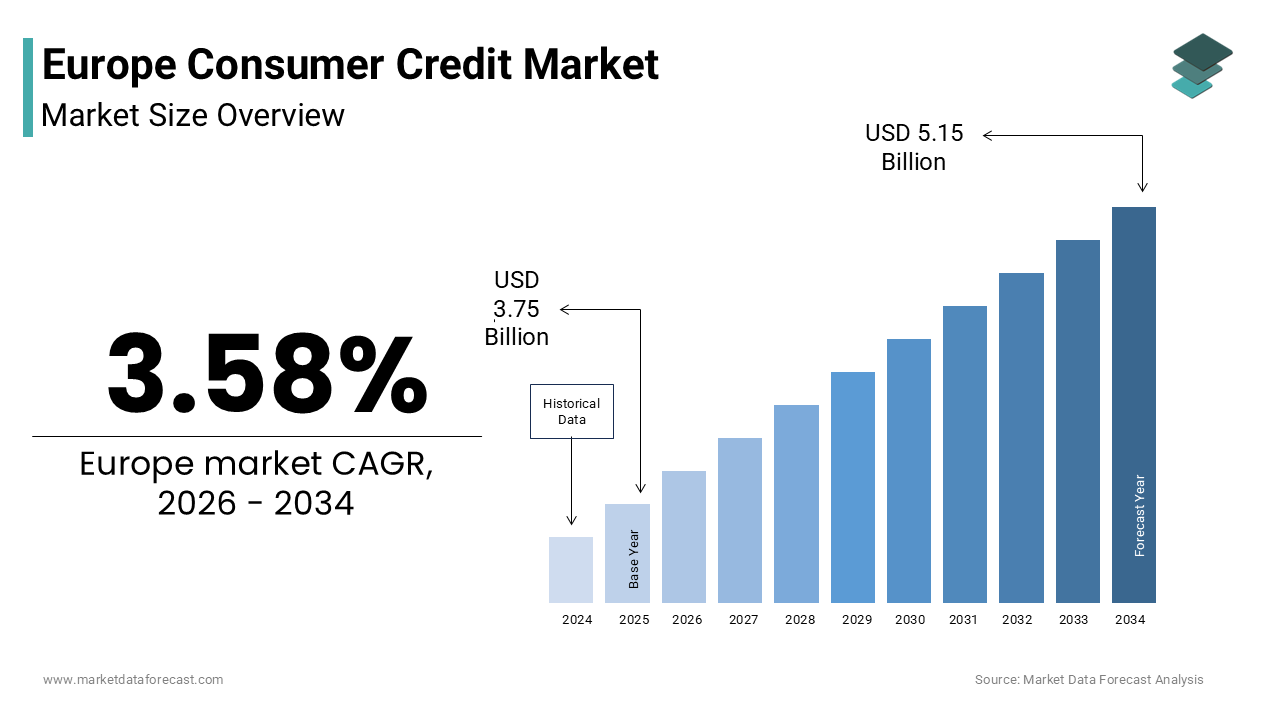
Consumer credit encompasses the diverse array of financial instruments extended to households for personal consumption excluding mortgages secured by real estate. This ecosystem includes unsecured personal loans, credit cards, overdrafts, and point of sale financing that enable individuals to manage cash flow fluctuations and acquire goods immediately. The landscape is currently undergoing a profound transformation driven by the integration of digital technologies and shifting regulatory paradigms aimed at protecting borrowers while fostering competition. As per Eurostat data, household debt levels across the European Union have stabilized, which is reflecting a cautious approach to borrowing amidst economic uncertainty. The market definition now extends beyond traditional banking institutions to include fintech lenders and buy now pay later providers who leverage alternative data for credit scoring. According to the European Central Bank, interest rate transmission mechanisms have become more potent following recent monetary policy tightening, which directly influences the cost of revolving credit for consumers. This evolving framework operates within the strict confines of the Consumer Credit Directive, which mandates transparency in lending terms and ensures responsible lending practices. The sector serves as a critical barometer for consumer confidence and economic health, where access to liquidity determines the purchasing power of millions across the continent.
MARKET DRIVERS
Resilient Demand for Digital Point of Sale Financing
The surging popularity of digital point of sale financing solutions particularly buy now pay later schemes is majorly driving the growth of the European consumer credit market. These embedded finance options allow consumers to split payments into interest free instalments or defer payments entirely thereby reducing the psychological barrier to purchase and increasing average order values. According to the European Payments Initiative, the use of buy now pay later methods in Europe has grown significantly, driven by widespread adoption in retail and e commerce sectors. This demand is fueled by the seamless integration of credit options at checkout pages which eliminates the need for traditional credit card applications and lengthy approval processes. As per McKinsey and Company, younger consumers in Europe show a strong preference for flexible payment methods compared to conventional credit cards for online purchases. Retailers actively promote these options to boost conversion rates creating a symbiotic relationship between merchants and non-bank lenders. The ability to access instant credit without impacting credit scores immediately makes these products highly attractive during periods of inflation where budget management becomes crucial. This shift in consumer behavior towards fragmented and flexible repayment structures ensures sustained growth in the digital consumer credit segment.
Expansion of Financial Inclusion through Alternative Data Scoring
The utilization of alternative data sources for credit scoring is further boosting the expansion of the European consumer credit market. Traditional credit bureaus often lack sufficient history on these segments leading to high rejection rates but new algorithms analyse cash flow utility payments and even social media activity to assess creditworthiness accurately. As per the European Banking Federation, the adoption of open banking frameworks has enabled lenders to access real time financial data allowing for more nuanced risk assessments that expand the eligible borrower pool. This technological advancement reduces reliance on historical credit reports which may not reflect current financial stability especially for gig economy workers whose income streams are irregular. According to the World Bank, improved credit assessment models in Europe have helped decrease default rates among new borrower categories while increasing loan approval speeds. Lenders leveraging artificial intelligence can process applications in minutes offering personalized terms that match the specific risk profile of each applicant. This democratization of credit access not only drives market volume but also fosters economic participation among marginalized groups who were previously excluded from formal financial systems.
MARKET RESTRIANTS
Stringent Regulatory Compliance and Affordability Checks
The rigorous enforcement of affordability assessments and responsible lending regulations acts as a significant restraint limiting the European consumer credit market growth. Lenders are mandated to conduct thorough checks on borrower income and expenditure to ensure loans can be repaid without causing financial hardship which often results in longer processing times and higher rejection rates. According to the Consumer Finance Association, a substantial portion of loan applications in the European Union were declined in the past year due to strict adherence to updated Consumer Credit Directive guidelines. These regulations require detailed verification of financial status which increases operational costs for lenders and creates friction in the user experience particularly for digital first borrowers expecting instant decisions. As per the European Central Bank, while these measures protect consumers, they inevitably cool down credit growth by filtering out marginal borrowers who might have accessed funds under looser regimes. Furthermore, the variation in national implementation of EU directives creates a fragmented compliance landscape where cross border lenders face complex legal hurdles when expanding into new jurisdictions. This regulatory burden discourages aggressive lending strategies and forces institutions to maintain conservative portfolios, thereby restraining the overall expansion of the consumer credit market despite potential demand.
Rising Interest Rates and Cost of Living Pressures
The macroeconomic environment characterized by elevated interest rates and persistent cost of living pressures severely dampens consumer appetite for taking on new unsecured debt, which is further impeding the growth of the European consumer credit market. Central banks across Europe have raised benchmark rates to combat inflation, which is leading to a direct increase in the cost of borrowing for credit cards and personal loans which discourages discretionary spending financed by credit. As per the Organisation for Economic Cooperation and Development, household savings rates in several major European economies have declined while debt servicing costs have risen prompting consumers to prioritize debt repayment over new borrowing. According to GfK, consumer confidence indices have remained subdued with many households expressing reluctance to take on additional financial commitments amidst economic uncertainty. The higher cost of capital means that monthly repayments for the same loan amount have increased substantially, which is making credit less affordable for average earners. Additionally, the fear of potential job losses or income reduction leads to a precautionary saving mindset where individuals avoid leveraging credit unless absolutely necessary. This contraction in demand is further exacerbated by tighter lending standards as banks anticipate higher default risks in a slowing economy creating a dual pressure that stifles market growth and limits the availability of cheap credit.
MARKET OPPORTUNITIES
Integration of Embedded Finance in Non-Financial Ecosystems
The seamless integration of credit products into non-financial platforms such as e-commerce marketplaces, travel booking sites, and automotive dealerships presents a prominent opportunity for market expansion. Embedded finance allows consumers to access loans, insurance, and payment plans directly within the user journey of their preferred apps, removing the need to visit separate banking interfaces. According to Bain and Company, the embedded finance market in Europe is expected to generate significant revenue in the coming years due to convenience and context aware offers provided to users at the point of need. This model leverages rich transactional data from host platforms to pre approve customers for credit lines instantly, enhancing conversion rates and customer loyalty. As per the European Fintech Association, retailers offering integrated financing options see notable increases in basket size compared to those relying on external payment methods. The ability to offer tailored credit products such as specific appliance loans or travel financing creates a highly relevant value proposition that traditional banks struggle to match. As more industries recognize the revenue potential of becoming lenders, the opportunity for consumer credit providers to partner with these ecosystems grows exponentially. This shift redefines distribution channels and opens new avenues for reaching customers in moments of high intent.
Adoption of Green Consumer Credit Products
The growing emphasis on sustainability and environmental responsibility offers a substantial opportunity for the European consumer credit market. Financial institutions are increasingly launching loan programs with preferential interest rates for electric vehicles, energy efficient home improvements, and sustainable consumer goods to align with European Green Deal objectives. As per the European Investment Bank, demand for green loans among retail customers has surged in recent years as consumers become more conscious of their carbon footprint. This trend is supported by government incentives and subsidies that make green investments more attractive when combined with favorable financing terms. According to the European Commission, linking credit conditions to sustainability criteria can drive significant behavioral changes and accelerate the transition to a low carbon economy. Lenders who pioneer these products can differentiate themselves in a crowded market and attract environmentally conscious demographics who prioritize ethical banking. Furthermore, the lower risk profile associated with assets like electric vehicles, which have stable residual values, can improve portfolio quality for lenders. This alignment of financial products with societal goals creates a win-win scenario that drives market growth while contributing to broader environmental targets.
MARKET CHALLENGES
Escalating Default Rates and Credit Risk Management
The rising incidence of loan defaults and delinquencies poses a major challenge to the stability and profitability of the Europe consumer credit market, as economic headwinds erode borrower repayment capacity. High inflation and stagnant wage growth have squeezed household budgets, leading to an increase in missed payments and insolvencies, particularly among subprime borrowers and those with variable rate debts. According to the European Central Bank, non performing loan ratios for unsecured consumer credit have shown upward trends in recent quarters, which is signalling deteriorating asset quality across the sector. Lenders are forced to increase provisions for bad debts, which directly impacts net income and restricts their ability to extend new credit. The complexity of managing risk in a volatile environment requires sophisticated predictive models and robust collection strategies, which many smaller lenders struggle to implement effectively. As per Creditreform, business and consumer insolvencies in Europe have reached high levels in recent years, adding pressure on credit portfolios. The challenge is compounded by the need to balance risk mitigation with customer retention, as aggressive collection practices can damage brand reputation and lead to regulatory scrutiny. Navigating this delicate equilibrium while maintaining capital adequacy remains a critical hurdle for market participants facing an uncertain economic outlook.
Intensifying Cybersecurity Threats and Data Privacy Concerns
The increasing sophistication of cyber-attacks and heightened concerns over data privacy represent a significant challenge to the European consumer credit market expansion. As lenders rely more heavily on digital channels and alternative data sources, they become prime targets for hackers seeking to steal sensitive personal and financial information. According to the European Union Agency for Cybersecurity, the financial sector has experienced a notable increase in ransomware attacks, with consumer lending platforms being frequent victims due to the vast amounts of stored personal data. Breaches not only result in direct financial losses but also erode consumer confidence, leading to hesitation in adopting digital credit services. The General Data Protection Regulation imposes stringent penalties for data mishandling, which is forcing lenders to invest heavily in security infrastructure and compliance protocols, which increases operational costs. As per Deloitte, reputational damage from a single data breach can lead to long term declines in customer acquisition and retention. Furthermore, the rise of identity fraud and synthetic identity scams complicates the onboarding process, requiring lenders to implement advanced verification methods that can sometimes fractionize the user experience. Balancing security imperatives with seamless digital journeys remains a persistent challenge for the European market.
REPORT COVERAGE
| REPORT METRIC | DETAILS |
| Market Size Available | 2025 to 2034 |
| Base Year | 2025 |
| Forecast Period | 2026 to 2034 |
| CAGR | 3.58% |
| Segments Covered | By Credit Type, Issuer, Payment Method and Region. |
| Various Analyses Covered | Global, Regional & Country Level Analysis, Segment-Level Analysis, DROC, PESTLE Analysis, Porter’s Five Forces Analysis, Competitive Landscape, Analyst Overview of Investment Opportunities |
| Country Covered | UK, France, Spain, Germany, Italy, Russia, Sweden, Denmark, Switzerland, the Netherlands, Turkey, the Czech Republic, and the Rest of Europe |
| Market Leaders Profiled | BNP Paribas, HSBC Holdings plc, Barclays plc, Santander Group, Deutsche Bank AG, Crédit Agricole S.A., ING Group, UniCredit S.p.A., Société Générale, and Lloyds Banking Group. |
SEGMENTAL ANALYSIS
By Credit Type Insights
The non-revolving credits segment dominated the market by holding the major share of the European consumer credit market in 2025 due to the specific nature of European borrowing habits which favor fixed term loans for distinct purchases over open ended credit lines. This category includes personal loans, auto finance, and student loans where the borrower receives a lump sum and repays it over a set period. The strong cultural and economic preference among European consumers for structured repayment schedules that offer budget certainty in a volatile economic environment is further aiding the dominance of the non-revolving credits segment in the European market. Unlike revolving credit where balances can fluctuate and minimum payments vary, fixed term loans provide borrowers with a clear timeline for debt freedom and predictable monthly obligations. According to the European Central Bank, household preferences have shifted toward instalment loans as rising interest rates make the variable costs of revolving credit less attractive for long term financing needs. As per the German Bundesbank, consumer lending volume in Germany shows a strong reliance on non-revolving instruments reflecting a broader regional trend toward disciplined debt management. This structure appeals to lenders as well since it reduces the risk of indefinite exposure and allows for more accurate provisioning against defaults. The clarity of these contracts aligns perfectly with stringent EU regulations that mandate transparent cost disclosures ensuring borrowers fully understand their total liability before signing. This mutual benefit of predictability for consumers and risk mitigation for lenders solidifies the leading position of non-revolving credits in the market.
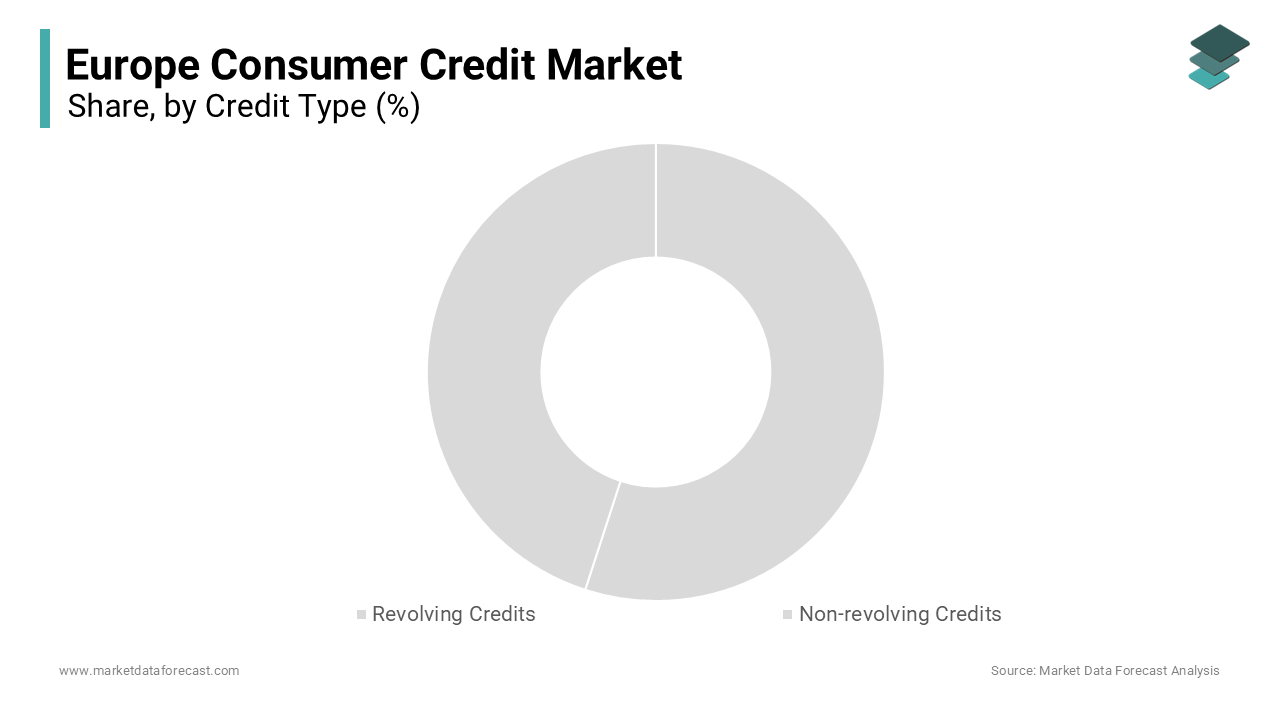
On the other hand, the revolving credits segment is projected to be the fastest growing category in the Europe consumer credit market and record a CAGR of 9.4% over the forecast period owing to the digital transformation of credit cards and the explosive adoption of buy now pay later solutions that function as modern revolving facilities. The seamless integration of revolving credit facilities into digital commerce ecosystems through buy now pay later platforms and virtual credit cards is further contributing to the growth of the revolving credits segment in the European market. These innovative products offer the flexibility of revolving credit with the convenience of instant approval at the point of sale appealing strongly to younger demographics who avoid traditional banking interfaces. According to McKinsey and Company, BNPL transactions in Europe have increased significantly with many of these services operating on a revolving credit model that allows users to carry balances month to month. As per the European Payments Initiative, online shoppers in countries such as the UK and France are increasingly utilizing digital revolving credit for everyday purchases. The ability to manage these facilities entirely through mobile apps with real time spending insights enhances user engagement and encourages frequent usage. As merchants increasingly embed these options to boost conversion rates the accessibility of revolving credit expands beyond traditional cardholders to include previously unbanked segments. This digital evolution transforms revolving credit from a static financial product into a dynamic tool for daily commerce driving its rapid growth trajectory.
By Issuer Insights
The banks and finance companies segment held the largest share of the European consumer credit market in 2025 due to their established infrastructure, vast capital reserves, and deep-rooted customer relationships that enable them to dominate lending activities. This group includes traditional retail banks, captive finance arms of automakers, and specialized consumer finance corporations. The dominance of banks and finance companies segment in the European market is further driven by their access to extensive capital reserves and widespread distribution networks that allow them to lend at scale and reach diverse customer segments effectively. Traditional banks possess low-cost deposit bases that provide a stable and cheap source of funding for consumer loans, giving them a competitive edge in pricing over non-bank lenders. According to the European Central Bank, banks account for the majority of consumer credit outstanding in the Eurozone, leveraging their branch networks and digital channels to distribute products widely. As per the European Banking Authority, the trust placed in licensed banks by consumers remains higher than for newer entrants, facilitating easier customer acquisition and retention. Captive finance companies affiliated with major automotive manufacturers further bolster this segment by providing tailored financing solutions that drive vehicle sales across the continent. The ability to cross sell credit products to existing banking customers creates a powerful synergy that maximizes lifetime value and reduces acquisition costs. Furthermore, their established compliance frameworks and risk management systems allow them to navigate complex regulatory environments with greater ease than smaller competitors. This combination of financial strength, market presence, and consumer trust solidifies the leading position of Banks and Finance Companies in the issuer landscape.
REGIONAL ANALYSIS
Germany Consumer Credit Market Analysis
Germany led the consumer credit market in Europe in 2025 with 25.5% of the regional market share. The dominating position of Germany in the European market is driven by its robust economy and high levels of consumer confidence despite a cultural preference for debt aversion. The German market is characterized by a strong dominance of instalment loans and auto finance, while revolving credit usage remains comparatively lower than in other European nations. According to the German Bundesbank, consumer credit volumes have shown resilience with a steady increase in digital lending adoption as fintechs challenge traditional savings banks. As per Bitkom, German consumers are increasingly utilizing online platforms for loan comparisons and applications, accelerating the shift away from branch-based banking. The country's strict regulatory framework ensures high standards of borrower protection, which fosters stability but also slows the proliferation of high-risk credit products. The automotive sector acts as a major engine for credit growth, with captive finance companies providing substantial volumes of non-revolving loans for vehicle purchases. Furthermore, the rise of buy now pay later services is beginning to alter traditional spending habits among younger generations who are more open to digital credit solutions. The convergence of economic strength, regulatory clarity, and digital innovation keeps Germany at the forefront of the European consumer credit landscape.
United Kingdom Consumer Credit Market Analysis
The United Kingdom secured the second largest position in the Europe consumer credit market in 2025 due to its mature and highly competitive lending environment that embraces both traditional and innovative credit models. The high penetration of credit cards and a thriving fintech sector that leads Europe in buy now pay later adoption are propelling the UK market expansion. According to the Bank of England, outstanding consumer credit figures have fluctuated with economic cycles, but the underlying infrastructure remains sophisticated with advanced open banking integration. As per the Financial Conduct Authority, the UK has the highest density of authorized consumer credit firms in Europe, fostering intense competition and product diversity. London serves as a global hub for fintech innovation, attracting significant investment into lending platforms that utilize artificial intelligence for risk assessment. The prevalence of unsecured personal loans and credit cards for daily spending is higher here than in continental Europe, reflecting different consumer attitudes toward debt. Recent regulatory adjustments aim to curb excessive costs in the high-cost short term credit sector while encouraging responsible innovation. The combination of a deep capital market, progressive regulation, and a tech savvy population maintains the UK as a pivotal market for consumer credit growth and experimentation.
France Consumer Credit Market Analysis
France is estimated to account for a promising share of the European consumer credit market during the forecast period owing to a balanced mix of traditional bank lending and emerging specialized finance companies. The strict usury laws that cap interest rates to ensure consumer protection while shaping the profitability and structure of credit products is further boosting the French market expansion. According to the Banque de France, consumer credit issuance has remained stable with a notable shift towards green loans and eco-friendly financing options supported by government incentives. As per the French Prudential Supervision and Resolution Authority, specialized credit institutions play a significant role alongside major banks, particularly in the automotive and home improvement sectors. The French consumer exhibits a strong preference for fixed rate instalment loans, which aligns with the regulatory emphasis on transparency and affordability. Digital transformation is gaining momentum, with traditional banks investing heavily in mobile apps to compete with pure play digital lenders. The rise of collaborative finance and peer to peer lending is also gaining traction, although within a tightly regulated framework. The interplay between protective legislation and the need for modern financial services creates a unique market dynamic that prioritizes stability and responsible lending practices.
Italy Consumer Credit Market Analysis
Italy is predicted to exhibit a healthy CAGR in the European consumer credit market during the forecast period. The historically low level of household debt compared to Northern Europe, but with rapid growth potential as financial inclusion initiatives take hold are driving the Italian market growth. According to the Bank of Italy, consumer credit volumes have been expanding steadily, particularly in the southern regions where access to banking services was previously limited. As per the Italian Association of Consumer Credit Companies, instalment financing for durable goods and automobiles is the primary driver of growth as consumers seek to replace aging assets. The government has introduced measures to promote digital payments and reduce the shadow economy, which indirectly boosts the formal consumer credit sector. Fintech startups are beginning to penetrate the market by offering simplified online loans to small business owners and self-employed individuals who often lack access to traditional bank credit. The gradual shift in consumer mindset, coupled with supportive policy measures, is unlocking significant latent demand. This transition from cash to credit positions Italy as a high potential market for future expansion in the European region.
Spain Consumer Credit Market Analysis
Spain is estimated to hold a notable share of the European consumer credit market during the forecast period. Spain is demonstrating a strong recovery in lending activities following the post pandemic economic rebound and a resurgence in tourism related spending. The market in Spain is characterized by a vibrant competition between large banking groups and specialized non-bank lenders, particularly in the personal loan and credit card segments. According to the Bank of Spain, consumer credit demand has increased as household confidence improves, leading to borrowing for consumption and travel. As per the Spanish Confederation of Savings Banks, digital channels now account for a majority of new credit applications, reflecting a rapid adoption of online banking services among the population. The tourism and hospitality sectors drive significant credit usage through seasonal financing and merchant services that support consumer spending in these industries. Regulatory oversight remains robust, ensuring that the rapid growth does not compromise asset quality or consumer welfare. The rise of neobanks and digital only lenders is intensifying competition, forcing traditional banks to innovate their product offerings and improve customer experiences. This dynamic environment, fueled by economic revitalization and technological adoption, ensures Spain remains a key contributor to the European consumer credit market.
COMPETITIVE LANDSCAPE
The competition in the Europe consumer credit market is intensely fierce characterized by a dynamic struggle between established traditional banks specialized finance companies and agile fintech disruptors vying for market share amidst evolving regulatory landscapes. Traditional banks leverage their vast capital reserves and deep customer relationships to maintain dominance while facing pressure to modernize legacy systems to match the speed of digital natives. Fintech entrants compete on superior user experience instant approval times and innovative products like buy now pay later that appeal strongly to younger demographics. The battleground has shifted from simple interest rate competition to value added services including financial wellness tools personalized rewards and seamless digital interfaces. Regulatory frameworks such as the Consumer Credit Directive act as both a barrier and a catalyst forcing all participants to innovate rapidly to meet strict transparency and affordability standards. New entrants specializing in niche verticals or alternative data scoring are challenging established norms by offering tailored solutions to previously unbanked populations. Strategic partnerships between banks and technology firms have become commonplace as companies seek to combine financial stability with technological agility. This complex ecosystem ensures that no single entity can rest on its laurels as shifting consumer preferences and economic conditions constantly reshape the competitive hierarchy.
KEY MARKET PLAYERS
Some of the companies that are playing a dominating role in the Europe Soybean Oil Market include
- BNP Paribas
- HSBC Holdings plc
- Barclays plc
- Santander Group
- Deutsche Bank AG
- Crédit Agricole S.A.
- ING Group
- UniCredit S.p.A.
- Société Générale
- Lloyds Banking Group
Top Players in the Europe Consumer Credit Market
BNP Paribas Personal Finance
BNP Paribas Personal Finance stands as a leading specialized lender across Europe offering a wide array of consumer credit products including personal loans and revolving credit lines. The company contributes globally by setting benchmarks for responsible lending practices and digital customer experiences within the retail banking sector. Recent actions to strengthen its market position include the aggressive expansion of its digital lending platforms in Southern and Eastern European markets to capture underserved segments. The firm has also invested heavily in artificial intelligence driven risk assessment tools to streamline approval processes and reduce default rates. By launching tailored green loan products aligned with European sustainability goals BNP Paribas Personal Finance reinforces its commitment to ethical financing. These strategic initiatives enhance its operational efficiency and broaden its customer base ensuring it remains a dominant force in the competitive European consumer credit landscape without relying on traditional branch networks alone.
Santander Consumer Finance
Santander Consumer Finance operates as a major dedicated consumer lending subsidiary serving millions of customers throughout Europe with diverse financing solutions for vehicles and personal needs. Globally the entity is recognized for its robust dealer networks and innovative digital financing options that facilitate seamless purchasing experiences. Recent efforts to solidify its market presence involve the acquisition of local fintech startups to accelerate digital transformation and improve mobile banking capabilities. The company has launched comprehensive buy now pay later services integrated directly into major e commerce platforms to attract younger demographics. Santander Consumer Finance also focuses on expanding its automotive finance portfolio by partnering with electric vehicle manufacturers to offer specialized green financing packages. These moves demonstrate a clear strategy to adapt to changing consumer behaviours and regulatory requirements while maintaining strong relationships with retail partners. Such proactive adaptations ensure sustained growth and relevance in the evolving European consumer credit environment.
Deutsche Bank via DKB and Partner Networks
Deutsche Bank leverages its extensive network and digital subsidiary DKB to provide significant consumer credit services across Germany and broader European markets. The group contributes globally by integrating advanced data analytics into credit decisioning processes to enhance risk management and customer personalization. Recent actions to strengthen its position include the rollout of fully digital personal loan products that offer instant approvals and flexible repayment terms via mobile applications. The bank has also formed strategic alliances with major retailers to embed credit options at the point of sale enhancing convenience for shoppers. Deutsche Bank continues to invest in cybersecurity infrastructure to protect consumer data and build trust in an era of increasing digital fraud. By focusing on sustainable finance initiatives, the bank offers preferential rates for eco-friendly purchases aligning with regional environmental mandates. These targeted investments and partnerships enable Deutsche Bank to compete effectively against both traditional rivals and agile fintech entrants in the dynamic European consumer credit sector.
Top Strategies Used by the Key Market Participants
Key players in the Europe consumer credit market primarily employ strategies centred on digital transformation and the integration of artificial intelligence to streamline lending operations and enhance customer experiences. Companies are heavily investing in mobile first platforms that allow borrowers to apply for loans and manage accounts seamlessly from their smartphones reducing reliance on physical branches. Another prevalent strategy involves the development of embedded finance solutions where credit products are integrated directly into e commerce checkout flows and retailer systems to capture customers at the point of purchase. Major lenders are also forming strategic partnerships with fintech firms to leverage alternative data sources for more accurate credit scoring and to reach underserved market segments effectively. Sustainability initiatives serve as a critical differentiator as vendors launch green loan products with preferential terms for eco-friendly purchases to align with European Green Deal objectives. Furthermore, organizations are focusing on personalized marketing campaigns driven by big data analytics to offer tailored credit solutions that meet specific customer needs. Acquisitions of niche lenders and technology providers allow these giants to expand their product portfolios and enter new geographical markets rapidly while strengthening their technological capabilities.
MARKET SEGMENTATION
This research report on the Europe Consumer Credit Market has been segmented and sub-segmented based on the following categories.
By Credit Type
- Revolving Credits
- Non-revolving Credits
By Issuer
- Banks and Finance Companies
- Credit Unions
- Others
By Payment Method
- Direct Deposit
- Debit Card
- Others
By Country
- UK
- France
- Spain
- Germany
- Italy
- Russia
- Sweden
- Denmark
- Switzerland
- Netherlands
- Turkey
- Czech Republic
- Rest of Europe