Europe Conveyor Systems Market Size, Share, Trends, & Growth Forecast Report By Product Type (Belt, Roller, Pallet, Overhead Specialty (Spiral, Climbing, Sorting)), End-user Industry, Load Type, Automation Level, Service and Country (UK, France, Spain, Germany, Italy, Russia, Sweden, Denmark, Switzerland, Netherlands, Turkey, Czech Republic and Rest of Europe), Industry Analysis From 2026 to 2034
Market Size, 2025
$3.40 BnMarket Estimate, 2026
$3.61 BnMarket Forecast, 2034
$5.79 BnCAGR, 2026–2034
6.09%Europe Conveyor Systems Market Report Summary
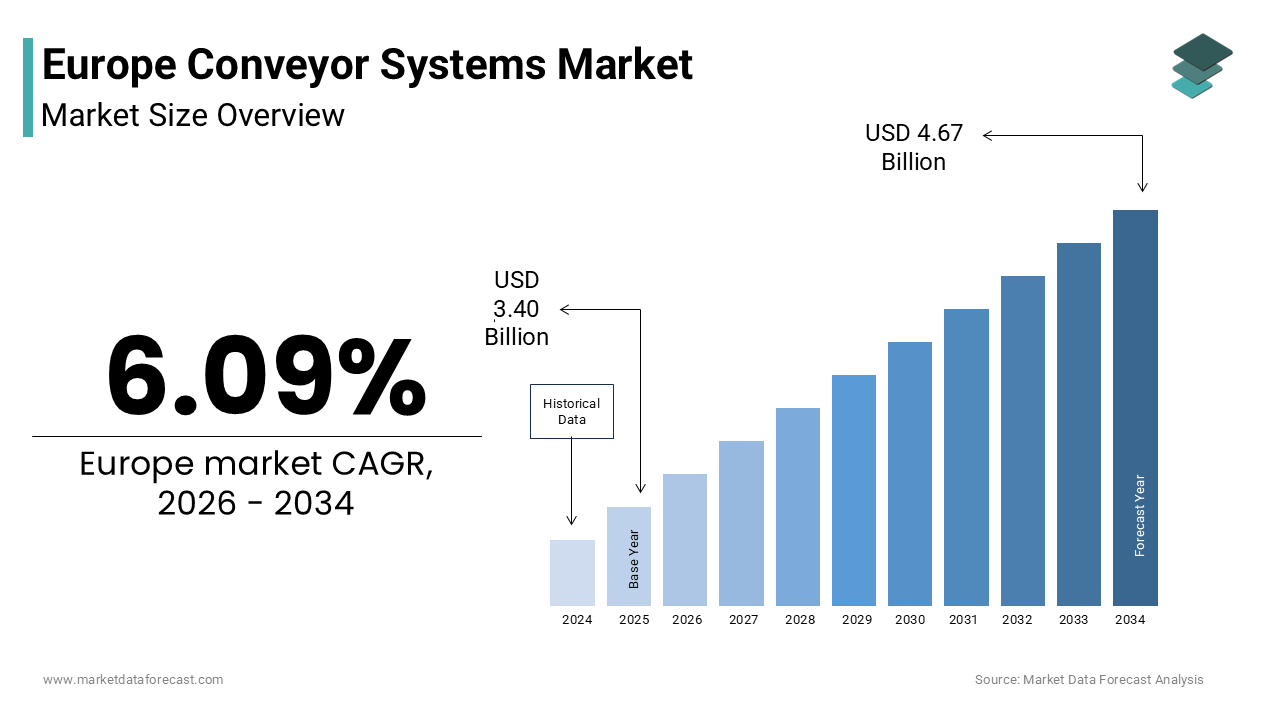
The Europe conveyor systems market was valued at USD 3.40 billion in 2025, is estimated to reach USD 3.61 billion in 2026, and is projected to reach USD 5.79 billion by 2034, growing at a CAGR of 6.09% during the forecast period from 2026 to 2034. The growth of the Europe conveyor systems market is driven by rising adoption of Industry 4.0 technologies, expanding e-commerce fulfillment infrastructure, and increasing automation across manufacturing, logistics, and airport operations. Conveyor systems are evolving from conventional material transport solutions into intelligent, modular, and energy-efficient automation components integrated with digital control platforms and predictive analytics. Additionally, infrastructure modernization in airports, growth in parcel volumes driven by online retail, and regulatory emphasis on workplace safety and energy efficiency are accelerating investment in advanced conveyor technologies. While regulatory compliance complexity and skilled labor shortages present challenges, ongoing innovation in modular design, digital monitoring, and sustainable material handling solutions continues to support market expansion across Europe.
Key Market Trends
-
Rapid integration of Industry 4.0 technologies enabling smart and sensor-enabled conveyor networks.
-
Strong growth of automated fulfillment centers supporting high-throughput parcel sortation.
-
Increasing deployment of modular and scalable conveyor systems across manufacturing facilities.
-
Rising adoption of conveyor solutions in recycling and circular economy infrastructure.
-
Growing demand for specialized conveyor systems in cold chain and temperature-controlled logistics.
Segmental Insights
- Based on product type, the belt conveyor segment held 38.9% of the Europe conveyor systems market share in 2025, supported by its versatility, cost efficiency, and widespread application across logistics, food processing, and industrial manufacturing operations.
- Based on end-user industry, the airport baggage handling segment accounted for 28.4% of the Europe conveyor systems market share in 2025, driven by high passenger volumes, modernization of baggage infrastructure, and stringent performance requirements across European airports.
- Based on service type, the installation services segment represented the largest share in 2025, owing to extensive deployment of new conveyor infrastructure across industrial plants, logistics facilities, and airport modernization projects.
Regional Insights
The Europe conveyor systems market demonstrates consistent growth across major countries supported by industrial automation initiatives, logistics infrastructure expansion, and manufacturing modernization.
-
Germany represents a leading market, driven by strong manufacturing activity, automotive production, and smart factory adoption initiatives.
-
The Netherlands maintains strong growth, supported by logistics hub development, advanced port infrastructure, and automated warehouse investments.
-
France continues to expand, fueled by airport modernization programs and growing e-commerce logistics automation.
-
The United Kingdom contributes significantly, supported by parcel logistics growth and warehouse automation across retail distribution networks.
-
Nordic countries show increasing adoption, particularly across recycling infrastructure, cold chain logistics, and advanced automated manufacturing environments.
Competitive Landscape
The Europe conveyor systems market is characterized by competition among global automation leaders and specialized regional integrators delivering customized material handling solutions across diverse industries. Market participants are focusing on integrating conveyor systems with robotics, warehouse management software, and predictive maintenance platforms to enhance operational efficiency and lifecycle performance. Innovation priorities include modular architecture, energy-efficient drive technologies, and sensor-enabled monitoring systems aligned with EU sustainability and safety directives. Strategic collaborations, acquisitions of niche automation firms, and expansion of service capabilities are enabling companies to strengthen market positioning and deliver end-to-end automation ecosystems. Key players operating in the Europe conveyor systems market include Siemens AG, Daifuku Co., Ltd., SSI Schaefer Group, Dematic (KION Group AG), Vanderlande Industries B.V., TGW Logistics Group, Interroll Holding AG, BEUMER Group GmbH & Co. KG, Honeywell Intelligrated, Fives Group, Murata Machinery, Ltd., Swisslog Holding AG, Mecalux S.A., Kardex Group, and FlexLink AB.
Europe Conveyor Systems Market Size
The Europe conveyor systems market size was valued at USD 3.40 billion in 2025 and is anticipated to reach USD 3.61 billion in 2026 from USD 5.79 billion by 2034, growing at a CAGR of 6.09% during the forecast period from 2026 to 2034.
A conveyor system is a mechanical handling assembly designed to transport materials, products, or loads automatically from one location to another. These systems are integral to sectors such as automotive, food and beverage, pharmaceuticals, e-commerce logistics, and airport baggage handling. Unlike generic material handling tools, conveyor systems in Europe are increasingly engineered for modularity, energy efficiency, and seamless integration with digital control platforms. According to Eurostat, the EU's industrial sector saw a 2% production decrease in 2024, with the total value of sold production reaching €5.86 trillion, highlighting the ongoing need for automated material movement solutions. Furthermore, ACI EUROPE reported that European airports handled over 2.5 billion passengers in 2024, driving demand for high-throughput baggage conveyor infrastructure. The market’s evolution is also shaped by stringent EU directives on workplace safety and energy consumption, compelling manufacturers to adopt smarter and more sustainable conveyor technologies. This convergence of industrial automation imperatives, regulatory frameworks, and infrastructural modernization defines the contemporary landscape of the Europe conveyor systems market.
MARKET DRIVERS
Rising Adoption of Industry 4.0 Technologies in Manufacturing
The integration of Industry 4.0 principles into European manufacturing facilities has emerged as a major accelerator of the Europe conveyor systems market. Smart factories now rely on interconnected conveyor networks equipped with sensors, real time data analytics, and predictive maintenance capabilities to optimize production flow. European Commission data suggests that large-scale manufacturers in key European economies are rapidly adopting digital technologies, with almost all reaching a high level of digital intensity by 2025. This digital transformation necessitates conveyors that communicate with enterprise resource planning and warehouse management systems, enabling synchronized material handling. For instance, Siemens has indicated that its automated material handling and conveyor solutions, which often utilize dynamic routing and load balancing, lead to reduced cycle times and improved efficiency in automotive production. Additionally, Horizon Europe continues to fund significant projects within the advanced manufacturing, automation, and robotics sectors to support the digital transformation of European industries. The shift toward flexible, data driven production lines means that static conveyor setups are being replaced by adaptive modular systems capable of reconfiguring based on real time demand signals. Consequently, conveyor systems are no longer passive transport mechanisms but active nodes in intelligent production ecosystems, directly contributing to throughput reliability and operational transparency across Europe’s industrial base.
Expansion of E-Commerce Fulfillment Infrastructure
The exponential growth of online retail across the region has enbaled unprecedented investment in automated fulfillment centers, which in turn boosts the expansion of the Europe conveyor systems market. In these facilities, conveyor systems serve as the backbone of sortation and distribution operations. According to official European statistical monitoring, the adoption of online shopping across the European Union has maintained a steady upward trajectory, driven by increased consumer reliance on digital marketplaces and a broader digital transformation across member states. This surge has compelled logistics operators to deploy high speed conveyor networks capable of processing thousands of parcels per hour with minimal human intervention. Amazon continues to scale its physical footprint across Europe, specifically focusing on expanding its fulfillment network with modern facilities characterized by high levels of internal automation and extensive mechanized sorting systems. Similarly, the Deutsche Post DHL Group is moving forward with a multi-year investment strategy focused on modernizing its European logistics infrastructure, directing capital toward automated hardware and material handling systems. The need for same day and next day delivery has intensified pressure on throughput accuracy, prompting adoption of tilt tray and cross belt sorters linked to AI driven routing algorithms. Moreover, urban logistics hubs in cities like Paris and Berlin are adopting compact spiral and vertical conveyors to maximize space efficiency in constrained footprints. This e commerce driven infrastructure boom has redefined conveyor requirements, emphasizing scalability, fault tolerance, and interoperability with robotic picking systems, thereby solidifying the conveyor system’s role as a critical enabler of Europe’s digital retail economy.
MARKET RESTRAINTS
Stringent Regulatory Compliance and Certification Requirements
The region’s complex and evolving regulatory landscape causes operational friction for manufacturers of these system within the Europe conveyor systems market. This imposes rigorous standards on safety, energy efficiency, and environmental impact. The Machinery Directive 2006 42 EC mandates comprehensive risk assessments and CE marking for all conveyor installations, requiring extensive documentation and third party validation. European safety authorities report that failures to meet safety standards remain a primary driver for removing industrial machinery from the market. Furthermore, updated European environmental regulations now require manufacturers of material handling systems to significantly lower the amount of energy their equipment consumes while idling. Achieving these benchmarks often necessitates redesigning drive systems and incorporating regenerative braking, increasing both development timelines and capital outlay. The REACH regulation also restricts the use of certain lubricants and polymer components, limiting material choices and raising supply chain complexity. A substantial portion of the European conveyor manufacturing sector consists of smaller firms that often face significant challenges meeting complex regulatory requirements compared to larger competitors. Consequently, Increased regulatory scrutiny and the transition to newer safety frameworks have led to noticeable delays in the time it takes for industrial products to receive certification and reach the market. While these regulations enhance user safety and sustainability, they simultaneously act as a structural restraint by elevating barriers to innovation and market participation, particularly for agile but resource constrained firms.
Persistent Shortages in Skilled Automation Technicians
The acute shortage of technicians proficient in industrial automation and mechatronics is among the serious obstacles for the Europe conveyor systems market. This is a critical barrier constraining the deployment and maintenance of advanced conveyor systems across the region. The European Centre for the Development of Vocational Training indicates that rapid digitalization and the adoption of AI are driving intense demand for new skills, with significant labor shortages emerging across EU manufacturing and service sectors. Conveyor systems, especially those integrated with programmable logic controllers and vision systems, require specialized knowledge for installation, troubleshooting, and software calibration. The International Federation of Robotics indicates that while robot demand continues to grow, persistent labor shortages in advanced economies are driving a need for greater automation. Vocational training pipelines have failed to keep pace with technological advancement. The European Commission's Skills Agenda emphasizes the urgent need for updated, practical vocational training to address mismatches between available training and the demands of the digital and green transitions. The OECD reports that labor market tightness, combined with high inflation in recent years, has contributed to rising wage pressures for skilled roles across Europe. Moreover, research indicates that in highly automated environments, unplanned downtime causes significant financial losses, making efficient maintenance and repair capabilities critical. This human capital gap will continue to impede the scalability and reliability of conveyor system operations without a coordinated upskilling initiative aligned with Industry 4.0 competencies. Ultimately, this mismatch undermines the very efficiency gains these systems are intended to deliver.
MARKET OPPORTUNITIES
Integration of Circular Economy Principles in Material Handling
The European Union’s aggressive push toward a circular economy offers a transformative opportunity for innovation within the Europe conveyor systems market. This is particularly true in the recycling and remanufacturing sectors. Under the Circular Economy Action Plan, the EU aims to double circular material use by 2030, necessitating highly adaptable conveyor infrastructure capable of sorting, transporting, and feeding diverse waste streams into recovery loops. The European Union exhibits an upward trend in municipal waste recycling, with countries such as Germany and Slovenia leading in performance through advanced material recovery infrastructure, according to the European Environment Agency. These facilities rely on multi stage conveyor networks equipped with near infrared spectroscopy and AI powered object recognition to separate polymers, metals, and composites at speeds exceeding 12 tons per hour. Market leaders in sorting technology, including TOMRA Systems, are experiencing increased demand for automated solutions to meet mandatory EU recycling targets and circular economy goals. Furthermore, the revised Waste Framework Directive mandates that all packaging placed on the EU market be reusable or recyclable by 2030, spurring investment in reverse logistics hubs where conveyors manage returned goods for refurbishment. Companies like Renault and Philips are already operating closed loop supply chains that depend on conveyor systems to route end of life products back into production. This regulatory and cultural shift toward resource circularity is redefining conveyor functionality, creating demand for corrosion resistant, modular, and sensor rich systems that support traceability and material integrity throughout secondary lifecycles.
Growth of Cold Chain Logistics for Perishable Goods
The expanding cold chain logistics sector in the region offers a substantial growth avenue for the Europe conveyor systems market. This market is driving demand for specialized conveyor systems engineered for temperature-controlled environments. Driven by rising demand for fresh produce, pharmaceuticals, and ready-to-eat meals, the European cold chain market is experiencing growth, particularly in automated storage and technology-driven logistics. Unlike ambient conveyors, cold chain variants must operate reliably at temperatures as low as minus 25 degrees Celsius while resisting condensation, ice buildup, and thermal contraction of components. This requires stainless steel construction, food grade belting, and explosion proof motors compliant with ATEX directives. Major retailers like Carrefour and Tesco have mandated full automation in their regional distribution centers for chilled goods, with each facility deploying over 8 kilometers of refrigerated conveyor lines. Increased demand for sensitive pharmaceuticals and vaccines is accelerating the adoption of specialized, real-time temperature-monitored logistics solutions. Furthermore, technological innovations in insulated components and transfer solutions are contributing to enhanced energy efficiency in storage, as researched by organizations like the Fraunhofer Institute. This shift opens a niche yet high-value segment for conveyor manufacturers who can master the intersection of thermal engineering and automated material flow.
MARKET CHALLENGES
Fragmentation of Technical Standards Across European Countries
Persistent discrepancies in national technical standards and grid specifications continue to challenge the uniform deployment of these systems across the region, and the expansion of the Europe conveyor systems market. This is despite EU harmonization efforts. While the CE marking provides baseline conformity, individual countries maintain supplementary requirements that affect electrical compatibility, noise emission thresholds, and emergency stop protocols. For example, France’s NFC 15 100 standard imposes stricter cable shielding rules than the IEC 60204 baseline, while Sweden mandates additional acoustic dampening for indoor conveyors beyond EU noise directives. Manufacturers of conveyor systems frequently encounter significant project modifications to meet the unique safety and technical regulations of specific countries, which often leads to an increase in the total financial investment required for the project. This fragmentation complicates pan European rollouts for multinational clients, who must either customize systems per jurisdiction or accept operational inefficiencies from over engineered universal designs. The German engineering sector experiences frequent disruptions in delivery schedules because equipment often requires late-stage design changes to satisfy the oversight and inspection requirements of local jurisdictions. Moreover, differences in voltage stability, ranging from 220 volts in Ireland to 230 volts nominal with tighter tolerances in Austria, affect motor performance and necessitate region specific drive configurations. Unless deeper alignment is achieved through initiatives like the Single Market Act II, this regulatory patchwork will continue to hinder scalability, forcing manufacturers to adopt expensive and lengthy localization strategies that undermine competitiveness.
Vulnerability to Geopolitical Disruptions in Component Sourcing
Mounting exposure to supply chain volatility impedes the growth of the Europe conveyor systems market. This volatility stems from geopolitical tensions and export controls on critical automation components. European conveyor manufacturers rely heavily on high-precision components and drives imported from Asian markets, particularly China and Japan, which maintain a dominant position in the global motion control supply chain. International trade regulations and export controls on advanced semiconductor technologies have introduced uncertainty into the supply chain, causing fluctuations in the availability and delivery schedules of programmable motion control drives. Simultaneously, Ongoing shifts in European energy sourcing continue to place upward pressure on manufacturing costs for metal components, affecting the pricing of industrial frames and rollers used in heavy machinery. Geopolitical tensions and the demand for renewable technologies have led to significant volatility in the cost of rare earth elements, which are essential for producing the permanent magnets used in high-efficiency motors. Although the EU’s Critical Raw Materials Act aims to bolster domestic refining capacity by 2030, current dependency leaves conveyor manufacturers vulnerable to sudden input shocks. This external fragility not only inflates production costs but also undermines just in time assembly models, compelling firms to hold larger inventories and absorb carrying costs. Europe’s conveyor systems market remains vulnerable to geopolitical instability and cost fluctuations until strategic autonomy in key electromechanical components is secured.
REPORT COVERAGE
| REPORT METRIC | DETAILS |
| Market Size Available | 2025 to 2034 |
| Base Year | 2025 |
| Forecast Period | 2026 to 2034 |
| CAGR | 6.09% |
| Segments Covered | By Product Type, End-user Industry, Load Type, Automation Level, Service and Region. |
| Various Analyses Covered | Global, Regional & Country Level Analysis, Segment-Level Analysis, DROC, PESTLE Analysis, Porter’s Five Forces Analysis, Competitive Landscape, Analyst Overview of Investment Opportunities |
| Country Covered | UK, France, Spain, Germany, Italy, Russia, Sweden, Denmark, Switzerland, the Netherlands, Turkey, the Czech Republic, and the Rest of Europe. |
| Market Leaders Profiled | Siemens AG, Daifuku Co., Ltd., SSI Schaefer Group, Dematic (KION Group AG), Vanderlande Industries B.V., TGW Logistics Group, Interroll Holding AG, BEUMER Group GmbH & Co. KG, Honeywell Intelligrated, Fives Group, Murata Machinery, Ltd., Swisslog Holding AG, Mecalux S.A., Kardex Group, and FlexLink AB. |
SEGMENTAL ANALYSIS
By Product Type Insights
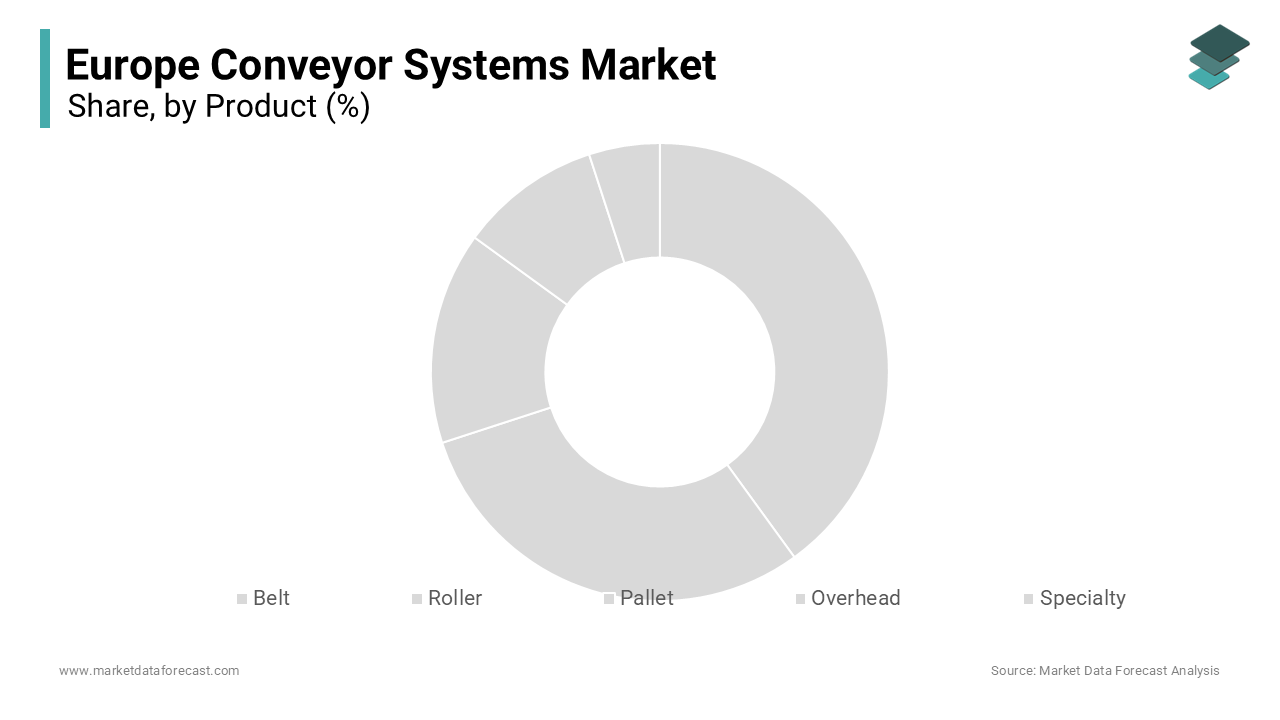
The belt conveyors segment dominated the Europe conveyor systems market and accounted for 38.9% share in 2025. The dominance of the segment is primarily driven by their versatility, cost efficiency, and suitability for continuous transport of bulk materials and packaged goods across diverse industries. In food processing, for instance, sanitary belt conveyors with FDA compliant surfaces are indispensable for handling raw ingredients and finished products without contamination. The European food and drink industry, representing hundreds of thousands of individual businesses, serves as the continent's largest manufacturing sector and relies extensively on automated conveyor lines for both processing and packaging. Additionally, automated belt systems form the primary infrastructure for major international logistics hubs, enabling companies like DHL and La Poste to sort and route massive volumes of parcels rapidly during peak demand periods. Their modular design allows easy integration with labeling, weighing, and scanning stations, making them ideal for automated workflows. Standard belt conveyors remain the most prevalent product type in the global material handling market, with European industrial centers acting as a primary region for the adoption of these systems due to their established manufacturing infrastructure. The simplicity of maintenance, low energy consumption compared to alternatives, and adaptability to inclines and curves further cement their leadership in material handling infrastructure.
The overhead conveyors segment is estimated to register the fastest CAGR of 8.1% during the forecast period owing to its space saving architecture and precision in handling complex assembly sequences, particularly in automotive and aerospace manufacturing. Unlike floor based systems, overhead conveyors utilize vertical airspace, freeing up valuable factory floor real estate, a critical advantage in high rent urban industrial zones like Stuttgart and Turin. In automotive paint shops, they enable smooth, vibration free movement of car bodies through multi stage coating and curing processes, reducing defects and rework. German automotive manufacturers continue to adapt their production facilities for electric vehicle platforms, requiring updated body handling protocols and specialized conveyor configurations to manage the different weight and assembly requirements of EV chassis. Moreover, the rise of just in time component delivery in electronics assembly has spurred demand for power and free overhead systems that can pause individual carriers at workstations without halting the entire line. Advanced semiconductor packaging facilities, particularly in major European technology hubs, increasingly utilize automated overhead transport systems to achieve stringent cleanliness standards by reducing human-generated particulates and floor-level traffic. These functional advantages position overhead conveyors as the preferred solution for high precision, space constrained, and contamination sensitive applications.
By End User Industry Insights
The airport baggage handling segment held the majority share of 28.4% of the Europe conveyor systems market in 2025. The supremacy of the segment is attributed to the continent’s dense air travel network and stringent International Air Transport Association baggage performance standards. Passenger traffic across the European airport network has successfully surpassed pre-pandemic records, placing immense pressure on baggage handling systems to maintain high reliability and throughput. Continental mega-hubs utilize expansive, multi-kilometer baggage networks that integrate advanced sorting technologies, real-time tracking, and automated security screening to manage complex transfer flows. European aviation authorities continue to advance security screening requirements, prompting a widespread transition toward more sophisticated explosive detection systems that must be integrated directly into existing conveyor infrastructure. Amsterdam Airport Schiphol is undergoing a multi-year modernization of its baggage handling facilities, focusing on large-scale automation and the testing of artificial intelligence to improve operational safety and anomaly detection. Furthermore, the push for seamless passenger experiences under the EU’s Single European Sky initiative has elevated expectations for baggage delivery times, compelling airports to adopt faster, more intelligent conveyor solutions. This combination of regulatory pressure, passenger volume growth, and service quality imperatives solidifies airports as the dominant end user segment for conveyor systems in Europe.
The e commerce and retail segment is anticipated to witness the fastest CAGR of 37.1% from 2026 to 2034 due to the structural shift toward online shopping. Retail sales through digital channels across the European Union have continued to rise steadily, resulting in a consistent year-over-year increase in parcel volumes that requires expanded logistics capacity. This surge has triggered massive investments in automated fulfillment centers, where conveyor systems form the central nervous system for sortation, packing, and dispatch. Leading online retailers, such as Zalando and Ocado, have established highly sophisticated fulfillment centers that utilize extensive networks of automated machinery and sorting systems to process high volumes of consumer orders during peak periods. The need for same day delivery in metropolitan areas has also led to the proliferation of micro fulfillment centers in urban basements and repurposed retail spaces, which rely on compact spiral and vertical conveyors to maximize throughput in limited footprints. The majority of major European retailers are actively modernizing their distribution networks, with a significant portion of their capital investment directed toward automated material handling systems to improve efficiency and speed. This relentless drive for speed, accuracy, and labor efficiency ensures that e commerce and retail will remain the most dynamic growth engine for conveyor systems in Europe.
By Service Type Insights
The installation services segment led the Europe conveyor systems market in 2025 because of the capital intensive nature of new industrial and logistics infrastructure projects. Every new conveyor deployment, whether in a greenfield automotive plant or a brownfield warehouse retrofit, requires comprehensive engineering, site preparation, mechanical assembly, electrical integration, and system commissioning. The European conveyor market continues to see steady investment, with a substantial portion of total project capital dedicated to initial installation and commissioning contracts as industries modernize their facilities. Major infrastructure developments, particularly in the aviation sector, require integrated teams of specialists and technicians who collaborate over extended periods to deploy complex material handling networks across vast airport terminals. Industrial engineering sectors are seeing a shift in their revenue models, where initial setup services remain a core component of income, even as suppliers increasingly focus on digital monitoring and long-term maintenance to ensure system longevity. The complexity of integrating conveyors with legacy systems or new building management software further elevates the value of professional installation. Moreover, stringent EU safety directives mandate certified installation procedures to ensure compliance with Machinery Directive 2006 42 EC, making third party validation non negotiable. This regulatory imperative, combined with the sheer volume of new automation projects across manufacturing and logistics, ensures that installation remains the cornerstone of the service ecosystem.
The predictive maintenance segment is emerging as the fastest growing service segment within the Europe conveyor systems market, which is propelled by the convergence of Industrial Internet of Things and artificial intelligence. Unlike traditional preventive maintenance based on fixed schedules, predictive models use real time sensor data from motors, bearings, and belts to forecast failures before they occur, minimizing unplanned downtime. Large-scale manufacturing enterprises across Europe are increasingly integrating digital transformation technologies, with a particular focus on using condition monitoring to oversee the health of production assets. Leading original equipment manufacturers are now incorporating sophisticated sensing hardware and diagnostic tools directly into their conveyor systems, allowing operational data to be analyzed via cloud platforms for maintenance scheduling. Research into industrial operations suggests that moving from reactive to predictive maintenance strategies can significantly decrease equipment downtime and contribute to the longer operational lifespan of automated sorting systems. For high-volume distribution centers, the financial consequences of an unexpected system failure are severe, providing a compelling economic reason for companies to invest in technologies that prevent unplanned outages. The market for industrial equipment services is expanding as businesses shift their spending toward advanced maintenance solutions, particularly those that utilize data-driven insights to manage equipment reliability. This shift from reactive to anticipatory care represents a fundamental transformation in asset management philosophy, positioning predictive maintenance as the highest growth service category.
REGIONAL ANALYSIS
Germany Conveyor Systems Market Analysis
Germany outperformed other countries in the European Conveyor Systems Market and occupied a 24.8% share in 2025. The dominance of the German market is driven by its position as the manufacturing powerhouse of the continent and a global hub for automotive and logistics innovation. The market position reveals an intense demand for highly automated, flexible, and intelligent material handling solutions that support Industry 4.0 initiatives across diverse sectors. According to the BVL (Bundesvereinigung Logistik) and latest industry reports, the German logistics sector—the nation’s third-largest economic pillar—employs approximately 3.35 million people and generates an annual economic output of roughly 335 billion euros, which is forecasted to reach 344.8 billion euros by 2025. This growth, fueled by high e-commerce penetration and the expansion of the Courier, Express, and Parcel (CEP) market, is driving a critical requirement for advanced, automated conveyor and warehouse infrastructure to manage increasing order volumes and delivery speeds. Among these, a key driving factor is the robust automotive industry, which accounts for a significant share of the national gross domestic product and relies heavily on sophisticated overhead and floor conveyor systems for just in time assembly lines. Furthermore, the strong presence of leading global conveyor manufacturers headquartered in Germany fosters a competitive ecosystem that accelerates the adoption of energy efficient and digitally connected systems. The government's push for supply chain resilience and nearshoring further amplifies demand for domestic automation solutions. This synergy of industrial depth, technological leadership, and strategic investment cements Germany's dominant position in the market.
France Conveyor Systems Market Analysis
France was the second largest country in the Europe Conveyor Systems Market and accounted for a 18.5% share in 2025. The growth of the French market is supported by a dynamic retail sector, a thriving aerospace industry, and aggressive government mandates to modernize logistics infrastructure. The market status shows a strategic shift toward sustainable and automated warehousing solutions to cope with the exponential growth of online shopping and the need for faster last mile delivery capabilities. The French e-commerce landscape is continuing to grow and enter a new phase of maturity, driven by a higher volume of transactions rather than by value alone, causing industry leaders to invest in automation and logistics technology. A further reason for this growth is the presence of Airbus and a dense network of aerospace suppliers, which require precision conveyor systems for the assembly of large aircraft components, driving demand for specialized heavy duty and automated guided vehicle integrated solutions. As per sources, the modernization of aging warehouse facilities is a top priority, with billions of euros allocated to upgrading material handling equipment to improve energy efficiency and throughput. The government's "France 2030" investment plan specifically targets industrial competitiveness, providing subsidies for automation projects that include advanced conveyor technologies. Furthermore, the expansion of food and beverage processing plants to meet export demands fuels the need for hygienic and corrosion resistant conveyor belts. This combination of sectoral strength, policy support, and digital transformation sustains France's significant role in the market.
United Kingdom Conveyor Systems Market Analysis
The United Kingdom continues to be a major player in the European market due to its mature logistics landscape, a dominant grocery retail sector, and a strong focus on airport automation despite post Brexit economic adjustments. The market currently shows the urgent need to address labor shortages in the warehousing and distribution sectors, which has accelerated the adoption of fully automated conveyor systems and robotic sortation technologies. Moreover, the UK logistics industry is increasingly turning to warehouse automation and robotics to counteract structural labor shortages and rising operating costs. In addition, this market is supported by the dominance of major supermarket chains that operate some of the most advanced automated distribution centers in the world, utilizing complex networks of conveyors for rapid order fulfillment and fresh food handling. As per studies, the expansion and modernization of major hubs like Heathrow and Gatwick drive substantial demand for baggage handling conveyor systems equipped with advanced security screening integration. The rise of nearshoring activities as companies seek to shorten supply chains has also led to increased investment in domestic manufacturing facilities requiring new conveyor installations. Furthermore, the strict health and safety regulations in the UK mandate the use of guarded and ergonomically designed conveyor systems, pushing vendors to offer higher specification products. This blend of labor dynamics, retail sophistication, and infrastructure development characterizes the UK market trajectory.
Italy Conveyor Systems Market Analysis
Italy experienced a steady growth in the Europe conveyor systems market owing to its strong manufacturing base in machinery, fashion, and food processing, which drives diverse requirements for conveyor applications. Key factors include the prevalence of small and medium sized enterprises that are increasingly consolidating and automating to compete globally, leading to a surge in demand for scalable and flexible conveyor systems. The Italian food and beverage sector is experiencing increased investment in automated, sanitary packaging technology, supported by strong international demand for Italian machinery. A major factor that aids this market is the renowned Italian packaging machinery industry, which exports globally but also drives domestic demand for integrated conveyor solutions that feed into wrapping, labeling, and palletizing machines. As per economic reports from Confindustria, the push toward Industry 4.0 tax credits has incentivized manufacturers to upgrade legacy material handling systems with smart conveyors equipped with sensors for predictive maintenance. The booming fashion and luxury goods sector also requires gentle handling conveyor systems to transport high value items without damage, creating a niche but lucrative market segment. Furthermore, the strategic location of Italy as a gateway to Mediterranean trade routes boosts activity in port logistics and intermodal terminals, necessitating heavy duty bulk handling conveyors. This fusion of traditional craftsmanship with modern automation needs positions Italy as a vital growth market.
Spain Conveyor Systems Market Analysis
Spain is likely to expand in the European market from 2026 to 2034 due to its role as a logistical hub for Southern Europe, a thriving tourism industry, and a rapidly expanding automotive manufacturing sector. The market status is characterized by significant investments in large scale distribution centers serving both domestic and international markets, particularly for fashion retailers and e commerce giants establishing regional headquarters. The Spanish logistics and transport sector is experiencing continued growth driven by domestic demand, but with mixed results in international transport, and it is not growing at a double-digit rate. Foreign investors are actively investing in warehouse capacity near major Spanish cities, reinforcing the logistics hub status of Madrid and Barcelona. A primary driving factor is the automotive industry, with Spain being the second largest car producer in Europe, driving consistent demand for assembly line conveyors and parts feeding systems as manufacturers transition to electric vehicle production. As per sources, the surge in cross border trade with North Africa and Latin America has prompted ports and airports to upgrade their cargo handling conveyor systems to increase throughput and reduce dwell times. The tourism sector also contributes through the continuous modernization of airport baggage handling systems to accommodate record passenger numbers. Furthermore, the agricultural export boom requires specialized bulk and unit load conveyors for sorting and packing fruits and vegetables. This alignment of geographic advantage, industrial activity, and trade growth drives steady expansion in the Spanish market.
COMPETITIVE LANDSCAPE
The competition in the Europe conveyor systems market is characterized by a mix of global industrial giants and specialized regional manufacturers vying for dominance across diverse application sectors. Established players leverage their extensive engineering expertise and integrated automation ecosystems to offer comprehensive turnkey solutions while smaller firms compete through agility customization and cost efficiency in niche domains such as food grade or cold chain conveyors. Intense rivalry is evident in the race to embed digital intelligence into mechanical systems with companies rapidly adopting IoT sensors cloud based monitoring and AI driven optimization tools. Differentiation increasingly hinges on sustainability credentials energy performance and compatibility with circular economy principles mandated by EU policy frameworks. Additionally service capabilities particularly in predictive maintenance and rapid installation have become critical competitive differentiators as end users prioritize uptime and lifecycle value over initial purchase cost. This dynamic landscape fosters continuous innovation but also pressures margins compelling participants to balance scale with specialization.
KEY MARKET PLAYERS
Some of the companies that are playing a dominating role in the Europe conveyor systems market include
- Siemens AG
- Daifuku Co., Ltd.
- SSI Schaefer Group
- Dematic (KION Group AG)
- Vanderlande Industries B.V.
- TGW Logistics Group
- Interroll Holding AG
- BEUMER Group GmbH & Co. KG
- Honeywell Intelligrated
- Fives Group
- Murata Machinery, Ltd.
- Swisslog Holding AG
- Mecalux S.A.
- Kardex Group
- FlexLink AB
Top Players in the Europe Conveyor Systems Market
Siemens AG
Siemens AG is a pivotal contributor to the Europe conveyor systems market through its advanced automation and digitalization solutions. The company integrates conveyor technologies with its broader industrial portfolio including programmable logic controllers and industrial software platforms. In recent years Siemens has focused on embedding artificial intelligence and edge computing into material handling systems enabling real time decision making and predictive maintenance. It launched its Simatic Conveyor Control System which allows seamless synchronization of conveyors with robotic arms and warehouse management software. This innovation strengthens its position in automotive and e commerce sectors across Germany France and the Netherlands. Siemens also collaborates with European research institutions to develop energy efficient drive systems aligning with EU sustainability mandates and reinforcing its leadership in smart factory infrastructure.
Dematic Corporation
Dematic Corporation plays a significant role in shaping automated material flow across Europe with its end to end intralogistics solutions. The company specializes in high speed sortation conveyors automated storage systems and software driven fulfillment platforms tailored for retail and parcel logistics. It also enhanced its SynQ software to include digital twin capabilities allowing clients to simulate conveyor performance before deployment. These initiatives support major European retailers and postal operators in achieving same day delivery targets. By continuously investing in scalable modular designs and AI powered control logic Dematic reinforces its relevance in fast evolving logistics environments across the continent.
Interroll Group
Interroll Group is a key enabler of energy efficient conveyor operations in Europe through its decentralized drive technology and roller-based transport solutions. The company supplies core components such as drum motors and gravity rollers to system integrators across food processing e commerce and airport sectors. It also introduced a new line of stainless steel rollers compliant with stringent hygiene standards for pharmaceutical applications. Through continuous product innovation and adherence to European environmental directives Interroll strengthens its integration into sustainable and high reliability material handling ecosystems across the region.
Top Strategies Used by the Key Market Participants
Key players in the Europe conveyor systems market employ several strategic approaches to maintain competitiveness. First they invest heavily in research and development to create modular and energy efficient conveyor designs aligned with Industry 4.0 standards. Second they form strategic partnerships with software providers and system integrators to deliver fully synchronized automation solutions. Third they expand manufacturing and service footprints within Europe to ensure faster delivery and localized support. Fourth they prioritize compliance with EU regulations on safety energy use and circularity to avoid market access barriers. Fifth they acquire niche technology firms specializing in sensors predictive analytics or robotics to enhance their solution portfolios. These strategies collectively enable companies to respond swiftly to evolving customer demands while reinforcing technological leadership and operational resilience across diverse industrial segments throughout Europe.
MARKET SEGMENTATION
This research report on the Europe Conveyor Systems Market has been segmented and sub-segmented based on the following categories.
By Product Type
- Belt
- Roller
- Pallet
- Overhead
- Specialty (Spiral, Climbing, Sorting)
By End-User Industry
- Airport
- E-Commerce and Retail
- Automotive Manufacturing
- General Manufacturing
- Food and Beverage
- Pharmaceuticals
- Mining and Bulk-Handling
By Load Type
- Unit Load
- Bulk Load
- By Automation Level
- ManualSemi-Automated
- Fully Automated / Smart Conveyors
By Service
- Installation
- Preventive Maintenance
- Predictive / IIoT-Enabled Maintenance
By Country
- UK
- France
- Spain
- Germany
- Italy
- Russia
- Sweden
- Denmark
- Switzerland
- Netherlands
- Turkey
- Czech Republic
- Rest of Europe
Frequently Asked Questions
What is the Europe conveyor systems market?
The Europe conveyor systems market refers to the industry focused on manufacturing, supplying, and integrating automated material handling systems used to transport goods and materials across industrial and logistics environments.
What factors are driving growth in the Europe conveyor systems market?
Key drivers include increasing warehouse automation, growth of e-commerce, industrial modernization, and demand for efficient material handling solutions.
Which industries are major users of conveyor systems in Europe?
Major end users include e-commerce and retail, automotive manufacturing, food and beverage, pharmaceuticals, mining, airports, and general manufacturing.
What types of conveyor systems are widely used in Europe?
Common conveyor types include belt conveyors, roller conveyors, pallet conveyors, overhead conveyors, and specialty conveyors such as spiral and sorting systems.
How does e-commerce growth influence the conveyor systems market?
Rising online retail demand drives the installation of automated fulfillment centers and sorting facilities, boosting conveyor system adoption.
What role does automation play in conveyor system demand?
Automation enhances operational efficiency, reduces labor dependency, and supports high-throughput operations, driving market growth.
Which countries lead the Europe conveyor systems market?
Germany, the UK, France, Italy, and Spain are key contributors due to strong industrial and logistics infrastructure.
What are unit load and bulk load conveyors?
Unit load conveyors transport packaged goods or discrete items, while bulk load conveyors handle loose materials such as grains, ores, or aggregates.
What challenges affect the Europe conveyor systems market?
High installation costs, system complexity, and integration challenges with legacy infrastructure are key constraints.
What opportunities exist in the Europe conveyor systems market?
Opportunities include expansion of automated warehouses, development of modular conveyor solutions, growth of smart logistics hubs, and rising demand for energy-efficient systems.
Access the study in MULTIPLE FORMATS
Purchase options starting from
$ 2000
Didn’t find what you’re looking for?
TALK TO OUR ANALYST TEAM
Need something within your budget?
NO WORRIES! WE GOT YOU COVERED!
Call us on: +1 888 702 9696 (U.S Toll Free)
Write to us: sales@marketdataforecast.com