Europe Copper Clad Laminates Market Size, Share, Trends, & Growth Forecast Report By Laminate Type (Rigid, Flexible), Resin, Reinforcement Material, Application and Country (UK, France, Spain, Germany, Italy, Russia, Sweden, Denmark, Switzerland, Netherlands, Turkey, Czech Republic and Rest of Europe), Industry Analysis From 2025 to 2033
Europe Copper Clad Laminates Market Report Summary
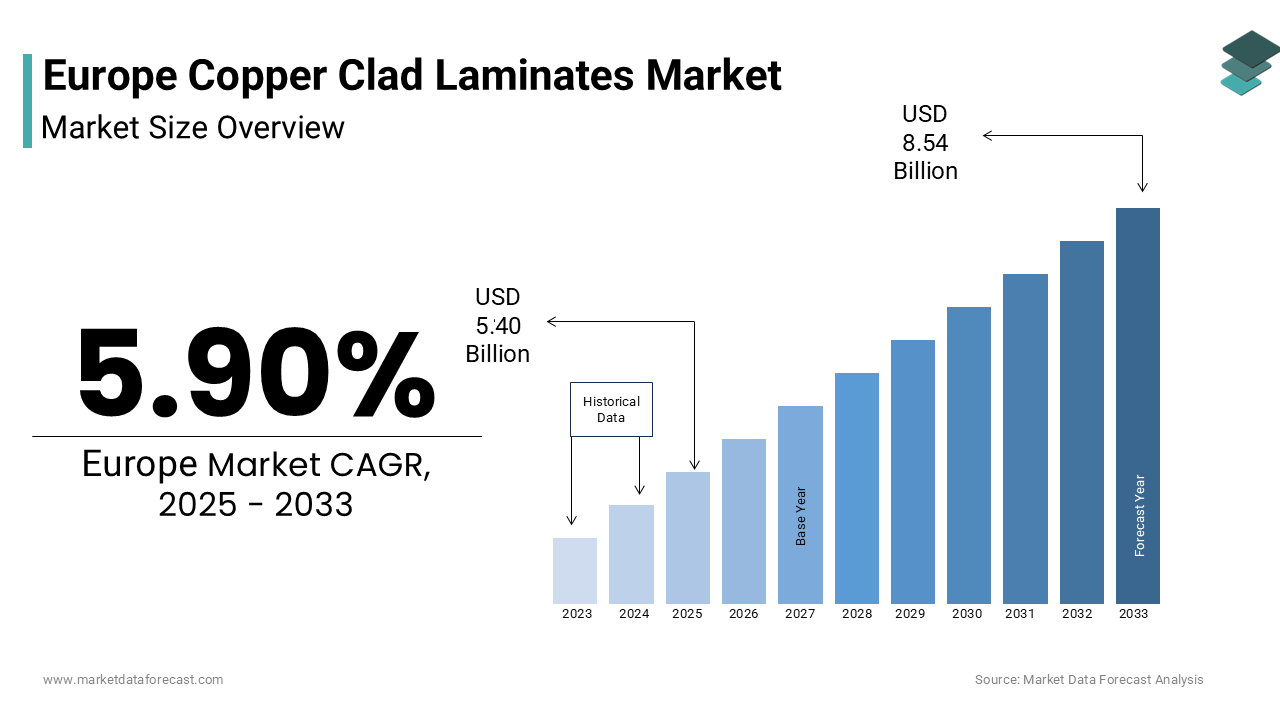
The Europe copper clad laminates market was valued at USD 5.10 billion in 2024, is expected to reach USD 5.40 billion in 2025, and is projected to attain USD 8.54 billion by 2033, growing at a CAGR of 5.90% during the forecast period from 2025 to 2033. Market growth is driven by the expansion of semiconductor manufacturing under the EU Chips Act, rising deployment of 5G infrastructure, and increasing demand for high-reliability electronic substrates across automotive, industrial, defense, and telecommunications sectors. Europe’s push toward digital sovereignty, localized electronics supply chains, and electrification of transport systems further strengthens demand for advanced copper clad laminates.
Key Market Trends
- Rising demand for high-frequency and low-loss laminates for 5G and satellite communications
- Increasing use of thermally conductive laminates in electric vehicle power electronics
- Transition toward halogen-free and REACH-compliant laminate formulations
- Growing integration of recycled copper under EU circular electronics initiatives
- Expansion of localized electronics manufacturing driven by semiconductor sovereignty policies
Segmental Insights
- Based on laminate type, the rigid copper clad laminates segment held the largest share of the Europe copper clad laminates market in 2024. This dominance is attributed to their extensive use in multilayer printed circuit boards for industrial automation, automotive electronics, and telecommunications infrastructure requiring high dimensional stability and thermal resistance.
- Based on reinforcement material, the glass fiber segment accounted for the leading share of the market in 2024. Its widespread adoption in FR-4 laminates, compatibility with lead-free soldering, and consistent dielectric performance make it the standard reinforcement material for high-reliability electronic applications.
- Based on application, communication systems and vehicle electronics collectively represent major demand contributors, supported by 5G base station rollouts, advanced driver assistance systems, and the electrification of automotive powertrains.
Regional Insights
The Europe copper clad laminates market demonstrates strong performance across major industrial economies, supported by electronics manufacturing, automotive innovation, and defense investments.
- Germany led the market by accounting for 24.6% of the regional share in 2024, driven by its strong semiconductor ecosystem, automotive electronics production, and stringent quality certification standards.
- France ranked second with 18.3% market share, supported by state-led investments in aerospace, defense electronics, and power semiconductor manufacturing under the France 2030 initiative.
- The United Kingdom is expected to witness steady growth due to high demand from aerospace, defense, and medical electronics sectors requiring ultra-reliable and traceable laminate solutions.
- Italy and the Netherlands continue to grow steadily, supported by industrial machinery manufacturing, household appliance production, and semiconductor equipment industries, particularly around ASML’s EUV lithography ecosystem.
Competitive Landscape
The Europe copper clad laminates market is characterized by technology-driven and regulation-centric competition, where differentiation is based on thermal performance, signal integrity, regulatory compliance, and supply chain reliability rather than price. Strict EU regulations on flame retardants, recycled content, and chemical safety raise entry barriers and favor manufacturers with strong R&D and certification capabilities. While Asian suppliers dominate high-volume segments, European and global players focus on high-value rigid, flexible, and metal-core laminates for automotive, aerospace, and telecom applications. Major companies operating in the Europe copper clad laminates market include Isola Group, Rogers Corporation, Panasonic Corporation, Shengyi Technology, Kingboard Laminates, Nan Ya Plastics, Ventec International Group, AGC Inc., Mitsubishi Gas Chemical, and Taiyo Holdings
Europe Copper Clad Laminates Market Size
The europe copper clad laminates market size was valued at USD 5.10 billion in 2024 and is anticipated to reach USD 5.40 billion in 2025 from USD 8.54 billion by 2033, growing at a CAGR of 5.90% during the forecast period from 2025 to 2033.
Copper clad laminates are a foundational class of composite materials consisting of a dielectric substrate typically epoxy resin reinforced with woven glass fiber bonded on one or both sides with electrolytic or rolled copper foil. These laminates serve as the structural and conductive base for printed circuit boards, which are indispensable in virtually all modern electronic systems. In Europe, their relevance is intensifying amid the continent’s strategic push for digital sovereignty and advanced electronics manufacturing. According to the European Commission, over 70% of the Union’s critical infrastructure including energy grids defense systems and telecommunications relies on secure and resilient electronic components. The Chips Act adopted in 2023 aims to double Europe’s global semiconductor production share to 20% by 2030, which inherently increases demand for high reliability substrates such as copper clad laminates. Additionally, Eurostat data indicates that the EU imported over 46 billion euros worth of electronic components in 2023, strategic vulnerabilities that national and supranational policies now seek to mitigate through localized supply chains.
MARKET DRIVERS
Expansion of European Semiconductor Manufacturing Under the EU Chips Act
The EU Chips Act has emerged for copper clad laminate demand by incentivizing domestic semiconductor and advanced packaging capacity, which is driving the growth of Europe copper clad laminated market. As per the European Commission, the legislation allocates thirty three billion euros in public funding through 2030 to establish integrated device manufacturing and advanced packaging facilities across strategic member states. These fabs and assembly plants require high frequency low loss laminates for probe cards interposers and substrate carriers during both production and testing phases. Similarly, the Bosch semiconductor plant in Dresden expanded its power electronics line in 2023 consuming over 60,000 square meters of thermally conductive laminates with copper thicknesses ranging from 12 to 35 micrometers. The European Semiconductor Equipment Industry Association confirmed that every new wafer fab triggers downstream demand for over five hundred metric tons of high-performance laminates within its first operational year. This policy driven industrial renaissance transforms copper clad laminates from passive materials into strategic assets underpinning Europe’s ambition to reduce third country dependency in critical electronics.
Proliferation of 5G Infrastructure and High Frequency Communication Systems
The continent-wide rollout of 5G networks has generated sustained demand for copper clad laminates with ultra-low dielectric loss and stable permittivity at microwave frequencies. The proliferation of 5G infrastructure and high frequency communication systems is additionally fuelling the growth of the Europe copper clad laminates market. According to the European Electronic Communications Authority, EU urban areas achieved 5G coverage by the end of 2023 with base station density increasing by 28% compared to 2022. Each macro and small cell site requires multiple printed circuit boards built on laminates such as PTFE or hydrocarbon ceramic composites that minimize signal attenuation above three gigahertz. Ericsson’s 2023 network deployment data shows that a typical 5G base station incorporates 4 to 6 high frequency PCBs consuming approximately 1.8 square meters of specialized copper clad laminate per unit. Furthermore, the European Space Agency’s IRIS2 secure satellite communications program mandates radiation resistant laminates for ground segment electronics where signal integrity cannot be compromised. Companies like Thales and Airbus now specify Rogers or Isola grade materials with dielectric constants below 3.2 for phased array antennas.
MARKET RESTRAINTS
Stringent Restrictions on Brominated Flame Retardants Under EU Chemicals Policy
The progressive restriction of brominated flame retardants particularly tetrabromobisphenol A which has been widely used in FR4 epoxy systems is solely restricting the growth of the Europe copper clad laminates market. According to the European Chemicals Agency, TBBPA was added to the Candidate List of Substances of Very High Concern in 2023 due to its persistence and endocrine disrupting properties. This classification triggers stringent communication obligations under REACH and may lead to full authorization requirements by 2026. As a result, laminate producers must reformulate core dielectrics using phosphorus based or inorganic alternatives which often exhibit inferior thermal stability and higher moisture absorption. The European Printed Circuit Association reported that small and medium laminate converters lack the technical capacity to validate new resin systems against IPC TM 650 thermal stress tests. Consequently, design cycles for compliant laminates have extended from eight to fourteen weeks increasing time to market for PCB fabricators. Germany’s Federal Institute for Risk Assessment further recommended in 2024 that TBBPA be restricted in all electronics placed on the EU market by 2027, accelerating reformulation pressures. This regulatory shift while environmentally justified imposes substantial R and D costs performance trade-offs and supply uncertainty across the European laminate value chain.
Limited Domestic Production of High Purity Electrolytic Copper Foil
The high purity electrolytic copper foil imported from Japan, South Korea, and China, is also degrading the growth of Europe copper clad laminates market. Domestic foil production is limited to a single aging facility in Germany operated by Schlenk Metallic Coatings, which supplies less than 15% of regional demand. The remainder relies on complex global logistics subject to trade friction and geopolitical volatility. In 2023, Japan’s Ministry of Economy Trade and Industry imposed export controls on copper foil with purity exceeding 99.99% citing national security concerns affecting European aerospace and defense contractors. Simultaneously, the European Union’s Carbon Border Adjustment Mechanism introduced in October 2023 added a 12 to 15% cost surcharge on imported foil due to its high embodied carbon from coal based smelting in Asia. These dual pressures supply concentration and carbon taxation elevate input costs and compromise lead time reliability.
MARKET OPPORTUNITIES
Integration of Recycled Copper in Laminates Under Circular Electronics Initiatives
The EU’s Circular Electronics Initiative for copper clad laminate manufacturers to incorporate certified recycled copper, while meeting performance standards is greatly influencing the growth opportunities for Europe copper clad laminates market. As per the European Commission, all new electronic products placed on the EU market from 2027 must contain a minimum of 20% recycled content in metallic components. Copper being infinitely recyclable without property loss is ideally suited for this mandate. Umicore and Aurubis have already launched electrolytic copper foil with up to 50% post-consumer recycled content certified under the Copper Mark and ISO 14021. Isola Group verified in its 2024 sustainability audit that laminates using recycled foil exhibit identical peel strength and thermal conductivity as virgin equivalents, when purity exceeds 99.993%. Additionally, the growing prominence for urban mining infrastructure for end of life PCBs are creating a localized feedstock loop.
Adoption of High Thermal Conductivity Laminates in Electric Vehicle Power Electronics
The electrification of transport is driving demand for metal core and insulated metal substrate laminates that efficiently dissipate heat from power modules inverters and onboard chargers. The adoption of high thermal conductivity laminates in electric vehicle power electronics, which is another attribute ascribed to boost the growth of Europe copper clad laminates market. According to the European Automobile Manufacturers Association, many new passenger cars sold in the EU in 2023 were battery electric or plug in hybrid models requiring advanced thermal management in their power electronics. Bosch’s 2024 technical bulletin confirmed that its latest 800 volt inverters use direct bond copper laminates on ceramic substrates to handle switching losses at high frequencies. Furthermore, the EU’s Euro 7 emissions regulation effective in 2025 mandates extended durability of electronic control units under high temperature conditions reinforcing the need for thermally robust substrates.
MARKET CHALLENGES
Volatility in Epoxy Resin Pricing Due to Petrochemical Feedstock Dependency
The persistent cost instability stemming from its reliance on epoxy resins derived from bisphenol A and epichlorohydrin both petrochemical intensive feedstocks is one of the challenges for the growth of Europe copper clad laminates market. According to the International Energy Agency, European benzene prices, which directly influence BPA cost fluctuated between January and November 2023, due to refinery outages and naphtha supply constraints. Since, epoxy resin constitutes 30-40% of laminate material cost this volatility directly impacts pricing predictability. The European Polymers Association reported that laminate producers faced average input cost increased in 2023, yet were unable to fully pass these to PCB fabricators due to fixed price contracts in automotive and industrial sectors. Compounding the issue is Europe’s limited epoxy resin capacity with only three integrated producers Hexion Huntsman and Olin supplying regional demand. When Olin’s Rotterdam plant underwent unscheduled maintenance in March 2024 resin lead times extended from four to nine weeks disrupting laminate production schedules.
Lack of Harmonized Flammability Standards Across EU Member States
The inconsistent interpretation and enforcement of flammability requirements for copper clad laminates is a major challenge for the growth of Europe copper clad laminates market. While the IEC 60950 and UL 94 standards provide global benchmarks national certification bodies often impose supplementary criteria that conflict with pan European norms. As per the European Printed Circuit Association, 17 of 27 EU member states maintain distinct flammability testing protocols for laminates used in public infrastructure projects. In France, for example laminates for railway electronics must pass an additional radiant panel test under NF F 16 101 not recognized by German or Swedish authorities. The European Commission acknowledged this issue in its 2023 Single Market Barriers Report noting that divergent safety standards cost the electronics sector an estimated eight hundred million euros annually in duplicated testing and inventory segmentation.
REPORT COVERAGE
| REPORT METRIC | DETAILS |
| Market Size Available | 2024 to 2033 |
| Base Year | 2024 |
| Forecast Period | 2025 to 2033 |
| Segments Analysed | By Laminate Type, Resin, Reinforcement Material, Application and Region |
| Various Analyses Covered | Global, Regional & Country Level Analysis, Segment-Level Analysis, Drivers, Restraints, Opportunities, Challenges; PESTLE Analysis; Porter's Five Forces Analysis, Competitive Landscape, Analyst Overview of Investment Opportunities |
| Regions Analysed | United Kingdom, France, Spain, Germany, Italy, Russia, Sweden, Denmark, Switzerland, the Netherlands, Turkey, and the Czech Republic. |
| Market Leaders Profiled | Isola Group, Rogers Corporation, Panasonic Corporation, Shengyi Technology Co., Ltd., Kingboard Laminates Holdings Limited, Nan Ya Plastics Corporation, Ventec International Group, AGC Inc., Mitsubishi Gas Chemical Company, Inc., and Taiyo Holdings Co., Ltd. |
SEGMENTAL ANALYSIS
By Laminate Type Insights
The rigid segment held a significant share of the Europe copper clad laminates market share in 2024 with their irreplaceable role in multilayer printed circuit boards used across industrial automotive and telecommunications infrastructure. A primary driver is the structural demand from industrial automation systems, which require high layer count boards with superior dimensional stability and thermal resistance. As per the European Association of Electrical and Electronic Industries, many programmable logic controllers and motor drives deployed in EU factories utilize FR4 based rigid laminates due to their compatibility with lead free reflow soldering at temperatures exceeding 260 degrees Celsius. The EU’s push for localized electronics manufacturing under the Chips Act, which prioritizes high reliability substrates for power modules and sensor systems. Bosch’s 2023 production data revealed that each of its industrial IoT gateway units integrates 6 to 8 rigid PCBs consuming over 0.9 square meters of high Tg FR4 laminate per device.
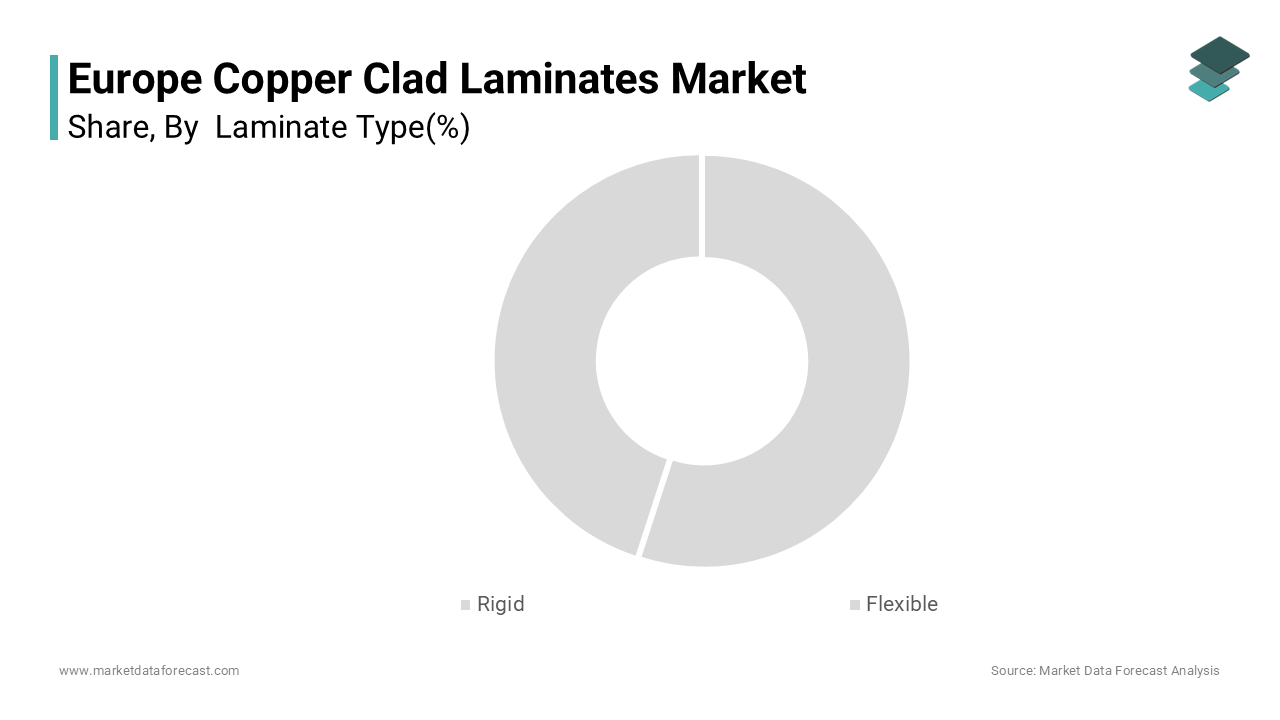
The flexible segment is anticipated to witness a fastest CAGR of 11.2% from 2025 to 2033 owing to the rising integration of foldable and compact electronics in automotive and medical devices, where space constraints demand bendable interconnects. In the automotive sector, advanced driver assistance systems now incorporate flexible circuits in steering columns instrument clusters and camera modules to accommodate complex geometries. As per the European Automobile Manufacturers Association, new passenger vehicles launched in 2023 featured at least three flexible PCB assemblies. The expansion of wearable medical technology is also enhancing the growth of the segment. The European Medicines Agency approved some new wearable diagnostic devices in 2023 all of which rely on polyimide based flexible laminates for skin conformal sensor integration. Companies like Medtronic and Philips now specify laminates with copper thicknesses below 12 micrometers and bend radii under 2 millimeters.
By Reinforcement Material Insights
The glass fiber segment was accounted in holding a dominant share of the Europe copper clad laminates market in 2024 owing to the material’s unmatched balance of mechanical strength thermal stability and dielectric performance in multilayer PCB applications. A key driver is its universal adoption in FR4, the industry standard substrate for rigid boards used in everything from power supplies to base station infrastructure. According to the European Telecommunications Standards Institute, 5G radio units deployed across the EU in 2023 utilized glass fiber epoxy laminates due to their consistent dielectric constant and low coefficient of thermal expansion. The Restriction of Hazardous Substances Directive permits glass fiber composites without special exemptions unlike certain halogenated paper based systems. Furthermore, glass fiber enables high layer count stacking essential for advanced packaging. Infineon’s Dresden fab reported in 2023 that its automotive radar modules require 12 layer boards achievable only with E glass woven reinforcement to prevent warpage during lamination.
The compound segment is likely to grow at a fastest CAGR of 12.2% from 2025 to 2033 owing to the hybrid systems, such as aramid glass or ceramic filled epoxy. The need for ultra-low loss and high thermal conductivity in next generation electronics is merely prompting the growth of this segment. In high frequency applications, such as millimeter wave 5G and satellite communications standard FR4 exhibits excessive signal attenuation above 20 gigahertz. As per the European Space Agency, its IRIS2 secure communication satellites mandate laminates with dielectric loss tangents below 0.002—achievable only through ceramic or PTFE glass composites. Similarly, the automotive sector’s shift to 800 volt architectures demands substrates with thermal conductivity exceeding 1.5 watts per meter kelvin to dissipate switching losses from silicon carbide inverters. STMicroelectronics verified in its 2024 materials specification that its third generation power modules exclusively use aluminum nitride filled laminates.
REGIONAL ANALYSIS
Germany Copper Clad Laminates Market Analysis
Germany was the top performer of the Europe copper clad laminates market by holding 24.6% of share in 2024 with its dense ecosystem of automotive industrial automation and semiconductor manufacturing. Bosch ZF and Siemens collectively consume over 40,000 square meters of rigid laminates monthly for engine control units factory robots and grid inverters. Additionally, Germany hosts Europe’s most stringent quality certification regime through VDE which mandates rigorous thermal cycling and flammability testing for all laminates used in public infrastructure. This regulatory rigor fosters trust in high reliability substrates and discourages low-cost alternatives. The Federal Ministry for Digital and Transport’s 2024 budget allocated 900 million euros to secure electronics supply chains directly benefiting domestic laminate converters like Schweizer Electronic and Schaeffler.
France Copper Clad Laminates Market Analysis
France copper clad laminates market held 18.3% of share in 2024. Its distinct profile arises from strong state led initiatives in defense aerospace and semiconductor sovereignty. The France 2030 Investment Plan committed 6.5 billion euros to secure electronics with copper clad laminates specified as substrates for radar systems secure communication boards and satellite payload electronics. Simultaneously, the STMicroelectronics GlobalFoundries joint venture in Crolles is scaling production of power management ICs requiring thermally enhanced laminates with copper thicknesses up to seventy micrometers. The French Defense Procurement Agency now mandates that all military electronics use laminates with French or EU origin certification under the Sovereign Electronics Decree of 2023.
The United Kingdom Copper Clad Laminates Market Analysis
The United Kingdom copper clad laminates market is expected to have a significant growth opportunities throughout the forecast period with a high concentration of aerospace defense and medical electronics firms demanding extreme reliability and traceability. Rolls Royce BAE Systems and Ultra Electronics specify polyimide and ceramic filled laminates for engine monitoring systems missile guidance boards and surgical robotics where failure is not an option. The UK’s Defence and Security Accelerator allocated three hundred twenty million pounds in 2023 to resilient electronics programs directly stimulating demand for laminates meeting MIL-PRF-31032 and ESA ECSS Q ST 70 standards. Additionally, the Medicines and Healthcare products Regulatory Agency’s stringent biocompatibility rules have driven adoption of halogen free flexible laminates in implantable devices.
Italy Copper Clad Laminates Market Analysis
Italy copper clad laminates market growth is likely to be driven by a dense network of industrial machinery and household appliance manufacturers requiring cost effective yet reliable rigid laminates. Companies like Indesit Candy and Smeg integrate FR4 based PCBs into washing machines ovens and refrigerators with annual volumes exceeding 15 million units. The Italian Association of Automation reported that industrial robots were deployed in Italian factories between 2021 and 2023, each requiring three to five control boards on standard glass fiber laminates. The Ministry for Ecological Transition’s 2023 ecodesign decree mandates that all new household appliances achieve at least class A energy rating, a rule accelerating adoption of switch mode power supplies built on high Tg laminates.
Netherlands Copper Clad Laminates Market Analysis
The Netherlands copper clad laminates market growth is expected to have significant growth opportunities from ASML’s dominance in extreme ultraviolet lithography systems, which require ultra stable laminates for sensor and control electronics operating in high radiation environments. ASML’s 2023 procurement data indicates annual consumption of over eighteen thousand square meters of high frequency rigid laminate from European suppliers to ensure supply security. Additionally, the Netherlands hosts a cluster of semiconductor equipment firms, including ASM International and BE Semiconductor that demand laminates with exceptional cleanroom compatibility and thermal shock resistance.
COMPETITIVE LANDSCAPE
The Europe copper clad laminates market features intense but specialized competition centered on technical performance regulatory compliance and supply chain proximity rather than pricing. Global material leaders such as Isola Panasonic and DuPont compete alongside European engineering specialists like Schweizer and Elantas through differentiated portfolios tailored to automotive industrial and telecommunications end uses. The regulatory environment notably the EU’s restrictions on brominated flame retardants and mandates for recycled content raises barriers to entry and favors firms with robust compliance infrastructure. Competition is further shaped by long qualification cycles in automotive and aerospace sectors which reward reliability over cost. While Asian suppliers dominate volume FR4 segments European players focus on high value rigid flexible and metal core laminates requiring advanced thermal electrical and signal integrity properties. Innovation in low loss high Tg and halogen free systems defines the competitive frontier as Europe advances its digital sovereignty and electrification agendas.
KEY MARKET PLAYERS
Some of the companies that are playing a dominating role in the Europe Copper Clad Laminates Market include
- Isola Group
- Rogers Corporation
- Panasonic Corporation
- Shengyi Technology Co., Ltd.
- Kingboard Laminates Holdings Limited
- Nan Ya Plastics Corporation
- Ventec International Group
- AGC Inc.
- Mitsubishi Gas Chemical Company, Inc.
- Taiyo Holdings Co., Ltd.
Top Players in the Europe Copper Clad Laminates Market
Isola Group
Isola Group is a leading global manufacturer of copper clad laminates with a strong engineering presence across Europe. The company supplies high performance materials for aerospace automotive and telecommunications applications in over fifty countries. In Europe Isola is recognized for its high frequency and halogen free laminate portfolios that comply with stringent REACH and RoHS directives. Isola expanded its technical support center in Heilbronn Germany to accelerate qualification cycles for European automotive and industrial customers. Its close collaboration with PCB fabricators and OEMs ensures rapid adoption of next generation substrates aligned with EU digital and green policy objectives.
Panasonic Industry Europe GmbH
Panasonic Industry Europe GmbH serves as the European arm of Panasonic’s global electronic materials division and is a key supplier of advanced copper clad laminates for industrial and automotive electronics. The company’s Megtron and R-5000 series are widely specified in high layer count boards requiring low signal loss and high thermal reliability. Panasonic introduced its Halogen Free Laminate HFE series with thermal conductivity enhanced for electric vehicle power modules. The company also upgraded its Munich application laboratory in January 2024 to support real time impedance simulation and thermal stress testing for European clients.
Schweizer Electronic AG
Schweizer Electronic AG is a German technology leader specializing in high reliability printed circuit boards and embedded copper structures that rely on proprietary copper clad laminates. The company plays a critical role in automotive power electronics supplying systems for inverters and battery management to premium European OEMs. Schweizer launched its PowerLink laminate platform enabling direct copper integration in high voltage substrates with superior heat dissipation. Its vertically integrated approach from laminate design to PCB assembly ensures tight control over quality and traceability meeting the exacting standards of European automotive and industrial sectors.
Top Strategies Used by the Key Market Participants
Key players in the Europe copper clad laminates market focus on developing halogen free and high thermal conductivity formulations to meet EU environmental and electrification mandates. They invest in localized application engineering centers to accelerate material qualification for automotive and industrial customers. Strategic expansion of production capacity for metal core and high frequency laminates addresses demand from electric vehicles and 5G infrastructure. Companies also prioritize compliance with REACH RoHS and IPC standards through rigorous testing and certification. Additionally, they strengthen partnerships with semiconductor and PCB ecosystem players to co-develop substrates aligned with next generation electronic architectures.
MARKET SEGMENTATION
This research report on the europe copper clad laminates market has been segmented and sub–segmented into the following categories.
By Laminate Type
- Rigid
- Flexible
By Reinforcement Material
- Glass Fiber
- Paper Base
- Compound Materials
By Resin
- Epoxy
- Phenolic
- Polyimide
- Other Resins
By Application
- Computers
- Communication Systems
- Consumer Appliances
- Vehicle Electronics
- Healthcare Devices
- Defense Technology
By Country
- UK
- France
- Spain
- Germany
- Italy
- Russia
- Sweden
- Denmark
- Switzerland
- Netherlands
- Turkey
- Czech Republic
- Rest of Europe
Frequently Asked Questions
What are copper clad laminates (CCLs)?
Copper clad laminates are composite materials consisting of copper foil bonded to an insulating substrate, mainly used for manufacturing printed circuit boards (PCBs).
What is driving the Europe copper clad laminates market?
The market is driven by rising demand for electronics, growth in automotive electronics, expansion of 5G infrastructure, and increased adoption of electric vehicles.
Which materials are commonly used in copper clad laminates?
Common substrate materials include FR-4 epoxy resin, phenolic resin, polyimide, and PTFE, depending on performance requirements.
What are the key applications of CCLs in Europe?
Key applications include consumer electronics, automotive electronics, telecommunications equipment, industrial electronics, and aerospace & defense systems.
Which countries are major contributors to the Europe CCL market?
Germany, France, the UK, Italy, and the Netherlands are major contributors due to strong electronics manufacturing and automotive industries.
How does the automotive sector influence the market?
The growing adoption of electric vehicles and advanced driver-assistance systems (ADAS) is increasing demand for high-performance copper clad laminates.
What challenges does the Europe copper clad laminates market face?
Challenges include volatile copper prices, supply chain disruptions, and high production costs of advanced laminates.
What types of copper clad laminates are widely used?
Rigid CCLs dominate the market, while flexible and high-frequency laminates are gaining traction in advanced electronics applications.
What is the future outlook for the Europe copper clad laminates market?
The market is expected to grow steadily, supported by digitalization, renewable energy systems, EV adoption, and next-generation communication technologies.
What technological trends are shaping the Europe CCL market?
Trends include the development of high-Tg laminates, low-dielectric materials, and advanced thermal management solutions for compact and high-power electronic devices.
Access the study in MULTIPLE FORMATS
Purchase options starting from
$ 2000
Didn’t find what you’re looking for?
TALK TO OUR ANALYST TEAM
Need something within your budget?
NO WORRIES! WE GOT YOU COVERED!
Call us on: +1 888 702 9696 (U.S Toll Free)
Write to us: sales@marketdataforecast.com